
Marten Falls Community Access Road Project
Decision Statement
Issued under Section 65 of the Impact Assessment Act
Document reference number: 282
to
Marten Falls First Nation
c/o Chief Bruce Achneepineskum
Ogoki Post
Marten Falls, ON
P0T 2L1
for the
Marten Falls Community Access Road Project
Marten Falls First Nation (the Proponent) is proposing the construction and operation of an all-season road on provincial Crown land and Marten Falls First Nation reserve land in northwestern Ontario. The new two-lane, all season community access road would be approximately 184 kilometers long connecting the northern end of Painter Lake forestry road to the community of Marten Falls. As proposed, the Marten Falls Community Access Road Project (the Designated Project) could enable future access to potential mineral development activities in the Ring of Fire area. The Designated Project is described in further detail in Schedule 1 of this Decision Statement.
Conduct of the Impact Assessment
The Impact Assessment Agency of Canada (the Agency) conducted an impact assessment of the Designated Project in accordance with the requirements of the Impact Assessment Act. The impact assessment commenced on February 24, 2020, and the Agency submitted its report to me in my capacity as Minister of the Environment on August 6, 2026.
Determination in Relation to the Adverse Effects within Federal Jurisdiction and Direct or Incidental Adverse Effects of the Designated Project
In accordance with paragraph 60(1)(a) of the Impact Assessment Act, after taking into account the Impact Assessment Report and the implementation of mitigation measures that I consider appropriate, I have determined that the carrying out of the Designated Project, in whole or in part, is likely to cause adverse effects within federal jurisdiction that are, to some extent, significant.
The carrying out of the Designated Project, in whole or in part, is not likely to result in adverse direct or incidental effects as defined under section 2 of the Impact Assessment Act that have not already been considered within the evaluation of effects within federal jurisdiction.
In accordance with paragraph 60(1)(b) of the Impact Assessment Act, I have determined that these effects are, in light of the extent to which I determined them to be significant and the factors referred to in section 63, justified in the public interest. The reasons for my determination are included in Schedule 2 of this Decision Statement.
In accordance with subsection 64(1) of the Impact Assessment Act, I have established the conditions set out in Schedule 3 of this Decision Statement in relation to the adverse effects within federal jurisdiction of the Designated Project, with which the Proponent must comply.
Substantially Begin
The Proponent is required to substantially begin to carry out the Designated Project within five years after the day of issuance of the Decision Statement, or within any extension of that period established in accordance with subsection 70(2) of the Impact Assessment Act. If the Proponent does not substantially begin to carry out the Designated Project by the end of that period, the Decision Statement will expire.
Issuance
This Decision Statement is issued in Ottawa, Ontario by:
<original signed by>
______________________________
The Honourable Julie Dabrusin
Minister of the Environment
August 31, 2026
______________________________
Date
Schedule 1 – Description of the Designated Project
Schedule 2 – Reasons for Determination
Schedule 3 – Conditions established under Section 64 of the Impact Assessment Act
Description of the Designated Project
The Designated Project is the construction and operation of an all-season, multi-purpose road on provincial Crown land and Marten Falls First Nation reserve land in northwestern Ontario. The Designated Project is a two-lane gravel public highway approximately 184 kilometres (km) long, connecting the northern end of Painter Lake forestry road to the community of Marten Falls (Figure 1).
The Designated Project includes the following physical activities and components.
Physical activities
Construction
Construction would require the following physical activities:
- field surveys, staking and layout;
- vegetation clearing and grubbing;
- earth excavation, grading and hauling;
- operation of pits and quarries in aggregate source areas;
- construction of Designated Project components; and
- reclamation of temporary infrastructure.
Operation (indefinite)
Operation would require the following physical activities:
- road maintenance including maintenance of the access road and drainage system;
- operation of pits and quarries in aggregate source areas; and
- dust control.
Components
The Designated Project components shown in Figure 1 include the following:
- approximately 184 km of two-lane gravel road approximately 13 metres (m) wide within a right of way of approximately 100 m wide that is cleared to a width of 60 m;
- water crossings, including bridges and culverts;
- maintenance facilities, rest areas and pull-out areas;
- permanent access roads;
- quarries, pits and associated infrastructure;
- temporary construction camps with storage and laydown yards and associated infrastructure including waste handling and storage facilities; and
- temporary access roads to quarries, pits, laydown areas, and construction camps.
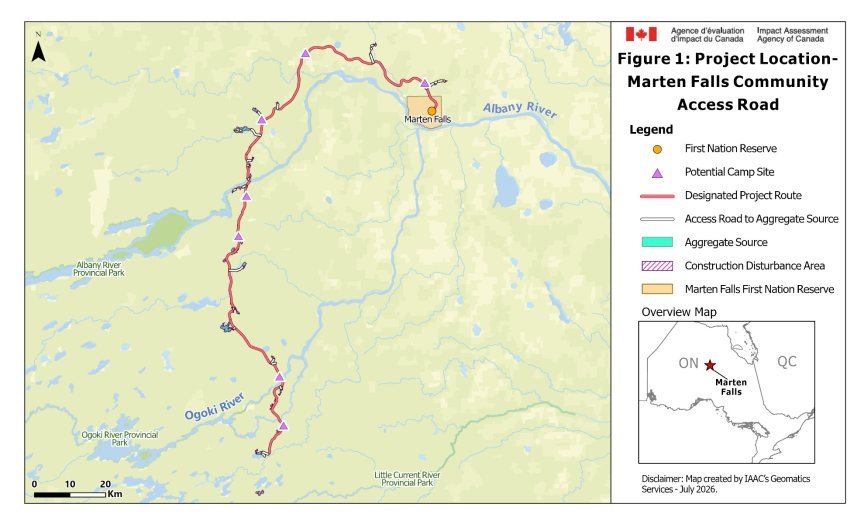
Figure 1 - Text version
Map showing the project route for the Marten Falls Community Access Road overlaid on top of a basemap depicting rivers and tributaries. The road connects the northern end of Painter Lake forestry road to the community of Marten Falls in northwestern Ontario. In addition to the road itself, features represented on the map include aggregate sources and their corresponding access routes, potential camp sites, the construction disturbance area, and the Marten Falls First Nation Reserve. An inlay in the bottom right corner shows an overview map depicting the province of Ontario with the project location indicated by a star symbol.
Reasons for Determination
As Minister of the Environment, I made two determinations in respect of the impact assessment of the Marten Falls Community Access Road Project (the Designated Project). After taking into consideration the Impact Assessment Report (IA Report) and the three factors referred to in section 63 of the Impact Assessment Act (IAA), I determined:
- pursuant to paragraph 60(1)(a) of the IAA, that certain adverse effects within federal jurisdiction likely to be caused by the Designated Project are likely to be significant to some extent and the extent to which these effects are significant, as outlined in Section 1; and
- pursuant to paragraph 60(1)(b) of the IAA, these effects are justified in the public interest, as outlined in Section 2.
Although the Designated Project may require federal permits, licences and authorizations, I determined that the direct or incidental adverse effects that may result from these are considered within the assessment of adverse effects within federal jurisdiction as per the definitions of these terms under the IAA. As such, the Reasons for Determination refer only to adverse effects within federal jurisdiction that are likely to result from the Designated Project. Similarly, the effects of the Designated Project on the environment on federal lands are considered within the assessment of effects of physical activities carried out on federal lands.
Below are the reasons for my determinations.
1. Adverse effects within federal jurisdiction
After taking into account the IA Report and the implementation of mitigation measures that I consider appropriate and that are set out as conditions in Schedule 3 of this Decision Statement, I have determined that the Designated Project is likely to cause adverse effects within federal jurisdiction that are likely to be, to some extent, significant as follows:
- Fish and fish habitat: The residual and cumulative adverse effects are likely to be significant to a low extent due to fish habitat loss and degradation that may not be fully offset locally. In making this determination, I took into account the rationale and conclusions outlined in Section 2.1 of the IA Report, including input from Fisheries and Oceans Canada and comments and concerns raised by Indigenous groups regarding the long-term protection of aquatic ecosystems, changes to water quality, fish habitat connectivity and fish passage, as well as cumulative effects associated with increased regional access and future development. I also took into account the mitigation measures recommended in Section 2.1 of the IA Report that I consider appropriate for these effects and that will be implemented as conditions related to fish and fish habitat as set out in Schedule 3 of this Decision Statement. I also require a follow-up program with respect to fish and fish habitat be implemented in consultation with Indigenous groups to verify the effects predictions and effectiveness of mitigation measures related to water quality.
- Migratory birds: The residual and cumulative adverse effects are not likely to be significant since the Designated Project is not likely to result in migratory bird populations being measurably diminished or lost within the regional area. In making this determination, I took into account the likely effects, rationale and conclusions outlined in Section 2.2 of the IA Report, which reflects comments and concerns raised by Indigenous groups regarding migratory bird habitat loss and disturbance from project activities, increased access and development, as well as cumulative effects on migratory bird movement patterns. I also took into account the mitigation measures recommended in Section 2.2 of the IA Report that I consider appropriate for these effects and that will be implemented as conditions related to migratory birds as set out in Schedule 3 of this Decision Statement.
- Effects from physical activities carried out on federal lands: The residual adverse effects are not likely to be significant as air quality parameters are expected to remain generally below applicable federal guidelines, limits, or objectives, and federal species at risk as well as eastern migratory caribou populations are expected to remain sustainable. The cumulative effects are not likely to be significant, except for caribou and wolverine, which are likely to be significant to a low extent due to changes in habitat availability and function throughout the species' respective ranges. In making this determination, I took into account the likely effects, rationale and conclusions outlined in Section 2.3 of the IA Report, which reflects comments and concerns from Indigenous groups regarding habitat fragmentation, increased public access, sensory disturbance, potential increases in wildlife mortality risk, and cumulative effects throughout the regional ranges of caribou and wolverine. I also took into account the mitigation measures recommended in Section 2.3 of the IA Report that I consider appropriate for these effects and that will be implemented as conditions, including for species at risk, as set out in Schedule 3 of this Decision Statement.
- Effects on Indigenous peoples, including effects on:
- Current use of lands and resources for traditional purposes by Indigenous peoples: The residual adverse effects are likely to be significant to a low extent, as the Designated Project would alter resource availability, reduce safe access to harvesting areas and travel routes, and diminish the quality of experience on the land, although the activities are expected to continue. The cumulative effects are likely to be significant to a low extent for traditional harvesting activities and significant to a moderate extent for hunting of caribou and other ungulates due to changes in species' movement patterns, range areas, and resource availability at preferred locations. In making this determination, I took into account the likely effects, rationale and conclusions outlined in Section 4.3.1 of the IA Report, which reflects concerns from Indigenous groups regarding the effects. I also acknowledge the importance of harvesting activities, stewardship of lands and waters, and the transmission of Indigenous knowledge, language, and cultural practices to present and future generations. I also took into account the mitigation measures recommended in Section 4.3.1 of the IA Report that I consider appropriate for these effects and that will be implemented as conditions related to current use of lands and resources for traditional purposes as set out in Schedule 3 of this Decision Statement. I also require a follow-up program related to monitoring air quality, noise, and wildlife species important to Indigenous groups.
- Structures, sites or things of historical, archaeological, or architectural significance to Indigenous peoples, and physical and cultural heritage: The residual and cumulative adverse effects are likely to be significant to a low extent, as the Designated Project would partially degrade sites of importance, reduce safe access at certain locations, and alter the quality of cultural experiences and use of the land, but continued access to sites and the ability to maintain cultural practices would remain available within the broader regional area. In making this determination, I took into account the likely effects, rationale and conclusions outlined in Section 4.3.2 of the IA Report, which reflects concerns raised by Indigenous groups regarding potential damage to culturally important sites and archaeological resources, changes to access to sites of importance and travel routes, and effects on cultural continuity associated with reduced opportunities to experience the land in a peaceful and undisturbed manner. I also took into account the mitigation measures recommended in Section 4.3.2 of the IA Report that I consider appropriate for these effects and that will be implemented as conditions related to physical and cultural heritage, and structures, sites or things of historical, archaeological, paleontological or architectural significance to Indigenous peoples as set out in Schedule 3 of this Decision Statement.
- Health, social or economic conditions of Indigenous peoples: The residual adverse effects are likely to be significant to a moderate extent, as the Designated Project may strain social infrastructure and reduce opportunities for the transmission of Indigenous knowledge and cultural practices, including by directly facilitating access to remote Indigenous groups. The cumulative effects are likely to be significant to a moderate extent from regional pressures affecting community well-being, cultural continuity, safety, and social cohesion that would be experienced by multiple Indigenous groups. In making this determination, I took into account the likely effects, rationale and conclusions outlined in Section 4.3.3 of the IA Report, which reflects concerns raised by Indigenous groups regarding existing pressures on community infrastructure and services, the potential for increased violence and community safety risks, effects on cultural continuity and traditional practices, and the cumulative impacts of colonialism, remoteness, and regional development. I also considered concerns raised by Indigenous groups that the likely effects outlined in Section 4.3.3 may disproportionately affect vulnerable populations, including women, children, youth, Elders, and 2SLGBTQ+ individuals. I also acknowledge the importance Indigenous groups place on maintaining connections to the land, preserving Indigenous knowledge and language, and supporting healing and cultural continuity for future generations. I also took into account the mitigation measures recommended in Section 4.3.3 of the IA Report that I consider appropriate for these effects and that will be implemented as conditions related to health and socio-economic conditions of Indigenous peoples as set out in Schedule 3 of this Decision Statement.
The mitigation measures and follow-up program identified in the IA Report and set out in Schedule 3 of this Decision Statement would also avoid or lessen, as well as monitor, adverse effects to species at risk listed on Schedule 1 of the Species at Risk Act and their critical habitat. The measures relate to adverse effects that are likely to occur during all phases of the Designated Project. I considered the measures to be consistent with applicable recovery strategies and action plans. I am satisfied that potential effects to species at risk and their critical habitat can be addressed, to the extent practical, through these measures, as well as through federal and provincial legislative frameworks and requirements, and thereby fulfill my obligations under section 79 of the Species at Risk Act.
In addition to the above likely adverse effects within federal jurisdiction, based on Section 3 of the IA Report, I understand that unlikely malfunction and accident scenarios associated with the Designated Project could occur and result in adverse effects within federal jurisdiction. I note that the likelihood of certain malfunction and accident scenarios may also be influenced by changing environmental conditions over the lifespan of the Designated Project, with climate change expecting to increase the frequency and intensity of extreme weather events. Measures to prevent malfunction and accident scenarios were identified in the IA Report and have been included as conditions that I established in Schedule 3 of this Decision Statement.
2. Factors considered in determining whether effects are justified in the public interest
Because certain likely adverse effects in federal jurisdiction are likely to be significant to some extent after the implementation of mitigation measures, I considered the IA Report and the three factors listed under section 63 of the IAA to determine whether those effects are justified in the public interest.
2.1 Impacts that the effects that are likely to be caused by the Designated Project may have on any Indigenous group and any adverse impacts that those effects may have on the rights of Indigenous peoples of Canada recognized and affirmed by section 35 of the Constitution Act, 1982
I considered the likely effects, both positive and adverse, resulting from the Designated Project on Indigenous groups, as well as any adverse impact those effects may have on the rights of Indigenous peoples. In considering this factor, I took into account the IA Report, including comments and concerns raised by Indigenous groups regarding cumulative effects associated with increased regional access and future development, the assessment methodology, information gaps and uncertainties, notably with respect to impacts on peatlands, caribou and socio-economic conditions. I also considered the Indigenous Knowledge provided and potential impacts on the rights of Indigenous peoples as articulated by Indigenous groups directly. I determined that the Designated Project would likely result in both positive and adverse effects on Indigenous groups, and in potential adverse impacts on Indigenous rights.
I considered the positive effects of the Designated Project described in Section 4.3.4 of the IA Report. The Designated Project is an opportunity for economic reconciliation and self-determination for Marten Falls First Nation. The Designated Project would likely create employment and economic opportunities for Marten Falls First Nation community members and potentially members of other Indigenous groups, though I acknowledge that these may be unevenly distributed across different groups, sub-groups and individuals. The Designated Project may strengthen community cohesion through a positive effect on the size of the population on Marten Falls First Nation reserve and, to a lesser extent, nearby Indigenous groups.
I considered the adverse effects on Indigenous groups described in Sections 4.3.1, 4.3.2 and 4.3.3 of the IA Report and outlined above. I have considered the mitigation measures and follow-up program for these adverse effects in these Sections of the IA Report and have included them as conditions that I established in Schedule 3 of this Decision Statement.
I considered the potential impacts on the rights of Indigenous peoples described in Section 4.4 of the IA Report. I consider that the proposed accommodations, in the form of the mitigation measures and follow-up program established as conditions in Schedule 3 of this Decision Statement, are designed to avoid or mitigate adverse effects on Indigenous peoples and to reduce the severity of the impacts on their rights. I am satisfied that implementation of these conditions will appropriately avoid or minimize potential impacts of the Designated Project on Aboriginal and treaty rights. For Indigenous groups that would be most directly impacted or reported some uses in the project footprint, namely Animbiigoo Zaagi'igan Anishinaabek, Aroland First Nation, Eabametoong First Nation, Fort Albany First Nation, Ginoogaming First Nation, Kashechewan First Nation, and Marten Falls First Nation, I agree with the IA Report's conclusion that the Designated Project may result in low to moderate severity of impacts on hunting and trapping rights, low severity of impacts on rights to fishing and water, and low to moderate severity impacts on the right to a continued way of life. For Indigenous groups whose preferred areas for the exercise of harvesting and cultural rights have limited overlap with the geographic scope of anticipated project effects, namely Attawapiskat First Nation, Constance Lake First Nation, Kitchenuhmaykoosib Inninuwug, Long Lake #58 First Nation, Neskantaga First Nation, Nibinamik First Nation, Webequie First Nation, and Weenusk First Nation, I agree with the IA Report's conclusion that the Designated Project may result in negligible to moderate severity of impacts on the hunting and trapping rights, and negligible to low severity of impacts on rights to fishing and water, and negligible to moderate impacts on the right to a continued way of life.
I understand that Indigenous groups have raised concerns that the potential increased access and future development in the Ring of Fire area could affect their ability to steward and govern their traditional territories. I acknowledge the Regional Assessment in the Ring of Fire Area conducted under the IAA and co-led by First Nations and the Government of Canada does not constitute mitigation or accommodation for adverse impacts associated with the Designated Project. However, through the Regional Assessment, Indigenous groups will have access to information on current and future conditions within their traditional territory to support and inform future planning and decision making in the Ring of Fire area. I also note that the Government of Canada continues to advance the Calls for Justice from the Final Report on Missing and Murdered Indigenous Women and Girls through a variety of investments, actions and programs that aim to improve safety and well-being for Indigenous groups and promote a holistic approach to community health.
As documented in the IA Report, notably in Section 4 and Annex D, and demonstrated through the consultation record for the Designated Project, I am of the view that federal consultation obligations have been met in a manner consistent with the principle of the Honour of the Crown. Indigenous groups potentially impacted by the Designated Project were consulted early and throughout the impact assessment process to fully understand their concerns and the nature and severity of potential impacts on Indigenous rights as summarized in Sections 4.1 and 4.2 of the IA Report. I acknowledge that Indigenous groups faced capacity constraints due to overlapping consultation processes and revisions to the impact assessment timelines through a timeline extension request from the proponent, followed by an accelerated timeline to complete the impact assessment in alignment with the timeline set out by the proponent and the province. Despite this, based on the IA Report and consultation record, I consider that the consultation process was comprehensive and guided by meaningful efforts to explain the federal impact assessment process, involve Indigenous groups in understanding the issues to be assessed, and understand the concerns of Indigenous peoples in good faith, through ongoing opportunities for two-way dialogue, flexibility and dedicated funding to support participation.
I acknowledge that, as outlined in Annex D of the IA Report, some Indigenous groups have requested accommodation measures beyond the mitigation measures and follow-up program conditions established in Schedule 3 of this Decision Statement in order to provide their consent for the Designated Project. I am satisfied that IAAC has responded to these requests and concerns in Annex D of the IA Report and that the implementation of the accommodations, in the form of mitigation measures and follow-up conditions established in Schedule 3 of this Decision Statement, will appropriately avoid or minimize potential impacts of the Designated Project on Indigenous rights.
2.2 Extent to which the likely effects of the Designated Project contribute to the Government of Canada's ability to meet its environmental obligations and its commitments in respect of climate change
I determined that the likely effects of the Designated Project would not contribute to the Government of Canada's ability to meet its environmental obligations. In making this determination, I considered Section 5 of the IA Report, including whether the Designated Project would contribute to Canada's environmental obligations under the Convention on Biological Diversity, Kunming-Montreal Global Biodiversity Framework and its domestic framework: Canada's 2030 Nature Strategy, the Species at Risk Act, including associated recovery strategies and action plans for listed species, Convention on Wetlands of International Importance Especially as Waterfowl Habitat (Ramsar), as implemented in part under the Federal Policy on Wetland Conservation and the North American Waterfowl Management Plan, and the Convention for the Protection of Migratory Birds in the United States and Canada as implemented through the Migratory Birds Convention Act, 1994, and supporting conservation objectives from Environment and Climate Change Canada's strategies for Bird Conservation Regions. The Designated Project would likely result in adverse effects on fish, including lake sturgeon which is a species at risk listed under the Species at Risk Act, migratory birds, including the Canada warbler, evening grosbeak, eastern whip-poor-will, eastern wood-pewee, olive-sided flycatcher, wood thrush, yellow rail, common nighthawk, barn swallow, and bank swallow which are species at risk listed under the Species at Risk Act, and on wildlife and their habitat as a result of activities carried out on federal lands, including little brown myotis, northern myotis, wolverine, rusty blackbird, short-eared owl, woodland caribou, and transverse lady beetle which are species at risk listed under the Species at Risk Act, as set out in Sections 2.1, 2.2, and 2.3 of the IA Report. I also note the likely effects of the Designated Project on terrestrial wildlife set out in Section 4.3.1 of the IA Report as well as on wetlands and species at risk listed under the Species at Risk Act, including on non-federal lands, as set out in Section 5 of the IA Report. The effects of the Designated Project would not result in a net positive contribution to Canada's ability to meet its environmental obligations as it relates to biodiversity; therefore, I determined that there is no contribution. As such, this factor did not weigh into my determination as to whether the Designated Project's significant adverse effects within federal jurisdiction are justified in the public interest.
I also determined that the likely effects of the Designated Project would not contribute to the Government of Canada's ability to meet its commitments in respect of climate change. In making this determination, I considered Section 6 of the IA Report, including whether the Designated Project would contribute to Canada's ability to meet its greenhouse gas (GHG) emissions targets established under the Canadian Net-Zero Emissions Accountability Act. The project would emit GHGs during the construction and the operation phases, and further there would be uncertainty of measurable reduction in GHG emissions or displacement of higher-emitting sources that could be linked with the project. Based on the rationale and conclusions set out in Section 6 of the IA Report, including information provided by Environment and Climate Change Canada, the likely effects of the Designated Project would result in net positive GHG emissions; therefore, I determined that there is no contribution. As such, this factor did not weigh into my determination as to whether the Designated Project's significant adverse effects within federal jurisdiction are justified in the public interest.
2.3 Extent to which the likely effects of the Designated Project contribute to sustainability
I determined that the Designated Project's likely effects would make a net positive contribution to sustainability to a low extent. In making this determination, I considered Section 7 of IA Report, which examines the extent to which the Designated Project's positive effects and likely adverse effects within federal jurisdiction contribute to sustainability, focusing on valued components and associated key issues relevant to sustainability. I considered the interactions between direct and indirect positive effects and adverse effects within federal jurisdiction and how they affect the systems on which human and ecological well-being depend. I also considered the costs and benefits of these effects to the environment, health, social and economic well-being of current and future generations, including:
- the adverse effects within federal jurisdiction of the Designated Project relevant to sustainability, including effects on fish and fish habitat and Indigenous current use, traditional practices, and community well-being;
- effects that are likely to result in positive contributions to sustainability, including:
- enhanced overall economic conditions and social well-being for Indigenous groups, particularly for Marten Falls First Nation;
- supporting economic reconciliation and self-determination for Marten Falls First Nation; and
- inducing spending and employment within Ontario, with a concentration of economic benefits in Northern Ontario.
Based on the IA Report, I acknowledge that uncertainties remain regarding the potential adverse effects within federal jurisdiction as well as benefits for future generations, and that sustainability gains may not be experienced equally across all communities or sub-groups. However, taking into account the mitigation measures and follow-up program, enhancement measures, as well as the positive contributions to sustainability, I determined that the likely effects of the Designated Project would make a net positive contribution to sustainability to a low extent. As such, this factor did weigh into my determination on whether the Designated Project's significant adverse effects within federal jurisdiction are justified in the public interest.
3. Conclusion
I am satisfied that the IA Report has considered and set out the likely effects of the Designated Project, including the adverse effects within federal jurisdiction, adverse and positive effects on any Indigenous groups, adverse impacts on Indigenous rights, effects that contribute to the Government of Canada's ability to meet its environmental obligations and its commitments in respect of climate change, as well as effects that contribute to sustainability. I considered the recommended mitigation measures and follow-up program proposed in the IA Report for adverse effects within federal jurisdiction to be appropriate and require their implementation through legally binding conditions with which the proponent must comply, as set out in Schedule 3 of this Decision Statement.
I have determined that, with the implementation of mitigation measures:
- residual and cumulative adverse effects on fish and fish habitat would likely be significant to a low extent;
- adverse effects from physical activities carried out on federal lands would likely be significant to a low extent when residual effects on caribou and wolverine habitat are considered cumulatively with the effects of other projects and activities;
- residual and cumulative adverse effects on the current use of lands and resources for traditional purposes by Indigenous peoples would likely be significant to a low extent, except for adverse effects on the hunting of caribou and other ungulates, which would be significant to a moderate extent when considered cumulatively with the effects of other projects and activities;
- residual and cumulative adverse effects on structures, sites or things of historical, archaeological, or architectural significance to Indigenous peoples, as well as on physical and cultural heritage would likely be significant to a low extent; and
- residual and cumulative adverse effects on the health, social or economic conditions of Indigenous peoples would likely be significant to a moderate extent.
I have then determined that these adverse effects within federal jurisdiction that are, to some extent, significant are justified in the public interest given:
- the extent of significance of the adverse effects within federal jurisdiction range from not significant to significant to a moderate extent;
- the likely effects of the Designated Project would adversely impact Indigenous groups and Indigenous rights, but would also have positive impacts and would promote economic reconciliation with Indigenous peoples, particularly for Marten Falls First Nation, by supporting community self-governance and self-determination; and
- the likely effects of the Designated Project would contribute to sustainability through improved year-round access to remote communities, enhanced access to goods and services, employment and training opportunities for Indigenous groups, support for the social and economic well-being of present and future generations for Marten Falls First Nation and potentially other Indigenous groups, as well as long-term economic development in the region.
Conditions established under section 64 of the Impact Assessment Act
1 Definitions
1.1 Adverse federal effects means "adverse effects within federal jurisdiction" and "direct or incidental adverse effects" as defined in section 2 of the Impact Assessment Act.
1.2 Agency means the Impact Assessment Agency of Canada.
1.3 Baseline means the environmental, health, social and economic conditions prior to initiating construction of the Designated Project.
1.4 Caribou Local Study Area means the area that extends 10 kilometres from the centreline, in both directions, of the Designated Project route and 500 metres around all other Designated Project components identified in Schedule 1 of this Decision Statement.
1.5 Construction means the phase of the Designated Project during which the Proponent undertakes the site preparation, building or installation of any components of the Designated Project, including periods during which these activities may temporarily cease.
1.6 Days means calendar days.
1.7 Designated Project means the Marten Falls Community Access Road Project described in Schedule 1 of this Decision Statement.
1.8 Environment and Climate Change Canada means the Department of the Environment as established under subsection 2(1) of the Department of the Environment Act.
1.9 Fish means "fish" as defined in subsection 2(1) of the Fisheries Act.
1.10 Fish habitat means "fish habitat" as defined in subsection 2(1) of the Fisheries Act.
1.11 Fisheries and Oceans Canada means the Department of Fisheries and Oceans as established under subsection 2(1) of the Department of Fisheries and Oceans Act.
1.12 Follow-up program means "follow-up program" as defined in section 2 of the Impact Assessment Act.
1.13 Heritage value means the aesthetic, historic, scientific, cultural, social or spiritual importance or significance for past, present or future generations.
1.14 Impact assessment means "impact assessment" as defined in section 2 of the Impact Assessment Act.
1.15 Indigenous groups means the following Indigenous peoples: Animbiigoo Zaagi'igan Anishinaabek, Aroland First Nation, Attawapiskat First Nation, Constance Lake First Nation, Eabametoong First Nation, Fort Albany First Nation, Ginoogaming First Nation, Kashechewan First Nation, Kitchenuhmaykoosib Inninuwug, Long Lake #58 First Nation, Marten Falls First Nation, Neskantaga First Nation, Nibinamik First Nation, Webequie First Nation and Weenusk First Nation.
1.16 Indigenous peoples means "Indigenous peoples of Canada" as defined in section 2 of the Impact Assessment Act.
1.17 Local Study Area means the area that extends 2.5 kilometres from the centreline, in both directions, of the Designated Project route and 500 metres around all other Designated Project components identified in Schedule 1 of this Decision Statement.
1.18 Migratory bird means "migratory bird" as defined in subsection 2(1) of the Migratory Birds Convention Act, 1994.
1.19 Mitigation measures means "mitigation measures" as defined in section 2 of the Impact Assessment Act.
1.20 Monitoring means collecting, analyzing, and using information to measure the adverse federal effects of the Designated Project and/or to verify the accuracy of the impact assessment and/or to determine the effectiveness of any mitigation measure.
1.21 Non-federal lands means lands other than "federal lands" as defined in section 2 of the Impact Assessment Act.
1.22 Offsetting Plan means "Offsetting plan" as described in Schedule 1 of the Authorizations Concerning Fish and Fish Habitat Protection Regulations.
1.23 Operation means the phase of the Designated Project during which public access to the Designated Project is allowed, including periods during which public access to the Designated Project may be temporarily interrupted.
1.24 Participate means to directly or indirectly assist or support initiatives through the provision of resources, including knowledge, time, data, access and other means that are economically and technically feasible and within the care and control of the Proponent.
1.25 Plant Harvesting Local Study Area means the area that extends 3 kilometres from the centreline, in both directions, of the Designated Project route and 500 metres around all other Designated Project components identified in Schedule 1 of this Decision Statement.
1.26 Progressive reclamation means reclamation which is carried out by the Proponent concurrently with all phases of the Designated Project to progressively return any physically disturbed areas to a state as close to the baseline as possible, or better, as soon after the disturbance as feasible.
1.27 Proponent means Marten Falls First Nation and its successors or assigns.
1.28 Qualified individual means someone who, through education, experience and knowledge relevant to a particular matter, provides the Proponent with advice within their area of expertise. Knowledge relevant to a particular matter may include community and Indigenous knowledge.
1.29 Record means "record" as defined in section 2 of the Impact Assessment Act.
1.30 Relevant authority means federal, provincial and/or municipal authorities that are in possession of specialist or expert information or knowledge, or that have a responsibility for the administration of a law or regulation, with respect to the subject matter of a condition set out in this Decision Statement.
1.31 Reporting year means January 1 to December 31 of the same calendar year.
1.32 Sites of importance means sites currently used or valued by Indigenous groups for traditional purposes, including hunting, fishing, trapping, and plant harvesting sites, burial sites, travel routes, and cultural, spiritual or ceremonial sites.
1.33 Species at risk means "species at risk" as defined in subsection 2(1) of the Species at Risk Act.
1.34 Structure, site or thing of historical, archeological, paleontological or architectural significance means a structure, site or thing that is determined by a qualified individual, on the basis of heritage value, to be associated with an aspect of the history or culture of the people of Canada, including Indigenous peoples.
1.35 Substantially begin means initiating the following components and activities required to carry out the Designated Project:
- 1.35.1 construction of a worker camp;
- 1.35.2 construction of a temporary water crossing required to support the road construction;
- 1.35.3 establishment of one or more quarry or pit sites; and
- 1.35.4 site preparation, including clearing and earthwork, for the preferred route corridor.
1.36 Wetland means land that is saturated with water long enough to promote wetland or aquatic processes as indicated by poorly drained soils, hydrophytic vegetation and various kinds of biological activity which are adapted to a wet environment and as further defined in the Canadian Wetland Classification System.
Conditions
These conditions may be established for the sole purpose of the Decision Statement issued under the Impact Assessment Act. They do not relieve the Proponent from any obligation to comply with other legislative or other legal requirements of the federal, provincial, or local governments. Nothing in this Decision Statement shall be construed as affecting what may be required of the Proponent to comply with all applicable legislative or legal requirements. In this Decision Statement, a reference to a statute will include every amendment to it, every regulation made under it, every amendment made to a regulation made under it and any law enacted in substitution for, or in replacement of, it.
2 General conditions
2.1 The Proponent shall ensure that its actions in meeting the conditions set out in this Decision Statement during all phases of the Designated Project are considered in a careful and precautionary manner, are informed by the best information and knowledge available at the time the Proponent takes action, including the most recent version of policies, guidelines and directives and community and Indigenous knowledge, are based on methods and models that are recognized by standard-setting bodies, are undertaken by qualified individuals, and have applied the best available economically or technically feasible technologies, or both.
Consultation
2.2 The Proponent shall, where consultation is a requirement of a condition set out in this Decision Statement:
2.2.1 provide a written notice of the opportunity for the parties being consulted to present their views and information on the subject matter of the consultation;
2.2.2 provide all available information that is relevant to the scope and the subject matter of the consultation and a reasonable period of time not less than 30 days, or as otherwise agreed upon with the parties being consulted, to prepare their views and information;
2.2.3 undertake an impartial consideration of all views and information presented by the parties being consulted on the subject matter of the consultation; and
2.2.4 advise as soon as feasible in writing the parties being consulted on how the views and information received have, or have not, been integrated into the subject matter of the consultation by the Proponent and provide a justification.
2.3 The Proponent shall, where consultation with Indigenous groups is a requirement of a condition set out in this Decision Statement, communicate with each Indigenous group with respect to the manner to satisfy the consultation requirements referred to in condition 2.2, including:
2.3.1 methods of notification;
2.3.2 the type of information and the period of time to be provided when seeking input;
2.3.3 the process to be used by the Proponent to undertake impartial consideration of all views and information presented on the subject of the consultation; and
2.3.4 the period of time and the means to advise Indigenous groups of how their views and information were considered by the Proponent.
Follow-up requirements
2.4 The Proponent shall, where a follow-up program is a requirement of a condition set out in this Decision Statement, develop the follow-up program taking into account any guidance documents provided by the Agency and determine, as part of the development of each follow-up program and in consultation with the parties being consulted during the development, the following information, unless already specified in the condition:
2.4.1 a description of the effects predictions or mitigation measures or both that will be evaluated through the follow-up program as required in the particular follow-up program condition;
2.4.2 the methodology, location, frequency, timing and duration of monitoring associated with the follow-up program;
2.4.3 the scope, content and frequency of reporting of the results of the follow-up program to the parties consulted for the development of the follow-up program;
2.4.4 the minimum frequency at which the follow-up program must be reviewed and, if necessary, updated;
2.4.5 the levels of environmental, health, social or economic changes relative to baseline that would require the Proponent to implement modified or additional mitigation measures, including instances where the Proponent may require Designated Project activities causing the change to be stopped;
2.4.6 the technically and economically feasible mitigation measures to be implemented by the Proponent if monitoring conducted as part of the follow-up program shows that the levels of change referred to in condition 2.4.5 have been reached or exceeded in order to return changes to levels below those referred to in condition 2.4.5;
2.4.7 the specific quantifiable end points that must be achieved before the follow-up program can end. Those end points should indicate that the accuracy of the impact assessment has been verified or that the mitigation measures are effective or both; and
2.4.8 the details of the results of the follow-up program to report to the Agency pursuant to condition 2.7.5.
2.5 The Proponent shall update the details determined for each follow-up program pursuant to condition 2.4 during the implementation of each follow-up program, at the minimum frequency determined pursuant to condition 2.4.4 and in consultation with the parties being consulted during the development of each follow-up program.
2.6 The Proponent shall provide the details of the follow-up programs referred to in conditions 3.6, 6.12 and 6.13, including the information determined for each follow-up program pursuant to condition 2.4, to the Agency and to the parties being consulted during the development of each follow-up program prior to the implementation of each follow-up program. The Proponent shall also provide any update made pursuant to condition 2.5 to the Agency and to the parties being consulted during the development of each follow-up program within 30 days of the follow-up program being updated.
2.7 The Proponent shall, where a follow-up program is a requirement of a condition set out in this Decision Statement:
2.7.1 implement the follow-up program according to the information determined pursuant to condition 2.4 and any requirement specified in conditions specific to each follow-up program;
2.7.2 conduct monitoring and analysis to verify the accuracy of the impact assessment predictions as it pertains to the particular condition or to determine the effectiveness of any mitigation measure or both;
2.7.3 determine whether modified or additional mitigation measure(s) are required based on the monitoring and analysis undertaken pursuant to condition 2.7.2;
2.7.4 if modified or additional mitigation measure(s) are required pursuant to condition 2.7.3, develop and implement these mitigation measure(s) as soon as feasible and monitor them pursuant to condition 2.7.2. The Proponent shall notify the Agency in writing within 24 hours of any modified or additional mitigation measure being implemented. If the Proponent implements any additional or modified mitigation measure not previously submitted to the Agency pursuant to condition 2.4.6, the Proponent shall submit a detailed description of the measure(s) to the Agency within 7 days of their implementation; and
2.7.5 report all results of the follow-up program to the Agency no later than 3 months following each reporting year during which the follow-up program is implemented and, subject to information determined pursuant to condition 2.4.3, to the parties being consulted during the development of the follow-up program. As part of reporting the results of the follow-up program, the Proponent shall, for each follow-up program, provide an analysis and conclusion about the accuracy of the effects predictions made during the impact assessment and effectiveness of mitigation measures.
2.8 Where consultation with Indigenous groups is a requirement of a follow-up program, the Proponent shall discuss the follow-up program with each group and shall determine, in consultation with each group, opportunities for their participation and resources required to support their participation in the implementation of the follow-up program, including the conduct of monitoring, the analysis and reporting of follow-up results and whether modified or additional mitigation measure(s) are required, as set out in condition 2.7.
Annual reporting
2.9 The Proponent shall prepare an annual report for each reporting year that sets out:
2.9.1 the activities undertaken by the Proponent to comply with each of the conditions set out in this Decision Statement;
2.9.2 how the Proponent complied with condition 2.1;
2.9.3 for conditions set out in this Decision Statement for which consultation is a requirement, how the Proponent considered any views and information that the Proponent received during or as a result of the consultation, including and Indigenous knowledge;
2.9.4 the information referred to in condition 2.4 for each follow-up program and any update to that information made pursuant to condition 2.5;
2.9.5 a summary of the information reported pursuant to condition 2.7.5 for each follow-up program;
2.9.6 for any condition where implementation is stated to be dependent in whole or in part upon technical and/or economic feasibility, and the Proponent has determined it is not technically and/or economically feasible, a justification for that determination;
2.9.7 for any plan that is a requirement of a condition set out in this Decision Statement, any update(s) to the plan that have been made during the reporting year; and
2.9.8 any modified or additional mitigation measure implemented or proposed to be implemented by the Proponent, as determined pursuant to condition 2.7.
2.10 The Proponent shall submit the annual report referred to in condition 2.9 to the Agency, including a plain language executive summary in both official languages, no later than 3 months following the reporting year to which the annual report applies.
2.11 The first reporting year for which the Proponent shall prepare an annual report pursuant to condition 2.10 shall start on the day the Minister issues the Decision Statement pursuant to subsection 65 (1) of the Impact Assessment Act.
Information sharing
2.12 The Proponent shall publish on the Internet, or any medium which is publicly available, the annual reports and the executive summaries referred to in conditions 2.9 and 2.10, the schedules referred to in conditions 2.18 and 2.19, the Indigenous Communities Communication Plans referred to in condition 7.3, the accidents and malfunctions response plan referred to in condition 9.2, and any update or revision to the above documents, upon submission of these documents to the parties consulted for the respective conditions. The Proponent shall keep these documents publicly available for 25 years following their publication. The Proponent shall notify the Agency and Indigenous groups of the availability of these documents within 3 business days of their publication.
2.13 When the development of any plan is a requirement of a condition set out in this Decision Statement, the Proponent shall submit the plan to the Agency prior to implementation, unless otherwise required through the condition.
Change of Proponent
2.14 The Proponent shall notify the Agency and Indigenous groups in writing no later than 30 days after the day on which there is any transfer of ownership, care, control or management of the Designated Project in whole or in part.
2.15 The Proponent shall notify the Agency in writing of any change to the contact information of the Proponent within 30 days of the change in contact information.
Change to the Designated Project
2.16 If the Proponent is proposing to carry out the Designated Project in a manner other than described in Schedule 1 of this Decision Statement, the Proponent shall notify the Agency in writing in advance of carrying out the proposed activities. As part of the notification, the Proponent shall provide:
2.16.1 a description of the proposed change(s) to the Designated Project and the adverse federal effects that may result from the proposed change(s);
2.16.2 any modified or additional measure to mitigate any adverse federal effects that may result from the proposed change(s) and any modified or additional follow-up requirement;
2.16.3 an explanation of how, taking into account any modified or additional mitigation measure referred to in condition 2.16.2, the adverse federal effects that may result from the proposed change(s) may differ from the federal effects of the Designated Project identified during the impact assessment; and
2.16.4 the results of consultation with Indigenous groups on the proposed changes, if the proposed changes may adversely affect those Indigenous groups, including any views on the adverse federal effects referred to in condition 2.16.1 and on the modified or additional mitigation measures and follow-up requirements referred to in condition 2.16.2.
2.17 The Proponent shall provide to the Agency any additional information required by the Agency about the proposed change(s) referred to in condition 2.16, which may include the results of consultation with relevant authorities on the proposed change(s) and adverse federal effects referred to in condition 2.16.1 and the modified or additional mitigation measures and follow-up requirements referred to in condition 2.16.2.
Schedules
2.18 The Proponent shall submit to Indigenous groups, the Agency and any other relevant authorities, prior to the start of construction, a schedule outlining all activities planned to fulfill each condition set out in this Decision Statement, including consultation activities pursuant to condition 2.2. The schedule shall indicate the commencement and estimated completion month(s) and year(s) for each of these activities.
2.19 The Proponent shall submit to Indigenous groups, the Agency and any other relevant authorities, prior to the start of construction, a schedule outlining all activities required to carry out all phases of the Designated Project. The schedule shall indicate the commencement and estimated completion month(s) and year(s) and duration of each of these activities.
2.20 The Proponent shall submit to Indigenous groups, the Agency and any other relevant authorities in writing an annual update to schedules referred to in conditions 2.18 and 2.19 every year no later than 3 months following each reporting year, until completion of all activities referred to in each schedule.
Record keeping
2.21 The Proponent shall maintain all records relevant to the implementation of the conditions set out in this Decision Statement, in physical or electronic form, and make them available to the Agency throughout construction and operation and for 25 years following their publication. Records retained electronically shall be stored on servers or electronic storage media that are physically located in Canada and remain under the control of the Proponent. The Proponent shall provide the aforementioned records to the Agency upon request within the timeframe specified by the Agency.
2.22 The Proponent shall provide the Agency with the Canadian location(s) where the records retained in accordance with condition 2.21 are stored and accessible. The Proponent shall notify the Agency at least 30 days prior to any change to those location(s).
3 Fish and fish habitat
3.1 The Proponent shall implement, during all phases of the Designated Project, measures to control sedimentation, runoff and erosion in order to meet total suspended solids and turbidity thresholds in the Canadian Council of Ministers of the Environment's Canadian Water Quality Guidelines for the Protection of Aquatic Life. In doing so, the Proponent shall:
3.1.1 stabilize all erodible areas, including excavated materials, and regularly inspect and maintain the stability of these areas until they are permanently stable;
3.1.2 install settling basins or filtration systems or both for water flowing onto sites within the Designated Project and water being pumped or diverted from these sites such that water run-off meets Canadian Water Quality Guidelines for the Protection of Aquatic Life before discharge into the receiving environment;
3.1.3 dewater gradually to prevent sediment resuspension and bank destabilization;
3.1.4 maintain an undisturbed vegetated buffer zone of 30 metres between areas of on-land activity and the high-water mark of any waterbody; and
3.1.5 isolate in-water Designated Project activities from the receiving fish bearing waters to mitigate intensity, spatial scale and duration of sedimentation in fish habitat, taking into account Fisheries and Oceans Canada's Interim standard: in-water site isolation.
3.2 The Proponent shall only use rock materials that are not acid-generating, non-potentially acid-generating, and non-metal-leaching during construction and during maintenance activities during operation, to mitigate adverse federal effects on fish and fish habitat resulting from changes to water quality.
3.3 The Proponent shall develop, prior to construction for work on the Marten Falls First Nation reserve and prior to work on non-federal lands for work on those lands, and implement, during all phases of the Designated Project, a spill prevention plan to mitigate adverse federal effects resulting from accidents and malfunctions. The plan shall require, at a minimum:
3.3.1 training for personnel in spill response;
3.3.2 implementing spill prevention measures;
3.3.3 placing spill response kits and equipment at work locations and inside vehicles;
3.3.4 limiting the refueling, servicing and maintenance of vehicles and equipment to designated areas;
3.3.5 using secondary containment systems for the storage of hazardous materials; and
3.3.6 containing and cleaning up spills as soon as feasible following any incident.
3.4 The Proponent shall implement, prior to in-water work or ground disturbing work, whichever comes first, measures to protect fish and fish habitat during Designated Project activities conducted in or near fish-bearing waterbodies, unless otherwise authorized by Fisheries and Oceans Canada. In doing so, the Proponent shall:
3.4.1 conduct Designated Project activities in or near fish-bearing water bodies in accordance with Fisheries and Oceans Canada's Timing windows to conduct projects in or around water, including by avoiding construction below the high-water mark during a fish restricted activity timing window;
3.4.2 design, construct, and maintain water crossings in fish-bearing waterbodies in a manner that maintains fish passage and avoids reductions in minimum flows, water levels, and velocities. In doing so, the Proponent shall:
3.4.2.1 design, construct and maintain temporary and permanent clear span bridges in accordance with Fisheries and Oceans Canada's Code of Practice: Clear span bridges: Construction, maintenance and decommissioning;
3.4.2.2 design, construct and maintain snow fills and ice bridges used as temporary watercourse crossings in accordance with Fisheries and Oceans Canada's Code of practice: Ice bridges and snow fills: Construction, maintenance and decommissioning;
3.4.2.3 construct temporary fords in accordance with Fisheries and Oceans Canada's Code of Practice: Temporary fords: Crossing; and
3.4.2.4 ensure breaching or removal of a beaver dam is carried out in accordance with Fisheries and Oceans Canada's Code of practice: Beaver dams: Breaching and removal;
3.4.3 ensure dewatering pumps are equipped with appropriate screens to avoid trapping fish in accordance with Fisheries and Oceans Canada's Interim standard: Water intake end-of-pipe fish screens; and
3.4.4 safely capture and relocate fish that may become trapped in isolated or enclosed areas, ensuring they are returned to the same watercourse or waterbody away from the work area in accordance with Fisheries and Oceans Canada's Interim standard: Fish capture and relocation.
3.5 The Proponent shall develop, to the satisfaction of Fisheries and Oceans Canada and in consultation with Indigenous groups, and implement any offsetting plan for activities that may result in the harmful alteration, disruption, or destruction of fish habitat, or the death of fish associated with the Designated Project. These plans should be developed taking into account Fisheries and Oceans Canada's Policy for Applying Measures to Offset Harmful Impacts to Fish and Fish Habitat. As part of the plan, the Proponent shall:
3.5.1 for any offsetting measures proposed in the plan that may cause direct or incidental adverse federal effects, develop and implement, following consultation with Indigenous groups and relevant authorities, measures to mitigate those effects.
3.6 The Proponent shall develop, prior to in-water work or ground disturbing work, whichever comes first, and implement during all phases of the Designated Project, a follow-up program to verify the accuracy of the impact assessment and determine the effectiveness of mitigation measures with respect to effects from the Designated Project on fish and fish habitat resulting from changes to water quality. The Proponent shall develop the follow-up program in consultation with Marten Falls First Nation, Fisheries and Oceans Canada and Environment and Climate Change Canada with respect to waterbodies located on the Marten Falls First Nation reserve, and in consultation with Indigenous groups, Fisheries and Oceans Canada, Environment and Climate Change Canada and the Ontario Ministry of Natural Resources with respect to waterbodies located on non-federal lands within the Local Study Area. As part of the follow-up program, the Proponent shall:
3.6.1 monitor, beginning during in-water work and ground disturbing work and continuing until a three-year trend analysis during operation indicates that water quality in the Local Study Area will not change due to effects attributed to the Designated Project, water quality parameters in groundwater and in waters frequented by fish, including total suspended solids, acidity (pH), electrical conductivity, ammonia, sulphates, nitrates, dissolved organic carbon, methylmercury, and heavy metals and metalloids, including aluminum, total mercury, arsenic, copper, iron, lead, manganese, nickel, and zinc;
3.6.2 compare the monitoring results in condition 3.6.1 to the Canadian Council of Ministers of the Environment's Canadian Water Quality Guidelines for the Protection of Aquatic Life. If the interpretation of monitoring results indicates an exceedance of these guidelines in relation to fish and fish habitat from changes to water quality as a result of the Designated Project, implement modified or additional measures and notify Indigenous groups within 30 days of confirmed exceedances; and
3.6.3 make the monitoring results available to Indigenous groups as soon as feasible.
4 Migratory birds
4.1 The Proponent shall carry out the Designated Project in a manner that protects migratory birds and avoids capturing, killing, taking, injuring or harassing migratory birds or destroying, taking or disturbing their eggs, or damaging, destroying, removing or disturbing nests protected under the Migratory Birds Convention Act, 1994 and its regulations or the Species at Risk Act, or both, while taking into account Environment and Climate Change Canada's Guidelines to Avoid Harm to Migratory Birds.
4.2 The Proponent shall determine, under the direction of a qualified individual, the presence or likely presence of migratory bird nest(s) protected under the Migratory Birds Convention Act, 1994 and its regulations, and residences protected under the Species at Risk Act that may be adversely affected by any Designated Project activity prior to initiating the activity. The Proponent shall use non-intrusive methods to determine the presence or likely presence of migratory bird nests.
4.3 The Proponent shall establish and delineate, under the direction of a qualified individual, setback distances around the nest(s) and residence(s) whose presence or likely presence is determined pursuant to condition 4.2 within which that activity shall not occur while those nests are protected under the Migratory Birds Convention Act, 1994 and its regulations or the Species at Risk Act, or both. When establishing setback distances, the Proponent shall take into account Environment and Climate Change Canada's Guidelines to Avoid Harm to Migratory Birds.
4.4 The Proponent shall develop, prior to establishing pits and quarries and under the direction of a qualified individual, and implement during all phases of the Designated Project, measures to prevent bank swallow (Riparia riparia) from nesting in pits and quarries, taking into account Environment and Climate Change Canada's document Bank Swallow (Riparia riparia): in sandpits and quarries.
5 Health and socio-economic conditions of Indigenous peoples
5.1 The Proponent shall implement, during construction, measures to mitigate fugitive dust emissions attributable to the Designated Project to mitigate adverse federal effects on the health of Indigenous peoples. As part of these measures, the Proponent shall:
5.1.1 establish and post speed limits on Designated Project roads under the Proponent's care and control and require all employees and contractors to abide by these speed limits;
5.1.2 use water or an environmentally acceptable alternative to stabilize the surface of Designated Project roads and areas that may generate dust; and
5.1.3 cover or enclose material that may become a source of fugitive dust in stockpiles, moved on conveyors or otherwise transported for Designated Project use.
5.2 The Proponent shall implement, during construction and maintenance activities during operation, measures to mitigate fugitive particulate emissions attributable to the Designated Project, to mitigate adverse federal effects on the health of Indigenous peoples. As part of these measures, the Proponent shall:
5.2.1 establish and enforce a policy to prohibit unnecessary idling, except when required for health, safety, or operational reasons;
5.2.2 ensure regular inspection, servicing, and maintenance of engines and exhaust systems on all mobile equipment and vehicles; and
5.2.3 prioritize the use of off-road equipment equipped with engines that meet the most stringent emission standards available, including the latest applicable tier of the Off-road Compression-Ignition (Mobile and Stationary) and Large Spark-Ignition Engine Emission Regulations.
5.3 The Proponent shall develop, prior to construction, and in consultation with Indigenous groups and relevant authorities, and implement, once developed and during operation, measures to promote safe, respectful and inclusive conduct in the workplace and community, prevent and address violence and harassment including gender-based violence, and protect the safety and security of Indigenous women, girls and gender diverse people to mitigate adverse federal effects on the health and social conditions of Indigenous peoples. In doing so, the Proponent shall:
5.3.1 implement a workplace anti-harassment, anti-bullying, anti-discrimination and anti-violence policy that incorporates gender-appropriate, gender-specific, and culturally appropriate policies and processes, including sexual harassment and assault counselling as well as confidential and culturally sensitive care;
5.3.2 implement for the workplace and the temporary construction camps, a policy that prohibits the use, possession, or being under the influence of, illicit drugs or alcohol at all times;
5.3.3 develop mandatory cross-cultural awareness training and provide the training to all employees and contractors associated with the Designated Project;
5.3.4 establish a worker code of conduct that outlines expectations and requirements in relation to the measures developed to promote safe, respectful and inclusive conduct in the workplace and the community while incorporating the policies and training referred to in conditions 5.3.1, 5.3.2 and 5.3.3; and
5.3.5 implement a fair and timely process to investigate and resolve incidents and complaints from Designated Project employees.
5.4 The Proponent shall establish, prior to construction and in consultation with Indigenous groups, and maintain during all phases of the Designated Project, a working group on community well-being, safety and monitoring, including violence and harassment prevention measures and programs and the safety and security of Indigenous women, girls and gender diverse people, to mitigate adverse federal effects of the Designated Project on the health and social conditions of Indigenous peoples. The working group shall be comprised of representatives from all interested Indigenous groups, including, if interested, representatives of Indigenous women, girls and gender-diverse people. The Terms of Reference for the working group shall be developed in consultation with Indigenous groups and shall include:
5.4.1 the means by which the Proponent and Indigenous groups shall jointly identify, prioritize and document topics to be discussed through the working group;
5.4.2 the means by which the Proponent shall share information with the working group;
5.4.3 the means by which the working group shall review and provide input on plans and follow-up programs, including participation in assessing the accuracy of adverse federal effects predictions and the effectiveness of mitigation measures;
5.4.4 the means by which adaptive management shall be informed through the working group, including the identification and recommendation of additional mitigation measures, where required; and
5.4.5 the means by which the Proponent shall develop and disseminate communications to Indigenous groups regarding environmental quality and risks, with the objective of supporting informed decision-making, maintaining confidence in mitigation measures, and minimizing potential reductions in the health and social conditions of Indigenous peoples.
6 Current use of lands and resources for traditional purposes
6.1 The Proponent shall prohibit Designated Project employees and contractors from fishing, hunting, trapping, plant gathering and using off-road vehicles for recreation purposes within the Local Study Area or using the Local Study Area to access surrounding areas for these purposes unless an employee or contractor is provided access by the Proponent for traditional purposes or the exercising of Indigenous rights, to the extent that such access is safe.
6.2 The Proponent shall reduce, during construction and operation, interruptions to waterway navigation to mitigate adverse federal effects on the current use of resources for traditional purposes related to fishing. In doing so, the Proponent shall:
6.2.1 establish a restricted work zone to protect the safety of waterway users from in-water construction and maintenance work;
6.2.2 notify Indigenous groups at a minimum 24 hours before in-water works occur;
6.2.3 post notices and signage in advance of in-water work; and
6.2.4 provide safe detours and direction to waterway users.
6.3 The Proponent shall install, during construction and operation, restrictive fencing or barricades or both near waterbody crossing sites, including on bridge structures, to mitigate adverse federal effects on the current use of resources for traditional purposes related to fishing.
6.4 The Proponent shall implement, during construction and operation, noise-reducing components on equipment and best practices for blasting to mitigate adverse federal effects on the current use of resources for traditional purposes.
6.5 The Proponent shall establish, prior to construction, and implement, during construction, a process for receiving and addressing complaints related to the effects of Designated Project activities on noise, dust, air quality and water quality. Once established, the Proponent shall communicate the process to Marten Falls First Nation. As part of the process, the Proponent shall:
6.5.1 address complaints within 48 hours of receipt; and
6.5.2 implement corrective measures, as applicable, to reduce exposure in a timely manner. The Proponent shall inform Indigenous groups of these corrective measures within 24 hours of implementation.
6.6 The Proponent shall mitigate adverse federal effects on the current use of resources for traditional purposes from sensory disturbance related to the Designated Project. In doing so, the Proponent shall:
6.6.1 establish thresholds for dry and high-wind conditions that could cause sensory disturbance and notify the Agency of these thresholds prior to construction;
6.6.2 restrict Designated Project activities that may generate dust during periods of dry and high-wind conditions pursuant to condition 6.6.1; and
6.6.3 notify, as soon as feasible and prior to Designated Project activities expected to reduce air quality and elevate noise levels, Indigenous groups of the timing when and locations where reduced air quality and elevated noise levels are expected to occur to avoid or minimize exposure.
6.7 The Proponent shall conduct progressive reclamation of areas disturbed by the Designated Project. In doing so, the Proponent shall:
6.7.1 identify, in consultation with Indigenous groups, plant species for use in establishing self-sustaining vegetation communities; and
6.7.2 use a seed mix that includes the plant species identified in condition 6.7.1 when conducting progressive reclamation, to the extent possible.
6.8 The Proponent shall conduct vegetation clearing outside sensitive breeding periods, including winter months, for wildlife of importance to Indigenous groups. In doing so:
6.8.1 the Proponent shall not use herbicides for vegetation clearing, unless mechanical and manual methods of clearing are not technically feasible.
6.9 The Proponent shall establish and delineate, under the direction of a qualified individual, setbacks and buffer zones around wetlands, riparian habitats, and known wildlife features and seasonal habitats, including nursing areas, for wildlife of importance to Indigenous groups.
6.10 The Proponent shall provide, prior to vegetation clearing near known harvesting sites, opportunities for:
6.10.1 Marten Falls First Nation to harvest plants on the Marten Falls First Nation reserve; and
6.10.2 Indigenous groups to harvest plants on non-federal lands within the Plant Harvesting Local Study Area.
6.11 The Proponent shall train Designated Project employees and contractors on wildlife awareness to mitigate adverse federal effects from the Designated Project on wildlife of importance to Indigenous groups.
6.12 The Proponent shall develop, prior to each phase of the Designated Project, and implement during the phase to which they pertain, a follow-up program to verify the accuracy of the impact assessment and determine the effectiveness of mitigation measures on the Marten Falls First Nation reserve with respect to sensory disturbance attributed to the Designated Project on the current use of lands and resources for traditional purposes in relation to each phase of the Designated Project. In doing so, the Proponent shall:
6.12.1 monitor on the Marten Falls First Nation reserve:
6.12.1.1 air quality contaminants including levels of dust, PM10, PM2.5, diesel particulate matter, sulphur dioxide, nitrogen dioxide, acrolein, benzene, benzo(a)pyrene, hexavalent chromium, iron, and nickel; and
6.12.1.2 noise levels;
6.12.2 implement additional or modified mitigation measures if monitoring shows exceedances of human health thresholds for air contaminants, including thresholds in the Canadian Ambient Air Quality Standards or Ontario's Ambient Air Quality Criteria, whichever is more protective of human health, or noise thresholds; and
6.12.3 notify Indigenous groups of any exceedances pursuant to condition 6.12.2 and include with the notification the monitoring results pursuant to condition 6.12.1 within 30 days.
6.13 The Proponent shall develop, prior to construction and in consultation with Marten Falls First Nation and relevant authorities for monitoring on the Marten Falls First Nation reserve and with Indigenous groups and relevant authorities for monitoring on non-federal lands within the Caribou Local Study Area, and implement, during all phases of the Designated Project, a follow-up program to verify the accuracy of the impact assessment and determine the effectiveness of mitigation measures with respect to adverse federal effects from the Designated Project on the current use of lands and resources for traditional purposes related to wildlife of importance to Indigenous groups, including caribou (Rangifer tarandus). As part of the follow-up program, the Proponent shall:
6.13.1 monitor adverse effects to the population, habitat and predator/prey dynamics of wildlife of importance to Indigenous groups, including caribou (Rangifer tarandus); and
6.13.2 provide the monitoring results to Indigenous groups as soon as feasible.
7 Physical and cultural heritage of, and structures, sites or things of historical, archaeological, paleontological or architectural significance to, Indigenous peoples
7.1 The Proponent shall determine, prior to construction and in consultation with Marten Falls First Nation and relevant authorities on the Marten Falls First Nation reserve, and prior to construction and in consultation with Indigenous groups and relevant authorities on non-federal lands, the sites and areas of historical, archaeological, paleontological or architectural significance and the sites of importance where construction activities shall be avoided. In doing so, the Proponent shall:
7.1.1 provide the opportunity for Indigenous groups to provide information on the sites and areas of historical, archaeological, paleontological or architectural significance and the sites of importance on non-federal lands within the Local Study Area;
7.1.2 provide the opportunity for Marten Falls First Nation to provide information on the sites and areas of historical, archaeological, paleontological or architectural significance and sites of importance on the Marten Falls First Nation reserve; and
7.1.3 designate, where possible, the areas and sites identified in condition 7.1.1 and 7.1.2 as no-work zones and inform Designated Project employees and contractors of the locations of the areas and sites. If not possible, the Proponent shall provide the reasons to the Agency and Indigenous groups within 30 days of the denial of the designation.
7.2 The Proponent shall develop, prior to construction, and implement, during construction, a chance-find protocol to mitigate adverse federal effects on structures, sites or things of historical, archaeological, or paleontological significance for any previously unidentified structures, sites or things of historical, archaeological, paleontological or architectural significance discovered within the Local Study Area. The Proponent shall provide the protocol to the Agency prior to implementation. As part of the chance-find protocol, the Proponent shall:
7.2.1 immediately halt work at the location of a discovery;
7.2.2 delineate an area around a discovery as a no-work zone;
7.2.3 notify Indigenous groups and the Agency within 24 hours of a discovery and allow Indigenous groups to monitor archaeological works; and
7.2.4 develop mandatory training on chance finds, which includes the identification of sensitive locations within the Local Study Area and the implementation of conditions 7.2.1, 7.2.2 and 7.2.3, and deliver this training to all employees and contractors associated with the Designated Project.
7.3 The Proponent shall develop, prior to construction and in consultation with Indigenous groups and relevant authorities, an Indigenous Communities Communication Plan to share information with Indigenous groups on adverse federal effects of Designated Project activities as they relate to impacts on structures, sites or things of historical, archeological, paleontological or architectural significance, and on sites currently used for traditional purposes including hunting, fishing, trapping and harvesting sites of importance to Indigenous groups, including as a result of potential accidents and malfunctions. The Proponent shall implement and maintain the Plan during all phases of the Designated Project. The Indigenous Communities Communication Plan shall include:
7.3.1 when and how Indigenous groups would be notified of the impacts referred to in condition 7.3; and
7.3.2 opportunities for Indigenous groups to assist with the measures implemented to mitigate the impacts referred to in condition 7.3.
8 Species at risk
8.1 The Proponent shall not undertake any activity associated with the Designated Project that could harm the nesting of non-migratory birds that are species at risk on the Marten Falls First Nation reserve, and to avoid the destruction of nests, eggs or nestlings. In doing so, the Proponent shall:
8.1.1 determine, under the direction of a qualified individual, the dates of relevant nesting periods for birds that are species at risk located on the Marten Falls First Nation reserve. The Proponent shall inform the Agency of these dates;
8.1.2 not undertake or continue any activity likely to harm nesting within the nesting periods determined under condition 8.1.1, unless not technically or economically feasible; and
8.1.3 provide a justification to the Agency if it is not technically or economically feasible to carry out any activity that could harm nesting outside the nesting periods determined in accordance with condition 8.1.1, and develop and implement additional mitigation measures to avoid adverse federal effects on birds during nesting. The Proponent shall provide these measures to the Agency before implementing them.
8.2 The Proponent shall establish and delineate, during construction and maintenance activities during operation and under the direction of a qualified individual, a vegetation setback of 120 metres from any maternity roosting habitats of little brown myotis (Myotis lucifugus) or northern myotis (Myotis septentrionalis) on the Marten Falls First Nation reserve.
8.3 The Proponent shall ensure Designated Project employees and contractors are trained by a qualified individual to identify maternity roosting habitat of little brown myotis (Myotis lucifugus) and northern myotis (Myotis septentrionalis) on the Marten Falls First Nation reserve. In doing so, the Proponent shall, at a minimum:
8.3.1 immediately halt work at the location of a discovery of a maternity roosting habitat;
8.3.2 delineate an area around a discovery as a no-work zone;
8.3.3 notify, within 48 hours, Marten Falls First Nation, Environment and Climate Change Canada and the Agency of the discovery; and
8.3.4 maintain the no-work zone around identified maternity roosting habitat.
9 Accidents and malfunctions
9.1 The Proponent shall take all reasonable measures to prevent accidents and malfunctions that may result in adverse federal effects and mitigate any adverse federal effects from accidents and malfunctions that do occur. As part of these measures, the Proponent shall:
9.1.1 undertake routine inspections of Designated Project components including bridges, culverts, road embankments, and upstream and downstream riverbanks, and complete repairs where required;
9.1.2 design, construct and maintain Designated Project infrastructure to meet applicable codes and standards that address seismic activity, wildfires, and extreme weather events;
9.1.3 design, construct and maintain water management structures such as bridges, culverts and ditches to accommodate extreme weather events based on historical climate data and projected future changes in extreme rainfall over the lifespan of the structures; and
9.1.4 inform Designated Project employees and contractors of applicable prevention and response measures.
9.2 The Proponent shall develop, prior to construction and in consultation with Marten Falls First Nation and relevant authorities on the Marten Falls First Nation reserve, and prior to construction and in consultation with Indigenous groups and relevant authorities on non-federal lands, and implement, during all phases of the Designated Project, an accidents and malfunctions response plan in relation to the Designated Project. The accidents and malfunctions response plan shall include:
9.2.1 a description of the potential types of accidents and malfunctions that may cause adverse federal effects, including severe structural failure, major spill, fire, explosion and extreme weather events;
9.2.2 the measures to be implemented in response to each type of accident and malfunction referred to in condition 9.2.1 to mitigate any adverse federal effect caused by the accident or malfunction taking into account Environment and Climate Change Canada's National Wildlife Emergency Response Framework; and
9.2.3 for each type of accident and malfunction referred to in condition 9.2.1, the roles and responsibilities of those involved in the implementation of the measures referred to in condition 9.2.2, including the Proponent, each relevant authority, and any other party that may be called upon to respond to an accident or malfunction.
9.3 The Proponent shall maintain the accidents and malfunctions response plan referred to in condition 9.2 up to date during construction. The Proponent shall submit any updated accidents and malfunctions response plan to the Agency and to parties consulted for the development of the plan within 30 days of the plan being updated.
9.4 In the event of an accident or malfunction with the potential to cause adverse federal effects during construction, including an accident or a malfunction referred to in condition 9.2.1, the Proponent shall immediately implement the measures appropriate to remedy the accident or malfunction, including any measure referred to in condition 9.2.2, and shall:
9.4.1 notify, as soon as feasible, relevant authorities with responsibilities related to emergency response, including environmental emergencies, in accordance with applicable legislative and regulatory requirements;
9.4.2 notify, as soon as feasible, Indigenous groups of the accident or malfunction and notify the Agency in writing no later than 48 hours following the accident or malfunction. In doing so, the Proponent shall specify:
9.4.2.1 the date and time when and location where the accident or malfunction occurred;
9.4.2.2 a summary description of the accident or malfunction;
9.4.2.3 a list of any substance and estimated quantities potentially released into the environment as a result of the accident or malfunction; and
9.4.2.4 a list of the relevant authorities notified pursuant to condition 9.4.1 and of the relevant authorities engaged in response to the accident or malfunction;
9.4.3 submit a written report to the Agency no later than 60 days after the day on which the accident or malfunction occurred. The written report shall include:
9.4.3.1 a detailed description of the accident or malfunction and of its adverse federal effects;
9.4.3.2 a description of the measures that were taken by the Proponent to mitigate the adverse federal effects caused by the accident or malfunction;
9.4.3.3 any view from Indigenous groups and advice from relevant authorities received with respect to the accident or malfunction, its adverse federal effects and the measures taken by the Proponent to mitigate these adverse federal effects;
9.4.3.4 a description of any residual adverse federal effects and any modified or additional measure required by the Proponent to mitigate residual adverse federal effects;
9.4.3.5 a description of the changes made to avoid a subsequent occurrence of the accident or malfunction; and
9.4.3.6 details concerning the implementation of the accidents and malfunctions response plan referred to in condition 9.2.