
Marten Falls Community Access Road Project
Marten Falls Community Access Road
Impact Assessment Report
Document reference number: 280
August 2026
© His Majesty the King in Right of Canada, as represented by the Minister of the Environment, Climate Change and Nature, 2026.
This publication may be reproduced for personal or internal use without permission, provided the source is fully acknowledged. However, multiple copy reproduction of this publication in whole or in part for purposes of redistribution requires the prior written permission from the Impact Assessment Agency of Canada, Ottawa, Ontario K1A 0H3, or information@iaac-aeic.gc.ca.
Catalogue Number: En106-300/2026E-PDF
ISBN: 978-0-662-74512-9
This document has been issued in French under the title: Projet de route d'accès à la collectivité de Marten Falls – Rapport d'évaluation d'impact
Executive Summary
The Impact Assessment Agency of Canada (IAAC) conducted an impact assessment of the Marten Falls Community Access Road (the project) proposed by Marten Falls First Nation (the proponent) according to the requirements of the Impact Assessment Act (IAA). The proponent is proposing the construction and operation, including maintenance, of an all-season multi-use community access road approximately 184 kilometres in length, connecting the northern end of Painter Lake forestry road to the community of Marten Falls. Marten Falls is located at the junction of the Albany and Ogoki rivers, approximately 170 kilometres northeast of Nakina, Ontario. As proposed, the project could enable future access to potential mineral development activities in the Ring of Fire area.
The impact assessment was carried out in coordination with the Government of Ontario, who conducted a comprehensive environmental assessment under its Environmental Assessment Act. IAAC worked with the province to align the federal impact assessment with the provincial environmental assessment.
- In addition to coordination with the Government of Ontario, IAAC collaborated with federal authorities, Indigenous communities, and other participants to assess the likely effects of the project.
- IAAC consulted and engaged with Indigenous communities throughout the impact assessment in a manner consistent with Canada's commitment to reconciliation and the principles of free, prior and informed consent. IAAC considered Indigenous Knowledge that was provided to inform the impact assessment.
- IAAC worked with the proponent, considering information presented in its Impact Statement and other submissions.
- IAAC considered specialist or expert information or knowledge from federal authorities, including Environment and Climate Change Canada, Fisheries and Oceans Canada, Natural Resources Canada, Transport Canada, Indigenous Services Canada, Health Canada, Women and Gender Equality Canada and Public Health Agency of Canada.
- IAAC engaged with the public, inviting comments at various points during the impact assessment, and considered input received.
This final Impact Assessment Report (final IA Report) provides information about the impact assessment and sets out IAAC's rationale and conclusions. It also provides a summary of the consultation process with Indigenous communities that was conducted in order to fulfill the federal Crown's duty to consult.
IAAC's impact assessment took into account the project's likely non-negligible "adverse effects within federal jurisdiction" and "direct or incidental adverse effects" (collectively referred to as "adverse federal effects"). IAAC considered a range of effect pathways that could result in adverse federal effects. For example, IAAC considered changes to boreal caribou populations as a pathway to an adverse federal effect on "the current use of lands and resources for traditional purposes by Indigenous Peoples", given concerns raised by Indigenous communities during the assessment. The IA Report is focused on adverse federal effects and effects pathways that are key issues. Where likely residual adverse federal effects were predicted to occur after the implementation of mitigation measures, IAAC assessed cumulative adverse federal effects, that is, effects that are likely to result from the residual effects of the project interacting with effects from other physical activities. IAAC's conclusions regarding the likelihood of significance of adverse federal effects are summarized in Table 1.
|
Adverse federal effect |
IAAC conclusion |
|---|---|
|
Effects on fish and fish habitat |
Residual effects and cumulative effects to which the project contributes are likely to be significant to a low extent, due primarily to degradation and loss of habitat that may not be fully compensated but that would have limited spatial and temporal overlaps with effects from other projects. |
|
Effects on migratory birds |
Residual effects and cumulative effects to which the project contributes are not likely to be significant, as mitigation measures would limit infrequent residual effects to the Construction Disturbance Area (CDA), with minimal spatial and temporal overlap with effects from other projects. |
|
Effects resulting from physical activities carried out on federal lands (Marten Falls First Nation reserve) |
Residual effects are not likely to be significant, as mitigation measures are expected to maintain sustainable species' populations and air contaminant levels generally below applicable guidelines. Cumulative effects to which the project contributes are not likely to be significant, except for cumulative effects to caribou and wolverine habitat, which are likely to be significant to a low extent due to habitat loss and degradation on the Marten Falls First Nation reserve interacting with habitat changes from other projects throughout the species' respective ranges. |
|
Effects on the environment on federal lands (Marten Falls First Nation reserve) |
The likely effects to the environment on federal lands are considered within the assessment of effects resulting from activities carried out on federal lands. No other effects to the environment on federal lands are likely. |
|
Direct or incidental adverse effects from:
|
The likely direct and incidental adverse effects associated with federal permits are considered within the assessment of effects on fish and fish habitat, migratory birds, effects on the environment on federal lands and impacts on Indigenous Peoples and their rights throughout the IA Report. IAAC considered adverse effects from the legislation that are relevant to the project, but notes that only work approvals under the Canadian Navigable Waters Act are likely to be required. No other direct or incidental adverse effects are likely. |
|
Effects on current use of lands and resources for traditional purposes by Indigenous Peoples |
Residual effects to which the project contributes are likely to be significant to a low extent, due to alterations to the practice of traditional activities including fishing, hunting, trapping, and plant harvesting through changes in resource availability, safe access and quality of experience away from some preferred sites as well as localized reduced safe access and quality of experience. Cumulative effects to which the project contributes are likely to be significant to a low extent for traditional activities except for hunting of caribou and other ungulates, for which the effects would be significant to a moderate extent, given that the project in combination with other foreseeable projects would alter movement patterns and range areas, affecting the availability of the resources. |
|
Effects on the physical and cultural heritage of Indigenous Peoples and effects on structures, sites or things of historical, archaeological, paleontological or architectural significance to Indigenous Peoples |
Residual effects and cumulative effects to which the project contributes are likely to be significant to a low extent, due primarily to physical damage or degradation of sites of importance and change to safe access to portions of some sites of importance. |
|
Effects on the health, social or economic conditions of Indigenous Peoples |
Residual and cumulative effects are likely to be significant to a moderate extent, mainly through the strain placed on social infrastructure and the ability to pass on Indigenous Knowledge, considering the strain from the project would combine with similar effects resulting from other reasonably foreseeable projects and would be facilitated by the ease of access to, and means of influence of, the remote Indigenous communities provided by the project. |
The impact assessment also took into account the adverse federal effects of malfunctions and accidents that may occur in connection with the project.
This IA Report was provided to the Minister of the Environment, Climate Change and Nature (the Minister) on August 4, 2026. The Minister will decide whether the adverse federal effects indicated in the IA Report are likely to be significant, and, if so, the extent of their significance. If applicable, the Minister will then decide if the significant adverse federal effects are justified in the public interest based on the IA Report and the decision-making factors set out in section 63 of the IAA. Table 2 identifies these factors and presents IAAC's summary conclusions regarding these factors. Alternatively, the Minister may pass these decisions to the Governor in Council.
|
Factor |
IAAC conclusion |
|---|---|
|
The impact that the likely effects of the project may have on any Indigenous group and any adverse impact that those effects might have on Indigenous rights (Sections 4.3 and 4.4) |
The project is likely to result in adverse effects on Indigenous Peoples, as described in Table 1. In addition, the likely effects of the project would have positive economic impacts for Indigenous Peoples and provide opportunities for self-determination. With regards to Indigenous People's rights as recognized and affirmed by section 35 of the Constitution Act, 1982, the project is likely to cause adverse impacts. Specifically, low to moderate severity of impacts on the right to hunt and trap, low severity of impacts on the right to fish, and low to moderate severity impacts on the right to a continued way of life for Indigenous communities that would be most directly impacted or reported some uses in the CDA: Animbiigoo Zaagi'igan Anishinaabek, Aroland First Nation, Eabametoong First Nation, Fort Albany First Nation, Ginoogaming First Nation, Kashechewan First Nation, and Marten Falls First Nation; and negligible to moderate severity of impacts on the right to hunt and trap, negligible to low severity of impacts on the right to fish, and negligible to moderate severity of impacts on the right to a continued way of life for Indigenous communities whose preferred areas for the exercise of harvesting and cultural rights have limited overlap with the geographic scope of anticipated project effects: Attawapiskat First Nation, Constance Lake First Nation, Kitchenuhmaykoosib Inninuwug, Long Lake #58 First Nation, Neskantaga First Nation, Nibinamik First Nation, Webequie First Nation, and Weenusk First Nation. |
|
The extent to which the likely effects of the project contribute to the Government of Canada's ability to meet its environmental obligations and its commitments in respect of climate change (Sections 5 and 6) |
The likely effects of the project do not contribute to meeting Canada's environmental obligations, specifically as it relates to biodiversity, as adverse effects of the project on species at risk, including caribou and wolverine, are predicted to remain. IAAC considered the adverse federal effects in Table 1 and effects on species at risk to inform its analysis. The likely effects of the project do not contribute to meeting Canada's climate change commitments, specifically greenhouse gas (GHG) emission targets as the GHG emissions from the project would continue beyond 2050 and there is overall uncertainty on whether the project infrastructure could contribute indirectly to Canada's ability to meet its climate change commitments in the long term. IAAC considered the adverse federal effects in Table 1 and effects on net GHG emissions to inform its analysis. |
|
The extent to which the likely effects of the project contribute to sustainability (Section 7) |
The likely effects of the project would result in net positive contributions to sustainability to a low extent, notably through positive effects on employment and the economy as well as community well-being, economic reconciliation and self-determination for Marten Falls First Nation. IAAC's analysis also considered adverse federal effects, notably on use of lands for traditional practices by Indigenous Peoples, in the context of changes to the environment and the transfer of Indigenous Knowledge. |
This is the final IA Report for the impact assessment of the project. This IA Report, along with potential conditions, supports decision making in relation to the project.
In addition to the impact assessment, the project may require federal permits for specific activities, including Canadian Navigable Waters Act work approvals, Fisheries Act authorization(s), Species at Risk Act permit(s) and Explosives Act explosives license(s). If it is decided that any likely significant adverse federal effects are justified in the public interest, IAAC will continue to coordinate the federal permits required for the project.
IAAC also notes that the Regional Assessment in the Ring of Fire Area is underway. While it is not a decision-making process, it aims to provide Indigenous communities with access to information on current and future conditions within their traditional territory, which would be available to support and inform future decision-making in the Ring of Fire area. The suite of measures including funding, research and data platforms, and other initiatives that will be provided through the Regional Assessment will be an additional means by which Indigenous communities will have access to information on conditions within their traditional territory to support and inform future planning and decision-making.
On this page
- Executive Summary
- List of tables
- List of figures
- List of abbreviations and acronyms
- Glossary
- 1 Introduction to the project and impact assessment process
- 2 Biophysical adverse federal effects
- 3 Malfunctions and accidents
- 4 Impacts on Indigenous Peoples and their rights
- 4.1 Consultation and engagement
- 4.2 Federal Crown's duty to consult
- 4.3 Effects on Indigenous Peoples
- 4.3.1 Effects on current use of lands and resources for traditional purposes by Indigenous Peoples
- 4.3.2 Effects on structures, sites or things of historical, archaeological, or architectural significance to Indigenous Peoples and effects on physical and cultural heritage
- 4.3.3 Effects on the health, social and economic conditions of Indigenous Peoples
- 4.3.4 Positive effects on Indigenous Peoples
- 4.4 Impacts on Indigenous rights
- 5 Extent to which project effects contribute to Canada's environmental obligations
- 6 Extent to which project effects contribute to Canada's climate change commitments
- 7 Extent to which project effects contribute to sustainability
- 8 Decision making and next steps
- Annexes
List of tables
- Table 1: IAAC's conclusions on adverse federal effects
- Table 2: IAAC's conclusions regarding factors to be taken into account in considering whether significant adverse federal effects are justified in the public interest
- Table 3: Categories used to characterize the extent to which the adverse federal effects are significant
- Table 4: Degree of Severity for adverse impacts on rights of Indigenous Peoples
- Table 5: The Severity of Potential Impacts of the Project on the Exercise of Rights ranges from low to moderate for Indigenous communities that would be most directly impacted or reported some uses in the CDA: Animbiigoo Zaagi'igan Anishinaabek First Nation, Aroland First Nation, Eabametoong First Nation, Fort Albany First Nation, Ginoogaming First Nation, Kashechewan First Nation, and Marten Falls First Nation
- Table 6: The Severity of Impacts of the Project on the Exercise of Rights ranges from low to low-to-moderate for Indigenous communities whose preferred areas for the exercise of harvesting and cultural rights have limited overlap with the geographic scope of anticipated project effects: Attawapiskat First Nation, Constance Lake First Nation, Kitchenuhmaykoosib Inninuwug First Nation, Long Lake #58 First Nation, Neskantaga First Nation, Nibinamik First Nation, Webequie First Nation, and Weenusk First Nation
- Table 7: Expected benefits and costs of the project to current and future generations by valued components
List of figures
- Figure 1: Project location and key components
- Figure 2: Local and regional study areas for fish and fish habitat
- Figure 3: Local and regional study areas for migratory birds
- Figure 4: Location of the Marten Falls First Nation reserve intersected by the project
- Figure 5: Approximate location of potentially impacted Indigenous communities
- Figure 6: LSA and RSA for caribou, other ungulates
- Figure 7: Traplines within the RSA
List of abbreviations and acronyms
- ARD/ML
- Acid rock drainage or metal leaching
- CDA
- Construction disturbance area
- COSEWIC
- Committee on the Status of Endangered Wildlife in Canada
- DFO
- Fisheries and Oceans Canada
- ECCC
- Environment and Climate Change Canada
- FPIC
- Free, Prior and Informed Consent
- GBA Plus
- Gender-based Analysis Plus
- GHG
- Greenhouse gas
- IAAC
- Impact Assessment Agency of Canada
- IAA
- Impact Assessment Act
- IA Report
- Impact Assessment Report
- IEPP
- Indigenous Engagement and Partnership Plan
- ISC
- Indigenous Services Canada
- LSA
- Local study area
- MECP
- Ontario Ministry of the Environment, Conservation and Parks
- Minister
- Minister of the Environment, Climate Change and Nature
- MNR
- Ontario Ministry of Natural Resources
- project
- Marten Falls Community Access Road
- proponent
- Marten Falls First Nation
- RSA
- Regional study area
- SARA
- Species at Risk Act
- TISG
- Tailored Impact Statement Guidelines
Glossary
The table below defines or explains key terms or phrases that are used in this IA Report. Refer to section 2 of the Impact Assessment Act for key terms that are defined under that Act.
- Adaptive management
- Adaptive management, in the context of impact assessment, is a planned and systematic process to respond to uncertainty around predicted project effects or the effectiveness of mitigation measures. It ensures timely and meaningful actions are taken to respond to adverse outcomes and allows for learning from the results of the actions that are taken. Adaptive management plans for specific issues can be required in addition to a follow-up program.
- Adverse federal effects
-
Collectively refers to two types of non-negligible effects defined in section 2 of the Impact Assessment Act, summarized here:
"adverse effects within federal jurisdiction" (includes non-negligible adverse effects caused by a project to fish and fish habitat; to marine plants (which are included in addition to fish as "aquatic species"); to migratory birds; to the marine environment outside of Canada caused by pollution; to boundary waters, international waters, and interprovincial waters caused by pollution; to the environment on federal lands; to Indigenous Peoples; and the adverse effects of any federal work or undertaking or activity occurring on federal lands); and
"direct or incidental adverse effects" (such as non-negligible adverse effects directly linked or necessarily incidental to a federal permit required for the project).
- Dewatering
- Removal or draining groundwater or surface water from an area within a construction site by pumping or evaporation.
- Marine plants
- As defined in the Fisheries Act, includes all benthic and detached algae, marine flowering plants, brown algae, red algae, green algae and phytoplankton.
- Critical habitat
- Habitat that is necessary for the survival or recovery of a listed wildlife species and that is identified as the species' critical habitat in the recovery strategy or in an action plan for the species (Species at Risk Act) (section 2(1)).
- Cumulative effects
- Effects likely to result from the project's residual effects in combination with other physical activities that have been or will be carried out.
- Effect pathway / Pathway of effect
- A cause-and-effect linkage between a project and a valued component.
- Equalization culvert
- Culverts placed to balance water head and elevation on both sides of an embankment and reduce possible water seepage flow.
- Fish
- As defined in the Fisheries Act, "fish" includes fish and fish parts, as well as shellfish, crustaceans, marine animals and their parts, and the eggs, sperms, spawn, larvae, spat and juveniles stages of these animals.
- Fugitive dust
- Particulate matter, often sand or mineral dust, released to the atmosphere by mechanical disruption of soil or by wind scouring.
- Heritage resources
- A land or resource (e.g., an artifact, object, or place) that is considered as heritage or any structure, site, or thing distinguished from other lands and resources by the value placed on it.
- Hydrology
- Hydrology is the study of water, whether flowing above ground, frozen in ice or snow, or retained by soil.
- Migratory birds
- Birds identified and protected by the Migratory Birds Convention Act, 1994 and listed in the schedule to that act.
- Peat
- Peat is partially decomposed organic material formed in waterlogged, low-oxygen conditions, often in cool environments
- Peatland
- Peatlands are wetlands with at least 40 cm of accumulated peat, including types such as bogs, fens, swamps, and marshes, which vary based on environmental conditions.
- Residual effect
- An effect expected to result from the project that is predicted to remain after the application of mitigation measures.
- Sedimentation
- A process in which solid particulates, or sediments, are formed or deposited.
- Social infrastructure
- Social infrastructure is the physical spaces, facilities, and organizations that support social connection, trust, civic participation, and a sense of belonging. It acts as the foundation for social cohesion and resiliency within a community.
- Species at risk
- Any species listed in Schedule 1 of the Species at Risk Act. This does not include species recommended for inclusion in Schedule 1 by the Committee on the Status of Endangered Wildlife in Canada, nor species that are listed under only provincial legislation.
- Turbidity
- Measure of the lack of clarity or transparency of water caused by biotic and abiotic suspended or dissolved substances. The higher the concentration of these substances in water, the more turbid the water becomes.
- Valued component
- An element of the natural or human environment that may be impacted by the project and is of value to participants.
- Watershed
- The area of land that drains into a body of water like a lake, river, or stream.
- Wetland
- A wetland is an ecosystem where the soil is either permanently or temporarily saturated with water. They contain plants adapted to very wet soil. Examples of wetlands include marshes, swamps, bogs and shallow open water.
1 Introduction to the project and impact assessment process
The Impact Assessment Agency of Canada (IAAC) coordinated an impact assessment with the Government of Ontario for the Marten Falls Community Access Road (the project) proposed by Marten Falls First Nation (the proponent) according to the requirements of the Impact Assessment Act (IAA) and Ontario's Environmental Assessment Act.
1.1 Project description
The proponent is proposing the construction and operation, including maintenance, of an all-season multi-use community access road approximately 184 kilometres in length, connecting the northern end of Painter Lake forestry road to the community of Marten Falls (Figure 1). Marten Falls is located at the junction of the Albany and Ogoki rivers, approximately 170 kilometres northeast of Nakina, Ontario. As proposed, the project could enable future access to potential mineral development activities in the Ring of Fire area.
The two-lane roadway would be approximately 12 to 13 metres wide, with a right-of-way approximately 100 metres wide, cleared to a width of 60 metres. Other project components would consist of associated works including temporary work areas and camps, road maintenance facilities and rest stops, temporary access roads, bridges, culverts, and quarries. The footprint of these project components is collectively referred as the Construction Disturbance Area (CDA).
Portions of the project are expected to pass through lowland and wetland ecosystems, including peatlands. In these areas, the proponent has indicated that the road will be built in a way that keeps the peat in place while allowing water to continue flowing naturally. This would include placing large rocks over the peat to create a stable road base with permeable embankment. This structure would be supported with reinforcing material such as heavy geogrid to help it settle without clogging to function properly. Where needed, culverts would also be used to maintain natural drainage patterns.
The construction phase of the project is expected to take between three and ten years, and the operation phase would continue indefinitely as the road would be permanent infrastructure. Accordingly, IAAC considered a temporal boundary extending into the foreseeable future for its assessment of all effects likely to result from the project.
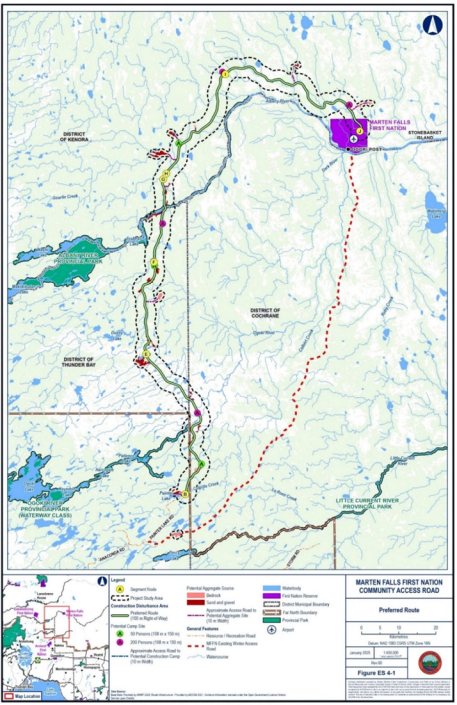
Source: Marten Falls Community Access Road Project, Environmental Assessment Report/Impact Statement, Figure ES 4-1
Figure 1 - Text version
The map shows the Marten Falls Community Access Road construction disturbance area and its key components within the local and regional study area. An inset map identifies the location within the province of Ontario.
The road would establish a permanent connection between the Marten Falls First Nation community and the Ontario provincial highway network. The purpose of the project is to address ongoing challenges posed by the community's remote location, including reliance on costly air transportation and increasingly unreliable winter roads, which constrain access to essential goods, services, and economic opportunities.
The need for the project is demonstrated by its potential to improve community well-being through enhanced access to health, education, and social services; reduce the cost of living; and support economic reconciliation by enabling sustainable development and long-term growth.
Alternatives to carrying out the project considered by the proponent included air transportation, a railroad, and the existing winter access road that is dependent on ice thickness and open sometimes only for a few weeks a year. For most of the year, the community relies on costly air transportation, which also limits what can be transported. The winter road, being weather dependent, is unreliable and insufficient to meet the community needs. Railroad was considered by the proponent but deemed insufficient to meet the needs of the community as it would not offer the same level of freedom of movement as an all-season road.
1.2 Impact assessment process, scope and considerations
IAAC conducted an impact assessment of the project, coordinating with the Government of Ontario. The impact assessment commenced on February 24, 2020. IAAC issued Tailored Impact Statement Guidelines (TISG) to the proponent, which set out the scope of the assessment and described the information and studies required of the proponent. Following amendments to the IAA, IAAC issued a letter to the proponent on June 11, 2025, clarifying that the next steps in the Impact Statement phase of the project will focus on key issues relevant for decision making, specifically the adverse effects within federal jurisdiction and the positive benefits of the project, as well as on leveraging federal and provincial legislative frameworks outside the IAA to address the key issues.
In addition to being subject to an impact assessment under the IAA, the proponent entered into a voluntary agreement with the Ontario Ministry of the Environment, Conservation and Parks (MECP) to subject the project to a comprehensive environmental assessment under Ontario's Environmental Assessment Act. The provincial environmental assessment process started on October 8, 2021. IAAC understands, where a project assessed through a comprehensive environmental assessment under the Environmental Assessment Act receives authorization to proceed, enforceable conditions imposed through the approval would include the implementation of all proponent commitments identified in the environmental assessment.
The proponent conducted studies and sought input from Indigenous communities, the public, federal authorities and provincial ministries, to address both federal and provincial requirements. IAAC and MECP coordinated, to the extent possible, the conduct of the federal and provincial assessments to streamline efforts of all parties. This included coordination of technical reviews to support the proponent in preparing a single set of documentation with the required information and studies, called the Impact Statement in the federal impact assessment process and the environmental assessment in the provincial process. The Impact Statement was submitted by the proponent to IAAC on February 20, 2026.
IAAC then prepared this IA Report, which provides information about the impact assessment and sets out IAAC's rationale and conclusions. In preparing the IA Report, IAAC considered multiple sources of information including: the proponent's Impact Statement, Indigenous Knowledge provided and other input from Indigenous communities, comments and community knowledge from the public, and information or knowledge provided by federal authorities and provincial ministries.
1.2.1 Effects assessment
Based on information made available through the federal and provincial assessments, the project is likely to cause the following effects on the environment, and on health, social, and economic conditions:
- adverse effects on:
- groundwater and surface water;
- geology, geochemistry, topography and soils;
- vegetation and wetlands;
- wildlife and wildlife habitat, including species at risk listed on Schedule 1 of SARA , fish and fish habitat and migratory birds;
- waterways navigation;
- Indigenous Peoples' current use of lands and resources for traditional purposes, archaeological and heritage resources;
- visual landscape;
- atmospheric environment, including air quality; and
- positive and adverse effects on health, social and economic conditions.
From among these effects, this IA Report identifies and provides information on the adverse effects within federal jurisdiction and direct or incidental adverse effects from the project as defined in Section 2 of the IAA (collectively referred to in this IA Report as "adverse federal effects"), as well as other effects that may inform decision making.
The adverse federal effects of the project are listed below and set out in Sections 2 and 4.3 of this document:
- Effects on fish and fish habitat;
- Effects on migratory birds;
- Effects on the environment on federal lands;
- Effects from physical activities carried out on federal lands;
- Effects on structures, sites or things of historical, archaeological, paleontological or architectural significance to Indigenous Peoples and effects to the physical and cultural heritage of Indigenous Peoples;
- Effects on current use of lands and resources for traditional purposes by Indigenous Peoples; and
- Effects on the health, social, and economic conditions of Indigenous Peoples.
Where effects could fall into more than one category of adverse federal effects, IAAC assessed them in a single category. For example, effects on fish and fish habitat are considered within its own section of the IA Report and not duplicated in the assessment of effects from physical activities carried out on federal lands. The effects of the project on the environment on federal lands are included or similar to the effects of physical activities carried out on federal lands, which are assessed in Section 2.3. As applicable, the result of interactions between effects informed the analysis in the sections about adverse federal effects of this IA Report.
The likely direct or incidental adverse effects associated with potential authorizations or permits under the Canadian Navigable Waters Act, Fisheries Act, SARA, and Explosives Act are included in, or similar to, the adverse federal effects on fish and fish habitat, migratory birds, and resulting from physical activities carried out on federal lands, as well as the adverse changes associated with effects on Indigenous Peoples, which are assessed in Sections 2.1, 2.2, and 2.3 and 4.3, respectively. No federal authority has provided financial assistance for the purpose of enabling the project to be carried out, in whole or in part.
In its assessment, IAAC considered likely effect pathways that could lead to adverse federal effects. This report focuses on adverse federal effects and effect pathways that are key issues.
In addition to adverse federal effects, IAAC considered other effects that could support decision making at the end of the impact assessment process. Specifically, this included information related to:
- the impacts that the likely effects of the project may have on any Indigenous group (positive and adverse) and adverse impacts on the rights of Indigenous Peoples;
- the extent to which the likely effects of the project contribute to the Government of Canada's ability to meet its environmental obligations and its commitments in respect of climate change; and
- the extent to which the likely effects of the project contribute to sustainability.
1.2.2 Other factors considered in the impact assessment
In conducting the impact assessment, IAAC considered the factors described in section 22 of the IAA to the extent of their relevance to the impact assessment for this project. Annex B lists the section 22 factors and indicates where they are included in this IA Report. Additional information on some factors is provided below.
1.2.2.1 Malfunction and accident scenarios
IAAC considered the effects from malfunctions and accidents that may occur in connection with the project during the construction and operation phases including:
- Scenario 1: Accidental spills of hazardous material, including spills that may impact fish and fish habitat by reducing water quality;
- Scenario 2: Vehicle or equipment accidents, including vehicular collisions with migratory birds and wildlife of importance to traditional practices of Indigenous communities;
- Scenario 3: Structural failure of a project component (e.g., road surface failure, bridge failure, or culvert failure or a storage facility accident) due to extreme weather or wildfire event could result in adverse effects to fish and fish habitat, migratory birds, wildlife important to Indigenous traditional practices, and community well-being; and
- Scenario 4: Accidental fires and explosions associated with project components (e.g., equipment, fuel storage, maintenance activities, or camps) which could result in adverse effects to migratory birds, wildlife important to Indigenous traditional practices, and community well-being.
Of the scenarios identified, IAAC considers Scenarios 1 and 2 as likely to occur. These scenarios are plausible during the construction and operation of the project, based on the nature of the activities and the operating environment. Further, these scenarios are consistent with hazards identified as priorities by the Ontario Ministry of Emergency Preparedness and Response. The adverse federal effects of the likely malfunctions and accidents are included in Sections 2 and 4.3 of this IA Report, as applicable. The adverse federal effects of unlikely malfunction and accident scenarios are considered in Section 3.
1.2.2.2 Effects to the project caused by the environment
IAAC considered potential effects caused by the environment to the project, such as severe natural events (e.g., extreme rainfall, drought, and seismic activity), including how these could be a contributing or complicating factor for malfunctions and accidents. The project has been designed to mitigate potential effects of the environment on the project with consideration of existing conditions and external environmental risks, including projected climate trends. All proposed structures, foundations, and related facilities would follow applicable Canada and Ontario codes, guidelines, specifications, and standards, including the Ontario Ministry of Transportation Highway Drainage Design Standards (2008) and Maintenance Manual (2003). Adequate road drainage, and properly sized and maintained culverts will be designed, based on historical climate data and future climate scenarios, as well as the Canadian Highway Bridge Design Code (CSA S6:25, 2019), and would ensure that bridge components would withstand extreme environmental conditions. Environment and Climate Change Canada (ECCC) considers the proponent's climate change risk assessment conclusions on the risks that environmental hazards may have on the project and their mitigations to be reasonable.
Furthermore, the baseline conditions that informed the assessment included consideration of how environmental conditions could change due to climate change, where relevant.
1.2.2.3 Other projects considered in the cumulative effects assessment
IAAC considered how the likely residual adverse federal effects of the project could interact with effects from other past, present or likely future physical activities, resulting in cumulative effects. The other physical activities considered were:
- mining activities;
- mineral exploration activities;
- electricity generation and water diversion;
- telecommunications activities;
- road construction and operation projects; and
- forestry management activities.
As applicable, the cumulative effects of the project in combination with other physical activities are discussed in Sections 2 and 4.3 of this IA Report.
1.2.2.4 Alternatives means of carrying out the project
IAAC considered the alternative means of carrying out the project identified by the proponent as technically and economically feasible, as well as the effects of those means. It also considered the rationale provided by the proponent for its preferred means of carrying out key project elements.
In accordance with provincial and federal requirements, the proponent considered multiple route alternatives. Two main route options were ultimately compared, with each route option including some sections that run parallel, overlap, and/or cross each other. Each route option also involves different potential water crossing locations. The two route options were further compared by dividing each into three separate segments, in order to identify the preferred alternative for each segment. Following technical study, data collection, and consultation that integrated Indigenous Knowledge and feedback from Marten Falls First Nation community members, Chief and Council, and other Indigenous communities, as well as feedback from the public, the proponent identified a preferred route corridor. A preferred route was identified and formally endorsed by Band Council Resolution in August 2024. Means for other project components were then selected from feasible options within the preferred corridor.
1.2.2.5 Gender-based Analysis Plus
IAAC applied Gender-based Analysis Plus (GBA Plus) to inform its assessment of the project's potential adverse federal effects and its consideration of information that could inform federal decision making. As applicable, the differential effects of the project on diverse populations – considering intersecting identify factors – were identified and considered, including in Section 4.3 of this IA Report.
1.2.3 Criteria for significance of likely adverse federal effects
Taking into consideration the recommended mitigation measures, IAAC assessed whether there are residual adverse federal effects of the project (i.e., adverse federal effects that are likely to remain after taking into account the implementation of recommended mitigation measures). Where there are residual effects, IAAC also assessed cumulative effects that are likely to result from the project in combination with other physical activities that have been or will be carried out.
IAAC described the residual adverse federal effects and cumulative effects using the rating criteria defined in Annex A. IAAC drew conclusions on whether those effects are likely to be significant, and, if so, characterized the extent to which effects are likely to be significant. Table 3 provides information about the criteria used to determine whether and to what extent adverse federal effects were likely to be significant.
|
Extent of significance |
Description |
|---|---|
|
Not significant |
Effect is sufficiently small that it does not individually or cumulatively have a significant effect on a valued component, and generates no or few impacts in social or ecological contexts. |
|
Low extent of significance |
Effect is significant but low in magnitude, of short duration, infrequent, small in spatial extent, reversible or readily avoided, and generates minor impacts in social or ecological contexts. Mitigation measures may not be required, or would allow baseline conditions to remain largely unchanged such that a valued component is not likely to be diminished or lost. |
|
Moderate extent of significance |
Effect is significant and moderate in magnitude, of moderate duration, occasionally frequent, possibly/partially reversible, and generates a moderate level of impacts in social or ecological contexts. Mitigation measures may be required but not fully eliminate, reduce, control or offset the effect but should prevent severe diminishment or loss of a valued component. |
|
High extent of significance |
Effect is significant and high in magnitude, permanent/long term, frequent, irreversible, and over a large spatial extent or within an area of exclusive/preferred Indigenous use or of ecological/environmental sensitivity. High levels of impacts in social or ecological contexts are expected. There is a high degree of uncertainty of the effectiveness of mitigation measures, or mitigation measures are unable to fully address effects such that a valued component is likely to be severely diminished or lost. |
1.3 Consultation and engagement with Indigenous communities
As set out in the Indigenous Engagement and Partnership Plan (IEPP), IAAC consulted and engaged with Indigenous communities. Section 4 describes the consultation process carried out over the course of the impact assessment and presents the perspectives of Indigenous communities regarding the process. It also provides information on the Indigenous Knowledge that was provided with respect to the project and was considered by IAAC in conducting the impact assessment and in preparing this IA Report. Input from Indigenous communities informed IAAC's assessment and is incorporated throughout the IA Report.
1.4 Public engagement
Consistent with the Public Participation Plan, IAAC engaged the public during the impact assessment process and considered their input. Engagement included:
- virtual and in-person meetings; and
- opportunities to comment on: the Summary of the Initial Project Description, the draft TISG and the draft Public Participation Plan, IAAC's preliminary analysis of federal effects and benefits of the project, and the draft IA Report and potential conditions.
IAAC provided $50,000 in participant funding to help the public participate in the impact assessment.
Written public comments received by IAAC were published on the project page on the Canadian Impact Assessment Registry, subject to privacy, security or confidentiality exceptions. Annex C provides a summary of public comments. Input from the public informed IAAC's assessment and is incorporated throughout the IA Report, as applicable.
2 Biophysical adverse federal effects
This section summarizes IAAC's rationale and conclusions related to the assessment of the biophysical adverse federal effects likely to be caused by the carrying out of the project.
2.1 Fish and fish habitat
The project is likely to cause residual and cumulative adverse effects on fish and fish habitat through degradation and loss of habitat, harm to fish populations, and increased recreational fishing. With the implementation of the recommended mitigation measures identified in Section 2.1.4, IAAC is of the view that the residual effects of the project on fish and fish habitat are likely to be significant to a low extent as local habitat loss may not be fully offset. The cumulative effects of the project in combination with other physical activities are likely to be significant to a low extent as the spatial and temporal overlap with effects from other proposed projects would be small.
IAAC assessed effects on fish and fish habitat including through degradation and loss of habitat, harm to fish populations, and decrease in fish population through recreational fishing.
The environment, including fish and fish habitat, surrounding the road is generally seen as pristine by Indigenous communities. The proponent indicated that the watercourses and waterbodies crossed by the proposed route contain fish habitat for 37 fish species. Considering the information provided by the proponent, IAAC assessed effects to all fish species, and focused the assessment of effects to the six fish species that were noted as important to Indigenous communities, which includes species at risk, identified in lakes and rivers within the study areas: lake sturgeon (a species of Special Concern under SARA), walleye, brook trout, northern pike, lake whitefish, and burbot. The proposed route includes water crossings at areas where potential spawning, rearing, and/or overwintering habitat for these species could be present.
Climate change is expected to affect the project over time through warmer temperatures and more frequent extreme precipitation and runoff events. These conditions may alter hydrology (e.g., water levels and flows) and increase erosion and sediment transport during high-runoff periods, as well as increasing water temperature. These changes to the environment could increase the likelihood or magnitude of effects on fish and fish habitat, including effects associated with how project components (e.g., water crossings and culverts) interact with fish and fish habitat. The proponent has indicated that the design of water crossing structures considered climate change effects.
IAAC considered effects on fish and fish habitat within the Local Study Area (LSA) as well as the Regional Study Area (RSA). The LSA extends 2.5 kilometres from the centreline on both sides of the proposed route plus a 500-metre buffer around each of the other project components. The RSA extends beyond the LSA and encompasses the area of the tertiary watersheds crossed by the proposed route. The proposed route is within the Southwestern Hudson Bay watershed and passes through three tertiary watersheds: the Upper Albany-Makokibatan, Lower Ogoki, and Upper Albany-Muswabik. The LSA and RSA contain abundant waterbodies, as depicted in Figure 2, and a variety of fish habitat features, including flats, runs, riffles, pools, and impoundments, which provide potential areas for spawning, rearing, and overwintering for a variety of fish species. Notably, many Indigenous communities identified the Albany River, and tributaries, as particularly significant, highlighting their importance as fish habitat for species of importance. IAAC considered effects during project construction and operation; decommissioning and abandonment of the road are not anticipated.
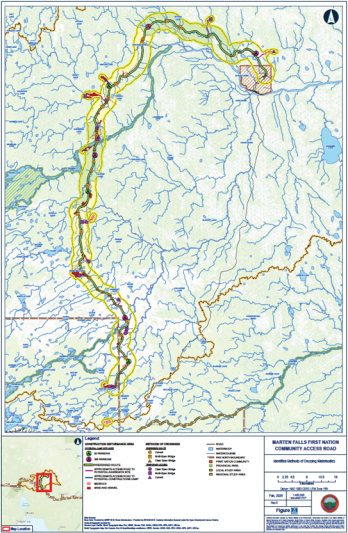
Source: Marten Falls Community Access Road Project, Environmental Assessment/Impact Statement, Appendix F Figure 7-1
Figure 2 - Text version
The larger map shows the waterbodies and watercourses intersecting the construction disturbance area (CDA) within the local study area, regional study area, and local environment. An inset map also identifies the location within the context of the broader Ontario region.
2.1.1 Assessment of effects
2.1.1.1 Degradation and loss of fish habitat
The project would result in the loss and physical degradation of 8.3 hectares of fish habitat, including resulting from the placement of water crossing structures along the proposed route, and an additional 4.4 hectares resulting from the placement of water crossing structures along temporary access roads. A variety of water crossing structures may be used including clear span bridges, culverts, ice bridges/snow fills, and rig mats. Potential spawning and/or rearing habitat for all six species of importance (lake sturgeon, walleye, brook trout, northern pike, lake whitefish, and burbot) would be degraded or lost from construction, including 2.6 hectares of habitat for lake sturgeon along the proposed route. Effects on fish habitat may result from in-water or near water works, including operating heavy machinery; installing isolation structures; bank treatments and site preparation, including clearing of aquatic and riparian vegetation; and placing structures, fill and other materials in the waterbody. The proponent would avoid channel realignment or infilling; however, where avoidance is not possible, IAAC is of the view/understands that the mitigation measures proposed by the proponent to address adverse changes in water quality, hydrology and fish passage would be appropriate.
IAAC notes that Animbiigoo Zaagi'igan Anishinaabek, Aroland First Nation, Marten Falls First Nation and Weenusk First Nation have expressed concerns about loss of spawning habitat. To mitigate the physical degradation or loss of fish habitat, the proponent selected a route that would minimize the number of water crossings, avoid sensitive habitats, and reduce the CDA. Also, the proponent committed to follow best practices, where possible, including by using isolation methods that maintain downstream flows; avoiding work during restricted activity timing windows; and minimizing vegetation removal to the requirement of the access road and alignment clearing width. Temporary crossings would include the same mitigation measures with the addition of Fisheries and Oceans Canada (DFO)'s code of practice Ice bridges and snow fills: Construction, maintenance and decommissioning, where appropriate. Further, IAAC understands that authorizations under the Fisheries Act and, for activities occurring on provincial Crown land, permits under Ontario's Public Lands Act and Lakes and Rivers Improvement Act may be required to carry out the project. These legislative mechanisms would manage effects on fish habitat associated with the project that cannot be avoided though project design by requiring offsetting where residual effects to fish and fish habitat remain (Fisheries Act) and may include implementation of proposed avoidance and mitigation measures, monitoring and reporting requirements, contingency measures as well as the identification of further site-specific measures during the permitting stage (Public Lands Act and Lakes and Rivers Improvement Act).
DFO noted that, because the local environment is largely undisturbed and ecologically intact, there may be challenges in finding suitable locations within the same reach or watershed to offset degradation or loss of fish habitat, potentially making offsetting difficult. If suitable offsetting locations cannot be found, a combination of different types of offsetting measures, including complementary measures like data collection, scientific research, and public education activities could be used to offset effects to fish habitat and meet DFO requirements. IAAC and DFO agree that the proponent should consult with Indigenous communities and provincial ministries with knowledge of the area to inform offsetting plans.
Effects from the project on fish habitat from changes to hydrology may occur as a result of the floating road design and project activities, including: the installation of water crossings, and in-water works for dewatering, water taking and discharging activities related to aggregate sites, worker camps, and other project components during construction and operation. Additionally, land-based construction activities, including aggregate placement, peat compression, and the installation of mineral and/or geotextile layers, may alter hydrology, especially in the peatland. Aroland First Nation and Fort Albany First Nation expressed concerns about impacts on fish and fish habitat from hydrological changes.
To minimize changes in hydrology (e.g., changes in water flows, levels and velocities), the proponent committed to design, install and maintain bridges and culverts to sustain downstream flows and fish passage in accordance with applicable standards and guidelines, including Environmental Guidelines for Access Roads and Water Crossings from the Ontario Ministry of Natural Resources (MNR), and DFO's Measures to Protect Fish and Fish Habitat, Code of Practice: Culvert Maintenance, and Standard: In-water site isolation. The proponent has also committed to maintaining hydrological flows through the peatlands by installing equalization culverts and the floating road design. The Fisheries Act and its regulations address potential changes in hydrology that would result in adverse effects to fish habitat, including through habitat protection and pollution prevention provisions which prohibit activities that would result in the harmful alteration, disruption, or destruction of fish habitat, the application of protective provisions as required through a Fisheries Act authorization, and following relevant DFO codes of practice where appropriate. Provincial requirements to address potential adverse effects to hydrology include, where applicable, the permitting of water crossings and approvals for temporary dewatering activities under Ontario's Lakes and Rivers Improvement Act; requirements for water taking, drainage, discharge, and treatment of wastewater and aggregate processing water in the Permit to Take Water and Environmental Compliance Approval issued under the Ontario Water Resources Act or the Environmental Activity and Sector Registry under Ontario's Environmental Protection Act; and other operating requirements included in site permits issued under Ontario's Aggregate Resources Act.
IAAC is of the view that, with the implementation of these mitigation measures, the project is expected to cause limited residual effects from the degradation and loss of fish habitat, despite the uncertainty on the types and locations of offsetting and/or compensatory measures that would be found to be suitable through DFO requirements.
2.1.1.2 Harm to fish populations
The project may result in harm to fish populations through in-water work (e.g., operating heavy machinery, placing fill or structures, and dewatering). To mitigate physical injury to fish, the proponent has committed to rescue fish within the isolated in-water work area and relocate them outside of the zone of impact. Mitigation measures would likely be a part of an authorization under the Fisheries Act as well as following DFO's Standards: In-water site isolation, Fish Capture and Relocation, Water intake end-of-pipe fish screens. Fish rescue would be conducted in accordance with a License to Collect Fish for Scientific Purposes issued under Ontario's Fish Licensing Regulation. In-water or near water works may also include blasting which can result in physical injury to fish but is not planned to be used in water for the project. If blasting is required in or near water frequented by fish during construction or maintenance work, the proponent has committed to following the Ontario Provincial Standard Specification General Specifications for the Use of Explosives, DFO's Guidelines for the Use of Explosives in or Near Canadian Fisheries Waters, and adhering to the protective provisions under the Fisheries Act to minimize risk of physical injury to fish from blasting. Further, IAAC understands that, under the Aggregate Resources Act, aggregate permit applications are required to include site plans and technical reports prepared in accordance with the Aggregate Resources of Ontario Site Plan (2020) and Technical Reports and Information (2023) Standards. This includes preparing a Natural Environment Report to determine if fish habitat is present within 120 metres of the site. Where potential impacts on these features are identified, the Natural Environment Report must outline proposed preventative, mitigation, or remedial measures. This may include recommendations to implement DFO's guidelines to mitigate any potential negative impacts to fish related to blasting, to be incorporated on the site plan.
Project activities may also result in harm to fish populations by changing water quality through aggregate placement, shoreline and in-water work (such as vegetation clearing), as well as water and wastewater discharges and site run-off. Placement of aggregate materials with a high potential for acid rock drainage (ARD) or metal leaching (ML) may result in changes to water quality and impact fish habitat, as was identified by Aroland First Nation. The proponent committed to undertake further testing of aggregate material (i.e., ARD/ML potential) prior to project construction to avoid developing sites that show potential for ARD/ML. Additionally, the pollution prevention provisions of the Fisheries Act prohibit the release of deleterious substances into water frequented by fish.
Aroland First Nation, Ginoogaming First Nation, Marten Falls First Nation, Nibinamik First Nation, and Weenusk First Nation expressed concerns about impacts to fish from changes to water quality that result from sedimentation and vegetation clearing. To mitigate this effect, the proponent has committed to develop and implement an erosion and sediment control plan and to follow best management practices (e.g., using multistage drainage and sediment controls to collect and treat stormwater runoff including collection ditches, silt fences and sediment traps/basins), DFO standard: Planning for land-based erosion and sediment control, and provincial standards (e.g., Ontario Provincial Standard Specifications Construction Specification for Temporary Erosion Control). Where applicable, authorizations issued under the Fisheries Act, and permits issued under Ontario's Public Lands Act and Ontario's Lakes and Rivers Improvements Act may include erosion and sediment control measures including restrictions on bank grading, and design requirements for water crossings to avoid and mitigate effects to fish and fish habitat.
Nibinamik First Nation expressed concern related to changes to water quality from discharges of water and wastewater, and from site run-off from aggregate sites, worker camps, and laydown and field office areas. The proponent proposed to discharge domestic wastewater onsite (e.g., leaching beds) or haul to a wastewater treatment plant for disposal. Changes to water quality would be managed in accordance with requirements under the Ontario Water Resources Act through an Environmental Compliance Approval for wastewater systems, site drainage water and stormwater management systems, as well as aggregate processing water. The proponent also committed to locating facilities (e.g. camps and laydown areas) a minimum of 30 metres from waterbodies and to review discharge locations to avoid discharging into sensitive areas, including areas identified the Indigenous Knowledge Program.
The proponent committed to conduct water quality monitoring for total suspended sediments and turbidity when in-water work would occur in or near fish and fish habitat. Water quality monitoring for turbidity would be required as part of an authorization under the Fisheries Act, and may also be required as part of a permit or approval under Ontario's Public Lands Act, Ontario's Lakes and Rivers Improvements Act, Ontario Water Resources Act, and Ontario's Environmental Protection Act. For the purpose of setting water quality guidelines for permits and approvals for protection of aquatic life, IAAC understands that DFO and Ontario would consider appropriate water quality benchmarks such as Provincial Water Quality Objectives, Canadian Water Quality Guidelines for the Protection of Aquatic Life, and Federal Water Quality Guidelines.
Accidental spills during storage, transportation, handling and dispensing of hazardous materials, from vehicle accidents or mechanical malfunctions during the construction and operation phases may occur and could also harm fish populations. Although spills are infrequent, short-term localized spills are likely to occur over the lifespan of the project. Constance Lake First Nation, Kashechewan First Nation, Marten Falls First Nation, and Nibinamik First Nation expressed concerns about impacts to fish from changes to water quality resulting from accidents and spills. Spills of harmful materials (e.g., petroleum products, sewage, ammonium nitrate) into or near waterbodies may degrade, or even destroy, fish habitat and injure fish through direct acute or chronic toxicity from contamination.
The proponent committed to prepare and implement a Spill Prevention and Emergency Response Plan in accordance with all applicable federal and provincial standards and legislation, such as DFO's Measures to protect fish and fish habitat. Additionally, it would be included as part of an authorization issued under the Fisheries Act. The plan would include preventative measures to reduce the likelihood of, or impact from, accidental spills, such as refueling away from waterbodies, where possible; providing spill response kits and equipment at dedicated petroleum storage areas; and training personnel in best practices for spill response and the transportation of dangerous goods. The proponent would also have to comply with legislative mechanisms, such as Ontario's Technical Standards and Safety Act, 2000 and Dangerous Goods Transportation Act as well as the federal Transportation of Dangerous Goods Act and Explosives Act.
In the event of a spill, the proponent committed to implement corrective actions that could reduce effects to fish and fish habitat, such as containing and cleaning up spills as soon as possible. IAAC understands that, under Ontario's Environmental Protection Act, it is the duty of the owner or controller of a spilled pollutant to clean up a spill and do whatever is practicable to prevent and eliminate adverse effects from a spill. Spills of any harmful material must be reported to the Spills Action Centre of MECP.
IAAC is of the view that, with the implementation of these mitigation measures, the project is expected to cause limited to no residual effects through harm to fish populations, given that potential effects would be infrequent (e.g. during construction, accidental spills) and be confined to small areas (e.g. near in-water work and aggregate pits blast sites).
2.1.1.3 Increased recreational fishing
Increased accessibility during construction and operation may lead to greater recreational fishing activity in nearby waterbodies over the life of the project, which could result in localized declines in fish populations. Animbiigoo Zaagi'igan Anishinaabek, Aroland First Nation, Attawapiskat First Nation, Fort Albany First Nation, Ginoogaming First Nation, Kashechewan First Nation, and Marten Falls First Nation expressed concern that there would be less fish available from increased angling in more easily accessible fishing areas.
To reduce potential recreational fishing, the proponent has committed to decommissioning and reclaiming temporary infrastructure including temporary access roads at the end of construction. Further, recreational fisheries in Ontario are managed through Ontario's Fish and Wildlife Conservation Act to protect fish populations and their habitats, notably by regulating recreational fishing.
IAAC is of the view that, with the implementation of the mitigation measures, the project is expected to cause limited to no residual effects on fish populations due to increased recreational fishing, depending on how many recreational anglers visit the area.
2.1.2 Residual effects
Based on the above assessment, IAAC is of the view that the project would likely result in residual adverse effects on fish and fish habitat, primarily through degradation and loss of habitat.
The residual effects, taking into account the mitigation measures described above, would be low in magnitude and geographic extent as there would be a net loss and degradation of fish habitat, including spawning habitat, as well as hydrological changes localized to the CDA, but the changes are not expected to affect fish populations. The effects would occur infrequently, primarily during project construction (except for effects from recreational fishing) and, if applicable, would be at least partially reversed through habitat offsetting required by Fisheries Act authorizations, which may not be local given the pristine conditions nearby and/or rely on complementary measures. DFO noted that the potential effects from the installation of waterbody crossings associated with the proposed project are well understood.
IAAC concludes that the residual adverse effects of the project on fish and fish habitat are likely to be significant to a low extent.
2.1.3 Cumulative effects
The residual adverse effects of the project on fish and fish habitat, in combination with the effects of other past, present, and reasonably foreseeable projects, are likely to result in cumulative effects that are significant to a low extent. IAAC considered the Albany River basin as the spatial boundary for the cumulative effects assessment because it encompasses the catchment area of the Albany River and Ogoki River and their tributaries, which are hydrologically connected to the fish populations and habitat that may be affected by the project. This spatial boundary captures the area where downstream effects to fish and fish habitat could occur from other projects, including operating and proposed mines, mineral exploration activities, water diversions, other roads, and the Rapid Lynx Broadband Project (a fibre-optic internet cable network). These projects would cause changes to the environment, notably degradation or removal of fish habitat, in basin areas upstream and downstream.
Federal (i.e., Fisheries Act) and provincial (e.g., Lakes and Rivers Improvement Act, Ontario Water Resources Act) protections for fish and fish habitat would apply to limit the effects of these projects on fish and fish habitat to project-specific areas. The project would have some geographic overlap with three of the other projects: Northern Road Link, Anaconda-Painter Lake Road, and Rapid Lynx Broadband. However, the effects from these projects are not expected to reduce fish population levels within the river basin.
In addition, residual effects from the project in combination with the other projects would mainly occur during project construction (except for effects from recreational fishing). As such, temporal overlap in residual effects between the proposed project and other projects would be limited.
Given that the interaction of the residual effect from the project with residual effects from other projects would be limited, IAAC does not recommend additional mitigation measures or a follow-up program related to cumulative effects.
Taking into consideration the recommended mitigation measures in Section 2.1.4 below, the likely cumulative effects to fish and fish habitat would be low in magnitude and geographic extent given that effects would be largely localized to the respective CDA, which is small relative to the area of fish habitat within the Albany River basin. In addition, the effects would be relatively short-term, occurring primarily during the construction phase and partially reversible over the long-term. For the types of projects considered, the effects are generally well understood and addressed with standard mitigation measures.
IAAC concludes that cumulative effects of the project on fish and fish habitat are likely to be significant to a low extent as the project, along with other projects, would contribute to habitat loss and degradation in a pristine region.
2.1.4 IAAC's recommended mitigation measures and follow-up program for implementation by the proponent pertaining to fish and fish habitat
Recommended mitigation measures that would potentially be included as conditions in the impact assessment decision statement
- If requested by DFO: develop, to the satisfaction of DFO and in consultation with Indigenous communities, and implement any offsetting plan for activities that may result in the harmful alteration, disruption, or destruction of fish habitat, or the death of fish associated with the project, taking into account DFO's Policy for Applying Measures to Offset Harmful Impacts to Fish and Fish Habitat.
With respect to changes in hydrology and fish passage:
- design, install, and maintain water crossings in a manner that addresses downstream flows, water levels, velocities, and fish passage, as appropriate to site conditions and as determined through applicable provincial review, permitting, and approval processes, including relevant standards, best practices, and permit conditions (e.g., MNR's Environmental Guidelines for Access Roads and Water Crossings, and DFO's Measures to Protect Fish and Fish Habitat and Code of Practice: Culvert Maintenance).
With respect to physical degradation of fish habitat:
- avoid construction below the high-water mark during a fish restricted activity timing window as determined through the applicable permitting and review process, using all information available and a precautionary approach where uncertainty remains regarding fish community composition, and considering relevant provincial guidance and the In-water Work Timing Window Guidelines.
With respect to physical injury to fish:
- rescue fish within the work area and relocate them away from the work area prior to starting any in-water work, where warranted by the nature of the work, in accordance with a License to Collect Fish for Scientific Purposes issued under the Fish Licensing Regulation.
With respect to changes in hydrology and water quality:
- conduct dewatering, water-taking and wastewater discharge in accordance with permits and approvals issued under the Ontario Water Resources Act, and Ontario's Environmental Protection Act.
Implement, at a minimum, the following mitigation measures to control sedimentation, runoff and erosion, as appropriate, during all phases of the project in order to meet suspended sediments and turbidity thresholds in the Canadian Council of Ministers of the Environment's Canadian Water Quality Guidelines for the Protection of Aquatic Life or Provincial Water Quality Objectives:
- stabilize all erodible areas (including excavated materials) and regularly inspect and maintain the stability of these areas until they are permanently stable;
- install a settling basin for water being pumped or diverted from aggregate sites such that water run-off meets Canadian Water Quality Guidelines for the Protection of Aquatic Life or Provincial Water Quality Objectives before discharge into the receiving environment;
- limit vegetation removal to the footprint of water crossing structures and maintain an undisturbed vegetated buffer zone of 30 metres upstream and downstream of each crossing; and
- isolate in-water project activities from the receiving fish bearing waters to mitigate intensity, spatial scale and duration of sedimentation in fish habitat taking into account DFO's Interim standard: in-water site isolation.
Use only rock materials characterized as not acid-generating, non-potentially acid-generating and non-metal-leaching for project works.
Restrict vehicle and equipment refueling and servicing to a minimum of 30 metres from waterbodies such that they cannot result in accidental spills reaching fish-bearing waters.
Establish and implement a Spill Prevention plan and Emergency Response Management Plan to prevent and address accidents and malfunctions that may result in adverse federal effects that includes, at a minimum, training personnel in spill response procedures, providing spill response kits and equipment for containing spills at work locations and in vehicles, and cleaning up and containing spills as soon as possible following incidents.
Recommended follow-up program that would be potentially included as conditions in the impact assessment decision statement
Implement a follow-up program, in consultation with Marten Falls First Nation with respect to waterbodies located on Marten Falls First Nation reserve land, and in consultation with Indigenous communities, DFO, ECCC, and MNR with respect to waterbodies located on non-federal lands within the LSA, to verify the accuracy of the impact assessment and determine the effectiveness of mitigation measures with respect to effects to fish and fish habitat from changes in water quality. The program should include:
- monitoring water quality parameters in groundwater and surface water (total suspended solids, acidity (pH), electrical conductivity, ammonia, sulphates, nitrates, dissolved organic carbon, methylmercury, and heavy metals and metalloids, including aluminum, total mercury, arsenic, copper, iron, lead, manganese, nickel, and zinc) in waters frequented by fish starting during construction and until a three-year trend analysis indicates that the project may not change water quality;
- comparing the monitoring results to the Canadian Council of Ministers of the Environment's Canadian Water Quality Guidelines for the Protection of Aquatic Life to determine whether modified or additional measures are required;
- consideration of views from Indigenous communities on the design of the monitoring program and on the trend analysis; and
- making the monitoring results available to Indigenous communities, as soon as feasible.
2.2 Effects on Migratory birds
The project is likely to cause limited residual and cumulative adverse effects on migratory birds through displacement due to vegetation clearing, sensory disturbances, and mortality risk due to potential accidental collisions and spills. With the implementation of the recommended mitigation measures identified in Section 2.2.4, IAAC is of the view that the residual adverse effects of the project on migratory birds are not likely to be significant as they would be limited to the CDA and occur infrequently. The cumulative effects of the project in combination with other physical activities are not likely to be significant as the spatial and temporal overlap with effects from other proposed projects would be minimal.
IAAC assessed effects on migratory birds including through displacement due to vegetation clearing, sensory disturbances during construction and maintenance activities, and mortality risk due to potential accidental collisions and spills.
The project would overlap with wetland and upland vegetation communities, which act as primary habitat for migratory birds. Migratory birds are known to occur within these vegetation communities in the area, which provide habitat for nesting, stopover, staging and migration.
IAAC considered effects to migratory birds within the LSA as well as the RSA. The LSA includes the CDA and extends three kilometres from the centreline on both sides of the proposed route. The RSA includes the LSA and further extends eight kilometres beyond the LSA boundary, as depicted in Figure 3. Effects were considered for both the construction and operation phases of the project.
The LSA and the RSA predominantly contain wetland habitats—bogs, fens, swamps, marshes, and open water — with upland coniferous, deciduous and mixed forests, as well as riparian areas also present across the landscape. These habitats support wetland songbirds (e.g., palm warbler and alder flycatcher), shorebirds (e.g., greater yellowlegs), waterfowl (e.g., Canada goose and mallard), and forest birds (e.g., orange-crowned warbler and Tennessee warbler), during the nesting season and during spring and fall migration periods.
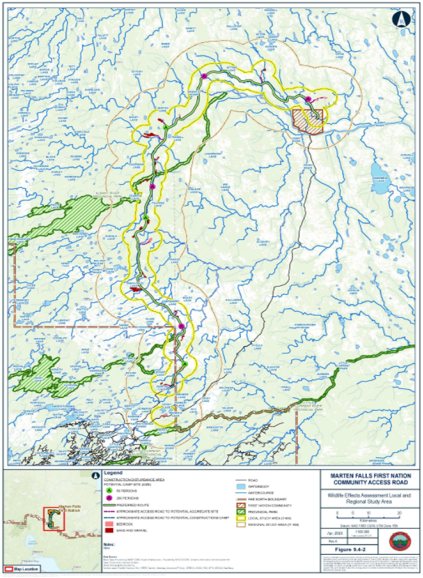
Source: Marten Falls First Nation Community Access Road Project, Environmental Assessment Report/Impact Statement, Figure 9.4-2
Figure 3 - Text version
Figure showing Marten Falls Community Access Road Project and the Local and Regional Study area considered for Migratory Birds.
Climate change is expected to affect migratory birds and their habitat over time through warmer temperatures, shifting seasonal patterns, and more frequent extreme weather events. These changes may alter the timing of migration, breeding, and nesting, as well as the availability and quality of habitat along migratory routes and within the RSA. These climate-related changes could increase the likelihood or magnitude of effects on migratory birds by altering how project components interact with migratory bird habitat during sensitive periods.
Migratory birds use a variety of habitat types within the LSA and RSA for breeding, foraging, and migration. Forest birds are commonly associated with upland and mixed forest habitats, but may also occur in treed wetlands and other forested areas. Shorebirds typically forage and nest in shoreline and other wetland habitats around waterbodies, watercourses and riparian areas widespread across the LSA and RSA. Waterfowl use open waterbodies and surrounding wetlands, including conifer swamps, sparse treed bogs and fens, and thicket swamps, within the LSA and RSA for breeding and for spring and fall migration staging. Wetland birds nest and forage in bog, fen, swamp or marsh habitats as well as other wetland and riparian areas during the summer nesting season as well as spring and fall migration periods.
Forest bird species at risk listed under Schedule 1 of the SARA, expected to be present within the LSA and RSA, include Canada warbler, evening grosbeak, eastern whip-poor-will, eastern wood-pewee, olive-sided flycatcher, wood thrush, and yellow rail. Common nighthawk, a species listed as Special Concern under SARA and associated with open or disturbed habitats, was detected within the CDA and LSA through acoustic monitoring conducted by the proponent.
2.2.1 Assessment of effects
2.2.1.1 Displacement of migratory birds
The project would result in the displacement of migratory birds due to loss of suitable migratory bird habitat through vegetation clearing during construction and maintenance activities. While some habitat types could experience higher proportional losses within the LSA, most affected habitat types are regionally abundant. No habitat within the CDA was identified as unique or critical to the survival of migratory birds, including federally listed migratory bird species at risk. Attawapiskat First Nation, Kashechewan First Nation, Neskantaga First Nation and Weenusk First Nation expressed concerns about the effects from the project on migratory birds and bird habitat, including changes to bird populations, migration patterns and changes in availability of birds used for traditional practices.
To reduce displacement of migratory birds due to habitat loss, the proponent committed to minimize the extent of vegetation clearing during construction. Temporary work areas that are no longer required would be decommissioned and reclaimed, and areas disturbed during construction are expected to revegetate naturally over time. Progressive revegetation of areas not actively used for construction would be implemented where feasible, using native seed or appropriate tree species.
IAAC is of the view that, with the implementation of these mitigation measures, the project is expected to result in residual adverse effects on migratory birds due to displacement limited to the CDA (e.g., cleared areas within the right-of-way, aggregate sites) and generally limited to specific times (e.g., construction) and no residual effects on bird populations.
2.2.1.2 Sensory disturbance to migratory birds
Sensory disturbances (e.g., noise, light, and vibrations) due to project activities during construction and operations, such as blasting, use of construction equipment, lighting, and vehicle operations may alter migratory birds' behaviour, leading to local displacement and/or nest abandonment within the LSA. During construction and operations, noise levels are expected to increase within and adjacent to the CDA and may extend into the LSA.
To reduce sensory disturbances to migratory birds, the proponent committed to setting buffer distances around active nests identified during surveys, as required in accordance with ECCC's Guidelines to Avoid Harm to Migratory Birds, minimize construction vehicles and equipment idling unless required by weather and/or safety conditions, use appropriate noise control measures, such as mufflers, acoustic linings, acoustic shields or acoustic sheds.
IAAC is of the view that, with the implementation of these mitigation measures, the project is expected to result in residual adverse effects on migratory birds due to sensory disturbances from noise that would be limited to the CDA and parts of LSA mainly during construction periods and there would be no residual effects on bird populations.
2.2.1.3 Mortality risk
Vegetation clearing during construction and maintenance activities within the CDA could destroy nests containing eggs or juveniles. To mitigate this, the proponent committed to conducting vegetation clearing in accordance with the Migratory Birds Regulations, 2022 and other guidance outlined in ECCC's Guidelines to Avoid Harm to Migratory Birds. IAAC further notes that the provisions of the Migratory Birds Convention Act, 1994 and Migratory Birds Regulations, 2022 to protect migratory birds, their nests and eggs would apply to protect migratory birds, their nest and eggs.
Project construction and maintenance activities may create open or disturbed habitat features within the CDA that could be used by common nighthawk which is a species at risk listed under Schedule 1 of SARA. Suitable habitat for bank swallow, a federally listed species under SARA, was not identified within the LSA. However, due to bank swallow's habitat preferences, including nesting in vertical sandy or silty substrates, the construction of the project may create suitable nesting habitat within the CDA, such as temporary sand or aggregate stockpiles, pits or quarries. Vehicular or equipment collisions with migratory birds that use the disturbed areas created by the project, would result in harm or death. IAAC recommends that the proponent follow guidance from ECCC related to the management of pits, quarries, and aggregate stockpiles to prevent or manage potential bank swallow nesting outlined in Bank Swallow (Riparia riparia): in sandpits and quarries. Additionally, IAAC recommends that the proponent monitor potential nesting and roosting areas for migratory bird species that are known to prefer disturbed areas, such as the common nighthawk, barn swallow and bank swallow, at times when these birds may be present in the CDA. If the birds or their nests are detected, the proponent should implement measures to decrease the likelihood of harm or death of individual birds, nests, and eggs. IAAC also notes that standard measures such as erecting road signs to lower vehicle speeds during the migratory bird nesting season and avoiding construction and maintenance activities during the migratory bird nesting season would limit collisions.
Given that much of the road crosses peatland and wetland environment, accidental spills could release harmful materials into surrounding wetlands and peatlands and cause harm or death to migratory birds. Mitigation measures described in Section 2.1.4, including those related to spill prevention and response, would support the management of potential adverse effects on migratory birds through control or containment of effects on aquatic and riparian environments where migratory birds could be present, resulting in infrequent effects confined to small areas. Effects from accidental spills are not likely in the portions of the road located in upland areas where swales and ditches within the right of way would capture spills and minimize the likelihood that any spills reach shorelines and waterbodies at a magnitude that could pose risk to migratory birds.
IAAC is of the view that, with the implementation of these mitigation measures, the project is expected to result in residual adverse effects on migratory birds due to mortality risk limited to the CDA (e.g., cleared areas within the right-of-way, aggregate sites) and generally limited to specific times (e.g., migratory bird nesting season, infrequent accidental spill), and no residual effects on bird populations.
2.2.2 Residual effects
Based on the above assessment, IAAC is of the view that the project would likely result in limited residual adverse effects on migratory birds from vegetation and land clearing, sensory disturbance and accidental collisions and spills.
The residual effects, taking into account the mitigation measures described above, would be low in magnitude and geographic extent as migratory birds would be displaced locally in the CDA into the LSA. The effects would occur infrequently (i.e., during land and vegetation clearing activities, and any collisions or spills where migratory birds are present) both during project construction and maintenance activities and would be irreversible. Changes at the population level are not anticipated, and there is low level of uncertainty given that likely effects from the project and appropriate mitigation measures are well understood.
IAAC concludes that the residual adverse effects of the project on migratory birds are not likely to be significant.
2.2.3 Cumulative effects
The residual adverse effects of the project on migratory birds, in combination with other past, present, and reasonably foreseeable projects, are likely to have cumulative effects. For its assessment of cumulative effects, IAAC used the proponent's Caribou RSA in order to encompass an area large enough to consider the effects on migratory birds from other reasonably foreseeable projects and physical activities beyond the migratory birds RSA defined by the proponent. This larger area encompasses upland habitat, wetlands and habitat near waterbodies likely to be suitable for migratory birds. IAAC included projects that could cause harm or death to migratory birds, mostly through vegetation clearing and habitat loss, such as operating and proposed mines, mineral exploration activities, other roads, Ogoki Forest Management Plan, and the Rapid Lynx Broadband Project. Effects from these other projects may displace migratory birds and increase mortality risk in a way that is additive with the residual effects of the proposed project.
These other projects would also subject to the Migratory Birds Convention Act, 1994, and requirements to implement appropriate measures to avoid harm or death to migratory birds, their nests and eggs. As such, cumulative effects would be limited and would not measurably affect migratory bird populations. IAAC does not recommend further mitigation measures or a follow-up program.
Taking into consideration the recommended mitigation measures in Section 2.2.4 below, the likely cumulative effects on migratory birds would be low in magnitude and geographic extent as they are not expected to result in population levels changes and would be localized within the respective CDAs. The effects would be long term, occur infrequently, mainly during construction and maintenance activities, and most effects would be irreversible. For the types of projects considered, uncertainty is low as the effects are generally well understood and addressed with standard mitigation measures. The project's contribution to these cumulative effects on migratory birds is not significant.
IAAC concludes that cumulative adverse effects of the project on migratory birds are not likely to be significant as migratory birds would not likely be measurably diminished or lost.
2.2.4 IAAC's recommended mitigation measures for implementation by the proponent pertaining to migratory birds
Recommended mitigation measures that would potentially be included as conditions in the impact assessment decision statement
Carry out the project in a manner that protects migratory birds and avoids capturing, killing, taking, injuring or harassing migratory birds or destroying, taking or disturbing their eggs, or damaging, destroying, removing or disturbing nests protected under the Migratory Birds Convention Act, 1994 and its regulations or SARA or both, while taking into account ECCC's Guidelines to Avoid Harm to Migratory Birds.
Determine, under the direction of a qualified individual, the presence, or likely presence of migratory bird nest(s) protected under the Migratory Birds Convention Act, 1994 and its regulations, and migratory bird residences protected under SARA that may be adversely affected by any project activity prior to initiating the activity, and bird nests or residences on federal lands. Non-intrusive methods used to determine the presence or likely presence of migratory bird nests should be appropriately selected based on the habitat type.
Establish and delineate, under the direction of a qualified individual, setback distances around nest(s) and residence(s) whose presence is likely or confirmed by the qualified individual, within which that activity shall not occur while those nest(s) are protected under the Migratory Birds Convention Act, 1994 and its regulations or SARA or both. When establishing setback distances, take into account ECCC's Guidelines to avoid harm to migratory birds.
Develop and implement mitigation measures to prevent bank swallow from nesting in pits and quarries while taking into account ECCC's document Bank Swallow (Riparia riparia): in sandpits and quarries.
Refer to measures for accidental spills in Section 3.1 and for establishing speed limits on project roads in Section 4.3.3 of this IA Report.
2.3 Effects from physical activities carried out on federal lands
The project is likely to cause residual adverse effects resulting from the portion of the project carried out on the Marten Falls First Nation reserve, notably through habitat loss and degradation, an increase in mortality risk for federal species at risk and eastern migratory caribou, and an increase in air emissions. With the implementation of the recommended mitigation measures identified in Section 2.3.4, IAAC is of the view that the residual effects from activities carried out on federal lands are not likely to be significant as species at risk and eastern migratory caribou populations are expected to remain sustainable and changes in air quality are expected to be localized, with air contaminant levels expected to remain below guidelines protective of human health at locations where people are known to reside or regularly use the land. Cumulative effects resulting from the portion of the project carried out on federal lands, in combination with other physical activities, are not likely to be significant, except for cumulative effects to caribou and wolverine habitat, which are likely to be significant to a low extent due to habitat loss and degradation on the Marten Falls First Nation reserve interacting with habitat changes from other projects throughout the species' respective ranges.
This section considers the assessment of effects from the project's physical activities being carried out on Marten Falls First Nation Reserve. About 4 kilometres of the project's road would be constructed and operated on the Marten Falls First Nation reserve. Effects from this physical activity carried out on federal lands are anticipated to be restricted to Marten Falls First Nation reserve.
IAAC focused its assessment on the atmospheric environment as well as on species at risk and eastern migratory caribou and their habitats. IAAC also acknowledges potential effects to wetlands on federal lands but accepts the proponent's Impact Statement predictions that likely effects on wetlands would be localized with no net loss of function of wetland ecosystems, and that the net loss or alteration of wetlands would be negligible. Other effects from the project described in the IA Report are inclusive of effects from physical activities carried out on federal lands, including effects on fish and fish habitat, including lake sturgeon (a species at risk), water quality (Section 2.1), migratory birds listed under the Migratory Birds Convention Act, 1994 (Section 2.2), on species of importance to Indigenous communities (Section 4.3.1), and on the health, social and economic conditions of Indigenous Peoples (Section 4.3.3).
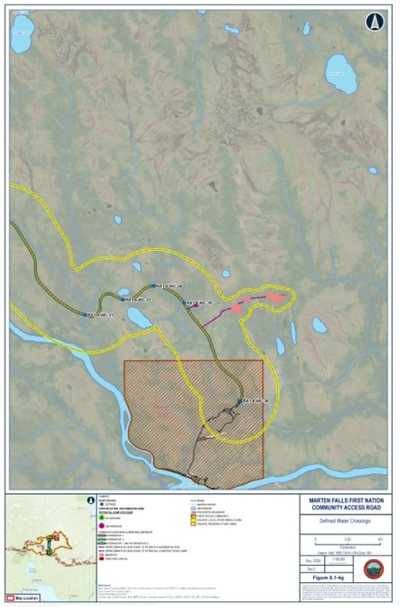
Source: Marten Falls Community Access Road Project, Environmental Assessment Report/Impact Statement, Figure 8.1-4g
Figure 4 - Text version
Map showing Marten Falls First Nation reserve boundary intersected with the Marten Falls Community Access road Project
2.3.1 Assessment of effects
2.3.1.1 Atmospheric environment
The project would result in changes to the atmospheric environment, including changes to air quality as well as increased noise and vibration on the Marten Falls First Nation reserve, largely due to particulate emissions generated from fugitive road dust during project construction and the operation of the road from vehicular traffic. Limited, short-term degradation of air quality may also occur during the construction phase due to road construction activities.
Predicted exceedances of air quality criteria may occur adjacent to the project; however, they are not expected to degrade air quality for sensitive receptors on federal lands or result in adverse health or environmental effects. Air quality modelling conducted by the proponent predicts localized exceedances of Ontario Ambient Air Quality Criteria (AAQCs) for particulate matter 10 (PM 10) and total suspended particulates (TSP) on or near the right-of-way under conservative, worst-case assumptions including maximum traffic volumes and elevated background concentrations. The exceedances would be primarily associated with fugitive dust emissions from vehicular movement on unpaved road surfaces and are predicted to occur within a limited distance from the road (approximately one kilometre or less) and away from known human receptor locations such as residences and sites where people regularly use the land.
To mitigate effects from air emissions, the proponent proposed to implement emissions management plans during construction and operations, which would include the use of environmentally friendly dust suppressants, and would consider additional measures, such as roadside vegetation, natural windbreaks, and speed limits. In addition, the recommended mitigation and follow-up program measures described to address change in quality of fishing experience in Section 4.3.1 would also mitigate the effects on air quality, as well as elevated noise levels during project construction and maintenance activities.
IAAC is of the view that, with the implementation of these mitigation measures, the project is likely to result in residual adverse changes to the atmospheric environment on federal lands that are localized, temporary and not expected to exceed relevant air quality thresholds at locations where people are known to reside or regularly use the land for extended periods, and elevated noise levels would be appropriately managed by meeting relevant noise guidelines.
2.3.1.2 Loss and degradation of species at risk and eastern migratory caribou habitat
IAAC focused its assessment on the following federal species at risk: little brown myotis (Endangered), northern myotis (Endangered), wolverine (Special Concern), rusty blackbird (Special Concern), short-eared owl (Special Concern), woodland caribou (boreal population, Threatened), transverse lady beetle (Special Concern). Woodland caribou (eastern migratory population) was also considered (assessed as Endangered by the Committee on the Status of Endangered Wildlife in Canada [COSEWIC]). The project intersects potential habitat on the Marten Falls First Nation reserve for these species. IAAC considers potential adverse effects to other species at risk, such as gypsy cuckoo bumble bee, nine-spotted lady beetle, and yellow-banded bumble bee, are unlikely as it is not aware of any information indicating their presence in the study areas.
LSA for wolverine and caribou includes the CDA and extends ten kilometres on either side of the CDA (Figure 6 in this IA Report). The LSA for little brown myotis, northern myotis, rusty blackbird, short-eared owl and transverse lady beetle includes the CDA and extends 3 kilometres on either side of it.
The project would result in the loss or degradation of species at risk and eastern migratory caribou habitat on federal lands. Direct loss of habitat for bats, wolverine, rusty blackbird, short-eared owl, transverse lady beetle and caribou from site preparation would include the removal of vegetation from the Marten Falls Nation reserve to clear land for the road. Regular maintenance activities during the operation phase would involve managing regrowth of vegetation in the CDA on federal lands. This could result in the destruction, degradation, and/or fragmentation of important habitat such as nests, roosts, dens, calving areas, winter areas, and travel areas, as well as the displacement of individuals from these habitats.
Effects on these species also include sensory disturbances during construction and operation from activities including earth hauling, vegetation clearing, construction lighting and vehicles travelling on the road. Sensory disturbances may lead to functional fragmentation of federal species at risk habitat as species alter their movements and behaviour to reduce their utilization of the area and to avoid human disturbance. In addition, the operation of the road may create a linear barrier to movement of species at risk on the Marten Falls First Nation reserve, especially caribou and wolverine. These effects are likely to result in changes to the distribution of species at risk on the Marten Falls First Nation reserve.
Effects and associated mitigation measures for wolverine and caribou are further described in the Hunting and Trapping subsection of Section 4.3.1. Effects on rusty blackbird and short-eared owl would be similar to effects on migratory birds described in Section 2.2 and the mitigation measures for migratory birds would be appropriate to mitigate effects on these species. To mitigate effects to species at risk bats and transverse lady beetle, the proponent committed to, where possible, minimize vegetation clearing, implement reclamation of temporary areas of disturbance, buffer areas to minimize impacts to potential roosting areas and waterbodies, project personnel wildlife awareness training and conduct maintenance activities outside of sensitive timing windows.
IAAC understands that authorizations under SARA for activities occurring on federal land that affect the individuals or residences of species listed under SARA as Threatened or Endangered would apply to the project. This legislative mechanism would manage effects to Threatened and Endangered federal species at risk individuals and residences, apart from effects stemming from broader habitat degradation and loss, including adverse changes to caribou critical habitat, and would ensure implementation of mitigation measures as well as the identification of further mitigation measures for site-specific concerns during the permitting stage.
IAAC is of the view that, with the implementation of these mitigation measures, there would be loss and degradation of species at risk and eastern migratory caribou habitat on federal lands, notably through fragmentation of wolverine and caribou habitat.
2.3.1.3 Injury or death of species at risk and eastern migratory caribou
The project may result in the injury or death of the above listed federal species at risk and eastern migratory caribou individuals on Marten Falls First Nation reserve. During construction and operation, collision with vehicles and equipment, changes to predator-prey dynamics through the creation of linear corridors, alteration of movement, vegetation clearing, and increased access by humans could increase federal species at risk injury or mortality rates. Aerial species are susceptible to vehicular collisions during project operation, while collision risks are lower for caribou and wolverine as they generally avoid areas with anthropogenic disturbance.
To mitigate effects from injury or death, the proponent committed to follow best practices where possible, including implementing speed limits which are effective to prevent vehicular collisions (see recommended mitigation measures in Section 4.3.3 of this IA Report).
IAAC is of the view that, with the implementation of these mitigation measures, the project is likely to result in limited and infrequent injury or death of species at risk and eastern migratory caribou.
2.3.2 Residual effects
Based on the above assessment, IAAC is of the view that the project would likely result in residual adverse effects from physical activities carried out on federal lands resulting from changes to the atmospheric environment, degradation and loss of species at risk and eastern migratory caribou habitat and injury or death to species at risk and eastern migratory caribou.
The residual effects, taking into account the mitigation measures described above, would be low in magnitude and geographic extent limited to LSA. The effects would generally occur infrequently, but indefinitely throughout the life of the project, with effects being partially reversible by the operation phase. There is a low to moderate level of uncertainty specific to species at risk on the federal lands portion of the project. Even while acknowledging this uncertainty, populations are expected to remain sustainable and air contaminant and noise levels are expected to remain below applicable guidelines at locations where people are known to reside or regularly use the land.
IAAC concludes that the adverse residual effects of physical activities carried out on federal lands are not likely to be significant.
2.3.3 Cumulative effects
IAAC considered the proponent's Draft Community-Based Land Use Plan and other foreseeable projects in the area, and is of the view that there are no foreseeable physical activities with expected effects on federal lands that would interact with the residual effects of the project on the atmospheric environment, species at risk, and eastern migratory caribou likely to occur on the Marten Falls First Nation reserve.
Known projects outside federal lands are not anticipated to result in measurable effects on the atmospheric environment within the Marten Falls First Nation reserve due to spatial separation. The residual adverse effects of the project on Marten Falls First Nation reserve land in combination with other past, present, and reasonably foreseeable projects, are likely to have cumulative effects primarily through loss or degradation of species at risk and eastern migratory caribou habitat. The proposed Webequie Supply Road Project, the proposed Northern Road Link Project, and the proposed Anaconda and Painter Lake Roads Upgrades Project, the proposed Rapid Lynx Broadband Project, and mineral exploration followed by mining at the proposed Eagle's Nest site have the potential to interact with the residual adverse effects from the project, in relation to habitat loss and degradation (including fragmentation), through clearing and grubbing activities, sensory disturbances from construction equipment and increased traffic.
Although federal and provincial legislative frameworks would apply to manage the effects of the projects on species at risk, effects from the other projects are likely to be additive with the residual effects from the proposed project. These cumulative effects would be low in magnitude, primarily through caribou and wolverine habitat loss and degradation and, to a lesser extent, habitat changes for little brown myotis, northern myotis, rusty blackbird, short-eared owl, and transverse lady beetle. ECCC noted that cumulative effects to caribou and caribou habitat may be significant despite mitigation, and MECP, noted that, although cumulative disturbance within the Missisa Range would increase, overall disturbance is expected to remain below the 35% threshold identified in the federal recovery strategy.
IAAC concludes that cumulative effects resulting from physical activities carried out on federal lands in combination with other projects are likely to be not significant for changes to atmospheric environment and species at risk, except for caribou and wolverine, which are likely to be significant to a low extent due to changes in habitat availability and function that would result from the project and other foreseeable projects, together, altering movement patterns and habitat availability, including within the Marten Falls First Nation reserve.
2.3.4 IAAC's recommended mitigation measures for implementation by the proponent pertaining to effects from physical activities carried out on federal lands.
Recommended mitigation measures that would potentially be included as conditions in the impact assessment decision statement include:
With respect to the atmospheric environment on federal lands:
- Implement, at a minimum, the following mitigation measures to control fugitive dust emissions from the project, as appropriate:
- use water or an environmentally acceptable alternative to stabilize the surface of project roads and areas that may generate dust.
With respect to bats, specifically little brown myotis and northern myotis:
- follow recommended timing windows by avoiding construction and maintenance activities, during the period of May 1 to August 31; establish and delineate, under the direction of qualified individuals, a vegetation setback of 120 metres for construction and maintenance activities from any maternity roosting habitat identified; ensure project employees and contractors are trained to identify potential maternity roosting habitat and be aware of protocols to follow should any be found including:
- cease work and document the feature; notify Marten Falls First Nation, ECCC and IAAC; and ensure the established setback, including the identified maternity roosting habitat, remains in place until ECCC approves SARA permit.
With respect to bird species at risk:
- Do not undertake activity associated with the project that could harm the nesting of birds that are species at risk on the Marten Falls First Nation reserve, to avoid the destruction of nests, eggs or nestlings. In doing so:
- determine the dates of relevant nesting periods for any year during which these activities are carried out. Inform IAAC of these dates, including a justification, before carrying out these activities.
- Do not undertake or continue any activity likely to harm nesting unless this is not technically or economically feasible. If it is not feasible, provide a justification to IAAC and develop and implement additional mitigation measures to avoid adverse effects on birds that are species at risk during nesting. Provide these measures to IAAC before implementing them.
Refer to measures for sensory disturbances (reduced air quality and elevated noise levels) as well as measures for monitoring wildlife species in Section 4.3.1 and Section 4.3.3 of this IA Report.
3 Malfunctions and accidents
Although unlikely to occur, certain malfunctions and accidents associated with the project could cause residual adverse federal effects. For example, an accidental fire or explosion or a structural failure of a project component, such as the road surface, bridge or culvert, may impact fish and fish habitat, migratory birds, as well as traditional practices and community well-being of Indigenous communities. Recommended mitigation measures to prevent potential malfunctions and accidents are listed in Section 3.1.1.
3.1 Assessment of effects
Malfunctions and accidents may be associated with the project. Likely scenarios are vehicle accidents or mechanical malfunctions, including any resulting accidental spills of hazardous material. These and their associated adverse federal effects are described in Sections 2.1, 2.2, and 4.3.1 to 4.3.3. Adverse federal effects of unlikely malfunction and accident scenarios are described below.
Although unlikely to occur, a structural failure of a project component or accidental fires or explosions associated with project components could result in adverse effects to migratory birds, wildlife important to Indigenous traditional practices, and community well-being.
A structural failure of a project component (e.g., road surface failure, bridge failure, culvert failure or a storage facility accident) due to faulty design, extreme weather, seismic activity or wildfire event could lead to increased erosion or sedimentation, changes to hydrology and hydraulics, and the potential for debris or materials to enter nearby waterbodies, which could adversely affect fish and fish habitat, alter traditional fishing by Indigenous persons that practice in the area and impact the cultural experience of Indigenous communities that maintain a connection to the land or have cultural sites in the area.
The likelihood of a structural failure of a project component may be influenced by changing environmental conditions over the lifespan of the project. Climate change is expected to increase the frequency and intensity of extreme weather events in the region, including heavy precipitation, flooding, freeze-thaw cycles, and wildfire conditions. These stressors can place additional demands on project infrastructure and increase the potential for malfunctions or accidents, such as erosion, overtopping, or structural failure of highway infrastructure.
To prevent structural failures, the project components would be designed in accordance with applicable federal and provincial standards and codes such as the Canadian Highway Bridge Design Code CSA S6:25, Ontario's Roadside Design Manual and Structural Manual, Drainage Management Manual, Highway Drainage Design Standards, and Gravity Pipe Design Guidelines. To manage climate-related stressors, the proponent would design project infrastructure to meet applicable codes and standards that address wildfires, and extreme weather events. This would include designing highway drainage infrastructure such as bridges, culverts, roadside ditches, and equalization culverts for the floating road portion, using best practices and engineering guidance. Designs would be based on historical climate data, incorporating effects from temperature, as well as future climate scenarios, including future changes in extreme rainfall over the expected lifespan of the structures. Additionally, the proponent committed to conduct routine inspection and maintenance of the road during the operation phase in accordance with applicable provincial standards for highway infrastructure, with repairs undertaken as required, to maintain structural integrity of project components. The proponent also indicated that storage facilities, particularly fuel storage areas, would have aboveground storage tanks with secondary containment and that fuel and other hazardous materials would be managed in accordance with the Canadian Council of Ministers of the Environment's Environmental Code of Practice for Aboveground Storage Tank Systems Containing Petroleum Products to minimize the likelihood of a storage breach.
Accidental fires or explosions associated with project components (e.g., equipment, fuel storage, maintenance activities, or camps) could result in localized harm or death of migratory birds and other wildlife, or temporary displacement of the wildlife due to smoke, noise, or habitat disturbance. Fires and explosions could reduce habitat quality in surrounding areas used for traditional purposes, as well as increase safety risks and cause disruption to harvesting activities or travel, which may contribute to stress and add emotional distress.
Ontario has legislative and regulatory requirements related to fire prevention, fire safety, and emergency preparedness — including requirements related to wildland fire prevention, fire safety planning and suppression equipment at camps and facilities, and fuel storage and handling — which are intended to reduce fire risk and support effective response.
Fire prevention and preparedness plan and a fire mitigation program and following the Ontario Regulation 207/96 would be implemented during construction and maintenance. IAAC recommends that the proponent's fire prevention and preparedness measures, include safe fuel handling and storage practices, regular maintenance of equipment to reduce ignition risks, and clear emergency response procedures; appropriate firefighting equipment at project sites; and trained staff capable of responding quickly and effectively to limit the spread of fire and minimize effects on wildlife and Indigenous communities.
3.1.1 IAAC's recommended mitigation measures for implementation by the proponent pertaining to malfunctions and accidents
Recommended mitigation measures that would potentially be included as conditions in the impact assessment decision statement:
Develop, prior to construction, and maintain, during construction, an accidents and malfunctions response plan including:
- a description of potential accidents and malfunctions that may cause adverse federal effects, including both worst-case and more likely alternate scenarios; measures for each scenario aligned with ECCC's National Wildlife Emergency Response Framework; and clearly defined roles and responsibilities for the proponent, relevant authorities and other parties involved in response efforts.
In the event of an accident or malfunction during construction:
- notify relevant emergency response authorities; inform Indigenous communities as soon as feasible, and IAAC within 48 hours, while providing:
- the date, time, and location of the accident or malfunction;
- a summary of the accident or malfunction;
- the substance and quantities released; and
- the relevant authorities notified and involved in the response; and
- submit a report to IAAC within 60 days, describing:
- the incident and its adverse federal effects;
- measures taken to mitigate the adverse federal effects;
- feedback from Indigenous communities and relevant authorities;
- residual effects and any additional mitigation or monitoring measures; and steps taken to prevent recurrence.
Implement the following mitigation measures to prevent structural failure of project components:
- undertake routine inspections of project component/roadway infrastructure, including bridges, culverts, road embankments, and upstream/downstream riverbanks, and complete repairs where required;
- design project infrastructure to meet applicable codes and standards that address seismic activity, wildfires, and extreme weather events; and
- design roadway drainage infrastructure such as bridges and culverts based on historical climate data with temperature incorporation and projected future changes in extreme rainfall over the lifespan/design service life of the structures.
Develop and implement an Emergency Response Management Plan to prevent and address accidents and malfunction scenarios that may result in adverse federal effects and that includes, at minimum:
- coordinated procedures for evacuation, communication, and emergency response for accident and malfunction scenarios.
Refer to measures for erosion protection and sediment control in Section 2.1.4.1 of this IA Report.
4 Impacts on Indigenous Peoples and their rights
Indigenous Peoples have a deep connection to their lands, territories, and resources, and an important constitutional relationship with the Crown (i.e. the federal and provincial governments acting on behalf of the Crown), making their participation essential to decision-making on the impacts of major projects. Impact assessments must evaluate the potential impact of a project on Indigenous Peoples and their rights. The government must assess the extent to which consultation and engagement with Indigenous communities has been carried out meaningfully, in keeping with Canada's commitment to implement the United Nations Declaration on the Rights of Indigenous Peoples. Recognizing the interconnected nature of these considerations, and in the spirit of respectful and meaningful consultation and engagement, IAAC presents this information in a dedicated, integrated section.
4.1 Consultation and engagement
IAAC is responsible for leading Crown consultation and engagement with Indigenous Peoples for the Government of Canada throughout the impact assessment. Both IAAC and the proponent maintain bilateral relationships with Indigenous communities throughout the impact assessment, with IAAC ensuring that consultation and engagement are tracked, and responsive to the issues and interests raised. For the purposes of this project, IAAC coordinated with the Government of Ontario to align consultation and engagement periods.
4.1.1 IAAC-led consultation and engagement
The federal Crown's consultation objectives are to meet the duty to consult, uphold the Honour of the Crown, and support long term relationships grounded in shared reconciliation goals. The scope of this duty depends on the specific context and facts before decision makers, and its implementation is guided by government policy, best practices, and evolving jurisprudence. In fulfilling this duty, the Crown seeks:
- to demonstrate meaningful efforts to understand Indigenous concerns and potential impacts;
- to provide opportunities, proportionate to the level of potential impacts on rights, for Indigenous communities to learn about the project, assess its implications, and communicate their views;
- to accurately understand and respond to issues raised, including through mitigation and accommodation, where appropriate; and
- to maintain a flexible, accessible, reasonable, and fair process grounded in good faith, respect, and recognition of the uniqueness of each Indigenous community.
IAAC consulted and engaged with potentially impacted Indigenous communities as part of a whole-of-government approach, involving federal authorities where appropriate. IAAC sought to reach a consensus with Indigenous communities on the approach to the assessment of the effects and impacts on Indigenous rights.
Indigenous communities that were invited to participate in consultation include those with the potential for adverse impacts on potential or established Aboriginal or treaty rights (section 35 rights). IAAC identified the Indigenous communities whose section 35 rights may be impacted by the project:
- Animbiigoo Zaagi'igan Anishinaabek
- Aroland First Nation
- Attawapiskat First Nation
- Constance Lake First Nation
- Eabametoong First Nation
- Fort Albany First Nation
- Ginoogaming First Nation
- Kashechewan First Nation
- Kitchenuhmaykoosib Inninuwug
- Long Lake #58 First Nation
- Marten Falls First Nation
- Mishkeegogamang Ojibway Nation
- Neskantaga First Nation
- Nibinamik First Nation
- Webequie First Nation
- Weenusk First Nation
In addition, IAAC engaged with the Métis Nation of Ontario (Region 2) based on their interest in the project. Mishkeegogamang Ojibway First Nation and the Métis Nation of Ontario (Region 2) did not participate actively in consultation with IAAC on the project; however, IAAC notified these two communities of all major milestones and opportunities to participate in the impact assessment process.
Figure 5 shows the approximate locations of the abovementioned Indigenous communities in relation to the proposed project.
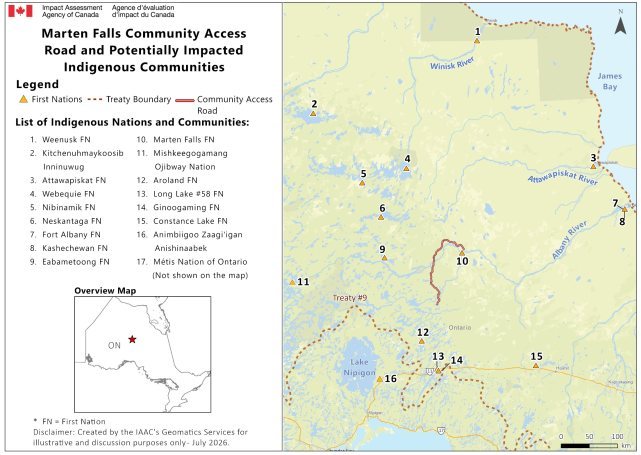
Source: IAAC
Figure 5 - Text version
The map shows, at the scale of the Ring of Fire region in Ontario, the locations of seventeen potentially affected Indigenous communities, with the project footprint depicted near the center.
Throughout the IA process, starting in 2019, IAAC maintained ongoing dialogue with potentially impacted Indigenous communities and kept them informed of process steps and timelines. IAAC supported participation by offering plain-language updates, providing funding through the Participant Funding Program, and sharing information to support community review and input. IAAC also adapted consultation approaches, including meeting formats and locations where feasible, to reflect the preferences of individual Indigenous communities. Input received from Indigenous communities, including Indigenous Knowledge where provided, informed the assessment of effects, the consideration of impacts on the exercise of section 35 rights, and the development of this IA Report.
IAAC instructed the proponent in the TISG to provide clear impact assessment information and project maps, work with Indigenous communities to gather and incorporate Indigenous Knowledge and offer participation in technical discussions. Indigenous communities identified potential impacts on their rights and on environmental, health, social and economic conditions, provided Indigenous Knowledge, and offered input to inform the Impact Statement. IAAC also created opportunities for Indigenous communities to learn about the project and the IA process, raise concerns about potential effects within federal jurisdiction and potential impacts on the exercise of section 35 rights, and discuss possible mitigation and accommodation measures, where appropriate. IAAC sent written information, organized in-person and virtual meetings. Comments and perspectives of Indigenous communities, including Indigenous Knowledge where provided, informed the identification of valued components, the assessment of potential effects and pathways of effects, and conclusions about the significance of these effects. Comments, perspectives, and Indigenous Knowledge provided by Indigenous communities also informed the Crown's understanding of potential adverse impacts on the exercise of section 35 rights and the effectiveness of proposed measures to avoid or minimize impacts on community rights and interests.
Throughout the IA process, IAAC also held meetings with sixteen Indigenous communities. Recognizing the remote status of most potentially impacted Indigenous communities and the preferences of many communities for in-person meetings, IAAC strove to meet with Indigenous communities in-community upon their request, whenever possible. IAAC held 70 meetings with Indigenous communities throughout the IA process, 20 of which took place in-person. Detailed engagement activities are described below.
4.1.1.1 Planning phase
Proponent's Initial Project Description
On May 31, 2019, IAAC informed potentially impacted Indigenous communities of an upcoming public comment period for the proposed project and its potential environmental effects. In its preliminary list, IAAC identified fourteen potentially impacted Indigenous communities for consultation for the project: Animbiigoo Zaagi'igan Anishinaabek, Aroland First Nation, Attawapiskat First Nation, Constance Lake First Nation, Eabametoong First Nation, Fort Albany First Nation, Ginoogaming First Nation, Kashechewan First Nation, Long Lake #58 First Nation, Marten Falls First Nation, Mishkeegogamang Ojibway Nation, Neskantaga First Nation, Nibinamik First Nation, and Webequie First Nation.
The proponent submitted the Initial Project Description (IPD) and its summary on July 29, 2019. IAAC informed the potentially impacted communities of the commencement of the comment period, held from September 11, 2019, to October 1, 2019, and invited them to provide comments on the summary of the proponent's IPD. IAAC also provided opportunities to discuss the project and held in-person meetings with Attawapiskat First Nation on August 13, 2019, and had virtual meetings with Animbiigoo Zaagi'igan Anishinaabek on September 26, 2019, and Fort Albany First Nation on September 27, 2019.
IAAC received eight submissions with formal comments on the IPD from Animbiigoo Zaagi'igan Anishinaabek, Aroland First Nation, Attawapiskat First Nation, Fort Albany First Nation, Marten Falls First Nation, Neskantaga First Nation, Nibinamik First Nation, and Webequie First Nation.
In November 2019, IAAC held an open house in Thunder Bay where Indigenous communities' representatives received a presentation from IAAC and were provided opportunities to ask follow-up questions. During the open house, IAAC discussed and met with Aroland First Nation, Eabametoong First Nation, Long Lake #58 First Nation, and Neskantaga First Nation. Also in November 2019, IAAC conducted in-community meetings with Fort Albany First Nation, Marten Falls First Nation, and Webequie First Nation, to discuss the project.
On November 25, 2019, IAAC reached out to Kitchenuhmaykoosib Inninuwug, inviting them to express interest in consultation regarding the project and its potential effects. Following this outreach, Kitchenuhmaykoosib Inninuwug was included in IAAC's draft IEPP.
IAAC's Planning Phase Documents
On November 29, 2019, IAAC determined that an impact assessment was required for the project, and sent letters on December 2, 2019, to notify potentially impacted Indigenous communities of this determination, provide the draft planning documents, and inform the communities about the upcoming steps.
On December 19, 2019, IAAC launched the public comment period (held from December 19, 2019, to January 28, 2020) and invited Indigenous communities to review and provide comments on the draft TISG and draft IEPP. At the outset of the comment period, IAAC shared with each Indigenous community a summary of comments received to date alongside IAAC's responses, outlined upcoming impact assessment process steps and invited them to meet with IAAC.
The draft IEPP summarized the objectives of Indigenous engagement and partnership, named the Indigenous communities identified by IAAC for Crown consultation as well as the communities that have expressed an interest in engaging on the project, described the methods and tools that IAAC would use to support engagement, described the phases of the impact assessment and opportunities for engagement during each phase, and defined the roles and responsibilities of federal authorities responsible for permits or authorizations in relation to the project.
IAAC received six submissions on the draft TISG and draft IEPP between the end of January and the beginning of February 2020, namely from Aroland First Nation, Attawapiskat First Nation, Eabametoong First Nation, Fort Albany First Nation, Long Lake #58 First Nation, and Neskantaga First Nation. During this period, IAAC attended in-community meetings with Animbiigoo Zaagi'igan Anishinaabek, Aroland First Nation, Ginoogaming First Nation and Nibinamik First Nation, and met with Eabametoong First Nation in Thunder Bay. IAAC also had virtual meetings with Constance Lake First Nation, Fort Albany, Kitchenuhmaykoosib Inninuwug, Kashechewan First Nation, Long Lake #58 First Nation, Marten Falls First Nation, Neskantaga First Nation, and Webequie First Nation.
4.1.1.2 Impact Statement phase
Commencement of Impact Statement phase
On February 24, 2020, IAAC notified potentially impacted Indigenous communities about the commencement of the impact assessment for the project and shared with each community:
- A summary of comments received between December 19, 2019, and February 24, 2020, alongside IAAC's responses, documenting how these comments had informed of changes to the TISG and IEPP;
- A community-specific summary of IAAC's understanding of each Indigenous community's exercise of rights and potential impacts of the project on those rights;
- The final TISG and the IEPP documents issued to the proponent; and
- A letter identifying next steps in the impact assessment process, opportunities and guidance for participation, and inviting Indigenous communities to meet with IAAC to discuss any questions or concerns about the process.
On March 13, 2020, IAAC followed up with potentially impacted Indigenous communities to request any additional information that would contribute to IAAC's understanding of each community's Aboriginal and Treaty rights and the project's potential adverse effects on the exercise of those rights. IAAC also sought confirmation of any consultation methods or activities not already included in the IEPP.
On September 16, 2020, IAAC sent an advance notice of the participant funding application period for the project to potentially impacted Indigenous communities followed by an invitation on October 19, 2020, to apply for this funding alongside information on next steps in the impact assessment process.
In January 2021, Weenusk First Nation expressed interest in the project. Following a meeting with Weenusk First Nation and follow-up correspondences, IAAC notified all Indigenous communities on August 6, 2021, of the amendment to the IEPP to include Weenusk First Nation in the project, effective April 30, 2021.
Collaborative assessment of impacts on Rights exercise
On November 29, 2021, IAAC invited potentially impacted Indigenous communities to participate in a collaborative assessment of impacts on Aboriginal and Treaty rights covering the three proposed Ring of Fire area road projects, namely the Webequie Supply Road, the Northern Road Link, and the Marten Falls Community Access Road projects The purpose of this exercise was to work with Indigenous communities to identify and understand the nature and context of the rights they exercise, determine the importance of specific areas and locations that may be affected by the projects, and assess how project-related changes could impact the conditions that support the exercise of those rights.
To support this process, for each Indigenous community, IAAC prepared a table summarizing the concerns previously shared by the community regarding how the projects could impact the exercise of rights and invited the community to validate the information and document any concerns that were not reflected in the table.
As part of the exercise, IAAC also prepared an accompanying worksheet, maps and an instructional handout. The worksheet was designed to function as a tracking tool, to be used throughout the impact assessment, allowing each community and IAAC to document information, concerns, and comments regarding potential impacts on rights. IAAC invited each Indigenous community to provide location-specific information that would assist IAAC in deepening its understanding of potential impacts from the proposed projects.
IAAC held two virtual information sessions, on December 7 and 15, 2021, to inform Indigenous communities about the structure and purpose of the exercise, to support their participation, and to respond to questions. IAAC encouraged each potentially impacted community to review the materials and update the worksheet in advance of future discussions. In February, 2022, IAAC followed up with Indigenous communities by phone and by email to offer virtual meetings to discuss and support their participation in the collaborative assessment of impacts on rights exercise.
On October 19, 2022, IAAC prepared and shared a summary table of comments received from Indigenous communities during the Impact Statement phase, along with IAAC's responses to all comments submitted between February 25, 2020, and August 31, 2022.
Extension request from the proponent and engagement on Ring of Fire area road projects
On November 2, 2022, IAAC notified all Indigenous communities of proponent's intention to request an extension of five months to the Impact Statement phase, extending the time limit from February 24, 2023, to July 24, 2023. Once the request was received, IAAC followed up on November 9, 2022, inviting Indigenous communities to provide comments on this extension request by December 9, 2022, to help inform IAAC's consideration to the request.
IAAC collected comments from Indigenous communities and other assessment participants on the extension request and compiled them into a summary table that was shared with all Indigenous communities. On January 13, 2023, IAAC notified all Indigenous communities that the extension had been granted to the proponent due to project delays associated with the COVID-19 pandemic, forest fires, adverse weather conditions, and overall project progress.
On January 24, 2023, IAAC informed and invited Indigenous communities to attend Ontario's Aboriginal and Treaty Rights and Interest Forum held in Thunder Bay, on February 8 and 9, 2023, and from November 21 to 23, 2023, providing an opportunity for IAAC to connect with the attending Indigenous communities and discuss the three proposed road projects and their potential impacts on Aboriginal and Treaty rights.
On March 13, 2024, IAAC met virtually with Métis Nation of Ontario to discuss concerns on the approach to archaeological work in the assessment area and confirmed they are not asserting section 35 rights in the project area. IAAC included the Métis Nation of Ontario in the engagement list, provided them with funding to support their participation, and continued to notify them during the remainder of the impact assessment process.
On February 25 and 26, 2025, IAAC attended the Three Road Project Gathering that was co-hosted by the Ontario Ministry of Energy and Mines and the proponents for the three Ring of Fire area road projects. During this forum, IAAC took the opportunity to connect with attending Indigenous communities to discuss their concerns about the three proposed road projects.
Draft Impact Statement
The proponent first shared a draft Impact Statement with Indigenous communities for review on February 18, 2025, followed by the launch of the proponent's public review period on April 22, 2025. Prior to this, IAAC followed up with Attawapiskat First Nation to discuss their concerns and questions regarding this upcoming draft release.
On June 11, 2025, IAAC sent a letter to the proponent to inform that, in light of the amendments to the IAA, IAAC would concentrate next steps in the Impact Statement phase on key issues relevant to federal decision making, specifically adverse effects within federal jurisdiction and the positive effects of the project, and would leverage federal mechanisms outside of the IAA, as well as provincial legislative frameworks and instruments, to address the key issues. IAAC also posted this letter.
The proponent shared with IAAC all comments from Indigenous communities regarding the draft Impact Statement. Some Indigenous communities also shared comments on the draft Impact Statement directly with IAAC. IAAC provided responses to the comments either directly to the communities or in the tables in Annex D of this IA Report. Several potentially impacted Indigenous communities submitted comments on the draft Impact Statement. The proponent reviewed submissions from Indigenous communities and responded to matters within its responsibility and referred other comments to IAAC and MECP. In response, on May 7, 2026, IAAC provided written responses to comments on the proponent's draft Impact Statement directly to Animbiigoo Zaagi'igan Anishinaabek, Constance Lake First Nation, Ginoogaming First Nation and Nibinamik First Nation. In its responses, IAAC also invited further discussion.
Between sharing the draft Impact Statement on February 18, 2025, and the submission of the final Impact Statement on February 20, 2026, IAAC offered to set up meetings with Indigenous communities to provide an overview of IAAC's preliminary analysis of adverse federal effects that would result from the project. IAAC engaged the potentially impacted Indigenous communities to validate the information available and sought input to augment IAAC's understanding of the effects on Indigenous Peoples and inform the assessment of impacts on their rights. On August 21, 2025, IAAC followed up with potentially impacted Indigenous communities on the letter sent on July 31, 2025, by IAAC Vice-President of Indigenous Relations to each community, inviting them to engage with IAAC and discuss potential impacts of the projects on the community's rights and interests, offering funding to support their participation, and seeking a meeting to continue consultation.
During this period, IAAC met virtually with Attawapiskat First Nation on August 7, 2025; Constance Lake First Nation on August 21, 2025, and on December 11, 2025; Fort Albany First Nation on September 9, 2025, and on February 3, 2026; Ginoogaming First Nation on December 4, 2025; Long Lake #58 First Nation on October 10, 2025; Métis Nation of Ontario on December 4, 2025; Neskantaga First Nation on December 2, 2025; and Weenusk First Nation on September 15, 2025.
IAAC held an in-community meeting with Webequie First Nation and Indigenous Services Canada (ISC) on September 23, 2025, and met with Nibinamik First Nation and ISC in Thunder Bay on September 24, 2025. IAAC met with Nibinamik First Nation again on December 11, 2025, in Thunder Bay, with some virtual attendees. IAAC met with Eabametoong First Nation in Toronto on November 21, 2025, as well as in-community on January 29, 2026.
Proponent's updated timeline and accelerated decision-making
On November 27, 2025, the Government of Ontario announced the signature of a Community Partnership Agreement of $39.5 million with Marten Falls First Nation to accelerate the project, including the assessment process, aiming to begin road construction as early as August 2026, pending approvals and consultations. Prior to this announcement, on November 24, 2025, IAAC had sent a letter to MECP, to confirm that federal assessments for the proposed Ring of Fire area road projects could be completed before the June 2026 provincial timeline for early works, provided that the information requested from the province, and the final Impact Statements from the proponents, are submitted without delay. The letter also confirmed that IAAC is prepared to support the proponents in submitting the Impact Statements without delay. On November 27, 2025, IAAC notified Indigenous communities of this updated timeline for the Ring of Fire area projects and offered to meet to discuss next steps, timelines, and any questions regarding the federal impact assessment process.
On February 9, 2026, to support meaningful engagement and prepare for the impact assessment phase, IAAC provided each potentially impacted Indigenous community with an updated community-specific summary of IAAC's understanding of the potential impacts of the project on the community. These summaries reflected information contained in the proponent's draft Impact Statement, as well as information shared by communities through previous correspondence and meetings with each community throughout the assessment process. IAAC invited communities to review and validate the information in these summaries and provide comments by March 2, 2026. IAAC also offered to meet to discuss these summaries, next steps and timeline for the federal impact assessment process. The summaries were used to inform the impacts on rights assessments in the IA Report.
Final Impact Statement
The proponent submitted the final Impact Statement on February 20, 2026. IAAC notified all potentially impacted Indigenous communities on March 3, 2026, and invited them to provide comments on the project's adverse federal effects and positive effects. IAAC also organized and invited Indigenous communities to two virtual public information sessions held on March 9 and 12, 2026, where it presented an overview of the impact assessment process and its preliminary analysis of potential adverse federal effects. IAAC offered to host community-specific information sessions upon request as well.
4.1.1.3 Impact assessment phase
On June 2, 2026, IAAC shared the draft IA Report and potential conditions with potentially impacted Indigenous communities for review and comment by July 6, 2026. Through its letter, IAAC also outlined the next steps in the impact assessment process, and offered to meet with all potentially impacted Indigenous communities during the comment period to discuss the draft IA Report and potential conditions.
IAAC met with Eabametoong First Nation on July 14, 2026, and with Animbiigoo Zaagi'igan Anishinaabek on July 17, 2026, to discuss the community's submissions on the draft IA Report and potential conditions.
4.1.1.4 Participant funding
Throughout the impact assessment process, IAAC supported Indigenous participation and consultation activities through its Participant Funding Program. A total of $1,174,000.51 in participant funding grants and contributions were provided to potentially impacted Indigenous communities to support participation in the impact assessment process for this project. Further, since 2019, a total of approximately $9.8M in Indigenous Capacity Support Funding has been allocated to Animbiigoo Zaagi'igan Anishinaabek, Aroland First Nation, Attawapiskat First Nation, Constance Lake First Nation, Eabametoong First Nation, Fort Albany First Nation, Ginoogaming First Nation, Long Lake #58 First Nation, Marten Falls First Nation, Métis Nation of Ontario, Neskantaga First Nation, Nibinamik First Nation, Webequie First Nation to support meaningful engagement and leadership of Indigenous Peoples in consultations on assessments, including building organizational capacity, and documenting Indigenous Knowledge and land use.
4.1.2 Proponent-led engagement
The proponent engaged with Indigenous communities to support IAAC's assessment of effects and impacts on rights. The proponent's engagement does not replace or substitute Crown consultation but does provide important information to support the Crown's informed understanding of potential impacts and appropriate responses.
Beginning in January 2019, the proponent engaged all seventeen potentially impacted Indigenous communities identified by IAAC to discuss their practice of section 35 rights, use of lands and resources, and the potential effects of the project.
In November 2022, Marten Falls First Nation requested a time limit extension to submit their Impact Statement, citing delays due to the COVID 19 pandemic, the 2021 forest fires, heavy snow conditions in 2021 and 2022, and the time required to comply with provincial and federal assessment requirements. In January 2023, IAAC granted the proponent an additional three and a half years to submit the required information and studies, extending the time limit from February 24, 2023, to July 24, 2023.
The proponent provided financial support to communities to retain technical experts to review baseline studies, alternatives assessments, and other documents; to conduct traditional knowledge, traditional land and resource use studies, and socio-economic studies, as well as independent Indigenous-led assessments; and to hire professional and legal advisors and community support, where appropriate.
All potentially impacted Indigenous communities were engaged separately to gather their knowledge and expertise for inclusion in the proponent's Impact Statement. The engagement activities organized by the proponent included communications by email, letters, social media outreach, virtual and in-person meetings and working sessions, and the sharing of information and documents. The proponent's Record of Consultation and Engagement indicates that they complied with the requirements set out in Section 6 of the TISG, which pertains to engagement with Indigenous communities.
The engagement process during the proponent's preparation of the Impact Statement took place over five rounds:
- Round 1 (October 29, 2021, to June 30, 2022) Notice of Commencement of Environmental Assessment: provided information to determine Indigenous communities' level of interest in the project, interest among Indigenous communities to meet with the proponent, preferred methods for receiving information during the assessment process, and interest in developing community specific consultation and engagement plans.
- Round 2 (July 1, 2022, to May 31, 2023) Effects Assessment Methods: provided a summary of feedback on the consultation and engagement approach, planned and completed existing conditions field programs, the assessment process, study areas, project phases, criteria and indicators, environmental interactions, and net effects characteristics; requested information on Indigenous community values, potential effects, and impact management measures, including effects on Aboriginal or Treaty Rights; confirmed through early release of Progress Report 1 that previous input was captured appropriately; and shared cumulative effects information through an explainer video and newsletter.
- Round 3 (June 1, 2023, to July 31, 2024) Identification of Preferred and Alternatives: provided a summary of feedback on alternative routes, proposed mitigation measures, route selection categories and technical considerations, comparative analyses of potential net effects, and preliminary road design; requested information on cumulative effects methodology, potential follow up and monitoring measures, projects and activities that may act cumulatively with the project, opportunities for Indigenous community participation, and potential cumulative effects; and confirmed through early release of Progress Report 2 that previous input was captured appropriately.
- Round 4 (August 1, 2024, to September 5, 2025) Review of the Draft Environmental Assessment / Impact Statement: provided a summary of feedback on ongoing issues resolution, the Draft Environmental Assessment / Impact Statement, proposed impact management and follow up measures including monitoring and adaptive management, cumulative effects assessment results, and draft conclusions; and confirmed through early release of Progress Report 3, the Draft Record of Consultation and Engagement for Interested Persons, and the Draft Environmental Assessment / Impact Statement that previous input was captured appropriately.
- Round 5 (September 6, 2025, to February 20, 2026): provided confirmation through release of Progress Report 4 that previous input was captured appropriately.
The proponent provided a draft version of its Impact Statement to Indigenous communities for a 120-day review period from February 19, 2025, to June 23, 2025, and later extended until September 5, 2025, to accommodate extension requests from Indigenous communities and government regulators, for a total 198-day review period. During this review period, the proponent led specific engagement activities, including with respect to the project schedule and the content of the draft Impact Statement. Indigenous communities provided comments on the draft Impact Statement to the proponent. All comments and proponent responses to comments, were included in Appendix C of the final Impact Statement.
4.1.3 Indigenous Knowledge provided with respect to the project
IAAC collaborated with Indigenous Knowledge holders to ensure their Knowledge was respected and meaningfully incorporated into the impact assessment and this IA Report. When Indigenous Knowledge was shared, IAAC considered it when writing this IA Report to help understand how the project might affect Indigenous communities and their rights.
Indigenous Knowledge that was shared informed multiple parts of the assessment, including:
- describing current use of lands and existing environmental conditions;
- identifying culturally significant species, places, and practices;
- identifying and assessing potential pathways of effects;
- evaluating the significance of predicted effects; and
- developing measures to mitigate or monitor adverse effects.
The integration of Indigenous Knowledge into the assessment was guided by Indigenous communities and ethical standards, including the First Nations principles of Ownership, Control, Access, and Possession (OCAP®). IAAC recognizes that Indigenous Knowledge remains the intellectual property of the respective Knowledge Holders and Indigenous communities, who determine how their Knowledge is shared, interpreted, and protected. While IAAC has described how Indigenous Knowledge informed the assessment in this IA Report, as available, IAAC recognizes that Knowledge holders are the only people who can truly define Indigenous Knowledge for Indigenous Peoples.
The proponent engaged with Indigenous communities to complete studies as part of the proponent's Indigenous Knowledge and Land and Resource Use Program or the Socio-Economic Primary Data Collection Program. The following Indigenous communities completed Indigenous Knowledge studies as part of those programs:
- Fort Albany First Nation
- Kashechewan First Nation
- Marten Falls First Nation
- Webequie First Nation
- Weenusk First Nation
Weenusk First Nation and Kashechewan First Nation opted to share their Indigenous Knowledge studies with IAAC. Knowledge in these studied informed IAAC's assessment of effects in federal jurisdiction, including impacts on Indigenous Peoples and their rights.
Pursuant to the Cooperation Plan for the project between IAAC and MECP and consistent with the Ontario-Canada Cooperation Agreement, IAAC and the Government of Ontario shared, as appropriate, information received from Indigenous communities, while ensuring that confidential Indigenous Knowledge was protected.
4.2 Federal Crown's duty to consult
This section provides IAAC's summary assessment of the Crown's consultation and accommodation efforts throughout the entire impact assessment, reflecting the complete consultation record and presents IAAC's view that it has fulfilled the Crown's duty to consult and accommodate based on the processes and procedures outlined in Section 4.1.1.
At the time of the draft IA Report, Indigenous communities provided perspectives on the Crown's consultation process, including regarding its adequacy in responding to issues raised and outstanding concerns. This section, as well as Annex D in this final IA Report, reflect those perspectives and IAAC's responses.
4.2.1 Adequacy of federal Crown consultation
This section draws on the information provided by, or about, potentially impacted Indigenous communities in various sections of this IA Report, and in particular the summary of Indigenous participation and collaboration in the assessment as described in Sections 4.1 and 4.3 of the IA Report.
4.2.1.1 Overview
The Government of Canada has a constitutional duty to consult and, where appropriate, accommodate Indigenous Peoples where they hold section 35 rights under the Constitution Act, 1982, that may be adversely impacted by a project. IAAC's approach to consultation was guided by Indigenous communities, respecting the preferred approaches and means for consultation expressed by Indigenous communities throughout the impact assessment process, as outlined in the IEPP and throughout Section 4 of this IA Report.
The preamble to the IAA describes the manner in which the IAA is to be implemented, including support for coordination among jurisdictions; fostering reconciliation and working in partnership with Indigenous Peoples; integration of Western scientific information and Indigenous Knowledge; and ensuring transparency, efficiency and timeliness in decision making. Consideration of any adverse impact on the exercise of the rights of Indigenous Peoples that is likely to be caused by carrying out the designated project is required both by the IAA, as well as to fulfill the Crown's constitutional obligation to consult with respect to these impacts.
During consultation, Indigenous communities raised concerns regarding project related effects and impacts on rights, which are described in Sections 4.3.1, 4.3.2, 4.3.3, and 4.4, and related to potential impact assessment conditions to address the project's adverse federal effects and to accommodate for impacts on rights. In response to these concerns, IAAC proposed accommodation measures in the form of mitigation measures and follow-up programs that IAAC is satisfied would avoid or mitigate adverse federal effects and reduce the severity of impacts on Indigenous rights. Annex D summarizes the concerns raised by Indigenous communities throughout the impact assessment process for the project, and the corresponding responses from IAAC.
The consultation and engagement undertaken with each Indigenous community on the project supports the federal Crown in meeting its duty to consult, and where appropriate accommodate, and in meeting broader reconciliation objectives.
4.2.1.2 Perspectives of Indigenous communities regarding the Crown's consultation process
IAAC was made aware that Animbiigoo Zaagi'igan Anishinaabek, Aroland First Nation, Attawapiskat First Nation, Constance Lake First Nation, Eabametoong First Nation, Fort Albany First Nation, Ginoogaming First Nation, Kitchenuhmaykoosib Inninuwug, Long Lake #58 First Nation, Marten Falls First Nation, Métis Nation of Ontario (Region 2), Neskantaga First Nation, Nibinamik First Nation, Webequie First Nation, and Weenusk First Nation had raised concerns regarding the regulatory process in general and/or the Crown's consultation conduct, including:
- Concerns regarding accelerated, strict, compressed or overwhelming timelines that were described as unworkable and limiting meaningful participation and community driven engagement.
- Concerns regarding lack of capacity, limited staff and expertise, insufficient or inadequate participant funding, and high costs associated with meaningful participation.
- Concerns regarding project splitting, separate and overlapping processes, and a significant consultation burden, including large volumes of documentation.
- Concerns that the information provided through the impact assessment process was insufficient to support meaningful participation and the assessment to assess impacts to communities' Aboriginal and Treaty rights.
- Concerns regarding a one-sided, Crown driven regulatory process and unilateral decision making, including that the process does not reflect a Treaty relationship or government to government consultation, and concerns regarding the Crown's ability to meet its duty to consult, the Honour of the Crown, and free, prior, and informed consent (FPIC).
IAAC acknowledges the views of Indigenous communities regarding timelines associated with the IA process for this project. IAAC started consulting and engaging communities in August 2019, early in the process and throughout the IA process to support informed participation. This included structured and ongoing opportunities for participation and continuous availability for additional discussions as needed. Indigenous communities were provided opportunities to identify issues of concern, potential impacts on their section 35 rights and interests, and any concerns they considered outstanding or unaddressed.
IAAC recognizes that communities have been participating in overlapping consultation processes and faced capacity constraints. In response, IAAC sought to minimize consultation fatigue and burden by ensuring that meetings provided a space to discuss the project as well as the concurrently occurring impact assessment processes for the proposed Webequie Supply Road and Northern Road Link projects. Materials on potential project effects within federal jurisdiction incorporated information about all three projects to the extent possible. IAAC met with communities in their preferred locations and formats, including travelling to communities to reduce time and cost burdens.
4.2.1.3 Conclusion
IAAC is of the view that, for the purpose of informing federal decision making, based on the information presented in this IA Report, IAAC has meaningfully consulted with each Indigenous community potentially impacted by the project to identify and address potential impacts on their rights in a manner consistent with meeting the Crown's obligations under section 35 of the Constitution Act, 1982. Comments received from Indigenous communities on the draft IA Report, including with respect to recommended mitigation measures and follow-up program, were meaningfully considered by IAAC.
IAAC conducted Crown consultation early and continuously throughout the impact assessment process with the aim to seek the free, prior, and informed consent of all potentially impacted Indigenous communities, consistent with the principles of the United Nations Declaration on the Rights of Indigenous Peoples (UN Declaration). IAAC is committed to implementing the objectives of the UN Declaration through the IAA, which was written with the UN Declaration and supporting policies and procedures in mind. The UN Declaration references FPIC in relation to a range of specific and general circumstances, particularly in article 32(2) relating to the approval of any project affecting Indigenous Peoples' lands, or territories, or other resources. Principle 6 of the Government of Canada's Principles respecting the Government of Canada's relationship with Indigenous Peoples recognizes that meaningful engagement with Indigenous Peoples seeks to secure their FPIC when Canada proposes to take actions that impact them and their rights. This principle reflects the commitment to new relationships that build on and go beyond the legal duty to consult.
IAAC considers that it has been diligent and proactive throughout the impact assessment process in its efforts to seek and secure the FPIC of potentially impacted Indigenous communities. Specifically, IAAC sought the involvement of potentially impacted Indigenous communities during all phases of the impact assessment process through methods such as providing funding for participation in consultation activities and the impact assessment process; providing information on the assessment process, including process steps and timelines as early as possible; providing opportunities to identify what should be assessed and inform the identification of areas of focus for the impact assessment; seeking opportunities for dialogue on potential impacts and how they could be addressed; offering and attending in person and virtual meetings; responding to comments received and specific needs identified; providing maps and community-specific summaries for validation to facilitate consultations; and providing summaries of what IAAC heard during consultations regarding potential impacts on Indigenous communities and their rights. As such, IAAC considers that the process has provided funding, information, and participation opportunities since the start of the impact assessment process in 2019 to strengthen Indigenous communities' capacity to form and freely express their own positions regarding the project's impacts and the outcomes of the impact assessment.
IAAC recognizes that Indigenous communities may have different views regarding what FPIC means for the project's assessment and/or what IAAC's approach to consultation should have been, and have provided various perspectives on their FPIC with respect to the project. Those perspectives are included in Annex D of this IA Report. IAAC appreciates the feedback provided and sees opportunity to collaboratively further develop approaches to FPIC.
4.3 Effects on Indigenous Peoples
The project is likely to cause adverse effects to Indigenous Peoples, as set out in the definition of adverse effects within federal jurisdiction in section 2 of the IAA, as well as positive effects. Section 4.3 assesses these effects, which were informed by concerns and aspirations shared by the Indigenous communities identified in Section 4.1.1 of this IA Report.
4.3.1 Effects on current use of lands and resources for traditional purposes by Indigenous Peoples
The project is likely to cause residual and cumulative adverse effects on the current use of lands and resources for traditional purposes by Indigenous Peoples through alterations to the practice of traditional activities including fishing, hunting, trapping, and plant harvesting due to changes in resource availability, safe access and quality of experience. With the implementation of the recommended mitigation measures identified in Section 4.3.1.4, IAAC is of the view that residual adverse effects on current use of lands and resources for traditional purposes by Indigenous Peoples are likely to be significant to a low extent and cumulative effects of the project, in combination with other physical activities, also are likely to be significant to a low extent for traditional activities except for hunting of caribou and other ungulates, for which the effect would be significant to a moderate extent.
IAAC's assessment of effects to current use of lands and resources for traditional purposes by Indigenous Peoples focused on alterations to the practice of traditional activities (fishing, hunting, trapping, and plant harvesting) due to changes in resource availability, safe access and quality of experience. IAAC considered information from the proponent's Impact Statement and concerns raised by Indigenous communities identified in the IEPP about the potential effects of the project on their traditional practices.
The project would intersect and overlap both wetland and upland areas. The wetlands provide diverse habitats for waterfowl, shorebirds, beaver, muskrat, amphibians, and wetland songbirds such as rusty blackbird (a species of Special Concern under both the federal SARA and Ontario's Species Conservation Act), and they also support caribou movement, nursery and calving areas, and wintering areas within the larger peatland complexes that form part of the boreal caribou range's (a Threatened species under both the SARA and Ontario's Species Conservation Act), and eastern migratory caribou winter range.
The upland areas include continuous coniferous, deciduous, and mixed forests. Upland habitats with mature coniferous and mixed stands provide important cover, forage, and travel corridors for a range of wildlife, including large mammals such as moose and caribou, as well as certain furbearers like the American marten.
Climate change is expected to bring warmer temperatures and more frequent extreme weather events over time, which may affect the timing, distribution, and health of plants and wildlife important to the traditional activities of Indigenous Peoples.
IAAC considered effects within the CDA and within LSAs and RSAs defined for each traditional activity as described in the fishing, hunting and trapping, and plant harvesting subsections below.
4.3.1.1 Assessment of effects
Fishing
Animbiigoo Zaagi'igan Anishinaabek, Fort Albany First Nation, Long Lake #58 First Nation, and Marten Falls First Nation, expressed concern regarding the impact of project activities during the construction and operation phases causing a loss or alteration to fish habitat. IAAC is of the view that the project would result in changes to traditional fishing in waterways identified by the proponent and Indigenous communities (i.e., along the Albany River) through construction and operation activities. Project activities that would cause changes to traditional fishing include clearing of aquatic and riparian vegetation to prepare the terrain for project components (e.g., road right-of-way, access roads and construction staging areas); installation of temporary flow isolation structures; blasting near waterbodies for in-water work; construction and maintenance of water crossing structures; and noise from traffic as well as from equipment and machinery operation. These project activities would potentially cause localized reductions (or perceived reductions) in fish availability; temporarily reduce access to fishing locations due to restricted navigability during in-water work activities; and reduce the quality of the fishing experience through sensory disturbances and the potential for an increase in persons fishing in the area. Animbiigoo Zaagi'igan Anishinaabek, Aroland First Nation, Attawapiskat First Nation, Constance Lake First Nation, Eabametoong First Nation, Fort Albany First Nation, Ginoogaming First Nation, Kashechewan First Nation, Long Lake #58 First Nation, Marten Falls First Nation, Nibinamik First Nation, Webequie First Nation, and Weenusk First Nation, have identified fishing as an important traditional activity and have notably expressed concerns regarding potential changes to fish availability and access to harvesting areas.
IAAC considered effects to traditional fishing within the CDA as well as within the fish and fish habitat LSA and RSA described in Section 2.1.
Change in fish availability
As described in Section 2.1, construction and maintenance activities would have residual effects on fish and fish habitat leading to localized reductions in fish availability within the CDA. IAAC is of the view that the recommended mitigation measures and follow-program included in Section 2.1.4 would maintain the fish available to support fishing in the LSA and RSA. Further, IAAC understands that fishing licenses issued by the Ontario MNR under Ontario's Fish and Wildlife Conservation Act regulates licensed fishing in Ontario for non-rights-based harvest, once conservation goals regarding fish and fish habitat are met.
Change in access to fishing locations and fishing experience
Aroland First Nation, Eabametoong First Nation, Fort Albany First Nation, and Nibinamik First Nation raised concerns regarding the potential loss or restriction of access to preferred sites for fishing. IAAC understands that in-water work to construct and maintain the water crossings would temporarily constrain navigation, resulting in continued but reduced safe access to fishing locations until completion of the work. The proponent notes that there may be temporary restrictions on access during the construction phase. However, the proponent committed to providing advance notice of construction activities and ensuring navigability of water crossings and portage routes during the operation phase by designing water crossings to meet requirements of the Canadian Navigable Waters Act.
Sensory disturbances caused by project activities would include change in the visual landscape, reduced air quality (through emissions of air contaminants such as dust, particulate matter, sulphur dioxide, nitrogen dioxide, acrolein, benzene, benzo(a)pyrene, hexavalent chromium, iron, and nickel) and elevated noise levels, and would disrupt the fishing experience and the sense of connection to the surroundings. To mitigate visual disturbances, the proponent committed to minimize clearing at shorelines and retain vegetation and landforms to block the view of the project from Indigenous users. To mitigate effects from reduced air quality and elevated noise levels, the proponent committed to implement speed limits on project vehicles; require routine equipment maintenance; limit vehicle and equipment idling; use dust suppression systems at aggregate sites; adhere to the construction specifications for dust suppressants under the Ontario Ministry of Transportation's Ontario Provincial Standard Specification 506; use noise-reducing equipment components; and apply best practices for blasting and other noise sources to meet Ontario's NPC-119 (for blasting) and NPC-300 (for stationary and transportation sources of noise emissions) guidelines. Further, IAAC recommends that the proponent halt or limit construction and maintenance activities during dry and high-wind conditions to reduce fugitive dust generation, schedule disruptive activities based on input from nearby Indigenous communities, monitor air quality and noise levels, and notify communities of when and where reduced air quality and elevated noise levels are expected to avoid or minimize exposure. IAAC also recommends that the proponent establish and implement a complaints resolution process to address sensory disturbance complaints from the land and resource users of the Indigenous communities.
The project could cause a reduction in the quality of the traditional fishing experience. The potential increased presence of persons fishing in traditional locations used by Indigenous communities would alter the fishing experience for the Indigenous communities through a change in ambiance and a perceived reduction in harvest success. To mitigate effects from the increased presence of persons, the proponent would discourage use of temporary work areas once they are no longer needed by using physical control measures such as revegetation, installation of barriers, and the removal of temporary crossings.
The project could result in vehicular accidents at locations that intersect with routes to fishing sites, as well as accidental spills of hazardous materials into the surrounding environment. These accidents would be emergency situations that could reduce safe access to harvesting sites and degrade the quality of harvesting experience in their vicinity. The mitigation measures for malfunctions and accidents described in Section 3.1.1 would also support the management of potential adverse effects on wildlife that support traditional harvesting activities, through control or containment of spill-related effects on aquatic and riparian environments where species of importance to Indigenous communities could be present. These measures would also address concerns from Indigenous communities about adverse effects to the quality of fish and quality of the traditional fishing experience (e.g., fish availability, access to fishing locations, and fishing experience), and concerns about potential project-related water contamination.
For fishing, IAAC is of the view that, with the implementation of these mitigation measures, the project would cause limited residual effects through localized reductions, or perceived reductions, in fish availability, temporary localized reductions in access to fishing locations, as well as alter the sensory experience and ambiance of fishing by Indigenous communities. Fish would remain abundant in the LSA and RSA and Indigenous communities would continue to have access to sites used for fishing.
Hunting and Trapping
The project would result in changes to traditional hunting and trapping activities through a reduction, or perceived reduction, in caribou and other wildlife availability which would be displaced due to habitat loss in the CDA, increased in recreational hunting activity due to an increase in public access, and habitat alteration and degradation due to sensory disturbances such as elevated noise, light, dust and vibrations.
Construction and operation activities such as site clearing and grubbing to prepare the terrain for project components would reduce access to preferred areas for traditional practice as well as the quality of experience. Aroland First Nation, Attawapiskat First Nation, Constance Lake First Nation, Eabametoong First Nation, Fort Albany First Nation, Ginoogaming First Nation, Kashechewan First Nation, Kitchenuhmaykoosib Inninuwug, Long Lake #58 First Nation, Marten Falls First Nation, Neskantaga First Nation, Nibinamik First Nation, Webequie First Nation, and Weenusk First Nation have expressed concerns regarding potential for effects to hunting and trapping, including reduced opportunities or availability due to wildlife displacement caused by construction activities, effects to wildlife populations and health due to sensory disturbances, and the potential increase in recreational hunting.
IAAC considered effects on boreal and eastern migratory caribou, other ungulate species and wolverine in the CDA; the caribou LSA, defined as the area that extends 10 kilometres from the centreline on both sides of the proposed route plus a 500-metre buffer around each of the other project components where project effects may extend; and the caribou RSA, defined as the Missisa, Nipigon, Ozhiski, and Pagwachuan caribou ranges. Figure Y depicts the LSA (area delineated in bright yellow) and RSA (area delineated in amber).
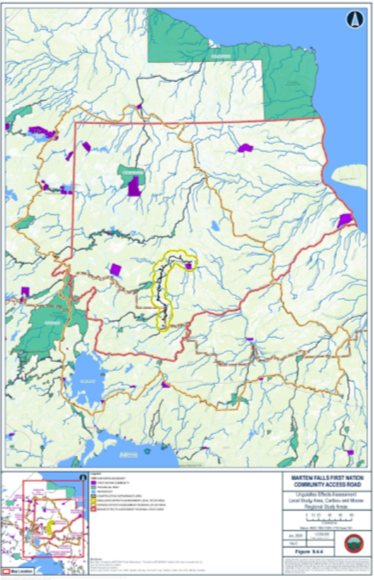
Source: Marten Falls Community Access Road Project Environmental Assessment Report/Impact Statement, Figure 9.4-4
Figure 6 - Text version
The figure depicts the Limited Study Area and Regional Study Area for Caribou and other ungulates
IAAC assessed effects on game birds and furbearers (excluding wolverine, which was assessed within the caribou LSA and RSA) across three spatial areas: the CDA; the other wildlife LSA, defined as the area extending three kilometres on either side of the route centreline plus a 500-metre buffer around other project components where project effects may occur; and the other wildlife RSA, which extends 11 kilometres on either side of the centreline (see Figure 3, Section 2.2).
Change in availability of caribou and other wildlife
Aroland First Nation, Attawapiskat First Nation, Constance Lake First Nation, Ginoogaming First Nation, Nibinamik First Nation and, and Weenusk First Nation raised concerns regarding loss or fragmentation and displacement of habitat that is important to traditional hunting practices during the construction phase. In addition, Attawapiskat First Nation raised concerns about the impact the construction and operation phases may have on caribou migration. With respect to caribou, the project would result in the loss, fragmentation and degradation of boreal and eastern migratory caribou habitat within the caribou LSA and portions of the RSA, including high-use habitat that could be used for calving/nursery areas (boreal caribou only), winter-use areas, and possible travel/migration corridors. The project would also alter, disrupt and restrict caribou movement across the caribou LSA as caribou are known to avoid areas of high anthropogenic activity and sensory disturbances (e.g., noise, vehicle activity, vibration, lighting), which in turn would reduce or alter traditional caribou harvesting areas. As a linear structure, the road corridor would also increase predation of caribou. Together, these effects in the CDA and caribou LSA would displace caribou farther into the caribou RSA and beyond the RSA for eastern migratory caribou, reduce connectivity between important habitats, and may alter movement and migration patterns within and between ranges and seasonal habitats. These changes may impact the availability of caribou within the caribou LSA.
The proponent indicated that the selected route corridor, compared to alternatives routes, reduced its overlap with high-use caribou habitat such as calving/nursery areas and travel corridors. To further mitigate effects from habitat loss, the proponent committed to minimizing overlap between project components and high-use caribou habitat where feasible; reduce vegetation clearing and undertake re-vegetation where feasible; and establish buffer zones around identified or confirmed key ecological features of high-use to caribou (e.g., known nursery areas). To mitigate effects from sensory disturbances, the proponent committed to avoid high-disturbance activities during sensitive periods, where practicable; implement noise, air emission, and equipment controls; and posting speed limits to reduce traffic-related disturbances during construction and maintenance activities.
IAAC also notes that the proponent would be subject to federal requirements, which would include permitting under SARA for adverse effects to caribou that may occur within the Marten Falls First Nation reserve, and to registerer or obtain a permit as applicable under Ontario's Species Conservation Act, 2025 in relation to boreal caribou and/or their habitats on provincial land. ECCC and MECP both indicated that the proponent should consider offsetting measures for caribou. MECP further noted the potential to restore habitats within the Missisa and/or Ozhiski ranges would be considered as part of the provincial environmental assessment and decision-making process. Based on information provided by ECCC and MECP, IAAC is of the view that changes in the distribution and movement patterns of caribou would result from the project.
With respect to other wildlife, the project would result in the direct loss of habitat for game birds, furbearers (including wolverine, listed as a species of concern under SARA and threatened under Ontario's Species Conservation Act, 2025, moose, and deer within the cleared right-of-way and in associated construction areas. This includes some forested upland habitat used by moose and American marten, wetland and riparian habitats used by beaver, muskrat, and other semi-aquatic furbearers, and mixed upland–wetland habitats used by game birds. In addition, habitat may become less suitable due to sensory disturbance (e.g., noise, vehicle activity, vibration, lighting) during both the construction and operation phases, which may cause certain species to avoid areas within and adjacent to the CDA. However, the proponent's modelling shows that, despite local losses, suitable habitat for these species remains abundant across the other wildlife RSA.
To mitigate effects on game birds, furbearers, moose, deer and other harvested wildlife the proponent committed to avoiding sensitive and high-use sites where feasible; limit vegetation clearing outside sensitive breeding periods, where practicable; apply buffer zones around wetlands, riparian habitats, and known wildlife features where feasible; re-vegetation of temporary cleared areas where appropriate; and implement speed limits, signage, and worker wildlife awareness training in areas where wildlife would be frequently observed.
The proponent also committed to implementing monitoring programs, including remote cameras along the right-of-way and at reference sites to monitor disruptions to wildlife from the start of the construction phase through the operation phase of the project; and monitoring of species at risk. IAAC recommends that the proponent provide opportunities for Indigenous participation in its wildlife monitoring programs and share the results with Indigenous communities.
Change in access to hunting and trapping sites and quality of experience
The project would result in changes to access to traditional hunting and trapping sites due to changes to terrain and the installation of barriers (e.g. fences and gates) and change in access to registered trapline areas (GE 138, GE 148, GE 153 GE 154, GE 157, GE 159, and GE 164 shown in Figure 7), which would be overlapped partially by the CDA. It is IAAC's understanding that the overlap between traplines and the CDA is minimal. Aroland First Nation has also identified five trapline areas that intersect with the RSA. In addition, Aroland First Nation expressed concerns regarding the potential restrictions to access of hunting and trapping sites during important harvesting seasons. IAAC understands the road would provide new means to access areas of the traplines. To mitigate effects from changes to access during construction and maintenance work, the proponent committed to keeping access routes to traditional harvesting areas open and unobstructed by creating temporary access roads or detours, where possible, to facilitate continued harvesting and use of trapline areas. Further, the proponent would provide notice to trapline holders on the timeline and periods of construction. The proponent also committed to scheduling construction activities to avoid peak harvesting periods.
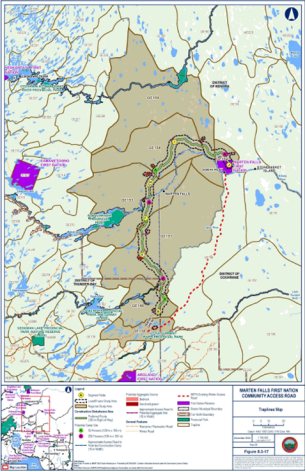
Source: Marten Falls Community Access Road Project Environmental Assessment Report/Impact Statement, Section 8, Figure 8.3-17
Figure 7 - Text version
The image depicts the locations of the traplines located within the Regional Study Area
The presence of non-resident project workers that may practice hunting would affect the quality of experience for Indigenous persons. To mitigate these effects, the proponent committed to implementing a firearms ban, prevent the use of recreational all-terrain vehicles within the other wildlife LSA, and prohibit hunting and harvesting of wildlife by on-site visitors and workers during the construction phase and periods of maintenance work, except for the purpose of safely exercising or enabling the safe exercise of Indigenous rights. IAAC also notes that the mitigation measures for sensory disturbances described above (for addressing changes in caribou and other wildlife availability) would also mitigate the changes in the quality of hunting and trapping experience due to project-related sensory disturbances.
During operation, vehicular collisions with caribou and other ungulate species that use the CDA could result in their harm or death, while vehicular accidents at locations that intersect with hunting and traplines could reduce safe access to harvesting sites and degrade the quality of harvesting experience in the vicinity of the accident site. To mitigate these effects, the proponent has committed to consider vehicular collisions through project design and operation (e.g., guardrails, clear line of sight to adjacent habitat, posted speed limits, regular maintenance of project equipment and vehicles), and employee safety training (including driver safety and wildlife awareness training and procedures).
Animbiigoo Zaagi'igan Anishinaabek, Aroland First Nation, Attawapiskat First Nation, Eabametoong First Nation, Fort Albany First Nation, Ginoogaming First Nation, Kashechewan First Nation, Marten Falls First Nation, Neskantaga First Nation and Nibinamik First Nation have raised concerns regarding pressures on hunting that would occur from an increase in access for hunters to the area. IAAC also understands that Ontario's wildlife management framework, administered by MNR, manages fish and wildlife harvest at a landscape level (e.g., fisheries management zones and wildlife management units).
For hunting and trapping, IAAC is of the view that, with the implementation of these mitigation measures, the project would cause residual effects through lower wildlife availability or changes to experience at preferred locations of caribou and other wildlife that would be displaced within the caribou and other wildlife LSAs as well as through low disruptions to safe access and the potential for an increase of non-Indigenous hunters and trappers. Regional habitat availability and sustainable population levels for all wildlife would be maintained, and traditional hunting and trapping could continue within the caribou and other wildlife RSAs.
Plant Harvesting
The project would result in changes to plant harvesting through project activities such as removal of habitat due to clearing and grubbing to prepare the terrain for project components, drilling, blasting, and installing culverts. Aroland First Nation, Attawapiskat First Nation, Constance Lake First Nation, Ginoogaming First Nation, Kashechewan First Nation, Long Lake #58 First Nation, Marten Falls First Nation, Neskantaga First Nation, Nibinamik First Nation, Webequie First Nation, and Weenusk First Nation have expressed concerns that the road would lead to the degradation and depletion of traditionally harvested plants. These communities are specifically concerned about fugitive dust and vehicle emissions smothering vegetation, the potential contamination of medicines by herbicides, and the threat of invasive species introduced by increased traffic. The communities emphasize that the loss of these resources in culturally vital peatlands would directly impact their food security, traditional economies, and intergenerational transfer of traditional knowledge.
The project activities would potentially cause a reduction, or perceived reduction, in harvest success from vegetation degradation or removal and from the negative perception of the quality of plants within the CDA, less safe access to harvesting sites, and reduced quality of experience due to elevated noise levels from traffic and operating equipment. IAAC considered effects to plant harvesting the CDA; the plant harvesting LSA, defined as the area that extends three kilometres from the centreline on both sides of the proposed route plus a 500-metre buffer around each of the other project components; and the plant harvesting RSA, defined as the area that extends 11 kilometres on either side of the centreline within which cumulative effects may occur. The areas that represent the LSA and RSA are depicted in Figure 3 in Section 2.2.
Change in plant availability
Animbiigoo Zaagi'igan Anishinaabek and Marten Falls First Nation, has expressed concern over the loss of plant harvesting sites due to construction activities. The project is expected to require 60-metre width of vegetation clearing within the 100-metre right-of-way and associated, resulting in permanent loss of a portion of upland forest, peatlands, and riparian vegetation communities where plants of Indigenous importance occur. Although some disturbed areas would be allowed to naturally re-vegetate following construction, and much of the cleared corridor would remain in an altered state due to ongoing road use and maintenance. High-value harvesting areas for traditional use plant populations were identified at Patience Lake, the Albany River Corridor, and areas in between them. The Patience Lake and its surrounding area are used to gather berries, and species used as medicines such as spruce roots, while the Albany River Corridor and its tributaries are largely used for harvesting of sage and cranberry. A number of traditional use plants were found in peatland ecosystems which dominates the CDA, such as muskrat root. The species composition of the vegetation community may be affected by altered surface water drainage and runoff as a result of road construction in the CDA.
The proponent proposed mitigation measures to reduce adverse effects on vegetation, including limit clearing within the 100-metre right of way; minimize disturbance to sensitive ecosystems, such as wetlands and riparian areas; implement vegetation clearing and grubbing practices that support natural revegetation and progressive reclamation of temporary disturbance areas to allow disturbed areas to naturally revegetate over time; and conduct vegetation clearing in winter months where feasible to reduce soil disturbance and protect root systems.
Change in safe access and quality of plant harvesting experience
Site preparation (e.g., land clearing, grubbing and grading) would reduce access to plant harvesting sites near the CDA and cause sensory disturbances that would reduce the quality of plant harvesting experience. IAAC notes that the mitigation measures proposed to address changes in access to hunting and trapping areas, would be appropriate to mitigate effects from changes to safe access to plant harvesting areas.
IAAC also recognizes that Indigenous Peoples may perceive plants located near or within the CDA as no longer being of harvesting quality, which may result in plant harvesting activities moved to locations away from the CDA and further into the plant harvesting LSA. Aroland First Nation and Kashechewan First Nation, raised concerns regarding the impact of pesticides on plant harvesting. To mitigate effects from changes in the quality of experience to plant harvesting, the proponent committed to avoiding the use of herbicides for vegetation maintenance along the road and proposed to utilize mechanical removal or environmentally friendly products. The measures described above to limit degradation in the quality of fishing experience from sensory disturbance would be appropriate for addressing effects on the quality of plant harvesting experience as well.
Vehicular accidents at locations that intersect with routes to plant harvesting sites could reduce safe access to harvesting sites and degrade the quality of harvesting experience in the vicinity of the accident site. The mitigation measures relevant for addressing effects from collisions and accidental spills and described in Section 2.1.4 would support managing potential adverse effects on plants that support traditional harvesting. The measures would include restricting vehicular refueling and maintenance activities to a minimum of 30 metres from waterbodies to prevent spillage, adhering to effluent limits and having in place a spill prevention and response plan at work locations with measures to control or contain spill-related effects on aquatic and riparian environments where plant species of importance to Indigenous communities could be present.
For plant harvesting, IAAC is of the view that, with the implementation of these mitigation measures, the project would result in a localized reduction, or perceived reduction, in harvest success through vegetation loss in the CDA and changes to how Indigenous Peoples could access plant harvesting locations near the CDA. Harvesting activities would continue as the vegetation communities would remain abundant in the LSA and RSA.
4.3.1.2 Residual effects
Based on the above assessment, IAAC is of the view that the project would likely result in residual adverse effects to the current use of lands and resources for traditional purposes by Indigenous Peoples. The route corridor would intersect with fishing, hunting, trapping and plant harvesting locations, which would cause changes to resource availability or perceived availability, safe access and quality of experience for the Indigenous persons who practice traditional activities near or within the CDA.
The residual effects, taking into account the mitigation measures described above, would be moderate in magnitude, geographic extent and timing, as wildlife displacement, sensory disturbance and decreased harvest success or quality in proximity to the CDA would displace traditional activities from the CDA into the respective LSAs or beyond, notably for hunting, throughout the harvesting seasons. The effects would be high in duration and frequency as well as irreversible. The effects would occasionally interact with the historical context of communities, depending on success and enjoyment during instances of traditional practices. The level of uncertainty would be moderate, as the cause-and-effect relationship between the project and traditional activities are not fully understood. Further, input on specific sites of importance for traditional use was not available for all Indigenous communities. Despite this, the traditional activities are expected to continue.
IAAC concludes that the residual adverse effects on the current use of lands and resources for traditional purposes by Indigenous Peoples are likely to be significant to a low extent.
4.3.1.3 Cumulative effects
The residual adverse effects of the project on the current use of lands and resources for traditional purposes by Indigenous Peoples, in combination with other past, present, and reasonably foreseeable projects, are likely to have cumulative effects through changes to resource availability, safe access to traditional harvesting sites, quality of experience and pressures from increased access by non-Indigenous persons. Effects from the proposed Webequie Supply Road Project, the proposed Northern Road Link Project, the proposed Anaconda and Painter Lake Roads Upgrade Project, the Rapid Lynx Broadband Project and mineral exploration followed by mining at the proposed Eagle's Nest site have the potential to interact with the residual adverse effects from the project in relation to clearing and grubbing activities, sensory disturbances from construction equipment and increased traffic, and changes to safe access of harvesting sites. These interactions would increase access to the area and may enable additional infrastructure development which, together, would increase pressures on resources and reduced the quality of experience when practicing traditional activities.
IAAC notes that federal and provincial legislative frameworks would apply to manage the effects of the projects on fish and terrestrial wildlife. In 2022, Canada and Ontario entered into a five-year conservation agreement under section 11 of SARA through which they agree to cooperate in the delivery of the conservation measures laid out in the agreement in a manner that minimizes duplication, maximizes efficiency, and respects each other's roles and responsibilities. The conservation measures laid out in the agreement are intended to support the long-term recovery of boreal caribou at the landscape-level. IAAC considers that existing applicable frameworks as well as the project-specific mitigation measures recommended in Section 4.3.1.4 would contribute to addressing the cumulative effects of the project on current use of lands and resources for traditional purposes.
IAAC is of the view that, taking into account mitigation measures, cumulative effects on fishing, plant harvesting, as well as hunting and trapping of small terrestrial wildlife would be limited, while effects on hunting of larger wildlife from the other projects are likely to be additive with the residual effects from the proposed project.
Cumulative effects on hunting of caribou and other ungulates would be moderate in magnitude, primarily through changes in movement patterns affecting their availability for hunting, particularly caribou, as ECCC and MECP noted that effects from the projects would further alter movement patterns through the RSA. The timing, frequency and duration for the cumulative adverse effects would be of a high extent as a reduced harvesting success is expected to occur throughout the harvesting periods from the project with a further reduction as more development occurs within the Ring Fire area. The effects would be irreversible. Despite this, the traditional activities could continue within the respective RSAs. The project's contribution to cumulative effects on traditional caribou hunting is expected to be of a similar extent as that of other proposed projects in the region, with ECCC noting that cumulative effects to caribou and caribou habitat may be significant despite mitigation, and MECP noting that, although cumulative disturbance within the Missisa Range would increase, overall disturbance is expected to remain below the 35% threshold identified in the federal recovery strategy.
Cumulative effects on wolverine are also anticipated due to a loss of habitat connectivity, and increased mortality due to a combination of increased access and incidental harvest. These effects would likely persist despite the proposed mitigation measures and the relative abundance of suitable habitat in the RSA. Despite this, the traditional activities that include wolverine could continue within the RSA.
IAAC concludes that cumulative effects to the current use of lands and resources for traditional purposes by Indigenous Peoples by the project in combination with other projects is likely to be significant to a low extent for traditional harvesting activities, except for hunting of ungulates, particularly caribou, which is likely to be significant to a moderate extent due to changes in resource availability that would result from the project and other foreseeable projects, together, altering movement patterns and range areas.
4.3.1.4 IAAC's recommended mitigation measures and follow-up program measure pertaining to effects to the current use of lands and resources for traditional purposes by Indigenous Peoples
Recommended mitigation measures that would potentially be included as a condition in the impact assessment decision statement include:
Establish and implement a complaints resolution process to receive and address sensory disturbance complaints and notify the Indigenous communities on how the process works to receive and address their complaints.
Reduce sensory disturbance, and where feasible minimize terrestrial vegetation clearing and undertake re-vegetation during project construction and maintenance, specifically:
- halt or restrict project activities during periods of dry and high-wind conditions;
- schedule project activities expected to reduce air quality and elevate noise levels in consideration of input from nearby Indigenous communities;
- notify Indigenous communities when and where reduced air quality and elevated noise levels are expected to occur to avoid or minimize exposure;
- limit vegetation clearing and conduct this project activity outside sensitive breeding periods (i.e., winter months) for game birds, furbearers, moose, caribou, and other harvested wildlife;
- avoid herbicides for vegetation clearing, unless mechanical and manual ways of vegetation removal are not feasible; and
- conduct progressive reclamation of areas temporarily disturbed by the project to progressively return them to a state as close as possible to, or better than, baseline once they are no longer required for the project, including identify plant species of interest in consultation with Indigenous communities for use in establishing self-sustaining vegetation communities.
Establish and delineate, under the direction of qualified individuals, setbacks and buffer zones around wetlands, riparian habitats, and known wildlife features and seasonal habitats (e.g., nursing areas and dens) for game birds, furbearers, moose, caribou, and other harvested wildlife.
Provide opportunities for Marten Falls First Nation and Indigenous communities to harvest plants prior to vegetation clearing near known harvesting sites on Marten Falls First Nation reserve and on non-federal lands within the LSA respectively.
Ensure project employees and contractors are trained on wildlife awareness.
Prohibit project employees and contractors while on shift or at construction camps, from:
- hunting, trapping, and plant gathering;
- keeping and using firearms; and
- using recreational all-terrain vehicles, with the exception of project-related activities.
Restrict access to project employees and contractors on non-federal lands within the LSA, in consultation with relevant provincial authorities, to the LSA to mitigate adverse federal effects on the current use of lands and resources for traditional purposes.
Minimize interruption to waterway navigation by:
- establishing a restricted work zone that would be accessible only by project workers to protect the safety of waterway users from the in-water construction and maintenance work;
- notifying Marten Falls First Nation and Indigenous communities when in-water works would occur on Marten Falls First Nation reserve and on non-federal lands within the LSA respectively;
- posting notices and signage in advance; and
- providing safe detours and direction to waterway users.
Install restrictive fencing and/or barricades near waterbody crossing sites, including on bridge structures, to deter fishing during the construction phase and periods of maintenance work during the operation phase.
Maintain equipment in an operating condition that prevents unnecessary noise, including but not limited to non-defective muffler systems, properly secured components, and the lubrication of moving parts. Restricting idling of equipment to the minimum necessary to perform the specified work.
Implement best practices for blasting during construction and maintenance activities.
Refer to measures for accidental spills in Section 2.1.4 and measures for establishing speed limits on project roads in Section 4.3.3 of this IA Report.
Recommended follow-up program measure that would potentially be included as a condition in the impact assessment decision statement include:
Monitor effects to wildlife species of importance to Indigenous communities for traditional purposes, in consultation with Marten Falls First Nation for monitoring on Marten Falls First Nation reserve and with Indigenous communities and relevant authorities for monitoring on non-federal lands within the LSA, including relevant predator-prey dynamics, the monitoring methods, indicators and thresholds to guide adaptive management, including the implementation of any additional or modified mitigation measures and make the monitoring results available to Indigenous communities, as soon as feasible.
Monitor and report on air contaminants emitted during project construction, including levels of dust, particulate matter 10, particulate matter 2.5, diesel particulate matter, sulphur dioxide, nitrogen dioxide, acrolein, benzene, benzo(a)pyrene, hexavalent chromium, iron, and nickel, as well as noise levels, on Marten Falls First Nation reserve and implement additional or modified mitigation measures if monitoring shows exceedances of health-based thresholds for air contaminants, including thresholds in the Canadian Air Quality Standards, or Ontario's AAQC, whichever is more protective of human health, or noise thresholds as well as notify Indigenous communities, and make the monitoring results available to Indigenous communities, as soon as feasible.
4.3.2 Effects on structures, sites or things of historical, archaeological, or architectural significance to Indigenous Peoples and effects on physical and cultural heritage
The project is likely to cause residual and cumulative adverse effects on structures, sites or things of historical, archaeological, or architectural significance to Indigenous Peoples through physical damage or degradation of sites of importance (i.e., travel routes; harvesting sites; cultural, spiritual, and ceremonial sites; and burial sites), and change to safe access to portions of some sites of importance (i.e., travel routes). Additionally, the project is likely to cause residual and cumulative adverse effects on physical and cultural heritage from changes in the quality of experience of Indigenous persons due to sensory disturbances when at, or enroute to, the sites.
With the implementation of the mitigation measures identified in Section 4.3.2.4, IAAC is of the view that residual adverse effects to structures, sites or things of historical, archaeological, or architectural significance to Indigenous Peoples, as well as the residual adverse effects to physical and cultural heritage, are likely to be significant to a low extent, while the cumulative effects of the project in combination with other physical activities are also likely to be significant to a low extent.
IAAC's assessment of effects to structures, sites or things of historical, archaeological or architectural significance to Indigenous Peoples focused on damage or degradation to sites of importance and change in safe access to those sites. The assessment of effects to physical and cultural heritage focused on change in experience from sensory disturbances perceived by Indigenous persons when at or near the sites of importance. IAAC considered information from the proponent's Impact Statement and concerns raised by Animbiigoo Zaagi'igan Anishinaabek, Aroland First Nation, Fort Albany First Nation, Eabametoong First Nation, Ginoogaming First Nation, Long Lake #58 First Nation, Métis Nation of Ontario, Nibinamik First Nation, and Weenusk First Nation about potential damage or loss of access to important sites and archaeological resources.
Sites of importance identified include travel routes; hunting, fishing, trapping and plant harvesting sites; cultural, spiritual and ceremonial sites; burial sites; and areas of archaeological potential.
IAAC considered effects to structures, sites or things of historical, archaeological, or architectural significance to Indigenous Peoples and effects to physical and cultural heritage from the project that would occur within the CDA, LSA and RSA. The LSA extends 2.5 kilometres from the centerline on both sides of the proposed route plus a 500-metre buffer around each of the other project components while the RSA extends five kilometres from the boundary of the LSA. IAAC's effects assessment focuses on the LSA as effects are expected to be localized.
4.3.2.1 Assessment of effects
Sites of importance
Damage or degradation to sites of importance
Animbiigoo Zaagi'igan Anishinaabek, Aroland First Nation, Long Lake #58 First Nation, Métis Nation of Ontario and Neskantaga First Nation expressed concerns regarding damage or loss to archaeological findings of importance to communities. Also, Métis Nation of Ontario expressed an interest in Métis archaeology and an expectation that archaeological findings of importance to Indigenous Peoples are protected. Project activities during the construction and operation phases, such as clearing and grubbing to prepare the terrain for project components (e.g., road right-of-way, access roads and construction staging areas), installing temporary supportive infrastructure such as access roads and water crossings (e.g., culverts and bridges), and developing and operating aggregate sites would cause environmental changes that could damage or degrade harvesting sites and areas of archaeological potential.
Mitigation to address the environmental effects to harvesting sites are described in Section 4.3.2.4 of this IA Report and would be adequate to mitigate the potential damage or degradation of harvesting sites of importance to Indigenous Peoples.
Project activities such as clearing and grubbing to prepare the terrain for project components (e.g., road right-of-way, access roads and construction staging areas), developing pits and quarries at aggregate sites, and conducting maintenance or refurbishment of water crossings would change the terrain or landscape, and may alter or disturb shorelines in areas with archaeological potential.
Regarding areas of archaeological potential, it is IAAC's understanding that identification of locations of archaeological potential and discovery of archaeological artifacts has and may occur by chance in the CDA during project construction or when conducting maintenance work during the operation phase. The proponent identified a campsite of potential cultural heritage value that has artifacts. The site is called Caviar Site (Eilp-1) and is located at the proposed Albany River water crossing along the proposed route. The proponent's Stage 2 Archeological Assessment resulted in the discovery of artifacts found at the site which included items such as a bottle pump, outhouse structure, cooking areas, etc. Based on the findings in the Stage 2 Archaeological Assessment a Stage 3 Archaeological Assessment is required under the Ontario Heritage Act to determine the extent and status of the site, and to make recommendations for mitigation, which would be carried out through a Stage 4 Archaeological Assessment. Archaeological Assessments would be undertaken by a licensed consultant archaeologist as early as possible during detailed design and prior to any ground disturbing activities.
The Ontario Ministry of Citizenship and Multiculturalism further indicated that if previously undocumented archaeological resources are discovered during construction, the resources may be a new archaeological site and therefore subject to section 48(1) of the Ontario Heritage Act. The proponent or person discovering the archaeological resources must cease alteration of the site immediately and contact a licensed archaeologist to carry out an archaeological assessment as required under the Ontario Heritage Act.
The environmental changes caused by the project may damage or degrade archeological artifacts encountered in those areas. To mitigate effects on encountered artifacts, the proponent committed to establishing a construction monitoring process that includes procedures and "no-go" zones to avoid impacts to areas with archeological potential. The proponent also committed to training construction personnel on procedures to follow when working in locations with potential for encountering archeological resources of heritage value. Accidental spills during storage, transportation, handling and dispensing of hazardous materials, from vehicle accidents or mechanical malfunctions during the construction and operation phases could degrade sites of importance and archaeological resources at or near the accident site. In addition, accidental collisions with machinery or vehicles could cause damage to archaeological resources within the CDA and LSA. Mitigation measures proposed by the proponent that would be applicable are described in Section 2.1.4. IAAC further recommends that the proponent create and put in place an Indigenous Communities Communication Plan for accidents and malfunctions, within six months of issuance of the decision statement, and maintain the plan throughout the life of the project. The plan would identify when and how Indigenous communities would be notified of impacts on sites of importance to Indigenous communities, including as a result of potential malfunction and accident scenarios, and the actions taken to respond.
IAAC is of the view that, with the implementation of these mitigation measures, residual adverse effects of the project on sites of importance through partial damage or degradation would be limited, while archaeological resources would be preserved.
Safe access to sites of importance
IAAC's assessment of effects to structures, sites or things of significance to Indigenous Peoples included the consideration of potential damage or degradation to historic trails and change in access to the trails and use of them by Indigenous Peoples, and considered information from the proponent's Impact Statement and concerns raised by Eabametoong First Nation, Ginoogaming First Nation, Kashechewan First Nation and Neskantaga First Nation, and Weenusk First Nation about potential damage or loss of access to trails.
Neskantaga First Nation expressed concern regarding the project's intersections with two trails used by the community that hold heritage value. According to the proponent's Impact Statement, impacts to five historic trails would occur in the CDA during project construction and the operation phase. It is IAAC's understanding that the road would pass through a single location of each trail along the northern part of the proposed route. To identify appropriate measures to minimize impacts to trails of heritage value, the proponent committed to conducting a further assessment of identified trails to determine their heritage value and the appropriate mitigation measures to protect their value.
To minimize adverse effects to these trails (and any discovered sites), the proponent committed to establishing a construction monitoring process that includes procedures and "no-go" zones to avoid impacts to heritage landscapes, confining construction activities to the right-of-way of the proposed route, training construction personnel on the procedures to follow when working in locations with potential heritage value, and providing cultural awareness and sensitivity training to its workers to minimize the risk of workers causing damage or disruption to sacred sites. In addition, the proponent would implement an Environmental Protection Plan which would include mitigation measures to address traffic concerns including, traffic control measures (such as signage and barriers), communication of road closures or detours, and implementing speed limits for workers during the construction phase and maintenance work. Also, the proponent has committed to incorporating traditional ecological knowledge into the road design and maintenance plan to limit adverse disruptions to sites of value to Indigenous communities, including use of the sites by community members.
Road accidents could involve Indigenous persons accessing sites of importance near the road and appropriate mitigation measures are described in Sections 2.1.4.
IAAC is of the view that, with the implementation of these mitigation measures, residual adverse effects of the project on safe access to sites of importance would occur where the road intersects with travel routes used to access sites of importance. While Indigenous communities would still be able to access sites of importance using the travel routes, they would be required to cross the road, reducing safe access.
Physical and cultural heritage
Aroland First Nation, Fort Albany First Nation, Eabametoong First Nation, Ginoogaming First Nation, Kashechewan First Nation, Long Lake #58 First Nation, Marten Falls First Nation, and Neskantaga First Nation have expressed concerns regarding the Albany and Ogoki Rivers as these rivers are considered culturally important heritage landscapes that hold deep cultural and spiritual meaning. Ginoogaming First Nation expressed concerns regarding the potential for disturbance to sacred sites and burial grounds identified near the CDA. Neskantaga First Nation in particular expresses concern for potential impacts to cultural, spiritual and sacred sites within the LSA. Further, Fort Albany First Nation and Long Lake #58 First Nation have expressed concerns regarding potential impacts to burial grounds. It Is IAAC's understanding that through archeological assessments and through the outcome of an alternatives assessment on route alignment conducted by the proponent, the CDA of the project would not intersect with any known burial sites. Therefore, IAAC understands that sites of importance with physical and cultural value would be impacted by the project only through sensory disturbances.
Aroland First Nation, Kashechewan First Nation, and Marten Falls First Nation have expressed concerns for the impact to the experience on the land due to visual and auditory environmental changes. Sensory disturbance from project activities during the construction and operation phases, including visual changes to the landscape, and reduced air quality and elevated noise levels at previously undisturbed culturally sensitive sites during project construction and maintenance work, as well as noise from traffic at sites located near the CDA, would disrupt or impede cultural practices at culturally important sites (burial, ceremonial and sacred sites). As such, these sensory disturbances would adversely affect intangible cultural heritage, including cultural identity and continuity of experience of Indigenous Peoples using the land.
Mitigation measures for changes to the quality of fishing experience and visual changes to the landscape, as described in Section 4.3.1.4, would be appropriate to mitigate effects on physical and cultural heritage.
With respect to physical and cultural heritage, IAAC is of the view that, with the implementation of these mitigation measures, residual adverse effects of the project on cultural activities carried out within and near the CDA would remain. Indigenous communities would still be able to experience the land, and cultural identity and practices could be maintained, however, the project would create a less tranquil experience for Indigenous persons on the land.
4.3.2.2 Residual effects
Based on the above assessment, IAAC is of the view that the project may result in residual adverse effects to structures, sites or things of historical, archaeological, or architectural significance to Indigenous Peoples and physical and cultural heritage as the proposed route would intersect with sites of importance and would damage or degrade segments of these sites, reduce safe access to impacted areas and degrade the experience at locations where the sites of importance would intersect with the road.
Structures, sites, or things of historical, archaeological, or architectural significance
The residual effects on structures, sites, or things of historical, archaeological, or architectural significance, taking into account the mitigation measures described above, would be moderate in magnitude as partial damage or degradation of sites of importance would occur but appreciation and use of the sites and any encountered archaeological resources would be maintained. Geographic extent, timing and frequency would be low to moderate, as the physical damage would occur within the CDA while degradation of the quality of experience at sites within the LSA may occur during site visits. Duration and reversibility are expected to be high as changes to access at points of intersection with the road would be permanent. Uncertainty is low as the cause-and-effect relationships and the recommended mitigation measures are well understood. The effects would have limited interactions with cultural practices, social values and ecological systems since Indigenous Peoples would not lose access to the sites or any encountered archaeological resources.
IAAC concludes that the residual adverse effects of the project on structures, sites or things of historical, archaeological, or architectural significance to Indigenous Peoples are likely to be significant to a low extent.
Physical and cultural heritage
With the implementation of the proposed mitigation measures and the proponent's commitments to address accidents and malfunctions, the residual adverse effects to physical and cultural heritage would be moderate in magnitude and geographic extent as partial degradation of sites of importance would change the experience of Indigenous persons visiting those sites within the LSA. In addition, timing and frequency are expected to be moderate as changes to sensory experience are expected to happen for Indigenous persons that access partially degraded sites of importance. Duration and reversibility would be of high extent as the degradation of the sensory experience from the partial degradation of sites would be ongoing and irreversible. Effects to sites of importance would have a limited impact on the resilience of Indigenous communities and their ability to experience the sites of importance could continue. The level of uncertainty would be low as the cause-and–effect relationship and mitigation measures are well understood. Though the required mitigation measures would not eliminate the effects on experience due to sensory disturbances, the value of the sites of importance to the Indigenous communities should remain.
IAAC concludes that the residual adverse effects of the project on physical and cultural heritage are likely to be significant to a low extent.
4.3.2.3 Cumulative effects
The residual adverse effects of the project on structures, sites, or things of historical, archaeological, or architectural significance, as well as on physical and cultural heritage, in combination with other past, present, and reasonably foreseeable projects, are likely to have cumulative effects. IAAC considered a spatial area similar to the proponent's caribou and other ungulates LSA and RSAs (see Figure 6 in Section 4.2.1, which captures where the likely residual effects of the project would interact with the likely effects of the proposed Webequie Supply Road, Northern Road Link, and Eagle's Nest projects, including through site clearing and grubbing activities conducted during their construction and operation phases, which may result in the partial damage or degradation of sites of importance and changes to the quality of experience of Indigenous persons engaging in traditional practices at these sites through sensory disturbances from operating equipment and traffic that would interact with the residual effects from the proposed project.
The same legislative mechanisms that would mitigate effects from the project on structures, sites, or things of historical, archaeological, or architectural significance, as well as on physical and cultural heritage, would apply to these other projects and would limit potential changes to the aquatic environment and terrain that would cause adverse effects to sites of importance to Indigenous Peoples and any encountered archaeological resources, as well as sensory disturbances that would affect the quality of experience, such that temporal and spatial overlaps in effects would also be limited.
Given that the interaction of project effects with the effects from other projects would be limited, IAAC does not recommend further mitigation measures or a follow-up program related to cumulative effects.
Structures, sites, or things of historical, archaeological, or architectural significance
Taking into consideration the recommended mitigation measures in Section 4.3.2.4 below, the likely cumulative effects on structures, sites, or things of historical, archaeological, or architectural significance would be moderate in magnitude as partial degradation of multiple sites could occur. The geographic extent, timing and frequency of cumulative effects would be low as changes to sites of importance would be limited to the disturbed areas near each project with the exception of interactions during periods of maintenance work. Duration would be high as partial degradation to sites of importance would be continuous and irreversible. Indigenous communities would continue to have access to sites of importance. Uncertainty is low as the cause-and-effect relationships and mitigation measures under applicable legislative mechanisms are well understood. The project's contribution to these cumulative effects on sites of importance would be small relative to the contributions of other foreseeable projects.
IAAC concludes that cumulative effects to structures, sites, or things of historical, archaeological, architectural significance to Indigenous Peoples would be significant to a low extent as the project, along with other projects, would contribute to the partial degradation and reduced safe access of sites of importance to Indigenous communities.
Physical and cultural heritage
Taking into consideration the recommended mitigation measures in Section 4.3.2.4 below, the likely cumulative effects on physical and cultural heritage would be moderate in magnitude as the quality of experience would be altered by visual changes resulting from physical degradation of travel routes and other sensory disturbances from operating equipment and any nearby traffic that may disturb persons visiting culturally important sites , while heritage resource value would be maintained. The geographic extent would be moderate as effects from each project are expected to be localized to the respective projects. Timing and frequency would be moderate as sensory changes are expected to occur on occasion when Indigenous persons would access the sites of importance. Duration would be high as changes would be continuous and irreversible. The effect would have limited interactions with the social values of the Indigenous communities and the existing ecological systems as Indigenous communities' ability to visit and experience the sites would be maintained.
IAAC concludes that cumulative effects on physical and cultural heritage is likely to be significant to a low extent as the project, along with other projects, would change the experience of heritage value at culturally important site to Indigenous communities.
4.3.2.4 IAAC's recommended mitigation measures pertaining to structures, sites and things of importance.
Recommended mitigation measures that would potentially be included as conditions in the impact assessment decision statement include:
Plan and undertake construction activities to avoid impacts by informing project personnel of the locations of potential archaeological resources.
Determine the sites and areas of importance where work shall not be conducted. In doing so:
- provide the opportunity for Indigenous communities to provide information on the sites and areas of importance.
Implement the following mitigation measures to protect and manage chance finds for any previously unidentified structures, sites or things of historical, archaeological, paleontological or architectural significance discovered within the CDA:
- immediately halt work at the location of a discovery;
- delineate an area around a discovery as a no-work zone;
- notify Indigenous communities and IAAC within 24 hours of a discovery and allow Indigenous communities to monitor archaeological works; and
- develop mandatory training on chance finds, which includes the identification of sensitive locations within the project CDA and the implementation of the above measures, and deliver this training to all employees and contractors associated with the project.
Implement an Indigenous Communities Communication Plan that:
- identifies when and how Indigenous communities would be notified of impacts on sites of importance to Indigenous communities, including as a result of potential malfunction and accident scenarios; and
- provides opportunities for Indigenous communities to assist in the response efforts to address the impacts related to these identified malfunction and accident scenarios.
Refer to measures for sensory disturbance (air quality and noise) in Section 4.3.1.4 of this IA Report.
4.3.3 Effects on the health, social and economic conditions of Indigenous Peoples
The project is likely to cause residual and cumulative adverse effects on the health, social and economic conditions of Indigenous Peoples, mainly through the strain placed on social infrastructure and the ability to pass on Indigenous Knowledge. With the implementation of the mitigation measures identified in Section 4.3.3.4, IAAC is of the view that residual adverse effects on the health, social and economic conditions of Indigenous Peoples would likely be significant to a moderate extent as existing infrastructure of Indigenous communities would be further strained and the cumulative effects of the project in combination with other physical activities are also likely to be significant to a moderate extent given the ease of access and means of influence to the remote Indigenous communities.
IAAC assessed the effects to Indigenous peoples' health from the project's air emissions, noise, risk from road traffic, and from consumption of potentially contaminated country foods. IAAC also assessed effects to the social infrastructure, which serves as the backbone for social capital, trust, and resilience within a society, including education, health care, and justice that support a community's quality of life and overall community well-being. In its assessment, IAAC has considered the unique identity and cultural needs of the Indigenous communities.
Indigenous communities in the area face challenges in maintaining adequate social infrastructure due to the remoteness of the communities and the impacts of colonialism. IAAC focused its assessment on how the project could further strain Marten Falls First Nation and neighbouring communities overburdened social infrastructures, as well as the unique pressures on emergency response services and traditional practices. Elements considered as contributing to the added strain include the influx of a transient workforce, increased accessibility of the land, increased risk of illegal or prohibited substances entering the community, concerns regarding public and road safety, and potential effects on cultural continuity and traditional practices.
IAAC considered effects from the project that would occur in the LSA and the RSA. The LSA is the area where changes to community health and socio-economic conditions due to the project are likely to occur and includes Marten Falls First Nation and Aroland First Nation. The RSA includes the following communities identified in the IEPP: Animbiigoo Zaagi'igan Anishinaabek, Attawapiskat First Nation, Constance Lake First Nation, Eabametoong First Nation, Fort Albany First Nation, Ginoogaming First Nation, Kashechewan First Nation, Kitchenuhmaykoosib Inninuwug, Long Lake #58 First Nation, Mishkeegogamang First Nation, Neskantaga First Nation, Nibinamik First Nation, and Weenusk First Nation. IAAC's assessment relies on the limited community-specific information that was available at the time this IA Report was prepared.
4.3.3.1 Assessment of effects
Changes to health condition
Health risk from project-related air emissions and noise
Animbiigoo Zaagi'igan Anishinaabek, Aroland First Nation, Constance Lake First Nation, Fort Albany First Nation, Ginoogaming First Nation, and Marten Falls First Nation raised health risks due to project activities during the construction and operation phases, such as operating heavy machinery and vehicles, drilling and blasting within the CDA, including construction activity on Marten Falls First Nation reserve, everyday road traffic and handling of aggregate material which could expose community members to air contaminants (e.g., exhaust and particulate dust emissions) and increased noise levels. As described in Section 2.3, the proponent has predicted potential exceedances to air quality on the reserve land during operations, however, there is no sensitive receptors identified near this location, therefore, limiting exposure to Indigenous peoples.
The measures described to address change in quality of fishing experience in Section 4.3.1.4 would be appropriate to mitigate health risk from air emissions and elevated noise levels.
IAAC is of the view that, with the implementation of these mitigation measures, residual effects of the project on human health risk from exposure to air contaminants and noise are not likely.
Health risk from road traffic
As raised by raised by Animbiigoo Zaagi'igan Anishinaabek, Aroland First Nation, Constance Lake First Nation, Ginoogaming First Nation, Long Lake #58 First Nation and Marten Falls First Nation, traffic poses a risk to personal safety throughout the life of the project. During project construction, the proponent anticipates an increase in winter road traffic as contractors drop off supplies and personnel, which could increase stress levels for commuters and pose road safety risk. The proponent has proposed to develop and implement an equipment mobilization plan with both Marten Falls First Nation and Aroland First Nation to mitigate the adverse project-related changes to traffic safety by separating construction traffic from community traffic. The plan would include a communications strategy to inform the communities of the mobilization schedule (i.e., periods of increased construction traffic on the winter road).
During the operation phase, traffic could impact personal safety of Indigenous community members through potential road accidents, whether they are traveling in a vehicle or accessing nearby sites for traditional practices. The proponent committed to comply with the Ontario Ministry of Transportation's Roadside Design Manual and to include adequate roadside safety elements, as well as post speed limits. The proponent is also considering pull outs and rest areas at regular intervals and the use of Indigenous languages on road signs to enhance safety, as well as, looking at alternatives to road salt to minimize attracting wildlife and subsequently the potential for vehicle-wildlife collisions. In addition, IAAC understands that the Ontario Ministry of Transportation would require the project to meet the relevant standard specifications for roads of the Ontario Provincial Standards organization, to help reduce accident risks.
IAAC is of the view that, with the implementation of these mitigation measures and applicable design standards and guidance, health risk from road traffic would be limited.
Risk of consuming potentially contaminated country foods
Animbiigoo Zaagi'igan Anishinaabek, Aroland First Nation, Attawapiskat First Nation, Constance Lake First Nation, Eabametoong First Nation, Fort Albany First Nation, Ginoogaming First Nation, Kashechewan First Nation, Long Lake #58 First Nation, Marten Falls First Nation, Nibinamik First Nation, Webequie First Nation and Weenusk First Nation expressed concern about potential risks to health from impacts on traditional food sources resulting from project activities, such as in-water works. Specifically, methylmercury was identified as a concern by Aroland First Nation, Attawapiskat First Nation, Fort Albany First Nation, Kashechewan First Nation and Nibinamik First Nation. Contaminants, including methylmercury, may bioaccumulate in fish, presenting a risk to safe consumption of fish or reluctance to consume fish.
The proponent indicated that parts of the road over peatlands would be constructed as a floating road keeping peat in place while promoting natural water flow, by adding a permeable embankment over the pit, supported by heavy geogrid to prevent clogging and allow settlement. The parts over peatlands are where changes to hydrology during construction or operation — especially following extreme rainfall — could cause groundwater impoundment or periodic surface flooding. These anoxic conditions could enhance methylmercury generation and increase its release into groundwater or surface water. In‑water works could resuspend sediments or introduce contaminants from surface aggregate, increasing the microbial formation and downstream transport of methylmercury.
Changes in water quality resulting from the project, including recommended mitigation measures, are described in Section 2.1. The proponent stated that the road design, which includes a gravel base and including equalization culverts, would not change the hydrological conditions of the peatlands. However, ECCC, Wildlife Conservation Society (WCS) Canada, Constance Lake First Nation, Nibinamik First Nation, and Weenusk First Nation, expressed uncertainty that the floating road design would maintain hydrological conditions of the peatland. IAAC acknowledges that this uncertainty may lead to a reluctance to harvest and consume country foods, possibly leading to food insecurity and reduced community health, even if water quality does not change as a result of the project. As such, IAAC recommends that long-term water quality monitoring in areas where country foods are harvested include methylmercury until a three-year trend analysis demonstrates the project is unlikely to generate or transport methylmercury, in consideration of the views from Indigenous communities on monitoring design and analysis. Further, IAAC recommends that the monitoring results, which includes a requirement to monitor for methylmercury, are shared with the Indigenous communities in a manner that shows any changes from baseline conditions (see Section 2.1.4.1 and Section 4.3.2.4).
In addition, the Fish Contaminant Monitoring Program, run by MECP, collects information on contaminants in fish from various testing locations and uses this information to produce fish consumption advisories. Fish consumption advisories are available at Guide to Eating Ontario Fish ' ontario.ca and Guide to Eating Ontario Fish: Advisory Database - Dataset - Ontario Data Catalogue, and data on contaminant levels in fish are available at Fish Contaminants - Dataset - Ontario Data Catalogue. IAAC understands that the program has some testing locations in the Far North, with the nearest to the project located at Wabimeig Lake (east of the project, in the Muswabik River – Upper Albany River tertiary watershed), which is within the fish and fish habitat RSA, with additional locations along the Albany River.
IAAC is of the view that, given the project design and with the implementation of the mitigation measures described in Section 2.1, residual effects from changes to health conditions from risk exposure to air contaminants, noise, or contaminated country foods would be managed, but reluctance to consume fish in waters understood to be hydrologically connected to the project may remain.
Changes to socio-economic condition
Added strain to social infrastructure
Aroland First Nation, Constance Lake First Nation, Eabametoong First Nation, Fort Albany First Nation, Ginoogaming First Nation, Long Lake #58 First Nation, Marten Falls First Nation, Nibinamik First Nation, Neskantaga First Nation, and Webequie First Nation raised concerns regarding the availability and quality of social infrastructure on reserves (e.g. health, education, and emergency response services), and the strain the project could place on the infrastructure as a result of non-Indigenous persons interacting with Indigenous community members while working on the project or accessing the land, which would have impacts on the mental and physical health, and overall wellbeing of Indigenous communities.
An influx of non-Indigenous persons, including workers, is anticipated during the construction and operation of the road. This would increase interactions between Indigenous and non-Indigenous persons, including through training and education programs off reserve and/or at the work sites as Indigenous persons take-up project related employment, as well as, through members of the public accessing the land once the project connects to the public highway network. Non-Indigenous workers often come from southern, urban centres with different values and western influences. This demographic shift within, or proximate to, an Indigenous community can create tensions and social conflict. Non-Indigenous workers may also introduce substances that are prohibited on many reserves in northern Ontario. For community members that may spend time away from the community for project-related work or training, that time away could also interfere with traditional practices and Indigenous language use by those members and possibly their families, which can negatively impact mental well-being. Together, these changes could lead to feeling disconnected and isolated and potentially increase instances of violence and substance use. In turn, it could lead to higher demand for health and social services on reserves (e.g. nursing stations, addiction and mental health services, child and family services, and emergency response services), adding to the existing strain. Additionally, the Municipality of Greenstone could experience added pressures from Marten Falls First Nation community members heading south to access services that are offered to the Indigenous persons that live in the region.
To minimize workforce interactions with the social infrastructure of Marten Falls First Nation, the proponent proposed to install construction camps with all required ancillary facilities for the workers and locate temporary housing accommodations away from the community. These accommodations would also be for Indigenous community members who seek out employment opportunities from the project to further minimize housing and infrastructure pressures from project-related population influx of persons to Marten Falls First Nation.
The proponent also proposed to implement a gradual work force integration for Indigenous employees to ease them into construction roles and provide culturally relevant mechanisms to support their mental health through initiatives like zero-tolerance policy for Indigenous language discrimination, provide elders or cultural liaisons on site in collaboration with Marten Falls First Nation and Aroland First Nation, and provide a flexible work schedule during key hunting, trapping, and gathering seasons. These measures would help Indigenous workers and their families manage long periods away from home and minimize being away for culturally relevant activities meant to support their households. Other proposed mitigation measures include the following: provide cultural and environmental awareness training to employees; and establish procedures and plans regarding drug and alcohol use during project work.
The proponent also committed to establishing a working group with Marten Falls First Nation, Aroland First Nation, and other interested Indigenous communities to discuss community topics as they relate to infrastructure pressures, and how to offer mental health supports, counselling and addiction supports. This working group could help identify social well-being concerns and address them quickly before the problems magnify.
Additionally, as part of infrastructure improvements, the proponent identified that Marten Falls First Nation intends to build a community treatment centre within the community, once the road is operational, in anticipation of reduced cost for materials. The centre would be holistic and culturally appropriate, focusing on mental health and substance abuse. Once operational, the centre could alleviate pressure on health infrastructure for Marten Falls First Nation during the operation phase of the project where the community could come into contact with not just non-Indigenous workers, but also members of the public accessing the land.
IAAC is of the view that, with the implementation of these mitigation measures, there would be residual effects from increased pressures on social infrastructure, in part due to western influences from community members' interactions with non-Indigenous persons disrupting Indigenous Knowledge transfer and potentially fueling higher demand for services on reserve and the Municipality of Greenstone to address issues related to substance use and violence. However, IAAC acknowledges that it is difficult to predict the project interactions with social infrastructure due to the limited information regarding existing availability and quality of infrastructure within Indigenous communities.
Added pressures on emergency response services
Indigenous communities could face added pressures on public safety services, including policing. Marten Falls Nation, Aroland First Nation and most other communities in the RSA have either Nishnawbe Aski Police Service or Anishinabek Police Service detachments on reserve that work in conjunction with the Ontario Provincial Police. These detachments are small and any change in community safety and crime, such as potential conflict that may arise between workers and community members or inflow of illegal or prohibited substances on reserve, would add pressure to these services. Furthermore, Women and Gender Equality Canada conducted a GBA Plus assessment to understand how diverse population groups may experience project effects differently when applied to the health, social, and economic conditions of the impact assessment and advised IAAC that an influx of workers may increase physical and sexual violence towards Indigenous women and girls, and raise the risk of human trafficking. Existing police services on reserve would have to manage the potential increase in gender-based violence in conjunction with the nearest Ontario Provincial Police detachment equipped to offer support.
To maintain road safety, policing services would be needed to monitor road usage and to ensure the provincial road safety standards are followed. IAAC understands that the Ontario Ministry of Transportation would implement road conditions patrols during the project's operation phase including in relation to maintenance activities. The proponent did not propose additional measures that would implement patrols of the road, so pressure could be placed on existing police services in Marten Falls First Nation and Aroland First Nation, the closest detachments to respond to incidents on the road.
In the event of an accident or natural disaster, there are no emergency medical or firefighting services available at Marten Falls First Nation reserve, however, there is a volunteer firefighting service at Aroland First Nation and the nearest paramedic service would be Nakina located in the Municipality of Greenstone. Traffic accidents are expected to be limited by minimal vehicle interactions that could result in collisions and that natural disasters are expected to be infrequent.
To support public safety during the construction phase, the proponent intends to provide training programs for employees on the safety of Indigenous women and girls. Additionally, to monitor public safety during the operation phase, the proponent has committed to establishing a working group for Marten Falls First Nation, Aroland First Nation, and other interested Indigenous communities to discuss road safety and traffic challenges, as well as issues related to violence prevention and crisis support for victims. This working group could assist with bringing forward identified issues and solutions to the proponent and community leadership as they arise locally.
IAAC is of the view that, with the implementation of the proposed training programs and the working group, increased pressures on emergency response services for traffic accidents or other incidents on the road would be infrequent while acknowledging it is difficult to predict human behaviour in relation to substance use, human trafficking and violence, which can influence the need for emergency intervention as well as impacts on the health and safety of Indigenous women and girls.
Decreased community well-being through pressures on traditional economy and practices
Animbiigoo Zaagi'igan Anishinaabek, Aroland First Nation, Attawapiskat First Nation, Constance Lake First Nation, Eabametoong First Nation, Fort Albany First Nation, Ginoogaming First Nation, Kashechewan First Nation, Long Lake #58 First Nation, Marten Falls First Nation, Neskantaga First Nation, Nibinamik First Nation, and Weenusk First Nation expressed that being on the land has a positive influence on community well-being. IAAC understands that community well-being could be impacted by pressures on traditional practices and related economic activities, including knowledge sharing of these practices. The pressures may stem from the likely adverse effects on the current use of lands and resources (described in Section 4.3.2), as well as from avoiding or reducing land use to minimize health risk exposure related to the adverse effects on health condition (described above), and visual changes to the landscape due to project components and road use. If the barrier to practice cultural activities is magnified, issues related to mental and emotional health, food security, and behaviours like substance use that may exist within an Indigenous community could worsen.
The proponent identified two sources of traditional economy. These include commercial harvesting sites used for trapping and snaring, 13 of which have been identified, and a blueberry harvesting initiative operated by Aroland First Nation. Economic gain from commercial harvest sites used for trapping and snaring has diminished significantly over the years due to the low price for fur pelts versus the cost of accessing these sites. Of the traplines intersected by the project, it is unknown whether commercial trapping activity continues within the vicinity of the project. Recognizing the absence of trapper-specific information, the proponent stated the need for continued engagement with trapline holders and follow-up monitoring to understand long-term effects on commercial activities. Additionally, Aroland First Nation operates the Aroland Youth Blueberry Initiative, which provides an opportunity for the community to engage in cultural continuity with youth and provide economic opportunities through the sale of the wild blueberries harvested. Wild blueberries harvesting sites could be impacted from potential disturbances or overharvesting from non-community members.
Outside of the traditional economy, Indigenous communities in the Far North rely on traditional practices to support food security. ISC has advised that reserve populations in Ontario experience disproportionately higher rates of food insecurity than the rest of Ontarian households. The remoteness of communities means the cost of food is higher than southern Ontario, so hunting, trapping, fishing, and gathering are important aspects of accessing quality foods at a lower cost and also supports a traditional diet. These activities also support cultural continuity through the opportunity to pass on knowledge and language. Aroland First Nation, Ginoogaming First Nation, and Marten Falls First Nation expressed concern with food security based on increased pressures from outside anglers, hunters, and harvesters on areas where they conduct traditional practices. IAAC understands that outside pressures can come from non-Indigenous and Indigenous persons, who will have better access to the area.
Community well-being could also be impacted through changes in the visual landscape. The proponent indicated that the open-water views at the Ogoki River and Albany River crossings could cause visual effects to the enjoyment of land as it would be seen approximately 250 to 400 metres when approached on either side of the water. The Public Health Agency of Canada, shared with IAAC that this kind of change can lead to feelings of ecological grief, negatively impacting mental well-being.
IAAC is of the view that, with the implementation of mitigation measures identified in Section 4.2.2, and given that the project could ease access by Indigenous community members, potentially increasing opportunities to interact with the land, community well-being through traditional practices on the land would be minimally altered. However, IAAC acknowledges it is difficult to predict the interest from members of the public and new Indigenous community members to access the land once the road is constructed.
4.3.3.2 Residual effects
Based on the above assessment, IAAC is of the view that the project would likely result in residual effects that include changes to health conditions that are not significant, as well as effects on infrastructure and cultural continuity stemming from an influx of workers, an increase in ease to access the land, and disruptions to the ability to pass on Indigenous Knowledge that are likely to be significant.
The residual effects, taking into account the mitigation measures described above, would be up to moderate in magnitude and geographic extent, specifically for social effects, as the project would strain the existing infrastructure of Indigenous communities (e.g., policing, substance use and victims' services) and cultural continuity, through exposure to new stressors and pressures. Timing, frequency, duration and reversibility would be high as the need for and access to quality and culturally relevant social services by Indigenous persons could occur at any time, be continuous and the strain on services would persist for an undetermined period and collectively have longer term ramifications on community well-being due to influx of western influences. Marten Falls First Nation has demonstrated resilience and willingness to withstand those stressors in order to benefit from the positive effects of the project, however, due to the connection of the road to the existing highway network, additional Indigenous communities could face strains on the infrastructure and services they use, whether those infrastructure and services are located on reserve or in the Municipality of Greenstone. Additionally, there is a high level of uncertainty regarding the effectiveness of the socio-economic mitigation measures, given it is difficult to predict human behaviour and needs.
IAAC concludes that the residual adverse effect of the project on the health, social and economic conditions of Indigenous Peoples is likely to be significant to a moderate extent, specifically due to the likely social effects.
4.3.3.3 Cumulative effects
The residual effects of the project on the health, social, and economic conditions of Indigenous Peoples, in combination with other proposed road projects and mining activity in the Ring of Fire area – namely the proposed Webequie Supply Road Project, the proposed Northern Road Link Project, the proposed Anaconda and Painter Lake Roads Upgrade Project, the Rapid Lynx Broadband Project, and mineral exploration followed by mining at the proposed Eagle's Nest site – are likely to have cumulative effects. If these other road projects and mining activity become operational, their cumulative effects on health, social, and economic conditions of Indigenous Peoples would be amplified beyond the LSA of the project and impact Indigenous communities within the LSA and RSA.
Combined, these proposed projects would increase road traffic, raising safety risks for Indigenous community members. An influx of non-Indigenous workers would also strain social infrastructure (e.g. policing, substance use treatment, victim services), introduce western influences and greater access to alcohol and drugs that may conflict with Indigenous ways of life, and may also pose additional safety risks to Indigenous women and girls. In addition, noise and other sensory changes from construction and operation of the proposed projects would affect traditional land-based practices and cultural continuity.
IAAC notes that the proponent has proposed measures to limit interactions between non-Indigenous workers and nearby Indigenous communities' social infrastructure, as well as measures to support positive social interactions. IAAC does not recommend further mitigation measures or follow-up programs related to cumulative effects.
Taking into consideration the recommended mitigation measures in Section 4.3.3.4 below, the likely cumulative effects on Indigenous Peoples' health, social and economic conditions would be moderate in magnitude, since already strained social infrastructure would be further strained by the project in combination with other foreseeable projects.
Geographic extent, timing, frequency, duration and reversibility would be high as the need for and access to quality and culturally relevant services by Indigenous Peoples is continuous, and the strain on services would persist for an undetermined period, as well as extend into the RSA (i.e. Municipality of Greenstone) and be irreversible. IAAC understands that anticipated changes brought on by the project in combination with future projects would cause considerable interactions with the social infrastructure of Indigenous communities. Uncertainty is high due to incomplete information about Indigenous communities' health, social and economic conditions.
IAAC notes that the long-term adverse effects could be managed from a regional context through leveraging government programs in collaboration with affected Indigenous communities and the Government of Ontario. IAAC also notes there is variability, as well as uncertainty, about the resiliency and willingness of Indigenous communities across the Far North of Ontario to absorb the additional stressors to their communities, as well as benefit from any socio-economic opportunities, from the project in the context of the other foreseeable projects. The project would contribute to these cumulative social effects by facilitating or amplifying effects from other foreseeable projects.
IAAC concludes that cumulative effects to the health, social and economic conditions of Indigenous Peoples is likely to be significant up to a moderate extent primarily through strain on social infrastructure as the project, in combination with other foreseeable projects, would facilitate access and means of influence to remote Indigenous communities adding up to uncertain, but likely fundamental social changes for Indigenous Peoples in the region.
4.3.3.4 IAAC's recommended mitigation measures pertaining to effects on the health, social and economic conditions of Indigenous Peoples
Recommended mitigation measures that would potentially be included as conditions in the impact assessment decision statement include:
Implement the following mitigation measures to promote safe, respectful and inclusive conduct in the workplace and community, as appropriate, within four months of commencing construction:
- implement a workplace anti-harassment, anti-bullying, anti-discrimination and anti-violence policy that incorporates gender-appropriate, gender-specific, and culturally appropriate policies and processes, including sexual harassment and assault counselling as well as confidential and culturally sensitive care;
- implement a workplace policy on the use and possession of drugs and alcohol, which prohibits the use of, or being under the influence of, prohibited drugs or alcohol; and
- establish a worker code of conduct that outlines expectations and requirements in relation to the measures developed to promote safe, respectful and inclusive conduct in the workplace and the community while incorporating above policies.
Implement, at a minimum, the following mitigation measures to control fugitive dust emissions from the project, as appropriate, to mitigate adverse effects on the health of Indigenous Peoples:
- use water or an environmentally acceptable alternative to stabilize the surface of Project roads and areas that may generate dust; and
- cover or enclose material that may become a source of fugitive dust in stockpiles, moved on conveyors or transported within and outside the project CDA.
Establish speed limits on project roads.
Implement, the following mitigation measures to control fugitive particulate emissions from mobile equipment and vehicles operating in the CDA, as appropriate, to mitigate adverse effects on the health of Indigenous Peoples:
- Establish and enforce a policy to prohibit unnecessary idling, except when required for health, safety, or operational reasons; and
- Ensure regular inspection, servicing, and maintenance of engines and exhaust systems on all mobile equipment and vehicles.
Develop mandatory cross-cultural awareness training and deliver it to all employees and contractors involved in the project.
Refer to measures for sensory disturbance (air quality and noise) in Section 4.3.1 and for water quality monitoring in Section 2.1 of this IA Report.
Establish a working group covering the topics related to community well-being and safety, including monitoring, during construction and operation with Marten Falls First Nation, Aroland First Nation, and other interested Indigenous communities.
4.3.4 Positive effects on Indigenous Peoples
The project would have positive effects on Indigenous Peoples through increase in employment, training, business opportunities, size of the on-reserve population and ability to self-govern, at least for the community of Marten Falls First Nation.
The proponent intends to hire, where possible, Indigenous persons for the construction and operation phases of the project. The hires would most likely reside in Marten Falls First Nation and possibly other Indigenous communities near the project, such as Aroland First Nation.
The proponent is aware that the skills of Indigenous community members may not align with the types of jobs that would be available during construction and operation. In order to better utilize the local Indigenous workforce, the proponent would create a local training plan to complete a skills assessment. Additionally, the proponent would provide information on the types of jobs required during the construction and operation phases so Indigenous community members are aware of the skills required. These two initiatives would help to understand the labour available locally and assist those who desire employment from the project identify the skills training they would need to access those jobs. Lastly, the proponent is proposing to collaborate with organizations to provide training that would align with the gaps identified through the local training plan and the jobs available from the project. This would assist with job readiness of Indigenous community members.
The proponent also indicated that an increase in employment and economic activity, as well as all-season access to the public highway network could have a positive impact on local incomes, stimulate local Indigenous economies, increase access to health care and educational services, and reduce the cost of goods and services on reserve, which could mean better prices for necessities such as food and fuel, as well as improved infrastructure and community services such as health, education and wellness. All of which would create a better environment for community members to return to on-reserve living and reduce the number of community members wanting to leave reserves to pursue education and economic opportunities elsewhere. Returning family members could help strengthen community ties within Marten Falls First Nation.
Additionally, IAAC understands that Marten Falls First Nation, as the proponent, is of the view that the project would have significant positive effects on their community resulting from safer and more reliable able access to their reserve and that the project would contribute to the Nation's ability to self-govern. As a community-led project, it would contribute to Marten Falls First Nation's ability to exercise its right to determine and develop its priorities and strategies for the development and use of its lands in alignment with the First Nation's decision-making authority, laws and customs.
IAAC is of the view that the project would likely have positive effects on Indigenous Peoples' employment and economic opportunities, provided the proponent ensures that the above enhancement measures would be implemented effectively and community members are receptive and successful in exploiting the measures. The project may also improve the infrastructure of Marten Falls First Nation due to connection to the all-season highway network, which may make it easier to access cheaper goods and services. Lastly, the project could strengthen community cohesion through a positive effect on the size of the population on Marten Falls First Nation reserve and, to a lesser extent, nearby Indigenous communities. IAAC notes that these positive effects are uncertain, as the likelihood for the employment and economic opportunities, and subsequent socio-economic benefits for the communities, would be dependent on external, market influences.
4.4 Impacts on Indigenous rights
The IAA requires that potential impacts on the exercise of section 35 rights of Indigenous Peoples be considered as part of a federal impact assessment of a designated project. The adverse federal effects to Indigenous Peoples described in Section 4.3 of this IA Report inform the assessment of impacts on the exercise of section 35 rights.
This section summarizes how the project may potentially impact the exercise of section 35 rights. This IA Report also contains Annex D with a summary of concerns shared by Indigenous communities with IAAC throughout the Impact Assessment and IAAC's responses.
4.4.1 Methodology
The federal government has a legal duty to consult and, where appropriate, accommodate Indigenous communities, when the Crown contemplates conduct that may adversely affect the exercise of Aboriginal and/or treaty rights that are recognized and affirmed in section 35 of the Constitution Act, 1982. In conducting the assessment of impacts on the exercise of rights, IAAC considered how non-negligible adverse changes to the environment on Indigenous Peoples' current use of lands and resources for traditional purposes (Section 4.3.1), sites of importance and physical and cultural heritage (Section 4.3.2), and non-negligible adverse changes to Indigenous Peoples' health, social and economic conditions (Section 4.3.3) would impact the exercise of each community's section 35 rights. IAAC's methodology for assessing impacts on the exercise of section 35 rights involved identifying existing rights and identifying key values that support the exercise of rights and understanding the pathways from project-related activities to changes to the environment that may result in changes to the exercise of rights (‘impact pathways'). In its assessment, IAAC considered the potential for reasonably foreseeable activities to cumulatively affect the conditions that could limit the meaningful exercise of Indigenous communities' section 35 rights. IAAC used the proponent's caribou RSA (see Figure 7) as the spatial boundary for impacts to the right to hunt and trap, and to the right to a continued way of life, and used the fish and fish habitat RSA (see Figure 2 [Section 2.1]) as the spatial boundary for impacts to the right to fish and water, which capture the outermost boundary where the likely residual effects of the project would interact with the likely effects of reasonably foreseeable activities (the proposed Webequie Supply Road Project, the proposed Northern Road Link Project, the Anaconda and Painter Lake Roads Upgrade project, the Rapid Lynx Broadband project and mineral exploration followed by mining at the proposed Eagle's Nest site).
IAAC sought information as well as Indigenous Knowledge from all potentially impacted Indigenous communities about the nature and extent of their section 35 rights and how the project may affect the exercise of their rights. For the purposes of the assessment of impacts on the exercise of section 35 rights, IAAC considered the potential impacts of the project on section 35 rights as articulated by Indigenous communities directly, as well as other information available to IAAC, including from the proponent's Impact Statement. IAAC considered the likelihood of impacts, geographic extent, frequency, duration, and reversibility, whether and how impacts on rights could be informed by additional factors, such as community health and well-being, and the proposed mitigation measures designed to minimize or avoid impacts. IAAC also considered how historic and current activities have affected the conditions that support the meaningful exercise of rights, as well as the cumulative impacts from reasonably foreseeable development.
Impact pathways are organized into three categories: effects to resources, access, and experience. Effects to resources considered Indigenous communities' right to sufficient quantity and quality resources in culturally important areas, as well as their right to connect to resources in a way that supports cultural continuity and intergenerational transfer of cultural practices and knowledge. Effects to access considered Indigenous communities' right to access important areas throughout their traditional territory without difficulty or health and safety risks, and to use preferred modes of travel and visit areas at preferred times. Effects to experience considered Indigenous communities' right to spend time on the land in peace and quiet, in physical and mental safety, and free from sensory disturbance.
Table 4 provides the definition of each assessment criterion to assign the severity of impact on section 35 rights.
4.4.2 Existing section 35 rights
The project is located in northern Ontario, within the area of Treaty 9 (1905-1906) (also known as the James Bay Treaty). Together with the area acquired by adhesions in 1929-1930, Treaty 9 spans almost two-thirds of what is currently the province of Ontario and defines the right to hunt, fish, and trap throughout the treaty territory. Aboriginal rights asserted by the potentially impacted Indigenous communities include the right to continued way of life, which involves the ability to practice their culture and share it with future generations. IAAC assessed potential impacts of the project on harvesting rights, which include the treaty rights to hunt, fish, and trap, and potential impacts on the Aboriginal right to a continued way of life. In this section, they were grouped and assessed as follows: hunting and trapping rights, rights to fishing and water, and right to a continued way of life. In this section, they were grouped and assessed as follows: hunting and trapping rights, rights to fishing and water, and right to a continued way of life.
The project is also located entirely within the Matawa traditional territory which is shared by nine Indigenous communities: Aroland First Nation, Constance Lake First Nation, Eabametoong First Nation, Ginoogaming First Nation, Long Lake #58 First Nation, Marten Falls First Nation, Neskantaga First Nation, Nibinamik First Nation, and Webequie First Nation.
The CDA of the project is located within the traditional lands of Marten Falls First Nation. The CDA also overlaps with the traditional lands of Aroland First Nation, Eabametoong First Nation, and Ginoogaming First Nation.
The Métis Nation of Ontario holds section 35 rights, including the right to hunt, trap, fish, and gather material that is important to Métis culture. This includes being able to practice its culture and share it with future generations. The project is located outside Métis Nation of Ontario's Nipigon and James Bay harvesting areas. IAAC understands that Métis Nation of Ontario does not assert section 35 rights in the area where project effects are anticipated, and that Métis Nation of Ontario's interests in the project relate to archaeology, Métis history, and culture.
4.4.3 Harvesting rights
The assessment of impacts on harvesting rights considered the project's residual adverse effects to the availability, quality, and ability to access resources. The assessment also considered contextual factors including pre-existing impacts and current socio-economic conditions that inform the exercise of each right. Table 4 provides the definition of each assessment criterion used to assign the severity of impact.
4.4.3.1 Hunting and trapping rights
A brief summary of the potential interactions and impact pathways on hunting and trapping rights are outlined below. For a more comprehensive overview of the predicted effects of the project on migratory birds, the current use of lands and resources by Indigenous Peoples for traditional purposes, physical and cultural heritage, and health, social, and economic conditions see Sections 2.2, 4.3.1, 4.3.2, and 4.3.3, respectively.
Context in which impacts on hunting and trapping rights would occur
All potentially impacted Indigenous communities described the importance of the exercise of hunting and trapping rights for sustenance and food security, and as a cornerstone of their culture and identity. Aroland First Nation described how harvesting and consuming country foods, moose in particular, strongly supports community members' wellbeing.
Fort Albany First Nation noted the importance of rivers, in particular the Albany River, which are of key importance for accessing harvesting and cultural areas, travelling to other communities (including Marten Falls First Nation), and sustaining intergenerational relationships with the land.
All Indigenous communities described caribou as a species of great cultural importance, and noted the continued importance of other wildlife, including moose and waterfowl.
Most Indigenous communities indicated that they rely on moose as a key component of a traditional diet with caribou hunted less frequently, although Kitchenuhmaykoosib Inninuwug and Weenusk First Nation shared that they continue to rely on caribou for sustenance. Both Long Lake #58 First Nation and Marten Falls First Nation noted that reliance on moose is due to the reduced availability of caribou, and that caribou remain culturally important.
All potentially impacted Indigenous communities noted they hunt migratory birds, including geese, grouse, and ducks. Attawapiskat First Nation, Fort Albany First Nation, Ginoogaming First Nation, Kashechewan First Nation, Marten Falls First Nation, and Weenusk First Nation described the importance of the seasonal goose hunt as an expression of the communities' hunting rights and an opportunity for families to gather.
Marten Falls First Nation noted that trapping has been historically central to community members' livelihoods. However, for many potentially impacted Indigenous communities, reliance on hunting and trapping has decreased compared to previous generations. Participation in trapping has declined due to low fur prices, high costs (e.g., for equipment, fuel, and maintenance), and reduced abundance of furbearers. Nevertheless, Webequie First Nation has noted that reliance on country foods is increasing within the community, due to the high price of fresh fruits and vegetables.
Animbiigoo Zaagi'igan Anishinaabek, Aroland First Nation, Attawapiskat First Nation, Fort Albany First Nation, Ginoogaming First Nation, Long Lake #58 First Nation, Marten Falls First Nation, and Weenusk First Nations shared that the ability to exercise hunting rights has already been impacted by existing development, including forestry and river diversions, and other changes in the region that have reduced wildlife availability and quality. Nibinamik First Nation noted that helicopter activity associated with mineral exploration has resulted in a decreased availability of caribou and moose in preferred hunting locations, while Eabametoong First Nation described that community members now avoid certain hunting lodges due to nearby helicopter activity that disturbs the peace and quiet of the area.
Fort Albany First Nation shared that four key conditions support the meaningful exercise of harvesting rights: access to harvesting areas, availability of harvested species, reliable harvesting practices, and trust in wildlife quality. The community also shared that changes to hydrology, including ice formation and break-up and flooding patterns makes travel on the land, and access to harvesting areas more challenging. Fort Albany First Nation noted that goose migration has been affected by the installation of a nearby transmission line, which has negatively affected the seasonal goose hunt.
One Indigenous community shared, confidentially, that the ability to harvest caribou has decreased recently, because accessing harvesting sites has become more challenging due to climate change: changes in ice formation and breakup patterns has increased the time, safety risks, and costs required for a successful hunt.
4.4.3.2 Pathways of impact from the project on hunting and trapping rights informed by consultations with Indigenous communities
Changes to wildlife availability and wildlife habitat
Based on IAAC's assessment of effects (Sections 2.2, 4.3.1 and 4.3.3), IAAC anticipates that the project would result in changes to the availability of wildlife, and changes to Indigenous communities' ability to successfully hunt and trap. These changes would be due to wildlife displacement from sensory disturbance, degradation and loss of habitat, wildlife mortality from increased predation and increased hunting by non-Indigenous persons, and changes to access to hunting and trapping sites. IAAC does not anticipate residual adverse effects on the quality of wildlife.
Aroland First Nation, Attawapiskat First Nation, Constance Lake First Nation, Fort Albany First Nation, Ginoogaming First Nation, Kashechewan First Nation, Kitchenuhmaykoosib Inninuwug, Long Lake #58 First Nation, Nibinamik First Nation, Webequie First Nation, and Marten Falls First Nation and Weenusk First Nation raised concerns that project-related sensory disturbances (e.g., noise, lights, odours, and human activity) during the construction and operation phases of the project, would result in alteration of movement patterns and avoidance of the CDA and adjacent areas, displacing wildlife from preferred habitats and disconnecting those habitats. Attawapiskat First Nation, Ginoogaming First Nation, Kitchenuhmaykoosib Inninuwug, and Weenusk First Nation stressed that avoidance of the road could disrupt caribou migration patterns. Attawapiskat First Nation shared concern that the cumulative effects of habitat loss and climate change would result in the loss of wolverine in certain parts of the community's territory.
Animbiigoo Zaagi'igan Anishinaabek, Ginoogaming First Nation, and Marten Falls First Nation expressed concern that traffic on the road would increase the risk of wildlife-vehicle collisions, causing to death and injury, particularly in ungulates.
Constance Lake First Nation, Fort Albany First Nation, Long Lake # 58 First Nation, Marten Falls First Nation, and Nibinamik First Nation noted that project impacts could cause ecological imbalances that would affect predator-prey relationships, reducing the availability of preferred wildlife species.
Animbiigoo Zaagi'igan Anishinaabek, Attawapiskat First Nation, Constance Lake First Nation, Eabametoong First Nation, Fort Albany First Nation, Ginoogaming First Nation, Kashechewan First Nation, Marten Falls First Nation, Neskantaga First Nation, and Weenusk First Nation also raised concerns that the project would increase hunting pressure on wildlife during the construction and operation phases, reducing wildlife availability for Indigenous land-users. Marten Falls First Nation were particularly concerned about hunting pressure in the area where the Wabassi River would be intersected by the road, an area used by community members for hunting.
Attawapiskat First Nation and Neskantaga First Nation worried that project construction could damage eskers, which provide important wildlife habitat and function as movement corridors for caribou and other species.
Marten Falls First Nation also noted that vegetation removal, soil disturbance, and ongoing use of the road could result in the death of birds, and the destruction of their nests and eggs.
Eabametoong First Nation, Ginoogaming First Nation, Kashechewan First Nation, Marten Falls First Nation, and Nibinamik First Nation shared that any reduction in the ability to harvest country foods due to the project, whether because of reduced wildlife availability, or due to concerns about adverse effects to the quality of animals (e.g., from spills, waste, or the release of methylmercury), would threaten food security, and negatively impact community members' health. Animbiigoo Zaagi'igan Anishinaabek, Attawapiskat First Nation, Eabametoong First Nation, and Fort Albany First Nation commented that the exercise of harvesting rights is contingent on a sufficiency of healthy animals, and that concerns about the quality of wildlife could result in harvesters losing trust in, and not harvesting species, or within areas understood to be contaminated.
Indigenous communities expressed concerns that the cumulative effects of reasonably foreseeable development, and future induced development could reduce the availability of key wildlife, affecting the ability to exercise the right to hunt. Animbiigoo Zaagi'igan Anishinaabek, Attawapiskat First Nation, and Kitchenuhmaykoosib Inninuwug noted that the three proposed road projects and other induced development could result in adverse impacts to the seasonal ranges, habitat, and calving areas of caribou and other species. Fort Albany First Nation expressed concern that induced development, including forestry and mining, would contribute to future cumulative pressure on wildlife. Animbiigoo Zaagi'igan Anishinaabek, Eabametoong First Nation, Ginoogaming First Nation, and Nibinamik First Nation also shared a more general concern that wildlife availability would decrease due vehicle collisions, and increased habitat fragmentation and degradation caused by these projects.
Fort Albany First Nation expressed particular concern about the cumulative impacts, particularly from climate change to the Albany river system, the health of which is key to Fort Albany First Nation's expression of rights.
Loss of preferred hunting and trapping sites and change in access
Based on IAAC's assessment of effects (Sections 2.2, and 4.3.1), IAAC anticipates that the project would result in the irreversible loss of preferred hunting and trapping areas within the CDA and changes to safe access to harvesting sites that are within the CDA, or that require passage through the CDA to access.
Indigenous communities' use within and adjacent to the CDA is concentrated along, but not limited to, the Albany and Ogoki Rivers and their tributaries, which have been identified as key waterbodies by many potentially affected Indigenous communities.
Marten Falls First Nation hunt moose and caribou at sites within the CDA on the Albany River and on Gourlie Creek, and within the LSA on the same watercourses, as well as at Teabeau Lake and along the Wabassi River. Marten Falls First Nation also indicated that there are hunting and trapping sites, and key moose habitat along the Dusey River, which crosses the CDA. However, IAAC is not aware of the location of these sites on the Dusey River relative to the CDA.
Marten Falls First Nation shared concern about impacts to the Ogoki Forest, a portion of which will be overprinted by the southern portion of the CDA. The Ogoki Forest was described as a vital source of life, providing employment, food, water, medicine, and the physical and spiritual foundation of traditional culture.
Aroland First Nation noted that access to preferred areas used for hunting and trapping along the Ogoki and Albany rivers, and along the road corridor could be lost, permanently or temporarily, due to construction activities, potentially during important seasons for harvesting. Aroland First Nation also noted that exposure to dust would impact harvesters' willingness to use the road.
Eabametoong First Nation noted that members have intensively used the Wabassi River area for harvesting and travel and are concerned that the project may restrict access to the area. The community also reported subsistence use along the Dusey and Albany River, including within the CDA, though did not clarify the nature of the use.
Fort Albany First Nation and Kashechewan First Nation characterized the Albany River as a lifeline, highlighting its importance for harvesting in this area. Fort Albany First Nation noted navigation restrictions could limit the use of the Ogoki and Albany Rivers for harvesting. They indicated that community members hunt moose along the Ogoki and Upper Albany Rivers, but IAAC is not aware of the specific locations. Animbiigoo Zaagi'igan Anishinaabek shared that they have a long history of harvesting along the Albany and Ogoki Rivers and worry that increased public access would affect the ability to hunt and trap.
Ginoogaming First Nation noted that the community has documented both historic and current hunting locations and hunting camps along the route of the project, although specific locations were not shared with IAAC.
Attawapiskat First Nation expressed concerns that the project, combined with reasonably foreseeable activities, would lead to changes to hydrology and the navigability of the Muketei and Attawapiskat Rivers, impacting their ability to continue traditional land use in those areas.
Kashechewan First Nation indicated that community members would likely avoid harvesting in areas in proximity to access controls, or where pesticides, herbicides, or dust suppressants are applied, and that members prefer to harvest in undisturbed areas. The proponent notes that herbicides and pesticides will not be used for vegetation maintenance, and that non-chloride compounds will be used for dust suppression. Eabametoong First Nation shared that members would likely avoid harvesting in areas in proximity to the project, whether due to increased human activity in the area or sensory disturbances.
As documented in Section 4.3.1, the CDA would overprint and impede access to multiple community held traplines. Aroland First Nation, Marten Falls First Nation, and Ginoogaming First Nation noted that they hold traplines that would be overprinted by the CDA. Although the proportion of traplines that are overprinted by the road is small, Aroland First Nation shared that trappers' ability to trap successfully is tied to their deep knowledge of the land, including effective access routes. Consequently, shifting trapping activity elsewhere within a trapline, due to land clearing or construction activities, may affect trapping success. Ginoogaming First Nation shared concern that impacts to their Tazhiikaaywinin (traditional land use areas) and ancestral homelands would be felt beyond the areas that overlap with the CDA due to changes in wildlife abundance and distribution and changes in the experience on the land.
4.4.3.3 IAAC's assessment of impact to hunting and trapping rights
IAAC is of the view that, after taking into account the implementation of mitigation measures, the project would result in residual effects to current use of lands and resources for traditional purposes by Indigenous Peoples that are likely to be significant to a low extent as described in Section 4.3.1, due to decreased resource availability or concerns thereof, safe access and quality of experience. IAAC finds that cumulative effects to the current use of lands and resources for traditional purposes by Indigenous Peoples are likely to be significant to a low extent for traditional harvesting activities, except for hunting of ungulates (particularly caribou), which is likely to be significant to a moderate extent due to changes in resource availability that would result from the project and other reasonably foreseeable projects, that, together would alter movement patterns and range areas. The changes to distribution and movement of caribou could affect availability at known or preferred reliable harvesting areas. These effects to current use directly impact Indigenous communities' hunting and trapping rights.
IAAC acknowledges the importance of the Albany and Ogoki River systems to Indigenous communities and their concerns regarding cumulative effects impacting the river system. IAAC is of the view that cumulative effects from reasonably foreseeable projects within the two river systems would be additive with the residual effects from the proposed project, having the potential to affect wildlife availability (in particular, caribou) as well as safe access to harvesting sites, and the quality of experience while harvesting. However, IAAC is of the view that the ability to hunt will be maintained within respective project RSAs.
IAAC understands that the project may result in impacts on Indigenous communities' ability to practice hunting and trapping rights in their preferred manner by reducing safe access to hunting and trapping areas within the CDA, reducing the availability of wildlife, contributing to concerns about the quality of wildlife, and changing the experience of hunting and trapping practices. Changes to Indigenous Peoples' experience of the land are discussed in greater detail in Section 4.4.4 (see subsection titled Changes to Tangible and Intangible Cultural Heritage).
IAAC understands that for Aroland First Nation, Ginoogaming First Nation and Marten Falls First Nation the project would result in the irreversible loss of portions of preferred hunting and trapping areas that are overprinted by the project. For Eabametoong First Nation the project would result in the irreversible loss of portions of preferred subsistence use areas that are overprinted by the project, although the type of uses were not shared with IAAC. For Indigenous communities including Animbiigoo Zaagi'igan Anishinaabek, Fort Albany First Nation, Ginoogaming First Nation, and Kashechewan First Nation, the project may result in the loss of hunting areas that would be overprinted by the project. However, IAAC does not know the specific locations of the preferred harvesting areas in relation to the CDA.
Changes to the ability to safely access preferred hunting or trapping areas would be temporary (i.e., during the construction phase), intermittent and reversible. However, changes to the ability to safely traverse traplines bisected by the road would persist through the operation phase. The proponent committed to mitigate impacts on safe access to harvesting sites by creating temporary access roads or detours during the construction phase, scheduling construction activities outside of peak harvesting periods, and by ensuring that sight distance on the road is sufficient to ensure drivers have time to identify and react to all elements of the road environment. In addition, the proponent anticipates that the traffic volume on the road will be low (on average, 700 vehicles per day on the north-south portion, and 100 vehicles per day on the east-west portion), with a mix of personal and commercial vehicles.
IAAC acknowledges that uncertainty about potential contamination of country foods, due to spills and leaks, and/or changes in hydrological conditions may result in avoidance of hunting and consumption of wildlife from areas understood to be impacted. IAAC notes that the involvement of Indigenous communities in a follow-up program to monitor effects to wildlife species of importance described in Section 4.3.1.4 is critical to enable the continued exercise of hunting and trapping rights.
Changes to caribou availability from residual project effects during construction and operation, including the loss and degradation of caribou habitat, avoidance of the caribou LSA due to sensory disturbance, and increased predation are expected to displace caribou away from the caribou LSA and further into the caribou RSA (defined as the Missisa, Nipigon, and Ozhiski, and Pagwachuan caribou ranges), and beyond the RSA for eastern migratory caribou, reducing habitat connectivity and altering movement and migration patterns.
IAAC is of the view that a project-related reduction in the availability of caribou within the LSA, and changes to movement and migratory patterns throughout the RSA, may reduce harvesting success. IAAC recognizes that, given the high cost of fuel in remote communities, harvesting success is an important factor that influences the likelihood of land-users engaging in land-based activities. Together, these impacts may result in adverse impacts on the exercise of hunting rights. IAAC recognizes the importance of involving Indigenous Peoples in wildlife monitoring programs and the timely sharing of monitoring results.
Changes to the availability of moose, furbearers, and game birds due to habitat loss, alteration of movement patterns and increased wildlife mortality would be limited to the areas adjacent to the CDA. The proponent proposed multiple mitigation measures to address effects on the availability of wildlife due to increased hunting pressure and increased predation, including prohibiting hunting and harvesting by construction and maintenance workers and on-site visitors (see additional details in Section 4.3.1).
IAAC is of the view that the project would result in localized reductions in the abundance of other wildlife, including moose, waterfowl, and furbearers, and changes to the experience of hunting and trapping activities that could result in the displacement of harvesting activities by Indigenous Peoples away from the CDA and into respective LSAs or RSAs (described in Section 4.3.1).
As described in Section 4.3.1, IAAC is of the view that for all wildlife populations, habitat will remain regionally available and populations will remain sustainable within the caribou and other wildlife RSAs.
IAAC is of the view that the project, in combination with reasonably foreseeable physical activities is likely to reduce the availability of caribou within the respective project LSAs and alter movement patterns and range areas within the project RSA. These changes, in addition to the project-related changes discussed above, may further reduce harvesting success throughout the RSA, diminishing the ability to exercise hunting rights. For Indigenous communities that have decreased their caribou harvest, or no longer harvest caribou due to reduced availability, the cumulative effects to caribou may further challenge attempts to ensure caribou remain available for future generations.
IAAC recognizes that the severity of project-related impacts on hunting and trapping rights would vary by Indigenous community. Table 4 provides the definition of the assessment criteria used to assign the level of impact for each rating criterion, and Tables 5 and 6 provide IAAC's preliminary conclusions on the severity of impact for each criterion. IAAC is of the view that the mitigation and monitoring measures identified in Sections 2.2.4 and 4.3.1.4 may support Indigenous communities' continued ability to exercise hunting and trapping rights, through inviting Indigenous community members to participate in project-related environmental monitoring activities and promptly sharing monitoring results, minimizing sensory disturbance, and limiting the loss of sensitive habitats.
4.4.3.4 Rights to fishing and water
A brief summary of the potential pathways of project's effects on the physical and biological conditions that support the right to harvest fish and use water resources is outlined below. Additional information about the predicted effects of the project on fish and water may be found in the fish and fish habitat, current use of lands and resources by Indigenous Peoples for traditional uses, and health, social, and economic sections (Sections 2.1, 4.3.1, and 4.3.3 respectively).
Context in which impacts on fishing rights would occur
All potentially impacted Indigenous communities described the importance of fishing, noting that it is a key component of a country food diet that supports health and wellbeing. Aroland First Nation, Neskantaga First Nation, Constance Lake First Nation, Eabametoong First Nation, Kitchenuhmaykoosib Inninuwug, Ginoogaming First Nation, and Nibinamik First Nation shared how fishing was integral to cultural practices and the communities' way of life, noting that the act of sharing country foods strengthens community bonds.
Aroland First Nation, Attawapiskat First Nation, Constance Lake First Nation, Fort Albany First Nation, Ginoogaming First Nation, Marten Falls First Nation, Kashechewan First Nation, Kitchenuhmaykoosib Inninuwug, and Weenusk First Nation noted that access to clean water is essential when engaging in harvesting, and spiritual and ceremonial activities, and that it supports community members' wellbeing. A Ginoogaming First Nation elder described water as the "giver of life" on which all other resources depend. Both Long Lake #58 First Nation and Kashechewan First Nation noted that community members rely on drinking water sourced from rivers when out on the land.
Multiple Indigenous communities described how changes over the past few decades have impacted their ability to practice fishing rights within their territories.
Aroland First Nation, Constance Lake First Nation, and Kashechewan First Nation described how industrial development (including forestry and mining) in their territories has altered fish habitat, impaired water quality and fish health, and led to declines in fish populations. Ginoogaming First Nation, Long Lake #58 First Nation, Kitchenuhmaykoosib Inninuwug, and Webequie First Nation noted that certain fish species within their territory exceed consumption guidelines for contaminants, while Weenusk First Nation expressed concern that mercury levels in walleye and pike are rising, which may impact community members' health.
Eabametoong First Nation has noted that water diversions on the Albany and Ogoki rivers have hindered community members' ability to navigate and harvest on these rivers. Long Lake #58 First Nation, Fort Albany First Nation, and Kashechewan First Nation also noted that dams have adversely affected both aquatic ecology and river navigation in their territory. Despite these changes, Neskantaga First Nation commented that the road is located in relatively intact watersheds that contain relatively unperturbed fish populations, which are important cultural and economic resources.
4.4.3.5 Pathways of impact from the project on fishing and water rights informed by consultations with Indigenous communities
Changes to the availability and quality of fish, fish habitat, and water
Based on IAAC's assessment of effects (Sections 2.1, 4.3.1 and 4.3.3), and considering the implementation of mitigation measures, IAAC anticipates that the project would result in localized death and harm to fish due to in-water work and increased recreational fishing, and loss and degradation of fish habitat, which would affect fish availability for harvesters within the CDA, making the practice of fishing rights more difficult in locations within and near the CDA. IAAC does not anticipate residual adverse effects on the quality of fish.
Animbiigoo Zaagi'igan Anishinaabek, Attawapiskat First Nation, Aroland First Nation, Constance Lake First Nation, Fort Albany First Nation, Ginoogaming First Nation, Kashechewan First Nation, Long Lake #58 First Nation, Marten Falls First Nation, Nibinamik First Nation, Webequie First Nation, and Weenusk First Nation raised concerns about contamination risks associated with construction and operation of the project, including spills and leaks, runoff, and the release of methylmercury. Indigenous communities noted that a degradation in water quality in waters hydrologically connected to the project would result in a reluctance to use those waters for fishing, drinking, and cultural practices, impacting the practice of rights.
Aroland First Nation and Eabametoong First Nation emphasized that potential spills from accidents or malfunctions could result in major contamination and/or concerns related to potential contamination, leading to avoidance of fishing, hunting, and cultural activities over large downstream areas, even where contamination may not be confirmed. Animbiigoo Zaagi'igan Anishinaabek noted that the remoteness of the area, fast-moving currents, and limited shoreline access could make spills difficult to contain and clean up, increasing the risk of exposure. Marten Falls First Nation and Kashechewan First Nation highlighted risks of contamination entering peatlands, where interconnected hydrology may allow pollutants to spread unpredictably, stressing the need to closely monitor the movement of water.
Animbiigoo Zaagi'igan Anishinaabek, Constance Lake First Nation, Ginoogaming First Nation, Marten Falls First Nation, and Nibinamik First Nation raised concerns that blasting could harm or kill fish, while sedimentation due to in-water works could disrupt spawning, and damage eggs and juvenile fish.
Marten Falls First Nation noted that several rivers crossed by the project are important spawning areas, including for brook trout on the Dusey River and lake sturgeon in the Ogoki River and at Kagiami Falls on the Albany River.
Aroland First Nation, Ginoogaming First Nation, Marten Falls First Nation, Nibinamik First Nation, and Neskantaga First Nation raised concerns that increased fishing by non-Treaty 9 rights-holders, including project workers, could increase pressure on preferred fish species and reduce their availability for Indigenous harvesters.
Attawapiskat First Nation, Constance Lake First Nation, Fort Albany First Nation, Ginoogaming First Nation, and Marten Falls First Nation raised concerns that consuming contaminated fish or water could negatively affect community members' health. Attawapiskat First Nation, Fort Albany First Nation, and Marten Falls First Nation further noted that concerns about contamination and resulting avoidance of fish could undermine health and food security, as country foods are viewed as healthier than store-bought alternatives.
Fort Albany First Nation expressed concern that the combined impacts to the Albany River would impact fish and aquatic habitats, reducing the reliability of fishing and harvesting areas and confidence in harvested resources.
Attawapiskat First Nation, Constance Lake First Nation, Ginoogaming First Nation, and Nibinamik First Nation raised concerns that the project, in combination with reasonably foreseeable developments and future induced development, could increase pressure on fish populations, degrade fish habitat and water quality, alter water levels, and irreversibly affect peatlands and the ecosystems they support, thereby adversely affecting the ability to exercise the right to fish.
Loss of and change in access to preferred fishing sites and change in fishing experience
IAAC understands that the project would involve the construction or installation of 47 bridges and 21 culverts, and that in-water work to construct and maintain water crossings would temporarily limit but not prevent navigation at locations of in-water works during construction and maintenance activities.
Marten Falls First Nation indicated that multiple fish harvesting sites on the Albany, Ogoki, and Duesy Rivers, as well as on Gourley Creek would be overprinted by the CDA, while Kashechewan First Nation noted that two fish harvesting sites would be overprinted by the CDA. Aroland First Nation emphasized the importance of the Dusey and Ogoki rivers for fishing and noted that the CDA would overprint a fishing site. Animbiigoo Zaagi'igan Anishinaabek also reported fishing within the CDA.
Fort Albany First Nation, Ginoogaming First Nation and Kashechewan First Nation reported fishing in rivers that would be crossed by the project but did not share site-specific fishing locations. Fort Albany First Nation and Kashechewan First Nation characterized the Albany River as a lifeline, highlighting its importance for harvesting. Both Animbiigoo Zaagi'igan Anishinaabek and Fort Albany First Nation described the Ogoki and Albany Rivers as important for fishing, for species including sturgeon, northern pike, pickerel. Eabametoong First Nation also noted that community members fish on the Albany River for sturgeon, and the Wabassi River for trout.
Eabametoong First Nation, Fort Albany First Nation, and Marten Falls First Nation indicated that construction activities would restrict access to preferred fishing sites along or near the project. Kashechewan First Nation indicated that community members would avoid areas with signs of construction (e.g., blasting, presence of industrial workers, murky waters, development odours, or industrial workers), and that they would prefer to harvest in quiet and clean areas with intact ecosystems.
4.4.3.6 IAAC's assessment of impact on rights to fishing and water
IAAC is of the view that, after taking into account the implementation of mitigation measures, the project would result in residual and cumulative adverse effects on fish and fish habitat likely to be significant to a low extent (see Section 2.1 for additional details). The residual and cumulative adverse effects to current use of lands and resources for traditional purposes by Indigenous Peoples, as it relates to fishing, is likely to be significant to a low extent (see Section 4.3.1 for additional details). Effects to current use directly impact Indigenous communities' fishing rights.
IAAC understands that the project may result in impacts on Indigenous communities' ability to practice fishing rights.
IAAC understands that for Aroland First Nation, Kashechewan First Nation, and Marten Falls First Nation, the project would result in temporary restriction of access to preferred fishing areas within the CDA. IAAC is of the view that the same temporary access restrictions may also affect Animbiigoo Zaagi'igan Anishinaabek, Eabametoong First Nation, Fort Albany First Nation, and Ginoogaming First Nation, who have indicated fishing on rivers that are crossed by the project, and in areas near the project, although IAAC is not aware of the specific locations of those fishing sites.
Following the implementation of mitigation measures described in Sections 2.1 and 4.3.1, IAAC acknowledges that the project is anticipated to lead to degradation and loss of fish habitat within or near the CDA, increased recreational fishing pressure, and a reduction of the availability of fish and opportunities to fish within the CDA. IAAC understands that habitat offsetting may not be possible within affected reaches or watersheds. IAAC is of the view that the project would displace fishing activities away from the CDA and into the fish and fish habitat LSA and RSA, where fish would remain abundant, and where access restrictions are not anticipated.
As outlined in Section 4.3.3, the proponent indicated that the project would not change hydrological conditions and that, as a result, the release of methylmercury is not anticipated. However, ECCC, WCS, as well as Aroland First Nation, Attawapiskat First Nation, Fort Albany First Nation, Kashechewan First Nation, and Nibinamik First Nation expressed uncertainty that hydrological conditions would be maintained, and that methylmercury wouldn't be released.
IAAC is of the view that the project would cause limited to no residual effects on water quality that would harm fish populations. Section 2.1.4 describes the relevant mitigation measures and follow-up program for fish and fish habitat recommended by IAAC. Additionally, the proponent notes that water crossings will be designed to maintain local and downstream hydrology, minimizing the likelihood of formation and bioaccumulation of methylmercury. IAAC acknowledges that, even with the implementation of mitigation measures, concerns about potential contamination may persist among land users, which may result in avoidance of fishing practices in waters understood to be hydrologically connected to the CDA. In response to these concerns, IAAC recommended in Section 2.1.4 the implementation of long-term water quality monitoring, including for methylmercury, in areas where country foods are harvested, until a three‑year trend analysis demonstrates the project may not change the water quality. The follow-up program would be implemented in consideration of the views from Indigenous communities on monitoring design and analysis, and the proponent would share monitoring results with Indigenous communities. IAAC also recommends that monitoring results be compared to the Canadian Council of Ministers of the Environment's Canadian Water Quality Guidelines for the Protection of Aquatic Life to determine whether modified or additional measures are required.
IAAC is of the view that the project, in combination with reasonably foreseeable development (as described in Section 2.1) is likely to contribute to fish habitat loss and habitat degradation within respective CDAs, which are located in ecologically intact areas. The cumulative effects of these projects would additively contribute to a reduced ability of Indigenous communities to exercise rights to harvest fish and use water resources, particularly if these projects overprint preferred harvesting sites. IAAC is of the view that the cumulative effects would be relatively short term and partially reversible.
IAAC recognizes that the severity of project impacts on the right to harvest fish and use water resources vary by Indigenous community. See Tables 5 and 6 for IAAC's conclusions related to severity of impacts on rights. IAAC notes the importance of the implementation of proponent's proposed mitigation and follow-up program measures, and the recommended mitigation measures discussed in Sections 2.1, 4.3.1, and 4.3.2 (Fish and Fish Habitat, Current Use, and Physical and Cultural Heritage, respectively). Some of these measures are particularly critical to support Indigenous Peoples' continued ability to exercise rights to harvest fish and use water, such as the implementation of the aforementioned follow-up program to verify the accuracy of the impact assessment and determine the effectiveness of mitigation measures with respect to effects to fish and fish habitat from changes in water quality; notifying Indigenous communities in the event of accidents or malfunctions during construction; and controlling sedimentation, run off and erosion; and the prevention of accidental spills.
4.4.4 Right to a continued way of life
As supported under section 35 of the Constitution Act, 1982, Aboriginal rights include a range of cultural, social, political, and economic rights. Indigenous communities identified "way of life" rights as rights in respect of cultural continuity. This includes the persistence of their culture and land-based way of life through rights-based activities and practices for safeguarding cultural identity and language, maintaining spiritual connections to the land and sense of place, promoting community well-being, fostering the intergenerational transferring of knowledge within their traditional territories. It also includes stewarding the lands of their traditional territories in the communities' preferred manner. IAAC acknowledges that the evaluation of potential adverse impacts on the exercise of rights should consider the interconnected nature of Indigenous harvesting practices and Indigenous cultural continuity, even when these are individually assessed.
Aroland First Nation, Attawapiskat First Nation, Eabametoong First Nation, Fort Albany First Nation, Ginoogaming First Nation, Marten Falls First Nation, Nibinamik First Nation and Weenusk First Nation shared that the condition of the land, water and the environment is critical to maintaining the communities' connection to and relationship with the land and the ability to retain and transmit Indigenous Knowledge, customs and cultural teachings, which together in turn are foundational to the communities' sense of healing and well-being. Fort Albany First Nation described the importance of continuous connection to specific landscapes and places, which supports practices that reinforce identity, belonging, and connection to ancestors.
The assessment of impacts on cultural continuity is below. The assessment considered contextual factors including pre-existing impacts and current socio-economic conditions that inform the exercise of the right to continued way of life. Table 4 provides the definition of each assessment criterion used to assign the severity of impact.
A brief summary of the potential interactions and pathways of the project's effects to the conditions that support the right of Indigenous communities to continue their way of life are outlined below. For a more comprehensive overview of the predicted effects of the project on Indigenous Peoples' current use of lands and resources, physical and cultural heritage, and health, social, and economic conditions, see Sections 4.3.1, 4.3.2, and 4.3.3, respectively.
4.4.4.1 Context in which impacts on the right to continued way of life would occur
All potentially impacted Indigenous communities shared, to varying degrees, that traditional ceremony and land-based activities, such as connecting to the land though harvesting, spending time in nature, and/or the intergenerational transfer of knowledge, are essential components of their right to a continued way of life. The land holds deep cultural, spiritual and practical significance for all potentially impacted Indigenous communities. Eabametoong First Nation, Marten Falls First Nation, Nibinamik First Nation and Weenusk First Nation described the value of the pristine quality of their traditional territories, where community members are able to experience freedom, tranquility, silence, and a sense of being in tune with nature. Weenusk First Nation described this isolation and freedom as key aspects of Weenuski Inninowuk (Weenusk First Nation members) identity. The expansive, remote, and isolated nature of Weenusk First Nation's traditional areas means that Weenuski Inninowuk have the freedom to travel and practice their way of life without interference or disturbance. Nibinamik First Nation community members spoke of the freedom of not being boxed into the streets of the city and instead the ability to go in any direction out on the land, where their senses can be at peace. Eabametoong First Nation described how time spent on the land facilitates not just learning and sharing culture, but supports community members' healing from addictions and other mental health challenges.
Animbiigoo Zaagi'igan Anishinaabek, Aroland First Nation, Eabametoong First Nation, Fort Albany First Nation, Ginoogaming First Nation, Kashechewan First Nation and Marten Falls First Nation describe having long histories with the Albany, Dusey, and Ogoki Rivers and emphasized their importance for traditional ceremony and land-based activities such as travel and harvesting. Fort Albany First Nation views the Albany River as having a central role in food security, cultural continuity, intergeneration knowledge transfer, and spiritual practices. Both Fort Albany First Nation and Kashechewan First Nation stressed the importance of the Albany River and indicated that they have been using them to travel at least as far as Marten Falls First Nation for countless generations. However, Fort Albany First Nation also noted that damming in the watershed has caused physical barriers and reduced water volume on the Albany River, making river navigation more difficult. Eabametoong First Nation also noted that dams and water control have affected water levels, altering members' use in the region. Marten Falls First Nation described the Ogoki and Albany Rivers as natural highways, enabling the movement of people and goods across the region, noting they are essential for maintaining relationships with neighbouring communities and accessing hunting and fishing territories.
Animbiigoo Zaagi'igan Anishinaabek, Aroland First Nation, Attawapiskat First Nation, Constance Lake First Nation, Eabametoong First Nation, Ginoogaming First Nation, Marten Falls First Nation, Kitchenuhmaykoosib Inninuwug, Neskantaga First Nation, Nibinamik First Nation, Webequie First Nation, and Weenusk First Nation indicated that stewardship, conservation, and preservation of the lands and waters, which ensures that culturally important resources are available for future generations, are all critical to maintaining their community members' longstanding connection to the land and spirituality. Kitchenuhmaykoosib Inninuwug and Nibinamik First Nation described stewardship as more than a responsibility; it is a sacred obligation to protect and sustain lands, waters, and all living things. Weenusk First Nation noted that a part of stewardship involves passing cultural knowledge and land-based teachings to younger generations, and that the community's histories and stories are directly tied to the lands and waters, and that the condition of the land and water directly facilitates Weenusk First Nation's way of life and ability to share Knowledge. A community member from Weenusk First Nation shared that understanding how to care for, and protect the land was not known from an early age; this knowledge came later as they explored their identity and passed these teachings and growth onto their own child. In this way, stewardship is tied very closely to the community member's identity. Several communities reported they are undertaking formal stewardship activities. For example, Long Lake #58 First Nation's is working to protect southern region moose populations, while Constance Lake First Nation has pursued an active role in monitoring and conserving caribou habitat through the purchase of a 1,500 km2 tract of land.
All potentially impacted Indigenous communities have shared, to varying degrees, that the system of colonial rules, laws, and institutions imposed upon their communities has resulted in health, social and/or infrastructure crises. They indicated that they are facing lack of access to clean drinking water, high cost of living, housing shortages, low educational outcomes, high unemployment rates, high rates of addictions, and mental health struggles together have resulted in intergenerational trauma, the loss of language, culture, and traditional knowledge, and a weakened connection to the land. This has deeply impacted the communities' ability to exercise rights and practice the traditional way of life. In this context, protecting the land, and maintaining a connection to the land, the traditional way of life, and their traditional languages is regarded as critical for healing from past and present traumas. Marten Falls First Nation members have observed that within the last twenty-five years, there has been a decline in community members participating in harvesting activities due to economic, social, and political pressures, the impacts of climate change, and reduced transmission of Indigenous Knowledge.
4.4.4.2 Pathways of impact on the right to a continued way of life informed by consultations with Indigenous communities
Changes to the availability and quality of, and access to resources
IAAC anticipates that the project would decrease the availability of, and contribute to concerns about the decrease in the quality of culturally important resources, such as caribou, moose, furbearers, waterfowl, fish, and culturally important plants, that Indigenous communities harvest to maintain their way of life, and reduce safe access to lands and waters, as described in Section 4.3.1 (Current Use), Section 4.3.2 (Physical and Cultural Heritage) and above in Section 4.4.3 (Harvesting Rights, specifically changes to the availability, quality of and access to wildlife and fish resources). The current section discusses the availability and quality of plants, and safe access to plant resources which, in combination with the above-mentioned resources, are important for maintaining the right to a continued way of life through the persistence of Indigenous communities' culture and land-based practices.
All Indigenous communities noted, to varying degrees, the importance of harvested plants, which are used for food, as medicines, and/or for ceremonial purposes. The ability to harvest plants supports food security and the overall health and well-being of Indigenous communities and creates opportunities to be on the land and share Indigenous Knowledge.
Marten Falls First Nation shared that they exercise plant harvesting in the CDA, along Albany River and Teabeau Lake. Aroland First Nation and Fort Albany First Nation shared that they harvest along the Albany River but did not indicate where harvesting locations lie in relation to the CDA or plant harvesting LSA or RSA. Animbiigoo Zaagi'igan Anishinaabek indicated they had harvesting interest within the southern half of the project's route, Eabametoong First Nation and Ginoogaming First Nation indicated that they harvest plants along the project route but did not share site-specific information.
Animbiigoo Zaagi'igan Anishinaabek, Aroland First Nation, Constance Lake First Nation, Eabametoong First Nation, Long Lake #58 First Nation, Marten Falls First Nation, Nibinamik First Nation and Weenusk First Nation indicated that dust from construction and operation, as well as contaminated equipment and vehicles, spills and leaks, would reduce the availability and quality of medicinal, culturally important, and food plant resources. Aroland First Nation, Constance Lake First Nation, Ginoogaming First Nation, Kashechewan First Nation, Nibinamik First Nation, and Weenusk First Nation expressed concern regarding the potential adverse impacts on health consuming plants that have been covered with dust and/or herbicides, which could affect gathering practices. Kashechewan First Nation noted that community members may avoid plant gathering where pesticide, herbicide or chlorine-based dust suppressants may be applied or are perceived to be applied, or where dust is present on plants. However, the proponent notes that herbicides and pesticides will not be used for vegetation maintenance, and that non-chloride compounds will be used for dust suppression.
Animbiigoo Zaagi'igan Anishinaabek, Aroland First Nation, Attawapiskat First Nation, Constance Lake First Nation, Ginoogaming First Nation, Marten Falls First Nation and Webequie First Nation raised concerns that the project's effects on the peatland/muskeg could harm plant communities and reduce the availability of culturally important plants. Animbiigoo Zaagi'igan Anishinaabek, Constance Lake first Nation, and Ginoogaming First Nation stated that peatlands are of utmost importance to their communities as a majority of identified traditional use plants grow in peatland ecosystems. Ginoogaming First Nation expressed concern that sacred old-growth forests and marshlands may be damaged or lost due to construction and operation of the road, noting that these ecosystems support most medicinal plants.
Constance Lake First Nation, Marten Falls First Nation, Nibinamik First Nation and Weenusk First Nation expressed concern that the presence of the road could lead to the introduction of invasive plant species that could displace native plant species of importance to Indigenous communities. Animbiigoo Zaagi'igan Anishinaabekand Constance Lake First Nation specifically expressed concern about the possible introduction and spread from Emerald Ash borer, which could damage or destroy culturally important Black Ash trees, resulting in profound cultural and intergenerational loss, particularly the traditional practice of basketry for Animbiigoo Zaagi'igan Anishinaabek.
Aroland First Nation, Constance Lake First Nation, Eabametoong First Nation, Marten Falls First Nation, Neskantaga First Nation, and Nibinamik First Nation also noted that the increased presence of workers and visitors in the area of the project would increase harvesting pressure on plants, reducing their availability for Indigenous land-users. For Aroland First Nation in particular, reduced availability of wild blueberries due to overharvesting is a concern, as blueberry picking strongly supports cultural continuity while also serving as a key source of income for youth in the community. Nibinamik First Nation expressed concern that the construction and operation of the road may affect access to plant and medicine harvesting sites.
Changes to physical and cultural heritage and sites of importance
As described in Section 4.3.2, IAAC anticipates that the project could result in damage to physical and cultural heritage resources within the CDA and the LSA (defined as 2.5 km from the centreline on both sides of the proposed route), degradation (through sensory disturbance) of sites of importance (i.e., travel routes; harvesting sites; cultural, spiritual, and ceremonial sites; and burial sites) and change in access to sites of importance. Section 4.4.3 (Harvesting Rights) and the above section (Changes to the availability and quality of, and access to resources) describes the potential damage to and reduced safe access to sites of importance as they relate to exercising hunting, trapping, fishing and plant gathering rights.
Animbiigoo Zaagi'igan Anishinaabek, Aroland First Nation, Constance Lake First Nation, Eabametoong First Nation, Fort Albany First Nation, Ginoogaming First Nation, Kashechewan First Nation, Long Lake #58 First Nation, Marten Falls First Nation, and Neskantaga First Nation expressed concern that the project could result in damage to or the loss of important physical and cultural heritage resources and sites of importance.
Ginoogaming First Nation confirmed that there are historically and culturally significant areas, sacred sites, as well as burial grounds located within or near the project corridor, which hold deep cultural and spiritual significance for the community. Animbiigoo Zaagi'igan Anishinaabekidentified that cultural heritage sites are located in the vicinity of the southern half of the project, however, IAAC is not aware of the exact location of these sites in respect of the CDA. They also expressed concern that the project could damage historical sites and artifacts in the CDA, including paintings that have existed for hundreds of years. Long Lake #58 First Nation expressed concerned that the project would lead to increased traffic in the area and impact historic trails, sites and areas of historic and future (resumed) use. Marten Falls First Nation and Nibinamik First Nation expressed concern that project construction activities such as aggregate extraction and blasting of rock could destroy burial, ceremonial, and sacred sites, and other important landscapes, including areas that are tied to oral histories. Animbiigoo Zaagi'igan Anishinaabek, Aroland First Nation, Eabametoong First Nation, Ginoogaming First Nation, Marten Falls First Nation, and Neskantaga First Nation identified sites of importance located within the CDA or LSA. They noted that they consider culturally important sites (e.g., burial grounds and travel routes) to be central to their cultural identity, language, community well-being, livelihood, and to spiritual practices. These Indigenous communities shared that their ability to pass on Knowledge to future generations would be impacted through changes to the sites of importance, such as through physical damage to those sites (e.g., loss of historical artifacts and paintings), changes to access, and /or changes to the quality of experience at those sites (e.g., due to increased presence of outsiders or sensory disturbances) due to their deep cultural and spiritual significance tied specifically to these sites. Fort Albany First Nation stressed the importance of protecting these sites throughout construction and operations.
Eabametoong First Nation indicated an important trail intersects with the proposed route and would thus be impacted by the project. As described in Section 4.3.2, Neskantaga First Nation identified two historic trails that could be potentially impacted during the construction and the operations phases. It is IAAC's understanding that, to identify appropriate measures to minimize impacts to trails of heritage value, the proponent committed to conducting a further assessment of identified trails to determine their heritage value and the appropriate mitigation measures to protect their value.
Aroland First Nation, Fort Albany First Nation, Kashechewan First Nation and Marten Falls First Nation have expressed concern about impacts to the safe access to sites of traditional land use and cultural heritage located along the Albany, Dusey and Ogoki Rivers, which are areas of importance for the communities. Aroland First Nation shared that the Dusey River and Dusey Lake is an important cultural place, as community members have lived and practiced fishing, hunting, and harvesting in this area for generations, and it is home to numerous cultural sites and important habitats for fish and waterfowl. Aroland First Nation also expressed concerns about potential damage to, or destruction of two sites located within the LSA (a frequently used traditional family camp area near a planned waterbody crossing, and an archaeological site). Furthermore, as described in Section 4.4.3 (Hunting and Trapping Rights), Aroland First Nation noted that potential restrictions to sites and areas of significance for hunting, trapping, and fishing in vicinity of the waterbody crossing on the Ogoki River, could prevent harvesting activities support family and community cohesion through food sharing and intergenerational knowledge transfer. Marten Falls First Nation identified dozens of sites and features of physical and cultural relevance, including harvest areas, cultural, spiritual and sacred areas, habitation areas, and travel routes along the Ogoki and Albany Rivers, including 30 sites that will be directly overprinted by the project, and 71 that would be located within the LSA. Marten Falls First Nation were particularly concerned that sites that are overprinted by the road along the Ogoki and Albany Rivers would be disturbed, damaged, or lost.
Changes to tangible and intangible cultural heritage
IAAC anticipates that the project would result in changes to tangible and intangible cultural heritage by diminishing opportunities to share and strengthen Indigenous Knowledge for the safe and effective exercise of rights, and diminishing the ability to exercise stewardship responsibilities, due changes to the availability and quality of resources, changes to access, and loss of sites of importance. The project would also result in changes to Indigenous communities' quality of experience, resulting in changes to cultural traditions, sense of place, mental well-being, and ability to transfer Indigenous Knowledge to future generations.
Aroland First Nation, Attawapiskat First Nation, Fort Albany First Nation, Kashechewan First Nation, Kitchenuhmaykoosib Inninuwug, Marten Falls First Nation, Neskantaga First Nation, Nibinamik First Nation, Webequie First Nation, and Weenusk First Nation expressed concerns that changes to wildlife habitat, mortality, health, distribution, and movement, and reduced access to or loss of preferred harvesting sites would affect the communities' ability to steward the lands, waters, and resources in their preferred manner. The Indigenous communities indicated that this could affect cultural continuity by impacting the transmission of Indigenous Knowledge, including language, to future generations. Kashechewan First Nation and Nibinamik First Nation indicated that project-related changes to their ability to steward the lands, waters, and resources that are required for the exercise of rights could be long-lasting and could adversely affect community well-being. Nibinamik First Nation expressed concern that there will be an increase in loss of language, cultural identity, and traditional place names through easier access. Aroland First Nation, Fort Albany First Nation, Kitchenuhmaykoosib Inninuwug, and Weenusk First Nation stated that a reduction in the ability to harvest resources, especially moose, caribou, waterfowl and fish, would limit the ability to share country foods among community members, an important tradition, which would lead to diminished community connectedness and well-being, and increasing reliance on store-bought foods. All of these effects (loss of language and impacts to community health and wellbeing) would also reduce opportunities to teach younger generations how to harvest these species, all of which would limit the ability to exercise harvesting rights and the ability to steward the lands in the communities' preferred manner.
Aroland First Nation, Attawapiskat First Nation, Constance Lake First Nation, Eabametoong First Nation, Fort Albany First Nation, Ginoogaming First Nation, Kashechewan First Nation, Kitchenuhmaykoosib Inninuwug, Long Lake #58 First Nation, Marten Falls First Nation, Neskantaga First Nation, and Nibinamik First Nation raised concerns about the potential cumulative impacts to communities' way of life that could be caused by the project in combination with the proposed Webequie Supply Road and Northern Road Link projects and future development in the Ring of Fire area, including the potential for increased road traffic, mining, forestry, and hydroelectric development, and new settlement. Attawapiskat First Nation and Kitchenuhmaykoosib Inninuwug expressed concern that the cumulative impacts of the three proposed road projects would affect the ability to steward caribou due to potential adverse impacts on the seasonal ranges, habitat, and calving areas of caribou, which are central to the history, culture, and way of life of the Indigenous Peoples in the region.
Attawapiskat First Nation raised concerns that the proposed construction of three road projects into the Ring of Fire area and the potential induced mining activity would set in motion a series of irreversible and cascading impacts that could permanently change Attawapiskat First Nation's way of life and exercise of rights. Eabametoong First Nation shared that the three proposed road projects, in combination with future development, represent the greatest range of opportunities and possible impacts to Eabametoong First Nation people and way of life since the making of Treaty 9. Eabametoong First Nation clarified that increased outsider use, including new mining claims and activities, will result in a further loss of their ability to steward their lands and pass on traditional teachings associated with harvesting. Nibinamik First Nation indicated that the three road projects will remain in the region forever and that they represent the first wave of an industrial revolution of the north that will have far reaching community-wide environmental, economic, and social impacts. Animbiigoo Zaagi'igan Anishinaabeknoted that rights to cultural continuity may be adversely impacted by potential effects on physical and cultural heritage over time, recognizing that cultural heritage is not static and can be affected by ongoing access, land use changes, resource pressures, and increased third-party activity with implications for cultural identity, spiritual practices, and the intergenerational transmission of knowledge. Long Lake #58 First Nation shared that Elders have concerns that the three roads, particularly the project, may expose traditional hunting grounds, wetlands, and sacred or archaeological sites, including camps and burial areas, to public use and potential disturbance.
Indigenous communities shared that health of lands and waters underpins the ability to hunt, fish, trap, and gather, which in turn supports other cultural practices. Animbiigoo Zaagi'igan Anishinaabek, Attawapiskat First Nation, Aroland First Nation, Constance Lake First Nation, Eabametoong First Nation, Fort Albany First Nation, Ginoogaming First Nation, Kashechewan First Nation, Marten Falls First Nation, Nibinamik First Nation, Webequie First Nation, and Weenusk First Nation noted concerns about project-related contamination of lands and waters, as well as poor air quality that may impact the safety of land users. They are concerned that this could lead to avoidance of traditional activities, which would diminish the ability to steward traditional lands in their preferred manner, sustain ceremonies and the spiritual and cultural connection to the land and water, and share customs, traditions, and Indigenous Knowledge across generations.
Animbiigoo Zaagi'igan Anishinaabek, Aroland First Nation, Constance Lake First Nation, Eabametoong First Nation, Fort Albany First Nation, Ginoogaming First Nation, Kashechewan First Nation, Marten Falls First Nation, Nibinamik First Nation, Webequie First Nation, and Weenusk First Nation raised concerns that project construction and operation would adversely impact their experience on the land through sensory disturbance and visual landscape changes. Indigenous communities indicated that exercising harvesting and cultural rights in their preferred manner means experiencing peace, quiet, solitude and freedom while out on the land, and that the majority of land users would actively avoid areas with access restrictions, including fencing or signage, visible development, and sensory disturbance. Nibinamik First Nation noted that the community has already experienced disruptions to traditional land, as noise from helicopters associated with mineral exploration has scared away moose, and expressed concern that the project would introduce additional noise, by facilitating further industrial development in the region.
Aroland First Nation, Fort Albany First Nation, and Marten Falls First Nation described the potential psychological impacts due to potential for noise and vibration associated with project construction and operation. This, in turn would have potential psychosocial and psycho-spiritual impacts such as a loss of sense of place, diminished mental health, and disruption to intergenerational transfer of cultural knowledge, which can further disconnect community members from land-based practices, impeding their ability to share, learn, and participate in cultural activities. Aroland First Nation shared that their community members have a strong psycho-spiritual connection to the land, and have identified the importance of the peace, quiet, and stillness of being in the bush to their well-being. Noise and vibration will likely impact this sense of well-being and lead community members to a reduction in the quality of their psycho-spiritual connection with the land.
Animbiigoo Zaagi'igan Anishinaabek, Aroland First Nation, Constance Lake First Nation, Eabametoong First Nation, Fort Albany First Nation, Ginoogaming First Nation, Kashechewan First Nation, Long Lake #58 First Nation, Marten Falls First Nation, Neskantaga First Nation, and Webequie First Nation expressed concern that community members would be discouraged or prevented from engaging in harvesting activities and cultural practices. They indicated that this could reduce opportunities to be on the land and to share Indigenous Knowledge with younger generations. They further identified several contributing factors, including an increased risk of road-related accidents, a greater presence of outsiders (including project workers), and increased access to drugs and alcohol. They also noted an elevated risk of harm to vulnerable populations, including women, children and youth, Elders, and 2SLGBTQ+ individuals. In their views, these impacts would negatively affect the safety, mental health and cultural cohesion of each of the communities. Marten Falls First Nation and Nibinamik First Nation noted that community members would have to leave their respective communities to obtain the education and training required to access employment opportunities presented by the project. These communities indicated that additional time away from the community would decrease community members' use of traditional language, which could have potential impacts social cohesion, intergenerational knowledge transfer and the ability to carry out cultural traditions. As described in Section 4.3.3, the proponent has committed to establishing a working group with Marten Falls First Nation, Aroland First Nation, and other Interested Indigenous communities to discuss community well-being and safety during the construction and operation of the project.
4.4.4.3 IAAC's Assessment of Impact on the Right to a Continued Way of Life
IAAC is of the view that, after taking into account the implementation of mitigation measures, the project would likely result in residual and cumulative adverse effects on current use, physical and cultural heritage, and health, social, and economic conditions through changes to the availability of resources, in particular of caribou, the quality of experience on the land, the ability to safely access resources, physical damage or degradation to sites of importance, and increased strain on social infrastructure and the ability to pass on Indigenous Knowledge (see Sections 4.3.1 through 4.3.3).
These changes would primarily affect communities that may exercise harvesting rights within the CDA and LSA, where wildlife availability is likely to be affected (see Section 4.3.1). These changes would also affect communities who harvest caribou and wolverine within the caribou RSA, where changes to caribou movement and distribution are anticipated, wolverine habitat connectivity is anticipated to decrease and wolverine mortality is anticipated which may affect the availability of these species at preferred harvesting sites. This would result in limiting Indigenous communities' ability to harvest and practice stewardship of caribou as a culturally important species and could affect the cultural and spiritual relationship between Indigenous communities and caribou. These effects impact Indigenous communities' rights to a continued way of life, including the ability to share harvesting-related Indigenous Knowledge, and to experience and steward the land in the preferred manner. IAAC acknowledges that adverse impacts to culturally important practices, including those tied to caribou harvesting, cannot be substituted with other aspects of Indigenous culture.
IAAC acknowledges that the aforementioned project effects would contribute the loss of inter-generational teaching of traditional practices and language through changes to the way in which Indigenous communities can practice their rights.
IAAC recognizes that project construction and operation could result in damage or degradation of important physical and cultural heritage resources and sites of importance to Indigenous communities. IAAC also recognizes that, should unidentified sites of physical, cultural, and historical importance to Indigenous communities overlap with project activities, these sites could be permanently lost or damaged once construction begins. IAAC understands that, in the event of chance finds, the proponent would be required to comply with Ontario Heritage Act, in addition to the other mitigation measures identified in Section 4.3.2.4, to preserve the heritage value of archeological resources and minimize impacts on sites of importance.
IAAC acknowledges that the project would affect the quality of experience for Indigenous persons who practice traditional activities near or within the CDAs. These changes are likely to interfere with Indigenous Peoples' sense of connection to the land and waters, and with their ability to enjoy traditional practices in the preferred manner. IAAC also recognizes that the construction and operation of the project would lead to an influx of non-Indigenous workers and land-users in their traditional territories, which are likely to result in adverse impacts on community health, well-being, and the ability to practice harvesting and cultural rights in the preferred manner.
IAAC is of the view that the project, in combination with reasonably foreseeable physical activities, would modify the availability of caribou within the respective project LSAs and alter movement patterns and range areas within the project RSA. These changes may further diminish Indigenous communities' ability and share knowledge and cultural practices related to caribou harvest, and the ability to steward the land, as described above. IAAC is also of the view that the project, in combination with reasonably foreseeable development, would facilitate access to remote Indigenous communities, raising safety risks for Indigenous community members (e.g., from violence towards Indigenous women and girls, and increased alcohol and drugs) which may deter community members from engaging in cultural practices, including the sharing of Indigenous Knowledge.
IAAC notes that through the ongoing Regional Assessment in the Ring of Fire Area, Indigenous communities would have access to information on current and future conditions within their traditional territory, which would be available to support and inform future decision-making in the Ring of Fire area. The Regional Assessment in the Ring of Fire Area aims to provide recommendations on how potential cumulative impacts on rights that cannot be fully addressed by project-specific mitigations could be accommodated through a suite of measures including funding, research, and data platforms, and other initiatives.
IAAC recognizes that the severity of project impacts on Indigenous communities' right to continue their way of life vary by Indigenous community. Table 4 provides the definition of the assessment criteria used to assign the level of impact for each rating criterion, and Tables 5 and 6 provide IAAC's conclusions related to the severity of impact for each criterion. IAAC recognizes that establishing a working group involving Marten Falls First Nation, Aroland First Nation and other interested Indigenous communities to discuss matters pertaining to the health, social, and economic conditions of Indigenous community members (as described in Section 4.3.3) and the implementation of mitigation and follow-up program measures described in Sections 4.3.1.4, 4.3.2.4, and 4.3.3.4 (e.g., scheduling project activities expected to reduce air quality and elevate noise levels in consideration of input from nearby Indigenous communities) are critical to supporting cultural continuity and the right to a continued way of life. These measures will minimize interactions with the project's adverse effects that prevent Indigenous community members from conducting cultural practices in their preferred manner. IAAC notes that the proponent plans to conduct further engagement with Indigenous communities to understand their cultural practices and needs, with the goal of developing and implementing further mitigation measures, as needed.
4.4.5 Governance and stewardship
Animbiigoo Zaagi'igan Anishinaabek, Attawapiskat First Nation, Eabametoong First Nation, Ginoogaming First Nation, Fort Albany First Nation, Kashechewan First Nation, Nibinamik First Nation, and Weenusk First Nation raised concerns about potential impacts on the communities' ability to exercise decision-making and governance over their territories. Attawapiskat First Nation expressed concerns that the Crown and the regulatory process for the project is imposing unilateral decision making over the Attawapiskat First Nation people. Ginoogaming First Nation shared that the impact assessment process limits governance rights as it prevents meaningful participation in decision-making. Both Attawapiskat First Nation and Fort Albany First Nation expressed concern that induced development within the Ring of Fire would limit the community's ability to meaningfully participate in, and influence decision making that affects their territory. Nibinamik First Nation indicated that the community holds inherent rights of self-determination and self-government, and the right to participate in decisions that have the potential to affect Nibinamik First Nation and the lands, waters, or resources of its Homeland. Weenusk First Nation indicated that stewardship of the environment is closely connected to Weenusk First Nation's governance. Changes to stewardship, or ability to practice it, interfere with Weenusk First Nation's ability to govern and exercise stewardship over the environment and natural resources in Weenusk First Nation's traditional territory. Eabametoong First Nation characterized the exercise of governance and stewardship rights as integral to all land-based activities. Eabametoong First Nation shared that Treaty 9 was intended by the Indigenous signatories to reflect a co-management approach to resources, and that any road and resource development should be jointly governed. Fort Albany First Nation shared that the meaningful exercise of governance and stewardship rests on the ability to exercise authority over lands and resources, continuity of knowledge about lands and resources, and the capacity for the community to fulfill stewardship responsibilities.
IAAC acknowledges concerns expressed by Indigenous communities regarding potential impacts of increased access from the project, in combination with the proposed Webequie Supply Road and Northern Road Link projects, as well as from associated future development, could affect their ability to maintain their stewardship and governance role in their territories.
IAAC notes that the federal decisions on the assessment under the IAA is limited to the project and does not alter Indigenous governance systems. Future developments would be subject to separate legislative frameworks, assessment processes, and consultation requirements, including opportunities for Indigenous participation. As part of the federal projects decision-making process under the IAA, the Crown seeks to avoid or minimize adverse impacts on the exercise of Indigenous rights and provides opportunities for Indigenous communities to participate in and inform decision-making through various methods. This can include providing participant funding, keeping communities informed of process steps and timelines, seeking opportunities for dialogue on potential impacts and how they could be addressed, including in person meetings, and providing individualized summaries regarding potential impacts to Indigenous communities.
Animbiigoo Zaagi'igan Anishinaabek, Aroland First Nation, Constance Lake First Nation, Eabametoong First Nation, Fort Albany First Nation, Ginoogaming First Nation, Kashechewan First Nation, Nibinamik First Nation, and Weenusk First Nation requested to be included in discussions concerning ownership, access, control, and managing the environmental effects of the project. While the proponent committed to discussions on ownership only with the Government of Ontario, IAAC has recommended mitigation measures and follow-up programs that would involve other Indigenous communities. IAAC recommends that the proponent consult Indigenous communities for reclamation planning (as described in Section 4.3.1.4), and for the follow-up program for water quality monitoring and on the monitoring of the effects to wildlife species of importance for traditional purposes (Sections 2.1.4 and 4.3.1.4) and recommends that the proponent share results of those follow-up programs with Indigenous communities. As described in Section 4.3.3.4, IAAC recommends the proponent establish a community well-being and safety working group involving Marten Falls First Nation, Aroland First Nation, and other interested Indigenous communities. IAAC recommends that the proponent notifies Indigenous communities prior to activities expected to reduce air quality and elevate noise levels (Section 4.3.1.4) and following accidents and malfunctions (Section 3.1.1). IAAC also recommends that Indigenous communities be provided opportunities to undertake activities such as plant harvesting and monitoring of archaeological work (as described in Sections 4.3.1.4 and 4.3.2.4). Based on the scope of the project and the evidence on the record, IAAC concludes that the project is not likely to result in adverse impacts on potentially impacted Indigenous communities' existing governing structures.
IAAC also notes that the Regional Assessment in the Ring of Fire area is being conducted under the IAA and is co-led by First Nations and the Government of Canada, recognizing the importance of stewardship and the desire of First Nation Partners' communities to influence future activities within their territory. Through the Regional Assessment, Indigenous communities would have access to information on current and future conditions within their traditional territory, which would be available to support and inform future decision-making in the Ring of Fire area.
4.4.6 Conclusion on impacts on Indigenous Peoples' rights
The tables below outline the IAAC's understanding of what would constitute a low, moderate, or high impact on rights (Table 4), and provide a summary of IAAC's conclusions related to likelihood, geographical extent, frequency, duration, and reversibility, community health and wellbeing, and cumulative impacts on hunting and trapping rights, rights to fishing and water, and right to a continued way of life (Tables 5 and 6).
Should the project proceed, IAAC acknowledges that the project is likely to cause changes to the exercise of Aboriginal and treaty rights.
IAAC notes that the project, as well as potential future projects in the region, are located on provincial Crown land and would be subject to applicable provincial legislative and regulatory frameworks. Such projects would also be subject to relevant federal and provincial processes, including requirements for consultation with Indigenous communities.
IAAC further notes that future decisions would be informed by information and knowledge, including Indigenous Knowledge, as well as regional initiatives such as the Regional Assessment in the Ring of Fire Area. Through the ongoing Regional Assessment in the Ring of Fire Area, Indigenous communities would have access to information on current and future conditions within their traditional territory, which would be available to support and inform future decision-making in the Ring of Fire area. As such, the Regional Assessment is also intended to inform and improve the effectiveness and efficiency of future impact assessments conducted under the IAA and support other decision-making processes in a way that helps to:
- preserve Indigenous ways of life, traditions, laws, customs and oral history.
- protect and improve the environmental, health, social, cultural and economic conditions of potentially affected communities.
- protect and advance Aboriginal and Treaty rights, claims and interests within the assessment area.
- create opportunities for community and regional economic equity and sustainable development.
These processes provide opportunities for continued engagement with Indigenous communities and for the consideration of potential impacts on the exercise of rights in future decision-making.
With regards to the potential impacts on rights due to the project, IAAC concludes:
- Low to moderate severity of impacts on hunting and trapping rights, low severity of impacts on rights to fishing and water, and low to moderate severity impacts on the right to a continued way of life for Indigenous communities that would be most directly impacted or reported some uses in the CDA: Animbiigoo Zaagi'igan Anishinaabek, Aroland First Nation, Eabametoong First Nation, Fort Albany First Nation, Ginoogaming First Nation, Kashechewan First Nation, and Marten Falls First Nation (see Table 5).
- Negligible to moderate severity of impacts on hunting and trapping rights, negligible to low severity of impacts on rights to fishing and water, and negligible to moderate severity of impacts the right to a continued way of life for Indigenous communities whose preferred areas for the exercise of harvesting and cultural rights have limited overlap with the geographic scope of anticipated project effects: Attawapiskat First Nation, Constance Lake First Nation, Kitchenuhmaykoosib Inninuwug, Long Lake #58 First Nation, Neskantaga First Nation, Nibinamik First Nation, Webequie First Nation, and Weenusk First Nation (see Table 6).
|
Severity Level |
Rationale |
|---|---|
|
Low |
Factors influencing a finding of low level of severity include:
|
|
Moderate |
Factors influencing a finding of moderate level of severity include:
|
|
High |
Factors influencing a finding of high level of severity include:
|
|
Criteria |
Values |
||
|---|---|---|---|
|
Historical context and cumulative impacts: Identification and understanding of the degree to which the existing exercise of rights may be vulnerable to project effects when the effects are added to, and interact with, the existing conditions, including existing cumulative effects from other sources |
Moderately sensitive context Animbiigoo Zaagi'igan Anishinaabek, Aroland First Nation, Eabametoong First Nation, Fort Albany First Nation, Ginoogaming First Nation, Kashechewan First Nation, and Marten Falls First Nation indicate being heavily impacted by the system of colonial rules, laws, and institutions imposed upon their communities, which has resulted in health, social and infrastructure crises, including lack of access to clean drinking water, high cost of living, housing shortages, low educational outcomes, high unemployment rates, high rates of addictions, and mental health struggles. As a result, the communities have described how intergenerational trauma, along with the loss of language, culture, and traditional knowledge, and a diminished connection to the land, have impacted their communities' ability to exercise rights and practice the traditional way of life. These Indigenous communities continue to depend heavily on the land for food security as a source of traditional diet. They have already been impacted by past and ongoing development, such as mining and mineral exploration, water diversions, and forestry, as well as climate change, which have contributed to declines in the availability and quality of harvesting resources. This has impacted their ability to practice hunting, trapping, and fishing rights. Despite this, these Indigenous communities also indicate that they consider their environment pristine, where resources continue to be abundant, and the expression of harvesting and cultural rights continues. |
||
|
- |
Hunting and Trapping |
Fishing and Water |
Continued Way of Life |
|
Likelihood: an estimation of the likelihood the impact would occur. |
Potentially low Project activities would have a low likelihood of impacting the exercise of hunting rights due to a reduction in the availability of wildlife for harvesting (in particular, for caribou, due to altered movement patterns, and habitat loss and disconnection). Project activities are unlikely to reduce the Indigenous communities' ability to access to preferred hunting areas outside of the CDA. |
Potentially low Project activities would have a low likelihood of reducing the quantity of fish available for fishing and changing the Indigenous communities' ability to access preferred fishing areas in their traditional territories. |
Potentially low Project activities would have a low likelihood of adversely impacting the continued practice of cultural and spiritual traditions and stewardship of lands and resources. Specifically, the project would potentially adversely impact species, sites or resources of cultural significance (e.g, caribou, and caribou harvesting sites) and the experience on the land as a result of adverse effects due to changes in resource availability due to altered movement patterns and range areas. This in turn adversely impacts irreplaceable and integral aspects of Indigenous cultural heritage. |
|
Geographic Extent: includes the consideration of the geographic extent of the impacts in relation to the geographic extent of the right, as practiced. |
Potentially low Project impacts on ungulates and furbearer availability would overlap with areas identified as important for hunting and trapping in the CDA, LSA and RSA for Aroland First Nation, Ginoogaming First Nation, and Marten Falls First Nation. For the other Indigenous communities, impacts may overlap with areas within the LSA where hunting practices may occur, although specific locations of preferred hunting and trapping areas are not known. |
Potentially low Residual effects on fish and fish habitat that would limit the availability of fish within the CDA, and changes to access overlap fishing areas identified by Aroland First Nation, Kashechewan First Nation, and Marten Falls First Nation. For the other Indigenous communities, impacts within the CDA may overlap with preferred fishing areas, although specific locations are not known. The Indigenous communities can continue to utilize areas for fishing in the RSA and beyond. |
Potentially low The project may result in damage to, changes to the experience at, and change in access to, areas of cultural significance in the CDA. The project may also alter the ability to steward culturally significant resources (particularly caribou) within the LSA and extending into the caribou RSA. |
|
Frequency, Duration, Reversibility: Includes the consideration of how often the impact may occur within a given period of time, the length of time that an impact may be discernible, and whether the exercise of rights is expected to recover from the impact. |
Potentially low Access restrictions to preferred hunting and trapping areas would be temporary, fully reversible and limited to the construction phase. Impacts on the exercise of hunting rights from project related changes to the availability of ungulates vary in space. Reduced availability of game birds and furbearers would be indefinite and irreversible within and adjacent to the CDA, while suitable habitat will remain within respective RSAs. Reduced ungulate availability is anticipated to be indefinite within the CDA and LSA. The duration and reversibility of changes to availability resulting from shifts in movement and migration patterns within the RSA are uncertain. |
Potentially low Project effects on fish and fish habitat that would limit the availability of fish for fishing are expected to be infrequent, primarily limited to project construction and to be partially reversible. Changes to the Indigenous communities' access to fishing sites would be temporary and reversible. Contamination of fish is unlikely. |
Potentially low Use and sense of connection to a portion of the Indigenous communities' traditional territories that overlap with the CDA and LSA, and potential damage to sites of cultural importance within the CDA, has the potential to be continuous and irreversible, while the reversibility of effects connected to caribou and wolverine within the RSA is uncertain. Reduced access to culturally significant sites would be reversible and limited to the construction phase. Project impacts on cultural continuity (including intergenerational transmission of Indigenous Knowledge) and ability to steward the land within the CDA would be indefinite. |
|
Community Health and Wellbeing: Includes the consideration of physical, mental, emotional and spiritual health, including Indigenous views of health. |
Potentially low The Indigenous communities expressed some concern about potential impacts of the project on health. Project-related effects to caribou and moose, which are species of importance to food security, would have a low likelihood of resulting in community-wide impacts on community health and well-being. |
Potentially low The Indigenous communities expressed concern about potential project-related contamination of water, affecting food security, physical, mental, and spiritual health. |
Potentially low The Indigenous communities identified potential impacts on health and well-being including reduced social cohesion, decreased food security, and impacts to mental health, but the exercise of the right to a continued way of life is unlikely to be meaningfully altered in the communities' traditional territories. |
|
Cumulative Impact: Includes the understanding of the degree to which the meaningful exercise of rights may be impacted when project effects are added to and/or interact with effects from reasonably foreseeable activities |
Potentially low to moderate The project is located in an undisturbed area. Cumulative effects are anticipated on woodland caribou (boreal population), within the Missisa, Nipigon, and Ozhiski, and Pagwachuan ranges, which are listed as "Threatened" under Ontario and Federal species at risk legislation, as well as woodland caribou (eastern migratory population), assessed as Endangered by COSEWIC. Cumulative effects to caribou are likely to be significant to a moderate extent, as a result of changes to species movement patterns, which would affect hunting due to resource availability at preferred locations. Cumulative impacts are anticipated to be potentially low for Animbiigoo Zaagi'igan Anishinaabek, and potentially low to moderate for Eabametoong First Nation, proportionate to the degree of overlap with potential cumulative effects to moose and identified harvesting areas. Cumulative impacts are anticipated to be low to moderate for the other Indigenous communities proportionate to the extent to which residual project and cumulative effects are anticipated to affect caribou availability, movement, and distribution. |
Potentially low The project is located in an undisturbed area. The project, in combination with other proposed projects, would contribute to fish habitat loss and degradation. However, IAAC anticipates that traditional fishing activities could continue within the respective proposed project RSAs. |
Potentially low to moderate The project is located in an undisturbed area. Cumulative effects to social infrastructure (including substance use treatment, policing, and victim services) are likely to be significant to a moderate extent. Cultural continuity may be interrupted due to reduced capacity of social infrastructure to manage adverse effects of reasonably foreseeable development including increased risk of gender-based violence and access to drugs and alcohol. Impacts are anticipated to be moderate for communities that will become road accessible (Marten Falls First Nation), and range from low, to low to moderate for those already on the road network (Animbiigoo Zaagi'igan Anishinaabek, Aroland First Nation, and Ginoogaming First Nation). The impact severity ranges from low (for Animbiigoo Zaagi'igan Anishinaabekand Kashechewan First Nation) to low to moderate (for Eabametoong First Nation, Fort Albany First Nation, and Ginoogaming First Nation) due to a reduced ability to maintain and share cultural practices and knowledge associated with ungulate harvest, proportionate to the extent to which residual project impacts and cumulative effects affect ungulates across communities' territories. |
|
Overall conclusions on impacts on rights. |
Potentially low to moderate Moderately sensitive context. Low impacts related to residual project effects: low likelihood of impacts on hunting rights, extent of impacts on hunting is largely concentrated within CDA to the LSA but also extends into the caribou RSA, impact duration ranges from temporary (i.e., occurring only during the construction phase) to indefinite, intermittent frequency, partially reversible, low impacts on community health and well-being. Low to moderate cumulative impacts. Mitigation should allow for the practice of the right to continue in a similar or modified way. |
Potentially low Moderately sensitive context, low likelihood of impacts on fishing rights, extent of impacts limited to CDA, impact duration largely limited to construction phase, partially reversible, and infrequent, low impacts on community health and well-being, and low cumulative impacts. Mitigation and follow-up program should allow for the practice of the right to continue in a similar manner. |
Potentially low to moderate Moderately sensitive context. Low impacts related to residual project effects: low likelihood of impacts on rights, impacts extending into the caribou RSA partially reversible to irreversible, low impacts on health and wellbeing. Low to moderate cumulative impacts. Mitigation should allow for the practice of the right to continue in a similar or modified way. |
|
Criteria |
Values |
||
|---|---|---|---|
|
Historical context and cumulative impacts: Identification and understanding of the degree to which the existing exercise of rights may be vulnerable to project effects when the effects are added to, and interact with, the existing conditions, including existing cumulative effects from other sources |
Moderately sensitive context Attawapiskat First Nation, Constance Lake First Nation, Kitchenuhmaykoosib Inninuwug, Long Lake #58 First Nation, Neskantaga First Nation, Nibinamik First Nation, Webequie First Nation, and Weenusk First Nation indicate being heavily impacted by the system of colonial rules, laws, and institutions imposed upon their communities, which has resulted in health, social and infrastructure crises, including lack of access to clean drinking water, high cost of living, housing shortages, low educational outcomes, high unemployment rates, high rates of addictions, and mental health struggles. As a result, the communities have described how intergenerational trauma, along with the loss of language, culture, and traditional knowledge, and a diminished connection to the land, have impacted their communities' ability to exercise rights and practice the traditional way of life. These Indigenous communities continue to depend heavily on the land for food security as a source of traditional diet. They have already been impacted by past and ongoing development, such as mining and mineral exploration, water diversions, and forestry, as well as climate change, which have contributed to declines in the availability and quality of harvesting resources. This has impacted their ability to practice hunting, trapping, and fishing rights. Despite this, these Indigenous communities also indicate that they consider their environment pristine, where resources continue to be abundant, and the expression of harvesting and cultural rights continues. |
||
|
- |
Hunting and Trapping |
Fishing and Water |
Continued Way of Life |
|
Likelihood: an estimation of the likelihood the impact would occur. |
Potentially negligible to low Project activities are unlikely to reduce the quantity of wildlife available for hunting and trapping in the Indigenous communities' traditional territories and are unlikely to change the Indigenous communities' ability to access preferred hunting and trapping areas. |
Potentially negligible to low Project activities are unlikely to reduce the quantity of fish available for fishing and are unlikely to change the Indigenous communities' ability to access preferred fishing areas in their traditional territories. |
Potentially negligible to low Project activities are unlikely to disturb and disrupt the continued practice of cultural and spiritual traditions, including the stewardship of lands and resources within the communities' traditional territories. |
|
Geographic Extent, Frequency, Duration, Reversibility: includes the consideration of the geographic extent of the impacts in relation to the geographic extent of the right, as practiced, how often the impact may occur within a given period of time, the length of time that an impact may be discernible, and whether the exercise of rights is expected to recover from the impact. |
Potentially negligible to low The project effects within the CDA and the caribou and other wildlife LSAs do not intersect with areas identified as preferred areas for hunting and trapping by the Indigenous communities. The Indigenous communities did report hunting for caribou within the caribou RSA, where project effects are anticipated. |
Potentially negligible to low Residual effects on fish and fish habitat that would limit the availability of fish overlap with Long Lake #58 First Nation's traditional use area of interest, and Neskantaga First Nation's area of use. Project effects are not expected to overlap with other Indigenous communities' territories or areas identified as preferred for fishing. |
Potentially negligible to low Project effects within the LSA would overlap with a culturally important site identified by Neskantaga First Nation but are not anticipated to overlap with areas or sites identified as culturally significant by the other Indigenous communities. The project may alter the ability to maintain cultural practices associated with harvesting within the RSA (due to changes in caribou distribution and movement), and within the LSA, for communities that have indicated use within, or whose territories overlap the LSA: Long Lake #58 First Nation and Neskantaga First Nation |
|
Community Health and Wellbeing: Includes the consideration of physical, mental, emotional and spiritual health, including Indigenous views of health. |
Potentially negligible to low The Indigenous communities expressed some concern about potential impacts of the project on health. Project-related effects on food security due to reduced availability of moose, caribou, birds and furbearers in the communities' traditional territories are unlikely. |
Potentially negligible to low The Indigenous communities expressed concern about potential project-related contamination of water, but the exercise of fishing rights in the communities' traditional territories is unlikely to be altered in a meaningful way. |
Potentially negligible to low The Indigenous communities identified potential impacts on health and well-due to reduced time spent on the land, from sensory disturbances and a sense of disconnection from the land, but the exercise of the right to a continued way of life is unlikely to be altered in the communities' traditional territories in a meaningful way. |
|
Cumulative Impact: Includes the understanding of the degree to which the meaningful exercise of rights may be impacted when project effects are added to and/or interact with effects from reasonably foreseeable activities |
Potentially low to moderate The project is located in an undisturbed area. woodland caribou are culturally important to and are harvested by the Indigenous communities. The project, in combination with other proposed projects, is likely to lead to potentially low to moderate impacts for Long Lake #58 First Nation, whose ability to harvest caribou has diminished due to industrial activity, and for Webequie First Nation, who's ability to harvest caribou will be strongly affected by reasonably foreseeable development. Impacts are anticipated to be low for the other Indigenous communities, as a result of cumulative changes to caribou movement patterns and range areas. |
Potentially low The project is located in an undisturbed area. The project, in combination with other proposed projects, is likely to contribute to fish habitat loss and degradation in a pristine region. However, IAAC anticipates that traditional fishing activities could continue within the respective proposed project RSAs. |
Potentially low to moderate The project is located in an undisturbed area. Cumulative effects are likely to reduce the ability of social infrastructure to manage adverse effects of reasonably foreseeable development, including increased risk of gender-based violence and access to drugs and alcohol, which may decrease opportunities to engage in cultural practices that would lead to low severity of impacts. These cumulative effects would lead to a low impact severity for the Indigenous communities, except for Webequie First Nation, for whom impacts are anticipated to be low to moderate, as a result of higher potential exposure to the effects. Cumulative effects are likely to contribute to reduced ability to exercise way of life rights that are reliant on abundant wildlife, in particular, caribou. |
|
Overall conclusions on impacts on rights. |
Potentially negligible to moderate Moderately sensitive context. Negligible to low impacts related to residual project effects: unlikely impacts on hunting rights, project effects on wildlife are not anticipated to extend into areas identified as preferred areas for hunting and trapping, low impacts on community health and well-being. Low to moderate cumulative impacts. Mitigation should allow for the practice of the right to continue in a similar or somewhat modified manner. |
Potentially negligible to low Moderately sensitive context, unlikely impacts on fishing rights, effects are not anticipated to extend into areas identified as preferred areas for fishing, low impacts on community health and well-being, and low cumulative impacts. Mitigation and follow-up program should allow for the practice of the right to continue in the same or similar manner. |
Potentially negligible to moderate Moderately sensitive context. Negligible to low impacts related to residual project effects: unlikely impacts on the right to a continued way of life, project effects have limited overlap with areas identified as culturally significant, low impacts on community health and well-being. Low to moderate cumulative impacts. Mitigation should allow for the practice of the right to continue in a similar or somewhat modified manner. |
Based on the analysis of effects within federal jurisdiction and impacts on rights and the related mitigation measures identified in Sections 2.1 (Fish and Fish Habitat), 2.2 (Migratory Birds), 4.3.1 (Current Use), 4.3.2 (Structures, Sites and Things of Importance and Physical and Cultural Heritage) and 4.3.3 (Health and Socio-economic Conditions), IAAC is of the view that the potential impacts of the project on the exercise of section 35 rights of the above noted Indigenous communities have been adequately identified and appropriately mitigated or accommodated.
IAAC notes the importance of the proponent's ongoing and meaningful engagement to continue to understand and address the project's potential impacts on rights. The proponent committed to continued engagement with Indigenous communities to identify and develop further mitigation measures that are needed to address these impacts.
5 Extent to which project effects contribute to Canada's environmental obligations
IAAC is of the view that the project effects would not contribute to Canada's environmental obligations due to its likely residual adverse effects on fish, migratory birds, and terrestrial wildlife, including some species at risk, as well as to wetlands.
IAAC conducted an analysis of the extent to which the likely effects of the project would contribute to Canada's ability to meet the following environmental obligations and identified the following biodiversity obligations as relevant:
- The Convention on Biological Diversity and Kunming-Montreal Global Biodiversity Framework and its domestic framework: Canada's 2030 Nature Strategy, as well as legislation supporting its implementation including SARA;
- Convention on Wetlands of International Importance especially as Waterfowl Habitat (Ramsar), as implemented in part under the Federal Policy on Wetland Conservation and the North American Waterfowl Management Plan; and
- Convention for the Protection of Migratory Birds in the United States and Canada, as implemented in part under the Migratory Birds Convention Act, 1994, and supporting conservation objectives from ECCC's strategies for Bird Conservation Regions.
5.1 Analysis
As described in Sections 2.1, 2.2, and 2.3, the project is likely to result in adverse federal effects on fish and fish habitat, on migratory birds, and on wildlife on federal lands, including species at risk listed under SARA or assessed as at risk by COSEWIC. Adverse changes to terrestrial wildlife, include effects to species at risk (woodland caribou – boreal caribou, woodland caribou – eastern migratory population, and wolverine) that support current use of lands and resources for traditional purposes by Indigenous Peoples as described in Section 4.3.1. In the relevant sections, IAAC recommended mitigation measures for these adverse federal effects and changes to wildlife. However, adverse effects to species at risk, including caribou and wolverine, are predicted to remain.
Furthermore, the project is likely to cause changes to other species at risk listed under Schedule 1 of SARA and occurring on provincial lands, including SARA-listed bird, bat, and insect species, largely from injury or death from collisions with vehicles, and additionally plant species, from habitat changes as described in the proponent's Impact Statement. Mitigation measures recommended in Section 2.2 to limit bird collisions would be suitable for minimizing harm to all aerial SARA-listed species. IAAC is of the view that habitat changes through habitat loss and sensory disturbance (such as noise) would displace the species to suitable habitats in other parts of the LSAs and RSAs. IAAC also acknowledges that the project may have adverse effects on eastern red bat, hoary boat, silver-haired bat, lesser yellow legs, short-billed dowitcher, snowy owl, suckley's cuckoo bumble bee and black ash assessed as at risk by COSEWIC. The mitigation and follow-up measures committed to by the proponent and recommended in relevant sections of this IA Report would avoid or lessen adverse effects to SARA-listed species, monitor these effects, and would be consistent with the applicable recovery strategies and actions plans.
The project was designed to minimize its footprint, including on wetlands, through the project's route selection. In addition, design features such as the proponent's commitment to minimize disruption to terrain conditions, would limit changes to wetland function and wildlife disruption. The proponent also made the commitment that temporary construction infrastructure areas would be reclaimed as soon as possible following construction which would be implemented as part of the project's environmental management plans still to be further developed.
These measures would reduce the effects of the project's construction and operation on biodiversity, although project-related adverse effects are predicted to remain and that would not contribute to Canada's ability to meet its environmental obligations related to biodiversity.
5.2 IAAC's rationale and conclusions
Based on the information above, IAAC is of the view that the likely effects of the project would not contribute to Canada's ability to meet its environmental obligations related to biodiversity.
6 Extent to which project effects contribute to Canada's climate change commitments
IAAC is of the view that the effects of the project are not likely to contribute to meeting Canada's climate change commitments due to its predicted greenhouse gas (GHG) emissions during construction and operation.
IAAC conducted an analysis of the extent to which the likely effects of the project would contribute to Canada's ability to meet the following climate change commitments:
- targets established under the Canadian Net Zero Emissions Accountability Act, including:
2030 Emissions Reduction Plan: Clean Air, Strong Economy of reducing its GHG emissions at least 40% below 2005 levels by 2035,
Canada's 2050 net zero GHG emissions target, and enable downstream domestic emissions reductions or displacement of higher-emitting sources.
6.1 Analysis
The project would emit GHGs during the construction phase and, to a lesser extent, during the operation phase. The estimated maximum annual GHG emissions from the construction phase of the project is 295,400 tonnes of carbon dioxide equivalent per year. The main GHG emission sources during this phase include construction mobile equipment, quarry and road blasting, and land-use changes. IAAC notes that the construction of the road would also have an impact on peatland ecosystems and carbon storage. The proponent indicated that the floating road design would slow or stop peatland decomposition which may result in GHG emission reductions. With respect to carbon storage, ECCC noted that peatlands can be carbon sources or sinks depending on the site, with a high-level of uncertainty. The estimated maximum annual GHG emissions from the operations phase of the project is 44,000 tonnes of carbon dioxide equivalent per year. The main GHG emission sources during this phase include road traffic and land-use changes. ECCC noted that the proponent's estimated GHG emissions are adequately calculated, supported by sufficient information and considered relevant guidance and methodologies.
Although the GHG emissions would likely be very small in national terms and in terms of Canada's 2030 emissions target, the project would be a net source of emissions and the proponent acknowledges that residual emissions from the project would continue beyond 2050. The project type and location limit the measures and technologies available to reduce GHG emissions. ECCC acknowledges that the proponent's efforts to limit emissions from land-use change and biomass have the greatest GHG reduction potential.
The proponent also noted that the project, by providing infrastructure that supports creation of a critical mineral supply chain for advancing the green and digital economy, could contribute indirectly to Canada's ability to meet its climate change commitments in the long term. ECCC noted that this potential indirect long term contribution is only in a specific scenario where the project infrastructure would support critical mineral projects, where those projects would not have occurred without the project infrastructure, and where the materials are used directly in Canada to have a measurable reduction in downstream GHG emissions or displace higher-emitting sources.
6.2 IAAC's rationale and conclusion
Based on the information above, IAAC is of the view that the likely effects of the project would not contribute to Canada's ability to meet its commitments in respect of climate change.
7 Extent to which project effects contribute to sustainability
The project's effects are likely to enhance overall economic and social well-being for Marten Falls First Nation and potentially other nearby Indigenous communities. The project's likely effects would also contribute to economic reconciliation and self-determination of Marten Falls First Nation. However, the project would likely have residual adverse federal effects on the environment, on Indigenous traditional practices, and on community well-being. Overall, the project is likely to make a net positive contribution to sustainability. The extent to which the project's likely effects contribute to sustainability is low.
Sustainability is defined in the IAA to mean "the ability to protect the environment, contribute to the social and economic well-being of the people of Canada and preserve their health in a manner that benefits present and future generations." IAAC considered the adverse federal effects and positive effects of the project on components of the environment, on health, as well as on social and economic well-being as outlined throughout this IA Report and focused its sustainability analysis on the following valued components and associated key issues:
- use of lands and resources for traditional practices by Indigenous Peoples, in the context of changes to the environment (fish and terrestrial wildlife) and Indigenous Knowledge transfer;
- community well-being, including as it relates to social infrastructure, continued way of life and identity;
- employment and economic conditions, including as it relates to the economic well-being of Indigenous communities as well as regional and provincial economies; and
- Indigenous economic reconciliation and self-determination, including the potential for net lasting gains related to increased economic opportunities.
The sustainability analysis considered how changes to these valued components and key issues may be experienced differently between groups within communities, different Indigenous communities, and across generations.
From a sustainability perspective, some of the project's effects may persist for several generations, particularly those related to Indigenous Knowledge, cultural practices, and community health and well-being. Given that the project would operate indefinitely, IAAC considered a temporal boundary of 80 years for the sustainability analysis to take into account the construction and operation phase, as well as potential effects on the well-being of current and future generations. IAAC considered effects holistically at a broad, regional-level spatial boundary consisting of the RSA identified in Section 4.3.3 of this IA Report.
7.1 Analysis
7.1.1 Interconnectedness and Interdependence of Human-Ecological Systems
The project is located within a territory with which the Anishinaabe people have maintained a deep and spiritual relationship for generations. This relationship has sustained their livelihood and shaped their way of life. This relationship forms the basis of the Anishnawbek concept of bimaadiziwin: a way of life that reflects the close spiritual connection between humans, the Earth and all living beings. IAAC considered that the potential effects of the project could affect this relationship over multiple generations due to the interconnectedness of its land, water, wildlife, and human components, and analyzed whether and how the effects of the project contribute to sustainability.
Project activities during the construction and operation of the road would permanently alter the land, as well as wildlife and aquatic resources within the traditional territories of Animbiigoo Zaagi'igan Anishinaabek, Aroland First Nation, Attawapiskat First Nation, Constance Lake First Nation, Eabametoong First Nation, Fort Albany First Nation, Ginoogaming First Nation, Kashechewan First Nation, Kitchenuhmaykoosib Inninuwug, Long Lake #58 First Nation, Marten Falls First Nation, Neskantaga First Nation, Nibinamik First Nation, Webequie First Nation, and Weenusk First Nation. These Indigenous communities practice traditional activities such as fishing, hunting, trapping, and plant harvesting in their traditional territories. These activities support the transmission of Indigenous Knowledge across generations, are deeply rooted in the cultures of Indigenous communities and are essential to preserving their traditional way of life. These activities also facilitate access to high-quality food at lower costs and help preserve traditional dietary habits. In terms of the environmental components of the ecosystem, the project would likely result in the degradation or loss of fish and wildlife habitats; the displacement of species that are important for fishing, hunting, and trapping; changes in the availability of game and other country foods; displacement of caribou as well as alterations of the landscape and impact how Indigenous Peoples use the land through reduced safe access to sites for traditional activities and reduced quality of Indigenous experience.
Project activities during the construction and operation would also alter the human components of the ecosystem, notably by further straining Indigenous social infrastructure while also generating sustained economic benefits for Marten Falls First Nation and potentially for nearby Indigenous communities, such as Aroland First Nation. These benefits include employment and training opportunities during construction and long‑term operation and maintenance. The project would also support Indigenous‑led business development and procurement. Once in operation, the road would enhance physical access to Indigenous communities, regional mobility and labour force participation, facilitate access to education and training opportunities on and off reserve, and support community‑driven economic initiatives for Marten Falls First Nation.
The project would result in improved year‑round access to Marten Falls First Nation through connection to the provincial highway network. This would reduce the high cost of living associated with the remoteness of the communities, enable more reliable and lower costs of delivery of goods and services, and support the development of new community infrastructure, including housing, health,education and wellness. Enhanced year‑round connectivity would support Indigenous communities' ability to exercise greater control over their social, economic, and cultural development, including the planning and delivery of housing, health care, education, emergency services, and community infrastructure in accordance with their own priorities. By enabling Indigenous communities to more effectively participate in regional and provincial economies, the project would support economic self‑sufficiency, community‑led development and self-determination, which are key elements of economic reconciliation. Collectively, these benefits would likely contribute to increased household incomes, improved social and economic conditions, and greater economic resilience for Marten Falls First Nation and potentially for nearby Indigenous communities, with positive effects expected to extend across generations.
The proposed road within this ecosystem would contribute to increased mobility of Indigenous communities and access to Indigenous reserves and traditional territories, which would present new economic and self-determination opportunities, but would also add strain on limited social infrastructure, as well as on traditional practices by Indigenous Peoples. An influx of non-indigenous peoples and workers would likely increase social tensions, introduce illegal or prohibited substances, undermine cultural and linguistic practices, and has the potential to increase violence in Indigenous communities, particularly against Indigenous girls and women.
7.1.2 Well-being of present and future generations
Based on the valued components identified for the sustainability analysis, IAAC assessed benefits and costs to the well‑being of present and future generations in Table 7.
|
Sustainability Valued Component |
Benefits to the well-being of current and future generations |
Costs to the well-being of current and future generations |
|---|---|---|
|
Use of lands and resources for traditional practices by Indigenous Peoples |
Improved year‑round access would facilitate reliable access to some remote areas of traditional territories and potentially support traditional practices in these areas. |
The project's environmental effects, particularly effects on wildlife harvesting, such as fishing and hunting of caribou, game birds, moose and deer, could reduce harvesting success and quality of experience and, in turn, when and how Indigenous Knowledge is transferred to the next generation. Construction and operation of the road could disrupt traditional activities such as fishing, trapping, and plant harvesting, thereby affecting cultural and spiritual practices, as well as the transmission of Indigenous Knowledge across generations. Although unlikely, potential contamination of country foods from project-related environmental effects, such as an accidental spill of hazardous material, may result in the avoidance of subsistence fishing, plant harvesting, hunting and trapping and of consuming wildlife in areas viewed as being contaminated by Indigenous communities. In turn, this could impact food security, and continuity in Indigenous culture and identity. |
|
Community wellbeing |
Improved year-round access would likely increase movement of people and families between communities in the region and could in turn revitalize these communities as well as strengthen family and cultural ties, reduce isolation, and enable community-driven planning for health and education. The project would increase access to affordable goods and services and improve their distribution. The potential return of community members to the Marten Falls First Nation reserve could contribute to the region's economic development, trigger construction of new housing, and help improve and maintain community infrastructure. |
Improved access would likely increase exposure to western influence, disrupt cultural practices, impact traditional ways of life, and Indigenous communities' abilities to pass on their culture to future generations as well as place additional strain, such as on social infrastructure for present and future generations. In addition, other communities, particularly the Municipality of Greenstone, could face additional pressure due to the influx of members of the Marten Falls First Nation traveling south to access services provided to Indigenous community members living in the region. An influx of workers may increase physical and sexual violence towards Indigenous women, girls, 2SLGBTQ+ individuals and vulnerable populations. It could also lead to increased pressure on the social infrastructure of Indigenous communities. Project-related population changes may increase social tensions, undermine social cohesion and elevate risks to community safety. The safety of Indigenous community members could also be compromised due to the increased risk of traffic accidents. |
|
Employment and economic conditions |
The project is expected to create direct employment during construction and for maintenance during operation, with associated on-the-job training, apprenticeships, and skills development. Increased household incomes and employability, particularly for Marten Falls First Nation members living on reserve, could support greater financial autonomy and resilience. Over time, improved access could reduce the high cost of living due to the remoteness of the communities and enable broader participation in regional labor markets, benefiting future generations. The project involves significant upfront capital expenditures associated with construction, while the road operation would represent a long‑lived transportation asset extending to multiple generations which would likely improve supply chain reliability under all seasonal conditions. The project would induce spending effects and employment within Ontario, with a concentration of economic benefits in Northern Ontario. Ongoing maintenance spending would contribute to provincial Gross Domestic Product (GDP) through the transportation and construction sectors and associated professional, technical, and service industries. By reducing logistical barriers, the project may also support broader economic participation by Indigenous communities and enable future investments consistent with community priorities, contributing incrementally to Ontario's and Canada's economic output. |
Economic benefits may not be evenly distributed within or among communities and may exacerbate income disparities. The project may reduce income from traditional economic activities, particularly the income generated by the sale of wild blueberries and commercial game hunting due to reduced harvesting success. |
|
Indigenous economic reconciliation and self-determination |
The project could support Indigenous economic reconciliation by enabling Indigenous-led business participation, procurement opportunities, and community-driven economic initiatives, primarily for Marten Falls First Nation. Improved year-round access would enhance the ability of Indigenous communities to exercise greater control over their social, economic, and infrastructure development and uses reserve and traditional lands, consistent with community priorities and strategies. These conditions could support long-term self-determination and lasting economic gains across generations. |
Adverse effects on lands, resources, and cultural practices may limit the extent to which economic gains translate into net improvements in self-determination. |
7.2 IAAC's rationale and conclusion
IAAC assessed the project's contribution to sustainability considering the likely effects of the project and the concerns raised by the potentially impacted Indigenous communities, as well as the project's long-term potential to address persistent structural challenges faced by Marten Falls First Nation and other remote Indigenous communities, most notably geographic isolation, limited access to services, high costs of living, and limited economic opportunities.
IAAC acknowledges uncertainties regarding the potential adverse federal effects as well as benefits of the project for future generations, notably regarding the effectiveness of the recommended mitigation measures, various degrees of willingness and capacity to participate in project-related opportunities expressed by Indigenous communities, broader regional economic and market conditions, and future development, spending and investment in the region. Despite this, IAAC is of the view that the project's effects are likely to result in both positive contributions to sustainability and adverse federal effects of relevance to sustainability, with a positive balance of environmental, health, social and economic effects, primarily for Marten Falls First Nation. Provided recommended mitigation and enhancement measures are effectively implemented and supported by community capacity, economic benefits associated with durable transportation infrastructure, skills development, and improved mobility have the potential to accrue and compound over time. Sustainability gains would not be experienced across all communities or sub-groups, but mitigation measures recommended for adverse federal effects would enable communities to maintain economic, health and social well-being across generations.
IAAC concludes that the likely effects of the project would make a net positive contribution to sustainability to a low extent.
8 Decision making and next steps
This final IA Report was provided to the Minister of the Environment, Climate Change and Nature (the Minister), along with potential conditions, to inform decision making. The Minister may refer decision making to the Governor in Council. The decision maker will consider the information in this IA Report and determine:
- after taking into account the implementation of any mitigation measures that the Minister or Governor in Council considers appropriate, whether the adverse federal effects indicated in the final IA Report (Sections 2 and 4.2) are significant, and, if so, to what extent they are significant; and
- if there are adverse effects that are likely to be to some extent significant, whether they are justified in the public interest taking into consideration the following factors:
the impact that the likely effects of the project may have on any Indigenous group and any adverse impact that those effects might have on Indigenous rights (Section 4);
the extent to which the likely effects of the project contribute to Canada's ability to meet its environmental obligations and its commitments in respect of climate change (Sections 5 and 6); and the extent to which the likely effects of the project contribute to sustainability (Section 7).
Following this decision, the Minister will issue a decision statement to the proponent that:
- informs it of the decision and the reasons for the decision;
- includes any conditions that the Minister considers appropriate other than mitigation measures the implementation of which the Minister is satisfied will be ensured by another person or by a jurisdiction;
- sets out the period within which the proponent must substantially begin to carry out the project; and
- includes a description of the project.
If it is decided that any likely significant adverse federal effects are in the public interest, the project may require the following federal permits for specific activities:
- Canadian Navigable Waters Act work approvals;
- Fisheries Act authorization(s);
- SARA permit(s); and
- Explosives Act explosives license(s).
IAAC considered adverse effects from the legislation that are relevant to the project, but notes that only work approvals under the Canadian Navigable Waters Act are likely to be required. IAAC will continue to coordinate the federal permits required for the project.
Annexes
Annex A: IAAC's effects rating criteria
IAAC used the following criteria to describe the project's likely residual adverse federal effects and cumulative effects. Table A-1 provides definitions of effects rating criteria for each adverse federal effects. Table A-2 to A-9 provides the definitions of effects rating criteria that apply to all adverse federal effects.
|
Valued component |
Low |
Moderate |
High |
|---|---|---|---|
|
Fish and fish habitat |
Measurable change in fish or fish habitat during any life cycle stage that would not affect fish populations. |
Measurable change in fish or fish habitat during any life cycle stage that would adversely affect fish populations. |
Measurable change in fish or fish habitat during any life cycle stage that would severely reduce or eliminate fish populations. |
|
Migratory birds |
Measurable change in migratory birds during any life cycle stage that would not affect migratory bird populations. |
Measurable change in migratory birds during any life cycle stage that would adversely affect migratory bird populations. |
Measurable change in migratory birds during any life cycle stage that would severely reduce or eliminate migratory bird populations. |
|
Current Use of Lands and Resources for Traditional Purposes |
Changes to locations or resources, experience, or use of locations or resources for traditional purposes but changes would not prevent carrying out these activities. |
Changes to locations or resources, experience, or use of locations or resources for traditional purposes that require change in how activities would be carried out. |
Changes to locations or resources, experience, or use of locations or resources for traditional purposes that would prevent carrying out these activities. |
|
Physical and Cultural Heritage |
Change in experience with no adverse change in the heritage resource value. |
Physical degradation and/or change in experience with adverse change in the heritage resource value. |
Severe degradation and/or loss of the heritage resource value. |
|
Structures, Sites and Things of Importance |
Partial damage or degradation to structures, sites and things of importance, and/or change in safe access to them. |
Major damage or degradation to structures, sites and things of importance, and/or reduced safe access to them. |
Severe degradation or loss of structures, sites and things of importance, and/or loss of safe access to the structures, sites or things of importance. |
|
Indigenous Health Condition |
Changes in environmental conditions that would present measurable differences in exposures generally below health-based standards. |
Changes in environmental conditions that would present measurable differences in exposures generally reaching health-based standards. |
Changes in environmental conditions that would present measurable differences in exposures consistently exceeding health-based standards. |
|
Indigenous social and economic Conditions |
Change in demand, access to and availability of police services, educational institutions, employment opportunities and services or community infrastructure could generally be managed within the capacities of existing infrastructure or services. |
Change in demand, access to and availability of police services, educational institutions, employment opportunities and services or community infrastructure would strain existing infrastructure or services. |
Change in demand, access to and availability of police services, educational institutions, employment opportunities and services, or community infrastructure would overwhelm the capacities of existing infrastructure or services and affect availability of services in the Municipality of Greenstone. |
|
Species at risk and eastern migratory caribou, and their habitat, on federal lands |
Harm to species and their habitat, without measurable change to populations. |
Harm to species and their habitat, that would adversely affect populations. |
Harm to species and their habitat, that would severely reduce or eliminate populations. |
|
Atmospheric environment on federal lands |
Measurable change in which parameter levels generally remain below federal guidelines, limits or objectives. |
Measurable change in conditions in which parameter levels generally meet federal guidelines, limits or objectives. |
Measurable change in conditions in which parameter levels consistently exceed federal guidelines, limits or objectives. |
|
Rating |
Rating definitions |
|---|---|
|
Low |
Effect expected to be limited to the CDA |
|
Moderate |
Effect expected to extend into the local study area |
|
High |
Effect expected to extend to the regional study area |
|
Rating |
Rating definitions |
|---|---|
|
Low |
Effect is expected to occur outside a sensitive period for fish or wildlife |
|
Moderate |
Effect is expected to occur occasionally during a sensitive period for fish or wildlife |
|
High |
Effect is expected to occur throughout a sensitive period for fish or wildlife |
|
Rating |
Rating definitions |
|---|---|
|
Low |
Effect expected to occur infrequently (i.e., no more than several times per year) |
|
Moderate |
Effect expected to occur intermittently (i.e., several times per month) |
|
High |
Effect expected to occur frequently (i.e., daily, almost daily, or continuously) |
|
Rating |
Rating definitions |
|---|---|
|
Low |
Effect expected to occur for less than three years |
|
Moderate |
Effect expected to occur from three to five years |
|
High |
Effect expected to last over five years |
|
Rating |
Rating definitions |
|---|---|
|
Low |
Effect would be fully or largely reversible by the operation phase |
|
Moderate |
Effect would be partially reversible by the operation phase |
|
High |
Effect would persist indefinitely |
|
Rating |
Rating definitions |
|---|---|
|
Low |
Effect would have limited interaction with social values, conditions and historical context |
|
Moderate |
Effect would have considerable interactions with social values, conditions and historical context |
|
High |
Effect would have extensive interactions with social values, conditions and historical context |
|
Rating |
Rating definitions |
|---|---|
|
Low |
The effect could alter the relationship between existing ecological systems with limited impacts, or the Indigenous interest has high resilience to the stressors that cause the effect |
|
Moderate |
The effect could alter the relationship between existing ecological systems and the receiving environment may adapt to the change, or the Indigenous interest has some resilience and may adapt to the stressors that cause the effect |
|
High |
The effect would alter the relationship between existing ecological systems and the receiving environment would not easily adapt to the change, or the Indigenous interest has low resilience and may not be able to adapt to the stressors that cause the effect |
|
Rating |
Rating definitions |
|---|---|
|
Low |
There is good understanding of the cause-effect relationship between the project and the valued component (VC), and sufficient data is available to support the effects assessment. The effectiveness of the selected mitigation measures is moderate to high. There is a low degree of uncertainty or bias associated with data inputs and/or modelling techniques, and variation from the predicted effect is expected to be low |
|
Moderate |
The cause-effect relationships between the project and the VC are not fully understood due to incomplete data and information. The effectiveness of mitigation measures may be moderate or high. Modelling predictions are relatively confident |
|
High |
The cause-effect relationships between the project and a VC are poorly understood. There may be several unknown external variables and/or incomplete data. The effectiveness of the mitigation measures may not yet be proven. Modelling results may vary considerably given the data inputs |
Annex B: Consideration of section 22 factors
In conducting the impact assessment, IAAC considered the factors described in section 22 of the IAA to the extent of their relevance to the impact assessment for the project. Where the consideration of a factor is reflected in this IA Report, or where a factor was not considered relevant to the assessment, this is indicated below.
|
Factor to be considered (subsection 22(1)) |
Where reflected in this IA Report |
|---|---|
|
(a) the changes to the environment or to health, social or economic conditions and the positive and negative consequences of these changes that are likely to be caused by the carrying out of the designated project, including
(b) mitigation measures that are technically and economically feasible and that would mitigate any adverse effects of the designated project |
Sections 2, 3, and 4.3 |
|
(c) the impact that the designated project may have on any Indigenous group and any adverse impact that the designated project may have on the rights of the Indigenous Peoples of Canada recognized and affirmed by section 35 of the Constitution Act, 1982 |
Section 4 |
|
(d) the purpose of and need for the designated project |
Section 1 |
|
(e) alternative means of carrying out the designated project that are technically and economically feasible, including through the use of best available technologies, and the effects of those means |
Section 1 |
|
(f) any alternatives to the designated project that are technically and economically feasible and are directly related to the designated project |
Section 1 |
|
(g) Indigenous Knowledge provided with respect to the designated project |
Considered throughout this IA Report, notably in Section 4. |
|
(h) the extent to which the designated project contributes to sustainability |
Section 7 |
|
(i) the extent to which the effects of the designated project hinder or contribute to the Government of Canada's ability to meet its environmental obligations and its commitments in respect of climate change |
Sections 5 and 6 IAAC scoped this analysis to what was needed to inform the extent to which the effects of the project contribute to the Government of Canada's ability to meet its environmental obligations and its commitments in respect of climate change. |
|
(j) any change to the designated project that may be caused by the environment |
Sections 2, 3, and 4 |
|
(k) the requirements of the follow-up program in respect of the designated project |
Sections 2, 3, and 4 |
|
(l) considerations related to Indigenous cultures raised with respect to the designated project |
Section 4, Annex(es) |
|
(m) community knowledge provided with respect to the designated project |
Sections 2 and 4 |
|
(n) comments received from the public |
Section 2, Annex C |
|
(o) comments from a jurisdiction that are received in the course of consultations conducted under section 21 |
Sections 2, 4, 5 and 6 |
|
(p) any relevant assessment referred to in section 92, 93 or 95 |
The ongoing Regional Assessment in the Ring of Fire Area was considered throughout this IA Report as applicable, notably the Regional Assessment Working Group interim report submitted on January 20, 2026, along with the information sharing platform. The Strategic Assessment of Climate Change was considered relevant to inform the extent to which the effects of the project hinder contribute to the Government of Canada's ability to meet its commitments in respect of climate change. |
|
(q) any assessment of the effects of the designated project that is conducted by or on behalf of an Indigenous governing body and that is provided with respect to the designated project |
Sections 2, 3, and 4, as informed by the proponent's Impact Statement. |
|
(r) any study or plan that is conducted or prepared by a jurisdiction — or an Indigenous governing body not referred to in paragraph (f) or (g) of the definition jurisdiction in section 2 — that is in respect of a region related to the designated project and that has been provided with respect to the project |
N/A |
|
(s) the intersection of sex and gender with other identity factors |
GBA Plus was applied in Section 4.3.3 of this IA Report. |
|
(t) any other matter relevant to the impact assessment that IAAC requires to be taken into account |
N/A |
Annex C: Summary of public comments
Some participants expressed general support for the project, while others expressed disapproval. IAAC considered all comments received to draft this IA Report. Comments are summarized below.
- The project could have adverse effects on migratory birds and their habitat.
- The disruption of the peatlands from the project, especially in consideration of the floating road design, and the cumulative effect of future development in the Ring of Fire area could increase greenhouse gas emissions.
- There is concern about the cumulative effects of the project as a result of the potential for future development activities in the Ring of Fire area.
- The project could have positive economic and social impacts on the area, especially considering future projects in the area; however, enhancement measures will need to be in place for Indigenous Peoples and businesses to benefit.
- The project could adversely impact fish and fish habitat.
- There is not adequate information from the proponent about future access controls and road ownership, as well as on the relationship of the project to future development in the Ring of Fire area.
- The project could disrupt eskers and glacial deposits, which could lead to heavy metals entering into the environment and affecting the quality of country foods and medicinal plants.
- IAAC needs to ensure there is a collaborative and well-funded consultation process throughout the federal impact assessment that is informed by Indigenous Knowledge, takes a holistic approach to impacts on Aboriginal and Treaty rights, and considers the cumulative effects of both past and future projects in the Ring of Fire area.
- The project could have adverse impacts on Indigenous traditional practices, such as navigating waters, hunting, trapping, fishing, and harvesting, as well as cultural and spiritual practices and traditional economies.
- The project could have adverse impacts on water quality and quantity, which could also change the riparian and wetland environment.
- The project could adversely impact species at risk, including caribou.
- The impact assessment for the project needs to consider impacts to vulnerable populations, such as women, elders and youth, and people with disabilities.
- The impact assessment for the project needs to consider worst case scenarios for accidents and malfunctions.
- The impact assessment for the project needs to consider alternative means to carry out the project.
- There is concern about the lack of clarity from the proponent regarding the implementation of offsetting as a mitigation tool.
- The ability of Indigenous Peoples to exercise traditional practices, including passing on teachings, language and spiritual ceremonies could be negatively impacted when considering the cumulative effects of the project. IAAC's understanding of sustainability should take this into consideration and move beyond the eighty-year temporal boundary.
- There is concern that the effects analysis by the proponent seems to minimize the impacts of the project, notably the floating road design, and the potential use of the road for mining activity.
- The effects of the environment and climate change on the project need to be considered in the analysis as it pertains to flooding and future changes in freezing and thawing of the region.
- The impact assessment needs to consider sustainability and potential impacts to future generations of Indigenous Peoples that live in the area.
- The project could adversely impact vegetation.
- The project could adversely impact the economic feasibility of remote outfitters in the Ring of Fire area.
- There is concern with IAAC's conclusions on potential impacts when taken into consideration the level of uncertainty regarding the floating road design and the information provided by the proponent.
- There is concern IAAC is relying too heavily on provincial mechanism and oversight.
IAAC also received comments on the following themes that were outside the scope of the federal impact assessment:
- The Regional Assessment in the Ring of Fire Area's assessment of the potential impacts of induced development within the area.
- The Government of Ontario's environmental assessment for the project and provincial permitting processes in the Far North.
IAAC shared these comments with the appropriate jurisdiction, as applicable.
Annex D: IAAC responses to summarized comments from Indigenous communities
Summary Tables of Comments Received between August 2019 and July 2026
The following summary tables are a compilation of the comments received between August 2019 and July 2026 for the impact assessment process for the project. The summarized comments reflect the concerns and input shared by Indigenous communities during the Planning, Impact Statement, and Impact Assessment Phases. The comments are grouped into the tables based on the thematic areas indicated by the table titles.
All comments provided, including the summarized comments from Indigenous communities below were considered by IAAC and, as appropriate, incorporated into the relevant section of the IA Report. Notably, the impact assessment and this IA Report was informed by comments and input from Indigenous communities, shared Indigenous Knowledge and community knowledge, information and knowledge from federal authorities and Ontario ministries, and public comments, in addition to submissions from the proponent, including the proponent's Impact Statement. This IA Report will be considered by the Minister and will inform decision-making under the IAA. IAAC also notes that all recommended mitigation measures and follow-up program requirements outlined throughout this IA Report have been recommended by IAAC for consideration by the Minister to establish as legally binding on the proponent. IAAC also notes that the proponent made additional commitments in its Impact Statement, notably as part of the provincial assessment process, and understands that Government of Ontario would impose the implementation of all these proponent commitments as enforceable conditions through its approval, and would require the proponent to demonstrate how it is fulfilling these commitments. For concision, this was not repeated throughout IAAC's Responses in the tables below.
Table D-1: Fish and Fish Habitat
Adverse effects to fish and fish habitat are adverse federal effects on which the impact assessment focused.
|
# |
Commenter |
Comment Summary |
IAAC Response |
|---|---|---|---|
|
1 |
Animbiigoo Zaagi'igan Anishinaabek Aroland First Nation Attawapiskat First Nation Constance Lake First Nation Eabametoong First Nation Fort Albany First Nation Ginoogaming First Nation Kashechewan First Nation Long Lake #58 First Nation Marten Falls First Nation Nibinamik First Nation Weenusk First Nation |
Concerned about effects to fish and fish habitat, including culturally important fish species and their habitat. |
Section 2.1 of this IA Report describes IAAC's assessment of effects on fish and fish habitat and includes culturally important fish and their habitat, as informed by Indigenous Knowledge shared about fish species and important waterbodies and watersheds, as well as cumulative effects. This assessment focuses on degradation and loss of habitat, harm to fish populations, and increased recreational fishing. IAAC is of the view that residual adverse effects to fish and fish habitat would be addressed through the proponent's proposed mitigation measures, and through IAAC's recommended mitigation measures and follow-up program identified in Section 2.1, which includes requirements for the proponent to consult with Indigenous communities on offsetting measures with respect to effects to fish and fish habitat, as well as make the monitoring results from the follow-up program available to the communities. IAAC understands that other jurisdictions, including Fisheries and Oceans Canada and the Government of Ontario, administer relevant legislative and regulatory mechanisms, as indicated in Section 2.1, with objectives that are consistent with IAAC's intent of minimizing adverse effects. |
|
2 |
Aroland First Nation Fort Albany First Nation Kashechewan First Nation Weenusk First Nation |
Commented that more information and community context is necessary to inform the assessment and support mitigation measures for fish and fish habitat, in particular to identify culturally important species, and to understand the effects of methylmercury mobilization on health and traditional foods. |
IAAC considered effects to fish and fish habitat in Section 2.1 of this IA Report, focusing on adverse changes to fish habitat, hydrology and water quality to understand likely adverse changes to fish availability and health, safe access to areas, and waterway navigation (Sections 2.1 and 4.3.1). IAAC also assessed pathways of effects on Indigenous Peoples, focusing on effects to current use of lands and resources for traditional purposes (Section 4.3.1), effects to sites of importance and heritage (Section 4.3.2), and effects to the health, social and economic conditions (Section 4.3.3). IAAC considered risk to Indigenous Peoples' health from risk of consuming potentially contaminated country foods, particularly methylmercury in fish that are traditionally harvested. IAAC recommended mitigation measures and follow-up programs (in Sections 2.1, 4.3.1, 4.3.2, and 4.3.3) to minimize and monitor the adverse effects. IAAC is aware of concerns regarding the potential for methylmercury to affect fish and human health. IAAC understands that other jurisdictions, including DFO and the Government of Ontario, administer relevant legislative and regulatory mechanisms, as indicated in Section 2.1, with objectives that are consistent with IAAC's intent of minimizing adverse effects, to alter soils, vegetation, and hydrology affecting the potential for methylmercury to affect fish and fish habitat, and human consumers of local fish. With respect to federal effects and impacts to health of Indigenous Peoples, IAAC recommended the implementation of a follow-up program in consultation with Indigenous communities and relevant authorities to monitor various parameters, including dissolved organic carbon, mercury, and methylmercury, and to make the monitoring results available to Indigenous communities. The assessment of effects also informed the analyses of potential impacts on Indigenous rights in Section 4.4. |
|
3 |
Aroland First Nation Constance Lake First Nation Eabametoong First Nation Fort Albany First Nation Kashechewan First Nation Nibinamik First Nation Weenusk First Nation |
Questioned whether enough is proposed to mitigate and monitor the effects to fish and fish habitat and support the conclusions for residual and cumulative effects to fish and fish habitat. |
IAAC is of the view that the proponent's proposed mitigation and monitoring measures are appropriate. Further, IAAC recommended mitigation measures and follow-up program requirements in Sections 2.1, 4.3.1, 4.3.2, and 4.3.3 of this IA Report to minimize and monitor the adverse federal effects, including standard measures to control sedimentation, runoff and erosion; to design, install and maintain water crossings that would allow downstream flows and fish passage; and to monitor water quality to support adaptive management. IAAC understands that the proponent would conduct project activities in or near fish-bearing waterbodies in accordance with Ontario's regulatory and legislative requirements, Fisheries and Oceans Canada's Measures to Protect Fish and Fish Habitat when required, and other mitigation measures stipulated by Fisheries and Oceans Canada as part of any Fisheries Act authorizations that may be required for the project. IAAC also proposed potential conditions based on the assessment of effects to fish and fish habitat, for consideration by the Minister to establish as legally binding on the proponent. |
Table D-2: Groundwater
The focus on groundwater was primarily in relation to pathways of effects to fish and fish habitat, with consideration also given to potential pathways of effects to the health conditions of Indigenous Peoples.
|
# |
Commenter |
Comment Summary |
IAAC Response |
|
1 |
Animbiigoo Zaagi'igan Anishinaabek Aroland First Nation Attawapiskat First Nation Constance Lake First Nation Fort Albany First Nation Ginoogaming First Nation Kashechewan First Nation Marten Falls First Nation Nibinamik First Nation Weenusk First Nation |
Expressed concern about adverse changes to groundwater, in relation to groundwater quality and flow. |
IAAC considered changes in groundwater quality and quantity, including from a cumulative perspective, in the assessment of effects on fish and fish habitat that is presented in Section 2.1 of this IA Report. IAAC is of the view that residual and cumulative adverse effects to fish and fish habitat are likely, and considered adverse changes to groundwater as a relevant effect pathway. IAAC is of the view that federal effects on fish and fish habitat through adverse changes to groundwater would be addressed through the proponent's proposed mitigation measures, and through the recommended mitigation measures and follow-up programs that are identified in Section 2.1 of this IA Report. |
|
2 |
Constance Lake First Nation Fort Albany First Nation Kashechewan First Nation Nibinamik First Nation Weenusk First Nation |
Questioned whether proposed mitigation measures and monitoring programs are sufficient in relation to groundwater quality and quantity. |
IAAC is of the view that federal effects to fish and fish habitat through adverse changes to groundwater would be addressed through the proponent's proposed commitments, and through IAAC's recommended mitigation measures and follow-up programs that are identified in Section 2.1 of this IA Report. IAAC understands that compliance with any requirements under the Fisheries Act would be verified by DFO as outlined in Section 2.1.1 of this report. On matters for addressing adverse changes to hydrology, wetlands, and hydrogeology, IAAC understands MECP's mandate involves managing Ontario's water resources in a manner that protects aquatic ecosystems. |
Table D-3: Surface Water
Surface water related concerns were assessed primarily through pathways of effects to fish and fish habitat, with consideration also given to potential pathways of effects to the health conditions of Indigenous Peoples.
|
# |
Commenter |
Comment Summary |
IAAC Response |
|---|---|---|---|
|
1 |
Animbiigoo Zaagi'igan Anishinaabek Aroland First Nation Attawapiskat First Nation Constance Lake First Nation Eabametoong First Nation Fort Albany First Nation Ginoogaming First Nation Kashechewan First Nation Long Lake #58 First Nation Marten Falls First Nation Neskantaga First Nation Nibinamik First Nation Weenusk First Nation |
Expressed concern about effects to surface water, including cumulative effects in relation to surface water quality and quantity. |
IAAC considered changes in surface water quality and quantity in the assessment of effects, including cumulative effects, to fish and fish habitat. IAAC's assessment concluded that the project would likely result in adverse effects to fish and fish habitat, in part as a result of potential adverse changes to water quality and hydrology (water flow, velocity and volume) that could infrequently harm fish populations in small areas, as described in Section 2.1 of this IA Report. IAAC recommended mitigation measures and a follow-up program to minimize adverse effects to fish and fish habitat in Section 2.1.4 of this IA Report. |
|
2 |
Animbiigoo Zaagi'igan Anishinaabek Aroland First Nation Constance Lake First Nation Fort Albany First Nation Ginoogaming First Nation Kashechewan First Nation Nibinamik First Nation Weenusk First Nation |
Expressed concern regarding the proposed mitigation measures and monitoring programs for managing effects to surface water quality and quantity. |
IAAC is of the view that adverse effects to fish and fish habitat through adverse changes to surface water would be addressed through the proponent's proposed mitigation measures and through IAAC's recommended mitigation measures and follow-up program identified in Section 2.1 of this IA Report. In addition, IAAC understands that compliance with any requirements under the Fisheries Act would be ensured by DFO as outlined in Section 2.1.1 of this report. On matters for addressing adverse changes to hydrology, waterbodies, and surface water, IAAC understands MECP's mandate involves managing Ontario's water resources in a manner that protects aquatic ecosystems. |
Table D-4: Migratory Birds
Adverse effects to migratory birds are adverse federal effects on which the impact assessment focused.
|
# |
Commenter |
Comment Summary |
IAAC Response |
|---|---|---|---|
|
1 |
Aroland First Nation Kashechewan First Nation |
Expressed concern that the proposed mitigation measures may not adequately protect migratory birds from project-related effects during nesting and breeding periods throughout project construction and operations. |
IAAC recommended mitigation measures to avoid or reduce adverse effects on migratory birds, including measures to protect migratory birds, nests and eggs, determine the presence of nests prior to project activities, and establish appropriate setback distances around confirmed or likely nests, as described in Section 2.2 of this IA Report. These measures reflect recognized practices and require that the proponent use qualified individuals and take into account ECCC's Guidelines to avoid harm to migratory birds. |
|
2 |
Animbiigoo Zaagi'igan Anishinaabek Aroland First Nation Nibinamik First Nation |
Concerned about potential impacts to birds (including migratory birds), notably effects to breeding and nesting habitats, changes in bird movement and migration patterns, and changes in harvesting success. |
IAAC assessed the adverse effects of the project on migratory birds, including through habitat loss, sensory disturbance and mortality risk, and considered information and recommendations provided by Indigenous communities, federal authorities and the public. IAAC considered comments and concerns raised regarding adverse effects on birds. IAAC's assessment of effects to migratory birds is describe in Section 2.2. of this IA Report and considered sensory disturbance due to project-related activities and other potential adverse changes to migratory birds and their habitat, while effects to bird species at risk on federal lands are described in Section 2.3 and effects on harvesting are described in Section 4.3.1. Based on the assessment, IAAC recommended mitigation measures based on recognized practices intended to avoid or reduce adverse effects on migratory birds, including through habitat changes. |
Table D-5: Current Use of Lands and Resources for Traditional Purposes
Adverse effects to current use of lands and resources for traditional purposes are adverse federal effects on which the impact assessment focused.
|
# |
Commenter |
Comment Summary |
IAAC Response |
|---|---|---|---|
|
1 |
Animbiigoo Zaagi'igan Anishinaabek Aroland First Nation Attawapiskat First Nation Constance Lake First Nation Eabametoong First Nation Fort Albany First Nation Ginoogaming First Nation Kashechewan First Nation Kitchenuhmaykoosib Inninuwug Neskantaga First Nation Nibinamik First Nation |
Advised that there are terrestrial wildlife, fish and plant species that are important to Indigenous communities for harvesting. |
IAAC is thankful to the Indigenous communities that shared information on wildlife and plants that support harvesting activities by the communities. IAAC's assessment of effects on Indigenous Peoples includes effects on current use of lands and resources for traditional purposes, as described in Section 4.3.1 of this IA Report. The assessment notably considered changes to terrestrial wildlife, fish, and plant species of importance identified by the proponent and by Indigenous communities. IAAC is of the view that the project would likely have adverse effects on current use of lands and resources for traditional purposes, and recommended mitigation measures and follow-up program requirements that include monitoring of changes in wildlife species of importance to Indigenous communities for traditional activities and allowing Indigenous communities to harvest plants prior to vegetation clearing activities. Mitigation measures and follow-up program related to wildlife, including fish, can be found in Sections 2.1, 2.2, and 2.3 of this IA Report. |
|
2 |
Animbiigoo Zaagi'igan Anishinaabek Aroland First Nation Attawapiskat First Nation Constance Lake First Nation Eabametoong First Nation Fort Albany First Nation Ginoogaming First Nation Kashechewan First Nation Kitchenuhmaykoosib Inninuwug Long Lake #58 First Nation Neskantaga First Nation Nibinamik First Nation |
Concerned about impacts to the availability of wildlife (notably fish, furbearers, and ungulates), as well as habitat quality and vegetation that support traditional harvesting activities, from pressures from influx of non-local persons as a result of easier access to harvesting areas. |
IAAC assessed effects on Indigenous Peoples, including effects on current use of lands and resources for traditional purposes in Section 4.3.1 of this IA Report, and considered changes in wildlife availability, changes in wildlife habitat, changes from increased access to harvesting sites and changes to the quality of the experience of the traditional activities. IAAC is of the view that the project would likely have adverse effects on current use of lands and resources for traditional purposes by Indigenous Peoples, and recommended mitigation measures and a follow-up program to minimize and monitor adverse effects to wildlife, including fish, and sensory disturbance that could alter the quality of experience. In addition, IAAC notes that the proponent committed to work with the Government of Ontario to restrict access to areas within non-federal lands to the extent feasible to support the continuation of harvesting practices, and understands that the Government of Ontario would require the proponent to demonstrate how it would fulfill its commitments that were made during the provincial environmental assessment for the project. |
|
3 |
Animbiigoo Zaagi'igan Anishinaabek Attawapiskat First Nation Constance Lake First Nation Eabametoong First Nation Fort Albany First Nation Ginoogaming First Nation Nibinamik First Nation |
Concerned that an increase in access to harvesting areas, including by those participating in guiding operations, could potentially enable poaching and cause overharvesting, making it difficult to harvest traditionally. |
Please see row #2 of this table (Table D-5 Current Use of Lands and Resources for Traditional Purposes). |
|
4 |
Animbiigoo Zaagi'igan Anishinaabek Aroland First Nation Constance Lake First Nation Fort Albany First Nation Ginoogaming First Nation Kashechewan First Nation Nibinamik First Nation Weenusk First Nation |
Concerned about impacts to vegetation and wetlands, and impacts from sensory disturbances (e.g. airborne dust), run-off contaminants and sediment release and reduced access to, or availability and quality of, medicinal plants and other culturally important vegetation. Commented that Indigenous communities should be provided the opportunity to harvest medicinal plants and other plant species of importance prior to construction. |
IAAC's assessment considered effects on Indigenous Peoples, including effects to current use of lands and resources for traditional purposes resulting from changes in access, quality (e.g. through potential contamination) and availability of resources as well as quality of experience (e.g. through sensory disturbance) in Section 4.3.1 of this IA Report. IAAC is of the view that the project would likely have adverse effects on current use of lands and resources for traditional purposes by Indigenous Peoples, and recommended mitigation measures and proposed potential conditions to minimize these adverse effects, including requirements that the proponent provide opportunities for Indigenous communities to harvest plants within the plant harvesting LSA prior to vegetation clearing. |
|
5 |
Animbiigoo Zaagi'igan Anishinaabek Aroland First Nation Attawapiskat First Nation Eabametoong First Nation Fort Albany First Nation Kashechewan First Nation Marten Falls First Nation Neskantaga First Nation Weenusk First Nation |
Concerned about potential impacts to harvesting activity and resources, including more harvesting activities occurring from increased access and development, could deter First Nation harvesters from visiting traditional harvesting locations and reduce participation in harvesting activities by these harvesters. |
Please see row #2 of this table (Table D-5 Current Use of Lands and Resources for Traditional Purposes). |
|
6 |
Animbiigoo Zaagi'igan Anishinaabek Aroland First Nation Constance Lake First Nation Fort Albany First Nation Ginoogaming First Nation Nibinamik First Nation |
Concerned about the potential spread of invasive species from vehicle traffic, soil disturbance, and the movement of equipment, that could impact culturally valued species, Indigenous land use, and traditional harvesting. |
IAAC acknowledges that increased access and physical disturbance may create pathways for invasive species to establish themselves, which may change the natural experience and current use of lands and resources by displacing native species of importance to traditional activities of Indigenous Peoples. To mitigate the introduction and spread of invasive species, the proponent made commitments such as implementing strict cleaning protocols for all equipment and clothing brought to the site and visual inspections of vehicles to ensure they are free of mud and debris, and prioritizing restoration with native plant species to limit the introduction of exotic species. The proponent also committed to implement the Government of Ontario's Best Management Practices and regulations outlined by the Ministry of Natural Resources to reduce the spread of invasive species in soil, as well as apply the Ontario Ministry of Transportation's Provincial Standard Specification 803 to avoid spreading invasive plant species, and the Ministry of Transportation's Weed Control Maintenance Best Practice. |
|
7 |
Animbiigoo Zaagi'igan Anishinaabek Aroland First Nation Attawapiskat First Nation Constance Lake First Nation Eabametoong First Nation Fort Albany First Nation Ginoogaming First Nation Nibinamik First Nation Weenusk First Nation |
Concerned about impacts on wildlife (notably fish, furbearers and ungulates) availability, such as displacement, higher mortality rates, predation and habitat fragmentation, from project activities such as in-water works, land clearing, and vehicular collisions, as well as cumulative effects from harvesting pressures, less habitat connectivity, and habitat fragmentation. |
IAAC's assessment considered effects to current use of lands and resources for traditional purposes, including cumulative effects, and notably considered adverse changes to availability of wildlife (e.g., fish, furbearers and ungulates) from displacement, mortality, predation and habitat changes that may result from project activities and components, in Section 4.3.1 of this IA Report. Further, Sections 2.1, 2.2, and 2.3 of this IA Report describe IAAC's assessment of effects on fish and fish habitat, migratory birds and wildlife on federal lands, respectively. IAAC is of the view that the project would likely have adverse effects on current use of lands and resources for traditional purposes, in part from changes in wildlife availability, and recommended mitigation measures and follow-up program requirements in Sections 2.1, 2.2, 2.3 and 4.3.1 of this IA Report to minimize and monitor these adverse effects, including requirements to monitor and report on adverse effects to wildlife populations, habitat and predator-prey dynamics. |
|
8 |
Fort Albany First Nation Kashechewan First Nation |
Shared Indigenous Knowledge about traditional activities, as well as traditional resources and their uses. |
IAAC thanks Indigenous communities for sharing Indigenous Knowledge about traditional practices and resources to assist in IAAC's understanding of effects from the project. IAAC's assessment of effects on Indigenous Peoples considered effects to current use of lands and resources for traditional purposes in Section 4.3.1 of this IA Report. IAAC is of the view that the project likely would likely have adverse effects on current use of lands and resources for traditional purposes by Indigenous Peoples, and recommended mitigation measures and follow-up program requirements to minimize these adverse effects. |
|
9 |
Animbiigoo Zaagi'igan Anishinaabek Aroland First Nation Attawapiskat First Nation Eabametoong First Nation Kashechewan First Nation Weenusk First Nation |
Expressed concern about impacts from sensory disturbances (e.g., reduced air quality from airborne contaminants, elevated noise levels from equipment vehicle operation, light emissions and traffic) during construction and operation, including wildlife displacement to less accessible areas or areas where more vulnerable to predation, disturbance or disruption of cultural sites and harvesting locations and site activities at times of use. |
IAAC assessed effects on Indigenous Peoples, including from sensory disturbances on current use of lands and resources for traditional purposes as described in Section 4.3.1 of this IA Report. IAAC is of the view that the project would likely have adverse effects from sensory disturbances, and recommended mitigation measures and follow-up program requirements in Section 4.3.1 to minimize and monitor these adverse effects, including requirements for the proponent to notify Indigenous communities of the timing and locations where reduced air quality and elevated noise levels are expected to occur to avoid or minimize exposure. |
|
10 |
Animbiigoo Zaagi'igan Anishinaabek Constance Lake First Nation |
Concerned about impacts to peatlands which have traditional use plants and are habitat for wildlife that is hunted by communities. |
IAAC thanks Indigenous communities for sharing Indigenous Knowledge about the importance of peatlands for resources found in peatland areas that support traditional activities, notably hunting and plant harvesting. IAAC assessed effects, including cumulative effects, on current use of lands and resources for traditional purposes by Indigenous Peoples and considered changes to resource availability, including wildlife, wildlife habitat and plant availability, as described in Section 4.3.1 of this IA Report. IAAC is of the view that the project would likely have adverse effects on current use of lands and resources for traditional purposes by Indigenous Peoples, in part due to adverse changes in suitable wildlife habitats and vegetative communities needed for resources that support traditional activities. IAAC recommended mitigation measures to establish and delineate setbacks and buffer zones around wildlife features and seasonal habitats, as well as avoid herbicide use, to support minimizing changes or loss of habitats and vegetation communities. In addition, the proponent made commitments to reduce changes to vegetation and wetlands. Among these are commitments to develop, through consultation and engagement with Indigenous communities, a Vegetation Restoration Plan, and implement the plan which would include measures specific for peatland communities and peatland rehabilitation and restoration. IAAC understands that the Government of Ontario administers legislative and regulatory mechanisms with objectives that are consistent with IAAC's intent of reducing adverse changes to vegetation communities and wildlife habitats, including those found in peatland areas. |
|
11 |
Attawapiskat First Nation Eabametoong First Nation Fort Albany First Nation Kashechewan First Nation Weenusk First Nation |
Concerned about downstream effects from changes in water quality, flow patterns, levels, hydrology, and sediment movement, disrupting critical ecological cycles, fish availability and impacts to travel safety and water uses, as well as cumulative effects from future water related mining projects. |
IAAC's assessment of effects to current use of lands and resources for traditional purposes is described in Section 4.3.1 of this IA Report and considered adverse changes to waterway travel. Also, IAAC considered adverse changes in water quality and hydrology in its assessment of effects on fish and fish habitat in Section 2.1 of this IA Report. IAAC is of the view that the project would likely have adverse effects on current use of lands and resources for traditional purposes due in part to adverse changes in water quality, hydrology and navigation, and recommended mitigation measures and follow-up program requirements in Sections 2.1 and 4.3.1 to minimize and monitor these adverse effects. |
|
12 |
Kashechewan First Nation Nibinamik First Nation Weenusk First Nation |
Concerned about the use of herbicides, pesticides and other chemicals, particularly in harvesting areas, which could contaminate vegetation, water, wildlife (including fish) and medicinal plants. |
IAAC notes that the proponent made commitments to use manual or mechanical removal methods instead of herbicides, pesticides and other chemicals to address concerns related to contamination. |
|
13 |
Aroland First Nation Constance Lake First Nation Fort Albany First Nation |
Commented that the project and future development would change the connection to, and stewardship of, the land, and cause irreversible harm to harvesting, as well as the land and water. |
IAAC assessed effects, including cumulative effects, to the current use of lands and resources for traditional purposes by Indigenous Peoples in Section 4.3.1 of this IA Report. For assessing the cumulative effects, IAAC considered the interactions of the project's residual adverse effects with the effects from past, present and reasonably foreseeable projects. IAAC is of the view that the project would likely have adverse residual effects and cumulative effects, and recommended mitigation measures and follow-up program requirements to minimize and monitor these effects in in Section 4.3.1. |
|
14 |
Aroland First Nation Constance Lake First Nation Eabametoong First Nation Fort Albany First Nation Long Lake #58 First Nation |
Recommended that permits be required for non-rights holding members of the public to use boat launch sites and harvesting sites, and that monetary compensation from the permits should be shared amongst the rights-bearing First Nations that share the territory. Expressed interest in financial compensation for project impacts. |
IAAC acknowledges that Indigenous communities are concerned about the potential for overharvesting in areas by non-rights holding members of the public. Permitting of public access and use of non-federal lands does not fall within federal jurisdiction. IAAC notes that the proponent made commitments to consult with the Government of Ontario about access control, restriction and/or prohibition to areas. |
|
15 |
Aroland First Nation Eabametoong First Nation |
Concerned about changes to safe access to traditional lands and resources, including harvesting locations, family camps and culturally important areas. |
IAAC acknowledges that continued safe access to harvesting sites is important to Indigenous communities. IAAC's assessment of effects on Indigenous Peoples considered effects to current use of lands and resources for traditional purposes as described in Section 4.3.1 of this IA Report, including adverse changes in safe access to harvesting sites, and effects to safe access to sites of importance. In addition, IAAC notes that the proponent made several commitments to maintain safe access or provide alternative access. |
|
16 |
Attawapiskat First Nation Fort Albany First Nation Kitchenuhmaykoosib Inninuwug Weenusk First Nation |
Concerned about impacts to caribou, caribou movement, migration patterns, habitat connectivity, and calving or nursery areas, including cumulative impacts and how the impacts would affect food security, and the teachings of future generations. |
IAAC's assessment of effects on federal lands in Section 2.3 of this IA Report and of effects to the current use of lands and resources for traditional purposes by Indigenous Peoples in Section 4.3.1, considered adverse changes to caribou and caribou habitat. IAAC is of the view that the project would likely have adverse federal effects, in part due to adverse changes in caribou and caribou habitat, and recommended mitigation measures and follow-up program requirements that support traditional harvesting activities and include the monitoring of changes to wildlife species of importance to Indigenous communities for traditional purposes. |
|
17 |
Animbiigoo Zaagi'igan Anishinaabek Fort Albany First Nation Ginoogaming First Nation Nibinamik First Nation |
Concerned about accidents and spills during construction and operation, potentially impacting water quality, fish and fish habitat, and other wildlife and plants important for traditional food and medicine, as well as potentially impacting the practice of harvesting and consuming traditional foods from the land. |
IAAC's assessment of effects on Indigenous Peoples considered effects from malfunctions and accidents on wildlife and plants that support harvesting activities. IAAC is of the view that effects from likely malfunctions and accidents, such as spills, would contribute to likely adverse effects on fish and fish habitat, migratory birds and current use of lands and resources for traditional purposes, as described in Sections 2.1, 2.2 and 4.3.1 of this IA Report, respectively, and recommended mitigation measures in Sections 2.1 and 3.1 to minimize risks of malfunctions and accidents and any resulting adverse federal effects. |
|
18 |
Aroland First Nation Constance Lake First Nation Eabametoong First Nation |
Commented that construction crew and staff, unless rights-holding, should be prohibited from fishing and hunting, and that additional harvesting restrictions should be put in place to prevent overharvesting from the general public. |
IAAC acknowledges that Indigenous communities are concerned about the potential for overharvesting in the area. Section 4.3.1 of this IA Report describes IAAC's assessment of effects to current use of lands and resources for traditional purposes by Indigenous Peoples and includes IAAC's recommended mitigation measures. Further, IAAC understands that the proponent committed to a prohibition on wildlife hunting and to consult with the Government of Ontario, about access control, restriction and/or prohibition to areas. |
|
19 |
Aroland First Nation Attawapiskat First Nation Nibinamik First Nation |
Commented that the road could improve access to harvesting sites to practice traditional activities, as well as provide easier access to supplies, foods and goods. |
IAAC acknowledges this view that the project could improve access to harvesting sites and could provide easier access to goods and supplies, and considered these positive effects in Sections 4.3.4 and 7 of the IA Report. |
|
20 |
Animbiigoo Zaagi'igan Anishinaabek Aroland First Nation Eabametoong First Nation Fort Albany First Nation Kashechewan First Nation Nibinamik First Nation |
Concerned that the project could impede the use of the waterways for travel to access the region, which could impact harvesting and traditional practices. Commented that Indigenous communities may avoid waterways near the road as they may not perceive the water or the fish that inhabit the water as being safe. |
IAAC's assessment of effects on current use of lands and resources for traditional purposes in Section 4.3.1 of this IA Report notably present IAAC's view that the project would likely have adverse effects through reduced in safe access and impacts to navigation of waterways used as travel routes and recommended mitigation measures to minimize interruptions to waterway navigation. Further, IAAC understands that the proponent would require work approvals under the Canadian Navigable Waters Act, and notes additional proponent commitments in the Impact Statement to minimize interruption to waterway navigation and protect the safety of waterway users during in-water work. |
|
21 |
Animbiigoo Zaagi'igan Anishinaabek Attawapiskat First Nation Constance Lake First Nation Eabametoong First Nation Fort Albany First Nation Ginoogaming First Nation Marten Falls First Nation Nibinamik First Nation |
Concerned about climate change impacts (including the potential increase in forest fires) and how such impacts would interact with project-related effects, such as impacts on traditional harvesting activities, wildlife and water levels. |
IAAC's assessment of effects to current use of lands and resources for traditional purposes in Section 4.3.1 of this IA Report considered the effects of climate change on wildlife and waterways that would impact traditional harvesting activities. Accordingly, IAAC recommended mitigation measures and follow-up program requirements to minimize and monitor adverse effects, including monitoring of wildlife and sharing the monitoring results with Indigenous communities, providing safe detours and directions to waterway users and notifying Indigenous communities when in-water works would occur. In addition, Section 6 of this IA Report describes the extent to which likely project effects would contribute to Canada's climate change commitments and concludes the project would not contribute. |
|
22 |
Constance Lake First Nation Eabametoong First Nation Nibinamik First Nation |
Concerned about the impact of unrestricted access, including what increased hunting, poaching, and tourism activities would have on traditional activities. |
IAAC's assessment of effects on current use of lands and resources for traditional purposes in Section 4.3.1 of this IA Report includes adverse changes to traditional harvesting activities from increased access to harvesting areas. IAAC is of the view that the project would likely have adverse effects on current use of lands and resources for traditional purposes, and recommended mitigation measures to minimize these effects. |
|
23 |
Constance Lake First Nation Fort Albany First Nation Ginoogaming First Nation Nibinamik First Nation |
Advised that there are traplines used by the community within the project area and that Indigenous communities still rely on trapping as part of their subsistence practices and cultural identity. |
IAAC thanks Indigenous communities for sharing Indigenous Knowledge about traplines within the project area. IAAC's assessment of effects on Indigenous Peoples considered effects to current use of lands and resources for traditional purposes in Section 4.3.1 of this IA Report, including adverse changes to trapping activities in trapline areas that the project would intersect. IAAC is of the view that the project would likely cause adverse effects on current use of lands and resources for traditional purposes by Indigenous Peoples, in part from changes to trapping, and recommended mitigation measures and follow-up program requirements to minimize adverse effects on practising traditional activities, such as trapping. |
Table D-6: Acoustic and Atmospheric Environment
Acoustic and atmospheric environment related concerns were assessed primarily through pathways of effects to current use of lands and resources for traditional purposes and pathways of effects to the health conditions of Indigenous Peoples.
|
# |
Commenter |
Comment Summary |
IAAC Response |
|---|---|---|---|
|
1 |
Animbiigoo Zaagi'igan Anishinaabek Aroland First Nation Constance Lake First Nation Fort Albany First Nation Kashechewan First Nation Weenusk First Nation |
Concerned about potential air emissions from project activities and components, as well as the associated impacts from exposure during land and resource use at sites of importance (e.g., harvesting and culturally sensitive areas). |
Sensory disturbances such as reduced air quality and elevated noise levels are considered in IAAC's assessment of effects. Notably, Sections 4.3.1 through 4.3.3 of this IA Report describe the assessments of effects on Indigenous Peoples, including how sensory disturbance would impact harvesting activities, including fishing, hunting, trapping and plant harvesting, as well as other practices at sites of importance. IAAC recommended mitigation measures to control or reduce sensory disturbance and address the adverse federal effects from sensory disturbance including to minimize exposure and to monitor air emissions and noise levels at sites of importance. |
|
2 |
Animbiigoo Zaagi'igan Anishinaabek Aroland First Nation Constance Lake First Nation Eabametoong First Nation Fort Albany First Nation Kashechewan First Nation Long Lake #58 First Nation Marten Falls First Nation Nibinamik First Nation Weenusk First Nation |
Concerned about impacts from noise and vibrations from project activities, as well as cumulative noise impacts on traditional land-use and harvesting activities, and recommended that Indigenous Knowledge be incorporated into the assessment of these impacts on Aboriginal and Treaty rights and land use. |
Sensory disturbances such as elevated noise levels, light and vibrations are considered in IAAC's assessment of effects. Notably, Sections 4.3.1 through 4.3.3 of this report assess effects on Indigenous Peoples, including how sensory disturbance would impact harvesting activities, including fishing, hunting, trapping and plant harvesting, as well as other practices at sites of importance through changes in wildlife availability and in the use of the land. IAAC recommended mitigation measures to reduce sensory disturbances and address the adverse federal effects from sensory disturbance, including to minimize exposure and to monitor air emissions and noise levels at sites of importance. IAAC also considered Indigenous Knowledge in its assessment of impacts on the exercise of Aboriginal and Treaty rights, as described in Section 4.4 of this IA Report. |
|
3 |
Aroland First Nation Attawapiskat First Nation Kashechewan First Nation Long Lake #58 First Nation Weenusk First Nation |
Expressed preference for proactive monitoring and management of adverse acoustic and atmospheric changes, including implementation of adaptive measures and reporting of monitoring results to Indigenous communities, rather than relying on complaint-based approaches. |
IAAC notes the expressed preference. As set out under the IAA, the impact assessment considered mitigation measures that are technically and economically feasible and the requirements of the follow-up program. The measures recommended by IAAC in Sections 4.3.1 and 4.3.2 of this IA Report are considered appropriate and feasible, and include requirements for the proponent to establish thresholds and proactively notify Indigenous communities when adverse exposure would occur, as well as ensure that a means of addressing complaints is in place. |
|
4 |
Aroland First Nation Attawapikat First Nation Constance Lake First Nation Long Lake #58 First Nation Weenusk First Nation |
Concerned that proposed air quality monitoring may not adequately characterize or detect changes in air quality and associated effects on human health and impacts on the exercise of Indigenous land and resource use. Recommended additional monitoring be developed and implemented, for the construction and operation phases, in relation to air quality, dust, noise and vibration. |
IAAC considered changes in air quality in relation to effects on the health of Indigenous Peoples and the exercise of Indigenous land and resource use, including at sites of importance. As set out under the IAA, the impact assessment considered mitigation measures that are technically and economically feasible and the requirements of the follow-up program. IAAC recommended mitigation measures and follow-up program requirements, including monitoring measures, that are considered technically and economically feasible to address adverse federal effects related to sensory disturbances, as described in Sections 4.3.1 and 4.3.3 of this IA Report. |
Table D-7: Soil
Soil-related concerns were assessed primarily through pathways of effects to the current use of lands and resources for traditional purposes, with consideration also given to potential pathways of effects to health conditions of Indigenous Peoples.
|
# |
Commenter |
Comment Summary |
IAAC Response |
|---|---|---|---|
|
1 |
Animbiigoo Zaagi'igan Anishinaabek Aroland First Nation Constance Lake First Nation Fort Albany First Nation Ginoogaming First Nation Kashechewan First Nation Weenusk First Nation |
Concerned about adverse changes in soils, including changes due to erosion, sedimentation, permafrost thaw, and terrain instability, and the related implications for wetlands, water quality, road stability, and community safety, as well as concerned about these adverse changes occurring under changing climate conditions. |
IAAC acknowledges the concerns raised regarding adverse changes to soils and terrain stability. The proponent made commitments during the assessment process to mitigate and monitor the project's potential adverse changes to soils from erosion, sedimentation and terrain instability. Among these are commitments to develop and implement a Permafrost Management Plan and a project-specific Soil Management Plan that would include recommendations for soil stripping and handling, reclamation procedures and best management practices, as well as an Erosion and Sediment Control Plan prepared and implemented for all project phases in accordance with Ontario Provincial Standard Specifications and the Ministry of Transportation's environmental guidelines. The proponent indicated that further details surrounding these plans would be refined and carried forward during the detailed design phase. IAAC understands that the Government of Ontario has relevant legislative and regulatory mechanisms with objectives to manage Ontario's environmental resources in a manner that protects ecosystems and the natural environment. |
|
2 |
Aroland First Nation Attawapiskat First Nation Fort Albany First Nation |
Raised concerns regarding potential impacts from aggregate extraction and quarrying on eskers and other sensitive geological features, including impacts on ecological, hydrological, wildlife habitat, and cultural functions. |
IAAC acknowledges the risks associated with aggregate extraction and quarrying and recognizes that eskers and other sensitive geological features provide critical habitat functions, including serving as essential travel corridors for caribou and other species of importance. The proponent made various commitments during the assessment process regarding the management of aggregate sources, quarries and pits to mitigate adverse changes to eskers. Among these are commitments to developing a Soil Management Plan to address stripping, handling and erosion and sediment control, monitoring aggregate-site rehabilitation to identify unintended adverse changes, and stripping and managing overburden rock at bedrock quarries before excavation. The proponent committed to implement the progressive and final rehabilitation of pits and quarries in accordance with Ontario's Aggregate Resources Act. IAAC understands that the Government of Ontario administers relevant legislative and regulatory mechanisms with objectives that are consistent with minimizing adverse changes to the environment. |
Table D-8: Terrestrial Wildlife (Including Species at Risk) and Their Habitats
Concerns about terrestrial wildlife, including species at risk, and their habitats were assessed primarily through pathways of effects to the current use of lands and resources for traditional purposes.
|
# |
Commenter |
Comment Summary |
IAAC Response |
|---|---|---|---|
|
1 |
Animbiigoo Zaagi'igan Anishinaabek Aroland First Nation Attawapiskat First Nation Constance Lake First Nation Eabametoong First Nation Fort Albany First Nation Ginoogaming First Nation Kashechewan First Nation Long Lake #58 First Nation Marten Falls First Nation Nibinamik First Nation Weenusk First Nation |
Concerned about potential adverse changes to terrestrial wildlife, including bats, moose, wolverine and other furbearers, reptiles and amphibians, and species at risk from changes in habitat (habitat alteration, fragmentation and loss), sensory disturbance, predation, vehicle collisions, and increased human activity and presence. |
IAAC considered adverse changes to terrestrial wildlife and habitats in assessing adverse effects on fish and fish habitat in Section 2.1 of this IA Report, migratory birds in Section 2.2, federal lands in Section 2.3, and current use of lands and resources for traditional purposes in Section 4.3.1. These effects were also considered in the assessment of impacts on rights described in Section 4.4 of this IA Report. Accordingly, IAAC's recommendations for mitigation and monitoring measures that would lessen and monitor adverse changes to terrestrial wildlife are described in Sections 2.1 through 2.3, and 4.3.1 of this IA Report. In addition, proponent commitments include mitigation and monitoring measures for species such as moose, reptiles and amphibians, beavers, wolverine, and bats. IAAC understands that the Government of Ontario administers relevant legislative and regulatory mechanisms with objectives to manage Ontario's environmental resources in a manner that protects ecosystems and the natural environment. |
|
2 |
Animbiigoo Zaagi'igan Anishinaabek Aroland First Nation Attawapiskat First Nation Constance Lake First Nation Eabametoong First Nation Fort Albany First Nation Ginoogaming First Nation Kashechewan First Nation Kitchenuhmaykoosib Inninuwug Long Lake #58 First Nation Nibinamik First Nation Weenusk First Nation |
Concerned about potential adverse changes to caribou and caribou habitat, including changes in migration routes and movement patterns, reduced habitat connectivity, changes in habitat (including habitat alteration, fragmentation and loss), sensory disturbance, and increased predation. |
IAAC's assessment of adverse effects on federal lands in Section 2.3 of this IA Report and on current use of lands and resources for traditional purposes by Indigenous Peoples in Section 4.3.1, considered adverse changes to caribou and caribou habitat. IAAC notably recommended a follow-up program to monitor changes to caribou populations and predator-prey dynamics. In addition, the proponent made commitments to mitigate and monitor adverse changes to caribou and caribou habitat. Further, the Government of Ontario administers relevant legislative and regulatory mechanisms, notably in relation to species at risk and wildlife management, with objectives that are consistent with IAAC's intent to minimize adverse changes to caribou and caribou habitat. |
|
3 |
Animbiigoo Zaagi'igan Anishinaabek Kashechewan First Nation Long Lake #58 First Nation |
Expressed concern regarding the introduction and spread of invasive species and the adequacy of monitoring, mitigation, and long-term management measures to address associated risks to terrestrial habitat and culturally important species. |
IAAC acknowledges that increased access and physical disturbance may create pathways for invasive species to establish themselves, which has the potential to change the natural environment and how it is experienced and for adverse effects on current use of lands and resources by displacing native species of importance to traditional activities of Indigenous Peoples. The proponent made commitments to limit the introduction and spread of invasive and exotic species such as to prioritize restoration with native plant species and to develop and implement an Environmental Protection Plan to prevent, mitigate and monitor invasive species. |
|
4 |
Attawapiskat First Nation Fort Albany First Nation Weenusk First Nation |
Expressed concern regarding the potential adverse changes to wildlife populations, harvesting opportunities, ecological integrity, and Indigenous rights, including adverse changes associated with other physical activities such as roads, mining, transmission infrastructure, and other reasonably foreseeable development in the area, stemming from increased access and future regional development. |
IAAC described adverse effects, including cumulative effects, on the current use of lands and resources for traditional purposes by Indigenous Peoples in Section 4.3.1 of this IA Report, including in consideration of changes in resource availability of wildlife and vegetation, safe access and quality of experience due to the project. For the cumulative effects assessment, IAAC considered the interactions of the project's residual adverse effects with the effects from past, present and reasonably foreseeable projects. The conclusions from the assessments of effects also informed the assessment of impacts on Indigenous rights, as described in Section 4.4 of this IA Report. IAAC is of the view that the project is likely to have adverse residual and cumulative effects, in part due to adverse changes in wildlife and wildlife habitat, and that these adverse effects would have adverse impacts on the Indigenous rights of some communities as described in Section 4.4 of this IA Report. As a result, IAAC recommended mitigation measures and follow-up program requirements in Section 4.3.1 to minimize adverse changes in wildlife availability and to monitor wildlife to guide adaptive management. The Government of Ontario also administers legislative and regulatory mechanisms in relation to species at risk and wildlife management with objectives that are consistent with IAAC's intent of minimizing adverse changes in wildlife and vegetation to support maintaining the current use of lands and resources for traditional purposes by Indigenous Peoples. In addition, the proponent made commitments to minimize and monitor adverse changes to wildlife, including to collaborate with Indigenous communities to refine the Ungulates Management and Monitoring Plan and the Preliminary Biodiversity Offset Plan, and to share the results of wildlife monitoring programs. To manage the risks of increased access, the proponent committed to restricting public access to the project corridor during construction, gating maintenance access roads when not in use, continuing dialogue with the province regarding future road ownership and gating security systems, prohibiting project employees and contractors from hunting, trapping, or carrying firearms and using motorized recreational vehicles while on shift or residing at construction camps. |
|
5 |
Aroland First Nation Kashechewan First Nation Weenusk First Nation |
Commented that details on wildlife monitoring (ex. Cameras, GPS collars), collision monitoring and/or reporting system are needed. |
As part of the assessment, IAAC recommended mitigation measures and follow-up program requirements with respect to wildlife and wildlife monitoring, notably in Sections 4.3.14 of this IA Report and notes that the proponent made additional commitments intended to minimize and monitor wildlife-vehicle collisions, including posting and enforcing speed limits, providing mandatory driver training on wildlife awareness and right-of-way protocols, coordinating worker transportation to site to reduce traffic volumes, establishing a formal reporting protocol and system for personnel to document incidental wildlife observations and wildlife-vehicle collisions involving bats, furbearers and large mammals. Extensive monitoring systems would include Before-After Control-Impact studies for species like caribou and wolverine to evaluate population trends and habitat use relative to baseline data. The proponent would provide details on the proposed wildlife and collision monitoring and reporting programs in the post-decision phase of the assessment process. The proponent also committed to deploying GPS collars on adult female caribou and moose to monitor seasonal movements and causes of mortality, as well as maintaining remote camera programs to track wildlife occurrence and distribution. Further, a Moose Access and Monitoring Plan would be developed in collaboration with Indigenous communities to identify high-risk collision zones and inform adaptive management, such as the implementation of targeted signage and reduced speed limits. Physical mitigations to support safe movement include the installation of subsurface eco-passages for reptiles and amphibians and the maintenance of gaps in road berms and snowbanks for ungulates. IAAC also understands that the Government of Ontario would provide feedback to the proponent on the proposed road patrols and inspections. |
|
6 |
Animbiigoo Zaagi'igan Anishinaabek Aroland First Nation Attawapiskat First Nation Constance Lake First Nation Fort Albany First Nation Kashechewan First Nation Long Lake #58 First Nation Weenusk First Nation |
Concerned about potential adverse changes to terrestrial habitat and species at risk, including habitat loss, fragmentation, altered hydrology, sensory disturbance, and long-term changes to habitat availability and ecological integrity associated with the project and related activities. |
IAAC's assessment of adverse federal effects, including on fish and fish habitat in Section 2.1 of this IA Report, migratory birds in Section 2.2, federal lands in Section 2.3 and current use of lands and resources for traditional purposes by Indigenous Peoples in Section 4.3.1, considered pathways of effects on wildlife availability and habitat such as direct habitat loss through quarrying and vegetation clearing, fragmentation and altered hydrology. IAAC recommended mitigation measures and follow-up program measures in Sections 2.1 to 2.3, and 4.3.1 to minimize and monitor adverse changes to wildlife and wildlife habitats contributing to adverse federal effects. Further, IAAC understands that the Government of Ontario has legislative and regulatory mechanisms with objectives to protect wildlife and wildlife habitat, which is consistent with IAAC's intent to minimize adverse changes in wildlife and wildlife habitat. |
|
7 |
Attawapiskat First Nation Fort Albany First Nation |
Expressed concern with regards to the lack of distinction between boreal caribou and eastern migratory caribou in the approach to the assessment. |
IAAC acknowledges that boreal caribou and eastern migratory caribou are distinct populations and considered adverse changes to both boreal and eastern migratory caribou as part of the assessment of the project's adverse effects on federal lands in Section 2.3 of this IA Report and on the current use of lands and resources for traditional purposes by Indigenous peoples in Section 4.3.1. IAAC is of the view that the project would result in the loss, fragmentation and degradation of boreal and eastern migratory caribou habitat, and recommended mitigation measures and follow-up program requirements accordingly. The proponent has described additional commitments intended to limit adverse changes to caribou, including to follow best management practices, sensitive timing windows, a biodiversity offsetting plan, GPS collaring on adult female caribou; and to establish a sensitive data license agreement with Ontario Ministry of the Environment, Conservation and Parks' Species at Risk Branch to acquire boreal caribou protected habitat information to support monitoring and mitigation. |
|
8 |
Aroland First Nation |
Questioned if non-migratory birds would be included in monitoring programs. |
IAAC's assessment focused on adverse federal effects, including effects on migratory birds in Section 2.2 of this IA Report as well on bird species at risk on federal lands in Section 2.3, and recommended mitigation measures to avoid or reduce adverse effects on migratory birds and their habitat, as well as on bird species at risk on federal lands. Beyond what IAAC recommended, there are proponent commitments relevant for non-migratory birds in the proponent's Impact Statement. Further, IAAC understands that the Government of Ontario has legislative and regulatory mechanisms with objectives to protect wildlife and wildlife habitat, including birds, which is consistent with IAAC's intent to minimize adverse changes in wildlife and wildlife habitat to limit adverse federal effects. |
Table D-9: Vegetation
Concerns about vegetation were assessed primarily through pathways of effects to the current use of lands and resources for traditional purposes, with consideration also given to potential pathways of effects to the health conditions of Indigenous Peoples.
|
# |
Commenter |
Comment Summary |
IAAC Response |
|---|---|---|---|
|
1 |
Animbiigoo Zaagi'igan Anishinaabek Aroland First Nation Fort Albany First Nation Ginoogaming First Nation Kashechewan First Nation Long Lake #58 First Nation Nibinamik First Nation Weenusk First Nation |
Concerned about potential long-term adverse changes to vegetation and wetlands from increased area access, proliferation of invasive species, dust, pollution, and use of herbicides and other project activities. |
IAAC assessed effects, including cumulative effects, on current use of lands and resources for traditional purposes in Section 4.3.1 of this IA Report and considered adverse changes to vegetation communities, plant availability, wildlife and wildlife habitat – including wetlands and upland areas – that support traditional land and resource use activities of Indigenous Peoples. IAAC is of the view that the project would likely have adverse effects on current use of lands and resources for traditional purposes by Indigenous Peoples, in part due to adverse changes in suitable wildlife habitats that include vegetative communities, and recommended mitigation measures and a follow-up program to minimize and monitor adverse changes to available habitats and vegetation utilized by wildlife (including insects), to limit the adverse effects to traditional activities, such as hunting, trapping and plant harvesting. This includes minimum setback distances and buffer zones to preserve areas, as well as requirements for plant species to use for progressive reclamation. In addition, the proponent made commitments to reduce changes to vegetation and wetlands, as described in the Impact Statement. Among these are commitments to implement measures for invasive species control, revegetation, dust suppression, and herbicide use restrictions. Further, the Government of Ontario administers legislative and regulatory mechanisms with objectives that are consistent with IAAC's intent of reducing adverse changes to vegetation and wildlife habitats that would support minimizing adverse federal effects. |
|
2 |
Aroland First Nation Kashechewan First Nation Weenusk First Nation |
Expressed concern regarding adverse changes to vegetation communities and/or requested that further details on mitigation and monitoring measures for the preservation of vegetation (plant species, riparian habitats, vegetation boundaries) be provided |
Proponent commitments regarding the implementation of comprehensive vegetation management plans and adaptive management plans are described in the Impact Statement. The proponent indicated that several environmental management and mitigation plans, including those for peatland and vegetation management, would utilize a phased approach, and that the specific details would be refined during the detailed project design phase. The proponent committed to refine vegetation mapping and field-verify the locations of sensitive or difficult-to-restore vegetation communities for the purposes of micro-siting, as well as peatland condition monitoring. |
|
3 |
Aroland First Nation Kashechewan First Nation Weenusk First Nation |
Expressed that further detail is required to inform the assessment of adverse changes to vegetation, including any mitigation measures and monitoring programs. |
Proponent commitments regarding the implementation of comprehensive vegetation management plans and adaptive management plans are described in the Impact Statement. The proponent indicated that several environmental management and mitigation plans, including those for peatland and vegetation management, would utilize a phased approach, and that the specific details would be refined during the detailed project design phase. The proponent committed to refine vegetation mapping and field-verify the locations of sensitive or difficult-to-restore vegetation communities for the purposes of micro-siting, as well as peatland condition monitoring. |
|
4 |
Constance Lake First Nation Fort Albany First Nation Ginoogaming First Nation Kashechewan First Nation Weenusk First Nation |
Expressed concerns regarding degree of loss of vegetation and riparian habitats and requested details surrounding restoration plans for vegetation and riparian habitats including approach (active or passive) and monitoring. |
IAAC acknowledges concerns regarding potential adverse changes to vegetation communities and riparian habitats and their importance to Indigenous communities. IAAC assessed effects, including cumulative effects, on current use of lands and resources for traditional purposes in Section 4.3.1 of the IA Report and on physical and cultural heritage in Section 4.3.2, considering changes to plant and habitat availability. IAAC incorporated Indigenous Knowledge to identify culturally significant ecosystems such as peatlands and riparian zones. The proponent committed to develop and implement a Vegetation Management Plan and an Environmental Protection Plan for vegetation restoration and revegetation of riparian zones using native species seed mixes as appropriate to stabilize soils. The proponent also made a commitment to develop and implement site-specific restoration actions as part of a Vegetation Restoration Plan and a Cleanup and Reclamation Plan, as well as committed to utilize progressive restoration, or reclamation, to restore temporary areas such as construction camps and staging areas as non-permanent features are decommissioned. Of note, the proponent indicated that specific details of these plans and restoration approaches would be refined during detailed project design. In addition, IAAC understands that the Government of Ontario administers relevant legislative and regulatory mechanisms with objectives to manage Ontario's environmental resources in a manner that protects ecosystems and the natural environment. As such, the proponent committed to engage with Ontario in the development of the restoration plans. |
Table D-10: Structures, Sites and Things of Historical, Archaeological or Architectural Significance
Adverse effects to structures, sites and things of historical, archaeological or architectural significance are adverse federal effects on which the impact assessment focused.
|
# |
Commenter |
Comment Summary |
IAAC Response |
|---|---|---|---|
|
1 |
Animbiigoo Zaagi'igan Anishinaabek Fort Albany First Nation Kashechewan First Nation Weenusk First Nation |
Concerned that Indigenous Knowledge provided by communities regarding sites of importance was not fully considered in the effects assessment. |
IAAC thanks Indigenous communities for sharing their Indigenous Knowledge on sites of importance, which was considered in IAAC's assessment of effects on structures, sites or things of historical, archaeological, or architectural significance to Indigenous Peoples and effects on physical and cultural heritage described in Section 4.3.2 of this IA Report. IAAC is of the view that the project would likely have adverse effects on sites of importance, and recommended mitigation measures in Sections 4.3.1 and 4.3.2 to avoid, minimize and monitor these adverse effects, including requirements for the proponent to develop a Communication Plan to share information on adverse effects of project activities as they relate to impacts on sites of importance to Indigenous communities. |
|
2 |
Animbiigoo Zaagi'igan Anishinaabek Aroland First Nation Constance Lake First Nation Fort Albany First Nation Ginoogaming First Nation Kashechewan First Nation Long Lake #58 First Nation Métis Nation of Ontario Nibinamik First Nation Weenusk First Nation |
Commented on the need for a chance find protocol that is created in collaboration with Indigenous communities in the LSA. Commented that culturally important sites should be protected and that communities should be involved in the monitoring of archaeological finds, including those that the belong to Indigenous communities. |
IAAC's assessment of effects on structures, sites or things of historical, archaeological, or architectural significance to Indigenous Peoples and effects on physical and cultural heritage described in Section 4.3.2 and includes recommended mitigation measures to minimize adverse effects to chance finds of previously unidentified structures, sites or things of historical, archaeological, paleontological or architectural significance and to allow Indigenous communities to monitor archaeological works. This includes requirements for the proponent to develop a Communication Plan to share information on adverse effects of project activities as they relate to impacts on sites of importance to Indigenous communities. In addition, the proponent would be required to provide opportunities for Indigenous communities to provide information on sites of importance. Further, IAAC understands that the Government of Ontario administers relevant legislative and regulatory mechanisms, as indicated in Section 4.3.2, with objectives to protect and preserve, to the extent feasible, resources with heritage value. |
|
3 |
Animbiigoo Zaagi'igan Anishinaabek Aroland First Nation Eabametoong First Nation Kashechewan First Nation Weenusk First Nation |
Concerned about adverse changes to access including safe access to sites of importance from project activities and public access. |
IAAC assessed effects on Indigenous Peoples, including effects on structures, sites or things of historical, archaeological, or architectural significance to Indigenous Peoples and on physical and cultural heritage in Section 4.3.2 of this IA Report. IAAC is of the view that the project would likely have adverse effects from changes to safe access and increased public access, and recommended mitigation measures to minimize these effects. In addition, the proponent made commitments about restrictions to public access. |
|
4 |
Animbiigoo Zaagi'igan Anishinaabek Aroland First Nation Attawapiskat First Nation Constance Lake First Nation Eabametoong First Nation Fort Albany First Nation Ginoogaming First Nation Kashechewan First Nation Métis Nation of Ontario Nibinamik First Nation Weenusk First Nation |
Shared Indigenous Knowledge on sites of importance (such as burial sites, sacred sites, harvesting areas, travel routes and important waterbodies) to their respective communities. |
Please see row #1 of this table (Table D-10 Structures, Sites and Things of Historical, Archaeological or Architectural Significance). |
|
5 |
Aroland First Nation Ginoogaming First Nation |
Concerned that sites of importance would be assessed without considering their community-specific values. |
IAAC thanks Indigenous communities for sharing Indigenous Knowledge on sites of importance. IAAC is of the view that the project would likely have adverse effects on sites of importance as described in Section 4.3.2 of this IA Report, and recommended mitigation measures to minimize these effects such as requirements for the proponent to develop a Communication Plan to share information on adverse effects of project activities as they relate to impacts on sites of importance to Indigenous communities. |
|
6 |
Aroland First Nation Ginoogaming First Nation Kashechewan First Nation Métis Nation of Ontario |
Concerned about the limited opportunities for Indigenous peoples, particularly Elders, to be involved in the archaeological assessments and field work, and with the methodology for assessing effects to archaeological sites and resources. |
IAAC's assessment of effects on structures, sites or things of historical, archaeological, or architectural significance to Indigenous Peoples and effects on physical and cultural heritage is described in Section 4.3.2 of this IA Report, including recommended mitigation measures to minimize adverse effects to chance finds and allow Indigenous communities to monitor archaeological works. This includes requirements for the proponent to develop a Communication Plan to share information on adverse effects of project activities as they relate to impacts on sites of importance to Indigenous communities. In addition, IAAC has recommended that the proponent provide opportunities for Indigenous communities to provide information on sites of importance. IAAC acknowledges concerns regarding the provincial methodology and notes that the Ontario Ministry of Citizenship and Multiculturism is responsible for overseeing the province's archaeological management framework. Further, IAAC understands that the Government of Ontario administers relevant legislative and regulatory mechanisms as indicated in Section 4.3.2 of this IA Report, with objectives to protect and preserve, to the extent feasible, resources with heritage value. |
|
7 |
Animbiigoo Zaagi'igan Anishinaabek Fort Albany First Nation Ginoogaming First Nation Kashechewan First Nation Long Lake #58 First Nation Nibinamik First Nation |
Concerned about potential impacts to sites of importance and how the sites would be protected. |
Please see row #2 of this table (Table D-10 Structures, Sites and Things of Historical, Archaeological or Architectural Significance). |
|
8 |
Kashechewan First Nation Weenusk First Nation |
Expressed that Indigenous communities would like to be involved in the identification of culturally significant areas. |
Please see row #2 of this table (Table D-10 Structures, Sites and Things of Historical, Archaeological or Architectural Significance). |
|
9 |
Ginoogaming First Nation Métis Nation of Ontario |
Concerned about potential for damages to archaeological resources and sites. |
As part of the assessment of effects on structures, sites or things of historical, archaeological, or architectural significance to Indigenous Peoples and effects on physical and cultural heritage described in Section 4.3.2 of this IA Report, IAAC considered impacts to archeological resources and sites that are important to Indigenous communities. IAAC is of the view that the project would likely have adverse effects, in part resulting from physical damage, and recommended mitigation measures to minimize adverse effects to chance finds of previously unidentified structures, sites or things of historical, archaeological, paleontological or architectural significance. This includes requirements for the proponent to develop a Communication Plan to share information on adverse effects of project activities as they relate to impacts on sites of importance to Indigenous communities. |
Table D-11: Physical and Cultural Heritage
Adverse effects to physical and cultural heritage are adverse federal effects on which the impact assessment focused.
|
# |
Commenter |
Comment Summary |
IAAC Response |
|---|---|---|---|
|
1 |
Animbiigoo Zaagi'igan Anishinaabek Fort Albany First Nation |
Concerned about potential archeological risk associated with historic shorelines. |
IAAC considered impacts to archeological resources and sites, which include those near waterbodies that are important to Indigenous communities, as part of its assessment of effects on structures, sites or things of historical, archaeological, or architectural significance to Indigenous peoples and effects on physical and cultural heritage described in Section 4.3.2 of this IA Report. IAAC is of the view that the project would likely have adverse effects, and recommended mitigation measures, including opportunities for Indigenous communities to provide information on sites of importance and requirements for the proponent to halt work at locations of discovery. The proponent also committed to implementing buffer zones around sites of importance. |
|
2 |
Aroland First Nation Attawapiskat First Nation Eabametoong First Nation Fort Albany First Nation Kashechewan First Nation Weenusk First Nation |
Expressed concern about impacts to waterways (e.g. Albany and Ogoki Rivers) as they hold a deep connection to Indigenous culture, practices and history. |
IAAC's assessed effects on current use of lands and resources for traditional purposes by Indigenous Peoples in Section 4.3.1 of this IA Report and considered impacts to waterways traditionally used for travel as notably informed by comments from Indigenous communities. IAAC is of the view that the project would likely have adverse effects, including from adverse changes in safe access due to impacts to navigation of waterways used as travel routes, and recommended mitigation measures to minimize interruption to waterway navigation. Further, IAAC understands that the proponent would require work approvals under the Canadian Navigable Waters Act, and committed to protect the safety of waterway users during in-water work. |
|
3 |
Animbiigoo Zaagi'igan Anishinaabek Aroland First Nation Attawapiskat First Nation Constance Lake First Nation Eabametoong First Nation Fort Albany First Nation Ginoogaming First Nation Kashechewan First Nation Nibinamik First Nation |
Commented that their connection to the land and water and the ability to harvest for subsistence is vital to the cultural and spiritual well-being of the community and supports transferring traditional knowledge and engaging youth in traditional activities. |
IAAC acknowledges the expressed views of how important the connection to the land is to cultural and spiritual well-being of Indigenous Peoples. IAAC's assessment of effects on Indigenous Peoples considered changes to the experience on the land through effects to current use of lands and resources for traditional purposes in Section 4.3.1 of this IA Report, and on structures, sites or things of historical, archaeological, or architectural significance to Indigenous Peoples and effects on physical and cultural heritage in Section 4.3.2. IAAC is of the view that the project would likely have adverse effects on Indigenous Peoples through adverse changes to the experience on the land, taking into account effects on current use of lands and resources for traditional purposes, effects to structures, sites or things of historical, archaeological, or architectural significance to Indigenous peoples and effects on physical and cultural heritage, and recommended mitigation measures and a follow-up program to help reduce the change in experience on the land. |
|
4 |
Aroland First Nation Ginoogaming First Nation Kashechewan First Nation Long Lake #58 First Nation |
Concerned that increased access to the lands would disturb conditions at traditional harvesting area, and at cultural and spiritual sites. |
IAAC considered increased access to cultural and spiritual sites in its assessment of effects on structures, sites or things of historical, archaeological, or architectural significance to Indigenous Peoples and effects on physical and cultural heritage in Section 4.3.2 of this IA Report). IAAC is of the view that the project would likely have adverse effects from increased access to sites of importance to Indigenous Peoples by non-local persons, and recommended mitigation measures and a follow-up program to avoid or minimize adverse effects to sites of importance. IAAC also notes that the proponent committed to consult with Ontario, Indigenous communities and various stakeholders on access controls, restrictions and/or permissions. IAAC also understands that the Government of Ontario administers relevant legislative and regulatory mechanisms with objectives that are consistent with IAAC's intent of minimizing adverse effects. |
|
5 |
Eabametoong First Nation Ginoogaming First Nation |
Advised of Indigenous Knowledge about values of the land and resources (including family areas, muskeg plants, old-growth forest, and specific waterways) that are of cultural, spiritual and historical importance to Indigenous communities. |
IAAC thanks Indigenous communities for sharing Indigenous Knowledge about values of the land and resources in the area. As outlined in Section 4.3.2 of the IA Report, IAAC is of the view that the project would likely have adverse effects on structures, sites or things of historical, archaeological, or architectural significance to Indigenous Peoples and on physical and cultural heritage. Accordingly, IAAC recommended mitigation measures and follow-up program requirements to avoid or minimize adverse effects at sites of importance, such as harvesting sites and culturally and spiritually sensitive areas, including opportunities for Indigenous communities to share information on sites of importance. IAAC also understands that other jurisdictions, including DFO and the Government of Ontario, administer relevant legislative and regulatory mechanisms as indicated in Sections 2.1, 4.3.1 and 4.3.2 with objectives that are consistent with IAAC's intent of minimizing adverse effects. |
|
6 |
Fort Albany First Nation Ginoogaming First Nation Weenusk First Nation |
Commented that changes to availability of wildlife and black ash for harvesting may affect how intergenerational knowledge is transferred from Elders to youth. |
IAAC thanks Indigenous communities for sharing Indigenous Knowledge about the cultural importance of wildlife and black ash for intergenerational knowledge transfer. IAAC's assessment of effects on current use of lands and resources for traditional purposes in Section 4.3.1 determined that the project likely would cause adverse effects through changes in availability of wildlife, wildlife habitats and plant species that support traditional activities such as hunting and plant harvesting. Accordingly, IAAC recommended mitigation measures and follow-up program measures to minimize and monitor changes in wildlife and wildlife habitat. In addition, the proponent committed to develop and implement a Vegetation Management Plan that would include protocols to protect black ash through emerald ash borer (an invasive insect species) prevention measures and long-term surveillance. |
|
7 |
Animbiigoo Zaagi'igan Anishinaabek Aroland First Nation Attawapiskat First Nation Constance Lake First Nation Eabametoong First Nation Fort Albany First Nation Marten Falls First Nation Neskantaga First Nation Nibinamik First Nation |
Concerned about cumulative effects on sites of importance (including waterbodies, harvesting sites, and other sites of cultural and spiritual teachings) from cultural impacts on those sites. |
IAAC assessed effects, including cumulative effects, on structures, sites or things of historical, archaeological, or architectural significance to Indigenous Peoples and effects on physical and cultural heritage in Section 4.3.2 of this IA Report. IAAC is of the view that the project would likely have adverse effects resulting from sensory disturbances, and recommended mitigation measures to avoid or minimize adverse changes at sites of importance. |
|
8 |
Aroland First Nation Kashechewan First Nation |
Concerned about sensory disturbances from the project impacting the spiritual experience on the land. |
As part of the assessment of effects on structures, sites or things of historical, archaeological, or architectural significance to Indigenous Peoples and effects on physical and cultural heritage described in Section 4.3.2 of this IA Report, IAAC considered adverse changes from sensory disturbances including reduced air quality and elevated noise could impact the experience of Indigenous peoples on the land. IAAC concluded that the project would likely have adverse effects resulting from sensory disturbances and changes in the experience of the land by Indigenous Peoples, and recommended mitigation measures to minimize these effects. |
|
9 |
Nibinamik First Nation |
Commented that communities should be compensated for the cultural heritage impacts from the project. |
IAAC acknowledges this point of view. As per Section 4.3.2 of this IA Report, IAAC's assessment of effects on cultural heritage on structures, sites or things of historical, archaeological, or architectural significance to Indigenous peoples and on physical and cultural heritage concluded that the project would likely have adverse effects resulting from sensory disturbances and changes in the experience of the land by Indigenous Peoples. IAAC recommended mitigation measures in Sections 4.3.1 and 4.3.2 to minimize these adverse effects. |
|
10 |
Animbiigoo Zaagi'igan Anishinaabek Aroland First Nation Eabametoong First Nation |
Concerned about potential impacts to archeological resources and sites. |
As part of its assessment of effects on structures, sites or things of historical, archaeological, or architectural significance to Indigenous peoples and effects on physical and cultural heritage in Section 4.3.2 of this IA Report, IAAC considered effects to archeological resources and sites that are important to Indigenous communities and recommended mitigation measures to avoid or minimize adverse effects. Further, IAAC understands that the proponent identified areas of archaeological potential within the LSA and would be responsible for conducting archaeological (Stage 2, Stage 3 or Stage 4) assessments under the Ontario Heritage Act. |
Table D-12: Health Conditions of Indigenous Peoples
Adverse effects to the health conditions of Indigenous Peoples are adverse federal effects on which the impact assessment focused.
|
# |
Commenter |
Comment Summary |
IAAC Response |
|---|---|---|---|
|
1 |
Animbiigoo Zaagi'igan Anishinaabek Aroland First Nation Attawapiskat First Nation Constance Lake First Nation Eabametoong First Nation Fort Albany First Nation Nibinamik First Nation |
Commented that reduced air quality and elevated noise levels can have negative impacts for the physical and mental health of land users and Indigenous workers, so monitoring for exceedance of air contaminants (including trace metals) and noise should be put in place. Additionally, recommended that the proponent avoid burning organic material and use Tier 4 engines to reduce equipment emissions to reduce impacts to air quality. |
IAAC considered changes in air quality and noise levels in its assessment of health effects on Indigenous Peoples as described in Section 4.3.3 of this IA Report and effects on current use of lands and resources for traditional purposes as described in Section 4.3.1. IAAC understands that the proponent committed to implement mitigation measures that would be technically and economically feasible, to address adverse changes in noise levels and air quality. Among IAAC's recommended mitigation measures and follow-up program requirements, IAAC incorporated measures to minimize exposure to elevated noise levels and reduced air quality. |
|
2 |
Animbiigoo Zaagi'igan Anishinaabek Aroland First Nation Attawapiskat First Nation Fort Albany First Nation Kashechewan First Nation Long Lake #58 First Nation Neskantaga First Nation Nibinamik First Nation Webequie First Nation Weenusk First Nation |
Commented that the project could impact the way Indigenous Peoples consume country foods, as a result of changes to the ability to harvest and of the potential for country foods to be contaminated from not only the project but also future mining, from disruption to the land reducing opportunities to harvest, or from easier access to store bought foods. Expressed concern this could have a negative impact on the health and community well-being of Indigenous peoples, especially on the ability to pass on traditional knowledge and practices to the youth. |
IAAC considered the risk of consuming potentially contaminated country foods into its assessment of effects on Indigenous Peoples in Section 4.3.3 of this IA Report, and is of the view that the risk of exposure to country foods contamination by the project would be low. To ensure that this prediction is accurate, IAAC recommended monitoring of water quality to detect early signs of potential health exposure risk to contaminated country foods, such as methylmercury in fish. IAAC also assessed effects to current use of lands and resources for traditional purposes in Section 4.3.1 of this IA Report and concluded that adverse changes to the land, particularly habitats of wildlife species that support traditional land use activities, would occur; however traditional activities could continue. |
|
3 |
Aroland First Nation Eabametoong First Nation Fort Albany First Nation Kashechewan First Nation Nibinamik First Nation |
Commented that the assessment of health impacts should rely on appropriately characterized baseline data, consider not just Marten Falls First Nation but all Indigenous communities in the regional study area (RSA), be informed by more than publicly available online data, and consider a wholistic approach to understanding health and well-being, while taking into consideration the cumulative effects. |
IAAC assessed potential health and social impacts and considered their interconnectedness and interaction in its assessment of effects on the health, social and economic conditions of Indigenous Peoples described in Section 4.3.3 of this IA Report. IAAC also took into consideration the limited community-specific information that was available at the time this IA Report was prepared and recommended mitigation measures in Section 4.3.3.4. |
|
4 |
Animbiigoo Zaagi'igan Anishinaabek Constance Lake First Nation Eabametoong First Nation Fort Albany First Nation Ginoogaming First Nation Kashechewan First Nation |
Commented on the need to invest in road safety due to the lack of infrastructure, emergency services and police presence along the road corridor. |
IAAC acknowledges the comment and notes that the Ontario Government would be responsible for road safety along the road corridor and for connecting the corridor to the provincial highway network. |
|
5 |
Nibinamik First Nation |
Recommended the use of nature-based solutions rather than chloride-based products when considering dust management. |
In Section 4.3.3 of this IA Report, IAAC identified mitigation measures to control fugitive dust, including the use of water or an environmentally acceptable alternative to stabilize the surface of project roads and areas that may generate dust. |
|
6 |
Aroland First Nation Fort Albany First Nation Neskantaga First Nation Nibinamik First Nation |
Commented on the challenges of addictions, mental health crises, and youth suicides in Indigenous communities. Expressed concern that the project could have a negative impact on the ability of Indigenous communities to address these health issues. |
IAAC's analysis of social effects on Indigenous Peoples in Section 4.3.3 of this IA Report considered the potential for the project to place strains on the health and social services of Indigenous communities due to the potential increased availability of banned or illegal substances that would enter communities and increase the need for addiction services and policing. IAAC also considered the potential for the project to have a negative impact on mental health due to the influx of western influence on Indigenous communities. |
Table D-13: Socio-economic Conditions of Indigenous Peoples
Adverse effects to the social and economic conditions of Indigenous Peoples are adverse federal effects on which the impact assessment focused.
|
# |
Commenter |
Comment Summary |
IAAC Response |
|---|---|---|---|
|
1 |
Aroland First Nation Fort Albany First Nation Ginoogaming First Nation Marten Falls First Nation Nibinamik First Nation |
Commented that Indigenous communities would need support to benefit from potential job opportunities. |
Section 4.3.4 of this IA Report describes the positive effects of the project and notes that the proponent is aware that the skill levels of Indigenous community members may not align with the types of jobs that would be available during construction and operation. To address this, IAAC understands that the proponent would create a local training plan to complete a skills assessment and would provide information on the types of jobs required during the construction and operation phases of the project, so that Indigenous community members would be made aware of the skills required. |
|
2 |
Animbiigoo Zaagi'igan Anishinaabek Attawapiskat First Nation Constance Lake First Nation Fort Albany First Nation Ginoogaming First Nation Nibinamik First Nation Weenusk First Nation |
Expressed concern that other Indigenous communities are not being offered the same level of support as Marten Falls First Nation to seek out the economic benefits of the project, and manage the potential negative social impacts from the project and the cumulative effects of the project. Stated that once the area is opened to development the effects would be felt across the region and would have consequences for continued way of life and community well-being. |
IAAC acknowledges the ability of Indigenous Peoples and businesses to benefit economically from the project may prove challenging. Further, IAAC notes that there are federal initiatives and programs to support Indigenous communities within the RSA, such as the Indigenous Skills and Employment Training Program that partners with the Anishinabek Employment and Training Services and the Kiikenomaga Kikenjigewen Employment and Training Services, as well as the Northern Ontario Development Program. |
|
3 |
Aroland First Nation Constance Lake First Nation Eabametoong First Nation Fort Albany First Nation Ginoogaming First Nation Long Lake #58 First Nation Marten Falls First Nation Nibinamik First Nation |
Expressed concern about potential increase in drug and alcohol trafficking as a result of the project creating increased accessibility to the area. |
IAAC considered these concerns and the effects from increased substance use as well as drug and alcohol trafficking that may result from the increased access created by the project in its assessment of effects on the social and economic conditions of Indigenous Peoples as described in Section 4.3.3 of this IA Report. IAAC also recommended mitigation measures to avoid or minimize these adverse effects, including the implementation of a ban on the use of alcohol and drugs at all times for the workplace and temporary construction camps, a resolution of incidents and complaints process, a worker code of conduct and policies for safe conduct in the workplace and community and a working group that interested Indigenous communities may join to discuss topics related to community well-being and safety. |
|
4 |
Animbiigoo Zaagi'igan Anishinaabek Aroland First Nation Eabametoong First Nation Fort Albany First Nation Ginoogaming First Nation Long Lake #58 First Nation Marten Falls First Nation Nibinamik First Nation |
Commented that there are socio-economic benefits to road access. |
IAAC considered the positive effects and potential benefits to road access in its assessment of positive effects on Indigenous Peoples in Section 4.3.4 of this IA Report as well as in its assessment of the contribution of the project to sustainability, including the social and economic well-being of present and future generations, in Section 7. IAAC notably concluded that the project would result in long-term positive contributions to social and economic well-being, primarily for Marten Falls First Nation and potentially other remote communities, while acknowledging that sustainability gains would not be experienced across all communities or sub-groups. |
|
5 |
Aroland First Nation Constance Lake First Nation Fort Albany First Nation Ginoogaming First Nation Marten Falls First Nation Nibinamik First Nation |
Expressed concern for health and safety, and potential human trafficking of Indigenous women, girls, and LGBTQ2+ populations, as a result of worker camps, and the broader future development in the area. Requested non-Indigenous employees have the required training to reduce harassment and violence towards Indigenous Peoples. |
IAAC considered how vulnerable Indigenous population sub-groups may be impacted in its assessment of effects on the health, social and economic conditions of Indigenous Peoples in Section 4.3.3 of this IA Report. IAAC recommended mitigation measures to help manage the behaviour of new persons to the area (who would work for the project), including requirements for the proponent to implement anti-harassment, anti-bullying, anti-discrimination and anti-violence policies that incorporate gender-specific and culturally appropriate polices and processes. Additionally, the proponent would have to implement a fair and timely process to investigate and resolve incidents and complaints from project employees. |
|
6 |
Attawapiskat First Nation Eabametoong First Nation Fort Albany First Nation Neskantaga First Nation Nibinamik First Nation |
Commented on the negative socio-economic conditions of Indigenous communities and the long-term impact this has had on the well-being and economic success of communities. Noted this has caused frustration amongst community members, especially Indigenous youth. |
IAAC considered the impact of colonialism and the difficulties of maintaining adequate social infrastructure, as well as the challenges faced by fly-in communities, and how these effects may be experienced differently by different communities and sub-groups such as youth in its assessment of adverse effects on the health, social, and economic conditions of Indigenous Peoples in Section 4.3.3 of this IA Report and of impacts on Indigenous rights in Section 4.4. The effects on the long-term social and economic well-being of communities and sub-groups were also considered in IAAC's sustainability analysis presented in Section 7. |
|
7 |
Nibinamik First Nation |
Requested supports specific to Nibinamik First Nation to ensure the community is prepared to benefit from the economic opportunities from the project and prepare for the social changes that may come from broader access to the region. |
IAAC acknowledges the concerns raised by Nibinamik First Nation regarding the economic opportunities and the potential social challenges being raised by the project. In the assessment of effects on health, social and economic conditions in Section 4.3.3 of this IA Report, IAAC recommended an additional mitigation measure since the comment period on the draft report, related to the community well-being and safety working group. Nibinamik First Nation may find the addition of interest to assist the community with bringing forward social issues as they relate to the project. IAAC also understands there are federal programs that Nibinamik First Nation may be able to access to support the community's participation in the project economically. One such program is the Indigenous Skills and Employment Training Program that partners with the Anishinabek Employment and Training Services and the Kiikenomaga Kikenjigewen Employment and Training Services, as well as the Northern Ontario Development Program. |
|
8 |
Eabametoong First Nation Fort Albany First Nation Neskantaga First Nation Nibinamik First Nation |
Expressed concern about the potential impacts to community well-being and cultural continuity, and potential negative impacts on health and social aspects of Indigenous peoples, especially when taking into consideration the cumulative effects. |
IAAC considered potential impacts to community well-being and cultural continuity and conducted a cumulative effects assessment to inform IAAC's understanding of the projects long-term health, social and economic impacts, as described in Section 4.3.3 of this IA Report and further applied in the assessment of impacts on rights in Section 4.4. |
|
9 |
Constance Lake First Nation Eabametoong First Nation Fort Albany First Nation Ginoogaming First Nation Weenusk First Nation |
Commented that traditional harvesting activities (e.g., hunting, trapping, gathering, and fishing) can also act as economic practices for Indigenous communities, so long-term impacts to these activities need to be considered. |
IAAC conducted the assessment of effects, including cumulative effects, on current use of lands and resources for traditional purposes, including fishing, hunting, trapping, and plant harvesting in Section 4.3.1 of this IA Report. Additionally, IAAC considered the potential for the project to impact traditional economies in Section 4.3.3.1. |
|
10 |
Aroland First Nation Constance Lake First Nation Ginoogaming First Nation Kashechewan First Nation Nibinamik First Nation Weenusk First Nation |
Commented that the approach to procurement strategies should be more specific to prioritize and promote Indigenous hiring and businesses. |
IAAC acknowledges the ability of Indigenous Peoples and businesses to benefit economically from the project may prove challenging. Further, IAAC notes that there are federal initiatives and programs to support Indigenous communities within the RSA, such as the Indigenous Skills and Employment Training Program that partners with the Anishinabek Employment and Training Services and the Kiikenomaga Kikenjigewen Employment and Training Services, as well as the Northern Ontario Development Program. |
|
11 |
Aroland First Nation Fort Albany First Nation Ginoogaming First Nation Kashechewan First Nation Weenusk First Nation |
Commented that the effects assessment of social and economic impacts needs to consider not just Marten Falls First Nation, but all Indigenous communities in the regional study area (RSA) and be informed by more than publicly available online data, but also Indigenous Knowledge and needs to ensure Gender Based Analysis Plus is applied to the Indigenous communities in the RSA. Commented that IAAC should also conduct a cumulative effects analysis when considering social and economic impacts. |
In assessing effects on social and economic conditions of Indigenous Peoples in Section 4.3.3 of this IA Report, IAAC notably considered the limited, community-specific infrastructure data that was available, as well as gender- based analysis. IAAC also conducted a cumulative effects assessment as part of IAAC's understanding of the project's long-term social and economic impacts. These supported IAAC's assessment of impacts on rights in Section 4.4, describing how each Indigenous community would be impacted by the project. |
|
12 |
Neskantaga First Nation Nibinamik First Nation |
Expressed concern with the increased cost to other Indigenous communities as the proponent puts pressure on the existing winter road network to begin construction of the road. |
IAAC notes in Section 4.3.3 of this IA Report that the proponent proposed to develop and implement an equipment mobilization plan to address increased traffic on the winter road. Additionally, through the Winter Roads Program, IAAC understands that ISC and the Ontario Ministry of Northern Economic Development and Growth fund the communities who are responsible for ensuring the construction and ongoing maintenance of the winter roads through the season. Communities may contact the program funders directly to discuss the funding pressures related to constructing and maintaining the winter roads. The contact information is as follows: ISC: winterroadsontarioroutehiver@sac-isc.gc.ca; NEDG: winter.roads@ontario.ca. |
|
13 |
Animbiigoo Zaagi'igan Anishinaabek Aroland First Nation Fort Albany First Nation Kashechewan First Nation Marten Falls First Nation Nibinamik First Nation Weenusk First Nation |
Commented that it is unclear how other Indigenous communities in the region would benefit from potential economic development, as well as the project's sustainability contributions, as it appears the focus is on the specific needs of Marten Falls First Nation. |
IAAC acknowledges the ability of Indigenous Peoples and businesses to benefit economically from the project may prove challenging. Further, IAAC notes that there are federal initiatives and programs to support Indigenous communities within the RSA, such as the Indigenous Skills and Employment Training Program that partners with the Anishinabek Employment and Training Services and the Kiikenomaga Kikenjigewen Employment and Training Services, as well as the Northern Ontario Development Program. |
|
14 |
Animbiigoo Zaagi'igan Anishinaabek Eabametoong First Nation Fort Albany First Nation |
Commented that IAAC's conditions regarding the social impacts of the project, including community well being and safety do not align with the moderate level of impacts concluded in the IA Report's effects assessment for social impacts on Indigenous peoples. |
Based on feedback from Indigenous communities, IAAC updated its recommended mitigation measures to include a working group that interested Indigenous communities may join to discuss topics related to community well-being and safety, as well as to ban the use of alcohol and drugs for the workplace and temporary construction camps. |
|
15 |
Eabametoong First Nation |
Commented that the removal of isolation status can affect government funding. |
IAAC noted the comment. Further, IAAC's conclusion on residual effects to health, social and economic conditions is described in Section 4.3.3.2 of this IA Report. IAAC notes its understanding that the isolation status and accessibility of Marten Falls First Nation's community would be most impacted by the project recognizes throughout this IA Report that Marten Falls First Nation has indicated its willingness to take on social and economic changes resulting from the project. |
|
16 |
Eabametoong First Nation |
Commented that the concept of ecological grief is a way to recognize the environmental changes that would result from the project, especially when considering the increased public access and cumulative effects of future development. Expressed that this needs to be balanced with the potential positive effects of the project. |
IAAC notes the comment and acknowledges the unique cultural connection Indigenous communities have to the land. In its assessment of effects on the health, social and economic conditions of Indigenous Peoples in Section 4.3.3 of this IA Report, IAAC considered potential impacts to community well-being and cultural continuity and conducted a cumulative effects assessment to inform IAAC's understanding of the project's long-term health and social impacts. This analysis was further applied in the assessment of impacts on rights in Section 4.4. |
Table D-14: Malfunctions and Accidents
The effects of malfunctions or accidents that may occur in connection with the project are a factor considered under section 22(1)(a) of the IAA.
|
# |
Commenter |
Comment Summary |
IAAC Response |
|---|---|---|---|
|
1 |
Animbiigoo Zaagi'igan Anishinaabek Aroland First Nation Attawapiskat First Nation Constance Lake First Nation Eabametoong First Nation Fort Albany First Nation Ginoogaming First Nation Kashechewan First Nation Long Lake #58 First Nation Marten Falls First Nation Webequie First Nation Weenusk First Nation |
Concerned that accidental spills and other contaminant releases could contaminate waterways, wildlife habitat, and impact downstream communities, and commented on the need to have in place clear spill prevention, containment and emergency response, and notification measures that account for the challenges of responding to spills in remote areas and at water crossings. |
The assessment of effects in Sections 2.1 to 2.3, 3.1, and 4.3 of this IA Report consider adverse federal effects from both likely and unlikely malfunctions and accidents, as well as measures to prevent unlikely malfunction and accident scenarios associated with the project and resulting adverse federal effects. IAAC concluded that, with the implementation of the recommended mitigation measures, including measures to prevent structural failures, an emergency response plan and a spill prevention plan with spill response measures, the likelihood and severity of adverse federal effects from malfunctions and accidents, including accidental spills, would be minimized. IAAC also recommended conditions requiring the proponent to notify potentially affected Indigenous communities and IAAC following an accident or malfunction, and to report on the incident and any corrective actions taken. |
|
2 |
Animbiigoo Zaagi'igan Anishinaabek Aroland First Nation Constance Lake First Nation Kashechewan First Nation Nibinamik First Nation |
Requested that Indigenous communities be included in the development, review and implementation of emergency preparedness, emergency response, early warning systems, and evacuation planning and expressed concern about the effectiveness of emergency response measures. |
The assessment of effects in Sections 2.1 to 2.3, 3.1, and 4.3 of this IA Report considered adverse federal effects from both likely and unlikely malfunctions and accidents. IAAC recommended mitigation measures to prevent and respond to malfunctions and accidents, including requiring the proponent to develop the accidents and malfunctions response plan in consultation with Indigenous communities and relevant authorities and identify the roles and responsibilities of those involved in implementing the response measures. The potential conditions also require the proponent to notify Indigenous communities of accidents or malfunctions that could result in adverse federal effects. In addition, the proponent's written report to IAAC must include any views received from Indigenous communities regarding the accident or malfunction, its adverse federal effects, and the measures taken in response, as well as any modified or additional mitigation measures required to address residual adverse federal effects. |
|
3 |
Aroland First Nation Eabametoong First Nation |
Recommended shorter timelines for notifying Indigenous communities and IAAC of accidents or malfunctions to ensure timely awareness of incidents that could affect Indigenous lands, waters, harvesting activities, community health, and participation in project oversight. |
IAAC considered comments recommending shorter notification timelines for malfunctions and accidents, and determined that the timelines set out in the recommended measures in Section 3.1.1 of this IA Report are appropriate to facilitate timely notification of Indigenous communities and IAAC, while allowing the proponent sufficient time to verify and communicate available information following an incident. |
Table D-15: Cumulative Effects
Cumulative effects that are likely to result from the project in combination with other physical activities that have been or will be carried out, is a factor to be considered under section 22(1)(a) of the IAA.
|
# |
Commenter |
Comment Summary |
IAAC Response |
|---|---|---|---|
|
1 |
Animbiigoo Zaagi'igan Anishinaabek Aroland First Nation Attawapiskat First Nation Eabametoong First Nation Fort Albany First Nation Ginoogaming First Nation Kashechewan First Nation |
Expressed concerns about impacts to the ability of community members to engage in traditional activities from cumulative impacts linked to past activities and future development that would contribute to adverse changes to the availability and conditions of environmental components (notably land, water, wildlife and wildlife habitats). |
IAAC conducted a cumulative effects assessment for all adverse federal effects and notably concluded that cumulative effects would alter the conduct of traditional activities; however, communities should be able to continue practicing traditional activities in the region. IAAC's rationale and conclusions on the effects on Indigenous Peoples and impacts on Indigenous rights appear in Sections 4.3.1 and 4.4 of this IA Report, respectively. |
|
2 |
Aroland First Nation Nibinamik First Nation |
Concerned about increased traffic volume from linking road networks and future mine claims, as well as contribution to changes to the atmospheric environment, including noise and air contaminants. |
IAAC assessed the residual adverse effects of the project in combination with effects from other past, present, and reasonably foreseeable physical activities, and included those physical activities that would cause adverse effects likely to interact with the residual adverse effects of the project. IAAC also considered how the project's effects, including cumulative effects where relevant, could impact the exercise of Indigenous rights. IAAC's rationale and conclusions on cumulative effects in relation to adverse federal effects appear in Sections 2.1, 2.2, 2.3 and 4.3 of this IA Report, and in Section 4.4 in relation to impacts on Indigenous rights. |
|
3 |
Animbiigoo Zaagi'igan Anishinaabek Aroland First Nation Attawapiskat First Nation Constance Lake First Nation Eabametoong First Nation Fort Albany First Nation Ginoogaming First Nation Kashechewan First Nation Long Lake #58 First Nation Neskantaga First Nation Nibinamik First Nation Weenusk First Nation |
Questioned the approach used to assess cumulative effects including the methodology, consideration of climate change-related risks, interactions between environmental effects, interconnectedness, mitigation measures, and significance determination. |
IAAC conducted a cumulative effects assessment that considered the project's residual adverse effects in combination with the effects of past, present, and reasonably foreseeable physical activities. IAAC also considered the potential effects of the environment on the project, including the implications of climate change, in the relevant sections of the IA Report. IAAC's assessment methodology, significance determinations, recommended mitigation measures, follow-up program requirements, and conclusions regarding cumulative effects are described throughout the relevant effects sections of this IA Report. IAAC also considered how cumulative effects may contribute to impacts on the exercise of Indigenous rights in Section 4.4 of this IA Report. |
|
4 |
Animbiigoo Zaagi'igan Anishinaabek Aroland First Nation Attawapiskat First Nation Constance Lake First Nation Eabametoong First Nation Fort Albany First Nation Ginoogaming First Nation Kashechewan First Nation Long Lake #58 First Nation Neskantaga First Nation Nibinamik First Nation Webequie First Nation Weenusk First Nation |
Expressed concern that the cumulative effects assessment does not adequately consider induced, future, and interconnected development associated with opening the Ring of Fire region, including the broader environmental, regional, and Indigenous rights-related impacts facilitated by the project and the future development the project would enable. |
Please see row #2 of this table (Table D-15: Cumulative Effects). |
|
5 |
Aroland First Nation Attawapiskat First Nation Eabametoong First Nation Fort Albany First Nation Kashechewan First Nation Long Lake #58 First Nation Neskantaga First Nation Weenusk First Nation |
Concerned that the cumulative effects assessment does not adequately consider the ongoing effects of past and existing physical activities, including their contribution to current environmental conditions and impacts on the exercise of Indigenous rights. |
IAAC considered how the likely residual adverse federal effects of the project could interact with the effects of other past, present and likely future physical activities in its cumulative effects assessment. As applicable, the cumulative effects assessment considered activities including mining, mineral exploration, electricity generation and water diversion, road construction and operation, telecommunications, and forestry management. In its assessment of impacts on the exercise of Indigenous rights, IAAC also considered how historic and current activities have affected the conditions that support the meaningful exercise of rights, as described in Section 4.4 of this IA Report. |
|
6 |
Aroland First Nation Constance Lake First Nation Eabametoong First Nation |
Expressed concern about cumulative impacts on community members from social and socio-economic changes (including implications to cultural practices) and safety considerations resulting from future development, including increased access, traffic and connection to the existing provincial highway network. |
For this IA Report, IAAC conducted a cumulative effects assessment, and notably concluded that cumulative effects would alter social conditions for communities through additional stressors on communities. IAAC's rationale and conclusions about changes in social and economic conditions of Indigenous Peoples and impacts on Indigenous rights appear in Sections 4.3.3 and 4.4 of this IA Report, respectively. |
Table D-16: Aboriginal and Treaty Rights
Any adverse impact that the project may have on the rights of the Indigenous Peoples of Canada is a factor to be considered under section 22(1)(c) of the IAA as well as under section 63(a) of the IAA as a factor for consideration of whether any significant adverse federal effects are justified in the public interest.
|
# |
Commenter |
Comment Summary |
IAAC Response |
|---|---|---|---|
|
1 |
Animbiigoo Zaagi'igan Anishinaabek Aroland First Nation Attawapiskat First Nation Constance Lake First Nation Eabametoong First Nation Fort Albany First Nation Ginoogaming First Nation Kashechewan First Nation Nibinamik First Nation Weenusk First Nation |
Commented that the proponent's Impact Statement does not meaningfully include, accurately report or properly contextualize information about Indigenous communities. Commented that their methodology and analysis of impacts to Aboriginal and Treaty rights is incomplete, insufficient, and/or lead to inaccurate conclusions. Commented that this is notably due to limited or unclear baseline data, input from Indigenous communities, and unclear and/or unsatisfactory mitigation measures and follow-up programs, which leads to an incomplete understanding of context and how impacts may be experienced. |
IAAC conducted an impact assessment of the project, focusing on adverse federal effects, including cumulative effects, in alignment with the purpose of the IAA, to prevent or mitigate significant adverse federal effects and as indicated in IAAC's June 11, 2025, correspondence to the proponent. IAAC also assessed the project's potential impacts on the Indigenous rights. IAAC's assessment of potential impacts on the rights of the Indigenous Peoples of Canada, including rationale and conclusions, are reflected in Section 4.4 of this IA Report, which was finalized using comments and input submitted to IAAC during the comment period on the draft IA Report, which ran from June 3, 2026, to July 6, 2026. The IA Report will inform decision making under the IAA by the Minister. IAAC considered information from the proponent, comments and input from Indigenous communities (including shared Indigenous Knowledge), information from federal authorities and Ontario ministries, and public comments to assess the severity of impacts to Indigenous rights including how they would be managed, leveraging other federal and provincial legislative mechanisms to address impacts to the extent possible. IAAC's methodology is described in Section 4.4.1 of this IA Report. Comments, perspectives, and Indigenous Knowledge provided by Indigenous communities informed the Crown's understanding of the nature and extent of each community's section 35 rights and the project's impacts on those rights. To reach its conclusions, IAAC considered the likelihood of impacts, geographic extent, frequency, duration, and reversibility, cumulative impacts, impacts to community health and wellbeing, as well as mitigation measures and follow-up programs. As noted in Section 4.1.1 of this IA Report, IAAC integrated the Crown's consultation and engagement activities throughout the IA process and invited all potentially impacted Indigenous communities to review and provide written comments during formal comment periods on the Summary of the Initial Project Description (September 11, 2019, to October 1, 2019), draft TISG and draft IEPP (December 19, 2019, to January 28, 2020), and draft IA Report and potential conditions (June 3, 2026 to July 6, 2026). Outside of formal comment periods, starting May 31, 2019, IAAC also provided opportunities to meet with communities virtually and in-person, provided material to support community-led information sessions, and developed community-specific summaries of IAAC's understanding of potential impacts from the project for review and validation. The information in those summaries, including any input provided by Indigenous communities, was used to inform the impacts on rights assessment in this IA Report. |
|
2 |
Attawapiskat First Nation Constance Lake First Nation Eabametoong First Nation Fort Albany First Nation Ginoogaming First Nation Kashechewan First Nation Nibinamik First Nation Weenusk First Nation |
Described the importance of governance and stewardship to the communities and noted historical impacts to governance and stewardship. Commented that IAAC's Summary of Information on potential impacts of the Marten Falls Community Access Road and draft IA Report do not capture communities' perspectives with respect to governance and stewardship as it relates to the project and do not scope in induced development. Commented that Governance and Stewardship rights and a continued Way of Life are not lessened by the fact that there is an ongoing Regional Assessment. Requested greater transparency in IAAC's specific pathway of effects analysis and conclusions, including severity assessment. |
IAAC acknowledges the expressed importance of the ability of Indigenous communities to exercise decision-making and governance over their territories and steward the resources within their territories. Concerns expressed by Indigenous communities on the subject of governance and stewardship have been integrated throughout the assessment of impacts on Indigenous rights, in Section 4.4 of this IA Report. As noted in Section 4.1.1 of this IA Report, IAAC developed individualized summaries of IAAC's understanding of potential impacts from the project on each community's rights. These summaries were initially shared with each community in February 2020 and were updated by IAAC throughout the impact assessment process following community review and validation, the most recent having been shared with communities in February 2026. The information in those summaries was used to inform the impacts on rights assessment in this IA Report. IAAC's methodology to assessing impacts to rights is described in Section 4.4.1. This approach was used to inform the analysis throughout section and 4.4, which draws its conclusion in Section 4.4.6. |
|
3 |
Animbiigoo Zaagi'igan Anishinaabek Aroland First Nation Attawapiskat First Nation Eabametoong First Nation Fort Albany First Nation Ginoogaming First Nation Kashechewan First Nation Neskantaga First Nation Nibinamik First Nation Webequie First Nation Weenusk First Nation |
Emphasized that the area for the project remains one of the few relatively undisturbed regions within their traditional territory and questioned whether the project will support healthy, accessible, and trustworthy conditions that are critical to the meaningful exercise of rights. Expressed concern that the adverse residual and cumulative effects of the project combined with the Webequie Supply Road and the Northern Road Link projects, as well as induced development could impact the availability of wildlife and the quality of experience on the land, which could result in irreversible impacts to Aboriginal and Treaty Rights, despite the proposed accommodations. Sought to mitigate the project and cumulative adverse effects maintain and protect the conditions that support the meaningful exercise of Aboriginal and Treaty Rights. |
IAAC acknowledges the importance of maintaining the conditions that support the meaningful exercise of Aboriginal and Treaty Rights. Mitigation measures and monitoring program identified in Sections 2.1, 2.2, and 4.3.1 of this IA Report, such as prohibiting hunting and harvesting by construction and maintenance workers and on-site visitors, monitoring water quality parameters until a three-year trend analysis indicates the project may not change water quality, and controlling or containing spills to limit effects on aquatic and riparian environments, would ensure that project effects are limited in order to maintain the conditions that support the exercise of Aboriginal and Treaty Rights. IAAC's assessment of potential impacts on the rights of the Indigenous Peoples of Canada, including rationale and conclusions, are reflected in Section 4.4 of this IA Report, including the cumulative effects assessment. IAAC considered information from the proponent, comments and input from Indigenous communities (including shared Indigenous Knowledge), information from federal authorities and Ontario ministries, and public comments to conduct the effects assessment to understand how adverse federal effects would be managed, leveraging other federal and provincial legislative mechanisms to address federal effects to the extent possible. The results of the effects assessment informed the analysis of potential impacts on rights. IAAC also acknowledges the concern shared regarding induced development. Should future projects in the area be subject to federal assessment, IAAC would provide opportunities for meaningful engagement and consultation with potentially affected Indigenous communities. IAAC also recommends further dialogue with the Government of Ontario regarding specific future development projects and consideration of any community-based land use planning. |
|
4 |
Aroland First Nation Attawapiskat First Nation Eabametoong First Nation Fort Albany First Nation Ginoogaming First Nation Kashechewan First Nation Nibinamik First Nation Weenusk First Nation |
Emphasized the importance of mitigation measures and legally binding conditions to limit impacts on Indigenous rights. Commented that the mitigation measures and follow-up programs identified in the draft IA Report are not adequate to address uncertainty, cumulative effects, and impacts to Indigenous rights. Requested strengthening of conditions to apply a precautionary approach and require the proponent to fulfill all commitments made in its Impact Statement (including all appendices, comment response tables, and addenda). Requested that mitigation and monitoring commitment language should be less discretionary, and that accountability mechanisms (including providing decision making authority) be put in place to ensure impacts to rights are addressed throughout the project lifetime. Requested that the proponent work collaboratively with all potentially impacted communities to identify and implement measures to avoid or otherwise mitigate adverse impacts to rights, including opportunities for participating in follow-up monitoring programs. Requested that the proponent clarify scope of proposed mitigation measures (i.e., whether they apply only to the proponent community or to all potentially affected Indigenous communities), which ones are embedded regulatory vs additional/project-specific, how community-specific input informed mitigation measures, and strengthen proposed mitigation measures. Requested clarification on potential application of off-setting measures. |
IAAC conducted an impact assessment of the project, focusing on adverse federal effects (including cumulative effects), in alignment with the purpose of the IAA, to prevent or mitigate significant adverse federal effects and as indicated in IAAC's June 11, 2025, correspondence to the proponent. An assessment of the project's potential impacts Indigenous rights also was conducted in Section 4.4 of this IA Report. IAAC also proposed potential conditions, developed from the recommended mitigation measures and follow-up programs for consideration by the Minister to establish as legally binding on the proponent. Mitigation measures identified in this IA Report are intended to avoid, reduce, or offset adverse effects and rely on monitoring to ensure effectiveness in addressing the adverse effect. The recommended mitigation measures and follow-up programs identified in this IA Report were developed in consideration of various sources of information including from the proponent, Indigenous communities and the public as well as from federal authorities and other jurisdictions. IAAC also understands that the proponent committed to consult with Indigenous communities on offsetting and restoration plans. It is IAAC's view that the proposed mitigation measures will avoid, reduce, control or offset adverse effects and recommended relevant follow-up monitoring measures to evaluate the accuracy of the predicted effects and effectiveness of the measures to address uncertainties identified through the assessment. IAAC has identified multiple opportunities for neighboring Indigenous communities to participate in monitoring and follow-up programs as outlined in the conditions for the project. |
|
5 |
Animbiigoo Zaagi'igan Anishinaabek Aroland First Nation Attawapiskat First Nation Eabametoong First Nation Fort Albany First Nation Ginoogaming First Nation Kashechewan First Nation Neskantaga First Nation Nibinamik First Nation Webequie First Nation |
Commented that historical context, ongoing stressors and industrial development is impacting the community's way of life and exercise of rights. Recommended that historical and ongoing context (e.g., climate change, increase in mining claims, legacy of residential schools and the Indian Act, etc.) be added to the IA Report. |
IAAC acknowledges that historic and existing development has the potential to cumulatively affect the conditions that support or limit Indigenous communities' meaningful exercise of rights. As described in Section 4.4.1 of this IA Report, the assessment of impacts on Indigenous rights considered how historic context (including ongoing stressors and industrial development) has been impacting the current ability to exercise rights. These considerations were described throughout section 4.4 and have informed the conclusions on the severity of impacts on Indigenous rights, described in Section 4.4.6 of this IA Report. |
|
6 |
Attawapiskat First Nation Eabametoong First Nation |
Commented that the community is concerned that the caribou population will decline to a point where they will no longer be able to meaningfully carry out traditional practices and pass on knowledge related to caribou harvesting to younger generations, and that interruption for just one generation would cause immeasurable adverse impacts and cause an irreversible loss to the community's Way of Life. |
IAAC acknowledges the concerns that potential adverse changes to the availability of caribou and caribou habitat may impact the meaningful exercise of Aboriginal and Treaty Rights, including the right to a continued way of life. IAAC's assessment of effects on the current use of lands and resources for traditional purposes by Indigenous Peoples (Section 4.3.1 of this IA Report), considered adverse changes to caribou and caribou habitat. For the assessment, IAAC considered information from the proponent, comments and input received from Indigenous communities (including Indigenous Knowledge), as well as information from federal authorities and Ontario ministries. IAAC is of the view that the project would likely cause adverse effects resulting from adverse changes to caribou and caribou habitat. As noted in Section 4.4.4 of this IA Report, IAAC is of the view that the project, in combination with reasonably foreseeable physical activities, would modify the availability of caribou and alter caribou movement patterns and range areas which may further diminish Indigenous communities' ability to share knowledge and cultural practices related to caribou harvest and the ability to steward and experience the land in the preferred manner. As indicated in Section 4.3.1.4 of this IA Report, IAAC recommended mitigation measures to minimize or avoid effects to caribou, such as limiting vegetation clearing, conducting this project activity outside sensitive breeding periods, and establishing setbacks and buffer zones around important caribou habitat. IAAC also recommended a follow-up program to monitor potential adverse changes to wildlife species of importance to Indigenous communities for traditional purposes, in consultation with Indigenous communities. These recommendations were developed into potential conditions for consideration by the Minister to establish as legally binding on the proponent. |
|
7 |
Animbiigoo Zaagi'igan Anishinaabek Aroland First Nation Constance Lake First Nation Eabametoong First Nation Fort Albany First Nation Ginoogaming First Nation Nibinamik First Nation |
Commented that the community was not appropriately and adequately accommodated as a result of the potential impacts from the project to Aboriginal and Treaty Rights, as well as the cumulative impacts that would result from future development in the Ring of Fire region and that consultation on meaningful accommodation measures is required. |
IAAC conducted an impact assessment of the project, focusing on adverse federal effects (including cumulative effects), in alignment with the purpose of the IAA, to prevent or mitigate significant adverse federal effects and as indicated in IAAC's June 11, 2025, correspondence to the proponent. An assessment of the project's potential impacts on Indigenous rights also was conducted. IAAC considered information from the proponent, comments and input from Indigenous communities (including shared Indigenous Knowledge), information from federal authorities and Ontario ministries, and public comments to assess the severity of impacts to Indigenous rights, including how they would be managed, leveraging other federal and provincial legislative mechanisms to address impacts to the extent possible. IAAC's assessment of potential impacts on the rights of the Indigenous Peoples of Canada, including rationale and conclusions, are reflected in Section 4.4 of this IA Report, which was finalized using comments and input submitted to IAAC during the comment period on the draft IA Report, which ran from June 3, 2026 to July 6, 2026. This IA Report will inform decision making under the IAA by the Minister. IAAC's IA Report included mitigation measures and follow-up programs that are intended to minimize the potential impacts to Indigenous peoples, to allow for Indigenous peoples to continue their way of life in the region. |
|
8 |
Attawapiskat First Nation Constance Lake First Nation Eabametoong First Nation Fort Albany First Nation Ginoogaming First Nation Kashechewan First Nation Neskantaga First Nation Nibinamik First Nation Webequie First Nation |
Commented that IAAC's analysis of impacts to section 35 rights is incomplete due to deficiencies in the proponent and Government information and inaccurate assumptions, and uncertainties, issues with methodology, including significance and severity assessment, and limitations to ability of Indigenous communities to provide land use information and comments in the expedited time frames. Commented that this had led to mitigation that is inadequate, generic and deferred to future stages of the project. Requested that IAAC explain how conclusions on the severity of impacts on Indigenous rights were reached. Recommended that induced development be considered in the cumulative effects assessment to fully understand impacts to Aboriginal and Treaty Rights. |
IAAC conducted an impact assessment of the project, focusing on adverse federal effects (including cumulative effects), in alignment with the purpose of the IAA, to prevent or mitigate significant adverse federal effects and as indicated in IAAC's June 11, 2025 letter to the proponent. An assessment of the project's potential impacts on Indigenous rights also was conducted. As noted in Section 4.1.1.1 of this IA Report, IAAC started consulting and engaging communities in May of 2019 and continued engagement throughout each phase of the impact assessment process to support informed participation. This included structured and ongoing opportunities for participation and continuous availability for additional discussions as needed. Indigenous communities were provided opportunities to identify issues of concern, potential impacts on their section 35 rights and interests, and any concerns they considered outstanding or unaddressed. Comments, perspectives, and Indigenous Knowledge provided by Indigenous communities informed the Crown's understanding of potential adverse impacts on the exercise of section 35 rights and the effectiveness of proposed measures to avoid or minimize impacts on community rights and interests. Section 4.4 of this IA Report references mitigation measures and follow-up programs that would limit the severity of the project's residual and cumulative impacts on rights and which were incorporated into the potential conditions, which would be legally binding throughout the life span of the project. IAAC also notes that the proponent would conduct further engagement with Indigenous communities to understand their cultural practices and needs, with the goal of developing and implementing further mitigation measures, as needed. IAAC's assessment of potential impacts on the rights of the Indigenous Peoples of Canada, including rationale and conclusions, are reflected in Section 4.4 of this IA Report, which was finalized using comments and input submitted to IAAC during the comment period on the draft IA Report, which ran from June 3, 2026 to July 6, 2026, and will inform decision-making under the IAA. IAAC also acknowledges the concern shared regarding induced development. Should future projects in the area be subject to federal assessment, IAAC would provide opportunities for meaningful engagement and consultation with potentially affected Indigenous communities. IAAC also encourages further dialogue with the Government of Ontario regarding specific future development projects and consideration of any community-based land use planning. |
|
9 |
Eabametoong First Nation |
Commented that it is unclear who will own and operate the road in the short and long term, raising concerns related to the protection of their Aboriginal and treaty rights. |
Should the project proceed, the Decision Statement for the project would include legally binding conditions for the project and its proponent. These legally binding conditions would apply to the proponent throughout the project's lifespan, and to any successor proponent in the event that the proponent changes. |
|
10 |
Attawapiskat First Nation Eabametoong First Nation |
Commented that in the draft Impact Assessment report, the assertion that impacts due to changes to caribou movement and migration would not extend beyond one generation is not supported by the effects assessment. |
IAAC acknowledges this editorial error. The claim did not align with the analysis presented in Section 4.3.1 of the draft IA Report (nor this final IA Report), which concludes that changes to the distribution and movement of caribou would result from the project and would likely cause adverse effects to current use of lands and resources for traditional purposes. This error has been corrected in this final IA Report, ensuring consistency with the outcome of the effects assessment. |
Table D-17: Indigenous Consultation
Comments related to Indigenous consultation are considered as part of the impact assessment, including those related to the Crown's conduct and the procedural aspects of the impact assessment process. These are incorporated into Section 4 of this IA Report as part of the analysis completed on impacts on Indigenous Peoples.
|
# |
Commenter |
Comment Summary |
IAAC Response |
|---|---|---|---|
|
1 |
Animbiigoo Zaagi'igan Anishinaabek Aroland First Nation Attawapiskat First Nation Eabametoong First Nation Fort Albany First Nation Ginoogaming First Nation Kashechewan First Nation Long Lake #58 First Nation Nibinamik First Nation Weenusk First Nation |
Commented on the Crown's obligations under UNDRIP, stressing the importance of the UNDRIP Action Plan. Commented that the assessment processes for the project fell short of the free, prior, and informed consent standard, due in part to timelines, lack of information and a lack of meaningful engagement opportunities with the proponent and the Crown. Commented that the community's decision of whether to consent to the project must involve both community members and leadership. Requested the proponent's Impact Statement discuss how FPIC was considered in the process. Asked how IAAC seeks to secure FPIC from the entire community through the IA process and asked how UNDRIP and FPIC principles were operationalized in the assessment processes. |
The Government of Canada remains committed to implementing the IAA in a manner that is consistent with the UN Declaration. IAAC understands the FPIC standard in the UN Declaration as requiring a robust process of consultation. IAAC strived to establish a robust consultation process, including by providing potentially impacted communities with access to necessary funding, information and participation opportunities. IAAC began its consultations early and continuously shared information with communities to support their informed participation in the process. IAAC has taken steps to support the potentially impacted communities' capacity to participate in the impact assessment of the project by providing funding, keeping the potentially impacted communities informed of process steps and timelines throughout the impact assessment process. Additionally, IAAC prepared a summary, for each community's review and validation, of what IAAC had heard regarding potential impacts on the community from the project since the beginning of the consultation process, which considers information in the draft Impact Statement as well as comments, concerns and input shared throughout the impact assessment process, to inform IAAC's analysis, support information-sharing and consultation efforts, and focus the assessment on issues that are material for federal decision making. These steps will ensure the impact assessment decision by the Minister is informed by an understanding of the potential impacts on the communities' rights and interests. IAAC recognizes that Indigenous communities may have different views regarding what FPIC means for the project's assessment and/or what IAAC's approach to consultation should have been. IAAC appreciates the feedback provided and sees opportunity to collaboratively further develop approaches to FPIC. |
|
2 |
Animbiigoo Zaagi'igan Anishinaabek Aroland First Nation Attawapiskat First Nation Constance Lake First Nation Eabametoong First Nation Fort Albany First Nation Ginoogaming First Nation Kashechewan First Nation Long Lake #58 First Nation Métis Nation of Ontario Neskantaga First Nation Nibinamik First Nation Weenusk First Nation |
Commented that decision-making with respect to the project triggers the Crown duty to consult and accommodate, and that this has not been met. Commented that the community should be able to participate in partnership in decisions with respect to the project and future development in the Ring of Fire Area, and requested additional consultation prior to decision-making. Expressed concerns about the quality of the consultation conducted during the project's impact assessment, including that the process did not provide meaningful opportunity to address concerns and influence the assessment's conclusions, and asked what IAAC considers successful consultation. Commented that the consultation period overlapped with other events and community priorities, impacting their ability to fully participate in the consultation, and that consultation should include community members. Commented that the consultation process did not recognize the community as a Rights-bearing government, and did not afford the community sufficient decision-making authority. Commented that the Crown must uphold Treaty responsibilities. |
IAAC acknowledges the foundational importance of consulting with Indigenous communities to inform the impact assessment, and the importance of upholding treaty relationships. IAAC-led engagement is described in Section 4.1.1 of this IA Report. IAAC invited Indigenous communities to review and provide written comments during formal comment periods on the Summary of the Initial Project Description (September 11, 2019, to October 1, 2019), draft TISG and draft IEPP (December 19, 2019, to January 28, 2020), and draft IA Report and potential conditions (June 3, 2026, to July 6, 2026). Outside of formal comment periods, IAAC also provided opportunities to meet with communities virtually and in-person, provided material to support community-led information sessions, and developed community-specific summaries of IAAC's understanding of potential impacts from the project for review and validation. The information in those summaries, including the input provided by Indigenous communities, was used to inform the impacts on rights assessment in this IA Report. IAAC has taken steps to support Indigenous communities' capacity to participate in the impact assessment by providing participant funding and informing communities of process steps and timelines throughout the impact assessment process. These steps will ensure the impact assessment decision by the Minister is informed by an understanding of the potential impacts on the communities' rights and interests. |
|
3 |
Aroland First Nation Constance Lake First Nation |
Commented that the community supports the project for the purpose of community access. |
IAAC acknowledges this comment. |
|
4 |
Attawapiskat First Nation |
Commented that exchanging funding for consent for the project is exploitative of Indigenous communities' socio-economic circumstances. |
IAAC acknowledges this comment. |
|
5 |
Aroland First Nation Kashechewan First Nation Weenusk First Nation |
Commented that the community wants to remain informed of post-decision project activities, including the results of monitoring activities. |
IAAC has identified multiple opportunities for neighboring Indigenous communities to participate in post-decision project activities including monitoring and follow-up programs as outlined in the mitigation measures and follow-up program requirements recommended as conditions for the project. |
|
6 |
Animbiigoo Zaagi'igan Anishinaabek Attawapiskat First Nation Constance Lake First Nation Fort Albany First Nation Ginoogaming First Nation Métis Nation of Ontario Nibinamik First Nation |
Expressed concerns about the Government of Canada's Bill C-5 and the Government of Ontario's Bill 5, including expedited timelines, potential limitations or removal of regulatory processes, and potential negative impacts on environment and Indigenous communities, creating uncertainty about how impacts would be addressed. |
IAAC acknowledges the views of Indigenous communities regarding both bills, which were enacted following their respective periods of consultation. Regarding concerns about timelines, IAAC has kept Indigenous communities informed of the timelines and process steps associated with the impact assessment process for the project, has provided Indigenous communities with opportunities to participate in the development of IAAC led documents, and has offered participant funding to support participation in the impact assessment process for this project. Should the project proceed, federal and provincial permitting requirements would need to be met as permitting processes remain in place, with objectives to protect environmental resources. |
|
7 |
Fort Albany First Nation |
Commented that the community does not consent to, and would not support the project, even if conditions they recommend are put into place, due to issues the community identified in the proponent's EA/IS. |
IAAC acknowledges this comment. |
|
8 |
Animbiigoo Zaagi'igan Anishinaabek Constance Lake First Nation Fort Albany First Nation Ginoogaming First Nation Nibinamik First Nation |
Commented that decision-making with respect to the project should be withheld until the outstanding concerns of Indigenous communities have been addressed, the communities have been meaningfully consulted, and appropriate accommodations have been confirmed to address the adverse impacts on Indigenous land use, rights and cultural practices. |
IAAC conducted an impact assessment of the project, focusing on adverse federal effects, including cumulative effects, in alignment with the purpose of the IAA, to prevent or mitigate significant adverse federal effects and as indicated in IAAC's June 11, 2025, letter to the proponent. IAAC's assessment of potential impacts on the rights of the Indigenous Peoples of Canada, including rationale and conclusions, are reflected in Section 4.4 of this IA Report, which was finalized using comments and input submitted to IAAC during the comment period on the draft IA Report, which ran from June 3, 2026, to July 6, 2026, and will inform decision-making under the IAA. IAAC's IA Report included accommodations in the form of mitigation measures and follow-up program that are intended to avoid or minimize the severity of potential impacts to Indigenous rights and follow up programs to ensure the effectiveness of the mitigation measures. The recommended mitigation measures and follow-up program requirements identified in this IA Report were developed in consideration of various sources of information including from the proponent, Indigenous communities, the public, as well as from federal authorities and other jurisdictions. |
|
9 |
Aroland First Nation Attawapiskat First Nation Constance Lake First Nation Eabametoong First Nation Fort Albany First Nation Ginoogaming First Nation Nibinamik First Nation Weenusk First Nation |
Expressed concerns that tight timelines for reviewing large technical documents make it difficult for Indigenous communities to respond meaningfully. This has been made more challenging with the expedited process for the project, which has forced Indigenous communities to provide input into the impact assessment process prior to completing necessary engagement with their community members or having the necessary information required for impact analysis. Expressed that as a consequence, the comments provided may not reflect the full understanding of potential impact on their rights and interests. Expressed concern that the Impact Statement and/or the draft Impact Assessment Report is of insufficient quality to be relied upon for decision making. Requested additional time to participate in comment periods. |
IAAC acknowledges the views of Indigenous communities regarding timelines associated with the impact assessment process for this project. As noted in Section 4.1.1.1 of this IA Report, IAAC started consulting and engaging communities in May 2019 and continued engagement throughout the process to support informed participation. This included structured and ongoing opportunities for participation and continuous availability for additional discussions as needed. Indigenous communities were provided opportunities to identify issues of concern, potential impacts on their section 35 rights and interests, and any concerns they considered outstanding or unaddressed. As part of its consultation conduct, IAAC has kept Indigenous communities informed of the timelines and process steps associated with the impact assessment process, has provided Indigenous communities with opportunities to participate in the development of IAAC-led documents, and has offered participant funding to support participation. IAAC appreciates the input provided by Indigenous communities, including validation of documents produced throughout the impact assessment process. To conduct the assessment, IAAC considered not only the information from the proponent, but also the information from federal authorities and Ontario ministries, comments and input (including Indigenous Knowledge) from Indigenous communities, and public comments to conduct the federal impact assessment. IAAC's assessment, including rationale and conclusions, are reflected in this IA Report, which was finalized using comments and input submitted to IAAC during the comment period on the draft IA Report, which ran from June 3, 2026, to July 6, 2026, and will inform decision-making under the IAA. |
|
10 |
Attawapiskat First Nation Fort Albany First Nation |
Commented that Indigenous language translations of the Impact Statement and associated summaries were not provided, or were shared late, and/or that they were of poor quality and were not providing sufficient information to support understanding of the matters of interest. Concerned that community members did not have access to the information they needed to consider the project and its impacts to rights. |
Proponent-led engagement is described in Section 4.1.2 of this IA Report. IAAC understands that the proponent engaged all potentially impacted Indigenous communities separately to document Knowledge and expertise for inclusion in the proponent's Impact Statement through email, letters, social media outreach, virtual and in-person meetings, and working sessions, and also shared information and documents IAAC-led engagement is described in Section 4.1.1. Throughout the IA process, IAAC kept Indigenous communities informed of process steps and timelines and provided opportunities to meet virtually and in-person. IAAC supported Indigenous participation by sharing information and offering plain language updates. IAAC provided material to support community-led information sessions, and developed individualized summaries highlighting IAAC's understanding of potential impacts from the project for review and validation. IAAC provided the executive summary of the draft IA Report in Indigenous languages. To improve the accessibility of the IA Report, IAAC limited the use of acronyms and technical terms. |
|
11 |
Animbiigoo Zaagi'igan Anishinaabek Constance Lake First Nation Eabametoong First Nation |
Commented that no mechanism to address concerns regarding the Government of Ontario's role in funding and regulating the project was established. |
The Governments of Canada and Ontario agreed to coordinate activities for the federal and provincial assessment processes for this project. Throughout the assessment process, the Governments of Canada and Ontario shared information to support the assessment of affects in each government's respective area of responsibility. For the federal impact assessment process, IAAC conducted an impact assessment of the project, focusing on adverse federal effects, including cumulative effects and impacts to Indigenous rights, in alignment with the purpose of the IAA, to prevent or mitigate significant adverse federal effects. The Government of Ontario is conducting its environmental assessment of the project. The Ontario Minister of the Environment, Conservation and Parks will make a decision concerning the environmental assessment of the project once the Ministry of Environment, Conservation and Parks has considered all submissions received concerning the Ministry review of the proponent's environmental assessment report. |
|
12 |
Attawapiskat First Nation Constance Lake First Nation Eabametoong First Nation Fort Albany First Nation Ginoogaming First Nation Long Lake #58 First Nation Métis Nation of Ontario Neskantaga First Nation Nibinamik First Nation Weenusk First Nation |
Commented that despite their interest in participating in the impact assessment, the community had limited capacity to do so. Requested that the proponent and the Crown provide funding to support community capacity-building for the community to provide community-specific information, and support its participation in assessment, monitoring and decision-making in a meaningful way. Commented that the overwhelming amount of material to review, combined with the overlapping consultation activities for the three road projects and the Regional Assessment in the Ring of Fire created significant burden for the communities. Commented that consultation for the three road projects should have been aligned and/or that the three roads should have been considered one project. |
IAAC has taken steps to support Indigenous communities' capacity to participate in the impact assessment by providing participant funding, informing communities of process steps and timelines throughout the impact assessment process, and preparing individualized summaries for community review and validation of what IAAC had heard regarding potential impacts from the project on each community, since the beginning of the consultation process. A total of 1,174,000.51 dollars in participant funding grants and contributions were provided to potentially impacted Indigenous communities to support participation in the impact assessment process for this project, and, since 2019, a total of approximately 9.8 million dollars in Indigenous Capacity Support Funding contributions were signed with Animbiigoo Zaagi'igan Anishinaabek, Aroland First Nation, Attawapiskat First Nation, Constance Lake First Nation, Eabametoong First Nation, Fort Albany First Nation, Ginoogaming First Nation, Long Lake #58 First Nation, Marten Falls First Nation, Métis Nation of Ontario, Neskantaga First Nation, Nibinamik First Nation, and Webequie First Nation to support meaningful engagement and leadership of Indigenous Peoples in consultations on assessments, including building organizational capacity, and documenting Indigenous Knowledge and land use. As described in Section 4.2.1.1 of this IA Report, IAAC recognized that, during the impact assessment process, Indigenous communities were participating in multiple and overlapping consultation processes and faced capacity constraints. In response, IAAC sought to minimize consultation fatigue and burden by ensuring that meetings provided a space to discuss the project as well as the concurrently occurring impact assessment processes for the proposed Webequie Supply Road and proposed Northern Road Link projects. Materials on potential project effects within federal jurisdiction incorporated information about all three projects to the extent possible. IAAC met with communities in their preferred locations and formats, including travelling to communities to reduce time and cost burdens. IAAC provided the executive summary of the draft IA Report in Indigenous languages. To improve the accessibility of this IA Report, IAAC limited the use of acronyms and technical terms. |
|
13 |
Animbiigoo Zaagi'igan Anishinaabek Aroland First Nation Constance Lake First Nation Eabametoong First Nation Fort Albany First Nation Kashechewan First Nation Nibinamik First Nation Weenusk First Nation |
Commented that the community provided information to inform the Impact Statement, proposed amendments to the Impact Statement, and/or would provide comments at a later date. Commented that community expected its concerns to be meaningfully addressed. Requested that the Impact Statement provided more details on the record of consultation and greater transparency with regards to how information from the community informed the conclusions in the Impact Statement. Requested the opportunity to validate the proposed amendments, to get explanations on how the information was considered to inform the Impact Statement, and funding to do so. |
As noted in Section 4.1.1 of this IA Report, IAAC integrated the Crown's consultation and engagement activities throughout the impact assessment process and invited all potentially impacted Indigenous communities to review and provide written comments during formal comment periods on the Summary of the Initial Project Description (September 11, 2019, to October 1, 2019), draft TISG and draft IEPP (December 19, 2019, to January 28, 2020), and draft IA Report and potential conditions (June 3, 2026, to July 6, 2026). Following the close of the comment period for the draft IA Report and potential conditions, IAAC reviewed all submissions, and made changes to the IA Report. Outside of formal comment periods, IAAC also provided opportunities to meet with communities virtually and in-person, provided material to support community-led information sessions, and developed community-specific summaries of IAAC's understanding of potential impacts from the project for review and validation. The information in those summaries, including any input provided by Indigenous communities, was used to inform the impacts on rights assessment in this IA Report. |
|
14 |
Marten Falls First Nation |
Commented that the community provided its free, prior, and informed consent for the project. |
IAAC acknowledges this comment. |
|
15 |
Ginoogaming First Nation |
Commented that the community does not support development related to the Ring of Fire without their consent. Commented that the community would consent to the project if accommodations commensurate to the severity of impacts on rights from development of the entire Ring of Fire road network and associated mining development were secured. |
IAAC acknowledges this comment. |
|
16 |
Aroland First Nation Attawapiskat First Nation Constance Lake First Nation Eabametoong First Nation Fort Albany First Nation Kashechewan First Nation Nibinamik First Nation Weenusk First Nation |
Expressed concern that communication from the Crown and/or the proponent to the community has not always been timely, or directly in response to questions or comments raised. Expressed concern that the proponent and the Governments of Ontario and Canada have been deferring comments to each other, and not providing satisfactory responses. |
This federal impact assessment process has been coordinated with the Government of Ontario's environmental assessment process. IAAC notes that the proponent has shared with IAAC all comments from Indigenous communities regarding the draft Impact Statement. Responses to all comments, whether they have been directed at the proponent, the Government of Ontario, or the Government of Canada, have been provided in the tables in Annex D of this IA Report. |
|
17 |
Animbiigoo Zaagi'igan Anishinaabek Attawapiskat First Nation Constance Lake First Nation Ginoogaming First Nation Kashechewan First Nation Nibinamik First Nation Weenusk First Nation |
Expressed concern that the proponent focused on Marten Falls First Nation and Aroland First Nation with regards to engagement, inclusion in decision-making, and impacts analysis and conclusions, while the other Indigenous communities on the proponent's engagement list have not been meaningfully involved. |
Proponent-led engagement is described in Section 4.1.2 of this IA Report. IAAC notes that the proponent engaged all potentially impacted Indigenous communities separately to document Knowledge and expertise for inclusion in the proponent's Impact Statement and also shared information and documents. IAAC-led engagement is described in Section 4.1.1 of this IA Report. IAAC invited Indigenous communities to review and provide written comments during formal comment periods on the Summary of the Initial Project Description (September 11, 2019 to October 1, 2019), draft TISG and draft IEPP (December 19, 2019 to January 28, 2020), and draft IA Report and potential conditions (June 3, 2026 to July 6, 2026). Outside of formal comment periods, starting May 31, 2019, IAAC also provided opportunities to meet with communities virtually and in-person, provided material to support community-led information sessions, and developed individualized summaries of IAAC's understanding of potential impacts from the project for review and validation. The information in those summaries, including the input provided by Indigenous communities, was used to inform the impacts on rights assessment in this IA Report. |
|
18 |
Animbiigoo Zaagi'igan Anishinaabek Aroland First Nation Eabametoong First Nation Ginoogaming First Nation Weenusk First Nation |
Requested to discuss with IAAC the draft Impact Assessment report and the conditions, and/or proposed changes to the conditions (including requesting that the proponent document changes resulting from engagement associated with mitigation measures and follow-up requirements, and ensuring that the community is consulted in monitoring programs). |
On June 2, 2026, IAAC shared the draft IA Report and draft potential conditions with potentially impacted Indigenous communities for review and comment by July 6, 2026, advised of the comment period, and outlined next steps in the impact assessment process. IAAC recommended mitigation measures and follow-up program measures to minimize, avoid, and monitor adverse effects, including requirements for the proponent to consult all potentially impacted Indigenous communities and specify how that consultation is to take place. As part of the finalization of this IA Report, IAAC provided opportunities for discussion in June and July 2026 and offered follow-up meetings to discuss the documents and address concerns. |
Table D-18: Indigenous Knowledge
Indigenous Knowledge shared is a factor to be considered under section 22(1)(g) of the IAA.
|
# |
Commenter |
Comment Summary |
IAAC Response |
|---|---|---|---|
|
1 |
Animbiigoo Zaagi'igan Anishinaabek Aroland First Nation Attawapiskat First Nation Constance Lake First Nation Eabametoong First Nation Fort Albany First Nation Ginoogaming First Nation Kashechewan First Nation Nibinamik First Nation Weenusk First Nation |
Commented that Indigenous Knowledge was not considered when provided to the proponent or was not accurately reflected in proponent's impact statement. Requested the proponent to update the impact statement to accurately reflect Indigenous Knowledge or justify why it was not considered when provided. Requested the proponent to clearly identify how Indigenous Knowledge informed the effects assessment in the proponent's impact statement including mitigation measures and work with nations to ensure the integration of their Indigenous Knowledge into the assessment process, as well as, identifying which First Nations provided the Indigenous Knowledge. |
IAAC's assessment is informed by the information provided by the proponent in its Impact Statement, as well as input and knowledge received from Indigenous communities, expert information received from federal and provincial authorities and any other relevant sources of information. IAAC's assessment, including rationale and conclusions, are reflected in the IA Report, which was finalized using comments and input submitted to IAAC during the comment period on the draft IA Report, which ran from June 3, 2026, to July 6, 2026, and will inform decision-making under the IAA. |
|
2 |
Aroland First Nation Eabametoong First Nation Nibinamik First Nation |
Expressed interest and the need for support and funding in conducting a Traditional Knowledge and Land Use Study (TKLUS) |
IAAC provides eligible Indigenous communities the opportunity to undertake information gathering and studies through the Indigenous Capacity Support Program. More information regarding the program can be found on IAAC's webpage: Indigenous Capacity Support Program - Canada.ca. |
|
3 |
Fort Albany First Nation Long Lake #58 First Nation Nibinamik First Nation |
Commented on the importance of Indigenous Knowledge and the difference between western science and Indigenous Knowledge. |
IAAC has considered the perspectives and viewpoints of both Indigenous Knowledge and western science and incorporated this throughout this IA Report. |
|
4 |
Animbiigoo Zaagi'igan Anishinaabek Aroland First Nation Eabametoong First Nation Fort Albany First Nation Ginoogaming First Nation Kashechewan First Nation Neskantaga First Nation Weenusk First Nation |
Commented that Indigenous Knowledge was not reflected in IAAC's assessment. Requested explanations on how the nation's input was considered. Requested that IAAC make appropriate corrections to the IA Report and conditions to reflect indigenous input and knowledge. |
IAAC's assessment is informed by the information provided by the proponent in its Impact Statement, as well as input and Knowledge received from Indigenous communities, expert information received from federal and provincial authorities and any other relevant sources of information. IAAC thanks Indigenous communities for providing Indigenous Knowledge and has made updates to the IA Report where required to better reflect the information that has been shared with IAAC. |
|
5 |
Eabametoong First Nation Fort Albany First Nation Ginoogaming First Nation |
The Nation offered and shared its confidential Indigenous Knowledge and Land Use Study to IAAC. |
IAAC appreciates the opportunity to receive confidential Indigenous Knowledge. When Indigenous Knowledge is provided in confidence under the IAA, it is treated as confidential, will not be published on the Canadian Impact Assessment Registry, and is protected from disclosure under the Access to Information Act. While the IAA provides exceptions to confidentiality, as outlined in IAAC's guidance on the protection of confidential Indigenous Knowledge, it is IAAC's policy to consult with, and seek the consent of, Indigenous communities prior to any disclosure under those exceptions. |
Table D-19: Indigenous Communities' Participation in Post-assessment Monitoring Programs
The requirements of the follow-up program to verify and monitor the accuracy of the predicted adverse federal effects and/or of effectiveness of the mitigation measures is a factor to be considered under section 22(1)(k) of the IAA.
|
# |
Commenter |
Comment Summary |
IAAC Response |
|---|---|---|---|
|
1 |
Animbiigoo Zaagi'igan Anishinaabek Aroland First Nation Constance Lake First Nation Eabametoong First Nation Fort Albany First Nation Ginoogaming First Nation Kashechewan First Nation Nibinamik First Nation Weenusk First Nation |
Commented that the Indigenous communities should be involved, as early as possible, in ongoing discussions and decision with regards to management and ownership of the project and its effects, including in accommodation measures, mitigation, monitoring and follow-up activities, enforcement, adaptive management measures, associated committees and future terms of reference. Commented that funding should be provided to support enable meaningful and equitable involvement in these activities. Requested details regarding monitoring programs and how indigenous communities would be involved in their development. |
IAAC has identified multiple opportunities for neighboring Indigenous communities to participate in monitoring and follow-up programs as detailed in the potential conditions for the project. IAAC has taken steps to support the potentially impacted communities' capacity to participate in the impact assessment of the project by providing funding through the Participant Funding Program and the Indigenous Capacity Support Program, which can be used towards information gathering, studies, and for developing Indigenous governance structures to allow for more effective participation and coordination in impact assessment. |
Table D-20: Climate Change and Sustainability
Climate change is considered in relation to the extent to which the effects of the project would hinder or contribute to meeting Canada's climate change commitments under section 22(1)(i) of the IAA, and to any change to the project due to the environment under section 22(1)(j) of the IAA. The extent to which the likely effects of the project would contribute to sustainability, under section 22(1)(h) of the IAA, is considered in the assessment. Sustainability also is a factor under section 63 of the IAA, for consideration by the Minister in determining whether significant adverse federal effects are justified in the public interest.
|
# |
Commenter |
Comment Summary |
IAAC Response |
|---|---|---|---|
|
1 |
Animbiigoo Zaagi'igan Anishinaabek Aroland First Nation Attawapiskat First Nation Constance Lake First Nation Fort Albany First Nation Ginoogaming First Nation Kashechewan First Nation Nibinamik First Nation |
Concerned about climate change, including climate change impacts on Indigenous communities and their Indigenous rights, the resilience of natural ecosystems and wildlife, and any interaction with project-related and cumulative effects. |
The impact assessment conducted by IAAC focuses on adverse federal effects, in alignment with the IAA's purpose to prevent or mitigate significant adverse federal effects. IAAC focused its review of the information and studies provided by the proponent on key issues relevant for decision making, specifically adverse federal effects and the positive benefits of the project, as set out in IAAC's letter to the proponent of June 11, 2025. This letter was also shared with Indigenous communities. Under the IAA, mitigation measures and follow-up programs refer to measures to mitigate and monitor adverse federal effects only. The IAA does not provide any authorities for the mitigation or monitoring of effects that are not adverse federal effects, such as those related to the management of regional climate adaptation. Climate change informed IAAC's analysis, rationale and conclusions on adverse federal effects and consideration of effects of the environment on the project in Sections 2.1, 2.2, 2.3, 3.1 and 4.3 of this IA Report, as well as analysis, rationale and conclusion regarding the extent to which the likely effects of the project contribute to Canada's climate change commitments in Section 6. |
|
2 |
Animbiigoo Zaagi'igan Anishinaabek Aroland First Nation Constance Lake First Nation |
Expressed concern that the long-term climate change assessment, monitoring and adaptive management approach may not adequately address evolving and cumulative climate-related risks over the life of the project. |
IAAC considered the potential effects of climate change and other environmental conditions on the project, including severe natural events, as part of its assessment of effects of the environment on the project, as described in Section 3.1 of this IA Report. |
|
3 |
Animbiigoo Zaagi'igan Anishinaabek Constance Lake First Nation Fort Albany First Nation Ginoogaming First Nation Nibinamik First Nation Weenusk First Nation |
Expressed concern that the project's contribution to broader climate change and sustainability objectives were not characterized and described adequately. |
In accordance with the IAA, IAAC considered the extent to which the likely effects of the project contribute to the Government of Canada's ability to meet its commitments in respect of climate change and contribute to sustainability as factors informing decision making. IAAC's analysis, rationale and conclusions regarding these factors are presented in Sections 6 and 7 of this IA Report. |
|
4 |
Aroland First Nation Nibinamik First Nation |
Concerned about whether the project design, particularly the water crossings and floating road segments, adequately considers climate change impacts and seasonal operating conditions that could affect road safety. |
IAAC understands from the proponent's Impact Statement that climate change resiliency was incorporated into the project design and that the design, at minimum, meets relevant design codes, standards and guidelines, including the Canadian Highway Bridge Design Code and Ontario's highway drainage design standards. Also, the proponent indicated that, should the project move to the detailed design stage, additional analysis, including ice jam risks and groundwater flow and displacement, would be undertaken to inform the detailed design of the project. Further, IAAC's assessment considered information related to potential effects of climate change and extreme weather events on project infrastructure in Section 3.1 of this IA Report, as well as information from federal authorities and Ontario ministries regarding the design and operation of project components under future climate conditions. |
|
5 |
Fort Albany First Nation Nibinamik First Nation Weenusk First Nation |
Questioned how greenhouse gas emissions, including lifecycle emissions and mitigation measures, are considered in the assessment given the link between those emissions and climate change impacts. |
The impact assessment conducted by IAAC, and described in this IA Report, focuses on adverse federal effects, in alignment with the IAA's purpose to prevent or mitigate significant adverse federal effects and as set out in IAAC's June 11, 2025, letter to the proponent. Climate change informed IAAC's assessment of adverse federal effects and effects of the environment on the project and was considered in IAAC's assessment of the extent to which project effects contribute to meeting Canada's climate change commitments, as reflect throughout this IA Report. However, IAAC does not have the authority to recommend measures to mitigate, monitor or manage regional climate adaptation. |
Table D-21: Wetlands
The focus on wetlands was primarily in relation to pathways of effects to fish and fish habitat, as well as the extent to which the likely effects of the project hinder or contribute to Canada's environmental obligations under section 22(1)(i) of the IAA.
|
# |
Commenter |
Comment Summary |
IAAC Response |
|---|---|---|---|
|
1 |
Animbiigoo Zaagi'igan Anishinaabek Aroland First Nation Attawapiskat First Nation Constance Lake First Nation Fort Albany First Nation Ginoogaming First Nation Kashechewan First Nation Long Lake #58 First Nation Nibinamik First Nation Weenusk First Nation |
Expressed concern regarding effects to interconnected peatlands and wetlands, as well as impacts to their ecological functions and cultural significance to Indigenous Peoples. Expressed concern regarding the omission of wetlands from the cumulative effects analysis, and questioned the effectiveness of proposed mitigation measures. Requested offsetting where restoration would not be feasible. |
IAAC's assessment focused on adverse federal effects caused by the project. IAAC is of the view that potential changes to hydrology, including adverse changes to wetlands and peatlands, could contribute to residual effects to fish and fish habitat, as described in Section 2.1 of this IA Report. IAAC recommended mitigation measures and a monitoring program, described in Section 2.1.4, including that the proponent consult Indigenous communities and share follow-up water quality monitoring results with them. Further, IAAC understands that the Government of Ontario administers relevant legislative and regulatory mechanisms with objectives to protect water resources that are consistent with IAAC's intent of minimizing adverse effects from the project. IAAC considered comments regarding the reclamation of peatlands. In its assessment, IAAC considered the project's effects on peatlands and wetlands, as well as the proponent's commitments to restore, reclaim, and monitor disturbed areas through its environmental management plans. IAAC also considered the extent to which project effects contribute to Canada's environmental obligations in Section 5 of this IA Report and concluded that project effects would not contribute to Canada's environmental obligations due to its likely residual adverse effects, including adverse changes to wetlands. The project is designed to minimize its footprint on wetlands, through the project's route selection and design features to limit the changes to wetland functions, however adverse effects are predicted to remain that would not contribute to Canada's ability to meet its environmental obligations related to biodiversity. |
Table D-22: Effects Assessment
The focus of the assessment of effects from the project, including as considered under section 22(1)(a), is on key issues related to adverse federal effects and/or relevant to impact assessment decision-making.
|
# |
Commenter |
Comment Summary |
IAAC Response |
|---|---|---|---|
|
1 |
Animbiigoo Zaagi'igan Anishinaabek Aroland First Nation Constance Lake First Nation Eabametoong First Nation Fort Albany First Nation Ginoogaming First Nation Kashechewan First Nation Nibinamik First Nation Weenusk First Nation |
Expressed concern with the proponent's baseline information, survey methodology, assumptions, and conclusions regarding effects (including interactions and interconnectedness of effects), mitigation and follow-up measures, and significance determination. |
IAAC conducted an impact assessment of the project, focusing on adverse federal effects, including cumulative effects, in alignment with the purpose of the IAA to prevent or mitigate significant adverse federal effects and as set out in IAAC's June 11, 2025, letter to the proponent. An assessment of potential impacts on Aboriginal and Treaty rights also was conducted in Section 4.4 of this IA Report. IAAC sought to understand how adverse federal effects would be managed, including by federal and provincial legislative mechanisms, and to recommend appropriate mitigation measures and follow-up requirements to be potentially implemented as impact assessment condition. The results of the effects assessment informed the analysis of potential impacts on rights. IAAC's assessment, including rationale and conclusions, are reflected in this IA Report, which was finalized based on comments and input submitted to IAAC during the comment period on the draft IA Report, which ran from June 3, 2026, to July 6, 2026, and will inform decision-making under the IAA. |
|
2 |
Animbiigoo Zaagi'igan Anishinaabek Aroland First Nation Attawapiskat First Nation Constance Lake First Nation Eabametoong First Nation Fort Albany First Nation Ginoogaming First Nation Kashechewan First Nation Long Lake #58 First Nation Nibinamik First Nation Weenusk First Nation |
Expressed that unclear project design, insufficient baseline studies and detail on assumptions and methodology, as well as inconsistencies in how effects are described make it difficult to understand the proponent's effects assessment and how rights would be impacted. |
Please see row #1 of this table (Table D-22: Effects Assessment). |
|
3 |
Attawapiskat First Nation Kashechewan First Nation Neskantaga First Nation Weenusk First Nation |
Raised concerns regarding the spatial boundaries defined by the proponent for assessing effects to valued components, including on traditional land and resource uses, and to aquatic and ecological systems. |
IAAC notes that there are divergent views on how the spatial boundaries are defined in the proponent's Impact Statement. Sections 2.1, 2.2, 2.3, 4.3.1, 4.3.2, and 4.3.3 identify the spatial boundaries used by IAAC for each relevant valued component for its assessment of adverse federal effects, including cumulative effects. IAAC used the various information, studies and views to define the spatial boundaries, such that IAAC's definitions do not always match the proponent defined boundaries. |
|
4 |
Attawapiskat First Nation Fort Albany First Nation Ginoogaming First Nation Kashechewan First Nation Weenusk First Nation |
Advised that the proponent's cumulative effects assessment does not align with community's views and Indigenous Knowledge on environmental valued components, traditional land and resource uses, and how regional development could impact the community (social effects), and does not help the community understand how their rights could be impacted, including where impacts to Indigenous rights have not been fully assessed. |
IAAC conducted a cumulative effects assessment, which is included in this IA Report, selected spatial and temporal boundaries and considered how the likely residual adverse federal effects of the project could interact with effects from other past, present or likely future physical activities, including reasonably foreseeable regional development activities. IAAC's rationale and conclusions on cumulative effects in relation to adverse federal effects appear in Sections 2.1, 2.2, 2.3 and 4.3 of this IA Report, and in Section 4.4 in relation to impacts on Indigenous rights. |
Table D-23: Project-related Infrastructure, Risks, and Support
IAAC focused on the project as proposed by the proponent and considered comments related to its infrastructure, risks and support to the extent of their relevance to the impact assessment and in light of the factors that must be considered in an impact assessment under section 22 of the IAA.
|
# |
Commenter |
Comment Summary |
IAAC Response |
|---|---|---|---|
|
1 |
Animbiigoo Zaagi'igan Anishinaabek Aroland First Nation Attawapiskat First Nation Constance Lake First Nation Eabametoong First Nation Fort Albany First Nation Ginoogaming First Nation Kashechewan First Nation Kitchenuhmaykoosib Inninuwug Neskantaga First Nation Nibinamik First Nation Weenusk First Nation |
Questioned whether sufficient information was provided to justify key project assumptions regarding: construction approaches; design decisions, such as for future industrial mining traffic and for effects of the environment on infrastructure; emergency preparedness; and mitigation measures to manage effects. |
IAAC considered all information made since the start of the impact assessment process in 2019, including from the proponent, comments and input from Indigenous communities, shared Indigenous Knowledge and community knowledge, information from federal authorities and Ontario ministries, and public comments to conduct the impact assessment and develop recommended mitigation measures and follow-up program requirements, which would be implemented by, and under the care and control of, the proponent. Further, IAAC is of the view that the recommended mitigation measures and follow-up program would be technically and economically feasible. The project has been designed to mitigate potential effects of the environment on the project with consideration of existing conditions and external environmental risks, including projected climate trends. All proposed structures, foundations, and related facilities would follow applicable Canada and Ontario codes, guidelines, specifications, and standards. IAAC's understanding of the project design is notably based on information provided in the proponent's Impact Statement. The Impact Statement indicates that traffic associated with project operations would include limited heavy truck traffic for the transport of mining supplies and equipment but would not include the hauling or transport of mineral ore. The proponent further indicated that road design criteria were developed based on the road's intended function, classification, and anticipated traffic volumes and vehicle types expected during project construction and operation. IAAC understands that the road would be required to meet Ontario Ministry of Transportation requirements, including applicable Ontario Provincial Standards, which are intended to support road safety and minimize adverse effects. |
|
2 |
Aroland First Nation Constance Lake First Nation Fort Albany First Nation Ginoogaming First Nation Kitchenuhmaykoosib Inninuwug Kashechewan First Nation Long Lake #58 First Nation Weenusk First Nation |
Raised concern that uncertainty regarding future ownership of the road may affect the timely implementation and enforceability of mitigation measures and other project commitments including response measures to malfunctions and accidents. |
Should the project proceed, the Decision Statement for the project would include legally binding conditions for the project and its proponent. These legally binding conditions would apply to the proponent throughout the project's lifespan, and to any successor proponent in the event that the proponent changes. |
|
- |
Animbiigoo Zaagi'igan Anishinaabek Aroland First Nation Constance Lake First Nation Long Lake #58 First Nation Nibinamik First Nation |
Commented in support of building the project where there is equitable disbursement of benefits, ensuring that potential effects are studied, concerns are addressed, and standards are upheld for protecting water, land, wildlife and culture. |
IAAC acknowledges there is conditional support for the project. Section 4.3.4 of the IA Report describes the positive effects of the project on Indigenous Peoples, in consideration of information received. |
|
3 |
Aroland First Nation Constance Lake First Nation Eabametoong First Nation Fort Albany First Nation Ginoogaming First Nation Kashechewan First Nation Nibinamik First Nation |
Concerned that information gaps may limit the ability to adequately assess project effects, including Aboriginal and Treaty rights, and that future monitoring is being relied upon to address those gaps. |
IAAC reviewed information provided by the proponent, comments and input from Indigenous communities (including Indigenous Knowledge), information from federal authorities and Ontario ministries, and public comments to form its view that it had sufficient information to prepare this IA Report. The results of the effects assessment include recommended mitigation measures and follow-up programs to mitigate and monitor effects, respectively, and an analysis of potential impacts on Indigenous rights in Section 4.4 of this IA Report. |
|
- |
Aroland First Nation Attawapiskat First Nation Constance Lake First Nation Eabametoong First Nation Fort Albany First Nation Ginoogaming First Nation Kashechewan First Nation Métis Nation of Ontario Nibinamik First Nation Weenusk First Nation |
Commented that the Regional Assessment in the Ring of Fire Area must be completed before the road projects begin and that concerns and recommendations need to be addressed to properly inform the project-level impact assessments, including that the impact assessment does not adequately consider induced, future, and interconnected development associated with opening the Ring of Fire region. Expressed concern that the road projects are being advanced through project-splitting despite their intended role as a single continuous road to support Ring of Fire development. Requested IAAC and Ontario to clarify how the outcomes of the regional assessment would be integrated into the project assessment. |
IAAC acknowledges the preference to have the regional assessment completed before decisions are made on the individual road projects. The regional assessment and road project assessments are on separate timelines. However, any completed relevant studies for the regional assessment may be considered during an ongoing road project assessment, and the regional assessment may be informed by completed relevant studies or information collected for the road project assessments. The Canadian Impact Assessment Registry contains information and updates on projects within the region that have been or are subject to the IAA, including the response to the designation request for the Wyloo's Eagle's Nest Project: /050/evaluations/document/165043. |
|
4 |
Animbiigoo Zaagi'igan Anishinaabek Aroland First Nation Attawapiskat First Nation Constance Lake First Nation Fort Albany First Nation Kashechewan First Nation Long Lake #58 First Nation Neskantaga First Nation Nibinamik First Nation Weenusk First Nation |
Expressed concerns about the details and effectiveness of mitigation measures, and the reliance on monitoring for follow-up. Requested the proponent distinguish between design elements, standard practices, permitting, and mitigation measures. Requested the proponent commitments and mitigation measures be enforced, including through the conditions in federal and provincial approvals. |
Mitigation measures are identified to avoid, reduce, control, or offset adverse effects and follow-up programs evaluate the accuracy of the predicted effects and effectiveness of the measures. IAAC recommended mitigation measures and follow-up program in Sections 2.1, 2.2, 2.3, 3.1, 4.3.1, 4.3.2, and 4.3.3 of this IA Report to minimize and monitor adverse federal effects. IAAC understands that the project components would be designed in accordance with applicable federal and provincial standards and codes such as the Canadian Highway Bridge Design Code CSA S6:25, Ontario's Roadside Design Manual and Structural Manual, Drainage Management Manual, Highway Drainage Design Standards, and Gravity Pipe Design Guidelines. Irrespective of the timeline, IAAC understands that the rigour of regulatory permitting and approval processes would not change. |
Table D-24: Rehabilitation
IAAC considered all comments received related to rehabilitation, reclamation and revegetation, to the extent of their relevance to the impact assessment with respect to adverse federal effects.
|
# |
Commenter |
Comment Summary |
IAAC Response |
|---|---|---|---|
|
1 |
Aroland First Nation Fort Albany First Nation Kashechewan First Nation Nibinamik First Nation Weenusk First Nation |
Expressed concern related to the uncertainty regarding decommissioning of temporary infrastructure (including aggregate sites) and reclamation and rehabilitation (including closure planning). |
The proponent committed to have aggregate pits and quarries rehabilitated and surrendered in accordance with the requirements of Ontario's Aggregate Resources Act and have aggregate sites developed and rehabilitated in accordance with applicable permit requirements, including rehabilitation plans, as described in the Impact Statement. Further, IAAC understands that the Government of Ontario administers relevant legislative and regulatory mechanisms (including in relation to Ontario's Aggregate Resources Act) with objectives that are consistent with IAAC's intent to minimize adverse effects. |
Table D-25: Miscellaneous Comments
IAAC considered all comments received to the extent of their relevance to the impact assessment.
|
# |
Commenter |
Comment Summary |
IAAC Response |
|---|---|---|---|
|
1 |
Animbiigoo Zaagi'igan Anishinaabek Aroland First Nation Attawapiskat First Nation Constance Lake First Nation Eabametoong First Nation Fort Albany First Nation Ginoogaming First Nation Kashechewan First Nation Nibinamik First Nation Weenusk First Nation |
Expressed concerns regarding plain language summaries, and provided editorial feedback on the proponent's draft Impact Statement.Requested more information in the Impact Statement to support reviewers and to support conclusions about residual adverse effects. |
IAAC appreciates the input provided by Indigenous communities, including validation of documents produced throughout the impact assessment process. To conduct the assessment, IAAC considered the information from the proponent, as well as information and knowledge received from Indigenous communities, federal authorities, Ontario ministries, and the public. IAAC understands concerns with supporting the analysis and review of the proponent's Impact Statement. IAAC organized the structure of this IA Report by adverse federal effect and decision-making factors for clarity. IAAC's assessment, including rationale and conclusions, are reflected in this IA Report, which was finalized using comments and input submitted to IAAC during the comment period on the draft IA Report, which ran from June 3, 2026, to July 6, 2026, and will inform decision-making under the IAA. |
|
2 |
Animbiigoo Zaagi'igan Anishinaabek Aroland First Nation Attawapiskat First Nation Constance Lake First Nation Eabametoong First Nation Fort Albany First Nation Ginoogaming First Nation Long Lake #58 First Nation Neskantaga First Nation Nibinamik First Nation Weenusk First Nation |
Requested clarifications regarding the cooperation agreement with Ontario and expressed concerns about IAAC relying on provincial regulatory mechanisms as well as on future design or regulatory decisions. Requested the federal approval to be conditional on the provincial assessments being completed. |
Canada and Ontario agreed to coordinate activities for the federal and provincial assessment processes for this project. Through this cooperation, the proponent produced one set of documentation, the Environmental Assessment Report/Impact Statement, to satisfy the federal impact assessment process and the provincial environmental assessment process. The Cooperation Plan provides further details on how Canada and Ontario have worked together. Consistent with the Ontario-Canada Cooperation Agreement and IAAC's June 11, 2025 letter to the proponent, IAAC focused its assessment on key issues relevant to federal decision making, specifically adverse effects within federal jurisdiction, as defined in section 2 of the IAA, including cumulative effects, as well as the project's positive effects. IAAC also assessed the project's potential impacts on the rights of Indigenous Peoples in Section 4.4 of this IA Report. In response to comments received during the comment period on the draft IA Report, IAAC has developed potential conditions based on all recommended mitigation measures and follow-up program measures, as identified in this final IA Report. IAAC also understands that the project would be subject to any conditions imposed through Ontario's Environmental Assessment Act authorization to proceed, including that the project be carried out in accordance with the approved provincial environmental assessment and the implementation of all proponent commitments identified in the Impact Statement. |
|
3 |
Animbiigoo Zaagi'igan Anishinaabek Aroland First Nation Attawapiskat First Nation Constance Lake First Nation Eabametoong First Nation Fort Albany First Nation Ginoogaming First Nation Kashechewan First Nation Weenusk First Nation |
Expressed concerns about the effectiveness of the proponent's plan for offsetting impacts on biodiversity. |
IAAC acknowledges the concerns expressed by Indigenous communities with respect to relying on offsetting as a mitigation measure to address impacts. The proponent committed to further develop the Preliminary Biodiversity Offset Plan following consultation and engagement with other Indigenous communities, Environmental and Climate Change Canada, and the Ontario Ministry of the Environment Conservation and Parks. The plan would aim to offset habitat loss or alteration and would include long-term monitoring to fill knowledge gaps and support identifying adaptive measures as appropriate. |
|
4 |
Animbiigoo Zaagi'igan Anishinaabek Attawapiskat First Nation Fort Albany First Nation Kashechewan First Nation Weenusk First Nation |
Commented that the effects assessment should adequately characterize the adverse effects of the project and explain the significance determination, and asked why IAAC describes impacts as potential. |
Sections 2.1, 2.2, 2.3, 4.3.1, 4.3.2 and 4.3.3 of this IA Report describe IAAC's assessments of effects, which include characterizations of the residual and cumulative adverse federal effects. The definitions for the effects rating criteria as well as the criteria to characterize significance are set out and described in Annex A and Section 1.2.3 respectively, of this IA Report. In developing this IA Report, IAAC followed its guidance on the Assessment of Potential Impacts on the Rights of Indigenous Peoples. As described in the guidance, impact assessments identify potential impacts because they assess a proposed project and therefore the impacts have not occurred. |