
Timiskaming Dam-Bridge of Quebec Replacement Project
Decision Statement
Issued under Section 54 of the Canadian Environmental Assessment Act, 2012
Document reference number: 53
to
Public Services and Procurement Canada
c/o Stefan Dery, Director General,
Infrastructure Asset Management
50 Victoria St
Gatineau QC
J8X 3X1
for the
Timiskaming Dam-Bridge of Quebec Replacement Project
Description of the Designated Project
Public Services and Procurement Canada proposes to replace the Quebec Timiskaming dam-bridge. The dam-bridge spans the Ottawa River, connecting the provinces of Ontario and Quebec at Temiscaming. The new dam-bridge would be reconstructed approximately 19 metres downstream from the existing structure, which would be completely deconstructed. Construction would take place over approximately 30 months.
Conduct of the environmental assessment
The Impact Assessment Agency of Canada (the Agency) conducted an environmental assessment of the Designated Project in accordance with the requirements of the Canadian Environmental Assessment Act, 2012. The Agency commenced the environmental assessment on June 15, 2018, and submitted its report to me in my capacity as Minister of Environment.
Decision on environmental effects referred to in subsection 5(1) of the Canadian Environmental Assessment Act, 2012
In accordance with paragraph 52(1)(a) of the Canadian Environmental Assessment Act, 2012, after considering the report of the Agency on the Designated Project and the implementation of mitigation measures that I consider appropriate, I have determined that the Designated Project is not likely to cause significant adverse environmental effects referred to in subsection 5(1) of the Canadian Environmental Assessment Act, 2012.
In accordance with subsection 53(1) of the Canadian Environmental Assessment Act, 2012, I have established the conditions below in relation to the environmental effects referred to in subsection 5(1) of the Canadian Environmental Assessment Act, 2012, with which the Proponent must comply.
Decision on environmental effects referred to in subsection 5(2) of the Canadian Environmental Assessment Act, 2012
The carrying out of the Designated Project may require the following federal authorities to exercise a power or perform a duty or function conferred on them under an Act of Parliament other than the Canadian Environmental Assessment Act, 2012:
- The Minister of Fisheries and Oceans may issue authorization(s) under paragraph 35(2)(b) of the Fisheries Act;
- The Minister of Fisheries and Oceans may issue authorization(s) under section 73 of the Species at Risk Act;
- The Minister of Transport may approve works in, on, over, under, through or across navigable waters under the Canadian Navigable Waters Act; and
- The Minister of Natural Resources may issue a licence under subsection 7(1) of the Explosives Act.
In accordance with paragraph 52(1)(b) of the Canadian Environmental Assessment Act, 2012, after considering the report of the Agency on the Designated Project and the implementation of mitigation measures that I consider appropriate, I have determined that the Designated Project is not likely to cause significant adverse environmental effects referred to in subsection 5(2) of the Canadian Environmental Assessment Act, 2012.
In accordance with subsection 53(2) of Canadian Environmental Assessment Act, 2012, I have established the conditions below in relation to the environmental effects referred to in subsection 5(2) of Canadian Environmental Assessment Act, 2012, with which the Proponent must comply.
Decision Statement under the Impact Assessment Act
In accordance with subsection 306(2) of the Budget Implementation Act, 2024, I am of the opinion that the conditions included in this Decision Statement issued by me under subsection 54(1) of the Canadian Environmental Assessment Act, 2012 could be included in a decision statement issued under subsection 65(1) of the Impact Assessment Act. I hereby deem it to be a Decision Statement issued under subsection 65(1) of the Impact Assessment Act in accordance with subsection 306(3) of the Budget Implementation Act, 2024.
Consultation with Indigenous groups
In establishing the conditions below in relation to the environmental effects referred to in subsections 5(1) and 5(2) of the Canadian Environmental Assessment Act, 2012, I took into account the concerns and interests identified in the consultation process with Indigenous groups. I also considered the measures to address these concerns and interests that have been identified in the environmental assessment and consultation processes. I am satisfied that the consultation process undertaken is consistent with the honour of the Crown and, with the conditions I have established, that the concerns and interests of Indigenous groups are appropriately accommodated for the purpose of issuing this Decision Statement.
1 Definitions
1.1 Agency means the Impact Assessment Agency of Canada.
1.2 Baseline means the environmental conditions prior to initiating construction of the Designated Project.
1.3 Construction means the phase of the Designated Project during which site preparation, temporary works, deconstruction of the existing dam-bridge, and the construction of the new dam-bridge are carried out by the Proponent, including the restoration of areas disturbed by the Designated Project and any periods during which these activities may be temporarily suspended.
1.4 Days means calendar days.
1.5 Designated Project means the Timiskaming Dam-Bridge of Quebec Replacement Project as described in Schedule 1 of this Decision Statement.
1.6 Designated Project area means the geographic area occupied by the components of the Designated Project described in Schedule 1 of this document.
1.7 Environment and Climate Change Canada means the Department of the Environment as established under subsection 2(1) of the Department of the Environment Act.
1.8 Environmental assessment means "environmental assessment" as defined in subsection 2(1) of the Canadian Environmental Assessment Act, 2012.
1.9 Environmental effects means "environmental effects" as described in section 5 of the Canadian Environmental Assessment Act, 2012.
1.10 Fish means "fish" as defined in subsection 2(1) of the Fisheries Act.
1.11 Fish-bearing waterbodies means "water frequented by fish" as defined in subsection 34(1) and "Canadian fisheries waters" as defined in subsection 2(1) of the Fisheries Act.
1.12 Fisheries and Oceans Canada means the Department of Fisheries and Oceans as established under subsection 2(1) of the Department of Fisheries and Oceans Act.
1.13 Fish habitat means "fish habitat" as defined in subsection 2(1) of the Fisheries Act.
1.14 Follow-up program means "follow-up program" as defined in subsection 2(1) of the Canadian Environmental Assessment Act, 2012.
1.15 Health Canada means the Department of Health as established under subsection 2(1) of the Department of Health Act.
1.16 Heritage value means the aesthetic, historic, scientific, cultural, social or spiritual importance or significance for past, present or future generations.
1.17 Indigenous groups means the following Aboriginal Peoples: Algonquins of Pikwakanagan First Nation, Kebaowek First Nation, Timiskaming First Nation, and Wolf Lake First Nation.
1.18 Information Request Responses Round 2 means the document entitled From Public Services and Procurement Canada to the Impact Assessment Agency of Canada re: Responses to Second Information Request (Canadian Impact Assessment Registry Reference Number 80151, Document 35).
1.19 Migratory bird means "migratory bird" as defined in subsection 2(1) of the Migratory Birds Convention Act, 1994.
1.20 Mitigation measures means "mitigation measures" as defined in subsection 2(1) of the Canadian Environmental Assessment Act, 2012.
1.21 Monitoring means collecting, analyzing and using information to measure the environmental effects of the Designated Project and/or to verify the accuracy of the environmental assessment and/or to determine the effectiveness of any mitigation measure.
1.22 Offsetting plan means "offsetting plan" as described in Schedule 1 of the Authorizations Concerning Fish and Fish Habitat Protection Regulations.
1.23 Operation means the phase of the Designated Project during which the new dam-bridge is used for road traffic and for regulating water levels and flow, including periods during which these uses may be temporarily interrupted.
1.24 Participate means to directly or indirectly assist or support initiatives through the provision of resources, including knowledge, time, data, access and other means that are technically and economically feasible and within the care and control of the Proponent.
1.25 Proponent means Public Services and Procurement Canada and its successors or assigns.
1.26 Qualified individual means someone who, through education, experience and knowledge relevant to a particular matter, provides the Proponent with advice within their area of expertise. Knowledge relevant to a particular matter may include community and Indigenous knowledge.
1.27 Relevant authorities means any federal, provincial, or municipal authority that possesses specialist or expert information or knowledge, or has responsibility for administering a law or regulation related to the subject matter of a condition set out in this document.
1.28 Reporting year means January 1 to December 31 of the same calendar year.
1.29 Structure, site or thing of historical, archeological, paleontological or architectural significance means a structure, site or thing that is determined by a qualified individual, on the basis of heritage value, to be associated with an aspect of the history or culture of the people of Canada, including Aboriginal peoples.
Conditions
These conditions are established for the sole purpose of the Decision Statement issued under the Canadian Environmental Assessment Act (2012). They do not relieve the Proponent from any obligation to comply with other legislative or other legal requirements of the federal, provincial, or municipal authorities. Nothing in this Decision Statement shall be construed as affecting what may be required of the Proponent to comply with all applicable legislative or legal requirements. In this Decision Statement, a reference to a statute shall include every amendment to it, every regulation made under it, every amendment made to a regulation made under it, and any law enacted in substitution for, or in replacement of, it.
2 General conditions
2.1 The Proponent shall ensure that its actions in meeting the conditions set out in this Decision Statement during all phases of the Designated Project are considered in a careful and precautionary manner, are informed by the best information and knowledge available at the time the Proponent takes action, including the most recent version of policies, guidelines and directives and community and Indigenous knowledge, are based on methods and models that are recognized by standard-setting bodies, are undertaken by qualified individuals, and have applied the best available technologies that are technically or economically feasible.
Consultation
2.2 The Proponent shall, where consultation is a requirement of a condition set out in this Decision Statement:
2.2.1 provide a written notice of the opportunity for the parties being consulted to present their views and information on the subject matter of the consultation at least 15 days prior to the implementation of condition 2.2.2;
2.2.2 provide all available information that is relevant to the scope and the subject matter of the consultation and a reasonable period of time agreed upon with the parties being consulted, not to be less than 30 days, to prepare their views and information;
2.2.3 undertake an impartial consideration of all views and information presented by the parties being consulted on the subject matter of the consultation;
2.2.4 advise as soon as feasible in writing the parties being consulted on how the views and information received have, or have not, been integrated into the subject matter of the consultation by the Proponent, including a rationale for why the views have, or have not, been integrated; and
2.2.5 where relevant to the effects of the Designated Project on lake sturgeon (Acipenser fulvescens), the Proponent shall take into account, as part of implementing the condition being consulted on, the objectives and recommendations described in the Neme (Lake Sturgeon) Conservation Plan for the Ottawa River, developed by Kebaowek First Nation, Timiskaming First Nation, and Wolf Lake First Nation.
2.3 The Proponent shall, where consultation with Indigenous groups is a requirement of a condition set out in this Decision Statement, provide opportunities for collaboration with each Indigenous group and seek mutual agreement with respect to the manner to satisfy the consultation requirements referred to in condition 2.2, including:
2.3.1 methods of notification;
2.3.2 the type of information, and the period of time to be provided when seeking input; and
2.3.3 the period of time and the means to advise Indigenous groups of how their views and information were considered by the Proponent.
Follow-up programs
2.4 The Proponent shall, where a follow-up program is a requirement of a condition set out in this Decision Statement, develop the follow-up program taking into account any guidance documents provided by the Agency and determine, as part of the development of each follow-up program and in consultation with the parties being consulted during the development of each follow-up program, the following information, unless otherwise specified in the condition:
2.4.1 a description of the effects predictions and mitigation measures that will be evaluated through the follow-up program;
2.4.2 the methodology, location, frequency, timing and duration of monitoring associated with the follow-up program;
2.4.3 the scope, content and frequency of reporting of the results of the follow-up program to the parties consulted for the development of the follow-up program;
2.4.4 the minimum frequency at which the follow-up program must be reviewed and, if necessary, updated;
2.4.5 the levels of environmental change relative to the baseline that would require the Proponent to implement modified or additional mitigation measure(s), including instances where the Proponent may require Designated Project activities causing the environmental change to be stopped;
2.4.6 the technically and economically feasible mitigation measures to be implemented by the Proponent if monitoring conducted as part of the follow-up program shows that the levels of environmental change referred to in condition 2.4.5 have been reached or exceeded in order to return below the level referred to in condition 2.4.5; and
2.4.7 the specific and measurable end points that must be achieved before the follow-up program can end. Those end points should indicate that the accuracy of the environmental assessment has been verified and that the mitigation measures are effective.
2.5 The Proponent shall update the details determined for each follow-up program pursuant to condition 2.4 during the implementation of each follow-up program, at the minimum frequency determined pursuant to condition 2.4.3 and in consultation with the parties being consulted during the development of each follow-up program.
2.6 The Proponent shall provide the information determined for each of the follow-up programs referred to in conditions 3.9, 3.10, 3.11, 6.6, 6.7, 6.8, 7.5 and 8.8 including the information determined for each follow-up program pursuant to condition 2.4, to the Agency and to the parties being consulted during the development of each follow-up program prior to the implementation of each follow-up program. The Proponent shall also provide any update made pursuant to condition 2.5 to the Agency and to the parties being consulted during the development of each follow-up program within 30 days of the follow-up program being updated.
2.7 The Proponent shall, where a follow-up program is a requirement of a condition set out in this Decision Statement:
2.7.1 implement the follow-up program according to the information determined pursuant to condition 2.4 and any requirement specified in conditions specific to each follow-up program;
2.7.2 conduct monitoring and analysis to verify the accuracy of the environmental assessment predictions as it pertains to the particular condition and to determine the effectiveness of any mitigation measure;
2.7.3 determine whether modified or additional mitigation measure(s) are required based on the levels of environmental change determined pursuant to condition 2.4.5 and the monitoring and analysis undertaken pursuant to condition 2.7.2; and
2.7.4 if modified or additional mitigation measure(s) are required pursuant to condition 2.7.3, develop and implement these mitigation measure(s) as soon as feasible and monitor them pursuant to condition 2.7.2. The Proponent shall notify the Agency in writing within 24 hours of any modified or additional mitigation measure being implemented. The Proponent shall provide in writing a detailed description of all modified or additional mitigation measure(s) to the Agency within 7 days of their implementation; and
2.7.5 report all results of the follow-up program, including whether assessment predictions are accurate and mitigation measures are effective to the Agency no later than 3 months following each reporting year during which the follow-up program is implemented and, subject to information determined pursuant to 2.4.3, to the parties being consulted during the development of the follow-up program.
2.8 Where consultation with Indigenous groups is a requirement of a follow-up program, the Proponent shall discuss the follow-up program with each group and shall determine, in consultation with each group, opportunities for participation and resources required to support their participation in the implementation of the follow-up program, including the conduct of monitoring, the analysis and reporting of follow-up results and the determination of whether modified or additional mitigation measure(s) are required, as set out in condition 2.7.
Annual reporting
2.9 The Proponent shall prepare an annual report for each reporting year that sets out:
2.9.1 the activities undertaken by the Proponent to comply with each of the conditions set out in this Decision Statement;
2.9.2 how the Proponent complied with condition 2.1;
2.9.3 for conditions set out in this Decision Statement for which consultation is a requirement, how the Proponent considered any views and information that the Proponent received during or as a result of the consultation. The Proponent shall respect Indigenous knowledge protocols and shall keep Indigenous knowledge it has received confidential, if requested, and/or if required by legal and regulatory requirements;
2.9.4 the information referred to in condition 2.4 for each follow-up program and any update to that information made pursuant to condition 2.5;
2.9.5 a summary of the information reported pursuant to condition 2.7.5 for each follow-up program;
2.9.6 for any plan that is a requirement of a condition set out in this Decision Statement, any update(s) to the plan that has been made during the reporting year; and
2.9.7 any modified or additional mitigation measure implemented or proposed to be implemented by the Proponent, as determined pursuant to condition 2.7.
2.10 The Proponent shall submit the annual report referred to in condition 2.9 to the Agency, no later than 3 months following the reporting year to which the annual report applies.
2.11 The first reporting year for which the Proponent shall prepare an annual report pursuant to condition 2.9 shall start on the day the Minister of the Environment issues the Decision Statement pursuant to subsection 54 (1) of the Canadian Environmental Assessment Act, 2012.
Information sharing
2.12 The Proponent shall publish on the Internet, or any medium which is publicly available, the annual reports referred to in conditions 2.9 and 2.10, the schedules referred to in conditions 2.18 and 2.19, the process for receiving and addressing complaints referred to in condition 6.4, the communications plan referred to in condition 7.4, the reports related to accidents and malfunctions referred to in condition 12.4.3, the communications plan in the event of an accident or malfunction referred to in condition 12.5, as well as any update or revision to the documents referred to above, at the time these documents are submitted to the parties consulted for the applicable conditions. The Proponent shall ensure that these documents remain publicly available for a period of 25 years following their publication. The Proponent shall notify the Agency and Indigenous groups in writing of the availability of these documents within three business days following their publication.
2.13 When the development of any plan is a requirement of a condition set out in this Decision Statement, the Proponent shall submit the plan to the Agency prior to its implementation, unless otherwise required through the condition.
2.14 The Proponent shall provide to the Agency, in both official languages, any information or document that the conditions set out in this Decision Statement require the Proponent to submit to the Agency, unless otherwise advised by the Agency.
Change of Proponent
2.15 The Proponent shall notify the Agency and Indigenous groups in writing no later than 30 days after the day on which there is any transfer of ownership, care, control or management of the Designated Project in whole or in part.
Change to the Designated Project
2.16 If the Proponent is proposing to carry out the Designated Project in a manner other than described in Schedule 1 of this Decision Statement, the Proponent shall notify the Agency in writing in advance of carrying out the proposed activities. As part of the notification, the Proponent shall provide:
2.16.1 a description of the proposed change(s) to the Designated Project and the environmental effects that may result from the proposed change(s);
2.16.2 any modified or additional measure to mitigate any environmental effect that may result from the proposed change(s) and any modified or additional follow-up requirements;
2.16.3 an explanation of how, taking into account any modified or additional mitigation measure referred to in condition 2.16.2, the environmental effects that may result from the proposed change(s) may differ from the environmental effects of the Designated Project identified during the environmental assessment; and
2.16.4 the results of consultation with Indigenous groups on the proposed change(s), if the proposed change(s) may adversely affect Indigenous groups, including any views on the environmental effects referred to in condition 2.16.1 and on the modified or additional mitigation measures and follow-up requirements referred to in condition 2.16.2.
2.17 The Proponent shall provide to the Agency any additional information required by the Agency about the proposed change(s) referred to in condition 2.16, which may include the results of consultation with relevant authorities on the proposed change(s) and environmental effects referred to in condition 2.16.1 and the modified or additional mitigation measures and follow-up requirements referred to in condition 2.16.2.
Schedules
2.18 The Proponent shall submit to Indigenous groups, the Agency and any other relevant authorities, and no later than 60 days prior to the start of construction, a schedule outlining all activities planned to fulfill each condition set out in this Decision Statement, including consultation activities pursuant to condition 2.2. The schedule shall indicate the expected month and year of commencement and completion and the duration of each activity.
2.19 The Proponent shall submit to Indigenous groups, the Agency and any other relevant authorities a schedule outlining all activities required to carry out all phases of the Designated Project no later than 60 days prior to the start of construction. The schedule shall indicate the commencement and estimated completion month and year and duration of each of these activities.
2.20 The Proponent shall submit to Indigenous groups, the Agency and any other relevant authorities in writing an annual update to the schedules referred to in conditions 2.18 and 2.19 no later than 3 months after the end of each reporting year, until completion of all activities referred to in each schedule.
Record Keeping
2.21 The Proponent shall maintain all records relevant to the implementation of the conditions set out in this Decision Statement. The Proponent shall retain the records and make them available to the Agency during construction and operation, and for 25 years following their publication. The Proponent shall provide the records to the Agency upon demand within a timeframe specified by the Agency.
2.22 The Proponent shall retain all records referred to in condition 2.21 at a facility in Canada and shall provide the address of the facility to the Agency. The Proponent shall notify the Agency in writing at least 30 days prior to any change to the physical location of the facility where the records are retained and shall provide the address of the new location to the Agency.
2.23 The Proponent shall notify the Agency in writing of any change to the contact information of the Proponent within 30 days of the change in contact information.
3 Fish and fish habitat
3.1 The Proponent shall implement and maintain, during construction, measures to control sedimentation, runoff and erosion when carrying out activities in or near fish-bearing waterbodies, while taking into account the Canadian Council of Ministers of the Environment's Canadian Water Quality Guidelines: Protection of Aquatic Life – Total Particulate Matter. In doing so, the Proponent shall:
3.1.1 stabilize all areas susceptible to erosion, including excavated materials;
3.1.2 install temporary runoff management systems, including ditches and retention basins, to collect and treat waters originating from service and parking areas prior to their discharge into the receiving environment;
3.1.3 use turbidity curtains to enclose in-water works, deploying them in a manner that limits, to the extent possible, the entrapment of fish within the area enclosed by the turbidity curtains;
3.1.4 maintain an undisturbed vegetated buffer of at least 10 metres from the high-water mark of the Ottawa River. If activities related to the Designated Project are required within 10 metres, the Proponent shall implement measures to limit runoff and erosion during the implementation of these activities; and
3.1.5 locate any mobile concrete plant and concrete truck washout station at a minimum distance of 60 metres from the high-water mark of the Ottawa River, unless not technically or economically feasible. If washing of concrete trucks must take place within this distance, the Proponent shall implement measures to prevent wash water from entering the aquatic environment.
3.2 The Proponent shall collect and treat contact water generated within the Designated Project area, including water from sediment dewatering basins, water pumped from within cofferdam enclosures, and water that has come into contact with concrete as necessary, prior to discharge into the receiving environment.
3.3 The Proponent shall conduct any activity that may result in the harmful alteration, disruption or destruction of fish habitat, or the death of fish, within the Ottawa River, including installation of a cofferdam, only after the water temperature has reached 18°C for the first time in that year and 30 consecutive days have passed since that date, in order to mitigate effects on lake sturgeon (Acipenser fulvescens), unless otherwise authorized by Fisheries and Oceans Canada. In doing so, the Proponent shall develop, prior to the start of any in-water works and in consultation with Indigenous groups and Fisheries and Oceans Canada, and implement a water temperature monitoring protocol. The Proponent shall submit a description of the protocol to the Agency prior to its implementation. As part of the protocol, the Proponent shall include:
3.3.1 the methods for measuring water temperature, including the location, frequency, and duration of measurements;
3.3.2 the procedures used to confirm the date on which the water temperature first reached 18°C in that year, and to verify that 30 consecutive days have passed since that date;
3.3.3 procedures, consistent with condition 10.1, to provide opportunities for Indigenous observers to participate in observing, recording and reporting on the implementation of the protocol.
3.4 The Proponent shall assess and develop, prior to the start of construction and in consultation with Indigenous groups, Fisheries and Oceans Canada and any other relevant authorities, options for fish passage within the Designated Project area in the Ottawa River. Based on the results of the assessment, the Proponent shall implement measures for fish passage, if applicable. The Proponent shall provide a description of these measures to the Agency prior to their implementation. As part of the assessment and development of measures, the Proponent shall take into account:
3.4.1 options that reduce effects of the fish passage on the socio-economic conditions and current land use experience of Indigenous groups; and
3.4.2 how the design and operation of the fish passage may affect or impede access for Indigenous groups to the Designated Project area.
3.5 The Proponent shall evaluate, prior to the construction of the cofferdam and in consultation with Kebaowek First Nation, Timiskaming First Nation, Wolf Lake First Nation, Fisheries and Oceans Canada, and any other relevant authorities, design and construction method options for the cofferdam, including piles or sheet piles, that are technically and economically feasible. The Proponent shall select, in consultation with these groups and authorities, a design and construction method that minimizes, to the extent possible, the effects of the Designated Project on fish and fish habitat. The Proponent shall provide the Agency with a description of the options evaluated and of the selected design and construction method, and shall implement the selected option.
3.6 The Proponent shall develop, prior to the start of construction and in consultation with Indigenous groups, relevant authorities, and to the satisfaction of Fisheries and Oceans Canada, and implement, during construction, a protocol for the capture and relocation of fish and freshwater mussels trapped within the cofferdam enclosure and turbidity curtains, as applicable, including the hickorynut (Obovaria olivaria), taking into account the Protocol for the Detection and Relocation of At-Risk Freshwater Mussel Species in Ontario and the Great Lakes. The Proponent shall take into account Fisheries and Oceans Canada's Interim Standard: Isolation of an In-Water Work Area before undertaking any activity causing the destruction or disturbance of fish habitat and shall provide the protocol to the Agency prior to its implementation. In doing so, the Proponent shall:
3.6.1 prioritize relocation of fish and freshwater mussels within the same waterbody, outside the Designated Project area and into an area where fish or freshwater mussels are already present; and
3.6.2 provide Indigenous groups with opportunities to participate in the capture and relocation of fish and freshwater mussels.
3.7 The Proponent shall revise, in consultation with Indigenous groups and Fisheries and Oceans Canada, the water management plan for the new dam-bridge to reduce the effects of the Designated Project on fish and fish habitat and shall optimize, as needed, the downstream flow regime of the new dam-bridge to create conditions conducive to spawning by lake sturgeon (Acipenser fulvescens).
3.8 The Proponent shall develop, prior to the start of construction and to the satisfaction of Fisheries and Oceans Canada and in consultation with Indigenous groups, and implement, any offsetting plan for Designated Project activities likely to cause the harmful alteration, disruption or destruction of fish habitat, or the death of fish, taking into account Fisheries and Oceans Canada's Policy for Applying Measures to Offset Adverse Effects on Fish and Fish Habitat. The Proponent shall provide the plan to the Agency prior to its implementation.
3.9 The Proponent shall develop, prior to the start of construction and in consultation with Indigenous groups and Fisheries and Oceans Canada, and implement, a follow-up program to evaluate the effectiveness of the offsetting measures carried out under the offsetting plan referred to in condition 3.8, including follow-up on the effectiveness of re-created spawning beds, if applicable.
3.10 The Proponent shall develop, prior to the start of construction and in consultation with Indigenous groups, Fisheries and Oceans Canada, and any other relevant authorities, and implement, during all phases of the Designated Project, a follow-up program to verify the accuracy of the environmental assessment and to evaluate the effectiveness of mitigation measures with respect to adverse environmental effects of the Designated Project on fish and fish habitat. As part of the follow-up program, the Proponent shall:
3.10.1 monitor, during construction, the condition of existing lake sturgeon (Acipenser fluvescens) spawning beds located near the Designated Project area; and
3.10.2 if the results of the monitoring referred to in condition 3.10.1 indicate a change from the baseline condition of the existing spawning beds, implement modified or additional mitigation measures.
3.11 The Proponent shall develop, prior to the start of construction and in consultation with Indigenous groups, Environment and Climate Change Canada and Health Canada, and implement, during all phases of the Designated Project, a follow-up program to verify the accuracy of the environmental assessment and to evaluate the effectiveness of mitigation measures with respect to adverse environmental effects of the Designated Project on surface water quality. As part of the follow-up program, the Proponent shall:
3.11.1 identify, prior to the start of construction, contaminants of potential concern to be monitored, including total mercury, inorganic mercury, methylmercury, and petroleum hydrocarbons, as well as the locations where these contaminants are to be monitored;
3.11.2 monitor, beginning 4 to 6 months prior to the start of construction and continuing through operation, surface water quality, including total suspended solids, pH and the contaminants identified in accordance with condition 3.11.1;
3.11.3 monitor, during construction and operation, concentrations of total suspended solids in the Ottawa River at 100 metres and 300 metres downstream, and at 100 metres and 300 metres upstream of the areas where Designated Project activities have the potential to generate total suspended solids;
3.11.4 if the results of the monitoring referred to in condition 3.11.2 exceed the thresholds established in the Canadian Council of Ministers of the Environment's Canadian Water Quality Guidelines for the Protection of Aquatic Life or the Québec's Critères de qualité de l'eau de surface pour la protection de la vie aquatique (Surface Water Quality Criteria for the Protection of Aquatic Life), whichever is most protective of fish and fish habitat, the Proponent shall implement modified or additional mitigation measures; and
3.11.5 if the results of the monitoring referred to in condition 3.11.3 indicate that total suspended solids exceed, relative to baseline conditions, 25 mg/L at 100 metres downstream or upstream, or 5 mg/L at 300 metres downstream or upstream of the areas where Designed Project activities have the potential to generate total suspended solids for 6 consecutive hours, implement modified or additional mitigation measures.
4 Birds (including migratory birds)
4.1 The Proponent shall carry out the Designated Project in a manner that protects migratory birds and avoids capturing, killing, taking, injuring or harassing migratory birds, destroying, taking or disturbing their eggs, or damaging, destroying, removing or disturbing nests protected under the Migratory Birds Convention Act, 1994 and its regulations or the Species at Risk Act, while taking into account Environment and Climate Change Canada's Guidelines to Avoid Harm to Migratory Birds.
4.2 The Proponent shall determine, under the direction of a qualified individual, the presence or likely presence of bird nests protected under the Migratory Birds Convention Act, 1994 and its regulations, and residences protected under the Species at Risk Act, that may be adversely affected by any Designated Project activity prior to initiating the activity.
4.3 The Proponent shall establish, under the direction of a qualified individual, setback distances around any nest(s) and residence(s) whose presence or likely presence is determined pursuant to condition 4.2 within which that activity shall not occur while these nests are protected under the Migratory Birds Convention Act, 1994 and its regulations or the Species at Risk Act or both. When establishing setback distances, the Proponent shall take into account Environment and Climate Change Canada's Guidelines to Avoid Harm to Migratory Birds.
4.4 The Proponent shall implement measures to avoid adverse effects of the Designated Project on birds other than migratory birds, their nests, eggs or nestlings. As part of these measures, the Proponent shall:
4.4.1 determine, under the direction of a qualified individual, the dates of relevant nesting periods for bird species other than migratory birds for any year during which these activities are carried out. The Proponent shall inform the Agency of these dates, including a justification, before carrying out these activities;
4.4.2 not undertake or continue any activity likely to harm nesting within the nesting periods determined under condition 4.4.1 , unless this is not technically or economically feasible; and
4.4.3 provide a justification to the Agency if it is not technically feasible to carry out any activity that could harm nesting outside the nesting periods determined in accordance with condition 4.4.1, and develop, in consultation with Indigenous groups and relevant authorities, and implement additional mitigation measures to avoid adverse effects on birds during nesting. The Proponent shall provide these measures to the Agency before implementing them.
4.5 The Proponent shall develop, in consultation with Indigenous groups and Environment and Climate Change Canada, and implement, prior to the start of the nesting period that immediately precedes preceding the start of the deconstruction of the existing dam-bridge and until the end of that deconstruction, measures to prevent birds from accessing the existing dam-bridge, including the installation and maintenance of exclusion netting, and shall regularly inspect the exclusion netting to ensure it remains functional and implement corrective measures in the event of failure.
5 Special status species
5.1 The Proponent shall develop, in consultation with Indigenous groups, Environment and Climate Change Canada, and any other relevant authorities, and implement, measures to mitigate adverse effects of the Designated Project on the bat species listed in Appendix E of the Proponents Information Request Responses Round 2. The Proponent shall provide these measures to the Agency prior to implementation. As part of these measures, the Proponent shall:
5.1.1 conduct, under the direction of a qualified individual, an inventory to establish the presence of maternity sites, hibernacula and roosting areas for the bat species listed in Appendix E of the Proponents Information Request Responses Round 2, on the existing dam-bridge prior to the start of deconstruction;
5.1.2 if maternity sites, hibernacula or roosting areas are identified in accordance with condition 5.1.1, the Proponent shall:
5.1.2.1 install exclusion netting on the existing dam-bridge prior to the start of deconstruction of the existing dam-bridge, maintain it until the end of deconstruction, and regularly inspect the exclusion netting to ensure it remains functional and implement corrective measures in the event of failure; and
5.1.2.2 install, prior to the start of deconstruction of the existing dam-bridge, a compensation structure to provide roosting, hibernation or maternity opportunities.
5.2 The Proponent shall develop, in consultation with Indigenous groups, Environment and Climate Change Canada, and any other relevant authorities, and implement, measures to mitigate adverse effects of the Designated Project on the blanding's turtle (Emydoidea blandingii), the snapping turtle (Chelydra serpentina) and the eastern painted turtle (Chrysemys picta picta). The Proponent shall provide these measures to the Agency prior to implementation. As part of these measures, the Proponent shall:
5.2.1 install, prior to construction, and maintain from installation through construction, exclusion devices to prevent access by the blanding's turtle (Emydoidea blandingii), the snapping turtle (Chelydra serpentina) and the eastern painted turtle (Chrysemys picta picta) to the Designated Project area and to discourage nesting within the Designated Project area, and regularly inspect these devices to ensure they remain functional, and implement corrective measures in the event of failure;
5.2.2 conduct, under the direction of a qualified individual, monitoring of the presence of the blanding's turtle (Emydoidea blandingii), the snapping turtle (Chelydra serpentina) and the eastern painted turtle (Chrysemys picta picta) in the Designated Project area during construction;
5.2.3 halt work in the immediate area if a turtle is observed pursuant to condition 5.2.2, while respecting operational health and safety requirements; and
5.2.4 capture and relocate the turtle, under the direction of a qualified individual, to a suitable and safe habitat identified by a qualified individual, as soon as technically feasible, before resuming work.
6 Health and socio-economic conditions
6.1 The Proponent shall develop, prior to construction, and implement, during construction, measures to control fugitive dust emissions in the Designated Project area, in order to mitigate adverse effects on human health as well as on Indigenous physical and cultural heritage. The Proponent shall provide these measures to the Agency prior to implementation. As part of these measures, the Proponent shall:
6.1.1 develop, in consultation with the Wolf Lake First Nation, and implement, during construction, a protocol for cleaning the buildings of the Algonquin Canoe Company, the picnic area, and the boat rack, and establish a protective buffer for these structures; and
6.1.2 limit fugitive particulate and dust emissions during blasting activities, including through the use of splash mats.
6.2 The Proponent shall develop, prior to the start of any blasting activities associated with the deconstruction of the existing dam-bridge, and implement, during blasting activities, mitigation measures to minimize NO₂ emissions from blasting that may reach nearby human receptors. In doing so, the Proponent shall establish clear criteria that identify non-optimal blasting conditions, including periods of high winds or wind directions that may transport blasting gases toward receptors, and shall implement the mitigation measures when these criteria are met. The Proponent shall provide these measures to the Agency prior to their implementation.
6.3 The Proponent shall develop, prior to the start of construction and in consultation with Wolf Lake First Nation, and implement, during construction, measures to mitigate potential adverse effects of the Designated Project on the acoustic environment of the Algonquin Canoe Company, including proactive communication of noisy activities and the implementation of corrective measures where technically and economically feasible. The Proponent shall provide these measures to the Agency prior to implementation.
6.4 The Proponent shall establish, prior to the start of construction, and implement, during construction, a process for receiving and addressing complaints related to the effects of Designated Project activities on noise, dust, air quality and water quality. As part of the process, the Proponent shall:
6.4.1 address complaints within 24 hours of receipt;
6.4.2 implement corrective measures, as applicable, to reduce exposure in a timely manner; and
6.4.3 inform Indigenous groups of corrective measures implemented in response to complaints.
6.5 The Proponent shall implement, in consultation with Wolf Lake First Nation, measures to mitigate adverse effects of the Designated Project on socio-economic conditions and on Indigenous physical and cultural heritage. As part of these measures, the Proponent shall:
6.5.1 carry out, prior to the start of operation, exterior landscaping to restore the appeal of the area and encourage spontaneous tourist stops at the Algonquin Canoe Company;
6.5.2 implement measures to inform the public that the Algonquin Canoe Company remains open during construction, including by installing signs visible from the road; and
6.5.3 communicate information on construction activities likely to affect Algonquin Canoe Company operations to the Algonquin Canoe Company.
6.6 The Proponent shall develop, prior to the start of construction and in consultation with Kebaowek First Nation, Timiskaming First Nation and Wolf Lake First Nation, Health Canada, Environment and Climate Change Canada and any other relevant authorities, and implement, during construction, a follow-up program to verify the accuracy of the environmental assessment and to evaluate the effectiveness of mitigation measures with respect to adverse environmental effects of the Designated Project caused by changes to air quality. As part of the follow-up program, the Proponent shall:
6.6.1 identify the locations where PM2.5 is to be monitored, including human receptors and traditional gathering sites;
6.6.2 monitor PM2.5 at the locations identified in accordance with condition 6.6.1; and
6.6.3 if the results of the monitoring referred to in condition 6.6.2 exceed the thresholds established in the Canadian Council of Ministers of the Environment's Canadian Ambient Air Quality Standards, implement modified or additional mitigation measures.
6.7 The Proponent shall develop and implement, prior to the start of construction and in consultation with Wolf Lake First Nation and Health Canada, a follow-up program to verify the accuracy of the environmental assessment and to evaluate the effectiveness of mitigation measures with respect to adverse effects of the Designated Project on human health caused by changes in the acoustic environment. As part of the follow-up program, the Proponent shall:
6.7.1 identify the location of sensitive noise receptors where human health may be affected;
6.7.2 monitor continuously during construction, noise levels at the locations identified pursuant to condition 6.7.1; and
6.7.3 if the results of the monitoring referred to in condition 6.7.2 indicate that noise levels exceed the thresholds indicated in Health Canada's Guidance for Evaluating Human Health Impacts in Environmental Impact Assessments: Noise, implement modified or additional measures.
6.8 The Proponent shall develop, prior to the start of construction and in consultation with Wolf Lake First Nation, and implement, during construction, a follow-up program to verify the accuracy of the environmental assessment and to evaluate the effectiveness of mitigation measures with respect to adverse effects resulting from environmental changes caused by the Designated Project on the socio-economic activities associated with the Algonquin Canoe Company.
7 Current use of lands and resources for traditional purposes
7.1 The Proponent shall maintain access to the Long Sault Island boat launch and its parking area throughout construction. If access is unavailable for more than one week, the Proponent shall provide an equivalent alternative access point.
7.2 The Proponent shall evaluate, prior to the start of construction and in consultation with Indigenous groups, Fisheries and Oceans Canada, and any other relevant authorities, the feasibility of stocking fish species of importance identified by Indigenous groups, including lake sturgeon (Acipenser fulvescens), as a potential measure to mitigate adverse effects on the availability of these fish species for Algonquin fishing. The Proponent shall provide the Agency with the results of this evaluation and implement any stocking measures if they are determined to be feasible and authorized by relevant authorities.
7.3 The Proponent shall carry out, in consultation with Indigenous groups and relevant authorities, progressive reclamation of areas disturbed by the Designated Project, including the revegetation and reforestation of Long Sault Island. As part of progressive reclamation, the Proponent shall:
7.3.1 identify, in consultation with Indigenous groups, plant species of interest that will be used to re-establish plant communities;
7.3.2 implement, according to a schedule appropriate for the plant species identified pursuant to condition 7.3.1, the planting or seeding of those plant species;
7.3.3 designate a vegetation area, within the Designated Project area, that the Proponent commits to preserving;
7.3.4 establish performance standards for reclaimed areas, including that the areas be self-sustaining, reduce establishment of invasive species, restore native species assemblages; and
7.3.5 monitor reclaimed areas for a minimum of five years during operation or until performance standards established pursuant to condition 7.3.4 are met.
7.4 The Proponent shall develop, prior to the start of construction and in consultation with Indigenous groups, a communication plan to inform them of the schedule for construction, operation and maintenance activities of the dam-bridge. The Proponent shall implement and maintain the communication plan during all phases of the Designated Project. As part of the plan, the Proponent shall:
7.4.1 communicate to Indigenous groups schedules and updates indicated in conditions 2.18 and 2.19 at a frequency determined in consultation with Indigenous groups;
7.4.2 advise Indigenous groups, as soon as possible and no later than 24 hours after the restriction is put in place, of any restricted access to Long Sault Island or any navigation restrictions on the Ottawa River, for safety reasons, as applicable; and
7.4.3 provide Indigenous groups with advance notice of the dates, times, and duration of all scheduled blasting activities that will be carried out by the Proponent, and of any updates to the blasting schedule prior to their occurrence.
7.5 The Proponent shall develop, prior to the start of construction and in consultation with Indigenous groups, and implement, during construction, a follow-up program to verify the accuracy of the environmental assessment and to evaluate the effectiveness of mitigation measures with respect to adverse effects resulting from environmental changes caused by the Designated Project on the current use of lands and resources for traditional purposes. As part of the follow-up program, the Proponent shall monitor access to Long Sault Island and navigation in the immediate vicinity of the Designated Project on the Ottawa River, and the quality of experience associated with current use of the area by Indigenous groups, including by providing opportunities for Indigenous groups to provide feedback.
8 Physical and cultural heritage and structures, sites or things of historical, archaeological, paleontological or architectural significance for Indigenous peoples
8.1 The Proponent shall stop construction work in the area around the Algonquin Canoe Company and keep that area clear on National Indigenous Peoples Day (June 21) and on the National Day for Truth and Reconciliation (September 30), unless this is not technically or economically feasible. If the Proponent cannot stop Designated Project activities on either of these days, the Proponent shall notify Indigenous groups as soon as possible.
8.2 The Proponent shall establish or improve, in consultation with Indigenous groups, a gathering area to support cultural and traditional activities, including the installation of temporary or semi-permanent structures, unless this is not technically or economically feasible.
8.3 The Proponent shall offer opportunities for Indigenous groups to conduct ceremonies prior to the start of construction and consider participating in ceremonies, if requested by Indigenous groups.
8.4 The Proponent shall develop, in consultation with Indigenous groups and relevant authorities, and implement, once the cofferdam is installed, an archaeological inventory of the Ottawa Riverbed to identify and protect archaeological resources likely to be affected by the Designated Project, in a manner that respects Indigenous groups' chance-find protocols, including the requirements set out in condition 8.6. When safe to do so, the Proponent shall invite Indigenous groups to participate in the inventory. The Proponent shall provide to the Agency, Indigenous groups and relevant authorities, the results of the inventory prior to resuming Designated Project activities in the area where the inventory was conducted.
8.5 The Proponent shall develop, prior to construction and in consultation with Indigenous groups, and implement, during operation, measures to enhance and recognize the Algonquin heritage of Long Sault Island, in areas under the Proponent's care and control. The Proponent shall provide these measures to the Agency prior to their implementation. As part of these measures, the Proponent shall:
8.5.1 install features that restore the island's natural visual characteristics, consistent with the cultural heritage importance attributed to it by Indigenous groups;
8.5.2 install Algonquin toponymy signage at locations identified by Indigenous groups, marking historical and contemporary Algonquin cultural sites on Long Sault Island;
8.5.3 develop and install a commemorative feature recognizing the island's heritage value in Algonquin culture, written in Canada's two official languages and in the Algonquin language; and
8.5.4 incorporate Algonquin art into the architecture of the dam-bridge or at locations on Long Sault Island, as identified in consultation with Indigenous groups.
8.6 The Proponent shall implement the following mitigation measures to protect and manage chance finds for any structure, site, or thing of historical, archaeological, paleontological or architectural significance discovered within the Designated Project area. In doing so, the Proponent shall:
8.6.1 immediately halt work at the location of a discovery, while respecting operational health and safety requirements;
8.6.2 delineate an area around a discovery as a no-work zone;
8.6.3 notify Indigenous groups and the Agency within 24 hours of a discovery and allow Indigenous groups to monitor archaeological works;
8.6.4 consult with Indigenous groups and relevant authorities on the manner by which the Proponent shall comply with applicable legislative requirements respecting the discovery, recording, transferring and safekeeping of previously unidentified structures, sites or things of historical, archaeological, paleontological or architectural significance, and how Indigenous groups' chance find protocols will be respected and implemented to the extent consistent with those legislative requirements; and
8.6.5 develop and provide, to all employees and contractors associated with the Designated Project, mandatory training on chance finds that includes the identification of sensitive locations within the Designated Project area, the cultural significance of Long Sault Island to Indigenous groups, the heritage value of buildings and structures located within the Designated Project area, the procedures for respecting and implementing Indigenous groups' chance-find protocols referred to in condition 8.6.4, and the implementation of conditions 8.6.1 to 8.6.3.
8.7 The Proponent shall, prior to the start of construction and in consultation with Indigenous groups, participate in the development of Indigenous-led activities or initiatives that are technically and economically feasible to mitigate adverse effects of the Designated Project on Indigenous cultural heritage, including the transfer of intergenerational knowledge. The Proponent shall provide a description of the activities or initiatives to which it will participate to the Agency.
8.8 The Proponent shall develop, prior to the start of construction and in consultation with Indigenous groups, and implement, during operation, a follow-up program to verify the accuracy of the environmental assessment and to evaluate the effectiveness of mitigation measures with respect to adverse effects resulting from environmental changes caused by the Designated Project on the physical and cultural heritage of Indigenous peoples. As part of the follow-up program, the Proponent shall:
8.8.1 monitor the effectiveness of progressive reclamation and enhancement measures implemented on Long Sault Island pursuant to conditions 7.3 and 8.5, to assess their ability to restore physical and cultural heritage characteristics consistent with the heritage significance of the island;
8.8.2 monitor the effectiveness of the gathering area established or improved pursuant to condition 8.2, including its ability to support cultural and traditional activities; and
8.8.3 monitor the quality of experience associated with cultural gatherings on Long Sault Island, including those occurring during periods when construction is suspended pursuant to condition 8.1.
9 Indigenous Environmental Committee
9.1 The Proponent shall establish, prior to the start of construction and in consultation with Kebaowek First Nation, Timiskaming First Nation and Wolf Lake First Nation, and maintain throughout all phases of the Designated Project, an Indigenous Environmental Committee to support dialogue, information sharing, and issue resolution between the Proponent and Kebaowek First Nation, Timiskaming First Nation and Wolf Lake First Nation related to the Designated Project. The Proponent shall invite Kebaowek First Nation, Timiskaming First Nation and Wolf Lake First Nation to participate in all committee activities and shall consult them on the development of Terms of Reference for the committee. The Proponent shall strive to reach consensus on the Terms of Reference and shall submit the final Terms of Reference to the Agency prior to the start of construction. As part of the Terms of Reference, the Proponent shall include:
9.1.1 how the Proponent and Kebaowek First Nation, Timiskaming First Nation and Wolf Lake First Nation will jointly identify topics for discussion and how these discussions will be documented;
9.1.2 the frequency and format of committee meetings and how meeting minutes will be recorded and approved;
9.1.3 how the Proponent will share information with the committee, including opportunities for Indigenous participation in monitoring, mitigation, and follow-up programs;
9.1.4 how the Proponent will document and consider views and recommendations received from Kebaowek First Nation, Timiskaming First Nation and Wolf Lake First Nation, including any unresolved issues and proposed solutions; and
9.1.5 how the Terms of Reference will be periodically reviewed and updated in consultation with Kebaowek First Nation, Timiskaming First Nation and Wolf Lake First Nation.
10 Indigenous observers
10.1 The Proponent shall identify, prior to the start of construction and in consultation with Kebaowek First Nation, Timiskaming First Nation and Wolf Lake First Nation, Indigenous observers to observe Designated Project activities and the implementation of the conditions set out in this Decision Statement. Prior to identifying the observers, the Proponent shall undertake a collaborative process with Kebaowek First Nation, Timiskaming First Nation and Wolf Lake First Nation to determine the scope, purpose and objectives of the involvement of Indigenous observers, and shall provide this information to the Agency prior to the start of construction. As part of this process, the Proponent shall determine:
10.1.1 how each Indigenous observer will be involved in the observation of Designated Project activities, including the place, frequency, schedule and duration of their involvement. These activities include in-water works, the installation of turbidity curtains in accordance with condition 3.1.3, and activities in relation to the implementation of condition 3.3; and
10.1.2 how the Proponent will support the involvement of Indigenous observers.
11 Independent environmental monitor
11.1 The Proponent shall retain, prior to the start of construction and in consultation with Indigenous groups and taking into account federal procurement policies and agreements, the services of a third-party independent environmental monitor, who is a qualified individual with experience working with Indigenous groups, to independently observe and record the implementation of the conditions set out in this Decision Statement during construction and to report findings to the Proponent, Indigenous groups and the Agency.
11.2 The Proponent shall require the independent environmental monitor to report to the Proponent, Indigenous groups and the Agency in writing, if, in their view, any Designated Project activity does not comply with the condition set out in this Decision Statement. The Proponent shall require the independent environmental monitor to report the information to Indigenous groups and the Agency at a frequency and in a format determined in consultation with Indigenous groups and the Agency, respectively.
12 Accidents and malfunctions
12.1 The Proponent shall take all reasonable measures to prevent accidents and malfunctions that may result in adverse environmental effects and mitigate any adverse environmental effects from accidents and malfunctions that occur. In doing so the Proponent shall:
12.1.1 implement fire and spill prevention measures;
12.1.2 limit the refueling and maintenance of vehicles and equipment to designated areas located at least 30 metres from the high-water mark of all waterbodies and ensure that such activities are carried out in a manner that prevents spills;
12.1.3 use secondary containment systems for the storage of hazardous materials; and
12.1.4 inform Designated Project employees and contractors of applicable prevention and response measures.
12.2 The Proponent shall develop, prior to each phase of the Designated Project and in consultation with Indigenous groups and relevant authorities, and implement, during the phase to which they pertain, an accidents and malfunctions response plan in relation to each phase of the Designated Project. The accidents and malfunctions response plan shall include:
12.2.1 a description of the potential types of accidents and malfunctions that may cause adverse environmental effects during any phase of the Designated Project, including those resulting from Designated Project activities and those resulting from environmental conditions acting on the Designated Project, covering both worst-case and more likely alternate scenarios, including severe structural failure, major spill, fire in fuel storage areas and extreme weather events;
12.2.2 the measures to be implemented in response to each type of accident and malfunction referred to in condition 12.2.1 to mitigate any adverse environmental effect caused by the accident or malfunction; and
12.2.3 for each type of accident and malfunction referred to in condition 12.2.1, the roles and responsibilities of those involved in the implementation of the measures referred to in condition 12.2.2, including the Proponent, each relevant authority, and any other party that may be called upon to respond to an accident or malfunction.
12.3 The Proponent shall maintain the accidents and malfunctions response plan referred to in condition 12.2 up to date during the phase to which it pertains. The Proponent shall submit any updated accidents and malfunctions response plan to the Agency and to parties consulted for the development of the plan within 30 days of the plan being updated.
12.4 In the event of an accident or malfunction with the potential to cause adverse environmental effects, including an accident or a malfunction referred to in condition 12.2.1, the Proponent shall immediately implement the measures appropriate to remedy the accident or malfunction, including any measure referred to in condition 12.2.2, and shall:
12.4.1 notify, as soon as feasible, relevant authorities with responsibilities related to emergency response (including environmental emergencies) in accordance with applicable legislative and regulatory requirements;
12.4.2 notify, as soon as feasible and pursuant to the communication plan referred to in condition 12.5, Indigenous groups of the accident or malfunction, and notify the Agency in writing no later than 48 hours following the accident or malfunction, of any accident and malfunction referred to in condition 12.2.1 included in each of these notifications, the Proponent shall specify:
12.4.2.1 the date and time when and location where the accident or malfunction occurred;
12.4.2.2 a summary description of the accident or malfunction;
12.4.2.3 a list of any substance and estimated quantities potentially released into the environment as a result of the accident or malfunction; and
12.4.2.4 a list of the relevant authorities notified pursuant to condition 12.4.1 and of the relevant authorities engaged in response to the accident or malfunction.
12.4.3 submit a written report to the Agency and Indigenous groups no later than 60 days after the day on which the accident or malfunction occurred. The written report shall include:
12.4.3.1 a detailed description of the accident or malfunction and of its adverse environmental effects;
12.4.3.2 a description of the measures that were taken by the Proponent to mitigate the adverse environmental effects caused by the accident or malfunction;
12.4.3.3 any view from Indigenous groups and advice from relevant authorities received with respect to the accident or malfunction, its adverse environmental effects and the measures taken by the Proponent to mitigate these adverse environmental effects;
12.4.3.4 a description of any residual adverse environmental effect and a description of any modified or additional measure required by the Proponent to mitigate or monitor residual adverse environmental effects;
12.4.3.5 a description of any changes made to avoid a subsequent occurrence of the accident or malfunction; and
12.4.3.6 details concerning the implementation of the accidents and malfunctions response plan referred to in condition 12.2.
12.5 The Proponent shall develop, in consultation with Indigenous groups, a communication plan for accidents and malfunctions in relation to the Designated Project. The Proponent shall develop the communication plan prior to the start of construction and shall implement and keep it up to date during all phases of the Designated Project. The plan shall include:
12.5.1 the geographic areas where accidents and malfunctions are possible and within which Indigenous groups would like to receive notifications;
12.5.2 the types and thresholds of accidents and malfunctions requiring the Proponent to notify the Indigenous groups;
12.5.3 the information to be included in the notifications, as well as those referred to in condition 12.4.2 and 12.4.3, to support Indigenous group's community preparedness and response;
12.5.4 the method and frequency of notifications, including opportunities for Indigenous groups to assist in accident or malfunction response efforts; and
12.5.5 the names and contact information of the Proponent and Indigenous group representatives for the purposes of notification pursuant to condition 12.5.3.
Issuance
This Decision Statement is issued in Ottawa, Ontario by:
<original signed by>
______________________________
The Honourable Julie Dabrusin
Minister of the Environment
May 21, 2026
______________________________
Date
Schedule 1
Description of the Designated Project
The Designated Project is the construction and operation of a new interprovincial bridge, which also functions as a dam, intended to replace the existing Timiskaming Quebec Dam. This dam-bridge spans the Ottawa River and connects the provinces of Ontario and Québec in the town of Temiscaming. The existing dam-bridge will be deconstructed after the new one is commissioned.
The Designated Project area covers approximately 15 hectares and includes planned construction areas as well as new permanent infrastructure, as shown in Figure 1. The expected lifespan of the new dam-bridge is approximately 75 years.
The Designated Project includes the following physical activities and components.
Physical activities
Construction
Construction would require the following physical activities:
- clearing, grubbing, stripping, and grading of land;
- development of temporary parking, service, work, and storage areas;
- installation and removal of a temporary cofferdam downstream of the existing dam-bridge;
- construction of a temporary access road on the cofferdam;
- water management at the existing dam-bridge and at the new dam-bridge during construction;
- construction of the new dam-bridge, including travel lanes and water level and flow control structures;
- deconfiguration of travel lanes on the new dam-bridge;
- deconstruction of the existing dam-bridge and the existing interprovincial road; and
- restoration of areas disturbed by the Designated Project, including revegetation of Long Sault Island.
Operation
Operation would require the following physical activities:
- commissioning of the new dam-bridge and the new interprovincial road;
- water management at the new dam-bridge; and
- maintenance of dam-bridge structures.
Components
Planned Construction Areas
The Planned Construction Areas shown in Figure 1, includes the following components:
- temporary cofferdam and access road; and
- temporary parking, service, work, and storage areas.
New permanent infrastructure
The new permanent infrastructure shown in Figure 1, includes the following components:
- new dam-bridge, including travel lanes on the interprovincial road, and water level and flow control structures; and
- new alignment of the interprovincial road approaching the new dam-bridge.
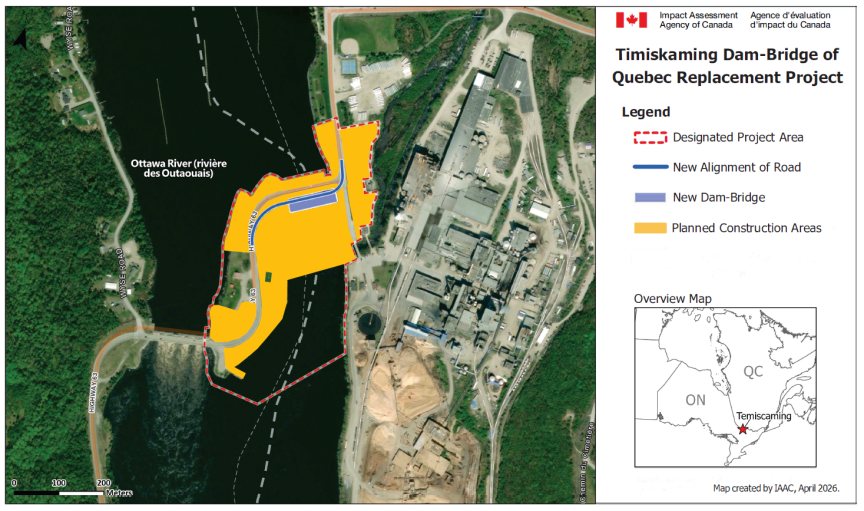
Figure 1 - Text version
Map showing the Timiskaming Dam Bridge of Quebec Replacement Project area, including the new dam bridge, the new road alignment, and planned construction areas. The map shows the project location along the Ottawa River between Ontario and Quebec, in the town of Temiscaming.