
Crawford Nickel Project
Crawford Nickel Project
Draft Impact Assessment Report
Document reference number: 195
May 2026
© His Majesty the King in Right of Canada, as represented by the Minister of the Environment, Climate Change and Nature, 2026.
This publication may be reproduced for personal or internal use without permission, provided the source is fully acknowledged. However, multiple copy reproduction of this publication in whole or in part for purposes of redistribution requires the prior written permission from the Impact Assessment Agency of Canada, Ottawa, Ontario K1A 0H3, or information@iaac-aeic.gc.ca.
This document has been issued in French under the title: Projet nickélifère Crawford – Version provisoire du rapport d'évaluation d'impact
Executive Summary
The Impact Assessment Agency of Canada (IAAC) conducted an impact assessment of the Crawford Nickel Project (the project) proposed by Canada Nickel Company (the proponent) according to the requirements of the Impact Assessment Act (the IAA). The proponent is proposing the construction, operation, decommissioning, and abandonment of an open-pit nickel-cobalt mine and on-site metal mill, located 42 kilometres north of Timmins, Ontario. As proposed, the project would have a mine ore production capacity of 240,000 tonnes per day and a mill ore input capacity of 120,000 tonnes per day. The project would operate for about 41 years.
The impact assessment process was carried out in cooperation with the Province of Ontario, in accordance with the Cooperation Plan. Ontario regulates certain aspects of the project through class environmental assessments pursuant to the Environmental Assessment Act and through various environmental permits and approvals. Collaboration included information sharing and consideration of mitigation measures that Ontario would ensure are implemented.
In addition to the province, IAAC worked with others to assess the likely effects of the project.
- IAAC consulted and engaged with Indigenous communities throughout the impact assessment, as described in the Indigenous Engagement and Partnership Plan and in a manner consistent with Canada's commitment to reconciliation and the principles of free, prior and informed consent. IAAC collaborated with Indigenous communities on resolution of key issues and considered Indigenous Knowledge that was provided to inform the assessment. While the goal of the impact assessment was for all parties to agree upon the conclusions based on a collaborative process, IAAC included the perspectives of all Indigenous communities to be considered in decision-making.
- IAAC worked with the proponent, considering information presented in the Impact Statement and other submissions.
- IAAC considered expert advice from federal authorities, including Employment and Social Development Canada (ESDC), Environment and Climate Change Canada (ECCC), Federal Economic Development Agency for Northern Ontario (FEDNor), Fisheries and Oceans Canada (DFO), Health Canada (HC), Indigenous Services Canada (ISC), Natural Resources Canada (NRCan), Transport Canda (TC), and Women and Gender Equality Canada (WAGE).
- IAAC engaged with the public, inviting comments at various points during the impact assessment, and considered input received including community knowledge.
This draft Impact Assessment Report (draft IA Report) provides information about the impact assessment and sets out IAAC's rationale and conclusions. It also provides a summary of the consultation process with Indigenous Peoples that was conducted to meet the duty to consult.
IAAC's impact assessment took into account the project's likely non-negligible "adverse effects within federal jurisdiction" and "direct or incidental adverse effects" (as defined in section 2 of the IAA and collectively referred to as "adverse federal effects"). IAAC considered a range of effects pathways that could result in adverse federal effects. For example, IAAC considered how changes to water quality could be a pathway to an adverse federal effect on the health conditions of Indigenous Peoples. The report is focused on adverse federal effects and effects pathways that are key issues. Where likely residual adverse federal effects are predicted to occur, that is, effects remaining after the implementation of mitigation measures (including measures ensured by another jurisdiction), IAAC assessed cumulative adverse federal effects. Cumulative adverse federal effects include those that are likely to result from the residual effects of the project interacting with the effects from other past, present or likely future projects and activities. IAAC's conclusions regarding the likelihood of significance of adverse federal effects are summarized in Table 1. While the effects are typical for a metal mine, IAAC's conclusions about effects reflect the scale of the project.
|
Adverse federal effect |
IAAC's conclusion |
|---|---|
|
Effects on fish and fish habitat |
Residual effects are likely to be significant to a moderate extent, due to the large geographic extent of habitat loss, potential effects to fish health from changes to water quality, and the risk of injury or mortality during a major dewatering event. Uncertainty in the amount of habitat loss, the technical feasibility of proposed offsets, and the extent of water quality changes informed this conclusion. Cumulative effects are likely to be significant to a low extent due to changes in water quality from another mine upstream of the project. |
|
Effects on migratory birds |
Residual effects are likely to be significant to a moderate extent, due to the large geographic area from which birds would be displaced and effects from concentrating individuals in the remaining habitat. Cumulative effects are likely to be significant to a low extent due to forestry-related displacement that could further concentrate the remaining individuals. |
|
Direct or incidental adverse effects (effects on wetlands from authorizations under the Fisheries Act and amendments to Schedule 2 of the Metal and Diamond Mine Effluent Regulations) |
Direct or incidental residual effects on wetlands are likely to be significant to a low extent, taking into account the local and regional abundance of similar wetlands. Cumulative effects are likely to be significant to a low extent due to other local mining activities. |
|
Effects on the physical and cultural heritage (including structures, sites or things of historical, archaeological, paleontological or architectural significance) of Indigenous Peoples |
Residual effects are likely to be significant to a low extent, due primarily to the loss of culturally significant sites within the project area. Cumulative effects are likely to be significant to a low to moderate extent due to ongoing resource development in the area contributing to the loss of culturally significant sites and longer-term effects to cultural continuity. |
|
Effects on the current use of lands and resources for traditional purposes by Indigenous Peoples |
Residual effects are likely to be significant to a low extent, due primarily to a large loss of lands that supports harvesting and other land uses and potential avoidance due to change in experience on the land. Cumulative effects are likely to be significant to a moderate extent due to ongoing resource development in the area, further contributing to the loss of lands and resources and avoidance of harvesting country foods. |
|
Effects to the health, social or economic conditions of Indigenous Peoples |
Residual effects to the social and economic conditions of Indigenous Peoples are likely to be significant to a low extent, due primarily to strains on local services and infrastructure. Cumulative effects are likely to be significant to a low to moderate extent due to strains on services and infrastructure from ongoing resource development in the area. |
The impact assessment also took into account the adverse federal effects of malfunctions and accidents that may occur in connection with the project.
Once this draft IA Report is finalized, it will be provided to the Minister of Environment, Climate Change and Nature (the Minister). The Minister will decide if the adverse federal effects indicated in the IA Report are likely to be significant, and if so, the extent of their significance. If applicable, the Minister will then decide if the significant adverse federal effects are justified in the public interest based on the effects described in this report and the three decision-making factors set out in section 63 of the IAA. Table 2 identifies these factors and presents IAAC's summary conclusions regarding these factors. Alternatively, the Minister may pass these decisions to the Governor in Council.
|
Factor |
IAAC's conclusion |
|---|---|
|
The impact that the likely effects of the project may have on any Indigenous community and any adverse impact that those effects might have on Indigenous Peoples' exercise of rights (Sections 4.2 and 4.3) |
The project is likely to have positive economic impacts for Indigenous Peoples, in addition to the adverse federal effects on Indigenous Peoples described above. The project is likely to cause adverse impacts to the exercise of Indigenous Peoples' rights as recognized and affirmed by section 35 of the Constitution Act, 1982. Specifically, IAAC considered the right to hunt and trap, fish, harvest plants, cultural continuity, and governance. |
|
The extent to which the likely effects of the project contribute to the Government of Canada's ability to meet its environmental obligations and its commitments in respect of climate change (Sections 4 and 5) |
The likely effects of the project do not contribute to meeting Canada's environmental obligations, specifically as it relates to biodiversity, as adverse effects of the project on fish, birds, wildlife, wetlands and species at risk are predicted to remain after mitigation. Any potential positive contribution of the likely effects of the project to Canada's climate change commitments is uncertain and not yet demonstrated. The project is likely able to achieve net zero greenhouse gas emissions by 2050, but it will not contribute to short-term emission targets for 2030, and it is uncertain whether project effects will enable downstream domestic emissions reductions. |
|
The extent to which the likely effects of the project contribute to sustainability (Section 6) |
The likely effects of the project would result in net positive contributions to sustainability to a low to moderate extent. The project effects are likely to strengthen Canada's role in critical mineral production and support long-term economic resilience for current and future generations. However, the project would also result in adverse effects on traditional Indigenous practices and knowledge transfer, and could place strain on the social well-being of Indigenous Peoples. The project's economic benefits for Indigenous communities and the region are expected to help reduce adverse effects on Indigenous Peoples. |
A comment period is being held on this draft IA Report, along with draft potential conditions. Following the comment period, IAAC will finalize this IA Report and potential conditions to support decision-making.
In addition to the impact assessment, the project is expected to require federal permits for specific activities including: authorizations under the Fisheries Act for any activities that are likely to result in the death of fish and/or harmful alteration, disruption or destruction of fish habitat; amendments to Schedule 2 of the Metal and Diamond Mining Effluent Regulations for the use of waters frequented by fish for storage of mine waste; authorizations under the Canadian Navigable Waters Act for activities that may impact navigation of navigable waters; and potentially a permit under the Species at Risk Act for any species at risk migratory bird residences that are protected year-round, if found). If it is decided that any likely significant adverse federal effects are justified in the public interest, IAAC will help coordinate the federal permits required for construction of the project.
On this page
- Executive Summary
- List of tables
- List of figures
- List of abbreviations and acrony
- Glossary
- 1 Introduction to the project and impact assessment process
- 2 Biophysical adverse federal effects
- 3 Malfunctions and accidents
- 4 Impacts on Indigenous Peoples and their Exercise of Rights
- 5 Extent to which project effects contribute to Canada's environmental obligations
- 6 Extent to which project effects contribute to Canada's climate change commitments
- 7 Extent to which project effects contribute to sustainability
- 8 Decision making and next steps
- Annexes
List of tables
- Table 1: IAAC's conclusions on adverse federal effects
- Table 2: IAAC's conclusions regarding factors to be taken into account in considering whether significant adverse federal effects are justified in the public interest
- Table 3: Categories used to characterize the extent to which the adverse federal effects are significant
- Table 4: Summary of IAAC's recommended mitigation measures and follow-up program for implementation by the proponent pertaining to fish and fish habitat
- Table 5: Summary of IAAC's recommended mitigation measures and follow-up program measures pertaining to migratory birds
- Table 6: Summary of IAAC's recommended mitigation measures and follow-up program for implementation by the proponent pertaining to malfunctions and accidents
- Table 7: Summary of IAAC's recommended mitigation measures and follow-up program measures pertaining to effects on the physical and cultural heritage of Indigenous Peoples
- Table 8: Summary of IAAC's recommended mitigation measures and follow-up program measures pertaining to effects on the current use of lands and resources for traditional purposes by Indigenous Peoples
- Table 9: Summary of IAAC's recommended mitigation measures and follow-up program measures pertaining to changes to the health, social and economic conditions of Indigenous Peoples
- Table 10: Expected benefits and cost of the project to current and future generations.
- Table 11: Consideration of section 22 factors
- Table 12: Rating criteria for magnitude
- Table 13: Rating criteria for geographic extent (applicable to all effects)
- Table 14: Rating criteria for timing (applicable to all effects)
- Table 15: Rating criteria for frequency (applicable to all effects)
- Table 16: Rating criteria for duration (applicable to all effects)
- Table 17: Rating criteria for reversibility (applicable to all effects)
- Table 18: Rating criteria for social and ecological context (applicable to all effects)
- Table 19: Rating criteria for uncertainty (applicable to all effects)
- Table 20: Summary of Assessment of Residual Impacts on Apitipi Anicinapek Nation from the Project
- Table 21: Summary of comments received and IAAC's response
- Table 22: Species of importance identified by Indigenous communities
List of figures
- Figure 1: Project Location and Major Components
- Figure 2: Project Site Plan
- Figure 3: Local and regional study areas for fish and fish habitat
- Figure 4: Findings of the 2023 Cumulative Effects Study in AAN Territory (High Impact Scenario)
List of abbreviations and acronyms
- AAN
- Apitipi Anicinapek Nation
- ARD
- Acid rock drainage
- CCME CWQG-FAL
- Canadian Council of Ministers of the Environment Canadian Water Quality Guidelines for the Protection of Aquatic Life
- COPCs
- Contaminants of Potential Concern
- DFO
- Fisheries and Oceans Canada
- ECA
- Environmental Compliance Approval
- ECCC
- Environment and Climate Change Canada
- EEM
- Environmental Effects Monitoring
- ESDC
- Employment and Social Development Canada
- FEDNor
- Federal Economic Development Agency for Northern Ontario
- HC
- Health Canada
- IAA
- Impact Assessment Act
- IAAC
- Impact Assessment Agency of Canada
- IA Report
- Impact Assessment Report
- IEPP
- Indigenous Engagement and Partnership Plan
- ISC
- Indigenous Services Canada
- LSA
- Local Study Area
- MCM
- Ministry of Citizenship and Multiculturalism
- MDMER
- Metal and Diamond Mining Effluent Regulations
- MECP
- Ministry of the Environment, Conservation and Parks
- MEM
- Ministry of Energy and Mines
- Minister
- Minister of the Environment, Climate Change and Nature
- ML
- Metal leaching
- MNR
- Ministry of Natural Resources
- NO2
- Nitrogen dioxide
- NRCan
- Natural Resources Canada
- OAAQC
- Ontario's Ambient Air Quality Criteria
- Ontario
- Government of Ontario
- PA
- Project Area
- project
- Crawford Nickel Project
- proponent
- Canada Nickel Company
- PWQO
- Provincial Water Quality Objectives
- RSA
- Regional Study Area
- Registry Internet Site
- Canadian Impact Assessment Registry Internet Site
- TC
- Transport Canada
- WAGE
- Women and Gender Equality Canada
- 2SLGBTQQIA+
- Two-spirit, lesbian, gay, bisexual, trans, queer, questioning, intersex, asexual plus
Glossary
The table below defines or explains key terms or phrases that are used in this draft IA Report. Refer to section 2 of the Impact Assessment Act for key terms that are defined under that Act.
- Abandonment
- The phase of the project after passive closure once water quality meets criteria for discharge to the environment, at which time the remainder of water management infrastructure would be removed.
- Acid rock drainage
- Some rocks, typically those containing an abundance of sulphide minerals, when exposed to water and air, can generate water which is more acidic than the natural surrounding environment. Often associated with metal leaching.
- Active closure (Decommissioning Phase 1)
- The phase of the project which would include removing infrastructure, covering the impoundment facility and stockpiles with remaining overburden, revegetating the footprint to support habitat restoration, and the start of flooding of the open pits. Activities would take approximately five years.
- Adaptive management
- Adaptive management, in the context of impact assessment, is a planned and systematic process to respond to uncertainty around predicted project effects or the effectiveness of mitigation measures. It ensures timely and meaningful actions (often referred to as contingency measures) are taken to respond to adverse outcomes and allows for learning from the results of the actions that are taken. Adaptive management plans for specific issues can be required in addition to a follow-up program.
- Adverse federal effects
- Collectively refers to two types of non-negligible effects defined in section 2 of the Impact Assessment Act, summarized here:
- "adverse effects within federal jurisdiction" (includes non-negligible adverse effects caused by a project to fish and fish habitat; to marine plants (which are included in addition to fish as "aquatic species"); to migratory birds; to the marine environment outside of Canada caused by pollution; to boundary waters, international waters, and interprovincial waters caused by pollution; to the environment on federal lands; to Indigenous Peoples; and the adverse effects of any federal work or undertaking or activity occurring on federal lands); and
- "direct or incidental adverse effects" (such as non-negligible adverse effects directly linked or necessarily incidental to a federal permit required for the project).
- Care and maintenance
- A stage in the lifecycle of a mining project where operations have temporarily ceased, but the site is maintained in a stable condition with the intent to resume production in the future.
- Construction
- The phase of the project during which physical activities would be undertaken that consist of preparing the site and constructing the mine infrastructure needed for initial operations (e.g., water management facilities, first ore processing plant, on-site roads, impoundment facility, initial ore stockpiles, rail spur, a temporary Highway 655 bypass), as well as initial open-pit mining. Activities would take place over approximately three years.
- Contact water
- Surface water or groundwater that has contacted project components within the mine site.
- Contaminants of potential concern
- Any chemical substance for which the concentration in an environmental medium (e.g., air, water, soil) may have the potential to cause adverse effects in receptors.
- Critical habitat
- Habitat that is necessary for the survival or recovery of a listed wildlife species that is identified as the species' critical habitat in the recovery strategy or in an action plan for the species (Species at Risk Act (section 2(1)).
- Cumulative effects
- Effects likely to result from the project's residual effects in combination with other physical activities that have been or will be carried out.
- Deleterious substance
- As defined in section 34(1) the Fisheries Act, summarized here:
- any substance that, if added to any water, would alter the quality of water so that it is rendered deleterious to fish or fish habitat, or use by people of fish
- any water that contains a substance in such quantity or concentration, or otherwise changed from a natural state that it would, if added to any other water, would be rendered deleterious
- Duration
- When used to describe a residual adverse federal effect:
The period of time over which a residual effect would occur. This may be longer than the duration of the physical work or activity that produced the potential residual effect. - Effect pathway / Pathway of effect
- A cause-and-effect linkage between a project and a valued component.
- Effluent
- Contact water that is released from the mine site to the external environment, including controlled, treated effluent and uncontrolled effluent (run-off and seepage that is not contained).
- Extent of significance
- A characterization of the extent to which the residual effects after the application of mitigation measures, are significant as defined in Table 3.
- Frequency
- When used to describe a residual adverse federal effect:
How often the residual effect would occur during a project phase or activity in a specific time period. - Geographic extent
- When used to describe a residual adverse federal effect:
The spatial boundaries within which the residual effect is expected to occur. - Gender-based Analysis Plus
- A process used to assess how diverse groups of women, men and non-binary people may experience policies, programs, initiatives, or the effects of the project. The "plus" includes other identity factors beyond sex and gender such as race, ethnicity, religion, age, and mental or physical disability.
- Impoundment facility
- The primary material storage area designed to manage and segregate non-ore materials generated onsite into stockpiles of waste rock, sand, till, and clay.
- Indigenous Knowledge
- A body of knowledge built up by a group of Indigenous Peoples through generations of living in close contact with the land.
- Indigenous rights
- Aboriginal and/or treaty rights, as recognized and affirmed under Section 35 of the Constitution Act, 1982.
- In-Process Tailings Carbonation
- An active carbon sequestration process where concentrated carbon dioxide is injected into the mine's tailings slurry during processing, before tailings are discharged to ultimately store carbon.
- Magnitude
- When used to describe a residual adverse federal effect:
The degree or change in a measurable parameter or variable relative to baseline conditions. - Metal leaching
- The release of metals from rocks, site materials and pit walls exposed to water and air, which can increase the concentrations of these metals in contact water. Often associated with acid rock drainage.
- Mine site
- The geographic area overprinted by mining-related components (e.g., open pit, ore processing plants, tailings management facility, impoundment facility, stockpiles, water management facilities). Refer also to "project footprint".
- Mixing zone
- An area where water quality temporarily exceeds PWQO or CCME CWQG-FAL criteria.
- Operations
- The phase of the project during which would include open-pit mining, ore processing, construction of the remaining mine infrastructure (e.g., North Driftwood River Diversion Channel, second processing plant, Highway 655 and transmission line relocation), mine waste and water management, and progressive rehabilitation. Activities would take approximately forty-one years.
- Ore
- A natural rock or sediment that contains one or more valuable minerals, such as metals, that can be mined and processed to extract the valuable mineral.
- Overburden
- Material overlying the ore deposit, including rock, soil, and other unconsolidated (i.e., loose) materials.
- Passive closure (Decommissioning Phase 2)
- The phase of the project after rehabilitation which would include long-term environmental monitoring, any required closure maintenance, and continued natural filling of the open-pit lake, which may take more than 100 years.
- Particulate matter (PM10)
- Airborne particles with diameters of 10 micrometres or less.
- Fine particulate matter (PM2.5)
- Airborne particles with diameters of 2.5 micrometres or less.
- Migratory birds
- Birds identified and protected by the Migratory Birds Convention Act and listed in the schedule to that Act.
- Modelled Mine Boundary
- The geographic area that the proponent will own, lease, or have agreements in place with the owners that would enable the proponent to restrict access to the public if required. This area would provide a buffer around the project footprint where any seasonal or permanent housing will be avoided, and no overnight stays would be possible.
- Project footprint
- The geographic area overprinted by mining-related project components at the mine site, as well as the portion of the relocated transmission line and Highway 655, North Driftwood River Diversion Channel, and new rail spur. Refer also to "mine site" and "modelled mine boundary".
- Process water
- Water that is added to the crushed ore during mineral extraction at the processing plants.
- Residual effect
- An expected effect of the project that is predicted to remain after the application of mitigation measures.
- Reversibility
- When used to describe a residual adverse federal effect:
Whether the residual effect on conditions for the valued component can be returned to their previous condition or other target once the activity or component causing the disturbance ceases. - Seepage
- The slow movement of water through soil, rock, or engineered mine structures due to gravity and hydraulic pressure.
- Seepage face
- An area where groundwater discharges into the environment including into surface water.
- Species at risk
- Any species listed in Schedule 1 of the Species at Risk Act.
- Social and ecological context
- When used to describe a residual adverse federal effect: Takes into account existing pressures on the environment, or on social, economic, and health conditions which affect the sensitivity or resilience of a valued component.
- Source terms
- Quantitative descriptions of how, where, and the rate a chemical constituent is released from a solid phase into the surrounding environment. Source terms are used in models to predict the movement of contaminants over time.
- Tailings
- The mixture of depleted ore material, water, and residual chemicals generated during mineral processing.
- Timing
- When used to describe a residual adverse federal effect:
Consideration of the periods of time during which a residual effect is expected to occur and overlap with sensitive periods. - Uncertainty
- When used to describe a residual adverse federal effect:
The degree of variation anticipated from the predicted effect based on the scientific uncertainty related to the data, methods, assumptions, and modelling used in the assessment of effects. - Valued component
- An element of the natural or human environment that may be impacted by the project and is of value to participants.
- Vulnerable subpopulations
- Specific segments of the population that may experience disproportionate impacts from the project due to existing inequities (e.g., Indigenous Peoples, children, seniors, low-income individuals, women and gender-diverse groups).
- Waste rock
- Excavated, unprocessed non-ore rock that is extracted during the mining process.
- Water management facilities
- The infrastructure designed to collect, store, treat, and discharge water across the mine site. This includes water diversions, collection ditches and ponds, treatment plants, and pipes.
- Wetland function
- The natural processes and derivation of benefits and values associated with wetland ecosystems.
1 Introduction to the project and impact assessment process
The Impact Assessment Agency of Canada (IAAC) conducted a federal impact assessment of the Crawford Nickel Project (the project) proposed by Canada Nickel Company (the proponent) according to the requirements of the Impact Assessment Act (the IAA).
1.1 Project description
The proponent is proposing the construction, operation, decommissioning and abandonment of an open-pit nickel-cobalt mine and on-site metal mill, located 42 kilometres north of Timmins, Ontario. As proposed, the project would have an ore production capacity of 240,000 tonnes per day and a mill ore input capacity of 120,000 tonnes per day. The project would operate for about 41 years.
The project includes an open pit, two ore processing plants, ore stockpiles, a tailings management facility, and an impoundment facility for excess waste rock, clay, sand and till stockpiles. Water management facilities would include water diversions, collection ditches and ponds, treatment plants, and pipes. Effluent would be discharged along the North Driftwood River (a tributary of the Abitibi River) and the West Buskegau River (a tributary of the Frederick House River). A 7.7 km diversion channel would reroute a portion of the North Driftwood River that overlaps with the project footprint. A 25-kilometre rail spur would connect the mine site to existing rail infrastructure. Approximately 30 kilometres of Highway 655 and an existing 500-kilovolt transmission line would be relocated to the west of the mine site.
The project would be one of the largest base metal mines in Canada, at approximately 118 square kilometres. At its longest dimensions, the mine site would extend approximately 14 kilometres north to south and 7 kilometres east to west. The open pit would have two separate zones and would be up to 690 metres deep. The impoundment facility rock pile would be up to 115 metres high.
As proposed, the project would produce nickel and magnetite concentrate with applications for various industrial and consumer goods such as batteries and stainless-steel production. Cobalt, platinum, palladium, and chromium would also be recovered. The project is being proposed to help meet the increasing demand for critical minerals to support clean growth technologies. The proponent also intends for the project to serve as a carbon storage hub by sequestering carbon on site through In-Process Tailings Carbonation. As the primary purpose of the project is to extract and process critical minerals from the defined ore body, there are no alternatives to the project other than to not proceed.
The project would consist of the following main phases:
- Construction (approximately three years) would include preparing the site and constructing the infrastructure needed for initial operations (e.g., water management facilities, on-site roads, one ore processing plant, tailings management facility, impoundment facility, rail spur, temporary Highway 655 bypass). The construction phase would also include some initial open-pit mining and initial ore stockpiles.
- Operations (approximately 41 years) would include open-pit mining and ore processing, mine waste and water management, construction of the remaining infrastructure (e.g., North Driftwood River Diversion Channel, second ore processing plant, relocated Highway 655 and transmission line), and progressive rehabilitation. Tailings would be deposited in the tailings management facility until it is full (approximately seventeen years into operations) and then into the open pit as each zone is exhausted. Approximately thirty years into operations mining would be complete and ore processing would continue.
- Decommissioning would occur over two phases:
- Active closure (Decommissioning Phase 1) (approximately five years) would include removing infrastructure, covering the impoundment facility and stockpiles with remaining overburden, revegetating the footprint to support habitat restoration, and the start of filling of the open pit with water.
- Passive closure (Decommissioning Phase 2) would include long-term environmental monitoring, any required closure maintenance, and continued filling of the open-pit lake, which may take more than 100 years.
- Abandonment would occur once water quality meets criteria for discharge into the environment, at which time the remainder of water management infrastructure would be removed.
The project location and major project components are depicted in Figure 1. The project site plan is depicted in Figure 2.
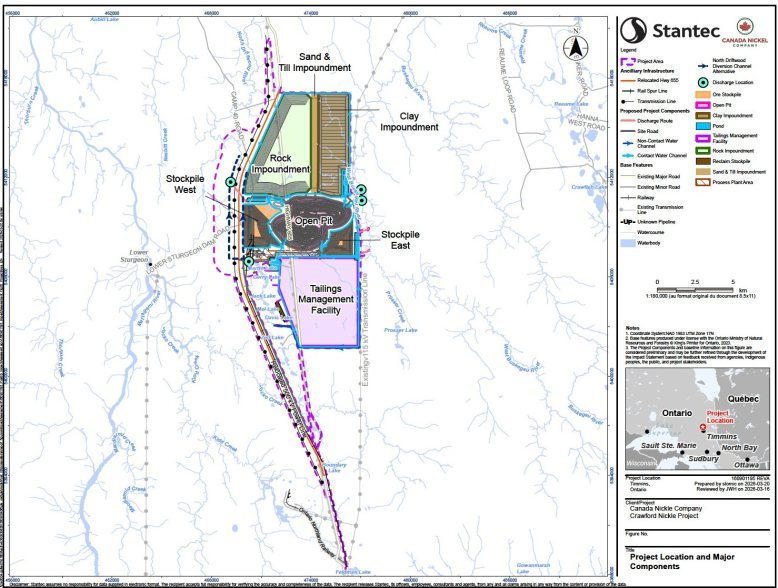
SOURCE: CANADA NICKEL COMPANY
Figure 1 - Text version
The Crawford Nickel Project would be situated in northern Ontario approximately 42 kilometres north of Timmins along Highway 655.
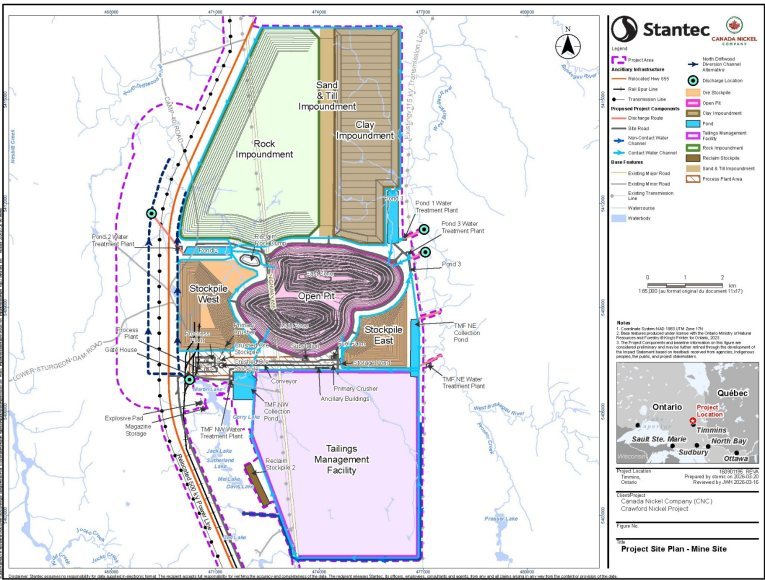
SOURCE: CANADA NICKEL COMPANY
Figure 2 - Text version
The mine site for the Crawford Nickel Project is centred around the open pit and includes an impoundment facility (to the north), ore stockpiles (to the west and east), and a tailings management facility (to the south). The project includes the relocation of a portion of Highway 655 and a 500-kilovolt transmission line to the west edge of the mine site. A diversion channel would reroute a portion of the North Driftwood River that would be overprinted by the project, around the west edge of the mine site. A new rail spur would be constructed to the south of the project, parallel to Highway 655, and connect to existing rail infrastructure. Effluent would be discharged along the North Driftwood River and West Buskegau River.
1.2 Impact assessment process, scope and considerations
IAAC conducted an impact assessment of the project. The assessment started on March 31, 2023, and included the following:
- IAAC issued Tailored Impact Statement Guidelines to the proponent on March 31, 2023, which set out the scope of the assessment and described the information and studies required. Following amendments to the IAA, IAAC issued a letter to the proponent on December 19, 2024 clarifying its focus on key issues relevant to decision-making.
- The proponent prepared an Impact Statement, which was reviewed by IAAC, federal authorities (i.e., federal departments or agencies with specialist or expert information or knowledge), Indigenous communities, the public, and the province. IAAC provided the proponent with focused comments on the Impact Statement, based on input received during the review process. The proponent then provided responses to the comments.
- IAAC prepared this draft IA Report, which describes the impact assessment and presents IAAC's rationale and conclusions. In preparing the draft IA Report, IAAC considered multiple sources of information, including the proponent's Impact Statement and supporting documents, Indigenous Knowledge and other input provided by Indigenous communities, comments from the public, and input from federal and provincial authorities.
The impact assessment process was carried out in cooperation with the Government of Ontario, in accordance with the Cooperation Plan. Ontario regulates certain aspects of the project through class environmental assessments pursuant to the Environmental Assessment Act and through various environmental permits and approvals. Collaboration included information sharing and the consideration of mitigation measures that Ontario would ensure are implemented. To address potential adverse federal effects, IAAC considered likely measures and regulatory outcomes from federal and provincial regulatory oversight. Further, IAAC considered complementary measures (i.e., initiatives, programs, and plans) of government jurisdictions (including federal, provincial, and municipal) to address potential adverse federal effects.
1.2.1 Effects assessment
Based on the information made available through the impact assessment, the project would likely cause the following effects to the environment, and to health, social, and economic conditions:
- Adverse effects to:
- groundwater and surface water;
- air quality and acoustic environment;
- geology and soil;
- vegetation, riparian areas and wetlands;
- fish and fish habitat;
- birds, terrestrial wildlife and habitat, including species at risk listed on Schedule 1 of the Species at Risk Act;
- access to lands;
- navigability of waterways;
- heritage resources;
- visual landscape and experience on the land; and
- positive and adverse effects to health, social, and economic conditions.
From among these effects, this report identifies and provides information on the adverse effects within federal jurisdiction and direct or incidental adverse effects from the project as defined in Section 2 of the IAA (collectively referred to in this report as "adverse federal effects"), as well as other effects that may inform decision-making.
The likely adverse federal effects of the project are listed below and set out in Sections 2 and 4 of this report:
- Effects to fish and fish habitat
- Effects to migratory birds
- Direct or incidental adverse effects to wetlands
- Effects to the physical and cultural heritage of Indigenous Peoples and to structures or things of historical, archaeological, paleontological or architectural significance to Indigenous Peoples
- Effects to the current use of lands and resources for traditional purposes by Indigenous Peoples
- Effects to the health, social, and economic conditions of Indigenous Peoples
Where effects could fall into more than one of the categories listed above, IAAC assessed them in a single category. For example, effects to fish and fish habitat are considered within its own section of the report and not duplicated in the assessment of direct or incidental effects. As applicable, the result of interactions between effects informed the analysis in Sections 2 to 7 of this report.
IAAC did not scope into the assessment the following adverse federal effects (as defined in section 2 of the IAA) as the project is not near any federal lands, is not a federal work or undertaking, and is not proximal to a marine or boundary water:
- Effects to the environment on federal lands
- Effects to the marine environment outside of Canada caused by pollution
- Effects to boundary waters, to international waters, and to interprovincial waters caused by pollution
- Other effects resulting from activities occurring on federal lands
- Other effects from a federal work or undertaking
IAAC considered likely effect pathways that could lead to adverse federal effects and may be relevant to decision-making. For example, IAAC considered how changes to groundwater levels could be a pathway to effects to fish and fish habitat (adverse federal effects). This report focuses on adverse federal effects and effect pathways that are key issues. The depth of assessment for each pathway was commensurate with the risk of effect; that is, the greater the risk, the greater the level of information and analysis used to inform the assessment.
In addition to adverse federal effects, IAAC considered effects that could support decision-making by the Minister or Governor in Council at the end of the impact assessment process. Specifically, this included information related to:
- the effects of the project on Indigenous groups (positive and adverse) and adverse impacts to the rights of Indigenous Peoples,
- the extent to which the likely effects of the project contribute to the Government of Canada's ability to meet its environmental obligations and its commitments in respect of climate change; and
- the extent to which the likely effects of the project contribute to sustainability.
1.2.2 Other factors considered in the impact assessment
In concluding the impact assessment, IAAC considered the factors described in section 22 of the IAA to the extent of their relevance to the impact assessment. IAAC's consideration of all section 22 factors in preparing this IA Report is found in Annex 1. Additional information on some factors is provided below.
Malfunctions and accident scenarios
IAAC considered the effects of malfunctions and accidents that may occur in connection with the project including:
- tailings management facility dam failure leading to release of tailings;
- water management facility failure leading to release of untreated contact water;
- stockpile slope failure leading to release of ore, rock, clay, and sand;
- release of fuel (e.g., diesel, gasoline) or hazardous materials (e.g., reagents, solvents, hydraulic fluid, nickel concentrate) from spills, traffic collisions, or train derailment; and
- accidental fires from equipment malfunction and rail traffic; and
- water diversion channel (e.g. North Driftwood River Diversion Channel) failures from erosion.
Of the scenarios identified, a water diversion channel failure was pre-cautiously considered likely to occur at least once over the project's lifespan, pending design and mitigation, based on technical uncertainties in the design of the North Driftwood River Diversion Channel. The adverse federal effects of this scenario are considered in Section 2.1. The adverse federal effects of unlikely malfunction and accident scenarios are considered in Section 3.
IAAC also considered the effects of an open-pit slope failure leading to unintentional expansion of the pit, or an over-blasting incident causing greater than intended explosion, but given that these would be restricted to the open pit area within the project footprint, IAAC did not identify any related adverse federal effects. As a result, these scenarios are not considered further in this report.
Effects to the project caused by the environment
IAAC considered potential effects of the environment on the project, such as severe natural events (e.g., extreme precipitation/snowmelt, drought), including how these could act as contributing or complicating factors for malfunctions and accidents. The main focus was on the potential effects of extreme precipitation events on the water management facilities (collection ponds, ditches) and the tailings management facility dam (refer to Section 3 for more information).
Furthermore, the baseline conditions that informed the assessment included consideration of how environmental conditions could change due to climate change, where relevant. A key consideration was the potential for climate change and drought to cause low-flow conditions in rivers where effluent discharge is planned, and the resulting potential effects on fish health (refer to Section 2.1 for more information).
Other projects considered in the cumulative effects assessment
IAAC considered how the likely residual adverse federal effects of the project could interact with effects from other past, present or likely future physical activities to cause cumulative effects. The other physical activities considered were:
- mining and mineral exploration activities;
- forest management activities; and
- transmission infrastructure.
IAAC also considered the broader history of resource development within the Timmins area identified by Indigenous Peoples. As applicable, the cumulative effects of the project in combination with other physical activities are discussed in Sections 2.1 to 2.3, 4.2, and 4.3 of this report.
Alternative means of carrying out the project
IAAC considered the alternative means of carrying out the project identified by the proponent as technically and economically feasible as well as the effects of those means. It also considered the proponent's rationale for its preferred means of carrying out key project elements.
Table 1 of the proponent's Summary of the Impact Statement outlines the alternative means considered by the proponent in accordance with the Tailored Impact Statement Guidelines and reasons for selecting each preferred alternative. This was informed by the proponent's assessment of the adverse effects of alternative means on the natural environment, social and economic conditions, and Indigenous Peoples. Partial disposal of tailings in the open pit was selected, instead of fully above-ground disposal, to minimize the project footprint. Transportation of metal concentrates by rail was selected over transportation by road to reduce vehicular emissions and traffic. Of particular note in relation to IAAC's assessment of federal effects, the proponent considered multiple effluent discharge locations (Section 2.1) and worker accommodation strategies (Section 4.2.3).
Gender-based Analysis Plus
IAAC applied Gender-based Analysis Plus to inform its assessment of the project's potential adverse federal effects and its consideration of information that could inform federal decision-making. As applicable, the differential effects of the project on diverse populations, including intersecting identity factors, were identified and considered in Section 4.2.3 of this report.
1.2.3 Criteria for significance of likely adverse federal effects
Taking into consideration the recommended mitigation measures, IAAC assessed whether there are residual adverse federal effects of the project (i.e., adverse federal effects that are likely to remain after taking into account the implementation of recommended mitigation measures). Where there are residual effects, IAAC also assessed cumulative effects that are likely to result from the project in combination with other physical activities that have been or will be carried out.
IAAC described the residual adverse effects and cumulative effects using the rating criteria defined in Annex 2. IAAC drew conclusions on whether those effects are likely to be significant, and if so, characterized the extent to which effects are likely to be significant. Table 3 presents information about the criteria used to determine whether and to what extent adverse federal effects are likely to be significant. Table 3 also describes non-exhaustive examples of rating criteria combinations.
|
Extent of significance |
Description |
|---|---|
|
Not significant |
Effect is sufficiently small that it does not individually or cumulatively have a significant effect on a valued component and generates no or few impacts in social or ecological contexts. |
|
Low extent of significance |
Effect is significant but low in magnitude, of short duration, infrequent, small in spatial extent, reversible or readily avoided, and generates minor impacts in social or ecological contexts. Mitigation measures may not be required, or would allow baseline conditions to remain largely unchanged such that a valued component is not likely to be diminished or lost. |
|
Moderate extent of significance |
Effect is significant and moderate in magnitude, of moderate duration, occasionally frequent, possibly/partially reversible, and generates a moderate level of impacts in social or ecological contexts. Mitigation measures may not fully eliminate, reduce, control or offset the effect but should prevent severe diminishment or loss of a valued component. |
|
High extent of significance |
Effect is significant and high in magnitude, permanent/long term, frequent, irreversible, and over a large spatial extent or within an area of exclusive/preferred Indigenous use or of ecological/environmental sensitivity. High levels of impacts in social or ecological contexts are expected. There is a high degree of uncertainty of the effectiveness of mitigation measures, or mitigation measures are unable to fully address effects such that a valued component is likely to be severely diminished or lost. |
1.3 Consultation and engagement with Indigenous communities
As set out in the Indigenous Engagement and Partnership Plan (IEPP), IAAC consulted and engaged with Indigenous communities. IAAC also engaged with additional Indigenous communities not listed in the IEPP to better understand potential impacts. Section 4.1 describes the consultation and engagement process carried out over the course of the impact assessment and presents the perspectives of Indigenous communities regarding the process. It also provides information on the Indigenous Knowledge that was provided and was considered by IAAC in conducting the impact assessment. Input from Indigenous communities informed IAAC's assessment and has been incorporated throughout the IA report.
In addition, Apitipi Anicinapek Nation provided a separate report summarizing their assessment of the impacts of the project on the Nation's exercise of rights. This report is provided in Annex 3.
IAAC has made available approximately $1.2 million in grants and contributions to Indigenous communities that it consulted and engaged with to support participation in comment periods, the review of technical documents, participation in meetings with IAAC, and other activities related to the federal assessment.
1.4 Public engagement
As set out in the Public Participation Plan, IAAC engaged the public during the impact assessment and considered their input throughout. Engagement included:
- Virtual and in-person meetings and information sessions
- Comment periods on the Summary of the Initial Project Description, the draft Tailored Impact Statement Guidelines and the draft Public Participation Plan, and the Impact Statement Summary
- Outreach and advertising in local media during comment periods
- Correspondence at key project milestones
IAAC has made available $74,788 in participant funding to help the public participate in the impact assessment.
Written public comments were published on the project page on the Canadian Impact Assessment Registry, subject to privacy, security or confidentiality exceptions. For additional information on which comments remain private and how IAAC protects individual privacy, please refer to IAAC's Submission Policy and Privacy Notice. Annex 4 provides a summary of public comments and IAAC's responses. Input from the public informed IAAC's assessment and is incorporated throughout the IA Report, as applicable.
2 Biophysical adverse federal effects
This section summarizes IAAC's rationale and conclusions related to the assessment of the biophysical adverse federal effects likely to be caused by the carrying out of the project. Adverse effects impacting Indigenous Peoples (also adverse federal effects) are considered in Section 4.
2.1 Fish and fish habitat
The project is likely to cause residual adverse effects to fish and fish habitat through habitat loss from overprinting, habitat alteration from changes to surface water flows, changes to the health of fish from changes to water quality, and the risk of injury or mortality during major dewatering activities. Cumulative effects are also likely to occur due to changes in water quality from another mine upstream of the project. With the implementation of the recommended mitigation measures identified in Table 4, IAAC is of the view that the residual adverse effects of the project on fish and fish habitat are likely to be significant to a moderate extent, and that the cumulative effects of the project, in combination with other physical activities, are likely to be significant to a low extent.
IAAC's assessment of effects to fish and fish habitat focused on key species such as Lake Sturgeon, Northern Pike, White Sucker, Walleye, and the Forage Species Guild (i.e., forage fish; ecologically similar small-bodied species including Brook Stickleback, Northern Peal Dace, Northern Redbelly Dace, Fathead Minnow, and Finescale Dace), as well as the aquatic ecosystems that support them. Indigenous communities emphasized the cultural and subsistence importance of the North Driftwood River, West Buskegau River, and Jocko Creek, highlighting the watercourses as important resources for harvesting.
The project is located within the headwaters of the North Driftwood River, West Buskegau River, and Jocko Creek watersheds. The North Driftwood River and West Buskegau River drain north and contribute to the Abitibi River, while Jocko Creek flows into the Mattagami River, both of which eventually drain into James Bay through the Moose River. Around the project footprint, these rivers are generally 10 to 20 metres wide, fed by low gradient (low energy) tributaries, and are themselves the tributaries of larger downstream rivers. Small lakes (i.e., Martin, Gerry, Mel, Sutherland, Davis) adjacent to the project form the headwaters of the North Driftwood River.
IAAC considered effects for all project phases and in the following areas:
- the Project Area (PA) (i.e., project footprint);
- the Local Study Area (LSA) (i.e., North Driftwood River watershed upstream from its confluence with Nesbit Creek and including the small headwater lakes; West Buskegau River watershed upstream from its confluence with the Buskegau River; Jocko Creek watershed upstream from its confluence with Kidd Creek); and
- the Regional Study Area (RSA) (i.e., North Driftwood River watershed downstream to its confluence with the Abitibi River, Buskegau River watershed downstream to its confluence with the Frederick House River; Jocko Creek watershed downstream to its confluence with the Mattagami River; Mattagami River from Lower Sturgeon Falls Dam downstream to Yellow Falls Dam; Figure 3).
The fish and benthic invertebrate communities of the river systems are typical of those observed in northeastern Ontario. The PA is largely dominated by smaller headwater tributaries that support the small-bodied forage fish, and while large-bodied fish species (e.g., Northern Pike, White Sucker) are present in these areas, they occur seasonally or at much lower densities, primarily as juveniles. The mainstem reaches of the North Driftwood River and West Buskegau River within the PA similarly support predominately forage fish, while large-bodied fish only become more common several kilometres downstream in the LSA where the rivers provide spawning, rearing, and overwintering habitat. The small headwater lakes in the LSA also largely support the small-bodied forage fish.
Lake Sturgeon (specifically the Southern Hudson-Bay James population, a federally listed species of special concern on Schedule 1 of the Species at Risk Act) adults are considered present in the LSA in the North Driftwood River and Jocko Creek, based on Indigenous Knowledge provided during the assessment. The proponent did not observe presence and reported obstacles to fish passage. Fisheries and Oceans Canada (DFO) has advised that this habitat in the LSA is more likely to be used as feeding areas by Lake Sturgeon juveniles or adults rather than more sensitive spawning habitat. Indigenous Knowledge has identified Lake Sturgeon spawning habitat where the Buskegau River meets the Frederick House River within the RSA.
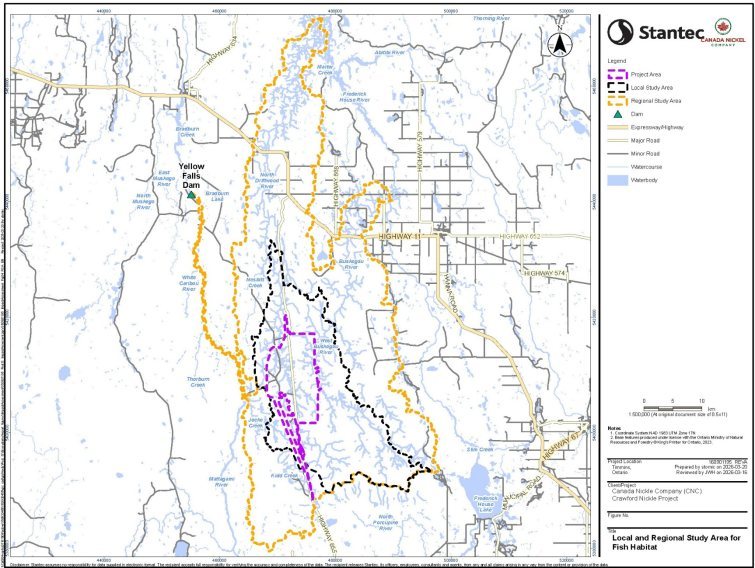
SOURCE: CANADA NICKEL COMPANY
Figure 3 - Text version
A map that delineates the project area and the local study area and regional study area for fish and fish habitat.
Assessment of effects
The project is likely to affect fish and fish habitat in the North Driftwood River, West Buskegau River, Jocko Creek, and associated unnamed headwater tributaries and ponds from loss or alteration of habitat, and risks to fish mortality and health. IAAC is not predicting any effects to the Mattagami River as no controlled effluent would be discharged to the Mattagami River and because any potential changes in stream flow, or water quality from uncontrolled seepage, in Jocko Creek would not extend into the Mattagami River.
Loss or alteration of fish habitat
The project is likely to cause the destruction or alteration of approximately 116 hectares of fish habitat throughout multiple ponds and watercourses, including 70 hectares in the North Driftwood River watershed, 45 hectares in the West Buskegau River watershed, and less than one hectare in the Jocko Creek watershed. This includes the permanent destruction of fish habitat due to overprinting by mine infrastructure, and temporary alteration of fish habitat due to the alteration of stream flows.
Harmful alteration, disruption, or destruction of fish habitat is prohibited under the Fisheries Act, except when authorized by DFO and carried out in accordance with established conditions. Authorization for the loss or alteration of fish habitat would be conditional on a plan to restore habitat and offset losses.
Loss of habitat from overprinting
Direct loss or alteration of 112 hectares of fish habitat in the PA is anticipated including 68 hectares in the North Driftwood River watershed, 44 hectares in the West Buskegau River, and a fraction of a hectare in the Jocko Creek watershed. This loss would result from ongoing development of project components (e.g., the open pit, tailings management facility, impoundment facility) in the construction and operations phases, and the development of the North Driftwood River Diversion Channel in the operations phase.
The majority of habitat loss from overprinting in the PA would be permanent. However, some new habitat would be added with the development of the North Driftwood River Diversion Channel which would redirect the headwaters of the North Driftwood River around and downstream of the major project components through a constructed naturalized 7.7-kilometre diversion channel, which is planned to incorporate natural channel design features.
The overall loss of habitat from overprinting in the PA would likely reduce fish population productivity within the LSA downstream of the PA by removing areas needed for different life stages. It may also affect fish productivity by altering sediment transport, nutrient and food availability, and the quality of downstream habitat.
Alteration of habitat from the alteration of stream flows
Dewatering of the open pit, disruption of surface runoff patterns across the large footprint, and operation of the water management facilities would alter stream flows and result in the indirect loss or alteration of 3.4 hectares of fish habitat in the LSA, downstream of the PA. This would include 2.1 hectares in the North Driftwood River watershed, 0.7 hectares in the West Buskegau River watershed and 0.5 hectares in the Jocko Creek watershed.
Dewatering of the open pit would lower groundwater levels and thereby reduce groundwater discharge to surface water features and reduce surface water flows near the open pit. The geographic extent of drawdown around the open pit is predicted to extend beyond the PA in some areas, including east of the open pit in the West Buskegau River watershed, and primarily extending to the northwest for at least a few kilometres beyond the impoundment facility in the North Driftwood River watershed. Surface water levels would gradually decline as the open pit is excavated with the greatest reduction near the end of operations, prior to progressive recovery once dewatering ceases and the open pit fills. It is predicted that for most surface water features, this change would become reversible throughout passive closure; however, the effect would not be completely reversed until the open pit has been filled and is connected to the North Driftwood River and West Buskegau River via spillways, which may not occur until over 100 years after active closure.
The project would also disrupt the natural water balance of local watersheds as precipitation that would normally runoff into local rivers would be captured by the project's water management facilities during construction and operation, or intercepted by the pit lake during and after closure. This would result in alteration of stream flows and cause effects to fish habitat throughout operations and closure until the pit lake is filled and connected to local rivers as described above. The proponent selected its preferred alternative for effluent management to better mimic natural drainage patterns in local watersheds to minimize this water balance disruption.
ECCC and NRCan identified a high level of uncertainty in the water quantity modelling which could influence the alteration of fish habitat. Specifically, habitat alteration from groundwater drawdown and changes to water balance may be underestimated for magnitude, geographic extent, and duration for the change.
To address uncertainty, the proponent has proposed a conceptual adaptive water management plan intended to minimize adverse effects to fish and fish habitat from flow alterations in the North Driftwood River and West Buskegau River through controlling the volume of effluent released in both rivers. This plan would consider the optimized balance between water quantity and quality in both rivers. Specifics would ultimately be decided through Ontario's Environmental Compliance Approval for Industrial Sewage Works required under the Ontario Water Resources Act and issued under the Environmental Protection Act, a provincial permission that allows facilities to be operated with environmental controls that protect the natural environment. Other corrective actions identified in the plan include the flexible optimization of on-site water treatment and storage, and diversion of water from the headwaters of Jocko Creek or other nearby watersheds.
Taking into account the proponent's predictions and the high uncertainty identified by ECCC and NRCan, and considering that measures exist that can mitigate flow effects, DFO advised that effects to fish habitat from flow alterations in the LSA are likely, but not anticipated to be severe (e.g., habitat would not be completely destroyed and fish passage would not be hindered). A more detailed accounting of effects would be determined during permitting.
Further, groundwater drawdown from dewatering the open pit would be managed through Ontario's water-taking framework under the Ontario Water Resources Act and issuance of a Permit to Take Water, which considers ecosystem needs and impacts on water users. Ontario has advised that the proponent's assessment to date provides a reasonable watershed-scale framework to assess potential changes in groundwater levels and discharge associated with open pit dewatering. Ontario would continue to provide advice to the proponent to refine predictions through any additional technical studies that may be required. Ontario would consult with DFO and Indigenous communities, as appropriate, and tailor project-specific conditions for effects monitoring, reporting, and contingency actions to prevent and mitigate adverse effects of water takings.
Construction of the realignment of Highway 655, the new rail spur, water management facilities, the diversion channel and other infrastructure would require water crossings over areas frequented by fish. Major crossings such as along North Driftwood River and Jocko Creek would have free span structures (e.g., bridges) while minor crossings would use culverts. The design and construction of these crossings are governed by the Lakes and Rivers Improvement Act, which requires approval from Ontario to ensure structural integrity and the protection of water rights and natural resources. If loss of fish habitat cannot be avoided through crossing design, it would be offset as a condition of the Fisheries Act authorization. Adverse residual effects to fish passage are not anticipated.
Fish habitat offsetting plan
Authorization under the Fisheries Act would be conditional on a plan to partially restore the lost habitat and to create or enhance fish habitat elsewhere to offset losses. This includes offsetting for any reduction in fish productivity from any permanent and temporary habitat loss. The proponent will inform the conditions of the Fisheries Act authorization by clarifying assumptions in its modelling and refining predictions for any outstanding uncertainty. Further, Schedule 2 of the Metal and Diamond Mining Effluent Regulations (MDMER) under the Fisheries Act would be amended to allow certain waterbodies to be used for the disposal of mine waste. Habitat loss from these would be offset as part of this broader offsetting plan.
The proponent has primarily proposed to create new or enhanced habitat types to offset losses because the creation of the same kind of habitat is not feasible or desirable (most of the impacted habitat provides limited habitat diversity and supports few, tolerant fish species). Preliminary offsetting concepts include the 7.7-kilometre North Driftwood River Diversion Channel and its floodplain, creation and extension of lakes within the affected watersheds, rehabilitation of collection ponds in the PA at closure, and research initiatives to improve the understanding and management of regional fish species including Lake Sturgeon and instream flow research.
The proponent estimates a net habitat gain after accounting for the relative productivity of different habitat types, the time required for offset measures to become functionally effective, and uncertainties associated with the performance of those offset options. Overall, once habitat loss and offsets are adjusted for relative value, the proponent anticipates that approximately 39 hectares would be offset in the North Driftwood River watershed (compared to 56 hectares lost), 40 hectares in the West Buskegau River watershed (compared to 27 hectares lost), no habitat offset in the Jocko Creek watershed (compared to 0.5 hectares lost), and 21 hectares from the proposed complementary measures and research opportunities.
DFO advised that while conceptually the North Driftwood River Diversion Channel can be designed to count towards offsetting, there are substantial uncertainties and risks associated with the length of the channel including the geotechnical feasibility and degree to which a natural design can be achieved. If the diversion channel cannot support fish, habitat alternatives would need to be established to offset the overall loss of habitat by the project. Details will continue to be refined by the proponent in consultation with Indigenous communities and DFO for any future application under the Fisheries Act. DFO has expressed confidence that there are no technical barriers preventing the proponent from effectively offsetting residual effects to fish habitat from the project despite the uncertainties. DFO would ensure that fish habitat is offset to their satisfaction. IAAC recommends a follow-up program be implemented to verify the efficacy of offsetting in the North Driftwood River Diversion Channel as it represents a sizeable portion of the proposed offsets. DFO would require monitoring for the efficacy of any fish habitat offsets established.
Taking into account the uncertainty associated to the extent of fish habitat alteration and the proposed offsets, IAAC is of the view that, with the implementation of these mitigation measures, the project is likely to result in residual adverse effects to fish habitat from overprinting, dewatering, and alteration of flows. While habitat loss would be offset, this would not occur in the same time span as when the habitat is lost, and the habitat would not be restored to its original state.
Fish health and mortality
The assessment of effects of the project to fish health focused on controlled effluent that would be discharged into the North Driftwood River and West Buskegau River and uncontrolled effluent (e.g., uncontained runoff and seepage) that would be released into the North Driftwood River (and headwater lakes), West Buskegau River, and Jocko Creek watersheds, as well as the related mine waste management and site water management strategies.
Mine waste and site water management
Mine waste and ore stockpiles release contaminants through metal leaching and acid rock drainage (ML/ARD) and as such require proper management. Under Ontario's Mining Act, the proponent must file a closure plan that conforms with standards in the Mine Rehabilitation Code of Ontario, and provide financial assurance for closure and rehabilitation. Where materials have ML/ARD potential, the code requires that a mine-waste management plan be developed to ensure the materials do not adversely affect the environment, with monitoring to test the performance of any covers.
Initial geochemical characterizations indicate that waste rock, ore, overburden, and tailings are generally non-acid-generating with low metal-leaching potential, and so waste segregation is not anticipated to be required. Nevertheless, the mine-waste management plan would use confirmatory testing to identify materials with ML/ARD-potential. The project would use thickened tailings (i.e., high-density slurry dewatered to a consistency that allows for conical stacking to improve stability) that would be ultimately stored in the tailings management facility until it is full and then in the open pit as each zone is exhausted. In both cases, the tailings would eventually be covered to reduce the potential for ML/ARD including vegetation cover over the tailings management facility and water in the open pit.
Non-ARD potential waste rock would be used to construct haul roads, the tailings dam, and other infrastructure, with excess material stored in laydown areas or the impoundment facility. If monitoring identifies ARD potential in the waste rock, the proponent would isolate and encapsulate it with non-acid-generating rock before storage in the impoundment facility, or the rock would be backfilled into the open pit after excavation.
The Mine Rehabilitation Code of Ontario requires that all materials to be left on site be sampled and tested in accordance with the Mine Environment Neutral Drainage Program's Prediction Manual for Drainage Chemistry from Sulphidic Geologic Materials. The project's mine-waste management plan is based on geochemical testing completed to date in accordance with this manual, including measured ML/ARD release rates used as source terms in site water quality models. These inputs support predictions of water quality and other effects. Based on NRCan's advice, IAAC is of the view that uncertainties identified in the Impact Statement regarding geochemical characterization have been appropriately addressed and carried forward into water-quality modelling and the assessment of effects on fish health. Contaminants of concern identified by ECCC and NRCan include aluminum, arsenic, chromium (VI), cobalt, copper, nitrate, nitrite, selenium, uranium, vanadium, and zinc.
To reduce uncertainty and limit contaminant release throughout the life of the project, NRCan recommended regular updates to source terms in site models, additional testing before using excavated materials in construction, monitoring, and revisions to the mine-waste management plan as needed. Monitoring must verify predictions, particularly because impacts become difficult to reverse once materials are incorporated into construction. The proponent has committed to take these steps including ongoing testing throughout the construction and operations phases to ensure ARD prone materials are appropriately segregated or blended before use in construction or as cover. Further, the proponent has proposed a preliminary adaptive management plan that would trigger investigation and corrective actions if effects differ from predictions. These refinements would inform updates to the mine waste management plan prior to construction and during provincial permitting pursuant to Ontario's Mining Act, Ontario Water Resources Act, and Environmental Protection Act. In addition to these measures required by Ontario, IAAC recommends ongoing data-driven refinements to material management, and updates to the site water-quality model.
The tailings management facility, ore stockpiles, impoundment facility, and open pit would generate contact water that must be managed on site before release to the environment. Ditches and ponds would intercept seepage and runoff and redirect contact water for onsite reuse. Excess contact water would be treated in effluent treatment plants before final discharge to the environment. IAAC recommends this approach.
The project cannot discharge mine effluent without an Environmental Compliance Approval for Industrial Sewage Works from Ontario (required under the Ontario Water Resources Act, and issued under the Environmental Protection Act). If issued, this approval would establish environmental controls that protect the natural environment, such as receiver-based effluent criteria, monitoring requirements, triggers and contingency measures.
For this impact assessment, the proponent has proposed receiver-based effluent criteria consistent with Ontario's report B-1-5 Deriving Receiving Water Based Point Source Effluent Requirements for Ontario Waters. These criteria draw from the Provincial Water Quality Objectives and Interim Provincial Water Quality Objectives, Canadian Water Quality Guidelines for the Protection of Aquatic Life, and the British Columbia Ministry of Environment and Climate Change Strategy for the protection of aquatic life. Final effluent criteria would be set by Ontario in the Environmental Compliance Approval.
IAAC recognizes the importance of minimizing contaminant release from mine waste and managing contact water to control effluent discharge. Recommended mitigation measures related to mine waste and site water management are highlighted above and included in Table 4.
Controlled effluent discharge to the North Driftwood and West Buskegau Rivers
The project would discharge treated effluent at two locations within the North Driftwood River watershed (one in the North Driftwood River Diversion Channel and one in Martin Lake), and at two locations along the West Buskegau River. These discharges would continue through operations and into closure until site runoff meets water quality standards.
Apitipi Anicinapek Nation and members of the public expressed concerns regarding the selection of rivers for final effluent discharge, noting their low flows. The proponent had considered the Mattagami River as an alternative effluent discharge point due to its higher flow and assimilative capacity. The Mattagami River has been identified as socially and culturally important to all Indigenous communities consulted. Despite their lower flows, the North Driftwood River and West Buskegau River were selected to avoid impacts to the Mattagami River including expanding infrastructure toward it, and to maintain natural drainage patterns and water volumes within each watershed. Effects to fish health from flow conditions of the rivers are considered below.
Under the Fisheries Act, effluent discharge must comply with the MDMER, which prohibits acutely lethal (to fish) deleterious substances (i.e., a concentration that will kill fish that are exposed to it for a short period). The project's industrial sewage releases are regulated under the Ontario Water Resources Act, which prohibits the impairment of surface water quality, typically assessed using the Provincial Water Quality Objectives (PWQO) and the Canadian Council of Ministers of the Environment Canadian Water Quality Guidelines for the Protection of Aquatic Life (CCME CWQG-FAL). Ontario applies the most protective threshold.
Effluent discharge cannot occur without an Environmental Compliance Approval (ECA) for Industrial Sewage (required under the Ontario Water Resources Act and issued under the Environmental Protection Act). An ECA may authorize a "mixing zone" (an area where water quality temporarily exceeds PWQO or CCME CWQG-FAL criteria) provided monitoring and environmental protections are in place. Receiver-based effluent criteria, the site water management plan and monitoring key parameters that may impact fish health (e.g. suspended solids, temperature, pH, and organic and metal contaminants) would be imposed through the approval.
Federal and provincial requirements include regular effluent testing and reporting. Under the MDMER the proponent must conduct compliance monitoring. If acute toxicity was demonstrated, effluent discharge could be paused or modified. ECCC's technical guidance encourages proponents to seek local knowledge, including from Indigenous Peoples to inform monitoring design.
These regulatory frameworks support monitoring of potential biological effects downstream of discharges such as reduced growth, impaired reproduction, behavior changes, and deformities for which Indigenous communities have reported similar effects from past industrial activity.
The proponent modelled preliminary mixing zones after application of water treatment and management under normal (most likely) and regulatory (worst-case) conditions. Under normal conditions, full mixing was predicted to occur 200 meters downstream, suggesting minimal potential for chronic exposure. However, Ontario, ECCC and NRCan identified uncertainties, including possible overestimation of river capacity (including during drought, low-flow, or future climate scenarios), cumulative effects of multiple discharges and limitations in water-quality and hydrology modeling.
IAAC considered the regulatory worst-case scenario as an upper bound on potential effects. In this scenario, full mixing was predicted to occur 15-30 kilometres downstream of both rivers for most parameters, and farther (up to 87 kilometres in the North Driftwood River and 41 kilometres in the West Buskegau River) for iron and phosphorus due to elevated baseline conditions. Ontario advised that parameters that are already high in the baseline should not be used to define mixing-zone length, and that receiver-based criteria for this project may require refinement during permitting.
Ontario and ECCC further noted that even these worst-case estimates likely underestimate the extent of proposed effects based on modelling approaches. However, Ontario noted that approved mixing zones in Ontario typically span only a few meters to a few hundred meters. IAAC therefore considers a mixing zone of a few hundred metres to be the most realistic estimate of continuous operational effects once refinements are made through permitting. However, there is still outstanding uncertainty as the proponent has not demonstrated how this would be achieved with their current proposal. Within this distance, fish may experience sublethal effects, with occasional short-duration exposures possible farther downstream.
Under normal conditions, Lake Sturgeon occur far enough downstream that interaction with the assumed mixing zone is unlikely. Under rare worst-case conditions, some individuals may be temporarily exposed in the North Driftwood River, but are not expected to experience lasting effects.
To manage uncertainty, effluent discharge may be paused or adjusted based on monitoring. The proponent has proposed adaptive measures such as modifying discharge volumes based on flow conditions and using on-site storage during low periods. These measures would be refined by the proponent in consultation with Indigenous communities during the ECA process, which may require additional technical studies and conditions for project-specific monitoring and contingency measures. IAAC will rely on Ontario to impose such measures during future permitting. IAAC will also rely on monitoring required under the MDMER.
IAAC acknowledges that treated effluent would be released in a controlled manner, when necessary, within regulatory limits and with ongoing demonstration that conditions are protective of fish. The mine waste management and site water management strategies would support this. Nevertheless, there is outstanding uncertainty on the proponent's ability to achieve effluent-based criteria required by Ontario. IAAC is of the view that, with the implementation of these mitigation measures, the project is likely to result in residual effects to fish from controlled effluent discharge in the North Driftwood River and West Buskegau River. Fish may experience short durations of sublethal concentrations immediately downstream of discharge points and infrequent changes farther downstream. All related effects would be reversible once effluent discharge stops.
Uncontrolled effluent in the North Driftwood River, West Buskegau River, and Jocko Creek watersheds
If contact water (runoff and seepage) from project components is not fully captured by the site water management system, uncontrolled discharges could alter water quality in the North Driftwood River and its headwater lakes, the West Buskegau River, and the Jocko Creek, potentially affecting fish health. Although most runoff is expected to be collected through stormwater controls consistent with Ontario's Guide to Applying for an Environmental Compliance Approval requirements, the proponent anticipates that some seepage from the tailings management facility, impoundment facility, and ore stockpiles would reach surface water receivers.
Seepage from the tailings and impoundment facilities is expected during operations and decommissioning while seepage from ore stockpiles would occur only during operations. Open pit dewatering would temporarily direct groundwater flow to the pit, but seepage is expected to gradually migrate outward to the North Driftwood River, West Buskegau River, and Jocko Creek watersheds over several decades after the project's lifespan. These groundwater inputs may influence water quality in the LSA (as they enter surface water) for several kilometres downstream of the project in the North Driftwood River, several kilometres upstream and downstream of the project in the West Buskegau River, and several kilometres upstream of the project in Jocko Creek over the project's lifespan and through passive closure.
The proponent predicted that all contaminant concentrations at the seepage face (where groundwater enters surface water) would meet the MDMER and most would fall below the thresholds protective of aquatic life (i.e., PWQO, CCME CWQL-FAL). For contaminants with elevated background levels (i.e., arsenic, fluoride, chromium VI, silver, iron, and zinc), the proponent does not anticipate additional project-related effects. For the contaminants expected to exceed protective thresholds at the seepage face (i.e., nitrate, nitrite, boron, cobalt, selenium, uranium, vanadium, and phosphorus) the proponent concluded that effects on fish health are unlikely because the seepage face is not fish habitat and does not support chronic exposure.
ECCC noted outstanding concerns with the proponent's assessment and completed a hazard quotient risk analysis which identified potential risks to surface water aquatic organisms at the seepage face for various contaminants (chromium (VI), cobalt, copper, nitrate-N, nitrite-N, selenium, uranium, vanadium, and zinc) at multiple locations along the North Driftwood River and West Buskegau River, and nearby small lakes. Further, ECCC is of the view that the seepage face could be fish habitat, and thus seepage would constitute a deposit into fish habitat, and therefore recommended that the proponent's assessment of effects to fish health be re-evaluated for multiple contaminants at the seepage face. Ontario and NRCan shared similar concerns that the proponent underestimated the extent of seepage. The Fisheries Act prohibits the deposit of all deleterious substances into waters frequented by fish or to any place, under any conditions, where it may enter water frequented by fish. IAAC therefore recommends a seepage management follow-up program to demonstrate that concentrations of the metals of concern would not, or do not, cause acute toxicity to fish at the seepage face.
Ontario will continue to advise the proponent on groundwater flow predictions and seepage mitigation required for any future applications for an Environmental Compliance Approval for Industrial Sewage Works required under the Ontario Water Resources Act and issued under the Environmental Protection Act).
The proponent has proposed a groundwater and surface water quality monitoring program to verify seepage pathways and concentrations, along with a preliminary adaptive management plan. If monitoring identifies unpredicted effects, additional measures, such as pump-back wells, cutoff walls, or permeable reactive barrier systems may be required. Ontario has advised that interception ditching alone would not be adequate. Ontario will continue advising the proponent on incorporating these monitoring and adaptive management measures into the Environmental Compliance Approval for Industrial Sewage Works. IAAC recommends that the proponent implement contingency measures such as pump-back wells and other measures, if needed to prevent acute toxicity to fish.
Since the tailings management facility, tailings stored in the open pits, and the impoundment facility are expected to continue generating seepage after passive closure, long-term monitoring would be required under Ontario's Mining Act. The Mine Rehabilitation Code of Ontario (Ontario Regulation 35/24, Rehabilitation of Lands) would also require monitoring of surface water and groundwater during decommissioning and closure to detect seepage from on-site sources and any discharges from the property boundary, as part of the closure plan. The monitoring would build on the project's baseline studies and the water quality monitoring and management program implemented during operations.
IAAC acknowledges that some seepage would not be captured by the site water management system. Given uncertainties in seepage quality, the proponent would have to demonstrate that uncontrolled effluent would not cause acute toxicity to fish at the seepage face, and implement contingency measures where necessary. With these measures in place, IAAC is of the view that the project is not likely to result in residual adverse effects on fish health due to uncontrolled effluent at the seepage face in the North Driftwood River, West Buskegau River, and Jocko Creek watersheds. Specific mitigation and follow-up measures recommended by IAAC, in relation to seepage, are highlighted in the paragraphs above and are included in Table 4.
Sedimentation from the North Driftwood River Diversion Channel
The proponent has proposed the North Driftwood River Diversion Channel to redirect flow and non-contact water around the project along the perimeter of the PA from the headwaters of the North Driftwood River to downstream reaches outside the PA. Establishing the channel is expected to increase downstream sedimentation during operations, as the new channel erodes its constructed embankments. Sedimentation should decline over time as the channel stabilizes. DFO advised that this temporary increase in downstream sedimentation may constitute harmful alteration of fish habitat requiring offsets under the Fisheries Act. Elevated sediment levels may also affect fish health by impairing respiration, reducing visibility and causing stress.
The diversion channel could also fail if precipitation or snowmelt exceeds its design capacity, leading to erosion or loss of channel form. Premature operation before stabilization could also trigger failure. Such events could increase sedimentation and adversely affect fish health, and a channel collapse could result in fish habitat loss within the channel and downstream reaches of the LSA.
To reduce the risk of failure, the proponent plans to use natural channel design, provide adequate floodplain access, implement monitoring and erosion control measures and construct the diversion channel "in the dry" until ready prior to redirecting flows from the North Driftwood River. If failure occurs, the proponent would repair the channel and remediate or offset any permanently lost habitat.
Despite the proponent's measures to reduce risk of failure, DFO has noted uncertainty regarding the technical feasibility of the diversion channel and Apitipi Anicinapek Nation has highlighted past diversion failures in Ontario. Project details would continue to be refined by the proponent in consultation with Indigenous communities and DFO under any future application for a Fisheries Act authorization. DFO would require the proponent to obtain appropriate expertise, gather necessary data, and develop project-specific mitigation, monitoring, and contingency measures. IAAC also recommends a follow-up program to monitor the diversion channel's performance.
IAAC is of the view that, with mitigation measures, the project is likely to result in residual adverse effects to fish health associated with increased sedimentation from the diversion channel. Fish may be exposed to medium-term, ongoing elevated sediment levels downstream of the channel. In the event of a failure, this would be further exacerbated as a higher magnitude but singular event. All sediment-related effects are expected to be reversible with time, and any altered habitat would be offset as required.
Other fish health and mortality due to project activities
During construction and operations, fish could become trapped in the areas that would be dewatered including the North Driftwood River and tributaries within and downstream of the PA. To avoid the incidental death of fish, the proponent would develop and implement a fish salvage and relocation program to move fish out of affected areas before in-water work or dewatering occurs. IAAC recommends the program be implemented in collaboration with Ontario, DFO, and that Indigenous communities have the option to participate in the relocation and use the fish salvaged, where appropriate. Any fish salvage would also need to be conducted in accordance with a License to Collect Fish for Scientific Purposes issued under Ontario's Fish Licensing Regulation.
In-water activities would also be scheduled outside of the Ontario Restricted Activity Timing Windows for the Protection of Fish and Fish Habitat to avoid fish death, unless DFO and Ontario grants an exemption to align optimal fish movement periods. Based on the effectiveness of similar programs DFO advised that large-scale fish mortality is still likely to occur as a singular event during dewatering, which would be addressed through the offsetting required under a Fisheries Act authorization.
Dewatering, stream diversions and changes to surface water flows in the PA and LSA would also disrupt the downstream drift of benthic invertebrates, which are a key food source for fish. This effect would be most pronounced in the North Driftwood River watershed, where benthic invertebrate biomass in the PA would be eliminated. The North Driftwood River Diversion Channel is expected to mitigate these effects by conveying flows through a naturalized channel rather than a water management structure; however, the benthic invertebrate community would take time to reestablish as organic matter accumulates. As a result, project activities would reduce the availability of benthic invertebrate drift for fish in affected watersheds and influence fish health downstream of the PA until communities are established. The proponent would continue working with DFO during future Fisheries Act authorizations to refine the diversion channel design and support benthic invertebrate community recovery.
IAAC also assessed other potential pathways for effects to fish health and mortality and determined that residual adverse effects are unlikely because they would be managed through standard mitigation to maintain compliance with the Fisheries Act:
- effects from underwater noise (drilling, blasting) as the project is not anticipated to exceed thresholds dictated by DFO;
- effects from impingement or entrainment in water intakes because pump intakes would be screened in accordance with the applicable guidelines; and
- effects from the introduction of invasive aquatic species and disease which would be mitigated through proper equipment management to avoid contamination.
With regards to health and mortality from other project activities, IAAC is of the view that, with the implementation of mitigation measures, the project is likely to result in residual adverse effects to fish from incidental mortality that cannot be avoided during large-scale dewatering activities and changes to the aquatic invertebrate community.
Residual effects
With the implementation of the recommended mitigation measures described in Table 4, and based on the rating criteria in Annex 2, IAAC concludes that the likely residual adverse effects to fish and fish habitat would be moderate in magnitude (measurable change but would not likely result in changes to the status of regional populations), limited to the LSA, continuous, and long-term. The likely residual effects are partially reversible because loss of fish habitat would be offset under the Fisheries Act to counterbalance losses including local offsets like the North Driftwood River Diversion Channel, and water quality is expected to be restored as effluent discharges cease and sedimentation from the diversion channel subsides. IAAC acknowledges a moderate level of uncertainty with the predicted magnitude of fish habitat loss, the technical feasibility of the North Driftwood River Diversion Channel, and the extent of water-quality changes that could affect fish health. IAAC proposes follow-up and monitoring measures to address this uncertainty, in addition to those required by Ontario and DFO.
IAAC concludes that the residual adverse effects of the project on fish and fish habitat are likely to be significant to a moderate extent taking into account the large geographic extent of habitat loss and alteration, as well as the potential changes to the health of fish from changes to water quality, and the risk of injury or mortality during a major dewatering event. A full list of the mitigation measures and follow-up measures recommended by IAAC in relation to effects to fish and fish habitat is included in Table 4.
Cumulative effects
IAAC's assessment of cumulative effects on fish and fish habitat focused on the effects from past, ongoing, and likely future activities within the North Driftwood River, West Buskegau River, and Jocko Creek watersheds where adverse residual project effects are anticipated. Indigenous communities have reported declines in the quality and quantity of harvested fish due to previous industrial development in the region.
The North Timmins Gold Project (also known as Bradshaw Mine) is a small underground gold mine located approximately 10 kilometres southeast of the project. The mine resumed operations in 2023 and has actively discharged effluent into the West Buskegau River upstream of the project under an approved Environmental Compliance Approval for Industrial Sewage Works. Although the mine is currently in care and maintenance mode, it is expected to restart with an eight-year lifespan that would likely overlap with this project's effluent discharge into the same river. Like this project, the mine is subject to the prohibitions of the Fisheries Act, MDMER, Ontario Water Resources Act, and its Environmental Compliance Approval under Ontario's Environmental Protection Act. The mine may cause residual water-quality changes upstream, which could reduce the West Buskegau River's assimilative capacity. The proponent would need to account for these cumulative conditions when developing receiver-based effluent criteria and effluent-management strategies for future Environmental Compliance Approvals. Further, Apitipi Anicinapek Nation has commonly observed lesions in fish downstream of other mines in the region despite no original predictions of an effect and when the mine is meeting effluent criteria imposed by federal and provincial authorities.
Transmission Infrastructure Partnerships 1 is proposing a 230 kV transmission line to improve regional transmission reliability which would also provide power to the project. This line would cross several shallow wetland-associated watercourses in the affected watersheds including Jocko Creek (and two of its tributaries) and the North Driftwood River (and six of its tributaries). Watercourse crossings would occur under frozen conditions and are not expected to affect fish or fish habitat. Most of the proposed alignment follows an existing transmission corridor.
Portions of downstream watersheds are eligible for crown-managed forestry harvesting over the project's 41-year lifespan as part of the Abitibi River Forest Management Plan. The available crown-managed harvesting is within 20-30 kilometres downstream of the project. There is minimal crown-managed harvesting closer as the project is largely surrounded by private land. Crown-managed forestry makes up most of the forestry activity in northern Ontario, but smaller scale forestry activities may occur on private land. Forestry and related stream-crossing installation may cause localized erosion, sedimentation, and short-term effects during stream-crossing installation, but mitigation and rehabilitation measures would be in place such that no residual effects are expected from forest management activities.
IAAC concludes that the likely residual cumulative effects from water quality changes upstream on the West Buskegau River would be low in magnitude, continuous, local in geographic extent, medium term in duration, and reversible. IAAC does not recommend further mitigation measures or follow-up program measures to address cumulative effects.
IAAC concludes that the residual cumulative effects of the project on fish and fish habitat are likely to be significant to a low extent.
Table 4: Summary of IAAC's recommended mitigation measures and follow-up program for implementation by the proponent pertaining to fish and fish habitat
Recommended mitigation measures that would potentially be included as conditions in the impact assessment decision statement
In consultation with Indigenous communities, and to the satisfaction of Ontario and DFO, develop and implement a protocol for salvaging and relocating fish before undertaking any activity that requires the removal of fish habitat. Before relocating fish in any waterbody, consult Ontario and Indigenous communities to identify opportunities for their participation and potential use of the salvaged fish.
To manage potential mine effluents continually refine the site water quality model with predictions for contaminants of concern, based on ongoing geochemical testing throughout construction and operation, and adapt the mine waste management plan prior to final closure.
In implementing above measures, ensure to maintain space for contingency measures (including pump-back wells, groundwater cutoff walls, and permeable reactive barrier systems) around sources of seepage (including the tailings management facility, impoundment facility, and ore stockpiles), and implement those measures if needed, to avoid acute toxicity to fish at the seepage face in the North Driftwood River (including headwater lakes), West Buskegau River, and Jocko Creek.
Recommended follow-up programs that would potentially be included as conditions in the impact assessment decision statement
Develop and implement, in consultation with DFO and Indigenous communities, a follow-up program for the efficacy of new fish habitat creation in the North Driftwood River Diversion Channel, that includes:
- assessing whether the restored and developed habitats are functioning as the intended fish habitat; and
- participation of interested Indigenous communities.
Develop and implement, in consultation with Indigenous communities and relevant authorities, a seepage management follow-up program for sources of seepage (including the tailings management facility, impoundment facility, and ore stockpiles). As part of this:
- demonstrate that concentrations of the following metals would not, or do not, cause acute or chronic toxicity to fish at the seepage face in the North Driftwood River (including headwater lakes), West Buskegau River, and Jocko Creek: chromium (VI), cobalt, copper, nitrate-N, nitrite-N, selenium, uranium, vanadium, and zinc;
- implement contingency measures (such as pump-back wells, pump-back wells, interceptor well systems, groundwater cutoff walls, and permeable reactive barrier systems) if needed to avoid toxicity; and
- enable Indigenous participation in monitoring, and report monitoring outcomes to Indigenous communities, to support ongoing decisions about traditional practices.
Recommended mitigation measures that would be ensured by DFO
As part of the Fisheries Act authorization:
- Develop, to the satisfaction of DFO and in consultation with Indigenous communities, and implement any offsetting plan for activities that may result in the harmful alteration, disruption, or destruction of fish habitat, or the death of fish associated with the project. These plans should be developed taking into account DFO's Policy for Applying Measures to Offset Harmful Impacts to Fish and Fish Habitat. This would also include any measures associated to ensuring the successful design of the North Driftwood River Diversion Channel and any harmful alteration of habitat from increased sedimentation.
Recommended mitigation measures that would be ensured by ECCC
The Proponent would have to manage mine effluent to comply with the pollution prevention provisions of the Fisheries Act and its regulations including the Metal and Diamond Mining Effluent Regulations. If acute toxicity was demonstrated, effluent discharge could be paused or modified. ECCC's technical guidance encourages proponents to seek local knowledge, including from Indigenous Peoples to inform monitoring design.
Recommended mitigation measures that would be potentially ensured by the Government of Ontario
Compliance would be required with the Ontario Water Resources Act and Environmental Protection Act.
The purpose of the Ontario Water Resources Act is to provide for the conservation, protection and management of Ontario's waters and for their efficient and sustainable use, in order to promote Ontario's long-term environmental, social and economic well-being.
The purpose of the Environmental Protection Act is to provide for the protection and conservation of the natural environment.
Where a permit or approval is required under the Ontario Water Resources Act or Environmental Protection Act for water-taking, dewatering activities and/or sewage works, the Ontario Ministry of the Environment, Conservation and Parks may issue a permit or approval that includes conditions intended to mitigate, monitor, and adaptively manage potential impacts to the quantity or quality of surface water or groundwater and prevent adverse effects.
Currently applicable Ministry policies include the Sewage Design Guidelines and the Stormwater Management Planning and Design Manual.
Compliance would be required with Ontario's Mining Act.
The purpose of the Mining Act is to encourage prospecting, registration of mining claims and exploration for the development of mineral resources to a degree that is consistent with the protection of Ontario's economy and in a manner consistent with the recognition and affirmation of existing Aboriginal and treaty rights in section 35 of the Constitution Act, 1982, including the duty to consult, and to minimize the impact of these activities on public health and safety and the environment.
The physical and geochemical stability of mine waste, including the prevention of metal leaching and acid rock drainage, will be managed through a mine production closure plan filed in accordance with Ontario's Mining Act. The Mine Rehabilitation Code of Ontario includes standards related to determining and appropriately managing the potential for metal leaching and acid rock drainage.
Compliance would be required with Ontario's Lakes and Rivers Improvement Act.
The purposes of the Lakes and Rivers Improvement Act are to provide for,
- (a) the management, protection, preservation and use of the waters of the lakes and rivers of Ontario and the land under them;
- (b) the protection and equitable exercise of public rights in or over the waters of the lakes and rivers of Ontario;
- (c) the protection of the interests of riparian owners;
- (d) the management, perpetuation and use of the fish, wildlife and other natural resources dependent on the lakes and rivers;
- (e) the protection of the natural amenities of the lakes and rivers and their shores and banks; and
- (f) the protection of persons and of property by ensuring that dams are suitably located, constructed, operated and maintained and are of an appropriate nature with regard to the purposes of clauses (a) to (e).
The design, construction, operation, maintenance and safety of certain dams would be managed through any approvals that may be issued under the Lakes and Rivers Improvement Act.
Rescue fish within the work area and relocate them away from the work area prior to starting any in-water work, where warranted by the nature of the work, in accordance with any licenses that may be issued under the Fish and Wildlife Conservation Act.
2.2 Migratory birds
The project is likely to cause residual adverse effects to migratory birds through local displacement from lost habitat. With the implementation of the recommended mitigation measures identified in Table 5, IAAC is of the view that the residual adverse effects of the project on migratory birds are likely to be significant to a moderate extent, and the cumulative effects of the project in combination with ongoing activities such as forestry, are likely to be significant to a low extent.
IAAC's assessment of effects to migratory birds focused on displacement from lost habitat, disturbance from noise and light, and harm or mortality from project interactions.
IAAC considered effects for all project phases in the following areas:
- the PA (i.e., the project footprint);
- the LSA (i.e., the area encompassing the sub-watersheds of West Buskegau River, North Driftwood River and Jocko Creek, and downstream reaches where project effects extend); and
- the RSA (i.e., the tertiary watersheds of the lower Abitibi River, central Mattagami River, and Frederick House River).
IAAC selected the RSA based on watersheds because the primary pathways of effects to migratory birds from the project are tied to changes in aquatic systems (as wetlands are the dominant land cover affected by the project). Tertiary watersheds were chosen for the RSA to account for potential effects in quaternary watersheds that can be transferred downstream.
Bird habitat in the PA is primarily composed of wetlands and upland conifer forests with minimal open water. A total of 111 species of migratory birds were confirmed or are conservatively assumed to be present in the RSA (including 67 forest birds, six marsh birds, eight shorebirds, five waterbirds, 13 waterfowl, and 12 other landbirds). Eleven of these are species at risk (including bank swallow, barn swallow, Canada warbler, chimney swift, eastern whip-poor-will, common nighthawk, evening grosbeak, bobolink, olive-sided flycatcher, yellow rail, and eastern meadowlark). Several species of migratory birds, including waterfowl such as geese, have been identified as species of importance to Indigenous communities (refer to Annex 5).
Assessment of effects
Displacement of Migratory Birds
Migratory bird habitat would be lost or altered, and migratory birds would be displaced, from removal of vegetation within the PA (11,785 hectares) and from sensory disturbance (e.g., noise, light, vibrations) within the LSA (3,371 hectares), during construction and operations. The scale of habitat loss is relatively large compared to other mining projects. The next largest mine in this part of Ontario is the Detour Lake Mine with a footprint that is less than half the size.
Loss or alteration of bird habitat from changes in groundwater and surface water interactions is also expected in certain areas beyond the PA, to an uncertain extent as advised by ECCC. This includes east of the open pit in the West Buskegau River watershed and primarily extends to the northwest for at least a few kilometres beyond the impoundment facility in the North Driftwood River watershed.
Together the loss and alteration of habitat from vegetation removal, sensory disturbance, and groundwater drawdown are expected to cause further habitat degradation, fragmentation, and edge effects which may promote the local displacement of migratory birds.
Displacement from lost habitat may affect migratory birds through the concentration of individuals in the remaining habitat, which could lead to reduced regional breeding success or increased predation pressure, disease, and competition. Habitat loss could also disrupt existing waterfowl migration routes.
ECCC and MNR note that accurate estimations of the effects of displacement and further concentrating birds are challenging to make due to factors such as a lack of species-specific information for this project and limited research on pathogen dynamics in the region. However, given the high mobility of most migratory birds, ECCC advised that effects are likely to be temporary (days to months) as the birds leave or circumnavigate the project area to find suitable habitat. IAAC understands that a new equilibrium state would be achieved over time, in the remaining habitat (e.g., changes to bird density in the remaining habitat would eventually stabilize, though total bird count may be lower). IAAC notes that habitat would be lost incrementally, and that additional suitable habitat is regionally abundant. Of note, the project is in the Ontario portion of the Regional Bird Conservation Area 8 (Boreal Softwood Shield), for which the habitat is considered capable of supporting a high abundance of migratory birds. Despite the uncertainty with the extent to which displaced birds can be further concentrated in the remaining habitat, IAAC is of the view that the status of the regional population would not change.
Progressive revegetation and rehabilitation of the mine development would be undertaken in accordance with a closure plan that meets the requirements of Ontario's Mining Act. IAAC understands this would support the partial rehabilitation of habitat suitable for migratory birds in the PA; however, as noted by Indigenous communities, species composition would be altered. Habitat loss from groundwater drawdown would be partially restored throughout operations and post-closure as groundwater levels equilibrate (refer to Section 2.1 and 4.2.2).
Indirect habitat loss from increased noise and light may lead to behavioral changes causing displacement or nest abandonment. Vibration, noise and light in the PA and some areas of the LSA would increase during construction, operations, and decommissioning. The proponent would develop and implement a noise and vibration management plan. Further, noise levels would also be regulated by the province through any Environmental Compliance Approval that may be required pursuant to Ontario's Environmental Protection Act and the Environmental Noise Guideline (NPC-300). The proponent would minimize light spill and glare by using shields on stationary light sources, directional lighting to target areas, optimized lighting design to reduce the amount needed, and smart lighting systems to reduce light use when not required. IAAC recommends that lighting be controlled in this manner. Altogether, controls on noise and light would reduce but not eliminate the indirect habitat loss and associated behavioral changes. Indirect habitat loss from vibration, noise, and light would be reversible post-closure as sensory disturbances abate.
IAAC is of the view that, following the implementation of the mitigation measures in Table 5, the project is likely to result in residual adverse effects to migratory birds due to displacement from the PA and the concentration of individuals in remaining habitat. The project would reduce migratory bird abundance and alter species composition in the PA, but would not likely change the status of overall regional populations. No offsetting or compensation is being proposed because similar habitat is regionally abundant, relatively undisturbed, and there are no specific species of migratory birds that would be uniquely threatened by the habitat loss for which special compensation should be targeted.
Mortality Risk
Vegetation clearing within the PA during construction could destroy nests containing eggs or flightless young, if undertaken during the breeding season. To mitigate this, vegetation clearing would be primarily conducted outside of the sensitive period (mid-April to late August), as defined in ECCC's Nesting Periods guidance, and would be conducted in accordance with ECCC's Guidelines to avoid harm to migratory birds. In rare instances when vegetation clearing may have to occur during the sensitive period, the proponent would determine the presence of nests prior to initiating vegetation clearing and, should nests be present, the proponent would establish set back distances around the nests.
Some migratory bird nests receive year-round regulatory protection until they are deemed abandoned (e.g., chimney swift and barn swallow). Similar to above, where protected nests are observed, the proponent would need to establish set back distances while the nests are protected. Removal of protected nests would have to comply with the Species at Risk Act and Migratory Bird Regulations, 2022 where it applies.
IAAC recommends all vegetation clearing and nest removal be done in accordance with ECCC's guidance and in a manner that complies with the Migratory Bird Convention Act, 1994 and the Species at Risk Act.
Transmission lines and highways can pose collision risks for birds. The collision risk associated with the relocation and operation of the existing 500-kW transmission line and Highway 655 is not expected to change from existing conditions given that there is no substantial net change in the footprint of that infrastructure. Hydro One Networks Incorporated has care and control of the design, construction and operation of the relocated transmission line. Hydro One Networks Incorporated would identify suitable mitigation measures to reduce collision risk, when undertaking a Class Environmental Assessment for Transmission Facilities to fulfill the requirements of Ontario's Environmental Assessment Act. Similarly, Ontario's Ministry of Transportation is being consulted by the proponent on the design of the relocated highway and would continue to be consulted as the proponent undertakes a Class Environmental Assessment for Provincial Transportation and Municipal Expressways to fulfill the requirements of Ontario's Environmental Assessment Act. The Ministry of Transportation would eventually take ownership and have care and control over the operations of the relocated highway.
Artificial lighting can attract nocturnal species, including species at risk such as the common nighthawk, thereby increasing their risk of mortality. IAAC recommends the lighting controls, as described above, to minimize this risk.
Migratory birds such as waterfowl may be attracted to open water with elevated levels of contaminants when migrating or staging in the PA, including in the tailings management facility collection ponds or the pit lakes. Indigenous communities have expressed concerns about waterfowl interacting with this type of open water. The proponent concluded that project disturbances would likely deter migratory birds from the PA, but that some may still come into contact with contaminated water. To mitigate potential exposure to contaminants, IAAC recommends the proponent ensure waterfowl do not access stored contact water that exceeds Canadian Council of Ministers of the Environment's Canadian Water Quality Guidelines for the Protection of Aquatic Life. To manage uncertainties associated with deterring waterfowl from the large PA, IAAC recommends a follow-up program to monitor the effectiveness of mitigations and whether additional measures need to be implemented.
Migratory birds may also experience harm through interactions with project contaminants in air and water beyond the PA from project emissions (e.g., dust) and effluent respectively. Air and water quality changes would be managed by Environmental Compliance Approvals issued by the province that would establish required measures consistent with Ontario's Ambient Air Quality Criteria and Provincial Water Quality Objectives.
Based on the analysis above, IAAC is of the view that, following the implementation of mitigation measures in Table 5, the project is not likely to result in residual adverse effects to migratory birds due to mortality risks.
Residual effects
With the implementation of the mitigation measures described in Table 5, and based on the rating criteria in Annex 2, IAAC concludes that the likely residual adverse effects to migratory birds from displacement would be moderate in magnitude (measurable change, but would not likely result in changes to the status of regional populations), limited to the LSA (with further concentration of individuals extending into the RSA), occur at a continuous frequency during low and high sensitivity periods, long-term in duration, and partially reversible. The receiving environment is moderately resilient as similar habitat is regionally abundant and relatively undisturbed. IAAC acknowledges there is a low degree of uncertainty with the extent to which birds can be further concentrated in the remaining habitat. The moderate degree of uncertainty associated with deterring waterfowl from exposure to project contaminants over a large area would be managed through a follow-up program.
IAAC concludes that the residual adverse effects of the project on migratory birds are likely to be significant to a moderate extent, taking into account the large geographic area from which birds would be displaced, and the resulting concentration of birds into the remaining habitat. A full list of the mitigation and follow-up measures recommended by IAAC in relation to effects to migratory birds is included in Table 5.
Cumulative effects
IAAC's assessment of the cumulative effects to migratory birds focused on the effects of displacement from altered habitat from past, ongoing, and future activities such as forestry and mining, where that displacement could further concentrate birds in the remaining habitat.
The project is largely surrounded by private land nested within the Abitibi River Forest Management Unit. Large areas throughout the Abitibi River Forest are eligible for harvesting over the project's 41-year lifespan, mostly in the RSA. Forestry practices on Crown land are regulated by Ontario through the Crown Forest Sustainability Act, in a way that considers biodiversity conservation and wildlife protection. Long-term forest management objectives are set to help determine where timber harvesting is permitted, taking into account private lands, mining activities, natural resource features, and values of interest to Indigenous Peoples. Forest management plans include measures to avoid overharvesting, promote regeneration, and to protect migratory birds through timing restrictions and buffers around sensitive habitat. Smaller-scale non-Crown forestry activities may also be occurring on private land in the LSA, not subject to forest management plans.
Displacement of migratory birds from the project and new forest harvest areas may lead to further concentration of birds in the remaining habitat. At the same time, active regeneration through standard forestry practices helps ensure habitat returns over time. The North Timmins Gold Project has also likely contributed, and the 230 kilovolt transmission line would likely further contribute, to a small extent. Migratory bird habitat is regionally abundant and relatively undisturbed across the RSA. Effects would be temporary as migratory birds situate in the remaining habitat, and reversible as previously harvested forest regenerates.
IAAC concludes that the likely residual cumulative effects of the project combined with other activities are moderate in magnitude, regional in geographic extent, occur at a continuous frequency during low and high sensitivity periods, long-term in duration, and are partially reversible through progressive revegetation and regeneration of harvested forests. The project itself is the largest contributor to the total cumulative effects based on the geographic extent of habitat removal and the time lag to regeneration. The receiving environment is moderately resilient, and uncertainty is low as regional habitat is regionally abundant across the RSA. IAAC does not recommend further mitigation measures or follow-up program measures to address cumulative effects.
IAAC concludes that the residual cumulative effects of the project on migratory birds are likely to be significant to a low extent.
Table 5: Summary of IAAC's recommended mitigation measures and follow-up program measures pertaining to migratory birds
Recommended mitigation measures for migratory birds that would be potentially included as conditions in the impact assessment decision statement
Carry out the project in a manner that protects migratory birds and avoids capturing, killing, taking, injuring or harassing migratory birds or destroying, taking or disturbing their eggs, or damaging, destroying, removing or disturbing nests and residences protected under the Migratory Birds Convention Act, 1994 and its regulations or the Species at Risk Act or both, while taking into account ECCC's Guidelines to avoid harm to migratory birds.
Determine, under the direction of a qualified individual (meaning someone who, through education, experience and knowledge relevant to a particular matter, provides advice within their area of expertise), the presence or likely presence of migratory bird nest(s) protected under the Migratory Birds Convention Act, 1994, and its regulations and residences protected under the Species at Risk Act that may be adversely affected by any project activity prior to initiating the activity. Non-intrusive methods used to determine the presence or likely presence of migratory bird nests should be appropriately selected based on the habitat type.
Establish and delineate, under the direction of a qualified individual, setback distances around the nest(s) and residence(s) whose presence is likely or confirmed above, within which that activity shall not occur while those nest(s) are protected under the Migratory Bird Convention Act, 1994 and its regulations or the Species at Risk Act or both. When establishing setback distances, take into account Environment and Climate Change Canada's Guidelines to avoid harm to migratory birds – Establishing buffer zones and setback distances.
Control project lighting, while meeting operational, health and safety requirements to mitigate attraction and disorientation of migratory birds, and taking into account the Convention on Migratory Species' International Light Pollution Guidelines for Migratory Species, including:
- use directional lighting that targets only the areas where lighting is required;
- optimize lighting design to reduce the total amount of lighting needed;
- use shielded fixtures to reduce glare and light leakage in directions where light is not required; and
- use automatic sensors or strobe lighting in areas where continuous light is not required.
Ensure migratory birds do not access sources of contact water (including tailings management ponds, water collection ponds, and settling ponds, pit lake, and any other infrastructure where contact water may be stored or conveyed) that consistently exceeds Canadian Council of Ministers of the Environment's Canadian Water Quality Guidelines for the Protection of Aquatic Life.
Recommended follow-up programs that would potentially be included as conditions in the impact assessment decision statement
Develop and implement a follow-up program to monitor waterfowl use of tailings management ponds, water collection ponds, settling ponds, the pit lake, and any other infrastructure where contact water may be stored or conveyed. Monitoring would be conducted from operation to post-closure.
If monitoring shows that waterfowl are using these areas, extra bird-deterrent measures would be put in place until the water meets the Canadian Council of Ministers of the Environment's Canadian Water Quality Guidelines for the Protection of Aquatic Life.
Recommended mitigation measures that would be potentially ensured by the Government of Ontario
Compliance would be required with the Environmental Protection Act.
The purpose of the Environmental Protection Act is to provide for the protection and conservation of the natural environment.
Where an approval is required under the Environmental Protection Act in relation to the emission of a contaminant (which can include dust and noise) into the air, the Ontario Ministry of the Environment, Conservation and Parks may issue an approval that includes conditions intended to prevent adverse effects such as mitigation measures, monitoring, and design requirements for equipment. Currently applicable Ministry policies include the Environmental Noise Guideline (NPC-300), Guideline A-10: Procedure for Preparing an Emission Summary and Dispersion Monitoring (ESDM) Report, and Basic Comprehensive Certificates of Approval (air and noise) – user guide.
Compliance would be required with the Ontario Water Resources Act and Environmental Protection Act.
The purpose of the Ontario Water Resources Act is to provide for the conservation, protection and management of Ontario's waters and for their efficient and sustainable use, in order to promote Ontario's long-term environmental, social and economic well-being.
Where an approval is required under the Ontario Water Resources Act for sewage works or stormwater, the Ontario Ministry of the Environment, Conservation and Parks may issue an approval that includes conditions intended to protect surface and groundwater and prevent adverse effects. Currently applicable Ministry policies include the Sewage Design Guidelines and the Stormwater Management Planning and Design Manual.
Compliance would be required with Ontario's Mining Act.
The purpose of the Mining Act is to encourage prospecting, registration of mining claims and exploration for the development of mineral resources to a degree that is consistent with the protection of Ontario's economy and in a manner consistent with the recognition and affirmation of existing Aboriginal and treaty rights in section 35 of the Constitution Act, 1982, including the duty to consult, and to minimize the impact of these activities on public health and safety and the environment.
Progressive rehabilitation of the project would be managed through a mine production closure plan should one be filed under Ontario's Mining Act. The Mine Rehabilitation Code of Ontario sets out standards for revegetation, monitoring and adaptive management requirements, and where applicable, requirements for consultation with Indigenous communities.
Additional mitigation measures and follow-up programs applicable to project related effects on migratory birds can be found in Section 2.1 and 4.2.2 of this report.
2.3 Direct or incidental adverse effects
The project is likely to require federal permissions under the Fisheries Act and Metal and Diamond Mining Effluent Regulations that enable changes to fish-bearing waterbodies, which are likely to result in residual adverse effects to adjacent wetlands. IAAC is of the view that the residual direct or incidental adverse effects of the project, and cumulative effects of these in combination with other physical activities, are likely to be significant to a low extent.
IAAC considered the direct or incidental adverse effects that are directly linked or necessarily incidental to the following federal permitting decisions:
- Authorization under the Fisheries Act;
- Schedule 2 amendment under the Metal and Diamond Mining Effluent Regulations;
- Approvals and/or exemptions under the Canadian Navigable Waters Act; and
- Authorization under the Species at Risk Act.
No federal authority has provided financial assistance to the proponent for the purpose of enabling the project to be carried out, in whole or in part; therefore, there are no direct or incidental adverse effects related to financial assistance.
IAAC's assessment focused on the direct or incidental effects to wetlands from changes to waterbodies and watercourses associated with federal decisions under the Fisheries Act and Metal and Diamond Mining Effluent Regulations. IAAC considered effects for all project phases.
Adverse effects to fish and fish habitat, migratory birds, and Indigenous Peoples, which may be related to the above-noted federal decisions, are assessed in Section 2.1, 2.2, and 4.2 respectively. No concerns were raised to IAAC about non-Indigenous fishing, bait harvesting or boating in the watercourses associated with federal decisions for the project. No other key effects beyond wetlands were identified that are directly linked or necessarily incidental to the listed federal decisions.
Assessment of effects
Wetlands (largely conifer swamp and treed bog) make up the dominant land cover in the local area around the project. They provide habitat for wildlife and help moderate flow regimes. Similar wetland types are regionally abundant throughout the Mattagami River and Abitibi River watersheds in the Timmins area. None of the wetlands in the local area around the project have been classified as provincially significant.
The majority of wetland loss associated with the project would be from overprinting by the tailings management facility, impoundment area, and open pit. Groundwater drawdown around the open pit, and flow alterations from changes to surface drainage patterns, may also affect wetlands beyond the PA. Some of these changes to wetlands (a subset of all changes) may be directly or incidentally related to federal permitting decisions under the Fisheries Act and Metal and Diamond Mining Effluent Regulations. For example, if issuance of a Fisheries Act authorization enables modifications to watercourses that contain fish, adjacent wetlands that do not contain fish may also become altered. Despite project-related wetland loss, wetlands would remain predominant in the local area around the project and would remain regionally abundant.
Progressive revegetation and final rehabilitation would be undertaken throughout operations and active closure in accordance with a closure plan filed with the province to meet the requirements of Ontario's Mining Act in accordance with the Mine Rehabilitation Code which sets standards for revegetation with the objective to enhance natural vegetation growth and establish self-sustaining vegetation cover (refer to Section 2.2). The proponent indicated that progressive rehabilitation is expected to restore some wetlands. IAAC has also recommended progressive rehabilitation of areas disturbed by the project, including wetlands where possible (refer to Section 4.2.2), but acknowledges that successful wetland restoration within the PA would be partial at best. New wetlands may also develop over time where conditions are suitable. With respect to wetland functions such as flow regime moderation, IAAC notes that stormwater management at the mine site, and optimal water balance in local watercourses, would be considered in the Environmental Compliance Approval for Industrial Sewage Works issued by Ontario (refer to Section 2.1).
IAAC is of the view that the project is likely to result in adverse residual effects to certain wetlands, some of which may be directly linked or necessarily incidental to federal permitting decisions. Wetland functions would continue, both locally and regionally.
Residual effects
With the implementation of relevant mitigation measures described in Table 4 of Section 2.1 and Table 8 of Section 4.2.2, and based on the rating criteria in Annex 2, IAAC concludes that the likely residual direct or incidental adverse effects on wetlands are moderate in magnitude (a measurable change to wetlands, that would partially affect local wetland function), and limited to the area surrounding the PA. The effects would be long-term in duration and partially reversible. There is uncertainty to a low degree regarding the final rehabilitation efforts.
IAAC concludes that the residual adverse direct or incidental effects of the project on wetlands are likely to be significant to a low extent, taking into account the local and regional abundance of similar wetlands. IAAC does not recommend any further mitigation measures or follow-up monitoring.
Cumulative effects
Cumulative effects were considered in relation to the potential for wetland alteration from forest management activities throughout largely the Abitibi River Forest, mining (e.g., the North Timmins Gold Project) and power transmission infrastructure (e.g., Transmission Infrastructure Partnership-1 and Wawa to Porcupine transmission lines).
The project is largely surrounded by private land nested within the Abitibi River Forest Management Unit. While large areas throughout the Abitibi River Forest are eligible for harvesting over the project's 41-year lifespan, Ontario's Forest Management Guide for Conserving Biodiversity at the Stand and Site Scales, pursuant to the Crown Forest Sustainability Act, provides direction on how to mitigate effects to wetlands. Mitigation includes prohibiting operations and tree felling within three metres of wetlands during the frost-free period.
The largest contribution to cumulative effects on wetlands is likely the rest of the project itself (those changes to wetlands that are not direct or incidental to federal permitting decisions). Groundwater drawdown from dewatering the open pit would be managed through Ontario's water-taking framework under the Ontario Water Resources Act and issuance of a Permit to Take Water, which considers ecosystem needs and impacts on water users. The North Timmins Gold Project, 10 kilometres southeast, could contribute to wetland loss in a similar way to this project, at a small scale. Transmission lines typically span wetlands, and towers are placed to avoid wetlands, so they are not expected to contribute to changes in wetland function in the RSA.
The cumulative effects from the direct or incidental effects on wetlands, combined with other effects to wetlands caused by this project, are moderate in magnitude (a measurable change to wetlands, that would partially affect local wetland function), and limited to the area surrounding the PA. The effects would be long-term in duration and partially reversible. Wetlands would continue to be the dominant land cover in the local area around the PA and regionally abundant. As such, IAAC concludes that the residual cumulative effects of the project on wetlands are likely to be similar to the project and are likely to be significant to a low extent. No additional mitigation measures are recommended.
3 Malfunctions and accidents
Although unlikely to occur, certain malfunctions and accidents associated with the project could cause residual adverse federal effects. For example, a tailings management facility dam failure could cause effects to fish and fish habitat, migratory birds, and Indigenous Peoples. Recommended mitigation measures to prevent potential malfunctions and accidents are listed in Table 6.
Malfunctions and accidents may be associated with the project. Adverse federal effects of a water diversion channel failure are described in Section 2.1, because the scenario was pre-cautiously considered likely to occur at least once, pending design and mitigation. Adverse federal effects of unlikely malfunction and accident scenarios are described below.
Unlikely malfunction and accident scenarios were defined as those that are not expected to occur during the life of the project. In considering the effects of these malfunctions and accidents, IAAC took into account existing provincial (e.g., Environmental Protection Act, Ontario Water Resources Act, Lakes and Rivers Improvement Act, Mining Act) and federal (e.g., Fisheries Act, Canadian Environmental Protection Act, 1999, Transportation of Dangerous Goods Act) mechanisms that collectively outline reporting, prevention, contingency, and rehabilitation requirements related to releases that may impact the environment.
For all unlikely malfunction and accident scenarios identified below, IAAC recommends that mitigation measures be put in place, personnel be trained to prepare for potential scenarios, and emergency response and communication plans be developed. A full list of mitigation measures recommended by IAAC in relation to malfunctions and accidents is set out in Table 6.
Assessment of effects
Tailings management facility dam failure leading to release of tailings
During operations, thickened tailings would gradually fill the dam-enclosed tailings management facility. In a worst-case scenario, a breach or other failure of the dams could release thickened tailings into the surrounding environment, and adversely affect the health and habitat of fish and migratory birds, the availability of land for traditional purposes, and the quality of country foods used by Indigenous Peoples. The geographic extent and magnitude of effects would be dependent on the location of the dam failure. On land, effects are predicted to be spatially limited to within or just outside the project footprint at the point of dam failure. In water, in a worst-case flood scenario, effects could extend up to eight kilometres downstream of the West Buskegau River (for an east side breach), and 10 kilometres downstream of the Jocko Creek reaching the Mattagami River (for a south side breach).
The risk of dam failure would be reduced through dam design and use of thickened tailings cones (i.e., high-density slurry dewatered to a consistency that allows for conical stacking to improve stability). In the unlikely event of a dam failure, the proponent has committed to emergency response measures including to containing and removing released materials to the extent possible through the use of temporary berms, constructed barriers, silt fencing and curtains. These barriers would be removed following any necessary habitat revegetation and treatment of contaminated water.
As noted above, IAAC recommends that a malfunction and accident response plan be developed that includes measures to respond to a tailings dam failure. In addition, IAAC recommends that the tailings management facility be designed in alignment with best practices, such as the Canadian Dam Association's Dam Safety Guidelines and the Mining Association of Canada's Guide to the Management of Tailing Facilities to reduce the likelihood of dam failure, noting that similar requirements exist under Ontario's Mining Act and Lakes and Rivers Improvement Act.
Water management facility failure leading to release of untreated contact water
The water management system consists of ponds and ditches to divert water that interacts with the project (i.e., contact water) for treatment prior to discharge into the surrounding environment. Ontario's Ministry of the Environment, Conservation and Parks would regulate site-wide water management through an Environmental Compliance Approval to ensure appropriate design, construction, operation, monitoring, and maintenance for stormwater and sewage works (refer to Section 2.1 for more information).
IAAC considered how climate adaptions would be included in the final water management planning. IAAC notes that certified engineers must exercise due diligence and have relevant guidance they can consider, such as the Principles of Climate Adaption and Mitigation for Engineers public guideline prepared by Engineers Canada. Further, the proponent completed a climate change resilience assessment in alignment with risk management best practices including ECCC's Strategic Assessment of Climate Change: Assessing Climate Change Resilience Draft Technical Guide (2022) and the Public Infrastructure Engineering Vulnerability Committee Protocol.
In the unlikely event of a worst-case scenario water management system failure (e.g., pond overflow, ditch failure), untreated contact water with elevated concentrations of contaminants of concern could be released into nearby terrestrial environments, wetlands and waterbodies and adversely affect surface water quality in the project footprint and portions of Jocko Creek, North Driftwood River, and West Buskegau River. Resulting effects of contamination could include adverse effects to fish health, the health and habitat of migratory birds, the use of lands and resources by Indigenous Peoples, and the quality of country foods used by Indigenous Peoples.
If a water management infrastructure failure occurs, the proponent has committed to pumping contact water back into the collection system and repairing the containment structures. In the event of an overflow of collection ponds, the proponent would divert excess contact water to the open pit for temporary storage. IAAC recommends that water management infrastructure be designed to accommodate extreme precipitation events, including at minimum, a 1-in-100-year flood event.
Stockpile slope failure leading to release of ore, rock, clay, and sand
Excavated materials from the open pit including ore, rock, clay, and sand would be stockpiled within the project footprint to the west, north, and east of the open pit. The waste rock stockpile in the impoundment area may exceed a hundred metres in height.
In a worst-case scenario, slumping may lead to a stockpile slope failure and release of the excavated materials into nearby terrestrial or aquatic environments outside of the project footprint. Stockpile slope failures could adversely affect fish health from changes in sedimentation, and the current use of lands and resources by Indigenous Peoples by reducing access to harvesting or fishing areas. Risk of stockpile slope failure would be minimized through stockpile slope design and regular inspections.
In the event of a stockpile slope failure, stockpiling would temporarily cease as structural integrity is assessed, debris collected, and affected habitat remediated.
Noting the proponent's commitment to do so, IAAC recommends that the project infrastructure be designed to meet applicable standards for slope stability. Further, the Mine Rehabilitation Code of Ontario, pursuant to the Mining Act, requires physical stability monitoring of mine-related structures such as rock piles to ensure they are left in a stable state.
Release of hazardous materials from spills, traffic collisions, or train derailment
Construction and mining equipment, storage tanks, generators, transport trucks, and railcars would store or transport fuel, ore, or other hazardous materials (e.g., reagents, solvents and hydraulic fluids). Accidental releases of these substances could occur as a result of equipment malfunction, vehicle collisions, or, in rare cases, train derailments. In a worst-case scenario, larger volumes of fuel could be released within the project footprint, or a transportation-related accident along Highway 655 or the portion of the proposed and existing rail spur up until the connection to the provincial rail network could result in the release of hazardous materials to adjacent terrestrial or aquatic environments.
For the purposes of the assessment, likelihood for this scenario was assessed for releases with the potential to go beyond the project footprint and /or exceed regulatory reporting thresholds. Such events could adversely affect fish and fish habitat, the habitat or health of migratory birds, availability of land for traditional purposes, and the quality of country foods used by Indigenous Peoples.
The risk of accidental releases would be reduced through effective storage practices, employee training, regular inspections, and transportation control measures. Refuelling and servicing of vehicles and equipment would be restricted to designated locations, and secondary containment systems would be used where appropriate to reduce the likelihood and severity of spills.
Oversight of rail operations on the proposed and existing rail spur, including adherence to safe operating guidelines such as speed limits, would be the responsibility of Ontario Northland Railway, a Crown agency reporting to Ontario's Ministry of Transportation. Ontario Northland Railway would have care and control and would be responsible for implementing measures (e.g., speed limits, track design and maintenance, prevention and emergency response to hazardous releases) to manage rail-related risks.
Rail infrastructure and operations would be designed and operated with specific safety and environmental considerations to reduce the risk of rail-related accidents in accordance with the Railway Safety Act and Transport Canada's Canadian Rail Operating Rules. Prevention and emergency response measures for the accidental release of hazardous materials would be implemented in accordance with the Transportation of Dangerous Goods Act.
In the event that an accidental release of a fuel or hazardous material occurs, the proponent has committed to controlling and containing the release, followed by appropriate collection, disposal, and remediation measures, as described in a response plan.
IAAC recommends restricting vehicle and equipment refueling and servicing to designated locations and using secondary containment systems to reduce the likelihood of an accident.
Accidental fire from equipment malfunction or rail traffic
Fire could result from an accident associated with project activities, including equipment malfunction, human error, or the spontaneous generation of sparks by rail traffic. In a worst-case scenario, a fire may extend beyond the project footprint in the form of a forest fire, and adversely affect the habitat and health of migratory birds, availability of land for traditional purposes, and the health conditions of Indigenous Peoples from changes to air quality.
The proponent indicated that the risk of accidental fire would be minimized through vegetation clearing within the project footprint and a buffer along the rail line, management of flammable materials, and proper training. Fire prevention and suppression systems would be maintained on-site and available for use.
IAAC recommends that the proponent's emergency response plan be aligned with ECCC's National Wildlife Emergency Response Framework.
Table 6: Summary of IAAC's recommended mitigation measures and follow-up program for implementation by the proponent pertaining to malfunctions and accidents
Recommended mitigation measures that would potentially be included as conditions in the impact assessment decision statement
Design project infrastructure to meet applicable codes and standards that address permafrost conditions, wildfires, landslides, slope stability, and extreme weather events. This includes, as appropriate:
- Tailings management facility containment structures designed in alignment with best practices, such as the Canadian Dam Association's Dam Safety Guidelines and the Mining Association of Canada's Guide to the Management of Tailing Facilities;
- Water management structures designed to accommodate, at minimum, a 1-in-100-year flood event, based on historical climate data and projected future changes in extreme rainfall over the lifespan of the structures.
Implement the following mitigation measures to prevent malfunctions and accidents that may result in adverse federal effects, as appropriate:
- Establish fire and spill prevention plans;
- Restrict vehicle and equipment refueling and servicing to designated locations;
- Use secondary containment systems for the storage of hazardous materials;
- Provide training to project employees on malfunction and accident prevention and response.
Develop and maintain a malfunction and accident response plan including:
- a description of potential accidents and malfunctions that may cause adverse federal effects during any phase of the project, including both worst-case and more likely alternate scenarios;
- measures for each scenario aligned with ECCC's National Wildlife Emergency Response Framework; and
- clearly defined roles and responsibilities for the proponent, relevant authorities and other parties involved in response efforts.
In the event of an accident or malfunction:
- notify relevant emergency response authorities;
- inform Indigenous communities as feasible, and IAAC within 48 hours, while providing:
- the date, time, and location of the accident or malfunction;
- a summary of the accident or malfunction;
- the substance and quantities released;
- the relevant authorities notified and involved in the response;
- submit a report to IAAC within 60 days, describing:
- the incident and its adverse federal effects;
- measures taken to mitigate the adverse federal effects;
- feedback from Indigenous communities and relevant authorities;
- residual effects and any additional mitigation or monitoring measures;
- steps taken to prevent recurrence.
Develop a communication plan in consultation with Indigenous communities for malfunctions and accidents, including:
- the geographic areas where Indigenous communities would like to receive notifications;
- the types and thresholds of incidents that would trigger notification;
- the information to be included in notifications to support community preparedness and response;
- the method and frequency of notifications, including opportunities for Indigenous communities' involvement in response efforts.
Recommended mitigation measures that would be potentially ensured by the Government of Ontario
Compliance would be required with the Mining Act.
The purpose of the Mining Act is to encourage prospecting, registration of mining claims and exploration for the development of mineral resources to a degree that is consistent with the protection of Ontario's economy and in a manner consistent with the recognition and affirmation of existing Aboriginal and treaty rights in section 35 of the Constitution Act, 1982, including the duty to consult, and to minimize the impact of these activities on public health and safety and the environment.
The Mine Rehabilitation Code of Ontario requires that all persons engaged in the design, construction, maintenance and decommissioning of tailings dams and other containment structures give due regard to the Canadian Dam Association's Dam Safety Guidelines and various technical bulletins related to the design, construction, maintenance and decommissioning of tailings dams, to ensure their long-term physical stability.
Compliance would be required with the Lakes and Rivers Improvement Act.
The purposes of the Lakes and Rivers Improvement Act are to provide for,
- (a) the management, protection, preservation and use of the waters of the lakes and rivers of Ontario and the land under them;
- (b) the protection and equitable exercise of public rights in or over the waters of the lakes and rivers of Ontario;
- (c) the protection of the interests of riparian owners;
- (d) the management, perpetuation and use of the fish, wildlife and other natural resources dependent on the lakes and rivers;
- (e) the protection of the natural amenities of the lakes and rivers and their shores and banks; and
- (f) the protection of persons and of property by ensuring that dams are suitably located, constructed, operated and maintained and are of an appropriate nature with regard to the purposes of clauses (a) to (e).
The design, construction, operation, maintenance and safety of certain dams would be managed through any approvals that may be issued under the Lakes and Rivers Improvement Act. This could include designing, installing and maintaining dams in accordance with provincial guidance and technical bulletins, as may be amended from time to time.
Compliance would be required with the Ontario Water Resources Act and Environmental Protection Act.
The purpose of the Ontario Water Resources Act is to provide for the conservation, protection and management of Ontario's waters and for their efficient and sustainable use, in order to promote Ontario's long-term environmental, social and economic well-being.
The purpose of the Environmental Protection Act is to provide for the protection and conservation of the natural environment.
Where a permit or approval is required under the Ontario Water Resources Act or Environmental Protection Act for water-taking, dewatering activities and/or sewage works, the Ontario Ministry of the Environment, Conservation and Parks may issue a permit or approval that includes conditions intended to mitigate potential impacts to the quality of surface water or groundwater and prevent adverse effects. Currently applicable Ministry policies include the Sewage Design Guidelines and the Stormwater Management Planning and Design Manual.
4 Impacts on Indigenous Peoples and their Exercise of Rights
Indigenous Peoples have a deep connection to their lands, territories, and resources, and have an important constitutional relationship with the Crown (i.e. the federal and provincial governments acting on behalf of the Crown). As such, Indigenous Peoples' participation in assessments is essential for making decisions regarding the impacts of major projects. Impact assessments must evaluate the potential effects of a project on Indigenous Peoples and their exercise of rights. As part of its assessment, IAAC also examines the extent to which consultation and engagement with Indigenous communities have been carried out meaningfully, in keeping with the Canada's commitment to implement the United Nations Declaration on the Rights of Indigenous Peoples. Recognizing the interconnected nature of these considerations, and in the spirit of respectful and meaningful engagement, IAAC has presented this information in a dedicated, integrated section.
4.1 Process for engagement and consultation
IAAC is responsible for leading Crown consultation and engagement with Indigenous Peoples for the Government of Canada throughout the impact assessment. Both IAAC and the proponent maintain bilateral relationships with Indigenous communities throughout the impact assessment, with IAAC ensuring that consultation and engagement are coordinated, tracked, and responsive to the issues and interests raised.
4.1.1 IAAC-led consultation and engagement
Approach to Crown consultation and engagement
IAAC consulted and engaged collaboratively with Indigenous communities through a whole-of-government approach, involving other federal and provincial authorities as appropriate. IAAC sought consensus with Indigenous communities on the assessment of effects and impacts on the exercise of Indigenous rights, as recognized and affirmed under Section 35 of the Constitution Act, 1982.
The Indigenous Engagement and Partnership Plan (IEPP) identifies six Indigenous communities with whom IAAC consulted, where there was potential for adverse impacts by the proposed project on their exercise of rights:
- Apitipi Anicinapek Nation
- Flying Post First Nation
- Matachewan First Nation
- Mattagami First Nation
- Métis Nation of Ontario (Region 3)
- Taykwa Tagamou Nation
The IEPP also lists two Indigenous communities with whom IAAC engaged, to better understand potential impacts from the project:
- Cree Nation Government
- Long Point First Nation
Further, IAAC engaged the following Indigenous communities to better understand their concerns, in response to the communities identifying interest in the project during the assessment:
- Brunswick House First Nation
- Moose Cree First Nation
IAAC also informed the following Indigenous communities of key updates and opportunities to participate in the impact assessment:
- Conseil de la Première Nation Abitibiwinni
- Conseil des Anicinapek de Kitcisakik
- Kitigan Zibi Anishinabeg
- Timiskaming First Nation
The principles guiding meaningful consultation throughout the assessment were collaboratively developed with Indigenous communities. Specifically, information on IAAC's approach and methods for consultation and engagement for the project are outlined in the IEPP, which was shaped by comments provided by Indigenous communities.
Throughout the assessment, IAAC sought input from Indigenous communities through emails, phone calls, letters, and in-person and virtual meetings. Input from Indigenous communities, including Indigenous Knowledge when provided, informed key aspects including the identification of valued components, the assessment of potential effects, pathways of effects, and conclusions on to the extent of significance of adverse effects. To support Indigenous input into key documents, IAAC invited communities to review and comment on the following documents during comment periods:
- Summary of the Initial Project Description (August 8, 2022, to September 7, 2022)
- Draft Tailored Impact Statement Guidelines and draft Indigenous Engagement and Partnership Plan (February 6, 2023, to March 8, 2023)
- Impact Statement and associated summary (December 9, 2024, to February 7, 2025)
- Draft IA Report, and potential conditions (May 11, 2026, to June 10, 2026)
In addition to consultation efforts with individual Indigenous communities, IAAC worked with Indigenous communities, the proponent, and federal and provincial authorities to establish a technical working group for the project. The technical working group discussed a subset of key technical issues related to potential effects of the project within federal jurisdiction, pursued collaborative resolution of these issues, and sought to integrate Indigenous Knowledge alongside western scientific knowledge in the assessment. Apitipi Anicinapek Nation, Flying Post First Nation, Matachewan First Nation, Mattagami First Nation, and Taykwa Tagamou Nation elected to participate in the working group alongside relevant federal and provincial authorities (DFO, ECCC, NRCan, MECP, MEM, and MNR). A terms of reference was jointly developed to guide participation with meetings held in March 2024 and June 2024. Information and meeting notes from the technical working group meetings were shared with all participants for review.
Prior to preparing the draft IA Report, IAAC met with Indigenous communities to consult and seek feedback on its preliminary assessment of potential impacts from the project and the suitability of the proposed mitigation measures to address these effects. IAAC shared information with communities through meetings and written correspondence for their input on potential impacts to the environment, Indigenous Peoples, and their exercise of rights. IAAC also validated information available to IAAC on communities' land use near the project and sought feedback on IAAC's approach to assessing impacts on the community's exercise of rights. Feedback provided by Indigenous communities was considered in preparing the draft IA Report.
At the Nation's request, IAAC and Apitipi Anicinapek Nation co-drafted content in the draft IA Report on impacts to the Nation's exercise of rights, following the Nation's expressed interest to do so. IAAC and Apitipi Anicinapek Nation collaborated on a Nation-specific consultation plan to outline the approach and principles to guide this effort, which included an agreement on a joint workplan. Through co-drafting, Apitipi Anicinapek Nation prepared a summary of their analysis (Section 4.3) and an extended analysis (Annex 3) on impacts to the Nation's exercise of rights for consideration in decision-making.
IAAC has made available approximately $1.2 million in grants and contributions to the Indigenous communities it consulted and engaged to support participation in comment periods, review of technical documents, meetings with IAAC, and other activities related to the federal assessment.
IAAC also encouraged Indigenous communities participating in the assessment to provide input on, or feedback regarding, Crown consultation and engagement. A summary of this input and feedback, and how IAAC responded to it, is outlined in the following section.
Response to Crown consultation and engagement
IAAC sought to be responsive to concerns or preferences identified by Indigenous communities regarding consultation and engagement throughout the assessment as follows:
- Responsiveness to feedback regarding assessment timelines: All Indigenous communities consulted on the project raised concerns regarding the length and timing of comment periods, including the Impact Statement comment period that partially occurred over the 2024-2025 winter holiday and harvesting seasons, and subsequent impacts to their capacity to provide comments in a meaningful way. With consideration of legislated timelines and in anticipation of this issue, IAAC implemented an extended comment period timeline for the Impact Statement, provided extensions for comment submissions upon request, and considered comments received beyond established deadlines.
- Community-specific consultation preferences: IAAC confirmed and implemented community-specific preferences regarding the format, frequency, or scope of meetings where possible (for example, scheduling monthly meetings upon the community's request). Additionally, IAAC explored with Indigenous communities their interest in developing community-specific consultation plans and advanced this work with Apitipi Anicinapek Nation as interest was confirmed. IAAC recognized that Wabun Tribal Council serves Flying Post First Nation, Matachewan First Nation, and Mattagami First Nation and supported the participation of Wabun Tribal Council representatives in consultation with these communities, both collectively and on a community-specific basis, in accordance with their preferences.
- A transparent and accessible assessment: In response to concerns regarding capacity limitations and guidance needed to meaningfully participate in the assessment, IAAC provided additional information, resources, or meeting opportunities to clarify questions raised by communities, including opportunities for funding and training to support participation. IAAC also provided advance notice regarding assessment milestones to Indigenous communities where feasible, following requests for such notice from communities.
- Joint Review Panel request and technical working group: In March 2023, Apitipi Anicinapek Nation requested that IAAC establish a Joint Review Panel for the project's assessment. The Nation proposed that the panel be composed of all or two-thirds of members appointed by the Indigenous communities to support Indigenous decision-making in the assessment. However, the Minister of the Environment, Climate Change and Nature was of the view that an IAAC-led assessment was appropriately positioned to support Indigenous leadership in assessing impacts on Indigenous Peoples. IAAC subsequently established a technical working group to bring together Indigenous communities, federal and provincial authorities, and the proponent to pursue resolution of key technical issues and support Indigenous leadership in the assessment. IAAC sought to be responsive to feedback provided by communities regarding the format for the technical working group and associated meetings to best support Indigenous participation. For example, in response to feedback, IAAC requested input on topics of interest for discussion, distributed materials to participants in advance of meetings to support review, and hosted the second meeting in person to better facilitate discussion. Further, IAAC supported interest from Indigenous communities to present information of interest to them, and Apitipi Anicinapek Nation presented on regional context and cumulative effects to inform discussion.
4.1.2 Proponent-led engagement
The proponent engaged with Indigenous Peoples to support IAAC's assessment of effects and impacts on the exercise of their rights. The proponent's engagement does not replace or substitute Crown consultation but does provide important information to support the Crown's informed understanding of potential impacts and appropriate responses.
The proponent is expected to undertake early, ongoing, and distinctions-based engagement, tailoring approaches to recognize and respond to the unique circumstances and perspectives of Indigenous communities with the aim of understanding and responding to project-specific concerns. The proponent engaged with Apitipi Anicinapek Nation, Flying Post First Nation, Matachewan First Nation, Mattagami First Nation, the Métis Nation of Ontario (Region 3), and Taykwa Tagamou Nation, beginning as early as 2021. The proponent's engagement activities included:
- Sharing information by email and newsletters on proposed activities, meetings, and project updates;
- In-person and virtual meeting with communities, including technical working group meetings and information sessions;
- Hosting or participating in open houses;
- Participating in community events such as Pow Wows and Annual General Meetings;
- Providing draft IS documents to communities for review, including community-specific chapters of the IS, prior to submission to IAAC;
- Developing agreements with the communities, such as Memorandums of Understanding (MOU), Impact Benefit Agreements (IBA), and Mutual Support Agreements;
- Providing maps and other resources to support knowledge-sharing on culturally important or potential archaeological sites;
- Providing tours of the project site to community representatives;
- Validating the proponent's interpretation and use of Indigenous Knowledge in assessment documents; and
- Supporting the participation of Indigenous peoples in environmental baselines studies in accordance with interests and capacity for participation.
The proponent also provided funding to support participation to the Indigenous communities identified by IAAC for consultation. Funding was provided to Apitipi Anicinapek Nation, Flying Post First Nation, Matachewan First Nation, Mattagami First Nation, the Métis Nation of Ontario (Region 3), and Taykwa Tagamou Nation for community-led studies, including traditional knowledge and land use studies, socio-economic studies, and an impact study. Information provided through these studies was incorporated into the proponent's Impact Statement and subsequently considered in this report.
The proponent also engaged other Indigenous communities as follows:
- Brunswick House First Nation: Engagement began in 2023, focusing on a potential advanced exploration project, the project's mining lease conversion, and exploration work on regional properties. Engagement occurred over emails, document sharing, and meetings. Most recently, the proponent drafted a MOU and offered to provide a community update, a technical meeting, and a site tour, but has not received a response from the community to date.
- Timiskaming First Nation: Engagement began in 2022 to discuss the project, including potential impacts, engagement strategies, water withdrawal plans, and community participation in baseline studies. Timiskaming First Nation confirmed to the proponent in 2023 that they did not wish to participate in the assessment moving forward.
- Algonquins of Barriere Lake, Conseil de la Première Nation Abitibiwinni, Conseil des Anicinapek de Kitcisakik, Cree Nation Government, Kebaowek First Nation, Kitigan Zibi Anishinabeg, Long Point First Nation, Nation Anishnabe du Lac Simon, and Wolf Lake First Nation: The proponent introduced the project through letters to the Indigenous communities in 2022 but did not receive a response.
4.1.3 Indigenous Knowledge provided with respect to the project
IAAC collaborated with Indigenous Knowledge holders to ensure their knowledge was respected and meaningfully incorporated throughout the assessment and into this report. When Indigenous Knowledge was shared, IAAC considered it in writing this report to help understand how the project might affect Indigenous Peoples and their exercise of rights.
Indigenous Knowledge shared by communities informed multiple parts of the assessment, including:
- describing current land and environmental conditions (baseline);
- identifying culturally significant species, places, and practices;
- understanding community-specific values of importance;
- identifying and assessing potential pathways of effects;
- evaluating the significance of predicted adverse effects; and
- developing measures to mitigate or monitor adverse effects.
For example, in section 2.1 for fish and fish habitat, Indigenous Knowledge confirmed the presence of Lake Sturgeon in the North Driftwood River and Buskegau River thereby informing IAAC's assessment of potential effects to fish and fish habitat. Further, Indigenous Knowledge shared on the presence and use of Lake Sturgeon in these rivers informed IAAC's assessment of impacts to Indigenous communities and their exercise of rights.
The integration of Indigenous Knowledge into the assessment was guided by Indigenous communities and ethical standards, including the First Nations principles of Ownership, Control, Access, and Possession. IAAC recognizes that Indigenous Knowledge remains the intellectual property of the respective Knowledge Holders and Indigenous communities, who determine how their knowledge is shared, interpreted, and protected. To protect confidential or sensitive Indigenous Knowledge, IAAC worked with Indigenous communities to confirm whether or how this information was included in this report. Generalized descriptions or summaries were also used to avoid identifying confidential or sensitive information. While IAAC has described how Indigenous Knowledge informed the assessment in this report, as available, IAAC recognizes that Knowledge Holders are the only people who can truly define Indigenous Knowledge for Indigenous Peoples.
Indigenous Knowledge was provided directly to IAAC in meetings and written submissions throughout the assessment. Information provided in meetings included comments on valued components, potential impacts to the community or their exercise of rights, identification of sites or species of land use or cultural importance, community context and values, and anticipated cumulative effects. Written submissions shared directly with IAAC included emails, comments provided during public comment periods, and community reviews of summaries prepared by IAAC of its understanding of impacts to each community and their exercise of rights. Additionally, Apitipi Anicinapek Nation shared with IAAC for consideration a summary of their Indigenous Knowledge, Land Use, and Occupancy Study and the Métis Nation of Ontario (Region 3) shared their Impact Study, both of which were submitted in confidence to IAAC. Indigenous Knowledge was also made available to IAAC through the proponent's Impact Statement, which integrated information from the community-led studies (provided by Apitipi Anicinapek Nation, Flying Post First Nation, Matachewan First Nation, Mattagami First Nation, the Métis Nation of Ontario Region 3, and Taykwa Tagamou Nation), community meetings, and other written submissions provided to the proponent by the Indigenous communities it engaged.
4.2 Effects to Indigenous Peoples
This project is likely to cause positive and adverse effects to Indigenous Peoples, as set out in the definition of adverse effects within federal jurisdiction in section 2 of the IAA.
4.2.1 Effects on the physical and cultural heritage and structures, sites, or things of historical, archaeological, paleontological, or architectural significance to Indigenous Peoples
The project is likely to cause residual adverse effects to the physical and cultural heritage of Indigenous Peoples including structures, sites, or things of historical, archaeological, paleontological, or architectural significance to Indigenous Peoples, collectively referred to in this report as physical and cultural heritage. Residual adverse effects are anticipated from changes to physical and cultural heritage sites and/or their access. Cumulative effects are likely to occur from the continued loss of sites of cultural significance or use, and associated challenges in supporting cultural continuity related to these sites over generations, as a result of regional resource development and the associated privatization and dispossession of land. With implementation of the recommended mitigation measures, IAAC is of the view that the residual adverse effects of the project on physical and cultural heritage are likely to be significant to a low extent, and that the cumulative effects of the project, in combination with other physical activities, are likely to be significant to a low to moderate extent.
In its assessment of effects to physical and cultural heritage, IAAC considered potential effects within the PA (i.e., the project footprint, see Figure 1); the modelled mine boundary (i.e., the area around the project footprint that the proponent will own, lease, or have agreements in place to restrict access); the LSA (i.e., a 10-kilometre buffer around the PA where direct and indirect effects may occur); and the RSA (i.e., a 50-kilometre buffer around the PA), consistent with the proponent's definition of the PA and the LSA and RSA related to Indigenous Interests within the Impact Statement. Effects were considered for all project phases.
The Stage 1 Archaeological Assessment included in the Impact Statement notes there are no registered archaeological sites within the study area or within a 10 kilometre radius of the study area. However, it found that 2.5 percent of the study area (which includes the project boundary and a 500 metre buffer) has general archaeological potential. The Impact Statement also notes a potential burial site in the north end of the PA which has not been confirmed by any Indigenous communities consulted on the project.
Indigenous communities identified waterbodies of cultural significance and use to be overprinted by, or in proximity to, the project. All Indigenous communities consulted identified the Mattagami River as either a sacred, ceremonial, or an historically or culturally important place. Other waterbodies noted as significant for historic or current cultural use and knowledge transfer include the North Driftwood River, West Buskegau River, and the Jocko Creek watershed.
Indigenous communities also identified transportation routes, habitation sites, and other features within or near the PA that have cultural significance or support teaching and other aspects of cultural continuity. Culturally significant access routes include Highway 655, Lower Sturgeon Dam Road, Camp 40 Road, a snowmobile trail intersecting the PA, and unnamed routes within and near the PA. Habitation features used by Indigenous communities within or near the PA include Lower Sturgeon Dam Road, Big Water Campground, and other unnamed habitation features or temporary overnight locations within or in proximity to the PA. Other identified features include cultural camps in the PA and the surrounding area, unnamed cultural features within the PA, a historic trapline to be overprinted by the PA, and a culturally significant esker adjacent to the project.
Assessment of effects
The project is likely to affect physical and cultural heritage within, or in close proximity to, the project area and the modelled mine boundary. Specifically, the project area may change or overprint recorded or unrecorded sites of cultural significance (such as waterbodies, transportation routes, and habitation sites) and modify their access. IAAC does not anticipate residual effects to any sites of archaeological significance to Indigenous Peoples within or in close proximity to the project, with implementation of the mitigation measures described in Table 7.
Archaeological Sites
IAAC assessed potential effects to sites of archaeological significance to Indigenous Peoples within or in proximity to the PA. It considered the Stage 1 Archaeological Assessment that found that 2.5 percent of the study area has general archaeological potential. The Stage 1 Archaeological Assessment recommends that a Stage 2 Archaeological Assessment be conducted to identify any archaeological resources present by way of visual inspection, examination of stream banks, and a Stage 2 test pit survey. Flying Post First Nation, Matachewan First Nation, Mattagami First Nation, the Métis Nation of Ontario (Region 3), and Taykwa Tagamou Nation received draft versions of the Stage 1 Archaeological Assessment for review and provided comments for consideration in the final Stage 1 Archaeological Assessment. Wabun Tribal Council, on behalf of Flying Post First Nation, Matachewan First Nation, and Mattagami First Nation, raised concerns with IAAC and the Ministry of Citizenship and Multiculturalism regarding the methodology, adequacy, and recommendations of the completed Stage 1 Archaeological Assessment. Additionally, Apitipi Anicinapek Nation commented that they were not invited to review the draft Stage 1 Archaeological Assessment and that it does not include consideration of the results of the Nation's Traditional Knowledge Study.
The proponent indicated that a Stage 2 Archaeological Assessment (and any further stages of archaeological assessment, if recommended) would be undertaken by a licensed consultant archaeologist and be conducted as early as possible prior to any ground disturbing activities to identify any archaeological features present. The Stage 2 Archaeological Assessment would be conducted in accordance with the Ontario Heritage Act and the Ontario Ministry of Citizenship and Multiculturalism's Standards and Guidelines for Consultant Archaeologists and with the participation of interested Indigenous communities. If an archaeological site is found during this Stage 2 Archaeological Assessment, the archaeological report would recommend a Stage 3 Archaeological Assessment to determine the extent and status of the site, and to make recommendations for mitigation, which would be carried out through a Stage 4 Archaeological Assessment. If a Stage 3 Archaeological Assessment is required, the licenced archaeologist may engage the relevant Indigenous communities in the assessment. In addition, IAAC recommends an Archaeological and Cultural Resources Management Plan to manage effects to any physical and cultural heritage resources and any structures, sites, or things of historical, archaeological, paleontological, or architectural significance to Indigenous Peoples discovered within the PA by the proponent or brought to the attention of the proponent by an Indigenous community or another party. As part of this protocol, the proponent committed to implementing a Heritage Chance Find Protocol to manage effects to any archaeological discoveries encountered during project activities, in accordance with requirements under the Ontario Heritage Act. If an archaeological resource is found, all work in the immediate vicinity would cease immediately, notice would be provided to the Ministry of Citizenship and Multiculturalism, Indigenous communities, and IAAC, and a licenced archaeologist would carry out a Stage 2 Archaeological Assessment with the participation of any interested Indigenous communities. IAAC recommends these measures be implemented, in consultation with interested Indigenous communities and the Ministry of Citizenship and Multiculturalism, to manage effects to any archaeological discoveries.
IAAC is of the view that with implementation of the measures described in Table 7, residual adverse effects of the project are not anticipated on any sites of archaeological significance to Indigenous Peoples. Archaeological sites were not confirmed within the PA by Indigenous communities, and potential effects to any sites discovered within the PA, such as the potential burial site in the north end of the PA referenced in the Impact Statement, would be managed through the recommended mitigation measures. IAAC acknowledges the uncertainty raised by Indigenous communities regarding sites of archaeological significance and the completed Stage 1 Archaeological Assessment and anticipates that the participation of Indigenous communities in future archaeological work may reduce this uncertainty.
Culturally Significant Sites and their Access
The project is expected to alter access to culturally important sites within or intersecting the PA and the modelled mine boundary. For safety reasons, access within the PA and modelled mine boundary would be restricted or controlled, and overnight stays would not be permitted. The project would overprint portions of the North Driftwood River and West Buskegau River, and a small portion of the Jocko Creek watershed; however, access to these waterbodies at locations outside of the project area will be maintained. The project would also overprint and eliminate access to cultural camps held by Matachewan First Nation where they take place in the PA, cultural features and a habitation feature within the PA, as well as portions of Lower Sturgeon Dam Road and Camp 40 Road. While access restrictions would be in place, the proponent would maintain controlled access on side roads intersecting the modelled mine boundary, including gates on access roads for the Mattagami River and North Driftwood River and Lower Sturgeon Dam Road. Based on the proponent's preliminary plans for site rehabilitation, IAAC understands that access to the PA would be restored during decommissioning or abandonment. To offset the loss of an existing snowmobile trail and warming hut, the proponent would establish a snowmobile bypass around the PA. However, this bypass may create undesired access opportunities along new right-of-way for non-Indigenous users. Indigenous communities also raised concerns about potential harassment and safety concerns in areas where cultural practices take place near the project site, which may lead Indigenous peoples to avoid these areas.
IAAC anticipates that the project may alter or overprint any unrecorded cultural heritage sites within or near the PA that do not have an archaeological presence (e.g., ceremonial sites, storied places, cultural landscapes). Indigenous communities identified cultural use of their traditional territories or areas of interest encompassing the PA since time immemorial and noted that information about locations and uses of culturally significant sites may be incomplete due to information lost over time or confidential information being retained. Apitipi Anicinapek Nation noted that the legacy of colonialism has disrupted intergenerational knowledge transfer leaving some members unaware of, and unable to share specific locations of certain locations cultural sites near the project. Concerns were also raised by Apitipi Anicinapek Nation and the Ministry of Citizenship and Multiculturalism regarding the absence of information on sites of Indigenous cultural significance in the proponent's Cultural Heritage Screening Report included in the Impact Statement which is used to identify known and potential built heritage resources and cultural heritage landscapes and to determine whether further cultural heritage studies (e.g., a Cultural Heritage Report) are required. IAAC understands that mitigation measures must support the identification and protection of both archaeological and non-archaeological sites of cultural significance, taking these uncertainties into account. As such, IAAC recommends that the proponent develop and implement an Archaeological and Cultural Resources Management Plan and a Heritage Chance Find Protocol. Together, the plan and protocol would set out procedures for engaging Indigenous communities if or when physical or cultural heritage sites of significance (with or without an archaeological presence) are found during construction and operations and would outline collaboratively developed measures to mitigate potential effects.
With implementation of the mitigation measures in Table 7 and 8, IAAC is of the view that the project is likely to result in residual adverse effects to culturally significant sites and their access. The project would overprint sites of cultural significance to Indigenous communities within the PA and change access to sites within or near the PA. While some cultural practices may continue at other heritage sites in the region, residual adverse effects on Indigenous communities' physical and cultural heritage are expected where sites with historic or current cultural significance and use are lost or altered.
Residual effects
IAAC is of the view that the project would likely result in residual adverse effects to the physical and cultural heritage of Indigenous Peoples due to the project area overprinting or changing access to sites of cultural and archaeological significance within the PA.
With implementation of the mitigation measures and follow-up programs described in Tables 4, 5, 7, and 8, and based on the rating criteria in Annex 2, IAAC concludes that the residual effect would be low to moderate in magnitude, local in geographic extent, continuous in frequency, and partially reversible. There is a moderate degree of uncertainty that shapes the assessment of effects to physical and cultural heritage, particularly due to the loss of information on heritage sites over time and the retention of some confidential information by Indigenous communities. IAAC also acknowledges that existing pressures from resource development in the region may influence Indigenous communities' capacity to adapt or respond to effects on physical and cultural heritage.
IAAC concludes that the residual adverse effects of the project on the physical and cultural heritage of Indigenous Peoples are likely to be significant to a low extent, considering the loss of culturally significant sites within the PA.
Cumulative effects
Indigenous communities consulted on the project identified concerns regarding effects to physical and cultural heritage from historic, ongoing, and future resource development and anthropogenic disturbances nearby (e.g., mining, forestry, hydroelectric facilities, and associated linear infrastructure) and the privatization and dispossession of land changing the landscape and accessibility to sites of cultural significance. IAAC's assessment of the cumulative effects to physical and cultural heritage considered the loss of culturally significant sites, changes to their access, and associated effects to cultural continuity.
Indigenous communities emphasized ongoing concerns regarding the need to preserve undisturbed areas of land that are culturally significant, particularly with consideration of the large project area and the loss of nearby land from resource development. Indigenous communities noted that the Timmins and Kirkland Lake Area have the highest concentration of active mines in Ontario, as of 2025. The loss of available land for culturally significant practices is highlighted by the noted presence of abandoned mines within communities' traditional territories that have not yet been remediated. The project is anticipated to contribute to the further loss of sites of cultural significance from past, current, and future resource development in the region, and influence opportunities for Indigenous communities to support cultural continuity from the use of these sites under preferred conditions. This effect was highlighted by Apitipi Anicinapek Nation in comments regarding the loss of knowledge regarding historic sites of cultural use or significance in the region over generations from land disturbances and displacement from resource development. The mitigation measures outlined in this report are expected to support the preservation of some culturally significant sites and support cultural continuity; however, these measures alone are unable to address longer term cumulative effects to Indigenous communities' physical and cultural heritage in the region and would benefit from new and existing complementary regional programs and initiatives. For example, Keepers of the Circle's On-the-Land Learning Program and the Timmins Native Friendship Centre's Cultural Resource Program aim to support connections to Indigenous culture and the land through outdoor ceremonies, land-based learning, community gatherings, and other activities that support cultural continuity.
IAAC is of the view that the project combined with other past, ongoing, and future activities would likely result in residual cumulative adverse effects to physical and cultural heritage of Indigenous Peoples. IAAC concludes that the likely residual cumulative effects are moderate in magnitude, regional in geographic extent, occur at a continuous frequency, and are long-term in duration. These effects are partially reversible if cultural practices held at affected sites can continue in other preferred areas, but the loss of any site-specific cultural values or practices may be irreversible. IAAC acknowledges moderate uncertainty in this assessment relating to Indigenous Knowledge available regarding culturally significant sites in the region.
IAAC concludes that the residual cumulative effects of the project on the physical and cultural heritage of Indigenous Peoples are likely to be significant to a low to moderate extent due to ongoing resource development in the area contributing to the loss of culturally significant sites and longer-term effects to cultural continuity.
|
Recommended mitigation measures that would potentially be included as conditions in the impact assessment decision statement |
|---|
|
The proponent shall develop, prior to any construction activities and in consultation with Indigenous communities, and relevant authorities, and implement, during construction, operations, and decommissioning, an Archeological and Cultural Resources Management Plan that includes a chance find protocol for any previously unidentified structures, sites or things of historical, archaeological, paleontological or architectural significance discovered within the project area by the proponent or brought to the attention of the proponent. As part of the chance find protocol, the proponent shall:
|
Additional mitigation measures and follow-up programs applicable to project related effects on the physical and cultural heritage of Indigenous Peoples can be found in Section 2.1, 2.2, 4.2.2 and 4.2.3 of this report.
4.2.2 Effects on the current use of lands and resources for traditional purposes by Indigenous Peoples
The project is likely to cause residual adverse effects to the current use of lands and resources for traditional purposes by Indigenous Peoples. Residual adverse effects are anticipated through alterations to the practice of traditional activities including hunting, trapping, fishing and plant gathering from changes to the availability and quality of lands and resources and changes to the experience on the land. Cumulative effects are likely to occur from regional resource development and associated changes to, or loss of, high quality habitat and resources, further reducing suitable lands and waters available for continuing traditional land use practices and affecting the transmission of Indigenous Knowledge. With the implementation of the recommended mitigation measures, IAAC is of the view that the residual adverse effects of the project on the current use of lands and resources for traditional purposes by Indigenous Peoples are likely to be significant to a low extent, and that the cumulative effects of the project, in combination with other physical activities, are likely to be significant to a moderate extent.
In its assessment of effects to the current use of lands and resources for traditional purposes by Indigenous Peoples, IAAC considered potential effects within the PA (i.e., the project footprint, see Figure 1); the modelled mine boundary (i.e., the area around the project footprint that the proponent will own, lease, or have agreements in place to restrict access); the LSA (i.e., a 10-kilometre buffer around the PA where direct and indirect effects may occur); and the RSA (i.e., a 50-kilometre buffer around the PA), consistent with the proponent's definition of the PA and the LSA and RSA related to Indigenous Interests within the Impact Statement. Effects were considered for all project phases.
IAAC examined effects to hunting and trapping from the loss or alteration of wildlife habitat, reduced wildlife availability, and changes to, or concerns regarding, wildlife quality. Indigenous communities identified hunting and trapping practices for sustenance and/or cultural purposes taking place within or near the PA that are anticipated to be affected by the project. Preferred hunting or trapping sites include areas along Highway 655 intersecting the PA, Lower Sturgeon Dam Road, North Driftwood River, West Buskegau River, Mattagami River, Highway 655 between Driftwood and Kidd Creek mine, Camp Road 40, and other unnamed areas within or proximate to the PA. Species of importance to Indigenous communities for hunting or trapping in the area include moose, deer, fox, American marten, river otter, geese, and other species used for dietary consumption and traditional practices.
IAAC's assessment of effects to fishing focused on the loss or alteration of fish habitat, as well as changes to, or concerns regarding, the quality of fish. Indigenous communities identified areas used for fishing for sustenance and/or cultural purposes within the PA and LSA that were considered in examining potential effects from the project. Preferred fishing sites include the North Driftwood River, West Buskegau River, Mattagami River, waterbodies along Lower Sturgeon Dam Road, waterbodies along Highway 655 between Driftwood and Kidd Creek mine, the small lakes (e.g. Martin, Gerry, Mel) surrounding the TMF within the modelled mine boundary, and Bigwater Lake. Species of importance to Indigenous communities for fishing in the area include Lake Sturgeon, Brook Trout, Northern Pike, Pickerel, various baitfish, and other species used for dietary consumption and traditional practices.
In assessing effects to the gathering of plants, IAAC considered how the project would change the availability of plants and the accessibility of harvesting areas. Indigenous communities emphasized the importance of gathering plants for sustenance and cultural purposes within the PA and LSA for consumption, medicine, ceremony, crafts, building materials, firewood, and other traditional purposes. Preferred gathering sites within the LSA include the Mattagami River, Bigwater Lake, Feldman Lake, Lower Sturgeon Dam Road, areas along Highway 655 between Driftwood and Kidd Creek Mine, and other unnamed areas within or proximate to the PA. Plants harvested in the PA or LSA include blueberries, raspberries, blueberry and raspberry leaves, chokecherries, Labrador tea, tamarack branches, reindeer lichen, cattail, and yarrow.
IAAC also examined how the project would affect Indigenous peoples' experience on the land from environmental changes and changes to the use of lands and resources near the project. IAAC considered potential effects to transportation routes (e.g. Highway 655, sideroads and access routes, snowmobile trails), habitation features (e.g. hunting cabins and habitation sites used for extended or overnight stays), swimming locations (e.g. Bigwater Lake), and other land uses near the project identified as important for cultural or recreational purposes (e.g. cultural camps and other land-based teaching). Information on species of importance to Indigenous communities consulted on the project is included in Annex 5.
The following analysis reflects IAAC's understanding of the current use of lands and resources that may be affected by the project. Indigenous communities consulted by IAAC noted some information on land use may be incomplete due to retention of some sensitive information. IAAC acknowledges that incomplete information on Indigenous communities' current use of lands and resources may influence its analysis and associated mitigation of effects.
Assessment of effects
The project is likely to affect hunting and trapping due to changes to the environment (e.g., acoustic disturbances), the availability of species, and wildlife quality. Effects on fishing are also expected from the loss of fish habitat, concerns regarding changes to the quality of fish, and changes to the availability and distribution of fish. Changes to the access, availability, and distribution of plants is also anticipated to influence harvesting. Indigenous land users are also expected to be affected by changes to the quality of experience, changes to necessary conditions for land use, changes to opportunities for knowledge sharing on the land, and potential conflicts with other land users. IAAC acknowledges however, that the resources of importance for land use practices are available throughout the region, which supports opportunities for continuation of these practices.
Hunting and trapping
The project would directly remove all available wildlife habitat within the project footprint through overprinting and vegetation clearing that would occur primarily during the construction phase. Clearing for mine infrastructure, roads, and other components within the PA is expected to eliminate approximately 11,785 hectares of natural wildlife habitat (that is predominantly wetlands but also includes upland forest and water habitats) and anthropogenic areas. This includes a 222-hectare reduction in late wintering moose habitat, as well as habitat used by species of importance to Indigenous communities such as beaver, lynx, marten, snowshoe hare, and waterfowl. Indigenous communities emphasized concern regarding the scale of the project and the overall reduction of available habitat for the harvesting of wildlife, noting that hunting and trapping practices that rely on this habitat would need to be conducted elsewhere. Progressive rehabilitation of the PA would be managed by the Mine Closure Plan pursuant to the regulation under Ontario's Mining Act and in accordance with the Mine Rehabilitation Code of Ontario which sets standards for revegetation, monitoring and adaptive management requirements, and consultation with Indigenous communities. To complement these measures, IAAC recommends that the proponent in consultation with Indigenous communities progressively rehabilitate project-disturbed areas including wetlands, as the predominant habitat to be lost, where possible.
Habitat fragmentation from forest clearing is expected to result in habitat loss and interruption of migratory routes. This would change the availability of furbearers (e.g., mink and lynx) and moose at preferred hunting and trapping locations near the project. Indigenous communities have identified hunting furbearers and moose as critical for consumption and cultural continuity. IAAC understands that the proponent would implement mechanisms to support connectivity between habitats (e.g., culverts and bridges to facilitate east-west movement of wildlife, as well as progressive rehabilitation of disturbed areas), but residual effects from habitat fragmentation are anticipated. Since the wildlife habitat to be affected is available throughout the region, it is anticipated that Indigenous communities would be able to continue hunting and trapping species of importance within the region.
Changes in groundwater and surface water levels may lead to loss of terrestrial and wetland habitat used by species of importance to Indigenous Peoples beyond the PA through drawdowns, drying, and flooding. The proponent predicts that there would be no net loss of wildlife habitat because of the naturally occurring clay layer that would provide a barrier between groundwater and surface water systems and therefore prevent changes in groundwater and surface water levels. However, ECCC and Ontario have expressed uncertainty in the proponent's water quantity modeling and have indicated that changes in wildlife habitat may occur to an unknown geographic extent.
IAAC anticipates these water level changes may alter habitat features beyond the PA and thereby decrease the carrying capacity of the area and reduce opportunities to hunt for moose and other furbearers. Given the abundance of wetlands in the RSA, moose and furbearers are predicted to relocate to less disturbed areas, where hunting of those species could continue. As described in Section 2.1 of this report, IAAC would rely on Ontario's regulatory framework to manage groundwater drawdown and surface water discharge. However, to manage uncertainty regarding additional habitat loss that may occur from changes in water levels, IAAC recommends a follow-up program to confirm the accuracy of predictions and manage changes to habitat features used by wildlife, following advice provided by ECCC. Further, IAAC is supportive of Ontario's recommendation that the proponent verify water levels and the extent of effects on wetlands and pursue Indigenous-informed monitoring of key habitat features.
IAAC considered whether this collective loss of habitat would affect the recovery of boreal caribou and its availability for use by Indigenous communities. Indigenous communities have reported historical presence and use of caribou near the PA; however, none have been observed in over a generation so no effects to caribou individuals from the project are anticipated. The northern half of the PA intersects with the Kesagami Range. Because the Kesagami Range is below the 65 percent minimum undisturbed habitat threshold, as set by the 2020 federal recovery strategy, all existing habitat within the range that would contribute to the attainment of 65 percent undisturbed habitat is considered critical habitat. A large portion of the PA and LSA within the Abitibi River Forest that overlaps with the Kesagami Range is primarily considered to be habitat areas with the highest tolerance to alteration (Category 3 as per the Provincial General Habitat Description for Forest-dwelling Woodland Caribou) due to ongoing anthropogenic disturbance from forestry activities whereas caribou require large, undisturbed areas of old or mature forest. Forestry management on Crown land is outlined in the current Abitibi Forest Management Plan and its associated Dynamic Caribou Habitat Schedule (refer to the Abitibi River Forest Caribou Habitat Management Strategy within the Supplementary Documents) which manages long-term caribou habitat by controlling the timing of operations over a 100-to-140-year period. Forest management planning considers Indigenous use of caribou and is informed by Indigenous consultation. The Dynamic Caribou Habitat Schedule identifies the Crown land most proximate to the project as Z-blocks. Z-blocks are areas not currently occupied by caribou and that typically have low potential to become suitable caribou habitat. As such, forestry activities within these blocks are not restricted by the chronological harvest scheduling, and forest harvesting represents no increase in risk to the long-term persistence of caribou or its habitat within a range. As a result, IAAC understands that with or without the project, the southern end of the Kesagami Range would remain heavily disturbed and caribou individuals are unlikely to return to the PA in a way that could be used by Indigenous Peoples. Therefore, IAAC does not anticipate residual effects to caribou use from the project.
Indigenous land users' ability to hunt and trap within the LSA is expected to be affected by changes in wildlife availability, including species of importance such as moose, due to project-related noise disturbances (e.g., blasting). While an Environmental Compliance Approval for noise would be required for the project, this approval is intended to mitigate noise disturbances at levels detectable by humans. During construction and operations, noise disturbances are expected to be at or above 40 dBA (24-hour average) within six kilometres of the PA (from Lower Sturgeon Dam Road west of the PA to the Buskegau River east of the PA), which are levels detectable by moose and other wildlife. IAAC recognizes that while the Environmental Compliance Approval would reduce the significance of noise disturbances, there may still be residual effects on wildlife as they generally have a lower tolerance to noise disturbances than humans.
Increases in nocturnal traffic and lighting may also reduce wildlife availability and affect hunting and trapping near the project. Nocturnal construction activities and associated increased traffic from project activities may increase the risk of vehicle collisions with wildlife, particularly moose. Furthermore, lighting associated with construction and operations may disturb wildlife that are active at night and potentially lead to behavioral changes and habitat avoidance. IAAC recognizes that such disturbances and risk of mortality could reduce hunting opportunities for Indigenous communities in preferred areas near the project. To minimize these effects, the proponent committed to implementation of traffic control measures, as well as measures that would minimize the effects of lighting on wildlife as described in Section 2.2. In addition, IAAC recommends that the proponent establish a communication plan to guide information-sharing with Indigenous communities regarding the location and timing of project activities that may disturb wildlife.
Hunting and trapping near the project may also be affected by changes to, or concerns regarding, wildlife quality from bioaccumulation of contaminants (see Section 4.2.3). Indigenous communities identified that they anticipate avoiding hunting and trapping in the area due to potential contaminant concerns, particularly as land users continue to observe declining quality of wildlife. IAAC understands that the project would require Environmental Compliance Approvals for air and water, which are expected to reduce the risk to wildlife from contaminants. Furthermore, IAAC anticipates that species of Indigenous importance would migrate to less disturbed regions within the LSA or RSA, reducing potential exposure to contaminants. IAAC expects that with the management of pollutants through Environmental Compliance Approvals, the potential effect on wildlife quality and contamination would be reduced.
IAAC concludes that the project is likely to result in residual adverse effects to hunting and trapping practices near the project from changes to wildlife availability, habitat, and avoidance due to potential bioaccumulation. IAAC anticipates that existing regulatory mechanisms and the mitigation measures described in Table 8 would reduce the project's effects on hunting and trapping opportunities, should Indigenous land users choose to continue these practices near the project.
Fishing
Project infrastructure would overprint, dewater, or alter flows for 116 hectares of fish habitat across the North Driftwood River watershed, West Buskegau River watershed, and Jocko Creek watershed, which would reduce availability of suitable fishing areas primarily on the North Driftwood River and West Buskegau River. Additionally, this loss of habitat used by fish at various life stages is anticipated to reduce the productivity of fish populations proximate to and downstream of the PA, which would similarly affect fishing at preferred sites in these areas. Project-related changes are expected to mainly affect smaller-bodied baitfish harvested by Indigenous communities, because these species are more abundant near the project than larger-bodied fish. IAAC also acknowledges the remaining uncertainties identified by DFO, ECCC, and NRCan that may influence predictions about the extent of effects to fish habitat, as described in Section 2.1. IAAC recommends that fish habitat lost as a result of the project be offset through partial restoration of lost habitat and the creation or enhancement of fish habitat elsewhere. In addition to offsetting associated with the North Driftwood River Diversion Channel, the proponent proposed additional offsetting measures including the creation or rehabilitation of waterbodies and the support of research initiatives. In response to interest expressed by Indigenous communities, the fish habitat offsetting plan would be further refined through consultation with Indigenous communities and DFO, which enables Indigenous input on the location and types of offsets that would be most beneficial. Despite these offsets and other measures described in Section 2.1, IAAC anticipates residual effects to fishing from habitat loss as offsetting measures would not immediately restore habitat to the original condition or support comparable fishing opportunities.
It is anticipated that Indigenous land users would be deterred from fishing near the project due to concerns regarding, or observed changes to, the quality or health of fish. Indigenous communities raised concerns about the effects of effluent discharge on fish and bioaccumulation, with consideration of their reliance on harvesting healthy country foods for their diet. IAAC understands that mixing zones for effluent discharge approved by MECP through an Environmental Compliance Approval for Industrial Sewage typically span a few metres to a few hundred metres. Therefore, the likely effects of contamination of fish species of importance under normal conditions are anticipated within a few hundred meters downstream of effluent discharge points along the North Driftwood River and West Buskegau River. Under these normal conditions, IAAC anticipates an elevated risk of contamination of smaller-bodied fish (i.e., baitfish) that are significant to Indigenous peoples near discharge points in the North Driftwood River and West Buskegau River. IAAC also acknowledges a lower risk of contamination for larger-bodied fish of significance to Indigenous peoples (e.g., Northern Pike, White Sucker) that are present in these areas though they occur at much lower densities. IAAC also recognizes the potential for contamination throughout the mixing zone in an unlikely regulatory worst-case scenario, which extends up to 87 kilometres in the North Driftwood River and about 41 kilometres in the West Buskegau River for certain contaminants (see Section 2.1 for further information on the management of effluent discharge and the project's predicted mixing zones). Particular concern was raised regarding potential effects of a reduction in water quality on culturally significant Lake Sturgeon and a Lake Sturgeon spawning and harvesting area downstream on the Buskegau River. For Lake Sturgeon in this spawning and harvesting area, as well as the North Driftwood River and West Buskegau River, prolonged exposure to contaminants is not expected under normal conditions, but there may be infrequent effects under a worst-case scenario.
Indigenous communities identified that they are likely to avoid fishing at preferred downstream sites near the project due to these contamination concerns. While changes to surface water quality would be managed through the mechanisms described in Section 2.1, IAAC also recommends that the proponent implement water and fish tissue monitoring programs, as well as notify Indigenous communities of any potential contaminant exceedances detected through this monitoring (see Table 9). IAAC acknowledges uncertainty in the assessment of potential fish contamination, as identified by ECCC and NRCan and described in Section 2.1.
IAAC is of the view that the project is likely to result in residual adverse effects to fishing from changes to fish habitat as well as avoidance of fishing in the area due to concerns regarding, or observed changes to, the quality of harvested fish. Indigenous input into a fish habitat offsetting plan, along with implementation of water and fish tissue monitoring programs, are expected to complement existing regulatory mechanisms described in Section 2.1 and help manage the effects on fishing for sustenance and/or cultural purposes.
Plant Gathering
IAAC anticipates the ability to gather plants within or near the PA would be affected by reduced access to, or availability of plants from project activities (e.g., forest clearing, excavation, grading, dewatering). The proponent committed to work with interested Indigenous communities to provide safe access to the PA for gathering plants prior to clearing activities. IAAC recommends this measure be implemented to support access for harvesting species of importance. Access would be modified at certain plant gathering sites intersecting the PA where they are not overprinted, such as Lower Sturgeon Dam Road and Camp 40 Road. Plant gathering can continue at preferred locations in the LSA or RSA, as the species harvested are regionally available.
IAAC notes that reductions in wetlands and hydrological changes caused by dewatering may diminish the abundance and distribution of culturally important plants in certain areas of the LSA. Similarly, edge effects from vegetation clearing may alter the composition and availability of plants within the LSA, and Apitipi Anicinapek Nation commented that the extent of edge effects was not adequately assessed by the proponent. IAAC also acknowledges some uncertainty in its assessment regarding the likelihood of wetland loss from groundwater drawdown in the LSA (see Section 2.1). Indigenous communities also noted they are likely to avoid harvesting plants near the project due to concerns regarding the quality of plants from dust and other emissions (see Section 4.2.3). Revegetation measures within the Closure Plan for the Rehabilitation of Lands under the Mining Act are expected to support restoration of harvested species affected by edge effects. To complement these measures, IAAC recommends that the proponent conduct progressive rehabilitation of areas disturbed by the project, including wetlands where possible, and consult Indigenous communities on plant species native to the area and of use for traditional purposes to support revegetation activities. IAAC also recommends that the proponent invite Indigenous communities to participate in planting or rehabilitation activities. IAAC also recommends follow-up programs to monitor and manage effects to vegetation from air quality and hydrological changes. With these measures in place, IAAC anticipates the residual effect would be reduced. However, some effects may still occur, such as changes in the types and availability of harvested species near the PA area.
IAAC is of the view that the project is likely to result in residual adverse effects to plant gathering due to changes to accessibility of harvesting areas and reduced availability of harvested species, particularly from wetland loss and edge effects. IAAC anticipates that in addition to the Closure Plan for the Rehabilitation of Lands, measures for providing safe access prior to clearing, monitoring dustfall on plants, and progressive rehabilitation of disturbed areas would reduce effects on plant gathering.
Experience on the land
Indigenous peoples' experience on the land related to the current use of lands and resources for traditional purposes is anticipated to be affected by environmental changes near the project. These changes would shape the quality of Indigenous peoples' experience on the land, their relationships with the lands and resources, and knowledge sharing opportunities regarding land use practices, including cultural practices. These effects may be experienced where Indigenous peoples use the lands and resources near the project for harvesting (i.e. hunting and trapping, fishing, and gathering plants), habitation and overnight stays, and other culturally significant or recreational purposes.
Concerns regarding contamination and changes to the quality of the lands and waters near the project is anticipated to affect relationships with and experience on the land. All consulted communities identified the importance of maintaining a sense of place and a deep connection to the land near the project, including to species of cultural importance where there are concerns of contamination or loss. Indigenous communities noted they anticipate avoiding use of preferred sites near the project due to these concerns and relocating their practices elsewhere in the LSA or RSA. IAAC understands that the proposed mitigation measures and follow-up programs (see Table 8) may reduce these concerns but anticipates residual effects to the quality of the experience on the land.
IAAC considered potential changes to Indigenous communities' relationships with and experience at waterbodies of importance for traditional or cultural purposes near the project from changes to water quality, quantity, and flow. As outlined above and in Section 2.1, reductions in surface water quality are expected in the North Driftwood River and West Buskegau River a few hundred metres downstream from discharge points. Communities noted that concerns about contamination could result in reduced use or avoidance of waterbodies near the project and negatively affect the quality of experience on the water. Experience and use of these waterbodies may also be affected by fluctuations in surface water levels of the North Driftwood River and West Buskegau River, as well as changes to flow in the North Driftwood River, West Buskegau River, and Jocko Creek. The project would not impact water quality, quantity, or flow in the Mattagami River as the proponent selected alternative discharge locations to avoid impacts to the Mattagami River, with consideration of input provided by Indigenous communities regarding its cultural significance (see Section 2.1). Similarly, changes to water quality, quantity, or flow are not anticipated at Bigwater Lake.
Additionally, detectable changes to air quality and noise, as described in Section 4.2.3, are expected to affect Indigenous communities' relationships with and experience at, preferred sites used for traditional or cultural purposes near the PA. Indigenous peoples' relationships with and experience on the land near the project would also be shaped by changes to the visual landscape. In addition to the measures outlined in Tables 4, 5, and 7, the proponent committed to reducing changes to the visual landscape where possible through project design and operations. Based on comments from the Métis Nation of Ontario (Region 3), Taykwa Tagamou Nation, and other Indigenous communities regarding preferred conditions for land use, IAAC understands that Indigenous peoples are likely to avoid land use at sites most proximate to the PA and relocate their practices to other suitable areas in the LSA or RSA.
Indigenous communities noted that the increased presence of project personnel may also lead to conflict between land users and influence the experience on the land. IAAC understands that these pressures may be partially reduced through proponent commitments such as prohibiting workers from hunting, fishing, and bringing firearms and fishing gear to the site while working. IAAC recommends these measures to limit competition for harvested species and reduce the likelihood of conflicts between land users. While these measures would help reduce effects, IAAC anticipates that Indigenous peoples may experience residual changes to the quality of experience on the land from the presence of, and potential competition with, new land users.
IAAC also notes potential effects to the sharing of Indigenous Knowledge within and between generations as the project is expected to change, deter, or restrict the use of some preferred land use sites and associated practices (e.g., harvesting, overnight stays, or cultural practices) under preferred conditions. Consequently, the ability to share Indigenous Knowledge regarding these sites or practices may be affected. IAAC acknowledges that the sharing of Indigenous Knowledge regarding land use practices, cultural practices, and preferred sites will continue within communities and across generations, particularly given the regional availability of similar lands and resources, but there may be some disruption from project effects to opportunities to do so. IAAC recommends that the proponent participate in the development of, in consultation with interested Indigenous communities, a knowledge transfer activity for Indigenous land use and cultural heritage. This activity would be community-specific and designed to support the transfer of Indigenous Knowledge regarding land use practices and sites of significance, as well as cultural continuity, across and between generations potentially affected by the project and help reduce these effects.
IAAC is of the view that the project is likely to result in residual adverse effects to the experience on the land related to the current use of lands and resources for traditional purposes described above at sites near the PA and to knowledge sharing regarding land use practices, including cultural practices. These effects would be reduced with the mitigation measures described in Tables 4, 5, 7, and 8, and where these practices can continue in other suitable areas in the region. However, IAAC acknowledges that the relocation of such practices may not be an equivalent alternative to lost or altered preferred sites (e.g., ideal environmental conditions or proximity) or sites that are important to communities (e.g., cultural significance or historical use).
Residual effects
IAAC is of the view that the project would likely result in residual adverse effects to current use of lands and resources for traditional purposes by Indigenous Peoples, namely hunting, trapping, fishing, and plant gathering, due to changes to the availability and quality of harvested species or their habitat, as well as associated avoidance behaviours from contamination concerns. Residual adverse effects are also expected to the quality of experience, and the sharing of Indigenous Knowledge, due to loss or change to land use sites and/or their access or use under preferred environmental conditions.
With the implementation of mitigation measures and follow-up programs described in Table 8 and based on the criteria in Annex 2, IAAC concludes that the likely residual effects are low in magnitude, local in geographic extent, continuous in frequency during all seasons of land use, and partially reversible. While some residual effects would remain for the duration of the project, the project may also lead to multi-generational effects to the sharing of Indigenous Knowledge regarding land use practices or preferred land use sites. IAAC acknowledges moderate uncertainty in the assessment of the risk of fish contamination, the extent of fish habitat loss, and the likelihood of wetland loss in the LSA. Similarly, there is some uncertainty in the assessment due to potentially incomplete information available to IAAC regarding Indigenous communities' land use.
IAAC concludes that the residual adverse effects of the project on current use of lands and resources for traditional purposes by Indigenous Peoples are likely to be significant to a low extent, with consideration of the large loss of lands that support harvesting and other land uses and potential avoidance due to change in experience on the land.
Cumulative effects
Indigenous communities identified concerns regarding cumulative effects on the quality and availability of lands and resources for use from historic, ongoing, and future resource development and anthropogenic disturbances nearby (e.g., mining, forestry, hydroelectric facilities, and associated linear infrastructure), as well as the associated privatization and dispossession of land. IAAC considered effects from nearby mines such as the Bell Creek Mine and Kidd Creek Mine, new transmission lines and other linear infrastructure, and forestry under the Abitibi River Forest Management Unit. IAAC also acknowledges concerns raised through consultation regarding the effects of potential future resource development with consideration of the number of active mining claims and exploration activities in the region. For example, as noted in Annex 3, Apitipi Anicinapek Nation identified over 40,000 mining claims and 300 exploration projects currently in the Nation's traditional territory, which has shaped concerns regarding effects on the use of lands and resources from potential future development in the region. In its assessment of cumulative effects on the current use of lands and resources, IAAC considered effects from the project in combination with other past, current, and future physical activities where they are reasonably foreseeable. IAAC primarily assessed cumulative effects to wildlife habitat and quality, fish health and habitat, the quality of experience on the land, and the transmission of Indigenous Knowledge.
Indigenous communities identified that reductions in available wildlife habitat and wildlife quality are already evident in the region from regional resource development, including active and closed mines, and are expected to be further affected by this project. For example, Matachewan First Nation identified that hunting is no longer possible near Kidd Creek Mine due to contamination of hunted species, Apitipi Anicinapek Nation noted observations of green or lesioned organs in moose hunted in the region, and the Nation has also observed the loss of boreal caribou in their traditional territory for over a generation. Indigenous communities also noted that project contamination of fish habitat is anticipated to further reduce the quality of fish harvested in the region. Concerns were raised regarding seepage of contaminants into waterbodies of importance from nearby mines, such as Detour Lake, Bell Creek, and Black Fox Mines, as well as future development in the area (e.g. North Timmins Gold Project). Cumulative effects to fish quality have been observed by Apitipi Anicinapek Nation who noted that diseased fish are frequently caught throughout the southern portion of their traditional territory and high numbers of fish with lesions have been reported near some mining operations. IAAC recognizes the existing elevated levels of contaminants in nearby fish habitat from historical and current resource development, evidenced by fish consumption advisories currently in place on the Mattagami River and downstream from the project on the North Driftwood River, which reduces the long-term capacity of fish populations and habitat to assimilate from additional mining effluent. Further, the relatively large project footprint was noted by Indigenous communities as contributing to the cumulative loss of available suitable land use areas from resource development in the region. Although Indigenous communities noted they can harvest or carry out other culturally significant practices in alternative suitable areas in the LSA and RSA, as is currently done due to historic and ongoing development in the area, they expressed frustration with the continued reduction and fragmentation of undisturbed land available in the region for traditional practices. Changes to the availability and quality of land may further influence the experience on the land and how Indigenous Knowledge is shared across generations regarding these practices, or the sites preferred for these practices. Indigenous communities also noted cumulative effects to relationships with the land, particularly for Indigenous youth, due to changes to the quality or availability of species of importance and the loss of opportunities for land use practices and associated knowledge transfer.
Mitigation measures proposed by IAAC, as described in Table 8, are expected to support the continuation of the current land and resource use for traditional purposes by Indigenous Peoples and associated knowledge sharing.
Based on the above analysis, IAAC is of the view that, combined with other past, ongoing, and future activities, the project would likely result in residual cumulative adverse effects on the current use of lands and resources for traditional purposes by Indigenous Peoples. IAAC concludes that the likely residual cumulative effects are moderate in magnitude, regional in geographic extent, occur at a continuous frequency, and are long term in duration. These effects may be partially reversible following project closure. However, as resource development is anticipated to continue in the region, some cumulative effects may be irreversible, including the loss of Indigenous Knowledge.
IAAC concludes that the residual cumulative effects on current use of lands and resources for traditional purposes by Indigenous Peoples are likely to be significant to a moderate extent, with consideration of ongoing resource development in the area further contributing to the loss of lands and resources and avoidance of harvesting country foods.
Table 8: Summary of IAAC's recommended mitigation measures and follow-up program measures pertaining to effects on the current use of lands and resources for traditional purposes by Indigenous Peoples
Recommended mitigation measures that would be potentially included as conditions in the impact assessment decision statement
The proponent shall develop, prior to construction and in consultation with interested Indigenous communities and relevant authorities, a communication plan to share information with Indigenous communities on adverse environmental effects of project activities as they relate to effects on the current use of lands and resources for traditional purposes by Indigenous Peoples and the health of Indigenous peoples. The proponent shall implement and maintain the communication plan during construction, operations, and decommissioning and include procedures, including timing and methods, for sharing information on the following:
- procedures for the proponent to communicate information;
- the location and timing of activities that may affect quality of experience to Indigenous uses of lands for traditional purposes caused by changes in dust, noise or light within the modelled mine boundary and that may permanently or temporarily affect access to the modelled mine boundary;
- the dates and times of all regularly scheduled blasting events in the open pit to be conducted by the proponent, any update to the blasting schedule for the open pit, or if the proponent must conduct blasting activities in the open pit before 10:00 am or after 4:00 pm or on statutory holidays or days of cultural importance for Indigenous communities; and
- the plain language results of follow-up programs and any modified or additional mitigation measures developed and implemented by the proponent for each follow-up program as it relates to health conditions and current use of lands and resources by Indigenous Peoples.
The proponent shall provide Indigenous communities with accompanied access through the PA and modelled mine boundary, during all project phases, for the purpose of accessing select areas for cultural purposes or for exercising rights, to the extent that such access and exercising of rights are safe. The proponent shall advise Indigenous communities if access to the PA or modelled mine boundary must be prohibited for safety reasons. In doing so, the proponent shall:
- develop, prior to construction and in consultation with Indigenous communities, and implement procedures for Indigenous communities to request and gain access through the project area and modelled mine boundary; and
- inform Indigenous communities of forthcoming clearing activities to support the gathering of plants prior to clearing, in accordance with the communication plan, and provide accompanied access as needed.
The proponent shall prohibit project employees and contractors from fishing, hunting, trapping, plant gathering, and using off-road vehicles for recreational purposes within the PA, or from using the PA to access surrounding areas for these purposes, unless an employee or contractor is provided access by the proponent for exercising Indigenous rights, to the extent that such access is safe.
The proponent shall conduct, in consultation with Indigenous communities, progressive rehabilitation of areas temporarily disturbed by the project, including wetlands where possible, to progressively return physically disturbed areas to a state as close to baseline conditions as possible or better, as soon after the disturbance as feasible. In doing so, the proponent shall:
- identify plant species native to the region used for traditional purposes and that support habitat restoration for species used for traditional purposes; and
- invite Indigenous communities to participate in the planting and rehabilitation activities.
The proponent shall participate in the development of, prior to the start of construction and in consultation with interested Indigenous communities, an intergenerational knowledge-transfer activity to mitigate adverse effects of the project on Indigenous cultural heritage and the current use of lands and resources for traditional purposes. The proponent shall participate in the implementation of the activity and provide a description of the activity to IAAC prior to its implementation. In participating in the development of the activity and in consultation with Indigenous communities, the proponent shall:
- determine the preferred format(s) of the knowledge-transfer activity; and
- describe the roles, responsibilities and resources that the proponent will provide to support the participation of youth and elders.
The proponent shall manage, during all project phases and in consultation with Indigenous communities, adverse federal effects to vegetation of Indigenous importance. In doing so, the Proponent shall:
- identify plant gathering sites and vegetation of Indigenous importance located within the PA and modelled mine boundary;
- develop and implement an Erosion and Sediment Control plan and a Vegetation Management Plan: and
- develop and implement an Invasive Species Management Plan, including equipment cleaning protocols and revegetation measures.
Recommended follow-up programs that would be potentially included as conditions in the impact assessment decision statement
The proponent shall develop prior to construction and in consultation with Indigenous communities, and implement during construction, operations, and decommissioning, a follow-up program to verify the accuracy of the impact assessment and determine the effectiveness of mitigation measures for managing effects on plant gathering. As part of the follow-up program, the proponent shall:
- monitor dustfall at the identified sites of Indigenous importance;
- if the results of monitoring indicate that ambient air quality at any identified sites exceeds the Ontario Ministry of Environment, Conservation and Parks' Ambient Air Quality Criteria, notify Indigenous communities in accordance with the communication plan; and
- develop and implement modified or additional mitigation measures if feedback on the results from monitoring demonstrates that modified or additional mitigation measures are required to mitigate adverse federal effects the current use of lands and resources for traditional purposes related to plant gathering from changes to air quality.
The proponent shall develop, prior to operations and in consultation with Indigenous groups, and implement during operations, a follow-up program to verify the accuracy of the impact assessment and determine the effectiveness of mitigation measures for managing project-related hydrological changes (e.g. drawdown) on the current use of lands and resources for traditional purposes of Indigenous peoples. As part of the follow-up program, the Proponent shall:
- identify wildlife habitat or vegetation used by species of importance for Indigenous peoples; and
- monitor and verify groundwater levels, surface water levels, and wetland extent of hydrological changes and identify any unanticipated alteration of habitat features that support the identified wildlife habitat or vegetation.
The proponent shall provide to Indigenous communities the plain language results of follow-up programs for the current use of lands and resources for traditional purposes by Indigenous Peoples and any modified or additional mitigation measures developed and implemented by the proponent for each follow-up program, in accordance with the communication plan.
Recommended mitigation measures that would potentially be ensured by the Government of Ontario
Invasive species spread would be managed under the Invasive Species Act, implemented by the Ministry of Natural Resources. The Act prevents and manages the spread of species that may pose a harm to Ontario's natural environment.
Compliance would be required with Ontario's Mining Act.
The purpose of the Mining Act is to encourage prospecting, registration of mining claims and exploration for the development of mineral resources to a degree that is consistent with the protection of Ontario's economy and in a manner consistent with the recognition and affirmation of existing Aboriginal and treaty rights in section 35 of the Constitution Act, 1982, including the duty to consult, and to minimize the impact of these activities on public health and safety and the environment.
Progressive rehabilitation of the project would be managed through the mine production closure plan should one be filed under Ontario's Mining Act. The Mine Rehabilitation Code of Ontario sets out standards for revegetation, monitoring and adaptive management requirements, and, where applicable, requirements for consultation with Indigenous communities.
Additional mitigation measures and follow-up programs applicable to project related effects on the current use of land and resources for traditional purposes by Indigenous Peoples can be found in Section 2.1, 2.2, and 4.2.3 of this report.
4.2.3 Effects on the health, social, and economic conditions of Indigenous Peoples
The project is likely to cause residual adverse effects to the health, social, and economic conditions of Indigenous Peoples due to changes in the quality of harvested fish for consumption, changes in atmospheric conditions, and broader effects to socioeconomic conditions and wellbeing related to population influx and strains on local services and infrastructure. Cumulative effects are also likely to occur from regional contamination of fish and ongoing socioeconomic pressures in the region associated with the influx of labour from nearby resource development. With the implementation of the recommended mitigation measures, IAAC is of the view that the residual effects to the health of Indigenous Peoples due to contamination of country foods is not expected to be significant, and residual adverse effects of the project on the social and economic conditions of Indigenous Peoples are likely to be significant to a low extent. The cumulative effects of the project in combination with other physical activities are likely to be significant to a low to moderate extent.
IAAC's assessment of effects to the health of Indigenous Peoples considered changes to the quality of country foods for consumption from project-related contaminants and changes to air quality and noise levels near the project. Indigenous communities in the region experience challenges in the accessibility and affordability of services and infrastructure, and noted particular concern for further strains to housing, health services, substance abuse, food security, and community safety from regional development. As such, IAAC's assessment of effects to the socioeconomic conditions of Indigenous Peoples considered changes from the influx of labour on the availability and affordability of local services and infrastructure, social issues of Indigenous Peoples from the influx of labour. In its assessment, IAAC considered how changes to health, social, or economic conditions may disproportionately affect vulnerable Indigenous sub-populations, including women, youth, seniors, 2SLGBTQQIA+ individuals, and persons with disabilities.
IAAC considered potential effects within the project area (PA) (i.e., the project footprint, see Figure 1); the local study area (LSA) (i.e., for socio-economic effects the area encompassing the City of Timmins, Town of Cochrane, Town of Iroquois Falls, Town of Smooth Rock Falls, and the following First Nation reserves: Abitibi 70, Flying Post 73, Matachewan 72, Mattagami 71, New Post 69A; for health effects a 10-kilometre buffer around the PA where direct and indirect effects are expected); and the regional study area (RSA) (i.e., a 50-kilometre buffer around the PA where cumulative effects may be experienced). Effects were considered for all project phases.
Assessment of Effects
The project is likely to affect Indigenous health through potential consumption of contaminated fish (e.g. mercury, arsenic) harvested downstream near the project in the North Driftwood River and West Buskegau River. Effects to Indigenous health may also occur through changes to the atmospheric environment, primarily through exposure to airborne contaminants where land is used near and adjacent to the project and for longer periods of time. Indigenous health, social, and economic conditions may also be affected from potential changes to availability and affordability of local services and infrastructure (e.g., housing, health services, emergency services, and childcare) particularly for vulnerable sub-populations, due to population influx associated with the project. Changes in social dynamics associated with the influx of labour may also affect the wellbeing of Indigenous Peoples and contribute to other existing social issues, such as crime, human trafficking, and substance abuse and addictions.
Country Foods
IAAC assessed how changes to the quality of country foods (i.e., wildlife, fish, and plants that are harvested for food) could affect the health conditions of Indigenous Peoples through potential risk of consumption. In particular, these effects may occur through changes in the quality of fish harvested near the project from effluent discharge and seepage. Indigenous communities raised concerns about contaminants in waterways (e.g., methylmercury, arsenic) and their bioaccumulation in harvested fish (e.g., Sturgeon, Walleye, Northern Pike), given their reliance on country foods. IAAC also acknowledges concerns raised by Apitipi Anicinapek Nation and the Métis Nation of Ontario (Region 3) regarding potential mercury biomagnification through the aquatic food chain, affecting larger bodied fish that are consumed by Indigenous peoples, or similarly by wildlife that are also consumed by Indigenous peoples.
Changes to water quality are anticipated in the North Driftwood River and West Buskegau River, which were waterbodies identified by Indigenous communities as being important for harvesting fish for consumption. MNR and MECP identified the potential for mercury methylation associated with elevated sulfate levels from project discharges in these waterbodies. IAAC understands that existing mercury levels in fish within the LSA exceed safe consumption thresholds, and that no advisories were in place in the area at the time of writing. As described in Section 2.1, the likely effects of fish contamination within the North Driftwood River and West Buskegau River are primarily anticipated in smaller-bodied fish (e.g., baitfish) near the project; however, contamination is also possible in larger-bodied fish that are present at lower densities and are a food source for Indigenous peoples, including through bioaccumulation from smaller-bodied fish. In an unlikely scenario, the potential contamination of fish could occur throughout the mixing zones described in Section 2.1. Chronic exposure to these contaminants through consumption could result in health concerns, especially for sensitive populations including pregnant women and children under the age of 15, as described in MECP consumption advisories. IAAC also considered comments from Indigenous communities regarding potential changes to their diets due to concerns about the quality of harvested resources, including fish, as such concerns may discourage fishing near the project and limit access to suitable alternative food sources. IAAC considered the uncertainty identified by MECP related to the extent of methylmercury production from the creation of the diversion channel for North Driftwood River and the flooding of organic matter under all environmental conditions, including eutrophication. IAAC also considered Apitipi Anicinapek Nation's concerns regarding uncertainties in modelling assumptions, the potential influence of sulphate on methylmercury formation in downstream wetlands and lakes, and the need for additional future baseline monitoring of mercury and methylmercury. IAAC is of the view that the proponent's water management and treatment systems, combined with regulatory oversight and monitoring requirements (Table 9), would limit potential contaminant releases to the receiving environment and provide mechanisms to detect and respond to changes in mercury or methylmercury concentrations.
IAAC recommends that the proponent implement a follow-up program for fish tissue sampling for methylmercury and arsenic, with consideration of comments provided by Indigenous communities and Health Canada regarding potential risks to Indigenous health from bioaccumulation of these contaminants in consumed fish. Additionally, IAAC recommends water quality monitoring for other contaminants of potential concern, such as sulphates and tungsten (see Tables 4 and 9) against the Provincial Water Quality Objectives or other thresholds determined with other relevant authorities. These monitoring programs would support the management of potential exceedances that could pose risks to human health through the consumption of contaminated fish and would incorporate consideration and application of any future regulatory changes to acceptable thresholds. In addition to opportunities for Indigenous communities to provide input regarding fish species monitored under this program, IAAC recommends that the proponent support the participation of Indigenous monitors for the program for those Indigenous communities with an interest in participating. Furthermore, IAAC recommends that the proponent provide MECP mercury data from the fish tissue sampling program to support MECP's assessment of waterbodies for potential mercury advisories for any required consumption advisories in MECP's Guide to Eating Ontario Fish. IAAC understands that bioaccumulation risks for arsenic and mercury can be managed through the recommended fish tissue monitoring program, as suggested by Health Canada. Additionally, monitoring of sulphate levels will further reduce the risk of methylation of mercury, thereby limiting the health effects. IAAC also recommends that the proponent share the plain-language results of the programs with Indigenous communities. Should the results of programs indicate exceedances of contaminant thresholds, IAAC recommends that the proponent implement modified or additional mitigation measures. With the implementation of proposed mitigation and regulatory mechanisms, IAAC is of the view that residual effects on Indigenous health would be reduced.
Indigenous communities also expressed concern regarding the deposition of airborne contaminants affecting plants and wildlife. IAAC understands that beyond the project area, air quality would also be regulated by the province pursuant to Ontario's Environmental Protection Act , which would manage the deposition of contaminants on terrestrial plants consumed by Indigenous peoples (e.g., strawberries, blueberries, raspberries, and Labrador tea). IAAC therefore anticipates that potential contamination of plants is unlikely beyond the project area. Habitat disturbances are expected to cause harvested wildlife to avoid the project area, which would reduce exposure pathways from deposition of airborne contaminants and changes in water quality and associated health risks for Indigenous land users. With the mitigation measures identified in Tables 8 and 9, the risks of contaminant exposure for plants and wildlife beyond the project area are expected to be reduced. With consideration of the proposed mitigation measures, IAAC does not anticipate residual effects from potential contamination or bioaccumulation in plants and wildlife.
IAAC anticipates that residual effects from changes to health conditions due to potential exposure to contaminated fish are not anticipated to be significant and would be managed through implementation of the mitigation measures described in Tables 4 and 9.
Atmospheric and Acoustic Environment
Project activities throughout construction, operations, and decommissioning phases could affect the health conditions of Indigenous Peoples from changes to air quality and noise levels. Project activities during construction and operation phases (e.g. processing and transportation of ore within the project site) would emit contaminants of concern (COPCs) such as suspended particulate matter, PM10, PM2.5, nitrogen dioxide (NO₂), and chrysotile asbestos, which may lead to chronic health risks such as asbestosis. During construction and operations, visible dust may be present one to two kilometres downwind of the modelled mine boundary. Similarly, local pollutant concentrations and secondary pollutant formation (i.e., contaminants formed by pollutants reacting with atmospheric elements) would be most noticeable near the north and east boundaries of the PA. Similarly, increased detectable noise from project activities (e.g. construction and blasting) may affect the wellbeing of Indigenous Peoples. In both instances, effects would be limited predominantly to the PA and immediate surroundings extending into the LSA. Indigenous communities indicated that Indigenous peoples would likely avoid areas near the PA due to air quality and noise concerns. However, those using lands near the PA, or accessing the PA with proponent authorization, may still experience changes in air quality and noise levels. These effects are expected to be more pronounced at nearby sites used for extended or overnight stays (e.g., a habitation feature identified by Taykwa Tagamou Nation 1.6 kilometres east of the PA).
Changes to air quality and noise levels would be managed pursuant to Ontario's Environmental Protection Act, Ontario's Environmental Noise Guideline (NPC-300) and Ontario's Ambient Air Quality Criteria (OAAQC). For contaminants that do not have established standards (i.e., non-threshold pollutants of concern, such as asbestos), Ontario may require that the proponent assess potential health risks using toxicological assessments, in accordance with MECP's guidelines for implementation of air standards, to determine required actions to protect human health.
As recent annual trends for background levels of pollutants in the RSA have been reported to be high during summer months relative to the OAAQC defined safe air quality levels, IAAC recommends a monitoring and follow-up program to monitor air quality exceedances. The program would monitor exceedances of baseline levels for PM2.5, PM10, NO2, SO2, and any other contaminants of concern, during project construction and operations, at locations determined in accordance with the MECP Operations manual for air quality monitoring in Ontario and in collaboration with Indigenous communities. In addition to opportunities for Indigenous communities to provide input into this program, IAAC recommends that the proponent support the participation of Indigenous monitors for air quality monitoring with interested Indigenous communities. IAAC also recommends that the proponent provide personal protective equipment for any Indigenous peoples provided supervised access within the modelled mine boundary where exceedances may occur. Together these measures are anticipated to reduce the likelihood of any chronic or acute effects to the health conditions of Indigenous Peoples from changes to air quality or noise levels.
IAAC recognizes concerns raised by Apitipi Anicinapek Nation and the Métis Nation of Ontario (Region 3) regarding potential risks to the safety of Indigenous workers on the project site associated with chronic exposure to asbestos aerosolized from mine rock. However, these exposure risks would be managed by the province under the Occupational Health and Safety Act, which requires employers to implement exposure controls for hazardous airborne substances and noise on the project site, and to maintain a safe work environment. Potential exposure beyond the project site would also be addressed through these regulatory mechanisms.
IAAC anticipates that the project is likely to result in residual adverse effects to the health conditions of Indigenous Peoples due to changes to air quality and noise levels, particularly at sites near the project where prolonged use may occur. IAAC does not anticipate residual effects from asbestos exposure given the exposure controls that would be implemented on site. Regulatory mechanisms administered by other authorities, as well as measures for monitoring air quality exceedances, are expected to reduce the residual adverse effects.
Services, Infrastructure, and Socioeconomic Effects
The project is expected to bring in outside workers, increasing demand for local services and infrastructure and reducing their availability and affordability, including housing and temporary accommodations, utilities, health and emergency services, education and childcare, and transportation. The local population of Timmins is 15 percent Indigenous which is higher than the provincial average. Timmins is a regional hub that provides health and social services to Indigenous Peoples that live both on and off-reserve, including to remote coastal communities. Indigenous communities consulted on the project have noted the accessibility and affordability of these services are already strained in the region, particularly health services, and the project is expected to worsen these effects on Indigenous Peoples.
In addition, shifting social dynamics associated with an influx of outside labour may also contribute to other social issues such as crime, violence and harassment, human trafficking, and substance abuse. As highlighted in comments provided on behalf of Flying Post First Nation, Matachewan First Nation, and Mattagami First Nation, these effects are anticipated to be more pronounced for vulnerable Indigenous sub-populations, including women, youth, seniors, 2SLGBTQQIA+ individuals, and persons with disabilities, who may be less likely to participate in the economic benefits of the project. Comments also emphasized that Indigenous women are more likely to experience gender-based violence associated with resource development projects and are expected to be at a disadvantage for participating in the workforce as they are most often primarily responsible for childcare. Indigenous communities also noted concerns that the project could contribute to human trafficking by altering local social dynamics and increasing pressures on services, particularly given the project's proximity to Highway 11 which was identified as an existing human trafficking corridor.
The project's direct labour needs are projected to be an annual average of 860 full-time equivalent workers throughout the life of the project, peaking at an annual average of 1,671 full-time equivalents for Years 1 to 5 of the project. During Years 30 to 41 (late operations), the direct labour needs would decrease to an average of 360 full-time equivalents. The proponent estimated that 80 percent of the required labour force would need to be sourced outside the local area. Given that there are no on-site accommodations proposed, workers are expected to reside in nearby urban centres, with some possibility of fly-in and fly-out workers. Apitipi Anicinapek Nation expressed interest in on-site accommodations as a mechanism for alleviating housing pressures on Indigenous Peoples, especially vulnerable subpopulations, if alternatives such as improvements to local housing and social services are not expected to address these pressures. The proponent selected no on-site accommodations as the preferred option to reduce the project footprint, given the project's proximity to nearby municipalities where workers could commute and where the proponent could support regional accommodation initiatives.
Local municipalities including the City of Timmins, the Town of Cochrane, the Town of Iroquois Falls, and the Town of Smooth Rock Falls have noted existing and planned initiatives for infrastructure and service demands that are anticipated to support the growth required for the project. For example, the City of Timmins has existing or planned expansions for housing, including through the Housing Community Improvement Plan approved in February 2026. The municipalities also noted programs and investments to manage pressures on local services and infrastructure, including Timmins' Housing Community Improvement Plan, the Cochrane District Services Board's System of Care Framework for addressing homelessness and housing instability, women's shelters, municipalities' Community Safety and Wellbeing Plans, expansions for healthcare centers and physician employment, drug treatment centers, subsidized childcare, investments into police services, and the Nishnawbe Aski Police Service. Further, given the project's long lifespan, a portion of the workforce is expected to remain in the area and contribute over the long-term to the local tax base, funding future expansion of services and infrastructure. IAAC recognizes some uncertainty in whether implementation of municipal initiatives would coincide with the project's labour demand timelines to balance the immediate increase in competition for services.
The proponent works with a Socio-Economic Committee made up of social, economic, and municipal representatives from nearby communities (including the local district service board) to identify and discuss the project's effects, and to work together on developing and implementing solutions. The proponent has also committed to a Community Contributions Program to support local social, economic, health, and other activities and programs for local communities, including Indigenous communities. To address effects on Indigenous Peoples related to housing access and affordability, IAAC recommends that the proponent implement an Accommodation Plan to coordinate with municipalities on housing plans and initiatives and conduct an accommodations study to identify additional measures to address housing needs. IAAC also encourages the proponent to participate in regional initiatives related to the monitoring, assessment, and management of adverse effects of industrial projects in the region on local health and medical services that may be used by Indigenous Peoples. To support Indigenous Peoples' capacity to respond to potential changes in the affordability of services, IAAC recommends that the proponent implement a Training and Employment Plan to provide project-related employment, procurement, contracting opportunities for Indigenous Peoples, including Indigenous women and Indigenous-owned businesses, as well as supporting skill development, training, apprenticeship, and mentorship opportunities. Similarly, with consideration of interest identified by Indigenous communities in confirming and monitoring Indigenous economic participation in the project, IAAC recommends the proponent implement a follow up program to verify the effectiveness of the Training and Employment Plan with respect to providing opportunities for Indigenous Peoples to obtain skills and training, employment, procurement or contracting opportunities.
IAAC is of the view that, following the implementation of the mitigation measures in Table 9, the project is likely to result in residual adverse effects to the socioeconomic conditions of Indigenous Peoples from increased competition for services and infrastructure, particularly for vulnerable sub-populations who have a limited capacity to respond to such pressures. Adverse effects are anticipated to be concentrated during Years 1 to 5 of the mine as labour needs peak and the population increase stresses existing services. Effects are anticipated to taper during operation as labour demands decrease and services expand to reach a workforce equilibrium that would persist over the lifespan of the project.
Social Conditions
Indigenous communities raised concerns about the project resulting in local population growth, including increased risk of food insecurity, housing insecurity, substance abuse, crime, discrimination and violence, and changes to the accessibility and availability of local services, which could affect community well-being. Indigenous communities noted that these pressures may disproportionately affect vulnerable Indigenous sub-populations, including risks such as gender-based violence and safety concerns. Health Canada also advised that project-related working conditions could increase stress among Indigenous employees. This stress may lead to negative coping mechanisms such as substance use and social issues such as domestic violence. ISC highlighted the need for culturally appropriate on-site programs and harassment management strategies.
IAAC understands that regional municipalities, including Timmins, Smooth Rock Falls, Cochrane, and Iroquois Falls, have existing initiatives that are available to support the community wellbeing of Indigenous workers and community members (see Services, Infrastructure, and Social Issues above). IAAC recommends implementation of various on-site policies and tools proposed by the proponent to help manage effects on community wellbeing, including measures that respond to call to justice 13.1 in Reclaiming Power and Place: The Final Report of the National Inquiry into Missing and Murdered Indigenous Women and Girls. Recommended policies and tools include: a code of conduct; a workplace anti-harassment, anti-discrimination, and anti-violence policy; a diversity and inclusion policy; mandatory cultural awareness training; a policy prohibiting the use of, or being under the influence of, illicit drugs and alcohol during work hours; a whistleblower program for employee feedback and concerns; and a Community Feedback Protocol for Indigenous communities to share concerns and complaints. With consideration of concerns raised by several Indigenous communities on substance abuse risks among Indigenous employees, IAAC also recommends that the proponent implement a workplace health program that includes addictions awareness training and access to addictions support services.
With the implementation of existing municipal initiatives, IAAC expects that effects on community wellbeing would be reduced. IAAC recommends that the proponent collaborate with Indigenous communities to establish a policy for drugs and alcohol possession in workplace and provide a training program for access to mental and medical health care services. (Table 9).
IAAC anticipates residual adverse effects to community wellbeing of Indigenous communities due to the influx of workers and related social pressures, particularly for vulnerable sub-populations. However, the severity of these effects is expected to be reduced through municipal initiatives and workplace policies and tools.
Residual effects
Based on the above assessment, IAAC is of the view that the project would likely result in residual effects that include changes to health conditions of Indigenous Peoples that are not significant, as well as effects to local socioeconomic conditions.
With the implementation measures described in Table 9, and based on the rating criteria in Annex 2, IAAC concludes that the likely residual adverse effects on Indigenous health, social, and economic conditions would be low to moderate in magnitude, local to regional in geographic extent, occurring at a continuous frequency, long-term in duration, and partially reversible. The effects from changes to socioeconomic conditions or local services and infrastructure would be experienced in the broader RSA, whereas direct health effects would be limited to the LSA primarily from potential consumption of contaminated fish. Most residual adverse effects are reversible.
IAAC acknowledges some uncertainty in its assessment, including for bioaccumulation in fish due to the changes to water quality and the capacity of local services and infrastructure to respond to project-related population influx. IAAC anticipates some of the uncertainty related to local services would be managed through the proponent's collaboration with municipal and regional initiatives.
IAAC concludes that the residual adverse effects of the project on the social and economic conditions of Indigenous Peoples are likely to be significant to a low extent, with consideration of strains to local services and infrastructure from the influx of outside workers.
Cumulative effects
Indigenous communities consulted on the project identified concerns regarding cumulative effects on water contamination, air quality, and social wellbeing from existing, ongoing, and future resource development in the region (e.g., mining, forestry, and hydroelectric facilities). IAAC's assessment of cumulative effects focused on project contributions to cumulative effects on Indigenous health, social, and economic conditions due to changes to fish health and availability as well as social issues associated with increased population growth and changes to availability and affordability of local services and infrastructure.
IAAC acknowledges that regional resource development, such as the North Timmins Gold Project and Kidd Creek Mine, has led to changes to water quality, and the project is anticipated to contribute to these effects. Specifically, Indigenous communities highlighted concerns regarding progressive cumulative effects to the quality and availability of fish and fish habitat. For example, Apitipi Anicinapek Nation noted observations of declining fish populations and lesioned fish being more frequently caught, attributing these effects to water contamination from nearby mining operations. Further, Indigenous communities noted that difficulty catching healthy fish can reduce the ability to rely on locally harvested fish as a dietary staple, which can contribute to food insecurity and lead to increased substitution of processed foods in their diets. Apitipi Anicinapek Nation has also noted that these dietary changes have led to increased rates of diabetes among community members.
IAAC also notes that the potential effects on air quality from the project in combination with the environmental effects of other resource development, such as Kidd Creek Mine, may affect regional air quality. Recent annual trends show higher background pollutant levels in the RSA during summer months compared to OAAQC standards. Although an Environmental Compliance Approval for air would limit how often the project contributes to exceedances, the cumulative effects of air emissions from multiple industrial sources may increase health risks from regional air pollution.
Communities also raised concerns that the project may add to existing pressures from regional resource development and population growth on health, social, and economic conditions. Specifically, communities noted pressures on local services and infrastructure, as well as increased social issues and associated effects on wellbeing (e.g. gender-based violence, human trafficking, violence and harassment), which disproportionately affect vulnerable Indigenous sub-populations. Indigenous communities identified barriers related to the accessibility and affordability of regional medical services, housing, childcare and education services, and other health and social services, which the project may worsen. In particular, Indigenous communities noted concerns that further reductions to the accessibility of already strained health services may affect Indigenous health and well-being. The Métis Nation of Ontario (Region 3) commented that the Timmins Region, including the Porcupine and Timiskaming Health Unit areas, has some of the lowest social determinants of health in Ontario, and that additional pressures on primary and specialized care are expected to worsen these concerns. The Métis Nation of Ontario (Region 3) also noted that Timmins ranks among the cities in Ontario with the highest fatal opioid overdose rates, based on data from the Office of the Chief Coroner of Ontario. Indigenous communities expressed concern about rising substance abuse and addiction rates and noted their linkage to increased regional development and pressures on social services. Taykwa Tagamou Nation also emphasized the connection between substance abuse and underlying mental health challenges, as well as potentially inadequate housing and employment opportunities.
IAAC anticipates that the proposed mitigation measures (described in Table 9 below) would reduce project contributions to cumulative effects on the health, social, and economic conditions of Indigenous Peoples. Further, IAAC expects that these measures would likely benefit from existing or planned complementary municipal programs and investments to health and socioeconomic services.
Based on the above analysis, IAAC is of the view that the project, in combination with other past, ongoing, and future activities, would likely result in residual cumulative effects to health, social, and economic conditions of Indigenous land users. IAAC concludes that these likely residual cumulative effects are low in magnitude, regional in geographic extent, continuous in frequency during both low and high sensitivity periods, and long-term in duration. These effects are expected to be reversible following project decommissioning. IAAC acknowledges some uncertainty in this assessment, including uncertainty related to water quality, but also acknowledges that existing services and infrastructure have been shaped to manage population influx from mining and other resource development.
IAAC concludes that the residual cumulative effects on the health, social, and economic conditions of Indigenous Peoples are likely to be significant to a low to moderate extent, with consideration of further strains on local services and infrastructure from ongoing resource development in the area and associated population changes.
Table 9: Summary of IAAC's recommended mitigation measures and follow-up program measures pertaining to changes to the health, social and economic conditions of Indigenous Peoples
Recommended mitigation measures that would be potentially included as conditions in the impact assessment decision statement
The proponent shall develop, prior to construction and implement during construction, operations, and decommissioning, measures to promote safe and respectful and inclusive conduct in the workplace. These measures shall include actions to respond to call to justice 13.1 in Reclaiming Power and Place: The Final Report of the National Inquiry into Missing and Murdered Indigenous Women and Girls. As part of these measures, the proponent shall:
- implement a code of conduct that includes expectations and requirements in relation to the measures developed to promote safe, respectful and inclusive conduct in the workplace. The Proponent shall submit the worker code of conduct to IAAC prior to construction and describe to IAAC how employees and contractors associated with the project will be made aware of the worker code of conduct and will be required to comply with it;
- implement a workplace anti-harassment, anti-bullying, anti-discrimination and anti-violence policy that contains gender-appropriate and gender-specific policies and processes, including sexual harassment and assault counselling and confidential and culturally sensitive care;
- implement a diversity and inclusion policy;
- implement a policy regarding the use and possession of drugs and alcohol in the workplace that prohibits use of, or being under the influence of illicit drugs or alcohol during work hours;
- develop mandatory cross-cultural awareness training in consultation with Indigenous communities, to be provided to employees and contractors associated with the project, and document their participation in the training; and
- develop and implement a whistleblower program for employee feedback and communication of concerns.
The proponent shall develop, prior to construction and in consultation with Indigenous communities, and implement during construction, operations, and decommissioning, a Community Feedback Protocol for Indigenous communities, to share project-related comments and questions with the proponent related to noise, dust, air quality, water quality, and other community safety concerns. The proponent shall provide the protocol to IAAC and Indigenous communities prior to construction and make the protocol publicly available online. As part of the Community Feedback Protocol, the proponent shall:
- acknowledge receipt of any complaint within 48 hours;
- identify how a person may provide a complaint, how the proponent will record and address the complaint received, including ranking and responding to the complaint according to the anticipated level of impacts, and how the proponent will implement modified or additional mitigation measures(s) and/or follow-up requirement(s) in response to the complaint;
- implement, as soon as technically feasible, any modified or additional mitigation measure and/or follow-up requirement that the proponent deems necessary to respond to the complaint received;
- inform Indigenous communities of mitigation measures implemented in response to their complaints;
- develop reports summarizing community feedback and engagement statistics; and
- share reports summarizing community feedback with interested Indigenous communities and relevant authorities.
The proponent shall develop, prior to construction and in consultation with Indigenous communities, Indigenous Services Canada and other relevant authorities, and implement during construction and operation, a Training and Employment Plan to increase opportunities for Indigenous Peoples, including Indigenous women and Indigenous businesses, to obtain skills and training, employment, procurement or contracting opportunities related to the project. The plan shall describe how the proponent shall:
- Identify the prerequisite skills and training, both certified and uncertified, required to be employed by the project;
- Identify existing gaps in relation to the prerequisite skills and training among Indigenous Peoples that may be employed by the project and describe measures under the care and control of the proponent for filling these gaps. Measures shall include the provision of on-the-job training, apprenticeship, and mentorship programs for Indigenous Peoples;
- Inform Indigenous communities, using targeted communication procedures designed in consultation with Indigenous communities, of the skills and training prerequisites and measures to achieve these prerequisites;
- Inform Indigenous communities of project-related employment and procurement opportunities, using targeted communication procedures designed in consultation with Indigenous communities;
- Consider procurement bids from qualified locally owned businesses, and give due consideration to bids submitted by businesses owned by Indigenous Peoples, Indigenous women, Indigenous members of the 2SLGBTQQIA+ community, and Indigenous persons with disabilities;
- Develop and implement measures to support the transition of Indigenous employees through the decline in employment and contracting opportunities during project decommissioning and abandonment.
The proponent shall develop, prior to construction and in consultation with Indigenous communities and relevant health authorities, and implement during construction, operations, and decommissioning, measures to mitigate the effects of the project on the mental and physical well-being of Indigenous Peoples. In doing so, the proponent shall establish a workplace health promotion program that includes worker mental and physical well-being. The program will include addictions awareness training and access to addictions support services and remove barriers to seeking assistance, including by establishing a non-reprisal process for workers who access support services, to the extent permitted by applicable laws and any applicable workplace policies.
To ensure safe access where permitted, the proponent shall provide personal protective equipment and information on where personal protective equipment should be worn within the modelled mine boundary to Indigenous communities and their members accessing areas within the modelled mine boundary for traditional and cultural purposes, upon request by Indigenous communities and their members.
The Proponent shall develop, prior to construction and in consultation with interested Indigenous communities and potentially affected municipalities, an Accommodation Plan for housing to support the project workforce and to avoid or minimize adverse effects on the availability and affordability of housing for Indigenous Peoples in nearby communities. The Accommodation Plan shall include:
- procedures for notification of, and engagement with, interested Indigenous communities and municipalities regarding the Accommodation Plan;
- measures to cooperate with Indigenous communities and municipalities to support housing plans and initiatives intended to address workforce accommodation requirements, taking into account different workforce scenarios over the life of the project; and
- the results of an accommodations study to identify opportunities to participate in the measures described above.
Recommended follow-up programs that would be potentially included as conditions in the impact assessment decision statement
The proponent shall develop, prior to construction and in consultation with Indigenous communities and relevant authorities, and implement during construction and operations, a follow-up program with respect to adverse federal effects on the health, social and economic conditions of Indigenous Peoples from changes in air quality. As part of the implementation of the follow-up program, the proponent shall:
- Determine monitoring locations in consultation with Indigenous communities and in accordance with the Ontario Ministry of Environment, Conservation and Parks' Operations manual for air quality monitoring in Ontario;
- Monitor, during construction and operations, at the identified monitoring locations, for exceedances of baseline levels for PM2.5, PM10, NO2, SO2 and any other contaminants of concern determined in consultation with Indigenous communities;
- If feedback on the results from monitoring indicate exceedances of baseline levels, develop and implement modified or additional mitigation measures to mitigate adverse federal effects on the health conditions of Indigenous Peoples from changes to air quality; and
- For any feedback related to air quality received as part of the Community Feedback Protocol, the proponent shall identify how feedback will be ranked and responded to according to the anticipated level of impacts.
The Proponent shall develop, prior to construction and in consultation with Indigenous communities, the Ministry of the Environment, Conservation, and Parks, and Health Canada and implement, during construction, operations, and decommissioning, a fish tissue sampling program to verify the accuracy of the impact assessment and determine the effectiveness of mitigation measures with respect to adverse federal effects from the project on the health of Indigenous Peoples resulting from changes in fish consumed as country foods. As part of the implementation of the follow-up program, the proponent shall:
- Identify the species of fish consumed as country foods to be monitored;
- Establish thresholds for concentrations of arsenic and methylmercury in fish tissue of the identified species, in consultation with the Ministry of the Environment, Conservation, and Parks and Health Canada;
- Monitor concentrations of these contaminants in the identified species at representative upstream, downstream, and effluent discharge locations in the North Driftwood River and West Buskegau River;
- Provide the Ministry of the Environment, Conservation, and Parks data on mercury from the fish tissue sampling program to determine if any consumption advisories are required;
- If the results of monitoring indicate that arsenic and methylmercury exceed the thresholds noted above, implement modified or additional mitigation measures. The proponent shall submit these measures to IAAC before implementing them; and
- Share the plain language results of the follow-up program and any modified or additional mitigation measures developed and implemented by the proponent.
The Proponent shall develop, prior to construction and in consultation with Indigenous groups, the Ministry of the Environment, Conservation, and Parks, and Health Canada and implement during construction, operations, and decommissioning, a water quality monitoring program to verify the accuracy of the impact assessment and determine the effectiveness of mitigation measures with respect to adverse federal effects from the project on the health of Indigenous Peoples resulting from changes in surface water quality. In doing so, the proponent shall:
- Establish a threshold for sulphates in consultation with the Ministry of the Environment, Conservation, and Parks, and Health Canada and monitor concentrations against this threshold at representative upstream, downstream, and effluent discharge locations in the North Driftwood River and West Buskegau River;
- Monitor concentrations of tungsten against the Provincial Water Quality Objectives at representative upstream, downstream, and effluent discharge locations in the North Driftwood River;
- If the results of monitoring indicate that sulphates and tungsten exceed the thresholds noted above, implement modified or additional mitigation measures. The Proponent shall submit these measures to IAAC before implementing them; and
- Share the plain language results of follow-up programs and any modified or additional mitigation measures developed and implemented by the proponent for each follow-up program.
The proponent shall develop, prior to construction and in consultation with Indigenous communities, and implement, during construction and the first five years of operation, a follow up program to verify the effectiveness of the Training and Employment Plan with respect to providing opportunities for Indigenous Peoples to obtain skills and training, employment, procurement, or contracting opportunities. As part of the implementation of the follow-up program, the proponent shall monitor and report annually employment data for the project by identity factor(s) using disaggregated data provided as part of voluntary disclosures by employees and contractors.
The proponent shall retain, prior to construction, the services of Indigenous monitors to participate in the implementation of follow-up programs. Prior to retaining the services of Indigenous monitor(s), the proponent shall undertake a collaborative process to determine, in consultation with Indigenous communities, the scope, purpose and objectives of the participation of Indigenous monitor(s). The proponent shall provide that information to IAAC prior to construction with the permission of the respective Indigenous group. As part of that process, the proponent shall determine:
- how each Indigenous monitor shall be involved in monitoring their areas of interest, including the location, frequency, timing and duration of their participation;
- how Indigenous monitors shall be selected; and
- how the proponent shall support the participation of Indigenous monitors.
Recommended mitigation measures that would potentially be ensured by the Government of Ontario
Compliance would be required with the Environmental Protection Act.
The purpose of the Environmental Protection Act is to provide for the protection and conservation of the natural environment.
Where an approval is required under the Environmental Protection Act in relation to the emission of a contaminant (which can include dust and noise) into the air, the Ontario Ministry of the Environment, Conservation and Parks may issue an approval that includes conditions intended to prevent adverse effects such as mitigation measures, monitoring, and design requirements for equipment. Relevant ministry policies include the Environmental Noise Guideline (NPC-300), Guideline A-10: Procedure for Preparing an Emission Summary and Dispersion Monitoring (ESDM) Report, and Basic Comprehensive Certificates of Approval (air and noise) – user guide.
Fish consumption guidance would be managed through the Guide to Eating Ontario Fish administered by the Ontario Ministry of the Environment, Conservation and Parks. The program provides consumption advisories based on monitoring of contaminants such as mercury in fish tissue to protect human health. Project related monitoring data may be considered in future updates to the guide to ensure advisories reflect current contaminant levels and potential risks to fish consumers.
Additional mitigation measures and follow-up programs applicable to project related effects to health, social and economic conditions of Indigenous Peoples can be found in Section 2.1, 2.2 and 4.2.2 of this report.
4.2.4 Positive impacts on Indigenous Peoples
The project would have a potential positive effect to the economic conditions of Indigenous peoples through increased employment, contracting and procurement opportunities, and community partnerships. Indigenous communities identified employment and business growth as areas where the project could contribute positively and expressed interest in project-related economic benefits. Indigenous communities also noted the importance of meaningful and fair employment opportunities for community members (including youth) across all levels of employment, supported by skill development, training, apprenticeship, and mentorship opportunities. Additionally, Indigenous communities noted interest in prioritized contracting and procurement opportunities for local Indigenous-owned businesses. Enhanced income and community investment associated with these opportunities may reduce socio-economic pressures for Indigenous peoples, such as food and housing insecurity, while supporting improved well-being and community resilience.
The proponent committed to prioritize Indigenous employment as well as contracting and procurement of Indigenous-owned services and businesses in the region, including companies owned by Indigenous women and 2SLGBTQQIA+ individuals. Furthermore, the proponent developed, or is developing, agreements with Indigenous communities to support economic participation in the project. Business arrangements include a contracting agreement for construction of the rail spur and highway overpass and relocation of Highway 655 with Matachewan First Nation, Mattagami First Nation, and Flying Post First Nation, as well as a partnership and investment agreement with Taykwa Tagamou Nation. Agreements related to employment and procurement opportunities are expected to be in effect during each phase of the project. IAAC also recommends that the proponent inform Indigenous communities of project-related employment and procurement opportunities through targeted communications.
Furthermore, the proponent committed to explore opportunities to support training, education, apprenticeships, and scholarship programs to improve employment opportunities for Indigenous peoples and youth. The proponent's commitments include participating in and contributing to local training networks such as the Employment and Social Development Canada's Indigenous Skills and Employment Training Program and the Northern Center for Advanced Technology.
The long-term benefits related to capacity building and skills development for Indigenous workers are expected to extend beyond the lifespan of the project.
4.3 Impacts on the rights of the Indigenous People of Canada
The IAA requires that potential impacts on Indigenous Peoples' exercise of Section 35 rights be considered as part of a federal impact assessment of a designated project. The adverse federal effects to Indigenous Peoples described in Section 4.2 informed the assessment of impacts on the exercise of rights.
4.3.1 Methodology
IAAC sought information from the Indigenous communities IAAC consulted on the project (Apitipi Anicinapek Nation, Flying Post First Nation, Matachewan First Nation, Mattagami First Nation, the Métis Nation of Ontario (Region 3), and Taykwa Tagamou Nation) on the nature of their Section 35 rights and how the project may affect the exercise of their rights. Further, IAAC collaborated with the Indigenous communities consulted to identify measures to mitigate these impacts and refine IAAC's proposed approach to assessing these impacts, to best reflect communities' input within the assessment. IAAC also engaged Brunswick House First Nation and Moose Cree First Nation to better understand concerns raised by the communities regarding potential impacts to their exercise of rights. In determining how the project may intersect with criteria for impacts on rights, the Crown considered information shared by Indigenous communities through consultation as well as other information available to IAAC, including information provided by the proponent.
IAAC examined potential impacts from the project on the exercise of the right to hunt and trap, gather plants, fish, cultural continuity (including the use of water for cultural purposes), as well as governance and stewardship of lands and resources. In consultation with Indigenous communities, IAAC proposed that the assessment evaluate potential impacts on Section 35 rights, based on available information regarding the communities' potentially affected rights, interests, and values. Additionally, IAAC sought feedback from the consulted Indigenous communities on the rights considered in this assessment. As no changes to the identified rights were recommended, IAAC assessed potential impacts on the exercise of each right for each community as described in Section 4.3.2.
Several criteria were considered in determining the severity of potential adverse impacts on the exercise of rights. IAAC shared the proposed criteria with the consulted Indigenous communities and requested their feedback, including whether additional criteria should be considered. As no changes were recommended, the proposed criteria were applied to each community's assessment.
In accordance with IAAC's Guidance for the Assessment of Potential Impacts on the Rights of Indigenous Peoples, the following criteria were considered in the assessment of impacts on rights, as applicable, for all consulted Indigenous communities:
- Likelihood, geographic extent, frequency, duration, and reversibility of the impact;
- Impacts to health and country foods, land use plans and governance, areas of preferred use, interconnectedness, cultural well-being, and knowledge transfer;
- Any inequitable impacts on vulnerable sub-populations' exercise of rights;
- How impacts from this project would contribute to existing cumulative impacts.
The conclusion of severity of impacts on rights for each Indigenous community reflects an assessment of the above criteria. IAAC's assessment did not identify any non-negligible inequitable impacts from the project to vulnerable Indigenous sub-populations' exercise of rights; however, IAAC recognizes that disproportionate impacts to their health, social, and economic conditions (see Section 4.2.3) may influence the exercise of rights. The assessment was conducted in a holistic manner and considered how community values shape the exercise of rights and the severity of impacts, as well as how the proposed mitigation measures may reduce the severity of these impacts. IAAC determined conclusions for the severity of the impact to each right in this way, recognizing that different criteria may hold different weight in determining this conclusion. Where IAAC's analysis or conclusions differed from those of the communities consulted on the project, IAAC sought to reflect these perspectives in the report for consideration in decision-making.
For the assessment of impacts on Apitipi Anicinapek Nation's exercise of rights, IAAC and Apitipi Anicinapek Nation co-drafted the analysis following interest expressed by the Nation to do so. Apitipi Anicinapek Nation led and wrote the assessment outlined in Annex 3 on impacts to the Nation's exercise of rights, in addition to the Nation-specific summary below. Apitipi Anicinapek Nation also considered the importance of uncertainty in assessing impacts to the Nation's exercise of rights and incorporated it into its criteria. IAAC and Apitipi Anicinapek Nation acknowledged that while the goal of co-drafting is to agree upon the conclusions of the assessment based on a collaborative process, IAAC would include the perspectives of both IAAC and the Nation where they differ for consideration in decision-making.
4.3.2 Impacts on the exercise of Section 35 rights
Overview
IAAC assessed potential impacts on the exercise of Section 35 rights for each Indigenous community consulted on the project, as identified in Section 4.1.1. Specifically, IAAC examined potential impacts from the project on the exercise of the right to hunt and trap, gather plants, fish, cultural continuity, and governance and stewardship of lands and resources. Impacts to the exercise of rights to hunt and trap and the right to gather plants were described together with consideration of similar project effects that shape the severity of these impacts; however, IAAC recognizes that these rights as distinct and considered impacts to each of these rights. Additionally, for the purposes of this report, impacts to governance and stewardship were considered through the lens of impacts to the ability to make land use decisions and steward the land and resources. The following sub-sections summarize IAAC's assessment of potential impacts on the exercise of rights for each Indigenous community.
Existing Section 35 Rights
The project is located in the Treaty 9 area of Ontario, also known as the James Bay Treaty of 1905-1906. Including the adhesions to the Treaty in 1929-1930, Treaty 9 covers almost two-thirds of northern Ontario. The proposed project is located within the identified traditional territories of Apitipi Anicinapek Nation, Matachewan First Nation, Mattagami First Nation, and Taykwa Tagamou Nation, and in proximity to the traditional territory of Flying Post First Nation. The five First Nation communities are signatory to Treaty 9. The Aboriginal and treaty rights held by these communities are recognized and affirmed under Section 35 of the Constitution Act, 1982.
The project is also within the Métis Nation of Ontario's Consultation Region 3, as set out within the MNO-Canada Consultation Agreement, which encompasses the Abitibi Inland Historic Métis Community's area of interest. The project is within an area where the Province of Ontario recognizes the harvesting rights of the Métis Nation of Ontario. The Aboriginal rights held by Métis citizens are recognized and affirmed under Section 35 of the Constitution Act, 1982, and affirmed by R. v. Powley.
IAAC notes that the impact assessment process is not a rights determination process, and the information received from Indigenous communities has been considered as provided for the purposes of understanding rights practices and how they might be impacted.
Key Concerns regarding Impacts to the Exercise of Rights
Key concerns raised by Indigenous communities regarding impacts to the exercise of Section 35 rights include changes to the quality and availability of fish and wildlife necessary for the exercise of rights at preferred or otherwise culturally significant areas near the project. Concerns were also raised regarding impacts to the environmental conditions preferred or necessary for the exercise of rights. Additionally, Indigenous communities emphasized that these changes may influence community wellbeing, connection to the land, and opportunities for knowledge transfer that would support the ability to meaningfully exercise these rights. Indigenous communities also commented that the large project footprint would facilitate a large, long-term loss to the available lands and resources for the exercise of their rights within traditional territories, treaty territory, and harvesting areas. Indigenous communities noted that while the exercise of rights can continue elsewhere in the region, the loss of lands and resources from the project contributes to the ongoing dispossession of lands from resource development in the region.
Apitipi Anicinapek Nation
With implementation of the mitigation measures and follow-up programs recommended by Apitipi Anicinapek Nation, the Nation is of the view that the severity of project impacts on the Nation's exercise of rights to fish would be high, impacts to the exercise of rights to hunt, trap, and governance would be moderate, impacts to the right to gather plants and cultural continuity would be low to moderate, and impacts to socioeconomic conditions would be moderate. With implementation of the mitigation measures and follow-up programs recommended by IAAC, IAAC is of the view that the severity of project impacts on the Nation's exercise of rights to hunt and trap, gather plants, fish, cultural continuity, and governance would be low to moderate.
Apitipi Anicinapek Nation summarized their analysis on impacts to the Nation's exercise of rights for the purposes of this report, which is provided below. The complete analysis prepared by Apitipi Anicinapek Nation is included in Annex 3. The Nation has identified a disclaimer that the French translation of this summary and the associated annex was provided by the Crown and may not reflect the Nation's exact words.
Summary of Analysis provided by Apitipi Anicinapek Nation
The impacts of the Crawford Nickel Project on AAN's ability to exercise its rights are adverse, irreversible, high in magnitude, long-term to permanent and extend to the entire regional study area.
While not every criterion is rated as such, AAN concludes that the combined severity and context of effects produce an overall "high" impact rating. This is informed by cumulative industrial pressures, extensive land-use documentation, and clear indications that the proponent has under-represented potential environmental effects.
In their lifetimes, AAN Elders have observed wildlife, water quality and harvesting opportunities decline dramatically. Therefore, AAN evaluated this project using pre-colonial baselines rather than today's depleted conditions. Using the latter as baseline disguises the true scale of loss. AAN's experience with more than one hundred mines across its Territory has shown that environmental assessments consistently underestimate long-term harm. AAN must live with the consequences, so it applies a precautionary and realistic approach.
Highly adverse residual impacts remain on fish, fish habitat and water. Even with full implementation of proposed mitigation measures, AAN's ability to exercise the right to fish will be significantly curtailed. Effluent will be discharged upstream of a culturally important sturgeon spawning and harvesting area. Sulphate, metals, and other contaminants will persist in aquatic ecosystems and in fish tissue. AAN's experience with nearby mines shows how regulatory compliance can fail to prevent serious downstream impacts. Even the perception of contamination causes widespread avoidance of fishing, exacerbating food insecurity, cultural loss, and erosion of intergenerational knowledge.
Moderately adverse residual impacts remain on moose and wildlife, plants and medicines, culturally important sites, governance and socioeconomic conditions. The project will permanently destroy and fragment already-stressed wildlife habitat, causing displacement, loss of calving areas, and continuous disturbance that reclamation cannot meaningfully reverse, leaving long-term impacts on the exercise of hunting and trapping rights, and on transmission of cultural knowledge. Dust, metal deposition, and contaminant perception will drive people to avoid harvesting areas. Meanwhile, despite archaeological protocols, the destruction or alteration of eskers, springs, and sacred landscapes results in irreversible spiritual and cultural harm. These impacts are compounded by a mineral tenure regime that undermines AAN's jurisdiction by socioeconomic instability driven by marginal project economics and by extreme pressures imposed on our Nation from the immense influx of people coming to work at the mine. These impacts will be most acutely felt by AAN members already made vulnerable by existing development fallout.
These impacts foretell a significant and irreversible diminishment of AAN member ability to exercise their rights. Even with best-case mitigation, the project intensifies cumulative pressures that threaten to push our lands, waters, and culture beyond recovery. Regulations do not prevent the harms we have repeatedly experienced. The project is risk with no margin for error.
For these reasons, AAN asserts that these findings must guide any decision regarding the project's approval. AAN rightly fears enduring adverse impacts to its rights, culture, and governance – harms that will persist long after the mine closes.
IAAC's Perspective on Apitipi Anicinapek Nation's Analysis
IAAC has committed to including the perspectives of both Apitipi Anicinapek Nation and IAAC for the Minister of the Environment, Climate Change and Nature to consider in decision-making. IAAC acknowledges the impacts Apitipi Anicinapek Nation identified to their exercise of rights and socioeconomic conditions, with consideration of the Nation's values, history, context, and the role of uncertainty as a criterion unique to the Nation's analysis. Apitipi Anicinapek Nation recommended various mitigation measures, described in Annex 3, to reduce the severity of impacts from the project and provided conclusions on the anticipated severity of residual impacts to the exercise of rights, should these measures be implemented. Measures identified by the Nation within federal jurisdiction were considered by IAAC in its development of proposed mitigation measures throughout this report, while other measures were recommended by the Nation for the proponent to implement where they have not been otherwise addressed with the proponent. Specifically, in Tables 4, 8, and 9, IAAC has included mitigation measures related to management of contamination released into the environment, as well as follow-up program measures, to validate environmental outcomes. Where appropriate, IAAC is also proposing the participation of Indigenous communities in these measures to build confidence with community members and support continued traditional practices.
With consideration of the criteria in Section 4.3.1, the analysis in Sections 2 to 4.2 and Annex 3 of this report and implementation of IAAC's recommended mitigation measures and follow-up programs, IAAC is of the view that the severity of impacts to the Nation's exercise of rights to hunt and trap, gather plants, fish, cultural continuity, and governance would be low to moderate.
Flying Post First Nation
With implementation of the mitigation measures and follow-up programs recommended by IAAC, IAAC is of the view that the severity of project impacts on Flying Post First Nation's exercise of rights to hunt and trap, gather plants, cultural continuity, and governance would be low, and impacts to the exercise of the right to fish would be low to moderate.
Flying Post First Nation emphasized the importance of cultural teaching and knowledge transmission that depends on the health and availability of, and access to, resources, places of community and family gathering, ceremonial sites, and knowledge of place names and place-based oral histories. Flying Post First Nation identified the importance of, and concern for disruptions to, Seven Generation Forward Thinking and Seven Grandfather Teachings. The Seven Grandfather Teachings represent seven guiding principles for living a good life in peace and without conflict (wisdom, love, respect, bravery, honesty, humility, and truth). These principles are shared between generations with the understanding that decision-making is to be guided by consideration of impacts to the next seven generations. Flying Post First Nation also noted the importance of continuing the exercise of the right to hunt and trap, fish, and harvest plants for food and medicines and protecting the resources necessary for the exercise of rights. Specifically, Flying Post First Nation identified the importance of water for fishing and ceremonial purposes, noting sturgeon are considered teachers and a sacred animal. Flying Post First Nation commented that they anticipate the impacts from the project to their exercise of rights to be high, and that impacts to their exercise of the right to fish and the transfer of Indigenous Knowledge in particular are expected to be significant.
Hunting, Trapping, and Gathering Plants
In its assessment of potential impacts to the exercise of Flying Post First Nation's right to hunt, trap and gather plants, IAAC considered potential impacts to Flying Post First Nation's use, access, and experience of hunting, trapping and plant gathering sites and resources. With consideration of the information in Sections 4.2.2 and 4.2.3, the project would impact species availability and quality, overprint or change access to preferred harvesting areas, and alter the quality of experience and opportunities for knowledge sharing that support Flying Post First Nation's exercise of these rights within or close to the PA. Identified areas of importance anticipated to be impacted include a site used for subsistence and a site for hunting and trapping which intersect the PA, as well as berry, medicinal plant, and other subsistence plant gathering sites within and near the PA. Impacts to the exercise of the right to hunt and gather plants are anticipated to be minor in scale, frequent, long term, and partially reversible with rehabilitation. Moderate disruptions to community wellbeing, connection to the land, and the transmission of Indigenous Knowledge are anticipated from changes to where the exercise of these rights can occur under preferred conditions within and near the PA.
Flying Post First Nation also emphasized concerns regarding potential impacts from competition for resources from an influx of land users. While berries and other species of importance were noted to be harvested within or near the PA, IAAC acknowledges comments from the community that they would be able to continue exercising this right at similar locations in the region as the community is not aware of resources unique to this site. Berry harvesting at sites of importance within the PA could also occur prior to the PA being cleared during construction. The project would potentially contribute to cumulative effects on Flying Post First Nation's ability to exercise the rights to hunt and gather from past, existing, and reasonably foreseeable developments in the region, considering observed changes in and concerns regarding the quality and availability of wildlife and plant resources, as described in Sections 4.2.2 and 4.2.3.
With implementation of these factors and the mitigation measures proposed in Tables 8 and 9, IAAC is of the view that impacts to the exercise of the right to hunt and trap and the right to gather would be low in severity.
Fishing
In its assessment of potential impacts to the exercise of Flying Post First Nation's right to fish, IAAC considered potential impacts to Flying Post First Nation's use, access, and experience of identified fishing sites and resources. With consideration of the information in Sections 2.1, 4.2.2 and 4.2.3, the project would impact Flying Post First Nation's exercise of the right to fish due to the loss of or changes to preferred fishing areas, concerns regarding the quality of fish caught near the project, and changes to the availability or distribution of fish near the project. In particular, Flying Post First Nation's exercise of rights on the North Driftwood River and West Buskegau River is expected to be affected adjacent to and downstream of the PA. Flying Post First Nation emphasized they expect members will be hesitant to consume fish that are harvested near the project where there are contamination and long-term exposure concerns.
IAAC also considered impacts to Lake Sturgeon in particular, as Flying Post First Nation identified it as a teacher and an important species of cultural value and for consumption. IAAC anticipates any impacts to Lake Sturgeon would be of low likelihood as IAAC understands they are not typically found in high densities close to the PA. However, IAAC recognizes the hesitation to fish for potentially contaminated Lake Sturgeon, among other species of importance, may impact community well-being, health, or diet. Community concerns regarding contamination of fish may be reduced through implementation of the proposed measure for a fish tissue monitoring program to measure and notify communities of any contaminant exceedances.
IAAC anticipates that impacts to the exercise of the right to fish would be moderate in scale, frequent, long term in duration, and partially reversible over time with implementation of the proposed mitigation measures and natural recovery processes. Noting Flying Post First Nation's concern about long term bioaccumulation in the area, the project is expected to contribute to cumulative effects on the exercise of the right to fish from past, existing, and reasonably foreseeable developments in the region, including the contamination of fish in nearby waterways, as described in Sections 2.1, 4.2.2, and 4.2.3.
With implementation of the mitigation measures proposed in this report (Tables 4 and 8), IAAC is of the view that the severity of impacts to the exercise of the right to fish would be low to moderate.
Cultural Continuity
IAAC considered potential impacts to Flying Post First Nation's right to cultural continuity from changes to sites of cultural significance, their use, access, and experience, and other cultural values, in accordance with the effects described in Sections 4.2.1 and 4.2.2. The project is anticipated to overprint and remove access to two culturally significant food and medicinal plant areas within the PA. Impacts to the right to cultural continuity from these changes are understood to be minor in scale, long term, and partially reversible with consideration of similar environmental features throughout the region that can support cultural practices, recognizing that any unique features of altered or removed sites may not be replicable elsewhere. Some disruptions to knowledge transmission and cultural wellbeing may occur from the loss or changes to the use of these sites of significance; however, the recommended intergenerational knowledge transfer activity identified in Section 4.2.2 may reduce this impact. Recognizing the value of knowledge transmission for the community and comments regarding ongoing challenges in accessing ancestral places for knowledge transmission, IAAC understands the loss of these sites may contribute to cumulative effects to cultural continuity. Flying Post First Nation also noted that historic and ongoing resource development has shaped where the community carries out culturally significant practices in the region and expects this project would continue these pressures.
With implementation of the measures recommended in Tables 7 and 8, including the recommended intergenerational knowledge transfer activity for cultural heritage and the current use of lands and resources, IAAC is of the view that the severity of impacts to the right to cultural continuity would be low.
Governance and Stewardship
IAAC considered potential impacts to Flying Post First Nation's governance and stewardship of the lands and resources from the project, acknowledging the community's interests to continue protecting the lands and resources in their traditional territory for continued use in accordance with Seven Generation Forward Thinking. Changes to Flying Post First Nation's ability to make decisions regarding their land use in the project area would be long term over the lifespan of project construction and operations due to changes to land ownership and access. However, these changes would be reversible during abandonment with the remediation and return of Crown land. Most of the land overprinted by the PA and modelled mine boundary is occupied land where access restrictions may already be in place, rather than other areas accessed for the exercise of rights which are generally not contiguous. Changes in the accessibility and availability of lands and resources of sufficient quality within and near the PA may impact Flying Post First Nation's decision-making regarding the use and stewardship of the project area. IAAC also acknowledges the project would contribute to cumulative impacts to governance and stewardship from historic, current, and planned resource development in the region for communities who have already experienced historic and ongoing alienation and dispossession from the land and resources in the area.
Considering opportunities that would be available for Flying Post First Nation to participate in the design and implementation of recommended measures that shape how impacts to the lands and resources are managed and monitored (e.g. rehabilitation plans, water quality monitoring), IAAC is of the view that the severity of impacts to the community's governance and stewardship of lands and resources would be low.
Matachewan First Nation
With implementation of the mitigation measures and follow-up programs recommended by IAAC, IAAC is of the view that the severity of project impacts on Matachewan First Nation's exercise of rights to hunt and trap, gather plants, fish, and cultural continuity would be low to moderate, and impacts to the exercise of the right to governance would be low.
Matachewan First Nation emphasized the importance of maintaining cultural continuity across generations, including protection of: treaty rights; water; children and Elders; lands and resources that are close, safe, and productive; uncrowded and undisturbed areas; ceremonial sites, habitation sites, snowmobile trails, and other sites used for knowledge transmission across generations; and areas of ancestral significance. Additionally, crafting, stories, types of healing, spiritual practices, and the Seven Grandfather Teachings were noted as central to their culture. Matachewan First Nation identified the need to respect the people, plants, and waters in the Project Area according to the Seven Grandfather Teachings in decision-making, and that the project should support a sustainable world as per Seven Generation Forward Thinking. The community also noted concerns regarding impacts to the exercise of the right to hunt and trap, fish, and harvest plants, with consideration of the role of harvesting for nutrition, food security, knowledge transmission, connection to the land, and cultural persistence. Matachewan First Nation asserted that the environmental impacts of any mining project in its traditional territory conflict with the traditional cultural values of the Ojibway people.
Hunting, Trapping, and Gathering Plants
In its assessment of potential impacts to the exercise of Matachewan First Nation's right to hunt, trap and gather, IAAC considered potential impacts to Matachewan First Nation's use, access, and experience of hunting, trapping, and plant gathering areas and resources. Drawing on the information in Sections 4.2.2 and 4.2.3, the project is expected to change the availability and quality of harvested species, access to preferred harvesting locations, and the quality of experience and opportunities for knowledge transmission that support the exercise of these rights within and near the PA. Areas identified by the community that may be affected include one hunting area within the PA, three hunting areas intersecting the PA, additional hunting sites within five kilometres of the PA, and subsistence and medicinal plant gathering locations within the PA.
Effects to the exercise of the rights to hunt and gather are anticipated from project overprinting and restricted access at these sites within the PA, as well as sensory disturbances to harvesting sites near the project. These impacts are expected to be minor to moderate in scale, frequent, persist over the long term, and partially reversible after rehabilitation. IAAC also understands that comparable lands and resources are available elsewhere within the region but recognizes there may be a preference for specific harvesting locations in proximity to the project. Matachewan First Nation also expressed concerns regarding contamination and the potential for long-term exposure through the consumption of country foods, which IAAC anticipates would influence where these rights are exercised. Disruptions to the exercise of these rights from contamination concerns and impacts to experience on the land may also influence community wellbeing, connection to the land, and the sharing of Indigenous Knowledge.
The project is expected to potentially contribute to cumulative effects on Matachewan First Nation's exercise the rights to hunt and gather, when considered alongside past, existing, and reasonably foreseeable developments in the region. In particular, the community noted regionally observed changes to wildlife and plant resource quality and availability, including observed lesions in hunted moose and beavers (Sections 4.2.2 and 4.2.3).
Taking into account these considerations and the implementation of the proposed mitigation measures recommended in this report (Tables 8 and 9), IAAC is of the view that overall impacts to the exercise of the right to hunt and trap and the right to gather would be low to moderate in severity.
Fishing
In its assessment of potential impacts to the exercise of Matachewan First Nation's right to fish, IAAC considered potential impacts to Matachewan First Nation's use, access, and experience of fishing sites and resources. With consideration of the information in Sections 2.1, 4.2.2 and 4.2.3, the project is expected to impact Matachewan First Nation's exercise of the right to fish due to the loss of or changes to preferred fishing areas, concerns regarding the quality of fish caught in waters adjacent to the project, and changes to the availability or distribution of fish near the project. The community would experience changes in fishing practices from changes to access and loss of fish habitat at North Driftwood River and West Buskegau River, as well as potential changes to the perceived and actual quality of fish at four fishing sites near the project (Sections 2.1, 4.2.2 and 4.2.3).
Matachewan First Nation indicated that concerns regarding contamination and long-term exposure may also lead to hesitancy to exercise the right to fish near the project. Although alternative fishing opportunities in the region used by Matachewan First Nation remain available, IAAC recognizes that changes to preferred fishing locations and concerns regarding contaminated fish may influence fishing practices. IAAC also anticipates concerns regarding contamination may be reduced through implementation of the proposed measure for a fish tissue monitoring program to measure and notify communities of any contaminant exceedances. IAAC anticipates that impacts to the exercise of the right to fish would be moderate in scale, frequent, long term in duration, and partially reversible over time with the proposed mitigation measures and natural recovery. The project is also expected to contribute to cumulative effects on the exercise of the right to fish, including the contamination of fish in nearby waterways, from past, current, and reasonably foreseeable regional resource development, as described in Section 2.1, 4.2.2, and 4.2.3.
With implementation of the mitigation measures recommended in this report (Tables 4 and 8), IAAC is of the view that overall severity of impacts to the exercise of the right to fish for Matachewan First Nation would be low to moderate.
Cultural Continuity
IAAC considered potential impacts to Matachewan First Nation's right to cultural continuity by examining noted sites of significance, their use, access, and experience, and other cultural values. With consideration of the information in Sections 4.2.1 and 4.2.2, the project would overprint or change the access or necessary environmental conditions for the use of heritage sites both within or in close proximity to the PA. Matachewan First Nation identified displacement of Matachewan culture camps from the project area as well as a cultural feature that would be overprinted by the project. IAAC also notes the project would overprint part of a snowmobile trail identified as important for knowledge transmission for traditional practices and recognizes that a new snowmobile trail bypass around the PA will be established by the proponent to support continued use of the existing snowmobile trail. Impacts to the right to cultural continuity from changes to these sites of importance or their use, access, and experience are understood to be moderate in scale and long term. Impacts would be partially reversible with consideration of similar environmental features throughout the region that can support cultural practices, recognizing that any unique features of altered or removed sites may not be replicable elsewhere.
Some disruptions to knowledge transmission and cultural wellbeing may occur from the loss of, or changes to the use of, sites of cultural significance, with consideration of the cultural values identified by Matachewan First Nation; however, the recommended intergenerational knowledge transfer activity identified in Section 4.2.2 may reduce this impact. Further, the community noted mineral excavations would cause major disruptions to the spiritual energy and integrity of the areas within and near the PA. Matachewan First Nation noted concern regarding the project's contributions to cumulative effects to cultural continuity with consideration of the potential loss of cultural programs and teaching areas due to the project and current industrial activities in the region.
With implementation of the measures recommended in Table 7 and 8, IAAC is of the view that the severity of impacts to the right to cultural continuity would be low to moderate.
Governance and Stewardship
IAAC considered potential impacts to Matachewan First Nation's governance and stewardship of the lands and resources from the project, acknowledging the community's interests to continue protecting the lands and resources in their traditional territory for continued use in accordance with Seven Generation Forward Thinking. Changes to Matachewan First Nation's ability to make decisions regarding their land use in the project area would be long term over the lifespan of project construction and operations due to changes to land ownership and access. However, IAAC acknowledges that these changes would be reversible with the rehabilitation and return of Crown land. Most of the land overprinted by the PA and modelled mine boundary is occupied land where access restrictions may already be in place, rather than other areas accessed for the exercise of rights which are generally not contiguous. Matachewan First Nation's decision-making regarding the use and stewardship of the project area may be impacted through reductions in the accessibility, availability, and quality of lands and resources within and near the PA. IAAC also acknowledges the project would contribute to cumulative impacts to governance and stewardship from historic, current, and planned resource development in the region for communities who have already experienced historic and ongoing alienation and dispossession from the land and resources in the area.
Considering the opportunities that would be available for Matachewan First Nation to participate in the design and implementation of recommended measures that shape how impacts to the lands and resources are managed and monitored (e.g. rehabilitation plans, water quality monitoring), IAAC is of the view that the severity of impacts to the community's governance and stewardship of lands and resources in the project area would be low.
Mattagami First Nation
With implementation of the mitigation measures and follow-up programs recommended by IAAC, IAAC is of the view that the severity of project impacts on Mattagami First Nation's exercise of rights to hunt and trap, gather plants, fish, and cultural continuity would be low to moderate, and impacts to the exercise of the right to governance would be low.
Mattagami First Nation emphasized the role of knowledge transmission as fundamental to the community's cultural practice and way of life. For Mattagami First Nation, knowledge transmission was noted to be experiential, oral, rooted on the land, and dependent on opportunities for multiple generations to gather and practice on the land in important places. Mattagami First Nation noted the Seven Grandfather Teachings and Seven Generation Forward Thinking as being at the core of their community values and identified that the community continues to share these teachings with younger generations. The community also identified the importance of continuing the exercise of the right to hunt and trap, fish, and harvest plants for food and medicines, as most community members noted they collect food from Treaty 9 territory or during community gatherings. As such, Mattagami First Nation emphasized the protection of resources necessary for the exercise of rights and maintaining access to these sites. In addition, Mattagami First Nation noted interests in protecting waterbodies for ceremonial purposes and the collection of water, as well as for fishing as a component of community members' cultural health, which supports their relationships with the land, mental health, identity, and social fabric. Mattagami First Nation also expressed concerns regarding exclusion from decision-making and consultation regarding resource and industrial development on their traditional territory.
Hunting, Trapping, and Gathering Plants
In its assessment of potential impacts to the exercise of Mattagami First Nation's right to hunt, trap, and gather plants, IAAC considered potential impacts to Mattagami First Nation's use, access, and experience of harvesting areas and resources. With consideration of the information in Sections 4.2.2 and 4.2.3, the project is expected to impact access to preferred harvesting locations within the PA, the availability and quality of resources for traditional food, and the quality of experience and opportunities for knowledge transmission associated with the exercise of these rights. Areas identified by the community that would be overprinted include eight hunting areas within the PA and various plant harvesting locations within the PA. IAAC also notes the importance of plant-based medicines for the community's healing and wellness and acknowledges that two medicinal plant harvesting sites in the PA would be lost. Overprinting and access restrictions would remove opportunities to harvest at preferred sites within the PA; however, impacts to the quality or availability of resources may also be evident at sites adjacent to the PA. These effects are expected to be minor to moderate in scale, frequent, and persist over the long term. The effects are anticipated to be partially reversible with revegetation, progressive rehabilitation, and the availability of other suitable areas in the region; however, IAAC recognizes some impacted sites may be preferred compared to other similar areas.
Changes to harvesting locations, conditions, and resources may also disrupt community wellbeing, connection to the land, and opportunities for knowledge transfer related to the rights to hunt, trap, and gather. Mattagami First Nation emphasized a preference for wild meat over store bought alternatives and the importance of maintaining a consistent, year-round supply, which may increase sensitivity to changes in the availability or quality of harvested resources and heighten impacts to community well-being. The project would potentially contribute to cumulative effects on Mattagami First Nation's ability to exercise these rights when considered alongside past, existing, and reasonably foreseeable developments in the region, as described in Sections 4.2.2 and 4.2.3. In particular, the community noted increasing difficulty in finding suitable plant harvesting areas free of contamination as well as observed lesions in hunted moose and beavers.
With consideration of these factors and implementation of the mitigation measures proposed in this report (Tables 8 and 9), IAAC is of the view that impacts to the exercise of the right to hunt and trap and the right to gather would be low to moderate in severity.
Fishing
In its assessment of potential impacts to the exercise of Mattagami First Nation's right to fish, IAAC considered potential impacts to Mattagami First Nation's use, access, and experience of identified fishing sites and resources. Based on the information in Sections 2.1, 4.2.2, and 4.2.3, the project is expected to impact the exercise of this right through the loss of or changes to preferred fishing areas, concerns regarding the quality of fish caught in waters adjacent to the project, and changes to the availability or distribution of fish within and near the PA. These effects are anticipated at fishing locations adjacent and downstream to the project on the North Driftwood River and West Buskegau River, which are waterbodies used by the Mattagami First Nation for fishing. IAAC anticipates that these impacts would be moderate in scale, frequent, and long term in duration. Effects would be partially reversible with consideration of similar environmental features throughout the region that can support cultural practices, recognizing that any preferred sites that are altered or removed may not be replicable elsewhere.
Mattagami First Nation emphasized concerns regarding contamination and long-term exposure through the consumption of country foods, which may further influence hesitation to fish near the project and how the right to fish is exercised. IAAC recognizes that impacts from contamination concerns may be reduced through implementation of the proposed measure for a fish tissue monitoring program to measure and notify communities of any contaminant exceedances. The project is expected to contribute to cumulative effects on Mattagami First Nation's exercise of the right to fish when considered in combination with past, existing, and reasonably foreseeable resource development in the region, including broader changes to water quality affecting fish populations as described in Sections 2.1, 4.2.2, and 4.2.3.
With implementation of the mitigation measures recommended in this report (Table 4 and 8), IAAC is of the view that the severity of impacts to Mattagami First Nation's exercise of the right to fish would be low to moderate.
Cultural Continuity
In its assessment of potential impacts to the right to cultural continuity, IAAC considered changes to Mattagami First Nation's noted sites of cultural significance, their use, access, and experience, and other cultural values. Acknowledging the information outlined in Sections 4.2.1 and 4.2.2, the project would overprint or change the access or necessary environmental conditions for the use of heritage sites within or in close proximity to the PA that support Mattagami First Nation's cultural continuity. Identified sites of importance for cultural continuity include a cultural feature within the PA, transportation features intersecting the PA including a snowmobile trail and Highway 655, and two habitation features and a cultural feature near the PA. Impacts to cultural continuity in relation to changes to, or loss of, these sites or their use, access, and experience are anticipated to be moderate in scale, long term, and partially reversible with consideration of similar environmental features available throughout the region that can support continued cultural practices, recognizing that unique culturally significant sites or site-specific practices may not be replicable elsewhere.
Moderate disruptions to knowledge transmission and cultural wellbeing may occur from the loss of, or changes to the use of, sites of cultural significance; however, the recommended intergenerational knowledge transfer activity identified in Section 4.2.2 may reduce this impact. The project would also contribute to the cumulative impacts to cultural continuity from regional resource development due to changes in the quality of culturally significant waters and wildlife and the availability of culturally significant sites. Mattagami First Nation also noted an increase in the pace of regional development and an associated loss of ability to connect with important areas and spiritual values in their traditional territory.
With implementation of the measures recommended in Table 7 and 8, IAAC is of the view that the severity of impacts to the right to cultural continuity would be low to moderate.
Governance and Stewardship
IAAC considered potential impacts to Mattagami First Nation's governance and stewardship of the lands and resources from the project. Mattagami First Nation identified the importance of protecting the lands and resources in their traditional territory for continued use in accordance with Seven Generation Forward Thinking, including stewardship of medicinal plants to ensure continued availability of high-quality resources for the community. Changes to Mattagami First Nation's ability to make decisions regarding their land use in the project area would be long term over the lifespan of project construction and operations due to changes to land ownership and access. However, these changes would be reversible at abandonment with the rehabilitation and return of Crown land. Most of the land overprinted by the PA and modelled mine boundary is occupied land where access restrictions may already be in place, rather than other areas accessed for the exercise of rights which are generally not contiguous.
Changes in the accessibility, availability, and quality of lands and resources within and near the PA is expected to impact Mattagami First Nation's decision-making regarding the use and stewardship of the project area. IAAC also acknowledges the project would contribute to cumulative impacts to governance and stewardship from historic, current, and planned resource development in the region for communities who have already experienced historic and ongoing alienation and dispossession from the land and resources in the area.
Considering opportunities that would be available for Mattagami First Nation to participate in the design and implementation of recommended measures that shape how impacts to the lands and resources are managed and monitored (e.g. rehabilitation plans, water quality monitoring), IAAC is of the view that the severity of impacts to the community's governance and stewardship of lands and resources in the project area would be low.
Métis Nation of Ontario (Region 3)
With implementation of the mitigation measures and follow-up programs recommended by IAAC, IAAC is of the view that the severity of project impacts on the Métis Nation of Ontario's (Region 3) exercise of rights to hunt and trap, gather plants, and fish would be low to moderate, and impacts to the exercise of the right to cultural continuity and governance would be low.
The Métis Nation of Ontario (Region 3) highlighted that the practice and continuation of Métis rights and ways of life are deeply connected to lands and resources. These lands and resources are considered to be necessary for the related exercise of rights, including hunting and harvesting rights, as well as the right to engage in cultural activities such as ceremonies, dances, camps, feasts, and rendezvous. The Métis Nation of Ontario (Region 3) expressed concern in the reduced quality, accessibility, and availability of lands where Métis citizens can exercise those rights, with consideration of regional development and increased legal restrictions for access. The Métis Nation of Ontario (Region 3) noted that its area of interest is closely tied to historic use of key waterways in the region, including the North Driftwood River, West Buskegau River, Frederick House River, Abitibi River, Mattagami River, and the Jocko Creek watershed. The Métis Nation of Ontario commented that Métis citizens view themselves as stewards of the land with a role in protecting endangered and environmentally protected species. The Métis Nation of Ontario (Region 3) also noted that citizens are guided by the Seven Generations Principle, which is based on the understanding that decision-making is to be guided by consideration of impacts to the next seven generations.
Hunting, Trapping, and Gathering Plants
In its assessment of potential impacts to the exercise of Métis Nation of Ontario (Region 3) citizens' right to hunt, trap, and gather, IAAC considered potential impacts to the use, access, and experience of hunting, trapping, and plant gathering areas and resources. With consideration of the information in Sections 4.2.2 and 4.2.3, the project is expected to impact species availability and quality, access to preferred harvesting locations, as well as the preferred conditions and quality of experience that support the exercise of these rights. Identified areas of importance include harvesting cabins and a trapline in proximity to the PA, a hunting site in the PA, and harvesting locations for cranberry, mushrooms, and ferns within or in proximity to the PA.
Impacts to the exercise of the rights related to hunting, trapping, and gathering plants are anticipated primarily from sensory disturbances affecting harvesting conditions and experiences close to the PA or the loss of any overprinted sites within the PA. These effects are expected to be minor to moderate in scale, frequent, and long term in duration. The Métis Nation of Ontario (Region 3) also noted that harvesting activities, including those for wild rice, medicinal plants, berries, and wildlife, occur seasonally between April and November, which would coincide with project operations. Impacts would be partially reversible as citizens would be able to continue harvesting species of importance at similar locations in the region, recognizing that there may be a preference for specific harvesting locations near the project. With consideration of the preferred conditions noted by the Métis Nation of Ontario (Region 3) for the exercise of these rights, IAAC understands that changes in harvesting conditions and access from this project and other resource development in the region may disrupt wellbeing, connection to the land, and the continuation of Métis hunting, trapping, and plant gathering practices where these practices can occur.
The Métis Nation of Ontario (Region 3) noted that the cumulative loss of hunting, trapping, and plant gathering sites may also affect cultural and spiritual connections to the land and increase reliance on store bought foods where traditional resources become less available or are considered unsafe. Furthermore, the Métis Nation of Ontario (Region 3) noted that additional disturbance from the project may contribute to cumulative effects felt in the region that have reduced the availability of culturally significant plants and medicines and degrade riparian and wetland environments that support harvesting activities. With consideration of the information outlined in Section 4.2.2 and 4.2.3 and implementation of the mitigation measures described in Tables 8 and 9, IAAC is of the view that overall impacts to Métis Nation of Ontario (Region 3) citizens' exercise of rights related to hunting, trapping, and gathering plants would be low to moderate in severity.
Fishing
In its assessment of potential impacts to the exercise of Métis Nation of Ontario (Region 3) citizens' right to fish, IAAC considered potential impacts to Métis Nation of Ontario (Region 3) citizens' fishing locations, including their use, access, and experience. Identified areas of importance for fishing or fish habitat include the North Driftwood River and West Buskegau River. Impacts to Métis citizens' fishing on these waterbodies are anticipated due to the loss of or changes to preferred fishing areas or fish habitat, concerns regarding the quality of fish, and changes to the availability or distribution of fish near the project, with consideration of the information in Sections 2.1, 4.2.2, and 4.2.3. While alternative fishing locations and fish habitats of importance to the Métis Nation of Ontario (Region 3) remain available, IAAC understands that concerns regarding contamination and long-term exposure may influence the fishing that occurs in the area. IAAC anticipates that impacts to the exercise of the right to fish would be moderate in scale, frequent, long term in duration, and partially reversible over time with the proposed mitigation measures in Tables 4 and 8. The project is expected to contribute to cumulative effects on Métis Nation of Ontario Region 3 citizens' ability to fish when considered alongside past, existing, and reasonably foreseeable developments in the region, including broader changes to water quality and aquatic resources. Specifically, the Métis Nation of Ontario (Region 3) emphasized concerns regarding cumulative contamination from substances such as mercury, arsenic and the potential for bioaccumulation in fish and wildlife, which may affect food safety, food security, and confidence in harvested resources. IAAC anticipates that the proposed mitigation measures, including the recommended fish tissue monitoring program to measure and notify communities of any contaminant exceedances, would reduce the severity of these effects. However, the Métis Nation of Ontario (Region 3) commented that declines in fish populations and habitat quality may not be fully addressed through standard offsetting measures, contributing to ongoing pressures on Métis fishing practices. With implementation of the measures proposed in Tables 4 and 8, IAAC is of the view that the severity of impacts to the exercise of rights related to fishing would be low to moderate.
Cultural Continuity
IAAC assessed potential impacts to the Métis Nation of Ontario's (Region 3) right to cultural continuity with consideration of noted sites of significance, their use, access, and experience, and other cultural values. Acknowledging the information in Sections 4.2.1 and 4.2.2, IAAC understands that the project would overprint or change the access or necessary environmental conditions (e.g. noise disturbances from rail traffic), as identified in the Métis Nation of Ontario's Region 3 Impact Study, for sites or values that support the Métis Nation of Ontario's (Region 3) cultural continuity within or near the PA. The Métis Nation of Ontario (Region 3) identified cultural significance of waterbodies anticipated to be impacted by the project, including the West Buskegau River, North Driftwood River, and Jocko Creek, and noted concern regarding impacts to cultural practices and knowledge transmission near discharge points. The Métis Nation of Ontario (Region 3) also noted habitation sites, land use sites, and species of importance in the area that support cultural continuity and knowledge transmission. Impacts to the right to cultural continuity from changes to these values and their use, access, and experience are understood to be minor to moderate in scale, long term, and partially reversible with consideration of similar environmental features throughout the region that can support cultural practices, recognizing that any unique features of altered or removed sites may not be replicable elsewhere.
IAAC also understands that changes to the necessary environmental conditions and the availability of land that support cultural practices in the area would constitute some disruption to knowledge transfer and cultural wellbeing but anticipates that the proposed intergenerational knowledge transfer activity identified in Section 4.2.2 would reduce impacts to knowledge transfer. The Métis Nation of Ontario (Region 3) noted that the cumulative effects of this project further erode the lands and resources essential for supporting the exercise of rights and cultural continuity.
With implementation of the measures recommended in Tables 7 and 8, IAAC is of the view that the severity of impacts to the right to cultural continuity would be low.
Governance and Stewardship
IAAC considered potential impacts to the Métis Nation of Ontario's (Region 3) governance and stewardship of the lands and resources from the project, acknowledging Métis citizens' role as stewards of the land who are guided by the Seven Generations Principle, as identified by the Métis Nation of Ontario (Region 3). Changes to citizens' ability to make decisions regarding their use and stewardship of the project area would be long term over the lifespan of project construction and operations due to changes to land ownership and access. However, these changes would be reversible at abandonment with the rehabilitation and return of Crown land. The Métis Nation of Ontario (Region 3) identified that the project would constitute a further loss of access to the project area for the exercise of rights, acknowledging that access may be arranged by the proponent. IAAC understands that most of the land overprinted by the PA and modelled mine boundary is occupied land where access restrictions may already be in place, rather than other areas accessed for the exercise of rights which are generally not contiguous. IAAC also acknowledges the project would contribute to cumulative impacts to governance and stewardship from historic, current, and planned resource development in the region for communities who have already experienced historic and ongoing alienation and dispossession from the land and resources in the area.
Considering opportunities that would be available for the Métis Nation of Ontario (Region 3) to participate in the design and implementation of recommended measures that shape how impacts to the lands and resources are managed and monitored (e.g. rehabilitation plans, water quality monitoring), IAAC is of the view that the severity of impacts to the governance and stewardship of lands and resources would be low.
Taykwa Tagamou Nation
With implementation of the mitigation measures and follow-up programs recommended by IAAC, IAAC is of the view that the severity of project impacts on Taykwa Tagamou Nation's exercise of rights to hunt and trap would be moderate, impacts to the exercise of the rights to gather plants, fish, and cultural continuity would be low to moderate, and the impact on the right to governance would be negligible to low.
Taykwa Tagamou Nation noted they have the right and interest to maintain, protect, and harvest fish and wildlife. They also note that central to the community's identity is the harvesting and sharing of wild foods within the community, continuing fishing practices, harvesting plants and medicines, and maintaining travel, trade, and cultural continuity. The community also emphasized that the ability to use and maintain relationships with the lands and waters throughout their traditional territory is essential for Taykwa Tagamou Nation's identity, culture, well-being, and sustenance. The community emphasized an important component of their rights is their connection to the earth that provides life and medicine, including water as medicine, and the need to protect the earth. The community identified that their culture and worldview are rooted in the land and emphasized the role of land in healing and cultural revitalization. Taykwa Tagamou Nation's worldview and protocol were also noted to be shaped by the economic, environmental, and social pillars of sustainability with consideration of future generations. Taykwa Tagamou Nation has noted that the project represents an opportunity for the community to build a sustainable future while maintaining environmental and cultural priorities.
Hunting, Trapping, and Gathering Plants
In its assessment of potential impacts to Taykwa Tagamou Nation's right to hunt, trap, and gather plants, IAAC considered potential impacts to Taykwa Tagamou Nation's use, access, and experience at hunting, trapping, and plant gathering areas and resources. With consideration of Sections 4.2.2 and 4.2.3, the project is expected to impact the availability and quality of harvested species, access to preferred harvesting locations within and near the PA, and the quality of experience and opportunities for knowledge transmission that support the exercise of these rights. Areas identified by the community that may be affected by the project include 22 hunting features within the PA and 18 hunting sites in proximity to the PA. Taykwa Tagamou Nation identified several moose inhabited areas intersecting the PA that will no longer be available, indicating that changes to wildlife availability may influence access to dietary staples. The community also identified three plant and gathering locations of importance intersecting the PA, and four gathering locations in close proximity to the PA. These effects are expected to be moderate in scale for hunting and trapping and minor to moderate in scale for gathering. Effects would be frequent, long term in duration, and partially reversible with rehabilitation for hunting, trapping, and gathering.
IAAC recognizes that the exercise of these rights can continue at alternative areas used by the community within the region; however, there may be a preference for specific harvesting locations in proximity to the project. IAAC acknowledges that changes in harvesting locations and wildlife availability may contribute to disruptions in community wellbeing, connection to the land, and the sharing of Indigenous Knowledge. The project is also expected to contribute to cumulative effects on these rights when considered alongside past, existing, and reasonably foreseeable developments in the region, as described in Sections 4.2.2 and 4.2.3. With the implementation of the mitigation measures in Tables 8 and 9, IAAC is of the view that the severity of impacts to Taykwa Tagamou Nation's exercise of the rights to hunt and trap would be moderate and the severity of impacts to the exercise of the right to gather plants would be low to moderate.
Fishing
In its assessment of potential impacts to the exercise of Taykwa Tagamou Nation's right to fish, IAAC considered potential impacts to Taykwa Tagamou Nation's use, access, and experience of preferred fishing sites and resources. Based on Sections 2.1, 4.2.2, and 4.2.3, the project is expected to impact fishing practices through the loss of or changes to preferred fishing areas, concerns regarding the quality of fish caught in waters adjacent to the project, and changes to the availability or distribution of fish near the project. Taykwa Tagamou Nation identified areas of importance that may be impacted where overprinted by or adjacent to the project including the North Driftwood River, West Buskegau River, and other unspecified waterbodies along Lower Sturgeon Dam Road and Highway 655. IAAC anticipates that impacts to the exercise of the right to fish would be moderate in scale, frequent, and long term in duration. Effects are anticipated to be largely reversible with revegetation, progressive rehabilitation, and the availability of other suitable areas in the region such as the Mattagami River; however, IAAC recognizes some impacted sites may be preferred compared to other similar areas.
Taykwa Tagamou Nation expressed concerns regarding contamination of waterways, emphasizing the importance of water as a source of medicine and wellbeing. IAAC anticipates that contamination concerns would also impact the community's willingness to fish near the project and may influence community wellbeing. However, IAAC anticipates these impacts would be reduced through implementation of the proposed measure for a fish tissue monitoring program to measure and notify communities of any contaminant exceedances. The project is also expected to contribute to cumulative effects on Taykwa Tagamou Nation's ability to exercise the right to fish when considered in the context of existing and future regional development, with consideration of concerns regarding ongoing water quality contamination.
With implementation of the mitigation measures proposed in Tables 4 and 8, IAAC is of the view that the impacts to the exercise of the right to fish would be low to moderate in severity.
Cultural Continuity
In its assessment of potential impacts to Taykwa Tagamou Nation's right to cultural continuity, IAAC considered Taykwa Tagamou Nation's noted sites of cultural significance, their use, access, and experience, and other cultural values. As noted in Sections 4.2.1 and 4.2.2, the project would overprint or change the access or necessary environmental conditions for the use of sites within or in close proximity to the PA that are important to Taykwa Tagamou Nation's cultural continuity, including one habitation feature within the PA, two habitation features adjacent to the PA, and several access features of cultural, historic, or ceremonial use intersecting or adjacent to the PA. Impacts to cultural continuity from changes to, or loss of, these sites or their use, access, and experience are anticipated to be moderate in scale and long term. Impacts would be reversible where sites are not overprinted and access routes are modified but maintained; however, impacts are partially reversible where cultural use areas are overprinted as similar environmental features are available throughout the region, recognizing alternative sites may not hold similar cultural significance.
Moderate disruptions to knowledge transmission and cultural wellbeing are anticipated from the loss or changes to the use of sites of cultural significance; however, IAAC understands that the proposed intergenerational knowledge transfer activity identified in Section 4.2.2 would reduce impacts to knowledge transfer. In addition, the community anticipates significant cultural impacts from the project in relation to traditional harvesting practices, sharing of wild food, access to lands and waters, and social cohesion. Taykwa Tagamou Nation noted concern that the project's impacts would cause further loss of traditional lands and changes to uses of the lands and waters in a way that supports cultural and spiritual traditions. The project is anticipated to contribute to the cumulative effects to impacts to the right to cultural continuity in this way.
With implementation of the measures recommended in Tables 7 and 8, IAAC is of the view that the severity of impacts to the right to cultural continuity would be low to moderate.
Governance and Stewardship
IAAC also considered potential impacts to Taykwa Tagamou Nation's governance and stewardship of the lands and resources from the project, acknowledging the community's interests to protect the earth and its resources that provide life in the spirit of sustainability for future generations. Changes to Taykwa Tagamou Nation's ability to make decisions regarding their land use in the project area would be long term over the lifespan of project construction and operations due to changes to land ownership and access. However, these changes would be reversible in abandonment with the rehabilitation and return of Crown land. Most of the land overprinted by the PA and modelled mine boundary is occupied land where access restrictions may already be in place, rather than other areas accessed for the exercise of rights which are generally not contiguous.
Taykwa Tagamou Nation's decision-making regarding the use and stewardship of the project area may be impacted through reductions in the accessibility, availability, and quality of lands and resources within and near the PA. The proponent stated that Taykwa Tagamou Nation will hold one seat on Canada Nickel Company's board of directors, facilitated by equity ownership, which IAAC understands would provide a greater role for the community in decision-making regarding the project. IAAC also acknowledges the project would contribute to cumulative impacts to governance and stewardship from historic, current, and planned resource development in the region for communities who have already experienced historic and ongoing alienation and dispossession from the land and resources in the area.
Considering opportunities to participate in the design and implementation of recommended measures that shape how impacts to the lands and resources are managed and monitored (e.g. rehabilitation plans, water quality monitoring), as well as to hold a seat on Canada Nickel Company's board of directors, IAAC is of the view that the severity of impacts to the community's governance and stewardship of lands and resources would be negligible to low.
Other Indigenous Communities Considered
In response to interest identified by Brunswick House First Nation and Moose Cree First Nation regarding potential impacts from the project to their community and their exercise of rights, IAAC engaged the two communities during the assessment to better understand their concerns. A summary of IAAC's engagement with these communities is provided below.
Brunswick House First Nation
Brunswick House First Nation identified interest in participating in the assessment to IAAC during the Impact Statement phase, expressing that the community anticipates impacts to their exercise of rights from the project. The project as proposed is located at the edge of Brunswick House First Nation's updated traditional territory. Following Brunswick House First Nation's expression of interest, IAAC met with the community to better understand their land use near the project and potential impacts to the community and their exercise of rights. Brunswick House First Nation identified use of the Mattagami River for harvesting and travel and expressed concern for impacts to the river. However, the project as currently designed is not expected to impact the Mattagami River (refer to Section 2.1). IAAC offered funding to Brunswick House First Nation to support participation in the assessment, invited any further comments regarding potential impacts, and continued to communicate updates regarding the assessment. Additional comments have not been provided by Brunswick House First Nation as of this report drafting. With consideration of the information available, IAAC does not anticipate impacts from the project to Brunswick House First Nation's exercise of rights.
Moose Cree First Nation
Moose Cree First Nation expressed interest in understanding potential impacts to the community from effects on downstream water quality and flow due to project effluent. Specifically, the two rivers proposed to receive effluent from the project, the North Driftwood River and West Buskegau River, are tributaries of the Abitibi River which flows through Moose Cree First Nation's traditional territory. The project is located approximately 45 kilometres from Moose Cree First Nation's traditional territory at its closest point and approximately 260 kilometres south of Moose Cree First Nation's closest reserve.
In response to this interest, the proponent shared with IAAC their Preliminary Water Quality Assessment, which notes that Provincial Water Quality Objectives are anticipated to be met at the control points. IAAC provided this assessment, along with comments prepared by Ontario on the assessment, to Moose Cree First Nation for review. The proponent further revised their assessment of changes to water quality in response to IAAC's comments on the Impact Statement. IAAC used this information and comments from federal authorities and Ontario to consider effects to fish health (refer to Section 2.1) and effects to the health conditions of Indigenous peoples (refer to Section 4.2.3) from changes to water quality.
Due to regulatory oversight provided by Ontario, IAAC considers water quality changes of a few hundred metres along to be the most realistic estimate of continuous operational effects which would not extend sufficiently downstream to reach Moose Cree First Nation's traditional territory. Additionally, IAAC offered grant funding to Moose Cree First Nation to support their participation in the assessment, invited any further comments regarding potential impacts, and continued to communicate updates regarding the assessment. Additional comments have not been provided by Moose Cree First Nation as of this report drafting. With consideration of the information available, IAAC does not anticipate impacts from the project to Moose Cree First Nation's exercise of rights.
Process for Seeking Free, Prior, and Informed Consent
IAAC consulted and engaged Indigenous communities throughout the assessment on the project's potential impacts on Indigenous Peoples and their exercise of rights, in alignment with the Indigenous Engagement and Partnership Plan. This work reflects the Government of Canada's commitment to implementing the United Nations Declaration on the Rights of Indigenous Peoples (UNDRIP), including advancing reconciliation and upholding the principles of free, prior, and informed consent.
IAAC pursued ongoing collaboration and dialogue with Indigenous communities to refine and build consensus in its understanding of impacts and the efficacy of proposed mitigation measures. In preparation for the draft Impact Assessment Report, IAAC consulted and sought input on its preliminary assessment of effects and proposed conditions, with the intent to build consensus on the impacts described therein. Where consensus was not reached in the assessment, IAAC sought to reflect differing perspectives in this report for consideration.
Indigenous communities consulted may choose to provide statements of consent, non-objection, or non-consent regarding the project or its assessment. As of the time of publishing this draft Impact Assessment Report, IAAC has not received such statements formally from Indigenous communities. Indigenous communities consulted on the project have expressed support or objection to the project, components of the project, and/or the assessment; however, IAAC does not interpret such statements as identification of consent or non-consent unless explicitly identified as so. Taykwa Tagamou Nation provided written confirmation of support for the project in February 2025.
Any statements provided to IAAC on consent, non-objection, or non-consent in relation to the project or its assessment will be included in the final Impact Assessment Report to inform the Minister's decision-making.
4.3.3 Conclusion on impacts on Indigenous People's rights
IAAC considered the input provided by Apitipi Anicinapek Nation, Flying Post First Nation, Matachewan First Nation, Mattagami First Nation, the Métis Nation of Ontario (Region 3), and Taykwa Tagamou Nation regarding impacts from the project on the exercise of their Section 35 rights. This assessment also considered the proponent's proposed mitigation measures, as well as input provided by Indigenous communities throughout the assessment.
With consideration of the analysis of the potential impacts of the project on Indigenous communities, as described in Sections 2.1 and 4.2, IAAC is of the view that the recommended mitigation measures and follow-up programs of the project would avoid, minimize, or otherwise mitigate the potential adverse effects of the project on the exercise of rights. The recommended mitigation measures and follow-up programs are anticipated to support the continued exercise of rights in a similar manner to before the project.
4.4 Federal Crown's Duty to Consult
This section provides IAAC's views of the Crown's consultation and accommodation efforts in support of the drafting of the IA Report. At the time of this draft IA Report, IAAC's views are preliminary regarding whether the Crown's record of consultation demonstrates a meaningful and adequate process for the duty to consult and, where appropriate, accommodate Indigenous Peoples. This section, along with Section 4.1, provides information on consultation activities to date, IAAC's approach to meeting the duty to consult, key issues identified through consultation, and how the Crown worked to address the concerns raised by Indigenous communities. This section considers the information provided by potentially impacted Indigenous communities outlined in various sections of this report, and in particular the summary of Indigenous communities' response to Crown consultation and engagement as described in Section 4.1.1. This section will be updated in the final IA Report.
4.4.1 Adequacy of federal Crown consultation
Overview
The Government of Canada has a constitutional duty to consult and, where appropriate, accommodate Indigenous Peoples where they hold Aboriginal and treaty rights, as recognized and affirmed under Section 35 of the Constitution Act, 1982, that may be adversely impacted by a project. The approach to consultation was guided by ethical standards and input provided by Indigenous communities regarding community-specific consultation protocols and preferences, and a consultation approach was collaboratively developed with Indigenous communities, as outlined in the IEPP and throughout Section 4 of this report.
The preamble to the IAA describes the manner in which the IAA is to be implemented, including support for coordination among jurisdictions; fostering reconciliation and working in partnership with Indigenous Peoples; integration of Western scientific information and Indigenous Knowledge; and ensuring transparency, efficiency and timeliness in decision making. Consideration of any adverse impact on the exercise of the rights of Indigenous Peoples that is likely to be caused by carrying out the designated project is required both by the IAA, as well as to fulfill the Crown's constitutional obligation to consult with respect to these impacts.
IAAC, supported by the participation of federal authorities, consulted Indigenous communities on potential mitigation measures and draft potential federal conditions. These potential mitigation measures and draft potential federal conditions are designed to address both the adverse effects within federal jurisdiction of the project, and the potential need to accommodate Indigenous Peoples with respect to adverse impacts of the project on Indigenous Peoples and their exercise of rights. These proposed mitigation measures were developed with consideration of other complementary measures and any associated consultation that will be managed by other government authorities (i.e., federal, provincial, municipal).
Approach to meeting the duty to consult and key issues
IAAC sought to meet its duty to consult with Indigenous communities as described in Section 4.1.1 and pursued a collaborative approach to consultation. Through the assessment, IAAC worked towards meaningful dialogue with communities, created opportunities to share input and collaborate on the assessment, and provided funds to support communities' capacities to participate. IAAC also sought to be responsive to concerns raised by Indigenous communities regarding the Crown's approach to consultation and engagement throughout the assessment. In doing so, IAAC sought to ensure that Indigenous values, views, concerns, and traditional knowledge shared through consultation substantively shaped the assessment, including through identification of potential impacts on the exercise of rights, resolution of key issues, development of potential mitigation measures, and refinement of draft potential federal conditions.
IAAC worked with Indigenous communities to develop its preliminary assessment of potential impacts on the exercise of rights, associated mitigation measures, and proposed conditions, with the aim of achieving consensus in the assessment. Feedback regarding IAAC's preliminary assessment was provided through meetings, written submissions, the technical working group, and other forums. Indigenous input that shaped this component of the assessment included information or clarification regarding potential impacts to traditional land use near the project and species of importance, as well as recommendations for proposed monitoring programs.
During consultation, Indigenous communities raised concerns on project related effects and impacts on the exercise of their rights, which are described in Section 4.2 and 4.3 of this report and summarized in Appendix 4. Key concerns raised by Indigenous communities throughout the assessment include:
- Changes to water quality, quantity, and flow in watercourses and waterbodies used for fishing and the exercise of rights (e.g., Mattagami River, West Buskegau River, North Driftwood River), as well as the loss of fish habitat from the project footprint;
- Contamination and bioaccumulation in fish species of importance (e.g. Lake Sturgeon, Trout, Northern Pike, Pickerel) and risks to human health from consumption of contaminated species (e.g., methylmercury);
- Changes to the abundance, availability, and quality of terrestrial species of importance for consumption (e.g., moose, rabbit) and impacts to harvesting and the related exercise of harvesting rights;
- Loss of access to, or removal of, plant species of importance for consumption and heritage (e.g., berries, tamarack, sage);
- Changes to the air quality in preferred areas of traditional land use near the project (including concerns regarding asbestos) and dispersion on consumed plant species of importance;
- Strained access to social and health services, increased substance abuse and human trafficking, and reduced housing affordability and availability due to local population changes;
- Ensuring economic and procurement opportunities for Indigenous Peoples and businesses;
- Greenhouse gas emissions and the efficacy of carbon sequestration to manage project contributions to climate change; and
- Contributions to cumulative effects from industrial development (e.g., long-term effects of water contamination, contamination of species of importance such as moose, increased risk of flooding, climate change effects) and subsequent impacts to the traditional use of and experience on the land and the exercise of rights.
Recommended Mitigation Measures
Through dialogue with Indigenous communities, including in community-specific and technical working group meetings, IAAC sought to meaningfully respond to concerns by jointly developing or refining recommended mitigation measures to address these concerns. For example, IAAC has proposed a condition for air quality monitoring at locations of importance to be determined with Indigenous communities, in response to concerns regarding health effects from land use near the project. Additionally, input provided by Indigenous communities informed proposed conditions for various on-site policies and training that address cultural and social issues of concern, including cultural awareness training to be developed in collaboration with Indigenous communities and a drug and alcohol policy. Additional conditions may also be established throughout the remainder of the assessment period. Should the project proceed to the subsequent federal authorizations stage, building off the record of consultation and in consideration of the recommended mitigation measures, as documented in Tables 4-9 in this report, further consultations and conditions of approval would be contemplated.
IAAC continues to consult with Indigenous communities regarding the project's assessment. Comments provided on this draft report will similarly inform IAAC's analysis of potential impacts, associated mitigation measures, and the proposed conditions, in support of the final IA Report.
5 Extent to which project effects contribute to Canada's environmental obligations
IAAC is of the view that the project effects would not contribute to Canada's ability to meet its environmental obligations. Despite measures to limit effects, the project will likely result in residual adverse effects to fish, birds, wildlife, wetlands, and species at risk.
IAAC considered whether the likely effects of the project would contribute to Canada's ability to meet the following environmental obligations:
- Convention on Biological Diversity and Kunming-Montreal Global Biodiversity Framework and its domestic framework: Canada's 2030 Nature Strategy, as well as legislation supporting its implementation including the Species at Risk Act; and
- Convention for the Protection of Migratory Birds in the United States and Canada, as implemented in part under the Migratory Birds Convention Act, and supporting conservation objectives from ECCC's strategies for Bird Conservation Regions.
As described in Sections 2.1, 2.2, 2.3 and 4.2.2, the project is likely to result in adverse federal effects on fish, migratory birds, certain wetlands, and species of importance for Indigenous Peoples respectively. Furthermore, the project may adversely affect habitat for other birds, bats, turtles and insects listed as species at risk. Overall, the project's large, partially irreversible footprint would remove habitat that contributes to biodiversity that would not be entirely mitigated and therefore would result in lasting adverse effects over the project's lifespan.
IAAC acknowledges measures are in place to limit the adverse effects of the project on biodiversity, and that they would not entirely offset nor improve the situation. These include:
- the proponent's commitments to minimize effects (e.g., progressive rehabilitation, conceptual offsetting measures);
- the key mitigation measures recommended by IAAC in other sections of this report; and
- other federal and provincial regulatory oversight (e.g., Mine Closure Plan required by Ontario's Mining Act, Ontario's Species Conservation Act, Canada's Migratory Birds Convention Act, 1994).
Therefore, IAAC is of the view that the likely effects of the project would not result in positive net contributions to meeting Canada's environmental obligations and so paragraph 63(b) of the IAA cannot be used to justify the project's significant adverse federal effects.
6 Extent to which project effects contribute to Canada's climate change commitments
IAAC is of the view that any potential positive contribution of the project effects to Canada's climate change commitments is uncertain and not yet demonstrated. The project is likely able to achieve net zero greenhouse gas emissions by 2050, but it will not contribute to short-term emission targets for 2030, and it is uncertain whether project effects will enable downstream domestic emissions reductions.
IAAC assessed whether the likely effects of the project would contribute to Canada's ability to meet its climate change commitments by considering the potential for the project to:
- meet the greenhouse gas emission reduction targets established under the Canadian Net Zero Emissions Accountability Act, including:
- short-term targets for 2030 (reducing emissions by 40% below 2005),
- long-term targets for 2050 (achieving net zero emissions), and
- enable downstream domestic emissions reductions.
Project activities (e.g., vehicle and equipment emissions, blasting) throughout all phases (construction, operations, decommissioning) would result in greenhouse gas emissions. This includes land-use changes that would result in a loss of carbon sinks. ECCC noted uncertainties in the land classification used in the proponent's analysis of direct land use change emissions which could lead to a gross over- or under-estimation of emissions. Throughout the project's lifespan, the proponent anticipates that sources of emissions would be reduced via electrification, such as through the use of electric vehicles and the use of power from Ontario's low-carbon emission electricity grid. However, electrification of the project would take time, is unlikely to be achieved prior to 2030, and would not result in the project achieving net zero emissions. Therefore, the effects of the project are not anticipated to contribute to the achievement of Canada's 2030 target.
In 2050, the proponent anticipates that the project would continue to be in the operations phase and to emit some greenhouse gases although reduced after progressive electrification of the project in the lead up to 2050. The proponent has committed to purchase carbon offsets with the goal of achieving net-zero emissions by 2050. Further, while IAAC acknowledges the potential for the proponent's active carbon sequestration process, In-Process Tailings Carbonation, to achieve net negative emissions, the process is relatively new and lacks certainty. NRCan has recognized the promising potential for such technologies through funding provided by the Energy Innovation Program's Carbon Capture, Utilization, and Storage Research, Development, and Demonstration. However, NRCan has also highlighted uncertainties in the process' ability to be implemented as described, including the sourcing of sufficient carbon dioxide supply, carbon dioxide delivery methods, and sequestration pricing. NRCan advised IAAC that these uncertainties may be resolved as the process is developed. As the proponent would purchase offsets for outstanding emissions after 2050, the effects of the project are aligned with Canada's 2050 target.
Nickel, the primary output of the project, is an essential critical mineral for priority supply chains of clean technologies, as identified in the Canadian Critical Minerals Strategy, and thus may displace downstream domestic emissions. It is uncertain whether the mine's output would become an input to domestic production and use of electric vehicles; therefore, IAAC cannot conclude that the project would enable downstream domestic emission reductions.
With respect to international downstream emission reductions, the International Energy Agency predicts that the global energy transition to meet international climate goals will require significant increases in global nickel production. The proponent anticipates that the project is expected to represent the third largest nickel sulphide operation globally. The proponent notes that producing nickel in Ontario, with Ontario's green electricity mix, along with the proponent's plans to use electrified vehicles, reduces the project's carbon intensity compared to similar international operations. IAAC notes that there is uncertainty, given the increasing global demand for nickel, that the project would displace nickel produced by higher-emitting operations in other jurisdictions.
While the project is likely able to achieve net zero greenhouse gas emissions by 2050, it would not contribute to short-term emission targets for 2030, and IAAC is uncertain whether the project effects would enable downstream domestic emission reductions. Given these considerations, IAAC is of the view that any potential positive contribution of the project to Canada's climate change commitments is uncertain and not demonstrated. Accordingly, paragraph 63(b) of the IAA does not provide a basis to justify the project's significant adverse federal effects.
7 Extent to which project effects contribute to sustainability
The project effects are likely to strengthen Canada's role in critical mineral production and support long-term economic resilience for current and future generations. However, the project would also result in adverse effects on traditional Indigenous practices and knowledge transfer, and could place strain on the social well-being of Indigenous Peoples. The project's economic benefits for Indigenous communities and the region are expected to reduce adverse effects on Indigenous Peoples. Overall, the project is likely to make a net positive contribution to sustainability. The extent to which the project's likely effects contribute to sustainability is low to moderate.
Sustainability is defined in the IAA to mean "the ability to protect the environment, contribute to the social and economic well-being of the people of Canada and preserve their health in a manner that benefits present and future generations."
IAAC considered the adverse federal effects and positive effects of the project as outlined throughout this report. IAAC focused the sustainability analysis on the following valued components and associated key issues because of their influence on the well-being of present and future generations:
- use of lands and resources for traditional purposes, including Indigenous Knowledge transfer;
- social well-being of Indigenous Peoples;
- Indigenous economic reconciliation;
- regional and national economies; and
- Canada's critical mineral strategy and clean growth objectives.
The sustainability analysis considered how changes to valued components and key considerations may be experienced differently between groups within communities and across generations.
Some of the project's effects may persist for several generations, particularly those related to the transfer of Indigenous Knowledge, and economic opportunities with net lasting gains. Given that the project lifespan is 41 years, IAAC considered a temporal boundary of 65 years for the sustainability analysis to take into account the project lifespan, as well as potential effects on the well-being of current and future generations. The spatial boundaries associated with effects on the selected valued components are described in Section 4.2 of this report regarding implications for the use of land and resources for traditional purposes, social well-being of Indigenous Peoples, and Indigenous economic reconciliation. Spatial boundaries were expanded across Canada to consider implications of the domestic production of critical minerals and the national economy.
7.1 Analysis
7.1.1 Interconnectedness and Interdependence of Human-Ecological Systems
The project is in a region rich in natural resources that support ongoing traditional uses by Indigenous Peoples and a diverse, natural resource-based economy. There is a historic relationship between community well-being, natural resource development and the economy.
An early 1900s local gold rush led to hydropower development on the Mattagami and Abitibi rivers and local forest harvesting to support a rapidly growing mining industry. Despite some contributions to the gold rush as guides or labourers, Indigenous Peoples were largely excluded from the opportunity to participate equitably in the economic opportunities from natural resource development that followed and had little input into how the land was used.
Today, Timmins continues to be a prominent global hub for metal mining and a regional hub for health services, subject to boom-and-bust cycles driven primarily by mining and forestry. Gold is Canada's most valuable mined commodity, with large contributions from the Timmins area. In addition, the Government of Canada has emphasized the importance of critical minerals to Canada's economic prosperity and national security, leading to increased mineral exploration and investment in the region. Increasingly, Indigenous Peoples have become economically involved in natural resource industries, and proactive partners on many fronts, although to differing extents across communities.
As noted in Section 4.2.2, Indigenous communities continue practices such as hunting, trapping, fishing and plant gathering in the area, which in turn support sustenance and a deep connection to the land. However, Indigenous communities have reported that these practices have become increasingly strained by the cumulative impacts of natural resource development including mining, forestry and hydroelectric projects and the associated privatization of land.
As noted in Section 4.2.3, Timmins provides critical health and social services to Indigenous Peoples who live in towns and on nearby reserves. It also provides services for remote James Bay coastal communities and other municipalities in the region. Approximately 15% of the population of Timmins is Indigenous, which is much higher than the provincial average. The regional population is generally declining, driven by an aging population and youth that move away.
As noted in Section 4.2.3, Indigenous Peoples currently experience challenges with the accessibility and affordability of services and have noted particular concern about any further strains to housing, health services, substance use, food security, and community safety from continued regional development. Indigenous communities have expressed concern about rising substance use and addiction rates and noted a linkage to increased regional development and pressures on social services.
These Indigenous concerns are consistent with the local municipal Community Safety and Well-Being Plan (2025-2029) which sets out to improve outcomes in four priority areas that include homelessness, mental health and addictions, youth engagement, and gender-based violence, which are affecting both Indigenous and non-Indigenous people.
Indigenous communities seeking to improve community social well-being are often faced with difficult decisions regarding economic development and environmental stewardship that supports their traditional way of life.
The proposed project contains the world's second largest nickel reserve. The project would have a greater footprint (11,785 hectares) and longer lifespan (41 years) than most mining projects in the region. The size of the project, and influx of workers, would interact with the existing environmental and social context in a way that would provide both costs and benefits to present and future generations.
7.1.2 Well-being of present and future generations
Based on the valued components identified for the sustainability analysis, IAAC assessed benefits and costs to the well-being of present and future generations in Table 10.
|
Benefits to well-being of present and future generations |
Costs to well-being of present and future generations |
|---|---|
|
Indigenous Economic Reconciliation
Regional and National Economies
Canada's Critical Mineral Strategy and Clean Growth Objectives
|
Use of Lands and Resources for Traditional Purposes and Indigenous Knowledge Transfer
Social Well-being of Indigenous Peoples
Uncertainties with Effects Predictions
|
7.1.3 Uncertainties with Project Effects in Relation to Sustainability
Apitipi Anicinapek Nation noted that the volatility in nickel prices creates uncertainties about whether the positive impacts of the project for Indigenous Peoples would be realized. Specifically, downward shifts in the price of nickel may create periods during which the project is not economically viable and enters a care and maintenance mode. During these times some adverse federal effects on Indigenous Peoples would remain (e.g., traditional practices, well-being in towns) while the economic benefits (e.g., jobs, procurement) would not be realized.
The risk of market downturns may be reduced as the proponent has noted that the demand for nickel and other critical minerals is anticipated to grow substantially, up to 500 percent by 2050, with an anticipated market deficit past 2030. The proponent also predicted that the project would be a relatively low-cost producer compared to global nickel operations. Further, the proponent has announced plans to develop a nickel refinery and stainless steel and alloy production plant to refine metal concentrate processed by the project and other sources. The proponent aims to use this vertical integration (i.e., ownership of different stages of the supply chain) to insulate the project from volatilities in the price of nickel.
Should temporary shutdowns occur, the training provided to Indigenous workers, as described above, could support transition to other employment in the mining sector. In a worst-case scenario, if the proponent were to become financially insolvent and abandon the project, Ontario would ensure rehabilitation of the project using financial assurance set aside by the proponent in support of mine closure as required under Ontario's Mining Act.
7.2 IAAC's rationale and conclusions
IAAC assessed the project's contribution to sustainability considering the effects of the project and the concerns raised by the potentially impacted Indigenous communities.
IAAC acknowledges that there are uncertainties regarding potential adverse federal effects as well as the project's benefits for future generations, particularly with regard to the timing of planning initiatives to support service capacity, the ability of Indigenous Peoples to participate in project-related opportunities, and market conditions. Despite the uncertainties, IAAC is of the view that the project's effects are likely to result in both positive contributions to sustainability and adverse federal effects that influence sustainability, with an overall positive contribution.
The project effects strengthen Canada's role in critical mineral production which would support long-term economic resilience for current and future generations. The project results in the loss of a large land base used by Indigenous Peoples for traditional practices and increased strains on services that support their well-being. The project's economic benefits for Indigenous communities and the region, along with proponent-led measures and collaboration with municipalities on planning initiatives, are expected to help offset the adverse effects on Indigenous Peoples.
IAAC concludes that the likely effects of the project will contribute to sustainability to a low to moderate extent and therefore make a net positive contribution. As a result, paragraph 63(c) of the IAA can be used to justify the project's significant adverse federal effects.
8 Decision making and next steps
Following the comment period on this draft IA Report and the draft potential conditions, IAAC will finalize this IA Report and potential conditions and provide them to the Minister to inform decision making. The Minister may refer decision making to the Governor in Council. The decision maker will consider the information in this report and determine:
- after taking into account the implementation of any mitigation measures that the decision-maker considers appropriate, whether the adverse federal effects indicated in the final IA Report (sections 2 and 4) are significant, and, if so, to what extent they are significant; and
- if there are adverse effects that are likely to be to some extent significant, whether they are justified in the public interest taking into consideration the following factors:
- the impact that the likely effects of the project may have on any Indigenous groups and any adverse impact that those effects might have on Indigenous rights (section 4.3);
- the extent to which the likely effects of the project contribute to Canada's ability to meet its environmental obligations and its commitments in respect of climate change (section 5 and 6); and
- the extent to which the likely effects of the project contribute to sustainability (section 7).
Following this decision, the Minister will issue a decision statement to the proponent that:
- informs it of the decision and the reasons for the decision;
- includes any conditions that the Minister considers appropriate other than mitigation measures the implementation of which the Minister is satisfied will be ensured by another person or by a jurisdiction;
- sets out the period within which the proponent must substantially begin to carry out the project; and
- includes a description of the project.
If it is decided that any likely significant adverse federal effects are in the public interest, the project is expected to require the following federal permits for specific activities:
- Authorizations under paragraphs 34.4(2)(b) and 35(2)(b) of the Fisheries Act
- Schedule 2 amendments under the Metal and Diamond Mining Effluent Regulations
- Potential authorizations and/or exemptions under paragraphs 5(1)(a), 5(1)(b), and 24(1) of the Canadian Navigable Waters Act
- Potential authorization under paragraph 73(1) of the Species at Risk Act
IAAC would help coordinate the federal permits required for the project.
Annexes
Annex 1: Consideration of section 22 factors
The table below lists the factors to be considered in an impact assessment (set out in section 22(1) of the IAA). IAAC determined the scope of certain factors, including the extent of their relevance to the impact assessment of the project (as per subsection 18(1.2) of the IAA). Where the consideration of a factor is reflected in this IA Report, this is indicated below. Other factors may not be discussed in this report, including those that were determined not to be relevant to the project.
|
Factor to be considered (subsection 22(1)) |
Where reflected in this Report |
|---|---|
|
(a) the changes to the environment or to health, social or economic conditions and the positive and negative consequences of these changes that are likely to be caused by the carrying out of the designated project, including the effects of malfunctions or accidents that may occur in connection with the designated project; (ii) any cumulative effects that are likely to result from the designated project in combination with other physical activities that have been or will be carried out; (iii) the result of any interaction between those effects (b) mitigation measures that are technically and economically feasible and that would mitigate any adverse effects of the designated project |
Sections 2, 3 and 4 |
|
(c) the impact that the designated project may have on any Indigenous community and any adverse impact that the designated project may have on the rights of the Indigenous Peoples of Canada recognized and affirmed by section 35 of the Constitution Act, 1982 |
Section 3 and 4, and Annex 3 |
|
(d) the purpose of and need for the designated project |
Section 1 |
|
(e) alternative means of carrying out the designated project that are technically and economically feasible, including through the use of best available technologies, and the effects of those means |
Section 1, Section 2.1, and Section 4.2.3 |
|
(f) any alternatives to the designated project that are technically and economically feasible and are directly related to the designated project |
Section 1 |
|
(g) Indigenous knowledge provided with respect to the designated project |
Considered throughout this report, noted in Section 2.1, 2.2, 4.1-4.4, and 7 |
|
(h) the extent to which the designated project contributes to sustainability |
Section 7 |
|
(i) the extent to which the effects of the designated project hinder or contribute to the Government of Canada's ability to meet its environmental obligations and its commitments in respect of climate change |
Section 5 and 6 IAAC scoped this analysis to what was needed to inform the extent to which the effects of the project contribute to the Government of Canada's ability to meet its environmental obligations and its commitments in respect of climate change |
|
(j) any change to the designated project that may be caused by the environment |
Section 3 |
|
(k) the requirements of the follow-up program in respect of the designated project |
Section 2, 3, and 4 |
|
(l) considerations related to Indigenous cultures raised with respect to the designated project |
Section 4, Annexes 3 and 4 |
|
(m) community knowledge provided with respect to the designated project |
Section 2 and 4 |
|
(n) comments received from the public; |
Section 2, 3 and 4, and Annex 4 |
|
(o) comments from a jurisdiction that are received in the course of consultations conducted under section 21 |
Section 2, 3, 4, 5, 6, and 7 |
|
(p) any relevant assessment referred to in section 92, 93 or 95 |
There are no relevant assessments referred to in section 92, 93, or 95 |
|
(q) any assessment of the effects of the designated project that is conducted by or on behalf of an Indigenous governing body and that is provided with respect to the designated project |
Apitipi Anicinapek Nation (Annex 3, summarized in Section 4.2.3). |
|
(r) any study or plan that is conducted or prepared by a jurisdiction — or an Indigenous governing body not referred to in paragraph (f) or (g) of the definition jurisdiction in section 2 — that is in respect of a region related to the designated project and that has been provided with respect to the project; |
N/A |
|
(s) the intersection of sex and gender with other identity factors; |
Gender-based Analysis Plus was applied in Section 4.2.3 of this IA Report to understand how effects to the health, social, and economic conditions Indigenous Peoples may be experienced differently by sub-populations |
|
(t) any other matter relevant to the impact assessment that the Agency requires to be taken into account |
N/A |
Annex 2: IAAC's effects rating criteria
IAAC used the following criteria to describe the project's likely residual adverse federal effects and cumulative effects. Tables 11 provides definitions of effects rating criteria for each adverse federal effects. Table 12-16 provide the definitions of effects rating criteria that apply to all adverse federal effects.
|
Rating |
Rating definition |
|---|---|
|
Fish and fish habitat |
|
|
Low |
The residual effects result in a measurable change to fish and fish habitat that would not affect fish populations. |
|
Moderate |
The residual effects result in a measurable change to fish and fish habitat that would adversely affect fish populations but will not likely result in changes to the status of the regional populations. |
|
High |
The residual effects result in a measurable change in fish and fish habitat that would likely result in changes to the status of the regional populations. |
|
Migratory birds |
|
|
Low |
The residual effects result in a measurable change to migratory birds that would not affect migratory bird populations. |
|
Moderate |
The residual effects result in a measurable change to migratory birds that would adversely affect migratory bird populations but will not likely result in changes to the status of regional populations. |
|
High |
The residual effects result in a measurable change to migratory birds populations that will likely result in changes to the status of regional population. |
|
Direct or incidental effects (wetlands) |
|
|
Low |
The residual effects result in a measurable change to wetlands that would not affect wetland function. |
|
Moderate |
The residual effects result in a measurable change to wetlands that would partially affect local wetland function. |
|
High |
The residual effects result in a measurable change to wetlands that would eliminate local wetland function. |
|
Physical and cultural heritage (including structures, sites, or things of historical, archaeological, or architectural significance) of Indigenous Peoples |
|
|
Low |
The residual effects result in partial damage or degradation to archaeological or cultural heritage sites and/or change in safe access to them. |
|
Moderate |
The residual effects result in major damage or loss of archaeological or cultural heritage sites and reduced safe access to them, and the practices that occur at the affected sites can occur elsewhere. |
|
High |
Severe degradation or loss of archaeological or cultural heritage sites and loss of safe access to them, and the practices that occur at the affected sites cannot occur elsewhere. |
|
Current use of lands and resources for traditional purposes by Indigenous Peoples |
|
|
Low |
The residual effects result in a change to locations, resources, experience, access, or use of locations or resources for traditional purposes, but the activity and use by an Indigenous community could be practiced in the same or similar manner as before. |
|
Moderate |
The residual effects result in a change to locations, resources, experience, access, or use of locations or resources for traditional purposes, and preferred locations or means to practice the activity and use by an Indigenous community may be modified or limited. |
|
High |
The residual effects result in a change to locations, resources, experience, access, or use of locations or resources for traditional purposes, and the activity can no longer be carried out by an Indigenous community in its preferred manner and locations. |
|
Health, social, and economic conditions of Indigenous Peoples |
|
|
Low |
The residual effects result in detectable changes to the health conditions of Indigenous Peoples but within health-based standards, or socio-economic changes of Indigenous Peoples but managed by existing resources and services. |
|
Moderate |
The residual effects result in detectable changes to the health conditions of Indigenous Peoples that differ from health-based standards and may result in substantive changes in human health, or socio-economic changes of Indigenous Peoples that could be managed but cause existing resources and services to be strained. |
|
High |
The residual effects result in detectable changes to the health conditions of Indigenous Peoples that are beyond health-based standards and may likely result in substantive changes in human health, or socio-economic changes of Indigenous Peoples that cannot be managed within the capacity of the existing resources and services. |
|
Rating |
Rating definitions |
|---|---|
|
Site-Specific |
The residual effects are limited to the project area. |
|
Local |
The residual effects are within the local study area. |
|
Regional |
The residual effects are within the regional study area. |
|
Rating |
Rating definitions |
|---|---|
|
No sensitivity |
The residual effects occur outside a sensitive period (e.g., critical life stage such as fish spawning or bird nesting) or timing is not expected to affect the valued component. |
|
Lower sensitivity |
The residual effects occur during a lower sensitivity period (e.g., not during a critical life stage such as fish spawning or bird nesting, but near the beginning or end of it) meaning that the valued component is less vulnerable at that time. The effect may still be present, but the residual effect is not as severe due to reduced sensitivity. |
|
Higher sensitivity |
The residual effect occurs during a higher sensitivity period (e.g., during a critical life stage such as fish spawning or bird nesting) meaning that the valued component is more vulnerable at that time. |
|
Rating |
Rating definitions |
|---|---|
|
Once |
The residual effects are confined to one discrete event. |
|
Regular |
The residual effects occur at consistent intervals. |
|
Irregular |
The residual effects occur at sporadic intervals. |
|
Continuous |
The residual effects occur constantly. |
|
Rating |
Rating definitions |
|---|---|
|
Short-term |
The residual effects are present for three years or less (e.g., during the construction period). For current use of lands and resources for traditional purposes the residual effects last less than one complete season. |
|
Medium-term |
The residual effects are present for more than three years and less than 17 years (e.g., throughout construction and mining of the first open pit zone). For current use of lands and resources for traditional purposes the residual effects last less than one generation of land users. |
|
Long-term |
The residual effects are present for more than 17 years and less than 46 years (e.g., throughout mining of both pit zones and active closure). For current use of lands and resources for traditional purposes the residual effects last more than one generation of land users. |
|
Chronic |
The residual effects are present for more than 46 years (beyond active closure). For current use of lands and resources for traditional purposes the residual effects last for multiple generations of land users. |
|
Rating |
Rating definitions |
|---|---|
|
Fully reversible |
The residual effects are likely to be reversible to their pre-project state. |
|
Partially reversible |
The residual effects are likely to be partially reversible to their pre-project state. |
|
Irreversible |
The residual effects are likely to be irreversible to their pre-project state. |
|
Rating |
Rating definitions |
|---|---|
|
High resilience |
The receiving environment or population has high natural resilience to imposed stresses and can respond and adapt to the potential residual effect. |
|
Moderate resilience |
The receiving environment or population has a moderate resilience to imposed stresses and may be able to respond and adapt to the potential residual effect. |
|
Low resilience |
The receiving environment or population has low resilience to imposed stresses and will not easily adapt to the potential residual effect. |
|
Rating |
Rating definitions |
|---|---|
|
Low |
There is a good understanding of the cause-effect relationship between the project and the valued component, and sufficient data are available to support the assessment. Confidence in the effectiveness of the mitigation measures is moderate to high. There is a low degree of uncertainty associated with data inputs and/or modelling techniques, and variation from the predicted effect is expected to be low. |
|
Medium |
The cause-effect relationship between the project and the valued component are not fully understood (e.g., several unknown external variables, or data for the project area are incomplete). Confidence in the effectiveness of mitigation measures may be moderate or high. Modelling predictions are relatively confident. |
|
High |
The cause-effect relationships between the project and a valued component are poorly understood. There may be several unknown external variables and/or data for the project area that are incomplete. The effectiveness of the mitigation measures may not yet be proven. Modelling results may vary considerably, given the data input. There is a high degree of uncertainty in the conclusions. |
Annex 3: Apitipi Anicinapek Nation's Assessment of impacts to the Nation's exercise of rights
"[…] I just like to go out on the land and exercise my right as a community member, to say that we are still utilizing the land today, to protect ourselves and to say, ‘You know what? We still use it. You can't say we don't, when we do.' [...]It's going out there and it's nice and peaceful and you enjoy it. But today it's hard to find, because look what's upon us. We're being encroached on by the mining industry itself and the forestry. So they're just right around us and destroying the land base. But we try to protect what we can." (AAN Elder interviewed for the Crawford Project)
AAN's Conclusions on the Assessment of Impacts to the Exercise of Rights
AAN asserts that the available evidence indicates that the Crawford Nickel Project carries such risk of harm paired with economic marginality and uncertainty, it should only be approved if all of the mitigation measures proposed by AAN are met by either the Crown or proponent.
The Crawford Nickel Project is located in AAN Territory, where AAN members have exercised their Treaty and Aboriginal rights continuously since time immemorial. AAN members historically held fiercely guarded traplines throughout the Abitibi River watershed where members spent the winter hunting and trapping. In the summers the membership would gather at Abitibi Post in Lake Abitibi. While the Crawford Project is near the western edge of AAN Territory, the Crawford area was the core area for some AAN families exercise of rights. AAN members historically accessed the area both via water and via the portages that connect the various sub-watersheds of the Abitibi River and these portages were frequently located over eskers that form the natural drainage divides.
Before AAN families were forcibly sent to residential school and the Ministry of Natural Resources seized control of trapline allocation, an AAN family held the trapline where the Crawford Project is located. This family was displaced during the period when the Ministry of Natural Resources took control of trapline allocation and during the period when families were sent to residential school. During the period of displacement, much of the knowledge handed from generation to generation about this area was lost.
Today, many AAN members still frequently travel Highway 655 to exercise their right to hunt fish, trap, gather and practice ceremony. Members visit many lakes in the area to practice ceremony and maintain a deep understanding of the high-quality hunting grounds where members historically had excellent success hunting, particularly moose. Despite members spending much time hunting in the area, members report much lower success rates hunting in the area due to dramatically reduced wildlife populations, especially moose. Caribou have been extirpated from the area since the time when AAN elders were young.
The original displacement of AAN from this area during the residential school era was made worse by the loss of wildlife and is now being compounded further displacement by the Crawford Nickel Project.
The impacts of the project on the ability of Apitipi Anicinapek Nation (AAN) to exercise its rights are adverse in direction, high in magnitude, long-term to permanent, extend to the entire regional study area, continuous in duration and irreversible. The adverse impacts from this project will persist for generations. They will not end when the mine closes. They will live in the bodies, waters, and memories of AAN members, and in their permanently changed relationships with the land.
In conducting its assessment of the project, AAN is considering multiple impact criteria. While not every individual criterion is rated as "high," AAN concludes that the combined severity and context of effects result in an overall "high" impact rating. AAN's conclusions are informed by cumulative industrial pressures, extensive land-use documentation, and AAN's assertion that the proponent has substantially under-represented potential environmental effects.
AAN's assessment applies a rights-based cumulative effects framework that evaluates impacts relative to both historical and current baselines, considers Indigenous Knowledge alongside western scientific information, applies a precautionary approach where uncertainty exists, and assesses impacts holistically across interconnected rights rather than treating each effect in isolation. This approach reflects AAN's lived experience with cumulative industrial development and recognizes that impacts to land, water, culture, and governance cannot be meaningfully separated in practice.
The Crawford Nickel Project represents a profound and irreversible threat to Apitipi Anicinapek Nation's ability to exercise our Aboriginal and Treaty rights. The mine is proposed in our Territory, overlapping directly with areas where our members continue to hunt, fish, gather, trap, and conduct ceremony. These practices are lived, practiced, and have been passed down through the generations. They are the foundation of our identity, our health, and our survival.
Within the footprint of the proposed mine, AAN members have documented extensive and diverse land use and occupancy. These include hunting sites, gathering sites, trapping and snaring sites, fishing sites, and cultural sites. Community members report that access to hunting grounds and traplines has already been disrupted by prior mining activity in the area:
"[O]ur people have a lot of almost negative interactions with the mining company […] people tried going hunting, and then were running into gates and fences […] Native people generally don't like confrontation-nobody really does-but historically, Native peoples have been really oppressed. That's something that we've got to live with every day." (AAN Elder interviewed for the Crawford Project)
These are places where our people feed their families, teach their children, and connect with the Creator. Their destruction would be a direct and permanent adverse impact on those rights.
The cumulative impacts from the project will be very significant. AAN is already suffering from the legacy of intense development on our Territory. As early as 1939, western scholars observed that AAN has lost about half of its territory to "towns, mining centres, roads, railroads and farms" (Jenkins, 1939). Mining has been particularly devastating to AAN's land use, as there are more than 100 mines across AAN Territory, with some active, some closed and some abandoned. With over 40,000 mineral claims and 300 exploration projects in our Territory, our Nation likely has more mining development in our Territory than any other Indigenous Nation in all of Canada.
"There's plenty of damage already in Northern Ontario because of mining-lots of it[…] just even what we have done already has changed the wildlife patterns. Imagine a structure that big [the Crawford Nickel Project] […] and how that's going to affect wildlife and its interaction on the landscape is going to be something that has to be considered." (AAN Elder interviewed for the Crawford Project)
The intensive industrial development (especially mining and forestry) is the reason our moose are diseased or gone, our fish are sick, our waters are contaminated, and our youth are growing up feeling disconnected from the land that once sustained us. The Crawford Nickel Project further encroaches on our Territory, losing a large area of relatively pristine forests, lakes and wetlands that serve as critical habitat for the plants and animals that sustain us.
Reasons for Different Conclusion from IAAC
AAN has rated the severity of impacts to our Nation from the project higher than IAAC in many categories. The primary reason for this is the fact that AAN is able to take a more expansive view of impacts from the project than is done through the Impact Assessment process. The two means by which AAN takes a more expansive view is in the baseline to which the project is compared and how uncertainty assessed. Note that AAN evaluates impacts relative to both a historical baseline (to understand cumulative loss) and current conditions (to assess remaining resilience and risk of further impairment).
While the Impact Assessment generally requires the proponent to assess the impacts of the project against a baseline of the current conditions, AAN also uses a pre-colonial baseline as our frame of reference for assessing the project. Even in the lifetime of our elders, our members have observed extensive changes to the land, especially in relation to our ability to exercise our rights and interests. The fact that populations of fish and wildlife are already a fraction of what was the case historically creates an illusion that the project is inducing less change than it is, and our Nation is fully aware of this.
AAN is involved in many mining operations across our Territory and in fact may be involved in more mining projects than any other First Nation in Canada. Our Nation and many of our members have extensive experience in mine permitting, approvals, operations and closure. Our Nation has learned from experience that the underestimation of the severity of effects in impact assessments is the norm, not the exception.
AAN has vast experience working with the mining sector and has learned first-hand that negative effects on fish and wildlife from mines are generally much worse than anticipated. Consequently, AAN members are particularly likely to avoid areas newly impacted by mining from their learned experience that harvesting near mining operations can be a danger to the health and wellbeing of the members consuming harvested foods.
While Canada will necessarily review the project based on the assumptions provided by the proponent around uncertainty, our Nation will assess the uncertainty in accordance with our many experiences working with industry. Furthermore, it is our membership that have to live with the consequences of the operation having greater impacts than modeled in the Impact Assessment. We necessarily take a more conservative view on uncertainty because we know that the impacts of the project are more uncertain that what the proponent has presented in their Impact Statement. This is particularly true for such an immense project where even minor deviations from the anticipated impacts can compound in the environment much more than a smaller scale project.
AAN's Aboriginal and Treaty Rights and the Exercise of Rights
Apitipi Anicinapek Nation is a signatory to Treaty No. 9 and holds Aboriginal rights under Section 35 of the Constitution Act, 1982. Our people have lived continuously on our Territory for millennia, giving rise to our rights to a way of life on our Territory now shared with the Crown, under Treaty. This way of life is holistic, complex and interconnected, with economic and social components of harvesting (fishing, hunting, trapping, gathering), ceremony, governance, law, and spirituality.
AAN has a strong claim to exclusivity over portions of our Territory, which has been documented through extensive historical, archaeological, and land use research. Reports such as McPherson (1930) and Jenkins (1939) documented the location of the hunting grounds of the various AAN families that reflect the boundaries of AAN's Territory today. Both McPherson and Jenkins noted that AAN family hunting areas followed natural boundaries on the landscape, were hunted exclusively by individual families and were fiercely protected from others encroaching onto their hunting areas.
Our members continue to hunt, fish, trap, gather, and conduct ceremony throughout the project area as we have since time immemorial. Moose, partridge, rabbit, and other game animals are harvested for food, medicine, and ceremony. For some families, wild foods make up as much as 90% of their diet. The Crawford Mine will cover an exceptionally large footprint. We fish for sturgeon, pickerel, pike, and other species in the North Driftwood and West Buskegau Rivers. These waters are sacred. They are the veins of our Territory, carrying our stories and our sustenance. We gather blueberries, tamarack, chaga, cedar, and other plants for food, medicine, and crafts. We trap marten, beaver, and other furbearers on our traplines, including an ancestral trapline that runs directly through the project site. We stay out on the land in cabins and temporary structures, and we conduct ceremony at sacred sites, including those within the project footprint that are still used today.
These practices are the threads that hold our Nation together. They are expressions of our jurisdiction, our identity, and our responsibility to the land and to future generations.
AAN's Perspective on Uncertainty in Impact Assessments
An important consideration in this assessment is AAN's extensive prior experience with how proponents measure uncertainty. Specifically, AAN has consistently observed on the many other mining projects where we are involved that proponents dramatically underestimate the level of uncertainty in their predictions of impacts to the environment. Too often, environmental impacts exceed what was predicted during the environmental assessment phase of mining projects. Monitoring of lands and waters consistently demonstrate that mining-related impacts are greater than predicted, even when proponents remain compliant with permit conditions.
Several mining operations in AAN Territory present recent examples:
- Despite apparent compliance with permitted limits for effluent discharge at one mine site, Environmental Effects Monitoring have observed severe effects on aquatic life downstream of the effluent discharge point,
- The Environmental Effects Monitoring reports from at a different mine site document a majority of fish from some species with liver lesions as well as sediment contamination, and effluent exceeding regulatory limits. The tailings management facility has had multiple breaches, with geotechnical and geochemical risks that remain unresolved. Arsenic concentrations in seepage exceeding effluent criteria are expected to persist for generations, and the closure plan only proposes effluent treatment for five years-despite clear evidence that contamination will continue far longer. None of these risks were foreseen when the project was originally permitted and constructed,
- At still another mine site, the tailings facilities have issues with seepage of several contaminants despite the environmental assessment anticipating extremely limited seepage due to the impermeable lining of the tailings facility and the geochemical testing during the environmental assessment. This issue is causing ongoing contamination issues in lakes and rivers of high cultural and spiritual importance to AAN.
Despite far less public scrutiny than other comparable environmental contamination issues in Canada such the oil sands operations in Alberta, the effluent quantity and quality discharged to the environment and the observed environmental effects in these three examples are producing severe localized ecological effects.
In the context of these examples and many other similar experiences, AAN considers potential effects from the project to be significantly more uncertain that which is presented by the proponent. This leads directly to AAN's assessment of potential impacts from the project to be more severe than the assessment by IAAC and the proponent.
AAN's Understanding of Potential Impacts to the Exercise of Rights
Apitipi Anicinapek Nation's understanding of the impacts of the Crawford Nickel Project is based in our lived experience, Indigenous Knowledge, and more than a century of cumulative industrial activity. The project is a massive, adding to the more than 100 mines, 40,000 mineral claims, and 300 exploration projects across our Territory. These cumulative impacts have already profoundly diminished our ability to exercise our rights. The Crawford Project threatens to make these impacts significantly worse. Given the uncertainty associated with predicted environmental, social, and cultural effects, AAN has incorporated this uncertainty into all assessments, applying a higher level of severity where appropriate. While not every individual impact may be extreme, the combination of overlapping risks and high uncertainty justifies an overall assessment that impacts on AAN rights are high.
Fish, Fish Habitat and Water (Right to Fish)
The Crawford Nickel Project proposes to discharge effluent into the West Buskegau River, directly upstream of a high-quality, important sturgeon spawning and harvesting area.
"We were just worried about the tailings and what they're going to do with the dirty water after […] They said something about putting in the river. I don't know if that would be good when we go down there fishing. The fish are using all that stuff, so it's scary." (AAN Elder interviewed for the Crawford Project)
This site is an ecologically sensitive, critical harvesting location for Apitipi Anicinapek Nation and holds deep cultural significance. Sturgeon is a species of high importance to AAN, and the river itself is part of the broader Abitibi River watershed that is central to our cultural and spiritual relationships with the land. Members consume sturgeon as a delicacy and it is also used as a medicine. Sturgeon are a threatened species. The sturgeon spawning area is an important, relatively accessible sturgeon spawning area where members regularly go to harvest sturgeon for food and for cultural purposes. Sturgeon harvested here are shared with elders no longer able to get on the land and are considered sacred.
AAN has already experienced the consequences of water contamination from other mining operations throughout our Territory and in the Abitibi Watershed specifically. Members frequently report catching fish with lesions with much greater frequency than in the past. Together, these observations and documented contamination have eroded trust in local waters, leading many community members to avoid fishing in areas that were once central to sustenance and ceremonial practices. AAN's 2024 Traditional Knowledge and Land Use Study for the Crawford Project identified fishing in the Mattagami River and nearby lakes as recently as summer 2023, catching sturgeon up to 10 pounds and pickerel in large numbers. This highlights the risk that contamination from the Crawford Project could adversely impact active, culturally significant fishing practices. This perception, whether or not it matches measured contamination, disrupts fishing practices, diminishes cultural engagement, and erodes knowledge transfer.
The anticipated discharge of mine effluent, including sulphate that could lead to mercury methylation, poses a serious risk to fish health and water quality. These contaminants are known to persist in aquatic ecosystems and bioaccumulate in fish tissue, making them unsafe for consumption.
AAN's experience with catastrophic contamination is lived, not hypothetical. Community members recall a cyanide spill at a mine site that killed all the fish for a long distance downstream of the mine.
"You don't want cyanide, ever. And they say they don't use it, but that was one of their major chemicals that they were using for gold. But yeah, it was a big cyanide spill. Like right from the management area, from the mill, it was in between there where it had busted, and it was going down every creek. […] But it was killing fish, killing a lot of stuff." (AAN Elder interviewed for the Crawford Project)
At another relatively nearby mine site in AAN Territory, the majority of some fish species downstream of effluent discharge have been observed to be covered in lesions in the proponents own aquatics monitoring, despite meeting the effluent criteria imposed by Federal and Provincial regulations.
This erosion of trust is itself a form of harm. When members no longer feel safe fishing, the practice fades. And with it, the knowledge, stories, and relationships that are passed down through fishing traditions. The impact is physical, cultural, emotional, and intergenerational. Youth lose the opportunity to learn from elders. Ceremonies tied to water and fish are disrupted. The connection between people and place is severed.
Members exercise their fishing rights in the West Buskegau, North Driftwood and Mattagami River rivers and tributaries. The project is expected to change their flows and water quality in ways that will adversely affect the health of fish and fish habitat. AAN experience at other mines foretells that even if effluent is compliant by law, the net effect is further deterioration of opportunities to exercise hunting and fishing rights through impacted fish health and through avoidance of the area by AAN members.
The effects of effluent discharge and degradation of aquatic habitats will be continuous throughout the life of the mine and beyond. The geographic extent includes not only the immediate discharge zone but downstream ecosystems and fishing areas. The duration of impact is long-term to permanent, and the reversibility is low as the open pit will passively discharge contaminated effluent to the West Buskegau and North Driftwood Rivers for centuries. The uncertainty surrounding the full extent of these impacts is significant, particularly given AAN's past experience with underestimated seepage and contamination from other nearby mines.
Given the direct overlap with culturally significant fishing areas, the persistent nature of the contaminants, the disruption to cultural practices and knowledge transfer, and the high degree of uncertainty, the severity of adverse impacts on AAN's right to fish, fish habitat and water is unequivocally rated as very high.
Moose and Wildlife (Right to Hunt and Trap)
"Back in the day, there were lots, prior to 1965 when my dad worked in that area [along highway 655]. Animals were abundant back then--you didn't have to work so hard to get one. But now, you've got to work really hard." (AAN Elder interviewed for the Crawford Project)
"I'm just saying the population is affected out there due to the land base that's being disturbed. […] Yeah, it's still ongoing. The mining industry is there and it's still disturbing the land base." (AAN Elder interviewed for the Crawford Project)
The Crawford Nickel Project is proposed in an area of high-quality moose habitat and on an ancestral trapline that was held by an AAN family until the Ministry of Natural Resources trapline allocation policy displaced the AAN family.
AAN Indigenous Knowledge and the proponent's baseline studies agree that moose populations in the regional study area are critically low. The project's footprint and daily disturbances-construction, blasting, road traffic, and habitat clearing-are expected to further displace wildlife in the Regional Study Area.
Community members described the area as once rich with wildlife, particularly moose and bears, which were commonly seen along travel routes between Driftwood and Timmins.
"There's always lots of moose there, lots of bears-everything. […] There's lots of feed for them, lots of cover. […] I've just seen them when we were travelling by. We weren't really hunting for them, so I didn't really pay attention to it. Just like, ‘Oh, there's a bear.' [...] Normally you start seeing them about five kilometres or so from Driftwood, all the way into Timmins." (AAN Elder interviewed for the Crawford Project)
Many AAN elders speak of the presence of caribou even in the southernmost parts of AAN Territory when they were young, including in the area around the Crawford Project. Caribou have now been fully extirpated from the southern portion of their range for a generation.
These observations highlight the historical abundance of wildlife and the ecological richness of the area prior to industrial disturbance. Today sightings that were once routine have become occasional, underscoring the extent of change in local habitat conditions along Highway 655 and the greater project regional study area.
One community member shared that while moose were once visible within five minutes of driving in the Territory, it now takes over 30 minutes to spot one. In recent years, some harvested moose have also shown severe, alarming green discoloration and white lesions in their internal organs, raising serious concerns about contamination and whether the meat is safe to consume.
This decline in moose and other wildlife populations and health reflect a long-term trend driven by industrial development, habitat fragmentation, and historical displacement. AAN was forcibly removed from this area through the imposition of the provincial trapline system. Today, even as members seek to exercise their rights in the area, the land no longer supports the wildlife that once sustained them.
"They didn't tell us anything that they were going in there to cut, so we had no time to go and get our stuff. We just happened to drive down the road and all of a sudden there's nothing there, just all cut-everything is gone, all the way down to the cabin. So all of that traditional trapping territory that's been in our family for over 150 years is all destroyed." (AAN Elder interviewed for the Crawford Project referring to another project in AAN Territory)
Experiences like this show how quickly a working trapline or a teaching ground can disappear. Even when rights remain on paper, the practical ability to hunt and trap is eroded by habitat loss, road traffic, and repeated disturbance.
AAN members historically came to the Crawford area to hunt moose and were extremely successful in their annual harvests. In recent years, members have continued to come to the area to hunt, but now are much less frequently successful in their harvest. The massive physical disturbance of the Crawford project will further displace the remaining moose population and dramatically increase the fear for AAN members to harvest in the area for fear of further contamination of the wildlife. This will inevitably result in further reduced ability for AAN members to meaningfully exercise their treaty and aboriginal rights.
The immense scale of the Crawford Project will further displace moose and other wildlife to a dramatic extent. Daily disturbances from construction and operations such as noise, traffic, blasting, dust, and habitat clearing will extend beyond the mine footprint, disrupting migration corridors, calving grounds, and feeding areas. Once these habitats are degraded or lost to the operations for a half century or longer, recovery is unlikely. The damage will be long-term and, in many cases, irreversible. The uncertainty of wildlife responses to habitat fragmentation has been incorporated into the assessment, reinforcing the high severity rating.
For AAN, moose are integral to culture, ceremony, and identity. Their loss represents a severing of connection, knowledge, and rights. Trapping, historically the most important occupation of AAN members, has become nearly impossible due to industrial encroachment. The project will further reduce AAN's ability to exercise their right to trap, impacting wildlife populations and restricting access to preferred areas and preventing elders from passing on hunting and trapping knowledge to younger generations.
Given the direct overlap with an ancestral trapline, the ongoing observed decline in moose populations, the irreversible nature of habitat loss, and the disruption to cultural transmission, the severity of adverse impacts on AAN's right to hunt and trap is high.
Plants and Medicines (Right to Harvest)
AAN members continue to gather culturally significant plants such as blueberries, tamarack, chaga, and others, within and around the Crawford Project area. These resources are vital not only for food and medicine, but also for cultural practices, crafts, and intergenerational knowledge transfer. The project's footprint overlaps with known harvesting areas, and the surrounding landscape is actively used by AAN members for seasonal gathering.
The project poses direct risks to these practices. Vegetation clearing, combined with persistent dust emissions and air quality concerns, poses a serious threat to plant health and the safety of harvesters. These impacts will be continuous throughout the life of the mine, extending beyond the immediate footprint via wind and water into surrounding ecosystems. Once these plants are lost or contaminated, recovery may take generations, if it occurs at all. Airborne pollutants, including trace metals, pose risks to both plant and human health.
Once plants and medicines are contaminated, they cannot be safely consumed or used. Regrowth may take decades, if it occurs at all. Documented Indigenous Knowledge highlights a longstanding fear tied to contamination on the land, with community members expressing reluctance to gather from areas affected by industrial activity even when contamination is only suspected. This avoidance interrupts not just harvesting, but also the cultural transmission that comes from taking youth onto the land to learn about medicines, gathering, and ancestral teachings.
Medicinal plants are especially vulnerable. Tamarack branches used for crafts, cedar used for medicine ("the tree of life"), and chaga used for healing are all sensitive to dust and water quality changes. The project regional study area includes tamarack stands where AAN members have harvested for decades.
"Probably about a quarter kilometre from the Highway 655 […] We always wondered why nobody was around there […] But then you look at it in the big picture, and now that I know there's all these mines, they're probably affected." (AAN Elder interviewed for the Crawford Project)
These impacts are not limited to individual harvesters; they affect the community as a whole. Loss of safe gathering areas means fewer opportunities for Elders to pass knowledge to youth, fewer land-based cultural programs, and increased dependence on store-bought foods and medicines. Combined with the real and perceived contamination caused by mining, members may come to view the entire project regional study area as unsafe for harvesting.
Given the overlap with active harvesting areas, the continuous nature of dust and pollution, the health risks to plants and people, and the disruption of cultural knowledge, the severity of adverse impacts on AAN's right to harvest is rated as moderate, long-term and largely irreversible.
Culturally Important Sites
The Crawford Nickel Project is proposed in an area of cultural and spiritual significance to AAN. The land surrounding the project contains places where ceremony has been carried out for generations, as well as areas that may contain unmarked burial grounds tied to ancestral travel routes and land use. These are not abstract locations; they hold the stories, practices, and presence of AAN ancestors and knowledge keepers. Disturbance to these areas would create permanent and irreversible harm.
"When we walk upon this land, we're walking upon the blood and the bones of our ancestors. If we've been here for over 3000 years, I guarantee you could almost find any spot where somebody has been buried." (AAN Elder interviewed for the Crawford Project)
Industrial activity throughout AAN Territory, such as mine development, poses a direct and ongoing threat to these sacred spaces. Once disturbed, the spiritual harm cannot be undone. Loss of access, disruption of ceremony, and changes to the land would be permanent. These impacts extend beyond the footprint, affecting the broader landscape where water flows and cultural practices are carried out.
Several ceremonial locations were described along Highway 655 and within the broader project regional study area. At one such location, a ceremonial teepee stood near the highway, used for prayer and cultural practices. Another community member described conducting ceremony on the water near the mine, offering tobacco and watching the currents split and carry it in two directions -a meaningful sign connected to their healing and identity. These are active cultural places, not relics of the past. Their value cannot be relocated or reconstructed once altered.
Water is used in ceremony, prayer, and healing. Contamination through direct discharge or seepage undermines AAN's ability to engage with water spiritually and culturally. Elders describe going out on the land to pray, talk to the animals, and feel their ancestors' presence. Water is integral to these practices. Past experiences with other mines have shown that contamination frequently exceeds predictions, and the uncertainty surrounding this project is deeply troubling. Community members shared that some sacred spring water sources were permanently lost within five years of nearby mining operation, a disappearance that demonstrates how industrial activity can erase sacred water sources and cause irreversible spiritual and cultural harm.
"The practices, the knowledge, the stories, the teachings - they all fade away. That's a real harm that can't be measured by dollars or mine permits." (AAN Elder interviewed for the Crawford Project)
Today, many have begun to avoid water bodies that were historically central to ceremony, not only because of confirmed contamination, but also due to deep-rooted fears shaped by past experiences.
The Crawford Project poses direct risks to these same types of sacred water sources. The project will be constructed over an esker, a landform where AAN members gather water for ceremonial purposes. The mine footprint will remove a large section of the esker outright, and the groundwater drawdown and seepage during operations and after closure will alter and degrade the remainder. This will fundamentally and permanently disrupt AAN's ability to gather spring water for ceremonial purposes.
Cultural continuity depends on access to the land, the ability to return to ceremonial places, and the freedom to use clean water for prayer and spiritual healing. When these landscapes are destroyed or contaminated, cultural practices weaken, and knowledge cannot be passed to future generations. The impacts extend far beyond the mine's footprint and reshape how AAN members relate to their ancestral homeland.
AAN members have a number of sites near to the project where elders take youth onto the land to learn about their culture, history and to share their cultural practices with the next generation. There are currently several mining projects proposed that will directly disturb sites for youth on-the-land training. The site near to Crawford is downwind of the mine and likely to be disturbed by the increased concentrations of dust (including asbestos) in the air. The mine will actively discourage usage of nearby cultural transmission sites, especially a proximal one that is downwind and used to show practicing ceremony (including with waters from an esker) and harvesting medicinal plants.
Given the documented presence of sacred sites, the disruption of ceremonies due to mine development and the community's avoidance of once-ceremonial water sources due to contamination and fear, the severity of adverse impact on cultural continuity and use of water for cultural purposes is rated as moderate. Loss of perceived safety produces functional loss of access regardless of measured contamination.
Governance
Ontario's regulatory regime for mining and mineral exploration has created a system where AAN is forced to react to decisions made without its consent. This regime, especially under recent regulatory changes in Ontario, actively undermines AAN's ability to assert jurisdiction over its Territory. It systematically prioritizes corporate access over Indigenous governance, repeatedly leaving AAN in a constant state of defense responding to mineral claims, exploration permits, and project proposals that arrive unannounced and uninvited.
Through Ontario Superior Court File #CV-23-00701700-0000, AAN has asserted enforceable jurisdiction over decision-making and governance of what happens to, in and on the land comprising Treaty 9 territory. This is an asserted right to which the Duty to Consult and Accommodate must apply. It sets the bar for that Duty as high as it can go. The case asserts that AAN and other Treaty 9 Nations have the right of jurisdiction over their Treaty territory, shared with the Crown, and that no decisions about what happens to, in and on such lands can be made without their consent. The Duty must be met at the level sufficient to acquire AAN's consent.
If consent is not acquired, it is a violation of the Crown's constitutional Duty.
AAN is disproportionately impacted by development. The majority of its Territory is staked with mining claims, leases, and patents. New mining claims are staked, and new permit applications are filed every day, creating constant, intense pressure on AAN to respond meaningfully and deliberately.
CNC's mineral tenure is vast and runs contiguously from the Crawford Project site to the border of AAN's reserve. These claims were acquired without consultation. Operating the Crawford Mine will allow CNC to maintain these claims in good standing for decades, effectively locking AAN out of stewarding critical lands adjacent to our community.
In some instances in the past, the disregard has been overt. A company has bulldozed over sacred ground and burial sites, refusing to listen until the community was forced to protest and take legal action. These lived experiences explain why each new Crown-issued claim or permit feels like another erosion of AAN decision-making.
"The mines have approached the First Nation people before, and they come up with agreements. I found it was more to shut us up, like ‘The mine will provide employment,' and ‘We'll do this, we'll do that, give you X and Y dollars per year.' You know what I mean? Just to kind of shut us up. […] But eventually those mines are going to happen anyway […] They're not going to give up." (AAN Elder interviewed for the Crawford Project)
AAN is asserting jurisdiction, even as this pressure mounts, by advancing an Engagement and Consent Law that requires proponents to seek consent on AAN lands, and by pursuing Treaty 9 litigation to confirm that AAN's lands were never ceded and that AAN retains decision-making authority. The current system of tenure acquisition without consent, however, places AAN in a perpetual reactive posture that undermines these Nation-led governance tools.
The continued issuance and maintenance of mineral tenure without AAN consent constrains AAN's ability to undertake land-use planning, exercise jurisdiction over culturally important areas, and make decisions about the future use of its lands. These constraints directly impair AAN's practical ability to exercise and protect its Aboriginal and Treaty rights, transforming governance impacts into ongoing impacts on rights themselves.
The likelihood of impact to AAN's governance is certain. The geographic extent includes lands essential for land use planning, cultural continuity, and future development. The frequency of infringement is ongoing, and the duration is indefinite. Reversibility is low unless CNC relinquishes its claims and the Crown reforms its permitting system.
Given the scale of jurisdictional infringement, the proximity to reserve lands, the indefinite duration of mineral tenure, and the systemic exclusion from decision-making, the severity of impacts on AAN's governance and jurisdiction is high.
Socioeconomics
The Crawford Nickel Project poses significant socio-economic concerns due to its marginal economic viability. The low-grade nature of the deposit inherently results in high operational costs and thin profit margins, raising serious doubts about the project's long-term sustainability. Fluctuating nickel prices exacerbate these concerns, with a high likelihood of repeated start-stop cycles leading to unstable employment and economic benefits for the AAN members working at the mine. Such cyclical interruptions threaten job security for workers and cause economic disruptions for AAN members, AAN businesses and our Nation as a whole. This fundamentally undermines the potential social and economic gains from the project that intended to offset the guaranteed negative outcomes. Given the project's sensitivity to nickel price fluctuations, AAN considers employment benefits uncertain and therefore assigns greater weight to persistent environmental and social risks.
AAN experience with past industrial projects reinforces these risks: work has often been short-lived or inconsistent when markets shift or operations change, leaving families unable to rely on steady income and making long-term planning impossible. A number of members have faced harassment or racism working on mine sites as well.
"Money is not everything; it's only temporary." (AAN Elder interviewed for the Crawford Project)
This instability creates an unsustainable dynamic where environmental and cultural costs persist regardless of whether the mine is operational, while expected socio-economic benefits may not materialize or at best be realized inconsistently over time. With broadly analogous nickel projects with substantially higher grade experiencing frequent temporary closures, confidence in the Crawford Project's ability to deliver continuous community prosperity is further diminished. Uncertainty regarding nickel prices, mine productivity, and operational continuity has been explicitly factored into AAN's assessment of project impacts with a far greater likelihood of adverse impacts than what the proponent has presented publicly.
Community voices also underscore a pattern in which promised prosperity gives way to long-term harms after industry leaves while our Nation is left with the consequences to land, water, and wellbeing. This lived history shapes AAN's skepticism that the project will deliver stable, durable socio-economic benefits.
"We want our kids to have jobs, and their grandkids to have jobs, but I also don't want my grandkids to have poisoned water or poisoned land and stuff like that." (AAN Elder interviewed for the Crawford Project)
Known impacts from comparable projects elsewhere underscore the high likelihood of increases in illegal drug demand, supply and composition volatility across the region. Given that the Porcupine Health Unit including Timmins and surrounding communities already has among the highest drug poisoning death rates in Ontario, the dangers of increased drug supplies and toxicity must be mitigated to reduce the safety risks to members of AAN living on- and off-Nation.
Similarly, increased gendered violence near industrial development is an established fact. This arises in part owing to increases in unregulated and criminalized sex work that women, children and 2SLGBTQQIA people can be coerced into carrying out as a result of wage inequities. Therefore, dangers of sex work criminalization must be addressed alongside anticipated wage inequity that will result from selective hiring of primarily men in male-dominated construction and manual labour positions.
Already exacerbating these impacts in the region is a housing crisis that local governments have so far failed to address. In Timmins, roughly 90 percent of unhoused individuals are Indigenous according to recent Point-in-Time counts, placing AAN members at disproportionate risk as housings costs and rents inevitably rise during construction and operation of the mine development. An intersecting danger of houselessness is the high death rate of unhoused people who use drugs, particularly following encampment evictions – some measures place the risk of drug poisoning death among unhoused people at hundreds-fold higher than housed people. Housing must be addressed up-front to ensure the safety of AAN members living on- and off-Nation. This includes studying existing crowding and community response data to assess the existing degree of hidden houselessness.
Further aggravating these dangers is the relationship between mine workers and their temporary environs. Because a camp is not planned, workers are not accommodated. This means hundreds or thousands of temporary contractors with little or no long-term commitment to the region's health and sustainability will be let loose on Timmins and the surrounding areas, giving rise to chaos with little infrastructure or incentive for meaningful conflict resolution. The impacts on housing prices are sizeable and predictable, and people living on the margins will be pushed into greater risk of houselessness.
Police violence stands at the intersection of all these matters, and with Indigenous lives continuing to be lost to police violence, measures must be put in place ahead of development to ensure that the safety of new community members arriving for mine work are not prioritized ahead of the people living the region already. Minimizing criminalization of AAN members by all means necessary is of utmost importance in this regard, to protect the safety of women, children, 2SLGBTQQIA people, people who use drugs, precariously housed people, and subsistence sex workers.
Vulnerable AAN members will be exposed to greater risks of homelessness and violence from the increased social pressures from the influx of mine workers. Access to social services will be further strained and vulnerable members lives will be in danger from these increased social pressures.
In light of these factors, the severity of adverse socio-economic impacts on AAN is assessed as very high, exacerbated by the precarious employment prospects, economic uncertainty, and compounded social stresses arising from this potentially economically unviable project.
Mitigation Measures Proposed by Apitipi Anicinapek Nation
AAN has proposed a series of mitigation measures that reflect both Indigenous Knowledge and scientific analysis. These measures are the minimum required to begin addressing the profound harms this project will cause. While the proponent has proposed several mitigation measures, many are insufficient, lack enforceability, or fail to reflect Indigenous-led approaches. AAN's recommendations are outcome-based and must be included as conditions of approval for the project if they are not addressed through the Impact-Benefit Agreement (IBA) between the proponent and AAN.
Fish, Fish Habitat and Water (Right to Fish)
CNC-Proposed Measures
- The proponent proposes to obtain a Fisheries Act Authorization and implement a fish habitat offsetting plan. This includes designing a diversion channel for the North Driftwood River using natural channel design principles and installing culverts to maintain fish passage and will require substantial addition off-site fish habitat offsetting measures.
- The proponent is also proposing effluent treatment to achieve regulatory compliance in their effluent discharge
- The proponent is developing a Metal Leaching / Acid Rock Drainage (ML/ARD) Management Plan, as well as surface water and groundwater management and monitoring plans which includes adaptive management
- The proponent is designing mine features to capture seepage to allow for effluent treatment
- The proponent is proposing progressive reclamation of mine features to reduce the volumes of seepage requiring management
AAN Required Additional Measures:
- AAN requires additional off-site AAN-led fish habitat offsetting measures designed in collaboration with and approved by AAN.
- AAN requires long-term funding for an on-the-land youth training and stewardship program focused on aquatic ecosystem monitoring and cultural knowledge transmission.
- Effluent discharge criteria must approach or meet background water quality conditions t the point of discharge, particularly for sulphate, metals, and pH, through application of best available treatment technologies and adaptive management.
Moose and Wildlife (Right to Hunt and Trap)
CNC-Proposed Measures
- The proponent proposes a Wildlife Management Plan that includes progressive reclamation, lighting mitigation, and measures to reduce vehicle collisions.
- The proponent proposes timing restrictions to avoid critical life stage windows for sensitive wildlife species
- The proponent proposes biodiversity monitoring throughout the life of the project
AAN Required Measures:
- AAN requires the securing of fee simple lands for long-term conservation purposes, to be transferred to AAN for the Nation to steward.
- CNC mineral claims in Galna and McCool Townships, including connecting claims, must be transferred to AAN and subsequently withdrawn from mineral exploration.
- Long-term funding must be provided for an AAN-led land-based youth training and wildlife stewardship program.
Plants and Medicines (Right to Harvest)
CNC-Proposed Measures
- The proponent proposes progressive reclamation and invasive species management and has committed to pre-disturbance harvesting opportunities
- The proponent has committed to progressive reclamation utilizing native species
- The proponent is proposing measure to control dust emissions from the site.
AAN Required Measures:
- The proponent must fund development and long-term operation of an AAN Community Garden to support food sovereignty and cultural programming.
- Periodic AAN-led country foods and plant health studies must be funded and implemented.
- Funding must be provided for wild rice rehabilitation initiatives within AAN Territory.
Culturally Important Sites
CNC-Proposed Measures
- The proponent has agreed to comply with Provincial requirements around archaeological assessments and the development of a chance find protocol
- The proponent has committed to training workers on cultural sensitivity
AAN Required Measures:
- Destruction of eskers and natural spring features must be avoided wherever feasible. Where impacts cannot be avoided, the proponent must fund and support AAN-led ceremonial and cultural processes determined by AAN.
Governance
CNC-Proposed Measures
- The proponent has developed an Indigenous Engagement and Partnership Plan and has committed to ongoing consultation and engagement on the project.
- The proponent is negotiating an IBA with AAN
AAN Required Measures:
- An executed IBA with AAN must be in place prior to commencement of construction.
- Ontario and Canada must provide written commitments to recognize and adhere to AAN's Engagement and Consent Law.
- CNC mineral claims in Galna and McCool Townships, including connecting claims, must be transferred to AAN and subsequently withdrawn from mineral exploration.
Socioeconomics
CNC-Proposed Measures
- The proponent proposes employment targets, training programs, and housing studies.
- The proponent is negotiating an IBA with AAN
AAN Required Measures:
- The proponent must fund an independent financial analysis of the project assessing profitability, commodity price sensitivity, and long-term economic viability, with results publicly reported.
- The proponent must commit to stable economic benefits for AAN, including minimum annual payments, royalty sharing, and guaranteed financial provisions independent of production status.
- Programs supporting retraining, relocation assistance, and alternative employment opportunities must be implemented during periods of care and maintenance or operational shutdown.
- Employment initiatives must include targeted opportunities supporting women and 2SLGBTQQIA people to reduce wage inequities.
- Community benefit programs must diversify beyond direct mine employment, including infrastructure investment, business development funding, and skills training in non-mining sectors.
- The proponent or Canada must provide funding commitments for construction of eight housing units on AAN reserve lands and ten housing units in Timmins for unhoused or precariously housed AAN members.
- Ontario must fund reopening and continuous operation of a 24/7 supervised consumption service in Timmins.
- Ontario must fund accessible on- and off-Nation drug testing services.
- Canada must fund a low-barrier regulated alternative ("safe supply") program in Timmins.
- Ontario must fund a full-time harm-reduction-focused physician or nurse practitioner serving AAN.
- The City of Timmins, Ontario, and Canada must pursue and maintain applicable legal exemptions necessary to reduce criminalization risks associated with drug use and sex work for the duration of the project.
Anticipated Residual Impacts on Apitipi Anicinapek Nation's Exercise of Rights
The Crawford Nickel Project, even with mitigation measures proposed by both the proponent and AAN, will leave behind a legacy of harm that AAN will have to endure for countless generations to come. These residual impacts are permanent losses to our culture, our rights, and our relationship with the land.
The identified mitigation measures cannot eliminate all impacts. The following residual effects are likely to remain, even with best practices and the proposed mitigation measures:
Fish, Fish Habitat and Water (Right to Fish)
Even with the full implementation of mitigation measures proposed by both the proponent and AAN, significant adverse residual effects on AAN's right to fish will remain.
- Direction: Adverse
- Magnitude: High
- Extent: Regional Study Area - impacts will extend downstream throughout the Abitibi River watershed
- Duration: Long-term to Permanent - mine effluent and tailings seepage will persist for generations
- Frequency: Continuous - contamination risk exists for the full mine life and post-closure
- Reversibility: Largely Irreversible - impacts to aquatic systems from mine effluent and seepage as well as cultural trust cannot be restored for decades to centuries once degraded
Rationale
Although enhanced treatment, offsetting, and monitoring reduce some risks, effluent will still be discharged upstream of a culturally important sturgeon spawning and harvesting area. Sulphate, metals, and other contaminants persist in aquatic ecosystems and in fish tissue. AAN's lived experience with nearby mines demonstrates that regulatory compliance does not prevent serious downstream impacts. Even the perception of contamination causes widespread avoidance of fishing, leading to long-term food insecurity, cultural loss, and erosion of intergenerational knowledge.
Overall Residual Effect Rating for Fish and Fish Habitat: Highly Adverse
Moose and Wildlife (Right to Hunt and Trap)
Even with the full implementation of mitigation measures proposed by both the proponent and AAN, significant adverse residual effects on AAN's rights to hunt and trap will remain.
- Direction: Adverse
- Magnitude: Moderate
- Extent: Local to Regional Study Area
- Duration: Long-term
- Frequency: Continuous
- Reversibility: Low - habitat recovery uncertain and slow
Rationale
Mitigation may reduce collision risk and some disturbance; however, the project permanently removes and fragments habitat within an area where moose populations are already critically stressed. Wildlife displacement, loss of calving areas, and ongoing noise and traffic will continue throughout operations. Even with reclamation, wildlife recovery remains uncertain, leaving long-term constraints on hunting and trapping and undermining cultural knowledge transmission.
Overall Residual Effect Rating for Moose and Wildlife: Moderately Adverse
Plants and Medicines (Right to Harvest)
Even with the full implementation of mitigation measures proposed by both the proponent and AAN, adverse residual effects on AAN's right to harvest culturally important plants will remain.
- Direction: Adverse
- Magnitude: Low to Moderate
- Extent: Local Study Area
- Duration: Long-term
- Frequency: Continuous
- Reversibility: Partial and uncertain
Rationale
Dust control and reclamation reduce but do not eliminate risks of metal deposition and contamination in active harvesting areas. Even perceived contamination leads to long-term abandonment of gathering sites. Recovery of culturally important plants is slow, uncertain, and climate-sensitive, resulting in sustained impacts on harvesting practices and knowledge transmission.
Overall Residual Effect Rating for Plants and Medicines: Low to Moderately Adverse
Culturally Important Sites
Even with the full implementation of mitigation measures proposed by both the proponent and AAN, significant adverse residual effects on AAN's culturally important sites and cultural continuity will remain.
- Direction: Adverse
- Magnitude: Low to Moderate
- Extent: Project Footprint and Local Study Area
- Duration: Permanent
- Frequency: Continuous
- Reversibility: Irreversible
Rationale
Despite archaeological protocols and ceremonial accommodations, destruction of eskers, springs, and sacred landscapes causes permanent spiritual and cultural harm. Groundwater changes and blasting effects cannot be undone. Cultural loss is not "offsetable".
Overall Residual Effect Rating for Culturally Important Sites: Low to Moderately Adverse
Governance
Even with the full implementation of mitigation measures proposed by both the proponent and AAN, adverse residual effects on AAN's governance and jurisdiction will remain.
- Direction: Adverse
- Magnitude: Moderate
- Extent: Regional Study Area
- Duration: Long-term to Indefinite
- Frequency: Continuous
- Reversibility: Low
Rationale
While engagement and IBA commitments improve participation, permanent mineral tenure and regulatory structures continue to undermine AAN jurisdiction, land-use planning, and self-determination over large portions of its territory.
Overall Residual Effect Rating for Governance: Moderately Adverse
Socioeconomics
Even with the full implementation of mitigation measures proposed by both the proponent and AAN, adverse residual socio-economic effects on AAN will remain.
- Direction: Adverse
- Magnitude: Moderate
- Extent: Community and Regional
- Duration: Long-term
- Frequency: Recurrent
- Reversibility: Partial
Rationale
Even with a strong economic agreement, the project's marginal economics create chronic risk of employment instability, boom-bust cycles, and ongoing social stress. Environmental and cultural harms persist regardless of production status.
Overall Residual Effect Rating to Socioeconomics: Moderately Adverse
Cumulative Effects Assessment
"But when the industry diminishes the forest and the river system, well, we start losing our habitats: the animals, the fish. And our fish and animals get contaminated somehow, eating some of the things that are out there that are not good for the animals. And the animals catch it, and we end up eating the animals and we end up getting sick ourselves." (AAN Elder interviewed for the Crawford Project)
The cumulative effects of the Crawford Nickel Project must be understood within the broader context of more than a century of industrial development on AAN's Territory. AAN's assessment does not view the project in isolation, but as an additional and compounding burden layered atop extensive mining, forestry, hydroelectric development, transportation corridors, settlement, and ongoing mineral exploration. These cumulative pressures have already severely diminished AAN's ability to exercise its rights, and the Crawford Project threatens to further entrench and accelerate this loss.
In 2023, AAN completed a cumulative effects study which gathered spatial data for all publicly available anthropogenic stressors located within AAN territory. The anthropogenic stressors included in the study were roads, utility lines, abandoned mines, mines - boundary claims, dams, drill holes, forest management plan road corridors, harvest blocks, agriculture, urban, and developed lands. The modelling of cumulative effects took the same approach as the Blueberry River First Nation cumulative effects study. In the study, the low impact scenario assumed that each anthropogenic stressor is having minimal impact to the surrounding environment, which is highly unlikely for some stressors. The moderate impact scenario buffered all stressors at 250m, and the high impact scenario buffered all stressors at 500m. It is important to note that this study was not comprehensive of all anthropogenic stressors in AAN's territory, and therefore provides a very conservative estimate of the cumulative effects occurring on the landscape. Furthermore, AAN is currently updating this cumulative effects assessment to add in the missing data sets.
AAN's unpublished 2023 cumulative effects study provides critical context for understanding the magnitude of residual impacts. Across AAN's entire Territory in Ontario, approximately 35% was assessed as impacted under the high-impact model. These figures already represent an extraordinary level of encroachment on a treaty-protected land base. The situation is significantly more severe in the southern portion of AAN's Territory, where the Crawford Nickel Project is located and where industrial development is most concentrated. In this southern area, AAN's cumulative effects analysis found that 62.8% of the land base is affected under a high-impact scenario. These findings demonstrate that, depending on the intensity of disturbance considered, between nearly one-half and almost two-thirds of AAN's southern territory is already functionally compromised by development.
This level of cumulative disturbance fundamentally alters the context in which AAN assesses the residual effects from the Crawford Project. Even where project-specific mitigation reduces incremental impacts, the remaining effects interact with an already fragmented, stressed, and diminished land base. Wildlife populations, fish health, water quality, access to harvesting areas, and cultural sites are all affected not by a single project, but by overlapping and reinforcing disturbances. In this context, residual impacts that might be characterized as moderate in isolation translate into high and enduring effects on AAN's ability to meaningfully exercise its rights.
Uncertainty further amplifies cumulative effects. As outlined elsewhere in this report, AAN's experience with other mining projects consistently demonstrates that environmental effects are underestimated and that impacts frequently exceed predictions, even under regulatory compliance. When such underestimation is repeated across dozens of projects within the same watershed and regional landscape, the cumulative outcome is profound and often irreversible. The Crawford Project adds new sources of uncertainty; particularly related to long-term effluent discharge, tailings management, and habitat loss-into a system that is already approaching or exceeding ecological and cultural thresholds.
Rather than drawing conclusions about cumulative effects separately from the assessment of residual effects, AAN has incorporated our cumulative effects findings into our assessment of residual effects from the Crawford Nickel Project on our Nation. Our cumulative effects study findings help explain why our assessment of effects are substantially greater in magnitude, longer in duration, and more difficult to reverse than presented by the proponent. The project does not occur on an intact landscape with capacity to absorb additional disturbance. It occurs on a land base where the margin for error is extremely small, and where further losses directly translate into diminished food security, cultural continuity, governance capacity, and intergenerational transfer of knowledge. These cumulative realities are central to AAN's assessment of high residual impacts and must be given substantial weight in decision-making.
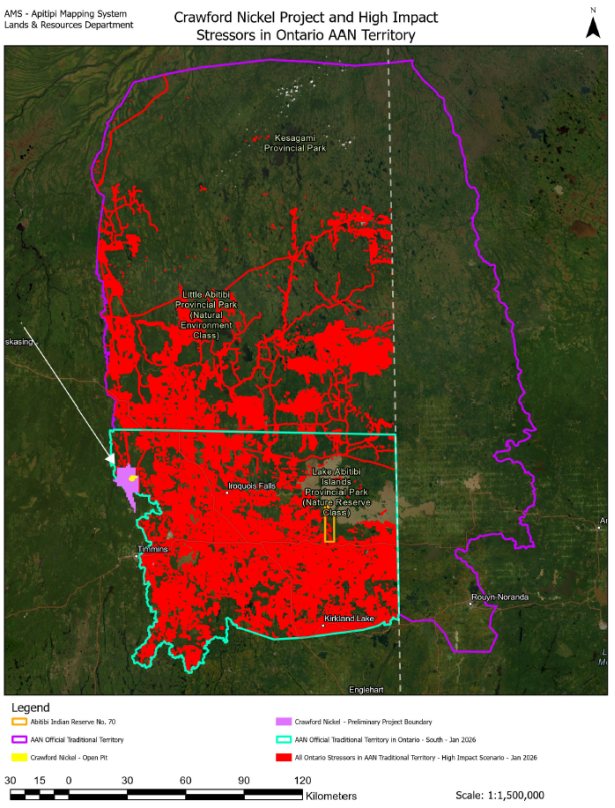
Figure 4 - Text version
A map showing the project footprint and cumulative effects on Apitipi Anicinapek Nation's traditional territory.
Monitoring and Follow-Up Proposed by Apitipi Anicinapek Nation
AAN expects to be meaningfully involved in all monitoring and follow-up activities required by the Crown and the proponent as part of the project's conditions of approval. This includes participation in the design and implementation of monitoring programs, access to data and results, and involvement in adaptive management where monitoring indicates unanticipated effects or underestimation of impacts on AAN's rights, lands, waters, and culture.
The specific roles, responsibilities, and resourcing for AAN's participation in monitoring and follow-up will be established through binding agreements, including the Impact Benefit Agreement and applicable regulatory instruments.
Summary and Conclusions
The Crawford Nickel Project will cause significant adverse effects on Apitipi Anicinapek Nation's Aboriginal and Treaty rights. Even after all mitigation proposed by both the proponent and AAN is applied, high and persistent residual impacts remain on fish and water, wildlife and harvesting, culturally important sites, governance, and community well-being. Several of these impacts are long-term, cumulative, and irreversible.
AAN's assessment is grounded in both technical analysis and lived experience. That experience shows that regulatory compliance does not prevent serious harm, especially to water quality, wildlife populations, cultural continuity, and Indigenous governance. The project adds to existing cumulative pressures and pushes already stressed systems further beyond recovery thresholds.
The additional mitigation and monitoring set out in this report are necessary, but they do not eliminate the most serious effects. AAN asserts that these findings must be central to any decision on whether the project should proceed and under what conditions.
Based on the available evidence, the proposed project appears so harmful and so economically marginal and uncertain, unless all of the AAN proposed mitigation measures are adopted by the proponent or Crown, it should likely not be approved.
|
Project Element / AAN Rights / Interests |
Context |
Impacts on AAN Rights |
Key Proponent Mitigation Measures |
AAN Proposed Additional Mitigation Measures |
Residual Impacts After Mitigation |
AAN Rationale for Residual Impacts Score |
|---|---|---|---|---|---|---|
|
Fish, Fish Habitat & Water (Right to Fish) |
Effluent discharge upstream of culturally significant sturgeon habitat; long-term seepage from tailings facilities; reliance on downstream fisheries for food, culture, and knowledge transmission. |
Very Highly Adverse |
Fisheries Act Authorization; fish habitat offsetting; diversion channel design; ML/ARD plan; effluent treatment to regulatory criteria; seepage capture; groundwater & surface water monitoring; adaptive management |
Offsite fish habitat offsetting determined by AAN; discharge criteria near background for sulphate/metals; funding for youth land-based training |
Highly Adverse – Long-term to permanent contamination risk; continuous discharge; irreversible cultural loss |
Effluent persists for centuries; sulphate & metals bioaccumulate; regulatory compliance does not prevent harm; perception of contamination erodes cultural fishing practices and knowledge transfer |
|
Moose & Wildlife (Right to Hunt & Trap) |
Project footprint overlaps ancestral trapline; critically low moose populations; habitat fragmentation |
Highly Adverse |
Wildlife Management Plan; progressive reclamation; timing restrictions; biodiversity monitoring |
Secure land for AAN; transfer CNC claims in Galna & McCool; funding for youth training |
Moderately Adverse – Long-term habitat loss; uncertain recovery |
Permanent habitat fragmentation; moose decline irreversible within meaningful timeframes; cultural transmission disrupted; mitigation cannot restore ancestral trapline |
|
Plants & Medicines (Right to Harvest) |
Active harvesting areas within project footprint; dust and metal deposition risk |
Moderately Adverse |
Dust control; progressive reclamation with native species; invasive species management; pre-disturbance harvesting |
AAN community garden; periodic AAN-led country foods studies; wild rice rehabilitation |
Low to Moderately Adverse – Long-term avoidance of harvesting areas |
Dust and contamination risks persist; perceived contamination disrupts harvesting; recovery slow and uncertain |
|
Culturally Important Sites |
Eskers, springs, ceremonial sites within project footprint; groundwater drawdown impacts |
Moderately Adverse |
Archaeological assessments; chance find protocol; cultural sensitivity training |
Prohibit esker destruction where feasible; fund AAN-led ceremonies; ceremonial accommodations |
Low to Moderately Adverse – Permanent cultural loss |
Eskers and springs destroyed; local spiritual harm irreversible; cultural continuity cannot be offset |
|
Governance & Jurisdiction |
CNC mineral tenure adjacent to reserve; systemic exclusion from land-use decisions |
Highly Adverse |
Indigenous Engagement Plan; ongoing consultation; IBA negotiations |
Execute IBA before construction; Crown commitment to AAN Engagement & Consent Law; transfer CNC claims |
Moderately Adverse – Indefinite jurisdictional infringement |
Mineral tenure persists for decades; regulatory regime undermines AAN governance; mitigation does not remove structural limits on AAN decision-making authority |
|
Socioeconomics |
Marginal project economics; volatile nickel prices; start-stop production risk; illegal drug demand, supply and composition volatility; gendered violence; wage inequity; hidden houselessness; police violence |
Very Highly Adverse |
Employment targets; training programs; housing studies; IBA negotiations |
Independent financial analysis; guaranteed minimum payments & royalties; retraining programs; diversification supports; clear housing commitments with timelines; women & 2SLGBTQQIA-specific employment; on-and off-Nation drug testing and low-barrier regulated alternative program; reopening of Timmins supervised consumption site for urban Nation member safety; federal drug and sex work decriminalization exemptions |
Moderately Adverse – Persistent economic insecurity |
Environmental and cultural costs remain regardless of production; benefits uncertain and unstable; cyclical shutdowns undermine community well-being; long-term impacts on housing and cost of living uncertain |
References
- Apitipi Anicinapek Nation and Tamarack Environmental Associates Inc. (2024). Apitipi Anicinapek Nation Canada Nickel Company Crawford Nickel Project Indigenous Knowledge, Land Use and Occupancy Study.
- McPherson, J.T. (1930). An ethnological study of the Abitibi Indians. Canadian Museum of History Archives. Ottawa, ON.
- Jenkins, W.H. (1939). Notes on the Hunting Economy of the Abitibi Indians. Catholic University of America (9). Washington, DC.
- Kistabish, M.J. (2022). The Traditional Territory of the Apitipi Anicinapek Nation. Edited version April 11, 2022. Unpublished.
Annex 4: IAAC responses to summarized comments
IAAC received comments throughout the impact assessment process from federal and provincial authorities, Indigenous communities, and the public that informed the assessment of adverse federal effects and public interest factors. Key comments were considered in Sections 2 through 6 of this report. The table below contains a summary of comments received including IAAC's response. IAAC shared comments received with the appropriate jurisdiction, as applicable and relevant to their mandate, expertise, and regulatory oversight.
|
# |
Commenter(s) |
Summary of Comment |
IAAC Response |
|---|---|---|---|
|
Aboriginal and Treaty Rights |
|||
|
01 |
Apitipi Anicinapek Nation Brunswick House First Nation Cree Nation Government Flying Post First Nation Matachewan First Nation Mattagami First Nation Métis Nation of Ontario (Region 3) Moose Cree First Nation Taykwa Tagamou Nation |
Expressed views on how the project will impact the exercise of Aboriginal and treaty rights of Indigenous communities. Provided input on at least one of the points noted below:
|
IAAC assessed the project's potential impacts on the exercise of Aboriginal and treaty rights in Section 4.3 of this report. In its assessment IAAC considered the comments and submissions received throughout the impact assessment from potentially impacted Indigenous communities to ensure the impacts on rights assessment reflected community-specific rights, values, interests, and concerns. |
|
Alternatives Assessment |
|||
|
02 |
Apitipi Anicinapek Nation Big Water Campground ECCC Flying Post First Nation Matachewan First Nation Mattagami First Nation Members of the public Métis Nation of Ontario (Region 3) MNR NRCan Northwatch Ontario Ministry of Tourism, Culture and Gaming Ontario Ministry of Transportation Taykwa Tagamou Nation Temiskaming Native Women's Support Group |
Expressed comments on the methodology and the need for an assessment of alternative means of carrying out the project, including:
|
Refer to Section 1.2.2 of this report on how IAAC considered alternative means of carrying out the project in the impact assessment. IAAC determined that the 230-kilovolt transmission was not incidental to the designated project as the proponent does not have care and control. This transmission line was considered for cumulative effects, where relevant and applicable. |
|
03 |
Apitipi Anicinapek Nation ECCC MECP Member of the public Ontario Rivers Alliance Taykwa Tagamou Nation Town of Smooth Rock Falls |
Expressed views on which rivers should be selected for effluent discharge including whether the Mattagami River, or North Driftwood River and West Buskegau River should be used. Comments expressed concerns about the cultural importance of the Mattagami River, the municipal water intake of Smooth Rock Falls, and the low assimilative capacity of the North Driftwood River and West Buskegau River. |
Refer to Section 1.2.2 of this report for how IAAC considered alternative means of carrying out the project in the impact assessment. Refer to Section 2.1 of this report for more information on the proponent's selection of locations for effluent discharge and implications for effects to fish and fish habitat. Since the project has been redesigned with consideration of Indigenous Knowledge and public input to avoid discharging effluent into the Mattagami River, there are no anticipated impacts to the municipal water intake of Smooth Rock Falls. |
|
Atmospheric, Acoustic, and Visual Environment |
|||
|
04 |
Apitipi Anicinapek Nation Big Water Campground ECCC Flying Post First Nation HC Matachewan First Nation Mattagami First Nation MECP Métis Nation of Ontario (Region 3) NRCan Northwatch Taykwa Tagamou Nation |
Expressed concerns about the potential adverse effects of the project to human health, migratory birds and wildlife harvested by Indigenous Peoples from changes in noise, light levels, and air quality. Concerns emphasized the potential for chrysotile asbestos to be present in bedrock that may be released into the air during mining or if used as construction material. |
IAAC considered changes to the atmospheric and acoustic environment in its assessment of pathways of effects to areas within federal jurisdiction. Refer to Sections 2.2, 4.2.2, and 4.2.3 for more information on how changes to the atmospheric and acoustic environments were considered in the assessment of effects on migratory birds, the current use of lands and resources of Indigenous Peoples, and the health conditions of Indigenous Peoples respectively. |
|
Biodiversity |
|||
|
05 |
Apitipi Anicinapek Nation ECCC Flying Post First Nation Matachewan First Nation Mattagami First Nation Métis Nation of Ontario (Region 3) MNR Northwatch Taykwa Tagamou Nation |
Expressed concerns about potential changes to biodiversity due to effects from the project highlighting the project's size. |
IAAC considered the extent to which the project's effects contribute to Canada's environmental obligations (including biodiversity) in Section 5 of this report. |
|
Climate Change and Greenhouse Gas Emissions |
|||
|
06 |
Apitipi Anicinapek Nation ECCC Mattagami First Nation Members of the public Métis Nation of Ontario (Region 3) Northwatch NRCan Taykwa Tagamou Nation |
Expressed concerns about the emissions of greenhouse gases from the project, loss of carbon storing peatlands, and contributions to climate change. Further, views were expressed about the use of mineral carbonation of tailings as a mitigation measure to store carbon and reduce net greenhouse gas emissions from the project, and the possibility of the project being net-zero by 2050. |
As the project is primarily provincially regulated, the greenhouse gas emissions from the project are not considered effects within federal jurisdiction under the IAA and therefore not assessed in the impact assessment. However, the extent to which the project's effects contribute to Canada's climate change commitments was considered in Section 6 of this report. |
|
Current Use of Lands and Resources for Traditional Purposes by Indigenous Peoples |
|||
|
07 |
Apitipi Anicinapek Nation Flying Post First Nation Matachewan First Nation Mattagami First Nation Member of Moose Cree First Nation Members of the public Métis Nation of Ontario (Region 3) Moose Cree First Nation Taykwa Tagamou Nation |
Expressed broad concerns about effects from the project on the current use of lands and resources by Indigenous Peoples. Concerns highlighted the large size of the project on a greenfield site and cumulative effects to the quality and availability of lands and resources for the current use for traditional purposes by Indigenous Peoples, including species of importance, from past, ongoing, and future industrial activity in the region. |
IAAC assessed the potential effects on the current use of lands and resources for traditional purposes by Indigenous Peoples including from cumulative effects in Section 4.2.2 of this report. Refer to Row 43 for more information on how changes to wildlife, wildlife habitat, and vegetation were considered. |
|
08 |
Apitipi Anicinapek Nation Flying Post First Nation Matachewan First Nation Mattagami First Nation Member of Moose Cree First Nation Members of the public Métis Nation of Ontario (Region 3) Northwatch Taykwa Tagamou Nation Temiskaming Native Women's Support Group |
Expressed concerns about decreased opportunities for hunting, trapping, fishing, gathering plants, sharing land-based traditional knowledge, and other land uses from habitat loss and fragmentation, dewatering and reductions of wetlands, edge effects, atmospheric disturbances, and the influx of project personnel. Commenters noted that changes to the preferred conditions for land use are expected to deter the use of lands and resources at preferred areas near the project. |
IAAC considered the potential for decreased opportunities for the current use of lands and resources, including hunting, fishing, and harvesting for traditional purposes by Indigenous Peoples in Section 4.2.2 of this report. |
|
09 |
Member of Moose Cree First Nation |
Expressed concern regarding impacts to the use of a trapline intersecting with the PA, held by a member of Moose Cree First Nation, and their exercise of rights to hunt and trap at the trapline due to overprinting and fragmentation of forest habitat, alteration of upstream waters, and changes to local environmental conditions. Concern was also raised regarding impacts to planned economic activities on the trapline. |
IAAC considered the potential for decreased opportunities for hunting and trapping in Section 4.2.2 of this report. IAAC understands that there are five traplines intersecting the PA and nine within the LSA, and that 239 hectares of the trapline held by the member of Moose Cree First Nation (approximately one percent of the total trapline area) will be overprinted by the project. The proponent noted it plans to meet with affected trapline holders and MNR to discuss and manage effects on affected traplines. |
|
10 |
Apitipi Anicinapek Nation Flying Post First Nation Matachewan First Nation Mattagami First Nation Member of the public Métis Nation of Ontario (Region 3) Taykwa Tagamou Nation |
Expressed concerns regarding contamination of harvested resources and challenges in finding high quality resources for harvest near the project. Comments also noted that contamination concerns are expected to deter harvesting at preferred areas near the project. |
IAAC assessed potential effects to Indigenous Peoples from changes to the quality of harvested resources in Section 4.2.2 and Section 4.2.3 of this report. |
|
11 |
Apitipi Anicinapek Nation Flying Post First Nation Matachewan First Nation Mattagami First Nation Member of Moose Cree First Nation Member of the public Métis Nation of Ontario (Region 3) Taykwa Tagamou Nation |
Commenters provided information and Indigenous Knowledge about their current use of lands and resources for traditional purposes, including:
Comments emphasized that information provided to the proponent and IAAC from Indigenous studies was not exhaustive of all Indigenous use of the land but rather a snapshot of use at the time when the information was collected. |
IAAC used the information and views provided to inform the assessment of effects to the current use of land and resources for traditional purposes by Indigenous Peoples from the project in Section 4.2.2 and Section 4.3 of this report. IAAC summarized the species of importance used to inform the assessment in Annex 5. |
|
12 |
Apitipi Anicinapek Nation Flying Post First Nation Matachewan First Nation Mattagami First Nation Member of Moose Cree First Nation Member of the public Métis Nation of Ontario (Region 3) Taykwa Tagamou Nation |
Expressed concerns about reduced access to areas important for Indigenous use of the land including to navigation of some waterways, such as the Mattagami River. Further, that access or use of the land may be interrupted during some project activities (e.g., blasting) and the need to be informed of such activities. |
IAAC assessed the effects to the current use of lands and resources for traditional purposes by Indigenous Peoples from project activities that would reduce access and interrupt traditional practices in Section 4.2.2 of this report. IAAC is of the view that with the information available there is no predicted impact to navigation by Indigenous Peoples from the project. Indigenous communities highlighted the importance of maintaining use of the Mattagami River for navigation, which is not predicted to be impacted by the project. Potential impacts to the use of navigable waterways would also be considered for any approvals that may be required under the Canadian Navigable Waters Act, which requires consultation with Indigenous communities, administered by Transport Canada. |
|
13 |
Apitipi Anicinapek Nation Métis Nation of Ontario (Region 3) MECP MNR Ministry of Tourism, Culture and Gaming Northwatch Taykwa Tagamou Nation |
Expressed views and the need for more information on the decommissioning and closure,, rehabilitation, and post-project environmental monitoring for the project. Concerns highlighted the need for the involvement of Indigenous communities in the rehabilitation of the project to minimize impacts to the use of the land for future generations. |
IAAC provided a project description in Section 1.1 of this report which details the project's main phases including decommissioning and abandonment. IAAC has recommended several follow-up programs with monitoring requirements throughout Sections 2 and 4.2 of this report. IAAC also acknowledged the role of other federal and provincial authorities that oversee regulatory frameworks with decommissioning and environmental monitoring requirements throughout the report. IAAC considered the rehabilitation of the project in the assessment of effects to the current use of lands and resources for traditional purposes by Indigenous Peoples in Section 4.2.2 of this report. Refer to the proponent's conceptual Mine Closure Plan, pursuant to Ontario's Mining Act in Appendix F of the Impact Statement for more information on how the project would be decommissioned, rehabilitated, and closed out. |
|
Effects of the Environment on the Project |
|||
|
14 |
Apitipi Anicinapek Nation ECCC MECP MNR Northwatch Taykwa Tagamou Nation |
Expressed concerns about potential increases in frequency and magnitude of extreme weather events. Comments emphasized the role of climate change and increased precipitation events on water management infrastructure. |
IAAC considered how extreme weather events including precipitation and drought could be contributing or complicating factors for malfunctions and accidents. Refer to Section 1.2.2 and 3 of this report for more information. |
|
Fish and Fish Habitat |
|||
|
15 |
Apitipi Anicinapek Nation DFO ECCC Flying Post First Nation Matachewan First Nation Mattagami First Nation Métis Nation of Ontario (Region 3) MECP MNR Taykwa Tagamou Nation |
Expressed concerns for the harmful alteration, disruption, and destruction of fish habitat, including from:
Concerns highlighted the need for viable fish habitat offsets developed with the input of Indigenous communities, uncertainties in the magnitude of predicted habitat loss or alteration, and uncertainties in the proponent's conceptual offsetting plan. |
IAAC assessed the adverse effects to fish and fish habitat from the loss or alteration of fish habitat in Section 2.1 of this report. |
|
16 |
Apitipi Anicinapek Nation DFO ECCC Flying Post First Nation Matachewan First Nation Mattagami First Nation Members of the public Métis Nation of Ontario (Region 3) MNR Taykwa Tagamou Nation |
Expressed concerns about the health of fish, including from:
Concerns highlighted potential effects to Lake Sturgeon, a federally listed species at risk, and a Lake Sturgeon spawning and harvesting area downstream on the Buskegau River. |
IAAC assessed the adverse effects to fish health in Section 2.1 of this report. |
|
17 |
Apitipi Anicinapek Nation DFO |
Expressed views on the sufficiency of studies used to assess effects to fish and fish habitat. Views highlighted gaps in the areas surveyed for field studies, particularly downstream of the project, and the composition and life history requirements of fish in affected watersheds. |
IAAC determined that the proponent provided sufficient information to characterize the extent of significance of adverse effects to fish and fish habitat for the impact assessment. Refer to Section 2.1 for how IAAC considered uncertainty for adverse effects to fish and fish habitat. DFO provided advice to the proponent on information that will be required for any future permitting needs under the Fisheries Act. Refer to Row 22 for more information on how IAAC managed uncertainty in the impact assessment broadly. |
|
18 |
Apitipi Anicinapek Nation DFO |
Expressed concerns about the proposed North Driftwood River Diversion Channel. Concerns highlighted uncertainties in the geotechnical feasibility of the channel, the channel's ability to be naturalized to support fish habitat, and past examples of diversion channel failures on other projects. |
IAAC considered the concerns raised regarding the North Driftwood River Diversion Channel as a fish habitat offset and the potential adverse effects of a diversion channel failure in Section 2.1 of this report. |
|
General, Assessment Methodology and Process |
|||
|
19 |
Apitipi Anicinapek Nation Flying Post First Nation Matachewan First Nation Mattagami First Nation Métis Nation of Ontario (Region 3) Taykwa Tagamou Nation |
Expressed the importance of considering Indigenous Knowledge on equal footing with western scientific information in the impact assessment. Further expressed interest in collaborating in the assessment, including through providing information from Indigenous-led studies (e.g., Traditional Knowledge and Land Use Studies, socio-economic studies) to inform the assessment of effects on Indigenous Peoples and their exercise of rights. |
Refer to Section 4.1 of this report for more information on the process for engagement and consultation during the impact assessment including IAAC's engagement and consultation (Section 4.1.1), the proponent's engagement (Section 4.2.2), and how Indigenous Knowledge was considered in the assessment (Section 4.1.3 |
|
20 |
Apitipi Anicinapek Nation Flying Post First Nation Keepers of the Circle Matachewan First Nation Mattagami First Nation Métis Nation of Ontario (Region 3) Taykwa Tagamou Nation |
Expressed the importance of protecting confidential Indigenous Knowledge. |
Refer to Section 4.1.3 of this report for how IAAC protected confidential Indigenous Knowledge. |
|
21 |
Apitipi Anicinapek Nation Canada Nickel Company City of Timmins Flying Post First Nation Matachewan First Nation Mattagami First Nation Métis Nation of Ontario (Region 3) Taykwa Tagamou Nation Town of Cochrane Town of Smooth Rock Falls |
Expressed divergent views on whether the project should be referred to a Joint Review Panel. Considerations cited included the large scale of the project's potential effects on Indigenous Peoples, the need for greater Indigenous involvement in decision-making, as well as support for a timely assessment led by IAAC, noting confidence in the opportunities for meaningful participation. |
On May 15, 2023, the Minister did not exercise their discretionary authority to refer the project to a review panel and communicated their view that an IAAC-led assessment was appropriately positioned to support Indigenous leadership in assessing impacts on Indigenous Peoples. Refer to Section 4.1 of this report for more information. |
|
22 |
Apitipi Anicinapek Nation DFO ECCC Flying Post First Nation HC ISC Legal Advocates for Nature's Defence Matachewan First Nation Mattagami First Nation Métis Nation of Ontario (Region 3) MCM MECP MNR Ontario Rivers Alliance NRCan |
Expressed concerns about the adequacy of baseline data including insufficient monitoring, representativeness, and methodology across several valued components that creates uncertainties in the predictions of effects. |
At the end of the Planning phase, IAAC published the Tailored Impact Statement Guidelines which outlined the studies and information required for the proponent's Impact Statement including assessment methodology. In the Impact Statement phase, IAAC published comments on the proponent's Impact Statement which identified areas of outstanding uncertainties on key effects within federal jurisdiction necessary for the conduct of the impact assessment. IAAC's comments were informed by comments received by federal and provincial authorities, Indigenous communities, and the public. The proponent provided responses which were also reviewed by IAAC and relevant federal and provincial authorities. IAAC used all available information to describe the adverse effects within federal jurisdiction in this report based on several rating criteria (refer to Annex 2 of this report) including uncertainty. IAAC's description of uncertainty was based on comments received including expressed concerns about the adequacy of baseline data. IAAC recommended several follow-up programs which may include monitoring and adaptive management measures to address uncertainties. Further, IAAC understands that the prediction of adverse effects will continue to be refined through future federal and provincial permitting processes. IAAC described these areas throughout the report and highlighted more specific instances in other parts of this table. |
|
23 |
Apitipi Anicinapek Nation ECCC Flying Post First Nation HC ISC Keepers of the Circle Legal Advocates for Nature's Defence Matachewan First Nation Mattagami First Nation Métis Nation of Ontario (Region 3) Members of the public Moose Cree First Nation MECP MNR Ontario Rivers Alliance Taykwa Tagamou Nation Temiskaming Native Women's Support Group |
Expressed concerns about the cumulative effects from past, ongoing, and future activities in the region including from climate change, forestry, urban development, roads, transmission lines (including the 230-kilovolt transmission line proposed by Transmission Infrastructure Partnerships 1), dams, mines (including North Timmins Gold Project) and mining claims, other resource development activities, and colonial policies. Concerns highlighted the cumulative effects on Indigenous Peoples. |
Refer to Section 1.2.2 of this report for more information on IAAC's approach to cumulative effects and the projects considered in the cumulative effects assessment. Refer to Section 2 and 4.2 for more information on the specific assessment of cumulative effects for each valued component within federal jurisdiction. IAAC did not factor changes to valued components due to climate change in its assessment of cumulative effects in each respective cumulative effects section. However, IAAC did consider climate change with respect to effects to the project caused by the environment (refer to Section 1.2.2) and the extent to which the project's effects contribute to Canada's climate change commitments (refer to Section 6). |
|
24 |
Flying Post First Nation ISC Keepers of the Circle Matachewan First Nation Mattagami First Nation Métis Nation of Ontario (Region 3) Taykwa Tagamou Nation Temiskaming Native Women's Support Group Women and Gender Equality Canada |
Expressed views on the need for information regarding diverse populations (e.g., women, youth, Elders, 2SLGBTQQIA+) and to incorporate Gender-based Analysis Plus to differentiate effects of the project on these diverse populations in the impact assessment. |
Refer to Section 1.2.2 of this report for how IAAC applied Gender-based Analysis Plus in the impact assessment. |
|
25 |
Apitipi Anicinapek Nation Flying Post First Nation ISC Matachewan First Nation Mattagami First Nation Métis Nation of Ontario (Region 3) Taykwa Tagamou Nation |
Expressed the need for the involvement of Indigenous communities in follow-up and monitoring programs, including the use of Indigenous monitors, and for a feedback mechanism to report issues to the proponent. |
IAAC recommended several follow-up programs with monitoring requirements to be developed in consultation with Indigenous communities to participate in follow-up programs throughout Section 2 and 4.2 of this report. Notably, in Section 4.2.3, IAAC recommended that the proponent shall retain the services of Indigenous monitors to participate in the implementation of follow-up programs and in Section 4.2.3, IAAC recommended a Community Feedback Protocol. |
|
Geochemistry |
|||
|
26 |
Apitipi Anicinapek Nation ECCC Flying Post First Nation Matachewan First Nation Mattagami First Nation Métis Nation of Ontario (Region 3) MECP NRCan Northwatch Taykwa Tagamou Nation |
Expressed concerns about the geochemistry of the mine and potential for metal leaching and acid rock drainage from waste rock, tailings, and overburden to impact the surrounding environment. Concerns highlighted the methodology and representativeness of the proponent's geochemical characterization, and the use of mine materials to be used for construction (e.g., tailings management facility dam, haul roads). |
IAAC assessed the potential adverse effects of the project to fish health focused on controlled effluent, uncontrolled effluent (e.g., uncontained runoff and seepage), and the related mine waste management and site water management strategies (refer to Section 2.1). |
|
Health, Social and Economic Conditions of Indigenous Peoples |
|||
|
27 |
Apitipi Anicinapek Nation ECCC Flying Post First Nation HC ISC Matachewan First Nation Mattagami First Nation Métis Nation of Ontario (Region 3) MECP Northeastern Public Health Taykwa Tagamou Nation |
Expressed concerns about the potential effects of the project to the health conditions of Indigenous Peoples from changes in biophysical determinants of health, including from:
Concerns were also raised regarding uncertainties in modelling assumptions related to methylmercury formation and the need for additional future baseline monitoring of mercury and methylmercury. |
IAAC assessed the potential impacts to the health conditions of Indigenous Peoples from biophysical determinants of health in Section 4.2.3 of this report. Refer to Rows 4 and 46-47 for more information on how IAAC considered changes to air and water quality respectively, and Rows 7-13 for more information on how IAAC considered impacts to harvesting for country foods. IAAC notes that adverse effects to health conditions from workplace injuries are not in scope of the impact assessment but would be managed under Ontario's Occupational Health and Safety Act which requires employers to maintain a safe work environment. |
|
28 |
Apitipi Anicinapek Nation City of Timmins Cochrane District Service Board Flying Post First Nation HC ISC Matachewan First Nation Mattagami First Nation Métis Nation of Ontario (Region 3) Northeastern Public Health Northwatch Temiskaming Native Women's Group Support Group Town of Smooth Rock Falls |
Expressed concerns about the socioeconomic effects (e.g., affordability and availability of housing, crime, substance abuse, human trafficking, accessibility of health and social services) to Indigenous Peoples, and vulnerable sub-populations in particular, from an influx of outside labour required for the project. Noted concerns that the services and infrastructure of local municipalities are already strained with limited capacity to support a population increase, and that on-site accommodations may be required to reduce housing pressures. Local municipalities provided views and information regarding planned initiatives for infrastructure and services demands. |
Refer to Section 4.2.3 of this report for how IAAC assessed the adverse effects of outside labour required for the project on the socio-economic conditions of Indigenous Peoples, and the rationale for the proponent's preferred alternative for worker accommodations. |
|
29 |
Apitipi Anicinapek Nation Employment and Social Development Canada Flying Post First Nation ISC Matachewan First Nation Mattagami First Nation Member of Flying Post First Nation Métis Nation of Ontario (Region 3) Taykwa Tagamou Nation |
Expressed views about participating in the economic benefits of the project including employment and procurement opportunities. Concerns and recommendations were also raised regarding obstacles to participating in employment opportunities, including
|
IAAC considered the potential socio-economic benefits of the project to Indigenous Peoples including obstacles in Sections 4.2.3, 4.2.4, and 6 of this report. |
|
30 |
Apitipi Anicinapek Nation Flying Post First Nation HC ISC Matachewan First Nation Mattagami First Nation Member of Flying Post First Nation Métis Nation of Ontario (Region 3) Taykwa Tagamou Nation Temiskaming Native Women's Group Support Group Women and Gender Equality Canada |
Expressed concerns about the potential impacts to social and mental well-being of Indigenous Peoples from the project and potential disproportionate effects on vulnerable sub-populations. |
IAAC assessed the potential adverse effects to the social and health conditions of Indigenous Peoples from the added strain on social services from the project, which could result in an effect to social and mental well-being in Section 4.2.3 of this report. |
|
Malfunctions and Accidents |
|||
|
31 |
Apitipi Anicinapek Nation Big Water Campground City of Timmins ECCC Flying Post First Nation HC ISC Matachewan First Nation Mattagami First Nation Members of the public Métis Nation of Ontario (Region 3) NRCan Northwatch Temiskaming Native Women's Support Group Transport Canada |
Expressed concerns about the potential effects of malfunctions and accidents that may occur in connection with the project, including:
Further, expressed the need for preventative measures, emergency preparedness and response plans, and communication plans. |
IAAC assessed the adverse federal effects of unlikely malfunction and accident scenarios, and recommended mitigation measures including preventative measures. Refer to Section 1.2.2 of this report for more information on how malfunctions and accidents were broadly considered. Refer to Section 2.1 of this report for how IAAC considered the potential for adverse effects to fish health from the potential failure of the North Driftwood River Diversion Channel. Refer to Section 3 of this report for how IAAC considered the adverse federal effects of unlikely malfunction and accident scenarios. |
|
Migratory Birds |
|||
|
32 |
ECCC MNR Taykwa Tagamou Nation |
Expressed concerns about the potential effects to migratory birds from displacement due to project activities that result in loss of habitat and disruption of migration routes. Concerns highlighted the potential for increased predation pressure, disease risk, competition, and decreased breeding success from the concentration of migratory birds in the remaining habitat. |
IAAC assessed the adverse effects to migratory birds from displacement due to project activities in Section 2.2.1 of this report. |
|
33 |
ECCC Flying Post First Nation Keepers of the Circle Matachewan First Nation Métis Nation of Ontario (Region 3) MNR Taykwa Tagamou Nation Temiskaming Native Women's Support Group |
Expressed concerns about the potential mortality risks to migratory birds and behavioral changes from project activities, including:
Concerns highlighted project effects may also be experienced by federally listed migratory birds species at risk (e.g., Chimney Swift, Bank Swallow, Evening Grosbeak). Views were provided on the timing restrictions that should be used to minimize effects during vegetation clearing. |
IAAC assessed the adverse effects to migratory birds from mortality risks and behavioral changes due to project activities in Section 2.2 of this report. |
|
34 |
ECCC |
Expressed views on the sufficiency of studies used to assess effects to migratory birds. Views highlighted insufficient field surveys and sampling methodology to confirm the presence or absence of certain migratory bird species, habitat, and nesting sites. |
IAAC determined that the proponent provided sufficient information to characterize the adverse effects to migratory birds for the impact assessment. IAAC made conservative assumptions regarding the presence of migratory bird species and has recommended follow-up programs to manage uncertainty in the assessment of effects in Section 2.2 of this report. Refer to Row 22 for more information on how IAAC managed uncertainty in the impact assessment broadly. |
|
Other |
|||
|
35 |
Employment and Social Development Canada ECCC Federal Economic Development Agency for Northern Ontario DFO HC ISC MCM MECP Ministry of Energy and Mines Ministry of Transportation Ministry of Tourism, Culture and Gaming NRCan Northeastern Public Health Transport Canada Women and Gender Equality Canada |
Federal, provincial, and municipal authorities provided advice and concerns regarding the project relevant to their mandate, expertise, and regulatory oversight including on the following topics:
|
IAAC considered the comments received for the impact assessment for its understanding of all section 22 factors, in Annex 1, and applied it where relevant to areas within federal jurisdiction, notably to fish and fish habitat, migratory birds, and Indigenous Peoples. IAAC posted comments received on the Canadian Impact Assessment Registry and shared the comments with the proponent to inform ongoing project planning and future regulatory approvals that may be required for the project. In Ontario, mining projects are primarily provincial-regulated and also require federal permits for certain effects. IAAC used comments received regarding federal and provincial regulatory oversight to develop the federal Permitting Plan and provincial Cooperation Plan for the project. |
|
36 |
Big Water Campground City of Timmins Members of the public Northwatch Taykwa Tagamou Nation Town of Smooth Rock Falls |
Expressed concerns related to the project's potential impacts to social conditions including:
|
As the project is primarily provincially regulated, these impacts are not considered effects within federal jurisdiction under the IAA and therefore not assessed in the impact assessment. Effects from the project to the social conditions of Indigenous Peoples was considered in Section 4.2.3 of this report. The proponent provided information on impacts to broader social conditions in Chapter 22 of the Impact Statement. |
|
Physical and Cultural Heritage and Sites of Significance for Indigenous Peoples |
|||
|
37 |
Apitipi Anicinapek Nation Brunswick House First Nation Flying Post First Nation Matachewan First Nation Mattagami First Nation Métis Nation of Ontario (Region 3) MCM Moose Cree First Nation Taykwa Tagamou Nation |
Expressed concerns about potential impacts to physical and cultural heritage, as well as their use, access, and experience, including:
Further, Indigenous communities highlighted the importance of being involved in future archaeological assessments and expressed concerns regarding the methodology, adequacy, and recommendations of the proponent's completed archaeological assessment. |
IAAC considered the potential adverse effects of the project on the physical and cultural heritage of Indigenous Peoples (including structures, sites, or things of historical, archaeological, paleontological, or architectural significance) in Section 4.2.1 of this report. |
|
Project Purpose and Need |
|||
|
38 |
Apitipi Anicinapek Nation Flying Post First Nation Matachewan First Nation Mattagami First Nation Members of the public Métis Nation of Ontario (Region 3) Northwatch Temiskaming Native Women's Support Group |
Expressed views on the purpose and need for the project. Views highlighted how the project would support the objectives of the Canadian Critical Minerals Strategy, and the purpose and need should reflect priorities of the public and Indigenous communities. |
IAAC provided a description of the project including the proponent's identified purpose and need in Section 1.1 of this report. For more information about the purpose and need for the project refer to Chapter 4 of the proponent's Impact Statement. |
|
Public Engagement and Indigenous Consultation |
|||
|
39 |
Apitipi Anicinapek Nation Brunswick House First Nation City of Timmins Cree Nation Government Flying Post First Nation ISC Keepers of the Circle Matachewan First Nation Mattagami First Nation Members of the public Métis Nation of Ontario (Region 3) Moose Cree First Nation Northwatch Taykwa Tagamou Nation Temiskaming Native Women's Support Group Town of Smooth Rock Falls Township of Black River-Matheson Northwatch |
Provided input and expressed concerns regarding how the public and Indigenous communities would be engaged and consulted during the impact assessment including how comments provided would be considered. Further, some expressed divergent views about the adequacy of public engagement and Indigenous consultation on the project. |
IAAC published the Public Participation Plan and the Indigenous Engagement and Partnership Plan during the Planning phase of the impact assessment process to outline how IAAC would conduct public engagement and Indigenous consultation. Refer to Sections 1.4 of this report for more information on IAAC's public engagement. Refer to Sections 1.3, 4.1, and 4.4 of this report for more information on IAAC's engagement and consultation with Indigenous communities including the adequacy of the Crown's duty to consult. Further, IAAC developed a project distribution list in response to interest and comments received which was updated throughout the impact assessment process. Public views provided throughout the process were tracked, made publicly available on the Canadian Impact Assessment Registry, and were considered for this report to inform decision-making. Further, IAAC directed comments provided by the public and Indigenous communities to the appropriate entity including other government jurisdictions or the proponent as applicable. |
|
40 |
Apitipi Anicinapek Nation Brunswick House First Nation City of Timmins Flying Post First Nation Keepers of the Circle Matachewan First Nation Mattagami First Nation Métis Nation of Ontario (Region 3) Moose Cree First Nation Northwatch Taykwa Tagamou Nation Temiskaming Native Women's Support Group Northwatch |
Expressed concerns that there were obstacles to meaningful public and Indigenous participation in the impact assessment including the timing and limited length of public comment periods and difficulty in accessing funding. |
IAAC provided opportunities for input into the impact assessment during comment periods including:
During comment periods, IAAC invited the public and Indigenous communities to provide comments. While IAAC set time limits on comments considered for certain milestones, comments could be provided directly to IAAC or the Canadian Impact Assessment Registry at any time throughout the assessment. IAAC considered all comments received, regardless of whether they were submitted during a comment period, for the draft Impact Assessment Report. IAAC also offered funding to participating members (and organizations) of the public and Indigenous communities through the Participant Funding Program, including grants and contributions. IAAC made available approximately $1.2 million to Indigenous communities and $74,788 to the public to help participation in the impact assessment. Refer to Section 1.4 of this report for more information on IAAC's public engagement. As noted in Section 4.1.1, IAAC worked with Indigenous communities, the proponent, and federal and provincial authorities to establish a technical working group for the project. |
|
41 |
Apitipi Anicinapek Nation Flying Post First Nation ISC Keepers of the Circle Matachewan First Nation Mattagami First Nation Métis Nation of Ontario (Region 3) Taykwa Tagamou Nation |
Expressed the need for the free, prior and informed consent of Indigenous communities, specifically prior to any decision-making regarding the project. Further, that accommodation measures will be required for impacts from the project. |
Refer to Section 4.3.2 of this report for more information regarding IAAC's process for seeking free, prior, and informed consent through the impact assessment. IAAC also assessed the impacts from the project on the exercise of consulted Indigenous communities' rights and the need for any mitigation measures or follow-up programs to avoid, minimize, or otherwise accommodate for potential effects of the project on the exercise of rights. Refer to Section 4.2 and 4.3 of this report for more information. |
|
Species at Risk, Vegetation, and Wildlife |
|||
|
42 |
Apitipi Anicinapek Nation ECCC Flying Post First Nation Legal Advocates for Nature's Defence Matachewan First Nation Mattagami First Nation Members of the public Métis Nation of Ontario (Region 3) MECP MNR Taykwa Tagamou Nation Temiskaming Native Women's Support Group Town of Smooth Rock Falls |
Expressed concerns about the project's potential adverse effects on species at risk (listed under Schedule 1 of the federal Species at Risk Act or the Species at Risk in Ontario List) including their residences, and critical habitat. |
As the project is primarily provincially regulated, effects to species at risk are not considered effects within federal jurisdiction under the IAA and therefore not all species at risk are assessed in the impact assessment. Species at risk are assessed if they are fish, migratory birds, or species of importance to Indigenous Peoples (e.g., as culturally important or as country foods) which are assessed in Sections 2.1, 2.2, and 4.2 of this report respectively. Further, as the project is not proposed on federal lands a permit under the Species at Risk Act may only be required for some activities that affect residences (e.g., nests, roosting structures) of certain listed migratory birds. For species at risk off federal lands, IAAC looks to Ontario as the primary regulator. Ontario's Species Conservation Act, 2025, administered by the Ministry of the Environment, Conservation and Parks, has the purpose of identifying species at risk and providing for the protection and conservation of the species. |
|
43 |
Abitibi River Forest Management Inc. Apitipi Anicinapek Nation ECCC Flying Post First Nation Matachewan First Nation Mattagami First Nation Métis Nation of Ontario (Region 3) MNR Northwatch Taykwa Tagamou Nation Temiskaming Native Women's Support Group |
Expressed concerns and views about potential changes to wildlife, wildlife habitat, and vegetation from the project, including from:
|
IAAC assessed the potential adverse effects to the current use of lands and resources for traditional purposes by Indigenous Peoples from changes to wildlife and wildlife habitat in Section 4.2.2 of this report, and recommended mitigation measures and follow-up programs. IAAC is of the view that sensory disturbances by the project will largely deter direct interaction with the project and wildlife. Wildlife will also be prevented from interacting with tailings from the dam and fencing that will surround the tailings management facility. Further, effects from the linear transportation (Highway 655, rail spur) and transmission (500-kilovolt) corridor is not expected to change substantially from baseline conditions as these corridors are largely being realigned and already exist. Care and control of these project components will ultimately lie with other parties including the Ontario Ministry of Transportation (Highway 655), Ontario Northland Transportation Commission (rail spur), and Hydro One Networks Incorporated (500-kilovolt transmission line). Refer to Row 4 and 46-47 for more information on how IAAC addressed potential effects from sensory disturbances and changes to water quality. |
|
Sustainability |
|||
|
44 |
Apitipi Anicinapek Nation Big Water Campground City of Timmins Cochrane District Service Board Members of the public NRCan Taykwa Tagamou Nation Town of Cochrane Town of Iroquois Falls Town of Smooth Rock Falls Township of Black River-Matheson |
Expressed views on the potential long-term economic benefits of the project including the local workforce, regional economy, and tax revenue. Views included letters of support for the project. Views also included concerns about the economic feasibility of the project, with emphasis on variabilities in the price of nickel. This may create situations where the environmental effects of the project persist, and the economic benefits of the project are not realized. |
IAAC selected the employment and economic opportunities from the project as one of the valued components for the analysis on the extent to which the project's effects contribute to sustainability. IAAC also considered the uncertainty associated with the price of nickel on the extent to which the project's effects contribute to sustainability. Refer to Section 6 of this report for more information. |
|
45 |
Apitipi Anicinapek Nation |
Expressed views that the sustainability analysis should reflect input from Indigenous communities and their own definition of sustainability. |
Sustainability is defined in the IAA to mean "the ability to protect the environment, contribute to the social and economic well-being of the people of Canada and preserve their health in a manner that benefits present and future generations". IAAC considered all comments received to determine the valued components to be considered on the extent to which the project's effects contribute to sustainability. Refer to Section 6 of this report for more information. |
|
Water Quality and Quantity |
|||
|
46 |
Apitipi Anicinapek Nation DFO ECCC Flying Post First Nation HC ISC Matachewan First Nation Mattagami First Nation Métis Nation of Ontario (Region 3) MECP NRCan Northwatch Taykwa Tagamou Nation |
Expressed concerns about changes to water quality in the North Driftwood River, West Buskegau River, and Jocko Creek watersheds from uncontrolled effluent discharge (i.e., seepage) into groundwater and then into surface water features. Concerns highlighted the irreversibility of groundwater contamination, uncertainties in the water quantity and water quality models, the sufficiency of the proponent's proposed mitigation measures and adaptive management, and the prohibitions of the Fisheries Act for the deposit of deleterious substances in water frequented by fish. |
IAAC considered the potential effects to fish and fish habitat from changes to water quality as a result of uncontrolled effluent discharge in Section 2.1 of this report. |
|
47 |
Apitipi Anicinapek Nation DFO ECCC Flying Post First Nation HC ISC Matachewan First Nation Mattagami First Nation Members of the public Métis Nation of Ontario (Region 3) MECP Moose Cree First Nation Northwatch Ontario Rivers Alliance Taykwa Tagamou Nation |
Expressed concerns about changes to water quality downstream from controlled effluent discharge in the West Buskegau River and North Driftwood River. Concerns highlighted uncertainties in the water quality model, the low assimilative capacity of the receiving rivers, the length of the proposed mixing zone, the alkalinity of the effluent, and application of provincial water quality guidelines. |
While effluent discharge is primarily discussed with respect to adverse effects on fish health (refer to Section 2.1 of this report), IAAC also considered its implications for the mortality risk to migratory birds and health conditions of Indigenous Peoples in Sections 2.2 and 4.2.3 of this report respectively. |
|
48 |
Apitipi Anicinapek Nation DFO ECCC MECP NRCan |
Expressed concerns about groundwater drawdown from open-pit mining that may result in changes to surface water flows and levels. Concerns highlighted the substantial size of the open pit, uncertainties in the water quantity models, and the true extent of groundwater-surface water interactions. |
IAAC considered the potential adverse federal effects from groundwater drawdown including to fish habitat, displacement of migratory birds, certain wetlands where direct or incidental to federal permitting, and the habitat of wildlife or vegetation used by Indigenous Peoples in Sections 2.1, 2.2, 2.3, and 4.2.2 of this report respectively. |
|
49 |
Apitipi Anicinapek Nation MECP |
Expressed concerns about the rehabilitation of the project's open pit into pit lakes. Concerns highlighted the length of time for pit lake filling, the restoration of water balance and flows once the pit lakes are reconnected to local rivers, and water quality prior to reconnection. |
The proponent proposed a conceptual closure plan in Appendix F of the proponent's Impact Statement. The proponent proposed to fill the open pit, after depositing the remainder of the tailings produced during operations, using surface water runoff, precipitation, and groundwater seepage until it forms a pit lake. This process is anticipated to take greater than 100 years after dewatering is terminated. Once the proponent confirms that the water quality meets relevant thresholds for discharge (and any water treatment that may be required), the pit lakes would be connected to the West Buskegau River and North Driftwood Rivers via spillways. Ontario would manage any water quality and quantity concerns under the Ontario Water Resources Act for any water discharges from the final pit lakes to the West Buskegau River and North Driftwood River. Further details on final mine closure are also anticipated to evolve over the project's lifespan pursuant to Ontario's Mining Act. |
Annex 5: Species of importance identified by Indigenous communities
Apitipi Anicinapek Nation, Flying Post First Nation, Matachewan First Nation, Mattagami First Nation, the Métis Nation of Ontario (Region 3), and Taykwa Tagamou Nation identified the following species of importance in the region for the purposes of the federal impact assessment for the Crawford Nickel Project.
|
Terrestrial Animals |
Birds |
Fish |
Plants |
|---|---|---|---|
|
American marten Beaver Black bear Boreal caribou Brown bats Cougar Coyote Fisher Fox Golden eagle Grey fox Little brown myotis (bat) Lynx Mink Moose Muskrat Otter Rabbit Red fox Wolverine Silver haired bat Snowshoe hare Spirit moose Squirrel Timber wolf Weasel White tailed deer Wolf |
Bald eagle Bank swallow Barn swallow Bobolink Canada warbler Common nighthawk Crane Duck Eagle Eastern whip-poor-will Evening grosbeak Geese Grouse/Partridge Olive-sided flycatcher Osprey Ruffed grouse Rusty blackbird Snowy owl Spruce grouse Turkey vulture Waterfowl Wild turkey Yellow rail |
Bass Brook Trout Burbot Catfish Dace Goldeye Jackfish Lake Sturgeon Lake Trout Lake Whitefish Lingcod Minnows Mooneye Muskie Northern Pike Perch Pickerel Pike Rainbow Trout Sauger Sea Trout Sheepshead Shiners Smelts Speckled Trout Splake Sturgeon Sucker Walleye White Fish |
Balsam Bamagillia buds Birch Birch bark Blueberries Blueberry leaves Cattail Cedar Chaga Chokeberries Cranberries (large and small) Fern Fireweed Goldenrod Gooseberries Hazelnut Horsetail Labrador tea Maple Mint Moss Mountain ash Mullein Mushrooms Pearly everlasting Pin cherries Raspberries Raspberry leaves Red willow Reindeer lichen Rose hip berries Sage Saskatoon berries Spirit berry Spruce Strawberries Swamp aster Swamp tea Swampy sage Sweetgrass Tamarack Tobacco White grandmother sage Wild rice Wild rose Willow Yarrow |