
Timiskaming Dam-Bridge of Quebec Replacement Project
Timiskaming Dam Bridge of Quebec Replacement Project
Draft environmental assessment report
Document reference number: 39
February 2026
© His Majesty the King in Right of Canada, as represented by the Minister of Environment, Climate Change and Nature, 2026.
This publication may be reproduced for personal or internal use without permission, provided the source is fully acknowledged. However, multiple copy reproduction of this publication in whole or in part for purposes of redistribution requires the prior written permission from the Impact Assessment Agency of Canada, Ottawa, Ontario K1A 0H3, or information@iaac-aeic.gc.ca.
This document has been issued in French under the title: Projet de remplacement du barrage-pont Témiscamingue du Québec – Rapport provisoire d'évaluation environnementale
Executive Summary
Public Services and Procurement Canada (the proponent) proposes to replace the Quebec Timiskaming dam-bridge. The dam-bridge spans the Ottawa River, connecting the provinces of Ontario and Quebec at Temiscaming. The new dam-bridge would be reconstructed approximately 19 metres downstream of the existing structure, which would be completely dismantled. Construction activities would take place over a period of approximately 30 months.
The Impact Assessment Agency of Canada (IAAC) conducted an environmental assessment (EA) of the project in accordance with the Canadian Environmental Assessment Act, 2012 (CEAA 2012), as it includes activities described in the following section of the Regulations Designating Physical Activities:
The construction, operation, decommissioning and abandonment of a new international or interprovincial bridge or tunnel.
IAAC initiated the environmental assessment process for the project on June 15, 2018, and issued the Environmental Impact Statement (EIS) Guidelines on August 21, 2018. The proponent's EIS and EIS Summary were accepted on April 3, 2023, which led to a technical review during which IAAC requested additional information from the proponent. In July 2022, the proponent obtained IAAC approval for a three-year extension to the original three-year timeline to submit the information and studies described in the EIS Guidelines, extending the deadline to August 28, 2025. The required information and studies were submitted by the proponent on August 8, 2025. The Environmental Assessment Report phase began on August 21, 2025.
On August 28, 2019, the Impact Assessment Act (IAA) came into force and CEAA 2012 was repealed. However, pursuant to the transitional provisions of the IAA, the environmental assessment of this Project continues under CEAA 2012 as if that Act had not been repealed.
The draft environmental assessment report summarizes the assessment conducted by IAAC, including an assessment of the project's potential environmental effects in areas of federal jurisdiction. This report also presents IAAC's conclusions as to whether the project is likely to result in significant adverse environmental effects, taking into account the implementation of mitigation measures and monitoring and follow-up programs.
IAAC assessed environmental effects within areas of federal jurisdiction under section 5 of CEAA 2012, including effects on fish and fish habitat, birds, other special-status species, human health, socio-economic conditions, natural and cultural heritage, Indigenous peoples' current use of lands and resources for traditional purposes, and on any structure, site or thing of historical, archaeological, paleontological or architectural significance.
IAAC also considered factors such as the effects of potential accidents and malfunctions, the effects of the environment on the project (including extreme and periodic weather events), and cumulative effects in combination with other past, present, and reasonably foreseeable projects or physical activities.
Finally, this report identifies Indigenous and Treaty rights of Kebaowek, Wolf Lake, Timiskaming and Algonquins of Pikwakanagan First Nations that could be affected by the Project. IAAC also considered impacts on asserted rights of the Algonquins of Ontario, Antoine First Nation, and the Métis Nation of Ontario.
IAAC identified the key mitigation measures and monitoring and follow-up programs that would prevent or reduce potential adverse environmental effects within areas of federal jurisdiction, verify the accuracy of the EA predictions, and verify the effectiveness of mitigation measures. In selecting key mitigation measures and monitoring and follow-up programs, IAAC relied on the proponent's commitments, advice from federal authorities and provincial departments, as well as comments from Indigenous groups and the public.
IAAC concludes that, taking into account the implementation of the key mitigation measures and the proposed monitoring and follow-up programs, the Project is not likely to result in significant adverse environmental effects, including cumulative effects, on the valued components identified under section 5 of CEAA 2012.
The Minister of Environment, Climate Change and Nature (the minister) will take into account the key mitigation measures proposed when establishing conditions in the context of an EA decision statement under CEAA 2012, should the Project be authorized to proceed. Any conditions established by the minister would be legally binding on the proponent.
The Minister will consider this report and comments received from Indigenous groups and the public when issuing the Decision Statement under CEAA 2012.
On this page
- 1. Introduction
- 2. Project Overview
- 3. Assessment of Alternative Means
- 3.1 Options for the Replacement of the Dam-Bridge
- 3.1.1 Building a New Dam-Bridge Downstream of the Existing Dam-Bridge
- 3.1.2 Building a New Dam-Bridge Upstream of the Existing Dam-Bridge
- 3.1.3 Partial Reconstruction of the Dam-Bridge at the Same Location as the Existing Dam-Bridge
- 3.1.4 Complete Construction of the Dam-Bridge at the Same Location as the Existing Dam-Bridge
- 3.1.5 Option Selected by the Proponent
- 3.1.6 IAAC Analysis and Conclusion
- 3.2 Cofferdam Construction Options
- 3.1 Options for the Replacement of the Dam-Bridge
- 4. Consultation and Engagement Activities and Advice Received
- 5. Predicted Effects on Valued Components
- 5.1 Fish and Fish Habitat, Including Special-Status Species
- 5.2 Birds, Including Special-Status Species
- 5.3 Other Special-Status Wildlife Species
- 5.4 Land and Resource Use, Physical and Cultural Heritage and Socio-Economic Conditions of Local Communities
- 5.5 Human Health
- 5.6 Current Use of Lands and Resources for Traditional Purposes by Indigenous Peoples
- 5.7 Physical and Cultural Heritage by Indigenous Peoples
- 5.8 Socio-Economic Conditions of Indigenous Peoples
- 6. Other Effects Considered
- 7. Impact on Indigenous and Treaty Rights
- 8. IAAC Conclusions and Recommendations
- Appendices
- Appendix A: Environmental Effects Rating Criteria
- Appendix B: Assessment of Residual Adverse Environmental Effects – Executive Summary
- Appendix C: Key Mitigation and Monitoring Measures Identified by IAAC
- Appendix D: Summary of Crown Consultation with Indigenous Groups
- Appendix E: Summary of Effects on the SART Communities
List of Tables
- Table 1: Valued Components Selected by IAAC
- Table 2: Summary Description of Project Activities and Schedule
- Table 3: Area of Fish Habitat Loss
- Table 4: Projects and Physical Activities Included in the Cumulative Effects Assessment
- Table 5: Results of Surveys on the Preferred Location for the Dam
List of Figures
- Figure 1: Projet Location
- Figure 2: Spatial Boundaries Established by the Proponent
- Figure 3: Identified Work Areas
- Figure 4: Construction Phase for the New Dam-Bridge
- Figure 5: Map Illustrating the Different Types of Lake Sturgeon Habitats, Including Confirmed and Potential Spawning Grounds
- Figure 6: Permanent and Temporary Encroachments in Fish Habitat
- Figure 7: Location of the Sensitive Areas and Sound Monitoring Stations
- Figure 8: WLFN,KFN,TFN Assserted Rights and Title Area (2013)
- Figure 9: Anticipated Impacts of the Project
1. Introduction
This report presents the draft environmental assessment of the Timiskaming Dam-Bridge of Quebec Replacement Project (the Project) proposed by Public Services and Procurement Canada (PSPC; the proponent). It summarizes the analysis conducted by the Impact Assessment Agency of Canada (IAAC), in accordance with the Canadian Environmental Assessment Act, 2012 (CEAA 2012). On the basis of the information gathered, this analysis evaluates the Project's potential adverse environmental effects and the likelihood of their significance after the proponent's proposed mitigation measures have been implemented. It aims to determine whether the project should proceed and, if so, to define the conditions for carrying out the project.
The Minister of Environment, Climate Change and Nature will take into account the final environmental assessment report when issuing the Environmental Assessment Decision Statement to the proponent under CEAA 2012.
On August 28, 2019, the Impact Assessment Act (IAA) came into force and CEAA 2012 was repealed. In accordance with the transitional provisions of the IAA, the environmental assessment of this project continues under CEAA 2012, as if that Act had not been repealed.
On June 21, 2021, the United Nations Declaration on the Rights of Indigenous Peoples Act received Royal Assent and came into effect. This assessment is guided by principles that respect the Government of Canada's relationship with Indigenous peoples and the Government of Canada's commitment to implementing the United Nations Declaration on the Rights of Indigenous Peoples (UNDRIP). The objective of IAAC was to obtain, wherever possible, free, prior and informed consent.
1.1 Brief Overview of the Project
The objective of the Project is to replace the Timiskaming Dam-Bridge of Quebec. The structural evaluation report, prepared by the proponent, determined that immediate short-term repairs were required on several parts of the dam-bridge, leading to the conclusion that the structure had reached the end of its useful life.
The dam-bridge is part of the Timiskaming Dam Complex, which was commissioned in 1913 and consists of two dams, the Quebec dam-bridge and the Ontario dam-bridge, located on either side of Long Sault Island on the Ottawa River. The original Quebec dam-bridge was replaced in 1930, while its Ontario counterpart was rebuilt between 2014 and 2017.
The complex plays a critical role in regulating water levels in Lake Timiskaming and flows in the Ottawa River, in collaboration with the Ottawa River Regulation Planning Board. These operations are essential to ensure safe navigation and provide flood protection for the banks. The complex is not intended to generate electricity, but rather to serve as a water control structure to retain the water needed by downstream hydropower facilities. It is also crucial for regional connectivity, providing a strategic road link between the provinces of Quebec and Ontario. The highway bridge infrastructure that makes up part of the complex connects two Ontario and Quebec provincial roads, Highway 63 and Route 101, respectively.
In this context, the purpose of the Project submitted by the proponent is to ensure water regulation in the Ottawa River and mobility between the two provinces via this highway, as well as the safety and longevity of the infrastructure.
The location of the Project is shown in Figure 1.
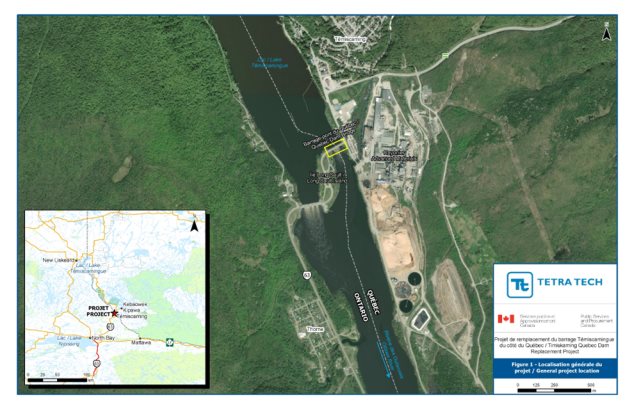
Figure 1 - Text version
The new Quebec dam-bridge would be located between the Quebec bank of the Ottawa River and the eastern bank of Long Sault Island, at the border of Quebec and Ontario.
1.2 Scope of the Environmental Assessment
1.2.1 Environmental Assessment Requirements
After analyzing the Project, IAAC determined that it was a designated project, since it represented a physical activity as described in subsection 28(a) of the Schedule to the Regulations Designating Physical Activities made under CEAA 2012:
The construction, operation, decommissioning, and abandonment of a new international or interprovincial bridge or tunnel.
In April 2018, the proponent submitted its project description to IAAC, which held public consultations on the description. IAAC also sought the expertise of various stakeholders, including federal and provincial experts and Indigenous groups, to determine the need for an environmental assessment of the project in accordance with CEAA 2012. Following the comments received, IAAC determined that an environmental assessment was required, and the assessment began on June 20, 2018.
IAAC finalized and issued the guidelines to the proponent for preparing an Environmental Impact Statement (EIS). The purpose of those guidelines was to provide the proponent with the minimum information requirements for the EIS.
To date, the following key stages of the environmental assessment process have been completed:
- August 2018: Final version of IAAC's EIS guidelines published.
- October 2022: EIS submitted by the proponent.
- November 2022: IAAC determined that the information in the EIS did not meet the guideline requirements.
- March 2023: Revised EIS submitted by the proponent.
- April 2023: IAAC determined the EIS to be in compliance with the guidelines.
- May 2023 to August 2025: IAAC carried out a technical analysis of the information provided by the proponent and issued two information requests to the latter.
- August 2025: IAAC began its environmental assessment based on the information provided by the proponent.
1.2.2 Factors Considered in the Environmental Assessment
IAAC issued EIS guidelines, which specify the nature, scope, and extent of information required to support the environmental assessment, and outline environmental effects, factors that must be considered, and valued components.
The valued components assessed are environmental and socio-economic characteristics that are likely to be affected by the project and that have been identified as areas of concern by the proponent, federal authorities, Indigenous groups, or the public.IAAC's environmental assessment focuses on components under federal jurisdiction, as defined in paragraphs 5(1)(a) and 5(1)(c) of CEAA 2012, as well as on species at risk pursuant to subsection 79(2) of the Species at Risk Act (SARA). As the Project is located on federal lands, IAAC has also assessed the changes that are likely to be caused to the environment in accordance with subparagraph 5(1)(b)(i). Table 1 shows these components.
|
Valued Component |
Legislative Requirements |
Rationale |
|---|---|---|
|
Fish and fish habitat, including special-status aquatic speciesFootnote 1 |
CEAA 2012 5(1)(a)(ii) SARA |
The Project is likely to affect fish, including special-status species and their habitats. The Project could lead to the loss or alteration of fish habitat as a result of infrastructure development and project activities. It could also result in the mortality and disturbance of individuals due to project activities and alterations (temporary or permanent) to the aquatic environment (noise, water quality, changes to the water regime, etc.). |
|
Birds, including special-status species |
CEAA 2012 SARA |
The Project is likely to affect birds (migratory and non-migratory), including special-status species and their habitats. The Project could lead to the loss or alteration of habitat as a result of infrastructure development and project activities. The Project could also cause disturbance to individuals, resulting in behavioural changes. |
|
Other special-status wildlife species |
SARA |
The Project is likely to affect special-status species and their habitats. The Project could lead to the loss or alteration of habitat as a result of infrastructure development and project activities. The Project could cause disturbance, leading to behavioural changes. |
|
Human health |
CEAA 2012 |
The Project could result in changes to the sound environment, air quality and water quality that are likely to affect human health and the quality of life of Indigenous groups and, on federal lands, of the local non-Indigenous population. |
|
Socio-economic conditions |
CEAA 2012 |
Environmental changes could have repercussions on the socio-economic conditions of the Indigenous groups and the local population, particularly recreational and tourism activities and traditional and sport fishing activities, and on any other traditional or contemporary activity practised by Indigenous groups and, on federal lands, by the local non-Indigenous population. |
|
Physical and cultural heritage |
CEAA 2012 |
The Project could result in the modification of certain characteristics inherent to the unique nature of a physical or cultural heritage component for Indigenous groups and, on federal lands, for the local non-Indigenous population. |
|
Current use of lands and resources for traditional purposes |
CEAA 2012 |
The Project could result in changes to the environment that could affect the current use of lands and resources for traditional purposes by Indigenous groups. |
|
Structures, sites or things of historical, archaeological, paleontological or architectural significance |
CEAA 2012 |
The Project could result in disturbances to historical, archaeological and architectural sites for Indigenous groups and, on federal land, the local non-Indigenous population. |
As part of its environmental assessment, IAAC took into account the factors indicated in subsection 19(1) of the CEAA 2012, as follows:
- The environmental effects of the project, including the environmental effects of malfunctions or accidents that may occur in connection with the project, and any cumulative environmental effects that are likely to result from the project in combination with other physical activities that have been or will be carried out;
- The significance of the environmental effects;
- Comments from the public;
- Mitigation measures that are technically and economically feasible and that would mitigate any significant adverse environmental effects of the project;
- The requirements of the follow-up program in respect of the project;
- The purpose of the project;
- Alternative means of carrying out the project that are technically and economically feasible and the environmental effects of any such alternative means;
- Any change to the project that may be caused by the environment;
- The results of any relevant regional study conducted under CEAA 2012.
1.2.3 Environmental Assessment Methodology
IAAC's assessment was based on the following documents:
- The proponent's EIS
- The information provided by the proponent in response to IAAC's two information requests
- Notices from the relevant federal and provincial departments and agencies
- Views expressed by affected or potentially affected Indigenous groups
- Comments received from the public
IAAC assessed the potential significant adverse environmental effects on valued components in accordance with the Operational Policy StatementFootnote 2. The potential direct and indirect effects of the project resulting from the anticipated environmental changes were also assessed.
Lastly, IAAC determined the significance of the residual effects on each valued component by considering the mitigation measures and monitoring, follow-up and offsetting/compensation programs proposed by the proponent. To characterize the significance of residual effects, IAAC used the following criteriaFootnote 3:
- Magnitude: Indicates the degree of disruption or disturbance (change) potentially experienced by the valued component under study. The assessment of magnitude takes into account the component's ecological or social context and can include the timing of the effect, which may refer to a phase in the component's life cycle (migration, reproduction, feeding, etc.) or a period during which a cultural, spiritual or recreational practice would be practised by Indigenous groups or the local non-indigenous population (e.g., hunting season).
- Geographical extent: Extent of the geographic area over which an adverse effect would occur.
- Duration: Period during which the adverse effects would be experienced.
- Frequency: The rate at which adverse effects would occur over a given period.
- Reversibility: Likelihood of a valued component recovering from the adverse effects caused by the project.
To determine the significance of each residual adverse effect on each valued component, IAAC used a grid to combine the levels of significance assigned to the criteria (see Appendix A). Effects with a high total level of significance were considered significant, while those with a medium or low level were not.
1.2.4 Spatial and Temporal Boundaries
Spatial boundaries identify the geographics areas where a project can interact with and affect the environment. Temporal boundaries take into account all activities and phases of the project life cycle likely to cause adverse effects on the environment.
Spatial Boundaries
This report took into account the following spatial boundaries established by the proponent (Figure 2):
- The Aquatic Study Area (ASA), encompassing the portion of the Ottawa River from the banks on the Quebec side to Long Sault Island, stretching 500 meters upstream and 1.5 kilometers downstream of the Timiskaming dam.
- The Terrestrial Study Area (TSA), encompassing the terrestrial sites likely to be directly affected by the work, including Long Sault Island (4.9 hectares) and the left bank of the Ottawa River. To assess the effects on wildlife components at the regional level, a study area with a radius of approximately two kilometers around the site was also considered.
- The Local Study Area (LSA) was used to assess the effects of the project on the socio-economic and health conditions of Indigenous and non-Indigenous populations in Quebec and Ontario within a 20-kilometre radius of the work area.
Temporal Boundaries
This report considered the following temporal boundaries, established by the proponent:
- The construction phase, to take place over three years, from 2027 to 2030
- The operation phase, expected to last for 75 years and occur continuously, 24 hours a day and 365 days a year
According to the proponent, at the end of the structure's useful life, the new dam-bridge would be replaced in accordance with the applicable laws and regulations.
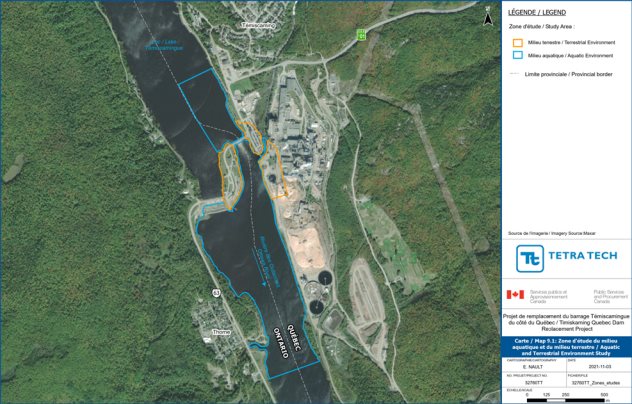
Figure 2 - Text version
The map illustrates the study areas surrounding the Timiskaming Dam on the Ottawa River, along the Quebec–Ontario border. The aquatic areas are delineated within the river between the Quebec shoreline and Long Sault Island, extending upstream and downstream of the dam. The terrestrial areas cover Long Sault Island as well as industrial and natural lands along the Quebec shoreline.
2. Project Overview
The information in this chapter serves as a reference for the environmental assessment described in Chapter 5.
2.1 Project Components and Activities
2.1.1 Construction Phase
Site Preparation
The proponent has identified the work areas that must be made accessible on a 24/7 basis during the construction phase. Figure 3 indicates the preferred work areas. The areas delineated in the figure represent the maximum rights-of-way that the contractor can use. The contractor will confirm the precise location of the areas it intends to use within these rights-of-way.
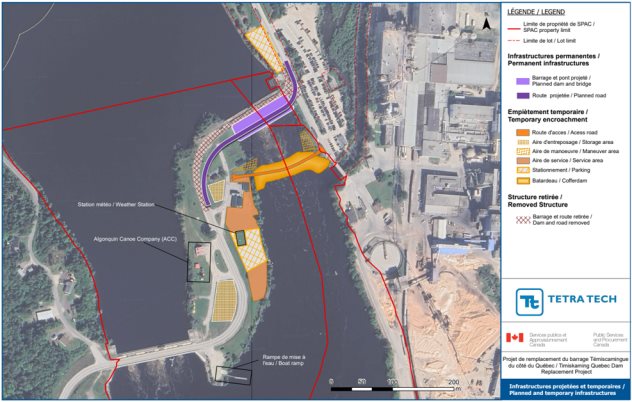
Figure 3 - Text version
The figure presents the proposed layout of the new dam-bridge and associated infrastructure, including roads and permanent structures. Areas of temporary encroachment are shown, corresponding in particular to access, storage, maneuvering, and service areas, as well as cofferdams. The proponent's property boundaries and lot lines are also delineated. The area also includes identified features such as a boat launch, a weather station, and the facilities of the Algonquin Canoe Company located on Long Sault Island.
Construction of the New Dam-Bridge
The new structure would be built roughly 19 meters downstream of the existing dam-bridge. The mechanized water management system for the new dam-bridge will include five bays with vertical gates, opening from bottom to top (with the water flowing through the base), and five bays with wooden stop logs, similar to those in the existing structure, opening from top to bottom (with the water flowing above the logs). Extension of the existing apronFootnote 4 downstream is also anticipated.
The bridge deckFootnote 5 will support a two-lane roadway for vehicles and a sidewalk for pedestrians and snowmobiles. The road's drainage system would be constructed using a similar approach to the existing one, with stormwater pipes equipped with outfalls discharging into the river downstream of the dam. Settling ponds are planned along the side of the road to capture the suspended solids in the stormwater before it is discharged into the river. The bridge approaches would be aligned with the new structure. Electricity, telephone and natural gas lines would be reinstalled on the new structure and connected to the lines on either side of the dam-bridge.
The Project is planned to ensure the continuity of vehicle traffic during the work.
The construction of the new dam-bridge will require the temporary dewatering of the riverbed using a cofferdam. The proponent plans to build a temporary cofferdam roughly 70 meters downstream of the existing structure (Figure 3). The pumped water will be treated inside the cofferdam so that the fine particles settle out before the water is returned to the river.
The main construction materials required are concrete and granular materials of various diameters. The contractor will be responsible for supplying the concrete. The proponent, as part of a commitment to sustainability, will include incentive clauses in the contract to reduce greenhouse gases (GHGs) and will also explore carbon neutrality options for the Project. The other materials will come from existing quarries and sand pits in the region with the required environmental authorizations.
Deconstruction of the Existing Dam-Bridge
The existing dam-bridge, made from reinforced concrete, is roughly 75 meters long and 15 meters wide. Jackhammers will be used for deconstruction. Blasting may be necessary on some parts of the existing structure, but will be kept to a strict minimum. Some uncertainties remain about the deconstruction methods to be implemented, which will be determined by the successful contractor and specified and analyzed during the authorizations phase. Once the new dam-bridge has been commissioned, the existing dam-bridge will be deconstructed and the existing road approaches will be dismantled.
Construction and Demolition Waste Management
All waste construction materials and demolition debris will be managed in accordance with current regulations; they will be recovered and temporarily stored in work areas, and then transported to authorized sites. Non-hazardous waste will be hauled to an appropriate disposal site or to available recycling or composting facilities. Hazardous liquid waste will be stored in secure containers for disposal. The proponent commits to disposing of waste materials resulting from land clearing, with a priority on composting.
Water Management at the Dam
Measures will be taken to ensure the security and continuity of infrastructure operations. Moreover, depending on the construction phase, the hydrological conditions and the dams' maximum hydraulic capacity, the Quebec dam will be completely or partially closed. Therefore, the outflow from Lake Timiskaming will have to be managed in whole or in part by the Ontario dam. Hydrological monitoring of the Ottawa River watershed will be carried out while the Quebec dam is closed. This initiative will make it possible to anticipate possible flooding and to plan for the optimal management of the work.
The Project will be managed in a way to ensure that water levels in Lake Timiskaming and flows in the Ottawa River are maintained throughout the construction phase.
Installation of a Fishway
As part of the Ontario dam-bridge replacement project, Fisheries and Oceans Canada had required the proponent to restore the American eel passage in anticipation of its future return to the watershed, with the goal of preserving the viability of the fisheries and increasing its productivity. However, the American eel is not present upstream of the Carillon dam near Montreal.
Discussions with certain Indigenous groups and organizations had raised interest in ensuring the free passage of multiple species across the new dam-bridge. In August 2019, the new Fisheries Act also came into effect, with section 34.3 on the free passage of fish aiming to promote the restoration of fish habitat connectivity. The proponent therefore proposed three more options in its EIS, in addition to the passage for the American eel:
- Installing a multi-species fishway that would enable the free passage of fish and access to habitats upstream, including spawning grounds;
- Maintaining the status quo, i.e., no fishway, which would protect the upstream watershed from potential aquatic invasive species, but which would not restore the free passage of fish; and
- Conducting a more detailed impact assessment to better understand the benefits and drawbacks for the watershed.
The proponent notes that further discussions are necessary with Fisheries and Oceans Canada and Indigenous groups to identify the preferred option. It also wishes to more closely examine the feasibility of the multi-species fishway, while taking into account the specific needs of the target species, under the Fisheries and Oceans Canada authorization process.
IAAC wishes to reiterate that, as part of the Ontario dam-bridge replacement project, the proponent is required to begin developing plans to enable the passage of the American eel through the Timiskaming Dam Complex as soon as the imminent return of this species upstream of the Otto Holden dam is anticipated, or in accordance with Fisheries and Oceans Canada guidelines.
2.1.2 Operation Phase
Transport Quebec and the Ontario Ministry of Transport are responsible for managing the road infrastructure. They perform maintenance of guardrails and lighting, as well as snow removal and the salting and sanding of roads.
The proponent is responsible for managing the dam portion. Water management at the dam ensures that water levels in Lake Timiskaming and flows in the Ottawa River are maintained. Fisheries and Oceans Canada may, however, require that water management be adapted or optimized to favour fish spawning.
In compliance with the proponent's procedures, the new dam-bridge structure will be inspected and maintained.
There are no plans to deconstruct the proposed dam-bridge. Should it become necessary, replacement will be carried out in compliance with the regulation in force.
2.1.3 Project Components, Activities and Schedule
The main activities required to complete the Project are summarized in Table 2 according to the construction phase. The phasing of the work is planned in accordance with the spring freshet and spawning periods. However, the contractor could revisit the phasing, depending on the timing, extent and magnitude of the spring freshet. Figure 4 shows the four proposed construction phases.
|
Component |
Activities |
|---|---|
|
Construction Phase – 30 months |
|
|
Site preparation |
June to mid-July – first year
|
|
Construction of the new dam-bridge |
Phase 1 – Mid-July to December – first year
Phase 2 – December of the first year to October of the second year
Phase 3 – August of the second year to July of the third year
|
|
Deconstruction of the existing bridge dam |
Mid-July to October – Third year
|
|
Operation Phase – 75 years |
|
| - |
|
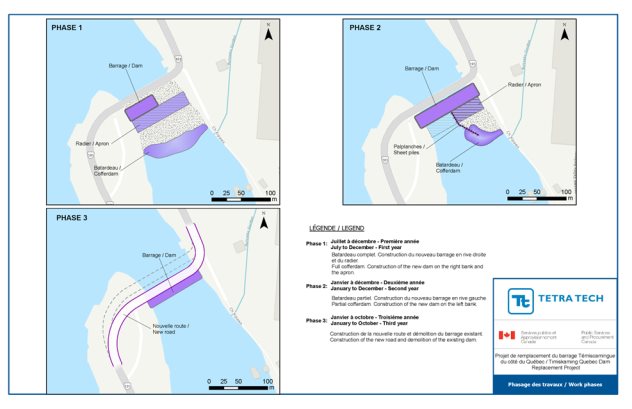
Figure 4 - Text version
Phase 1 shows the construction of the new dam on the right bank, including a full cofferdam and a foundation slab.
Phase 2 presents the continuation of the work on the left bank with a partial cofferdam and the installation of sheet piles.
Phase 3 illustrates the construction of a new road connecting the shores and the demolition of the existing dam. The work would be carried out from July to December in the first year for Phase 1, from January to December in the second year for Phase 2, and from January to October in the third year for Phase 3.
3. Assessment of Alternative Means
3.1 Options for the Replacement of the Dam-Bridge
The proponent decided to replace the Quebec dam-bridge, since, in its view, the limited space available reduces the potential options. Although the new dam-bridge could be built in a different location, no other alternatives are available for the other project components. It is critical that the road is built on the new dam-bridge to avoid further encroachment on fish habitat and to meet road design criteria.
First, the proponent conducted a comparative analysis of three replacement options, and subsequently a fourth option after submitting the EIS. The design options development and analysis study (Tetra Tech, 2017), updated in 2025 (Tetra Tech, 2025), presented a comparative analysis aimed at identifying the location for the new dam-bridge. The proponent analyzed the construction challenges for each option, addressing economic, technical and environmental aspects. The following chapters present the four replacement alternatives, the one selected by the proponent, and IAAC's analysis.
3.1.1 Building a New Dam-Bridge Downstream of the Existing Dam-Bridge
This option would involve the construction of a new dam-bridge located roughly 19 meters downstream of the existing dam-bridge, which would be completely deconstructed. It would also require the installation of a temporary cofferdam downstream of the existing dam-bridge.
According to the proponent's analysis, this option would respect the project schedule, which was established to mitigate impacts on water management during the spring freshet period. This option should have no impact on traffic. Some geotechnical uncertainties are involved, but the proponent states that the technical risks are manageable, because the same option was used during the Ontario dam-bridge replacement project. This approach has the advantage of being able to use the existing dam-bridge as an upstream cofferdam for dewatering the work area. However, it could have impacts on fish habitat, due to the temporary and permanent losses of fish habitat, as well as the alteration of water flows near spawning grounds.
3.1.2 Building a New Dam-Bridge Upstream of the Existing Dam-Bridge
This option would involve building a new dam-bridge located roughly 19 meters upstream of the existing structure and the complete deconstruction of the existing dam-bridge. A temporary cofferdam would also need to be installed upstream of the existing dam-bridge.
According to the proponent's analysis, this option would respect the project schedule, which was established to mitigate the impacts on water management during the spring freshet period. This option should have no impact on traffic. However, it entails scheduling and costing risks. The proponent would have to demolish and rebuild the Rayonier Advanced Materials (RYAM) plant's pumping station before constructing the new dam-bridge. Some geotechnical uncertainties, which could pose technical and financial risks, must also be considered. In addition, it would result in temporary and permanent losses of fish habitat, thus having a significant impact on this component. Work carried out outside the cofferdam dewatering area would be required, which could have effects on water quality.
3.1.3 Partial Reconstruction of the Dam-Bridge at the Same Location as the Existing Dam-Bridge
This option would involve rebuilding the dam-bridge, while retaining some of the piers and abutments. A temporary cofferdam would need to be installed downstream of the existing dam-bridge.
According to the proponent, this option has major drawbacks. The service life of the structure would be 50 years instead of the initially planned 75 years. Construction (an estimated 50 months) will take longer than for the two previous options. This could have an impact on the management of the spring freshet. For a period of 17 months, traffic across the dam-bridge would be alternating, which could result in impacts on traffic for residents in the region. The proponent has also identified some uncertainties surrounding the integrity of the existing structure, which could entail significant technical and financial risks. However, according to the proponent's analysis, the option would only have a moderate impact on fish habitat. Work carried out outside the cofferdam dewatering area would be required, which could have effects on water quality.
3.1.4 Complete Construction of the Dam-Bridge at the Same Location as the Existing Dam-Bridge
This option would involve the complete deconstruction of the existing dam-bridge and the construction of a new dam-bridge at the same location. The construction of a temporary bridge for traffic would also be required. Two temporary cofferdams would need to be installed downstream and upstream of the existing dam-bridge.
According to the proponent, this option presents major drawbacks. The construction work would have the longest time frame, an estimated duration of 61 months). The option is also likely to have a significant impact on fish habitat due to the installation of two cofferdams.
3.1.5 Option Selected by the Proponent
On the basis of a comparative analysis, the proponent concluded that the most beneficial option was Option 1, which involves constructing a new structure downstream of the existing dam-bridge. It would allow the proponent to respect the project schedule, established to mitigate impacts on water management during the spring freshet and spawning periods. It would have no impact on interprovincial mobility for the local and regional population. According to the proponent, this option presents lower technical and financial risk, as it was used for the Ontario dam-bridge replacement project in 2014.
3.1.6 IAAC Analysis and Conclusion
IAAC notes that the Timiskaming dam-bridge ensures water management in the Ottawa River and is an important road link for the region. The proponent demonstrated that extending the lifespan of the existing dam-bridge would require frequent and significant maintenance costs. IAAC is of the opinion that the Timiskaming dam-bridge needs to be replaced for safety reasons and to meet the stated needs.
The proponent has identified technically and socio-economically feasible alternatives and ascertained the potential environmental effects. As part of its analysis, the proponent took into consideration and provided several arguments to justify the construction of a new dam-bridge downstream of the existing one, including traffic maintenance, technical risk and schedule predictability. Constructing the new dam-bridge along a different road axis would allow traffic to continue on the existing dam-bridge throughout the construction phase. The proponent also stated that downstream reconstruction was the least technically and financially risky option and offered greater predictability in terms of the completion of the work.
In its comparative analysis (Table 7.1 in Tetra Tech, 2017), it would have been helpful if the proponent had used weighting to reflect the relative importance of the various evaluation criteria, but instead selected colour-coded ratings (green, yellow and red) to differentiate the various options. This gave all evaluation criteria and issues equal weight, but individual weighting might have been beneficial. For example, Kebaowek, Wolf Lake and Timiskaming First Nations are of the opinion that the potential effects on fish habitat would be greater for a downstream dam-bridge than for an upstream one, due to the different types of habitat found. Although the total loss of fish habitat with the downstream option would be similar to that for the upstream option (13,161 m² for the downstream option versus 13,315 m² for the upstream one), the permanent habitat loss in the spawning grounds would be much more significant (2,347 m² versus 110 m²) with the downstream option.
Nevertheless, IAAC is of the opinion that the proponent has evaluated feasible alternative means of carrying out the Project in compliance with CEAA 2012. It should be noted that some of the options may involve significant technical risks that could compromise the integrity of the structure during construction. According to the proponent's assessment, building a new dam-bridge along a different axis is the best solution.
3.2 Cofferdam Construction Options
In July 2025, Kebaowek, Wolf Lake and Timiskaming First Nations informed IAAC and the proponent that they did not consent to the downstream replacement option involving a riprap cofferdam, since it would be built in a spawning ground used by several species including lake sturgeon, a species of great cultural value, and could impact their rights as well as their commitment to land and resource management.
In response to this concern, the proponent has committed to diligently advancing the downstream option that uses a sheet pile cofferdam or other type of cofferdam—which would limit encroachment on the spawning ground used by lake sturgeon—as the Project's core design throughout the process. The proponent will only depart from this option if the parties ascertain, during detailed design and engineering, that it is not technically feasible. The objective is to identify the best option for replacing the dam.
In the event of a change to the preferred option during the detailed design phase that could alter the Project as assessed, the proponent must notify IAAC in writing as soon as possible. IAAC will then determine, in accordance with section 68 of the IAA, whether an amendment to the decision statement is required and, if so, the steps to be taken, within the limits provided for by the Act.
4. Consultation and Engagement Activities and Advice Received
IAAC integrated Crown consultation and engagement activities with Indigenous groups as part of the environmental assessment process, and also took into account public comments and community knowledge into account.
4.1 Consultation with Indigenous Peoples
4.1.1 Indigenous Consultation Activities Led by IAAC
The Crown has a duty to consult Indigenous Peoples in Canada and to accommodate, where appropriate, when its proposed conduct might adversely impact Indigenous or Treaty rights protected under section 35 of the Constitution Act, 1982 (section 35 rights). Consultation with Indigenous Peoples is also undertaken more broadly to aid good governance, sound policy development, and decision-making. The Minister's significance decision pursuant to subsection 52(1) of CEAA 2012 is considered Crown conduct that could give rise to the common law duty to consult and, where appropriate, accommodate with respect to potential adverse impacts on section 35 rights.
For the purposes of the federal environmental assessment, IAAC served as Crown Consultation Coordinator to facilitate a whole-of-government approach to consultation.
In addition to the federal government's broader obligations, CEAA 2012 requires, with respect to Indigenous peoples, that it considers the effects of environmental changes on health and socio-economic conditions, physical and cultural heritage, current use of lands and resources for traditional purposes, or any structure, site or thing that is of historical, archaeological, paleontological or architectural significance. The analysis of potential effects on Indigenous groups is presented in Chapters 5.5 to 5.8. The assessment of the Project's potential impacts on established or potential Indigenous and treaty rights is covered in Chapter 7.
The target Indigenous groups for consultation are those with a direct interest in the Project due to their geographical proximity, traditional land use and the potential impact on their established or potential Indigenous or treaty rights. As part of its consultation process, IAAC held discussions with the Kebaowek, Wolf Lake and Timiskaming First Nations in Quebec, and the Algonquins of Pikwakanagan First Nation (AOPFN) in Ontario. These First Nations have Indigenous and treaty rights. The Kebaowek, Wolf Lake and Timiskaming First Nations have made the decision to collaborate within the SARTFootnote 6 group (SART First Nations).
IAAC also considered the potential effects on the Algonquins of OntarioFootnote 7 (AOO), Antoine Nation and the Métis Nation of OntarioFootnote 8 (MNO).
Following discussions and meetings in 2018, IAAC suggested implementing a consultation pilot project for the Indigenous groups. The objective of this Project was to put in place a consultation process similar to that proposed to Indigenous groups for Projects assessed under the IAA. Under the proposed approach, the following activities would be added to the standard consultations offered:
- Upstream engagement activities before the proponent submits the EIS;
- Membership on IAAC's technical committee;
- Contribution to the authorship of certain chapters of the environmental assessment report (for example, those relating to the Project's effects on current use and impact to rights).
Throughout the process, IAAC has enabled Indigenous groups to become more familiar with the Project, to express their concerns about the Project's potential environmental effects and potential adverse impacts on Section 35 rights, and to review suitable mitigation and accommodation measures, where appropriate. IAAC invited Indigenous groups to consult and comment in writing on the proponent's Project description and IAAC's guidelines. Indigenous groups are also able to formulate questions to be included in IAAC's information requests following the submission of the proponent's EIS. They will also have the opportunity to review and comment on this draft environmental assessment report and potential conditions.
In December 2025, IAAC concluded a consultation framework agreement with SART First Nations, including a work plan and a protocol for seeking free, prior, and informed consent. This work plan provides for the collaborative drafting of Chapter 7 (Impact to Rights). In the framework agreement, IAAC commits to seeking consensual solutions with SART First Nations, where possible. In the event of disagreement, IAAC commits to communicating the First Nations' points of disagreement in the final environmental assessment report.
IAAC has agreed to terms of reference with AOPFN. In this agreement, IAAC commits to co-drafting Chapter 7 and to presenting any disagreements in the final environmental assessment report.
As part of IAAC's environmental assessment process, a total amount of $683,608.00 was allocated to Indigenous groups.
4.1.2 Indigenous Consultation Activities Led by the Proponent
In the summer of 2016, the proponent contacted a number of Indigenous groups in the region about the Project. In 2018, a press release was issued to the groups concerned after the list of the Indigenous groups to be consulted by IAAC was verified.
SART First Nations collaborated with the proponent to develop a formal consultation agreement before beginning consultation activities. The agreement was signed by the parties in November 2021.
In the spring of 2017, the proponent canvassed Indigenous groups to evaluate their rights and activities in the Project area, as well as their traditional knowledge. It also invited them to comment on the protocols for the inventories and surveys, and to take part in these activities in the field. Financial resources were also allocated to some Indigenous groups to carry out studies on various valued components.
The Indigenous groups were given the opportunity to review and comment on the draft and final versions of the proponent's technical studies and EIS prior to their submission to IAAC.
It should be noted that the 2019 coronavirus pandemic led to disruptions in the proponent's consultations with Indigenous groups between 2020 and 2021.
4.2 Public Participation
4.2.1 Public Participation Led by IAAC
IAAC held three series of public consultations, coinciding with the following key stages of the process:
- the proponent's submission of the summary of the Project description (May 3 to 23, 2018);
- the publication of IAAC's draft guidelines for the preparation of an EIS (June 20 to July 22, 2018); and,
- the submission of the proponent's summary of the EIS (April 3 to May 3, 2023).
These public consultations were announced on the Canadian Impact Assessment RegistryFootnote 9 and in the local media.
IAAC received comments from citizens and various groups. The main concerns are the following elements:
- The degradation and loss of lake sturgeon habitat due to the destruction of a spawning site;
- The need to implement environmental quality monitoring measures;
- Impacts of the fishway on the ecology of the Ottawa River (supporting the recovery of threatened species or posing a risk of spreading invasive species); and
- Cumulative effects of the Project on the ecological integrity of the Ottawa River.
Some organizations also indicated their support for the Project and underscored the socio-economic importance of the dam-bridge for the region, as well as the proponent's efforts to mitigate the Project's environmental effects.
4.2.2 Public Participation Led by the Proponent
In the summer of 2017, the proponent held a public consultation session in the town of Témiscaming. This initiative was aimed at soliciting the public's opinions and concerns about the Project. The proponent also met with representatives of the town of Témiscaming and the RYAM plant.
The proponent released a series of notices and press releases in the local media, on social media networks and on its website to present details on the Project and its progress.
4.3 Participation of Federal and Provincial Experts
Under section 20 of CEAA 2012, federal departments and agencies with expertise or knowledge required for the Project lent their support to IAAC throughout the environmental assessment process.
IAAC sought the expertise of the following government departments and agencies: Fisheries and Oceans Canada, Environment and Climate Change Canada, Transport Canada, Health Canada, Natural Resources Canada and Parks Canada. IAAC also relied on the Abitibi-Témiscamingue wildlife management division of the Quebec's Ministère de l'Environnement, de la Lutte contres les changements climatiques, de la Faune et des Parcs.
5. Predicted Effects on Valued Components
IAAC assessed the potential significant adverse environmental effects on valued components. The direct and indirect effects that may result from predicted changes to the environment were also assessed.
Appendix B presents a summary of the residual adverse environmental effects for each valued component, while Appendix C covers all of the mitigation measures and requirements for the monitoring and follow-up and offsetting programs deemed necessary by IAAC to prevent the Project from causing significant adverse environmental effects.
5.1 Fish and Fish Habitat, Including Special-Status Species
The Project could cause residual effects on fish and fish habitat, as defined in the Fisheries Act, particularly on species of special status and species of interest to Indigenous groups owing to the degradation and destruction of habitat, fish mortality and alteration of fish habitat.
IAAC is of the view that the Project is unlikely to have significant adverse effects on fish and fish habitat, including fish species at risk and those of special status, after considering the implementation of key mitigation measures and monitoring and follow-up programs.
5.1.1 Component Description
About 30 species of fish were recorded during various surveys conducted by the proponent in the study area, including lake sturgeon. Although the Great Lakes and upper St. Lawrence population of lake sturgeon is not listed in Schedule 1 of SARA, it is considered threatened by COSEWIC. Although lake sturgeon is a migratory species with an extensive home range, its range in the area is limited by the presence of dams.
The Project falls within the range of the hickorynut, which is listed in Schedule 1 of SARA. However, for safety reasons and because of the small amount of sandy substrate in the ASA, the proponent did not characterize the benthic fauna, particularly freshwater mussels. For some Indigenous groups, the hickorynut is a species of interest because of its relationship with lake sturgeon.
Lake sturgeon and walleye are species of special significance to Indigenous groups, with walleye being one of the most commonly harvested species. American eel is also a species of interest for Indigenous groups in the region; however, although it was previously present, it is currently not found in the ASA, as downstream dams prevent its migration.The proponent used the classification set out by Armellin et al. (1997) to characterize the aquatic habitats of the ASA based on four biophysical characteristics: flow velocity, mean depth, substrate particle size and the presence or absence of aquatic vegetation. This approach helped identify the main habitats present. Surveys were subsequently carried out to confirm the presence of spawning grounds and to identify potential ones. Within the ASA, the proponent identified 15 confirmed or potential multi-species spawning grounds (Figure 5).
The surveys conducted by the proponent revealed the presence of a spawning ground used primarily by lake sturgeon, located downstream of the existing dam-bridge (confirmed spawning ground TT-006; Figure 5) and characterized by a rocky substrate and swift flow conditions. Given that similar conditions are present along the banks downstream of the dam, these areas could be used by various species for spawning, including lake sturgeon (potential spawning grounds TT-003 and TT-004; Figure 5).
The ASA provides other types of habitat suitable for many species, including lake sturgeon (Figure 5).
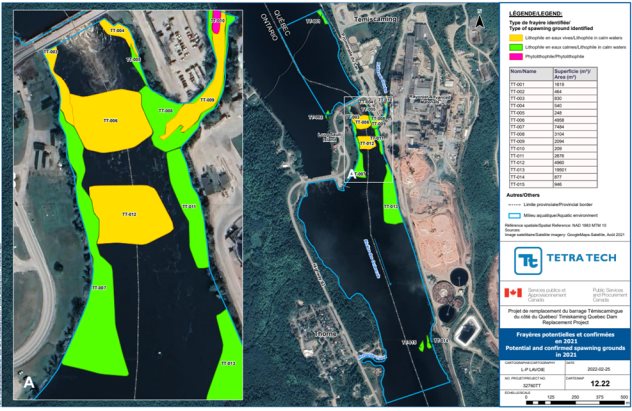
Figure 5 - Text version
The figure shows the spatial distribution of potential and confirmed spawning grounds within the aquatic study area. Three types of spawning habitats are represented: lithophilic spawning grounds in flowing waters, lithophilic spawning grounds in still waters, and phytophilic spawning grounds. The main spawning areas are located upstream and immediately downstream of the dam, as well as around Long Sault Island. The areas are identified by codes, and their surface areas are specified in a table.
5.1.2 Analysis of Potential Effects and Proponent's Proposed Mitigation Measures
According to the proponent, the main effects of the Project on fish and fish habitat are related to permanent and temporary habitat loss, fish mortality and altered flow regimes and water quality.
Special attention is given to lake sturgeon because of its conservation status and cultural significance to Indigenous groups.
Harmful Alteration and Destruction of Fish Habitat
Based on the chosen concept of constructing a new dam-bridge downstream of the existing one, the proponent estimates that the new structure will result in 9,264 m² of permanent encroachment in the Ottawa River, while the construction of a cofferdam would result in 3,907 m² of temporary encroachment (Figure 6). More specifically, the Project would result in the permanent loss of 2,357 m² of spawning grounds and a temporary loss of 3,842 m² of spawning grounds. Of these areas, 4,450 m² of confirmed and potential lake sturgeon spawning grounds would be affected. Furthermore, the permanent loss of nursery, rearing and food supply areas would be 6,907 m². The detailed areas of encroachment are presented in Table 3.
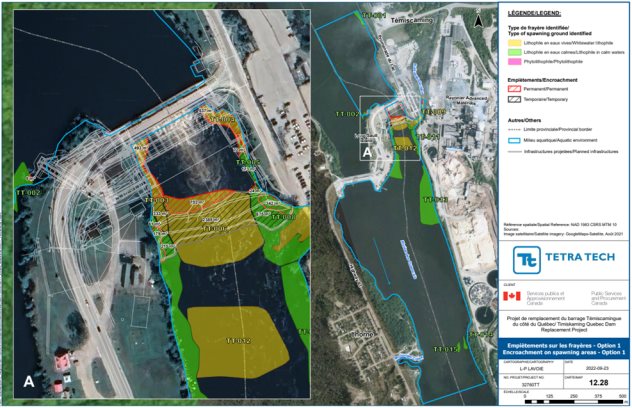
Figure 6 - Text version
The figure presents the temporary and permanent encroachments on spawning grounds within the aquatic study area, overlaid with the habitat mapping previously illustrated in Figure 5.
| - |
Permanent Loss (m²) |
Temporary Loss (m²) |
Total (m²) |
|---|---|---|---|
|
Confirmed and potential lake sturgeon spawning grounds (TT-003, TT-004 and TT-006) |
1,732 |
2,718 |
4,450 |
|
Other spawning grounds |
625 |
1,124 |
1,749 |
|
Other habitats |
6,907 |
65 |
6,972 |
|
Total |
9,264 |
3,907 |
13,171 |
|
Source: Adapted from Table 12.35 in answers to IR-1, PSPC, May 18, 2024, page 78. |
|||
According to Fisheries and Oceans Canada, uncertainties persist regarding the residual effects on fish and fish habitat, which are due to the inability to accurately assess the effects of dewatering the fish habitat enclosed by the cofferdam during the work period. Since some spawning grounds will no longer be available or will be altered, Fisheries and Oceans Canada is anticipating effects on the recruitment of fish species that use these habitats. Moreover, the time lag between the start of construction and the implementation of offsetting measures will also have a temporary effect on the recruitment of several species. However, according to Fisheries and Oceans Canada, the implementation of appropriate offsetting measures and monitoring, along with corrective work if necessary, will adequately offset losses while taking uncertainties into account.
Mitigation Measures
The proponent is committed to developing, in consultation with Indigenous groups, an offsetting plan for fish and fish habitat that is to the satisfaction of Fisheries and Oceans Canada.
The objective of the offsetting plan is to ensure the maintenance of habitat functions and the integrity of the affected ecosystem. For Fisheries and Oceans Canada, an important part of the offsetting plan involves enhancing multi-species spawning habitat downstream of the dam-bridge. Fisheries and Oceans Canada would be in favor of optimizing conditions in the area downstream of the dam, particularly with respect to the substrate type, in order to restore favourable habitat—or even improve it compared with initial conditions—to benefit the spawning of various species, with priority given to lake sturgeon. The enhancements would be designed to provide a range of depths and current velocities, thus meeting the requirements of different species that spawn on gravel substrates in swift waters. Flow modelling conducted by the proponent will be critical in determining the location of the spawning habitats to be enhanced during the implementation of offsetting measures. Fisheries and Oceans Canada will require corrective actions to restore conditions if discrepancies are observed between modelled flows and observations made during post-construction monitoring.
Fish Mortality
According to the proponent, the Project could pose a risk of fish mortality due to dewatering work upstream of the cofferdam. Indigenous groups have expressed concerns about the lack of a field survey and hickorynut mortality during the dewatering of the area enclosed by the cofferdam. However, the habitat characteristics at the work site differ from those sought by the hickorynut.
If the use of explosives is required to deconstruct the existing dam-bridge, the proponent is of the opinion that this activity could also pose a risk of fish mortality.
Mitigation Measures
In its EIS, the proponent planned to begin the installation of the cofferdam 10 days after the water temperature in the work area reached 18°C. The confirmed presence of lake sturgeon in the work area means that work restrictions periods specific to this species must be applied. Some authors have reported that lake sturgeon eggs hatch between 7 and 10 days after spawning. However, Smith et al. (2017) and Peterson et al. (2007) refer to a period of 8 to 14 days before hatching, depending on the water temperature, while Smith et al. (2017) and LaHaye et al. (1992) state that larvae consume their yolk sac reserves before drifting downstream from the spawning site—this period could last from 13 to 19 days after hatching. Therefore, according to Fisheries and Oceans Canada, any activity in fish habitat that could be harmful or lethal to fish must begin 30 days after the temperature reaches 18°C. This ensures that lake sturgeon are protected during the spawning period, egg incubation period and development period of lake sturgeon larvae in the spawning ground until they migrate downstream.
The proponent plans to salvage fish within the turbidity curtain and cofferdam and subsequently relocate them.
With respect to the hickorynut, the proponent has accounted for the possibility of its presence at the work site; the proponent has committed to using divers to conduct inspections throughout the cofferdam area before dewatering the enclosure and to relocating individuals, if necessary. Fisheries and Oceans Canada is of the opinion that the probability of the species being present is low and that the mitigation measure proposed by the proponent is sufficient to reduce the effects on the hickorynut. Fisheries and Oceans Canada has also confirmed that it will issue a permit in accordance with the Species at Risk Act and will assist the proponent in adapting the species-specific detection and relocation protocol.
As part of the deconstruction work on the existing dam-bridge, the proponent will be required to comply with Fisheries and Oceans Canada guidelines pertaining to the use of explosives. Explosives must be detonated outside spawning periods and within a turbidity curtain.
Altered Flow Regime
Flow management during the construction phase could cause alteration of fish habitat downstream of the dam-bridge, which would affect fish spawning and the productivity of certain species.
A complete closure of the dam in Quebec is scheduled between July and December in the first year of construction (Phase 1), which could cause a temporary disruption of general fish habitat and spawning habitat for species that spawn in the fall, such as salmonids. However, surveys did not reveal any spawning grounds for salmonids, including lake whitefish, downstream of the dam-bridge. According to the proponent, a decline in productivity over one year would not affect salmonid populations. In addition, a change in flow velocities on the Ontario side of the dam is planned during the complete closure of the Quebec dam. According to the proponent, this change in the flow regime on the Ontario side would be comparable to major flood conditions, and closing all the gates in a dam is common practice in how operations are currently managed.
Velocities will also increase on the Quebec side from December to August (during phases 2 and 3 of construction, when a half-cofferdam blocks half of the bays on the dam). Water will therefore flow only through the western part of the dam, which would affect the spring spawning period during the second year of construction. According to the proponent, the area affected by this change in flow velocity would be limited.
Although the confirmed spawning ground downstream, used primarily by lake sturgeon, will be fully or partly accessible over the three spring construction periods, Fisheries and Oceans Canada is of the opinion that uncertainties remain regarding the disturbances caused by the altered flow regime on the various spawning sites located in the area affected by the work and that a precautionary approach should be adopted. In order to address these uncertainties, the proponent will be required, at the request of Fisheries and Oceans Canada and in collaboration with Indigenous groups, to develop monitoring programs during and after the work. These monitoring programs will be outlined in the authorization to be issued by Fisheries and Oceans Canada.
The proposed dam-bridge would be equipped with sluice gates rather than stop logs, which are currently used to manage the existing dam. The proponent is of the opinion that changes to the flow regime could alter fish habitat downstream of the dam-bridge. Water would flow through the base (the bottom), so under the sluice, rather than by flowing above the stop logs. Flow velocities would be approximately 4 m/s downstream of the sluice gate, compared with 2 m/s currently. According to the models presented by the proponent, this difference would affect an area about 50 meters downstream of the structure. The return to optimal spawning conditions for lake sturgeon will therefore depend on the flow conditions of the new gate system. The proponent is confident that favourable spawning conditions will be reproduced once the new structure is built.
Mitigation Measures
During the construction phase, the proponent is committed to respecting the dates and periods of dam closures in accordance with the various life cycles of fish species. Among other things, it plans to completely close the Quebec dam only after the spring spawning period.
During the operation phase, the proponent plans to comply with the dam's operational management plan and to improve it, if necessary.
Altered Water Quality
The proponent anticipates that in-water and shoreline work, as well as surface runoff, could lead to an increase in suspended solids (SS) in the water. These releases of SS could alter the lentic habitats used by fish by affecting riverbed substrate grain size, primary production and light penetration. The deposit of SS could adversely affect the development of eggs and larvae; however, fine sediments would not settle in swift water spawning grounds because the current velocity is too high. According to the proponent, these changes will be episodic and will not have significant effects on fish.
Potentially contaminated sediments and soils could be remobilized to the aquatic environment. According to the proponent, downstream of the existing dam-bridge is not conducive to the accumulation of fine sediments, which are more likely to be contaminated. The proponent therefore considers the risk of contamination to the aquatic environment to be low.
Mitigation Measures
The proponent plans to develop an environmental management plan, including an erosion and sediment control plan, and will implement sediment and erosion control measures, such as the installation of erosion barriers. It will also install a turbidity curtain prior to the construction of the cofferdam and the deconstruction of the existing dam-bridge.
The proponent is committed to characterizing excavated or disturbed soils and sediments. Contaminated soils and sediments will be transported to a specialized site.
Lastly, the proponent plans to establish a baseline and monitor water quality, including via turbidity measurements.
Fish Passage
As part of the Project, the fish passage between the downstream and upstream areas of the dam-bridge will remain subject to restrictions. Since the construction of the existing dam-bridge, the structure has blocked migration corridors. Fisheries and Oceans Canada is of the opinion that the lake sturgeon population in the river segment located between the Timiskaming Dam Complex and the Otto Holden dam could struggle to grow due to habitat fragmentation. According to Fisheries and Oceans Canada, installing a fishway as part of the new structure would facilitate the free passage of fish, thereby mitigating the adverse effects of habitat fragmentation. As a result, and given the absence of aquatic invasive species downstream, it is recommended that connectivity be restored, particularly for lake sturgeon.
According to the proponent, the impact of installing a fishway on fish populations is nevertheless unknown. A fishway enables migratory fish to access other spawning grounds upstream. On the one hand, if fish are able to return to their original environment, the impact recruitment will be positive. On the other, if fish do not return to their original environment, the impact on recruitment would be negative. Moreover, the use of a fishway by alien invasive species could promote their spread upstream of the watershed, resulting in adverse consequences for native fish species.
Mitigation Measures
The proponent is committed to studying the possibility of installing a fishway in the new dam-bridge in Quebec to restore the free passage of fish.
5.1.3 IAAC Analysis and Conclusions on Residual Effects
To move forward with the Project, the proponent will need to obtain approval under sections 34 and 35 of the Fisheries Act. Fisheries and Oceans Canada will ensure that the Project is in compliance with this regulation upon the conclusion of the environmental assessment.
Harmful Alteration and Destruction of Fish Habitat
IAAC recognizes that the alteration and destruction of fish habitats associated with the construction work represent large areas within the Project footprint, and that concerns remain regarding the loss of spawning habitat for lake sturgeon associated with the installation of a cofferdam. IAAC understands that the proponent has committed to assessing technically and economically viable options for the construction of the cofferdam, before determining which option will be selected to mitigate the Project's effects on fish and fish habitat. Habitat loss is considered irreversible and severe given the areas altered or destroyed.
IAAC also understands that the proponent has committed to developing, in collaboration with Fisheries and Oceans Canada, a pre-construction fish habitat offsetting plan, as well as to obtaining all necessary regulatory approvals. The offsetting project(s) must be aimed at fully offsetting the alteration and destruction of habitats caused, particularly for lake sturgeon, in order to support the conservation and protection of fish and maintain the functions of lost habitat. This plan must be developed in consultation with the relevant provincial and federal authorities, as well as Indigenous groups, and will require approval by Fisheries and Oceans Canada. IAAC is of the opinion that the effects of habitat loss are adequately addressed by the requirements of a permit issued by Fisheries and Oceans Canada under the Fisheries Act, which reduces the residual effect's level of intensity to moderate. Although the Project could adversely affect one or more important stages of the fish life cycle, IAAC is of the view that the fish population would be maintained by the offsetting measures. It is unlikely that the alteration and destruction of fish habitat will lead to changes in fish abundance and distribution within the ASA and the LSA.
IAAC emphasizes the importance of engaging Indigenous groups in the development and implementation of a fish habitat offsetting plan, as well as a fish and fish habitat monitoring and follow-up program, to ensure that their perspectives and knowledge are considered. IAAC also notes the importance of developing and implementing a monitoring and follow-up program to verify the soundness of the analysis and the effectiveness of mitigation measures.
Fish Mortality
IAAC acknowledges that the Project could have adverse effects on the survival of fish, namely due to the dewatering upstream of the cofferdam and, where applicable, blasting activities.
IAAC is of the opinion that complying with the measure proposed by Fisheries and Oceans Canada, namely beginning in-water work 30 days after the temperature reaches 18°C, would protect the spawning and larval drift period of lake sturgeon during the first year. This measure should mitigate the effects of the Project on lake sturgeon spawning in the first year. However, IAAC is also of the opinion that it is important to develop and implement a monitoring and follow-up program to verify the soundness of the analysis and the effectiveness of mitigation measures.
Although no hickorynut survey has been conducted, IAAC is of the view that the proponent will apply the precautionary principle by conducting a survey prior to construction throughout the area likely to be dewatered by the cofferdam. If freshwater mussels are identified, they will be relocated.
IAAC is of the opinion that the proponent will need to develop and implement, in consultation with Indigenous groups and relevant authorities, an explosive and blasting management plan to regulate the management of explosive materials and minimize potential effects on fish and fish habitat.
Altered Flow Regime
IAAC is of the opinion that the Project will alter the flow regime downstream of the dam-bridge during the various phases of construction. IAAC acknowledges that no changes to the flow regime are anticipated during spring spawning of the first year. During the second year of construction, IAAC understands that part of the cofferdam will be removed prior to the spring spawning period and that water management at the Quebec dam will maintain suitable conditions that will enable fish, including lake sturgeon, to use the area for spawning. IAAC also acknowledges that fish, including lake sturgeon, could use the area downstream of the Ontario dam-bridge for spawning. The presence of lake sturgeon spawners and eggs in this area has been confirmed by surveys. Furthermore, IAAC recognizes that the proponent has committed to complying with the management of the Ontario dam during the spring spawning period. IAAC also understands that the half cofferdam would be removed prior to the spawning season in the third year, which is expected to mitigate the Project's effects on lake sturgeon spawning.
To mitigate the uncertainty caused by the temporary unavailability of part of the spawning grounds located in the work area, the proponent will have to submit an offsetting plan for fish and fish habitat that is to the satisfaction of Fisheries and Oceans Canada.
During the operation phase, IAAC understands that the new sluice gates would alter the flow regime downstream of the new dam-bridge. IAAC acknowledges that the proponent will need to justify to Fisheries and Oceans Canada the location of the new spawning grounds developed to ensure that spawning conditions are favourable starting from the first year. IAAC also recommends monitoring the use of these new spawning grounds and implementing corrective actions as needed.
Altered Water Quality
IAAC is of the opinion that the Project could alter water quality during various phases of construction. The intensity of changes to water quality is considered low, since most of the work will be carried out within a cofferdam and the proponent has proposed mitigation measures. The commitment to implementing a water quality monitoring and follow-up program would also help to fill in the gaps in current knowledge and to adjust the planned mitigation and offsetting measures as needed.
Fish Passage
Habitat fragmentation exerts pressure on multiple fish populations and has been identified as an important issue in the recovery of the lake sturgeon, Ottawa River population (COSEWIC, 2017). IAAC is of the opinion that the installation of a fishway would provide fish species, including lake sturgeon, access to new habitats and strengthen genetic dynamics within populations. However, IAAC acknowledges that there are still concerns surrounding the installation of such a structure in the river's watershed. IAAC recommends that the decision-making process for the type of fishway to be installed should be conducted in close collaboration with several key stakeholders, including the Quebec and Ontario governments, as well as Indigenous groups. In this context, IAAC is relying on Fisheries and Oceans Canada to continue the evaluation of the fishway in collaboration with the proponent, while ensuring that consultations are conducted properly as part of its authorization process. The objective of this process is to determine the best option for the construction of a fishway.
Conclusion
Taking into account the implementation of the key mitigation measures, the proponent's commitments and the offsetting activities still to be determined, IAAC assesses that effects on fish and fish habitat, including special-status species would be moderate. Its assessement is based on the environmental effects assessment criteria in Appendix A and the following findings:
- The intensity of the Project's residual effects would be medium;
- The residual effects of the Project would extend to the local area and would be felt more than five years (long-term duration);
- The residual effects of the Project would occur continuously during the construction phase but would be partially reversible over time.
Therefore, IAAC concludes that the Project is not likely to have significant adverse effects, within federal jurisdiction, on fish and fish habitat, including fish species at risk or with special status. IAAC also considers that proposed mitigation measures are consistent with the goals, objectives and activities of recovery strategies, action plans and management plans for these species at risk, and that they meet IAAC's obligations under section 79 of SARA.
Determining Key Mitigation Measures
IAAC considers that mitigation measures and monitoring and follow-up programs are necessary to ensure that there will not be significant adverse environmental effects on fish, including fish species at risk and with special status, and their habitat.
Project Timeline
- Begin any activity in fish habitat that could be harmful to fish or result in fish mortality 30 days after the water temperature reaches 18°C in order to allow spawning and egg incubation and to support the development of lake sturgeon larvae until their downstream migration, unless otherwise authorized by Fisheries and Oceans Canada.
Offsetting Measures
- Develop and implement an offsetting plan, in consultation with Indigenous groups and to the satisfaction of Fisheries and Oceans Canada, that is adequate to mitigate all residual effects on fish and fish habitat. Submit the plan to IAAC prior to its implementation.
Fish Passage
- Assess fishway options in consultation with Indigenous groups and Fisheries and Oceans Canada prior to construction. According to the result, design and plan the installation of a fishway in accordance with Fisheries and Oceans Canada guidelines.
Erosion Control and Transport of SS
- Limit any inputs of SS, sediment and debris into the aquatic environment;
- Implement effective measures (e.g., sediment barriers, berms, sediment traps, sedimentation ponds, temporary slope stabilization and diversion of water to vegetated areas) to minimize inputs of SS from the construction site into the receiving aquatic environment, and maintain such measures. Ensure that the measures remain effective during periods of flooding, heavy rain and frost, including limiting the input of fine particles into spawning grounds;
- Use turbidity curtains to enclose the work area and contain SS;
- Retain a buffer of undisturbed vegetation of at least 10 meters along the Ottawa River. If activities related to the Project are necessary within 10 meters, the proponent must implement measures to limit runoff and erosion during those activities.
- Install temporary runoff management systems, including ditches and retention basins, to capture and treat water from service and parking areas before it is discharged into the receiving environment.
Cofferdam and Turbidity Curtains
- In consultation with Fisheries and Oceans Canada and SART First Nations , assess the technically and economically viable cofferdam construction options and identify which option will be selected to mitigate the effects of the Project on fish and fish habitat.
- Deploy turbidity curtains in a manner that will limit fish entrapment within the enclosed area.
- Salvage and relocate, to the satisfaction of Fisheries and Oceans Canada, any fish trapped within the cofferdam and turbidity curtains enclosed areas.
- Develop and implement, prior to start of construction, a plan to capture and relocate hickorynut and other freshwater mussels to the satisfaction of Fisheries and Oceans Canada and in consultation with provincial authorities and SART First Nations and AOPFN.
- Treat the water from the cofferdam enclosure before returning it to the aquatic environment to minimize sediment inputs (e.g., vegetation buffer area, settling pond, drainage ditch, Envirobags, spillway bowl, combination of several methods).
Concrete Plan
- All mobile concrete plants and concrete mixer washing stations must be located at least 60 meters from the shoreline.
Need for and Requirements of Follow-Up
IAAC recommends implementing a monitoring program to verify the accuracy of the anticipated effects on fish and fish habitat, as well as the effectiveness of the proposed mitigation measures. The mitigation measures could be adjusted if necessary, thus minimizing adverse environmental effects.
- During the construction phase and during the first five years of the operation phase, implement, in collaboration with SART First Nations and AOPFN, a monitoring and follow-up program to monitor utilisation of existing spawning grounds near the work.
- Monitor the offsetting plan to determine its effectiveness and develop modified or additional measures should the plan prove ineffective.
- During the construction phase, implement, in consultation with Environment and Climate Change Canada, a program to monitor water quality downstream of the Project to ensure that:
- the Project's activities do not exceed the Canadian Council of Ministers of the Environment's Canadian Water Quality Guidelines for the Protection of Aquatic Life; and
- concentrations of SS in the water column at 100 and 300 metres from the work area do not exceed background concentrations by more than 25 mg/L and 5 mg/L, respectively, for more than six consecutive hours.
- Implement modified or additional mitigation measures if surface water quality monitoring results show adverse effects on fish and fish habitat resulting from changes in water quality.
- Review and improve, as needed, the dam management plan, in collaboration with SART First Nations and AOPFN and to the satisfaction of Fisheries and Oceans Canada. Notify IAAC of the dam water management plan.
- Optimize, as needed, the flow regime downstream of the new dam-bridge to create suitable conditions for lake sturgeon spawning, in collaboration with SART First Nations and AOPFN and to the satisfaction of Fisheries and Oceans Canada.
5.2 Birds, Including Special-Status Species
The Project could cause residual effects on birds, particularly on migratory bird species, special-status bird species and bird species of interest to Indigenous groups owing to the displacement of individuals and habitat loss and modification, mortality and sensory disturbances. Since the Project is located on federal lands, the environmental assessment applies to all birds present within the study areas.
IAAC is of the opinion that the Project is not likely to cause significant adverse effects on birds, taking into account the implementation of the main mitigation measures and the monitoring and follow-up programs recommended.
5.2.1 Component Description
The proponent analyzed data from the available databases and field surveys. The TSA and ASA provide breeding, brood-rearing and foraging habitats for many bird species in summer. Birds also frequent the TSA and ASA during the spring and autumn migration periods to feed and rest.
A total of 73 avian species, both migratory and non-migratory, were observed in the TSA and ASA in the proponent's surveys and incidental observations. During the fall and winter periods, the proponent did not conduct surveys, but consulted the records in the eBird database. Most species were recorded during autumn migration. Some bird species, including ducks and geese, Common Loon, Bald Eagle and Eastern Phoebe, are valued by Indigenous communities.
Thirteen bird species with special status, either under SARA or the provincial laws of Ontario and Quebec, are likely to occur in the TSA and the ASA. Among the species, four species at risk protected under SARA have been observed in the study areas: Barn Swallow, Chimney Swift, Eastern Wood-Pewee and Common Nighthawk. Individuals of Peregrine Falcon and Bald Eagle, species with special status in Quebec and Ontario, have also been observed in the TSA and ASA.
The existing dam-bridge provides a suitable structure for nesting for some bird species, such as the Barn Swallow. Although the species is present in the TSA, nesting on the structure has not been observed by the proponent. Environment and Climate Change Canada is of the opinion that the fact that birds were not detected during the proponent's two surveys does not mean that some species cannot use the existing dam-bridge structure for nesting.
Two critical habitat units for the Chimney Swift are located 1.1 kilometer and 15 kilometers from the work area. However, the TSA and ASA do not contain any structures suitable for the nesting of the species, such as chimneys, tall buildings and mature trees.
5.2.2 Analysis of Potential Effects and Proponent's Proposed Mitigation Measures
The proponent is of the view that the main effects of the Project on birds involve the permanent and temporary loss of habitat, bird mortality, noise and the risk of spills of hazardous materials such as hydraulic oil and other hydrocarbons.
Nesting, Displacement of Individuals and Habitat Loss and Alteration
According to the proponent, the clearing and grading of the construction site would result in the temporary loss of 5,530 m² of herbaceous habitats and shrubby and wooded shoreline habitats, which includes potential nesting sites for certain bird species, but this loss would be limited to the construction phase. However, the proponent is of the opinion that the suitable habitats in the TSA are small and are already disturbed due to the poor-quality environment. In addition, alternative habitats are available near the ASA and TSA.
The deconstruction of the existing dam-bridge, scheduled to take place between July and October, could have a temporary effect on fall migration. However, the proponent points out that the deconstruction site will be small and does not contain any habitats of interest.
According to the proponent, no adverse effects on birds are expected during the operation phase of the new dam-bridge, but the footprint of the new dam-bridge and road approaches would result in a permanent encroachment of 1,025 m² on bird habitat. However, the existing road approaches will be deconstructed and rehabilitated, which will reduce the area of encroachment.
Mitigation Measures
The proponent has undertaken to carry out the clearing and grading work outside the nesting period, to protect the existing vegetation around the TSA and to revegetate the shorelines disturbed by the Project.
The proponent has also committed to carrying out a bird nesting study each spring before the start of work to avoid damaging or disturbing nesting species, including a study one year before the deconstruction of the existing dam-bridge to verify birds' use of the structure for nesting. If nesting is confirmed, the proponent has undertaken to install exclusion nets to prevent birds from nesting on the existing dam-bridge, at least one year before construction begins and before the arrival of Barn Swallows (or any other bird species likely to nest there). These nets would be kept in place throughout the construction phase. Environment and Climate Change Canada recommends that the proponent consult the guide "Best Management Practices for Excluding Barn Swallows and Chimney Swifts from Buildings and Structures" to determine the best type of exclusion net to be used. If any bird species are found to be nesting on the existing dam-bridge, the proponent has also committed to include suitable nesting structures for these species on the new dam-bridge, enabling the bird population nesting on the existing bridge to move to the new structure.
Mortality
According to the proponent, the Project could result in potential bird mortality due to the increased activity and vehicle traffic in the TSA during the pre-construction and construction phases. However, the proponent is of the view that such effects will be limited and temporary, given the small area involved and the location of the work site, which has limited potential for use by birds.
If blasting is required during the deconstruction of the existing dam-bridge, the proponent is of the opinion that this activity could also pose a risk of bird mortality.
Furthermore, according to the proponent, the operation of the new dam-bridge would have no additional adverse effects on birds compared to the current situation.
Mitigation Measures
If blasting is required, the proponent has committed to carrying it out in winter and to using blasting mats and a suspended geotextile apron to provide protection from flying debris, in order to reduce the potential effects of blasting.
In the event that Bank Swallows are present, the proponent will cover equipment and materials to prevent the species from nesting in hazardous areas.
If accidental bird mortality due to the Project is detected, the proponent undertakes to implement additional measures to reduce the risk of mortality.
Sensory Disturbances
The proponent is of the opinion that the activities during the construction of the new dam-bridge and the deconstruction of the existing dam-bridge could cause sensory disturbances due to the noise, dust and lights, and could deter birds from using the TSA and ASA or modifying their behaviour. However, IAAC notes that some areas of the TSA and ASA, notably Long Sault Island, are already very noisy due to the road traffic and sound of the water passing through the dam-bridgeFootnote 10. If no mitigation measures are implemented, noise levels are likely to be higher during the construction phaseFootnote 11.
According to the proponent, the work is unlikely to affect birds in the wetlands bordering Gordon Creek. However, Environment and Climate Change Canada has reservations about this analysis.
According to the proponent, the noise levels resulting from the operation of the new dam-bridge will be lower than those from the operation of the existing dam-bridge, as the water will flow through the gates at the bottom of the dam-bridge, this will avoid the noise associated with water falling onto the wooden beams.
Mitigation Measures
The proponent has undertaken to carry out noise monitoring in sensitive areas for nesting birds, using a 10 dB threshold above the reference level. If this threshold is exceeded, work will be halted until additional mitigation measures are implemented.
During the construction phases, the proponent has also committed to monitoring birds in the wetlands along Gordon Creek between the spring migration and fall migration periods.
5.2.3 IAAC Analysis and Conclusions on Residual Effects
IAAC is of the opinion that the proponent has adequately characterized the potential effects of the Project on birds, particularly on migratory bird species, special-status species and species of interest to Indigenous groups. IAAC acknowledges that the Project will have limited temporary effects on Long Sault Island, which will be revegetated at the end of construction. IAAC points out that, to comply with the prohibitions set out in the Migratory Birds Regulations, the proponent will have to carry out clearing operations outside the nesting period. However, if nests are found in the work area, a protection zone will be established around each nest until nesting has been completed.
IAAC recognizes that the dam-bridge structure is suitable for nesting by Barn Swallows and that it is important to ensure that no birds are nesting in the structure before the construction and dismantling work begins.
Conclusion
Taking into account the implementation of key mitigation measures and the proponent's commitments, IAAC assesses that the residual effects on birds, including special-status species would be low. Its assessment is based on the environmental effects criteria in Appendix A and the following findings:
- The intensity of the Project's residual effects would be low;
- The residual effects of the Project would be limited to the ASA and TSA (site-specific) and would be experienced in the short-term;
- The residual effects of the Project would occur intermittently during the work period and would be reversible over time.
Therefore, IAAC concludes that the Project is not likely to have significant adverse effects, within federal jurisdiction, on birds, including migratory bird species, species with special-status species and species at risk. IAAC also considers that proposed mitigation measures are consistent with the goals, objectives and activities of recovery strategies, action plans and management plans for these species at risk, and that they meet IAAC's obligations under section 79 of SARA.
Determining Key Mitigation Measures
IAAC considers the following mitigation measures, as well as the noise mitigation measures presented in Chapter 5.5, to be necessary to ensure that there are no significant adverse environmental effects on birds, including at-risk and special-status bird species.
- Implement measures to protect migratory birds throughout the implementation of the Project. These measures are intended to prevent injury, death, or harassment of migratory birds; to take, damage, remove, or disturb their eggs; and to destroy, take, or disturb nests protected under MBCA and its regulations, as well as under SARA. In the design and implementation of these measures, the proponent takes into account Environment and Climate Change Canada's Guidelines to Avoid Harm to Migratory Birds.
- Prior to initiating an activity, determine, under the direction of a qualified person, the presence or probable presence of the nests of migratory birds protected under MBCA and its regulations and of residences protected under SARA likely to experience adverse effects due to project-specific activities. Non-intrusive methods used to determine the presence or probable presence of migratory birds must be selected appropriately based on the type of habitat.
- Establish and delineate, under the direction of a qualified person, the setback distances around nests and residences whose presence is probable or confirmed as identified above, within which the activity will not take place when these nests are protected under MBCA and its regulations or SARA. When establishing setback distances, the Guidelines to avoid harm to migratory birds - Establishing buffer zones and setback distances from Environment and Climate Change Canada should be taken into account.
- Carry out a complementary survey before the deconstruction of the existing dam-bridge, and implement measures (e.g., install exclusion nets on the structure) to prevent birds from accessing the structure before the start of the nesting period and no later than before the work begins on the existing dam-bridge and until the end of the deconstruction works.
Need for and Requirements of Follow-Up
IAAC does not recommend any follow-up or monitoring programs.
5.3 Other Special-Status Wildlife Species
The Project could cause residual effects on certain special-status species other than those described in Chapters 5.1 and 5.2, due to the destruction or alteration of their habitats. As the Project is located on federal lands, the environmental assessment applies to all species with special status present within the study areas.
After taking into account the implementation of the key mitigation measures, IAAC is of the view that the Project is not likely to result in significant adverse effects on other species with special status.
5.3.1 Component Description
Based on information provided by the proponent, 11 special-status species are likely to occur within the RSA and the LSA. The Little Brown Myotis, Northern Myotis, Tri-colored Bat, Blanding's Turtle and Monarch Butterfly are endangered species. Species of special concern under the SARA include the Snapping Turtle, Eastern Painted Turtle and Yellow-banded Bumble Bee. The Eastern Red Bat, Hoary Bat and Silver-haired Bat have been designated as endangered by COSEWIC since May 2023 and are under review for addition to SARA. However, only the Snapping Turtle has been observed in the ASA and TSA. The Ottawa River and Long Sault Island serve as transit and feeding habitats for the Snapping Turtle.
The Project is not expected to result in notable adverse effects on the monarch butterfly or the yellow-banded bumble bee due to the limited area of vegetation affected and milkweed is absent from this area.
Bats
In 2021, SART conducted an inventory of bats in an abandoned building located 800 metres north of the Project site, used as a maternity roost or hibernaculum. Eight bat species were identified, including three with protected status: the Little Brown Myotis, Northern Myotis and Tri-colored Bat. SART also reported hearing bats, including juveniles, within cracks in the structure of the existing dam-bridge. However, Environment and Climate Change Canada considers this inventory to contain technical and interpretive errors, rendering it insufficient to accurately reflect baseline conditions. The proponent has therefore committed to completing an additional inventory prior to deconstruction of the existing dam-bridge to clarify its use as a bat hibernation, resting or maternity site.
Snapping Turtle
Snapping turtles use the downstream portion of the Ontario dam-bridge as a feeding area and occasionally visit Long Sault Island. However, the habitat characteristics on the Quebec side of the island are not conducive to this species. Environments suitable for snapping turtles, which favour weak currents, muddy bottoms and dense aquatic vegetation, are absent from the Project site and the ASA. In addition, the work area and the area immediately downstream of the existing dam-bridge do not have the necessary conditions to provide suitable habitat for this species.
5.3.2 Analysis of Potential Effects and Proponent's Proposed Mitigation Measures
Bats
If bats use the structure of the existing dam-bridge, they could be affected during deconstruction activities. Throughout the site preparation and construction phases, the proponent identified activities that could affect bats, including habitat loss and disturbance (noise, light, dust, and vibration). However, the distance of 800 metres between the maternity site and the work site limits the expected disturbances. With the exception of the potential loss of resting habitat on the existing dam-bridge, the proponent considers the potential effects to be negligible.
A permit under SARA may be required if deconstruction of the existing dam-bridge results in the destruction of a residence, as defined under SARA (maternity colony or hibernaculum), used by a bat species at risk. If evidence of such a residence is detected, a SARA permit application would be required during the deconstruction of the existing dam-bridge, even if safety nets are installed to prevent bats from entering the structure.
Snapping Turtle
During the site preparation and construction phases, the proponent identified activities that could impact Snapping Turtle, including habitat alteration or loss, risk of mortality from turtle-vehicle collisions, and noise and light from the construction work. Clearing and grading will result in a loss of terrestrial wildlife habitatFootnote 12; however, the proponent considers this loss non-significant, as the work will occur primarily in grassy areas. Increased on-site traffic during construction could result in Snapping Turtle mortality, but the proponent assesses this risk as low owing to the absence of high‑quality habitat in the immediate vicinity of the dam‑bridge. Noise and light from the construction site, as well as disturbance caused by blasting during the deconstruction phase, could also disrupt turtles that may be present near the work area.
During the operation phase, the proponent does not expect any additional adverse effects on turtles at risk or their habitats compared with current conditions, although turtles in the vicinity could still be disturbed during maintenance and repair activities. Accidental spills of petroleum products or other hazardous materials, as well as equipment malfunctions, could also lead to habitat alteration and pose a mortality risk.
Mitigation Measures
To mitigate the Project's effects on special-status turtles and bats, the proponent committed, among other measures, implementing a standardized wildlife management protocol to relocate animals that enter the work area. The proponent will also notify Indigenous groups in the event of the mortality of an individual belonging to a special-status species.
The proponent also plans to remove vegetation and grade the site between early September and early March, outside the general breeding season for bats and turtles.
5.3.3 IAAC Analysis and Conclusions on Residual Effects
To proceed with the Project, the proponent will be required to obtain an authorization under SARA if deconstruction of the existing dam-bridge results in the destruction of a residence, as defined under SARA, used by the Little Brown Myotis, Northern Myotis and Tri-colored Bat.
Taking into account the implementation of key mitigation measures and the proponent's commitments, IAAC assesses that the residual effects on other special-status wildlife species would be low. Its assessment is based on the environmental effects assessment criteria in Appendix A and the following findings:
- the intensity of the Project's residual effects would be low;
- the residual effects of the Project would be limited to the RSA and LSA (site-specific) and would be of medium-term;
- the residual effects of the Project would occur intermittently and would be reversible over time.
Therefore, IAAC concludes that the Project is not likely to result in significant adverse effects, within federal jurisdiction, on other special-status wildlife species. IAAC also considers that proposed mitigation measures are consistent with the goals, objectives and activities of recovery strategies, action plans and management plans for these species at risk, and that they meet IAAC's obligations under section 79 of SARA.
Determining Key Mitigation Measures
IAAC considers the following mitigation measures to be essential to ensure that the Project does not cause significant adverse environmental effects on turtles and bats at risk.
Bats
- If bats use the existing dam-bridge, the proponent will
- conduct monitoring of bat maternity, hibernation and resting areas on the existing dam-bridge through a qualified person;
- install exclusion netting, in consultation with Environment and Climate Change Canada, in late fall and at least one year prior to deconstruction, and maintain them for the duration of the Project until deconstruction of the existing dam-bridge is complete;
- install a compensation structure for the new dam-bridge to provide bats with opportunities for resting, maternity or hibernation, prior to the start of deconstruction of the existing dam-bridge and in consultation with Environment and Climate Change Canada.
Turtles
- In consultation with Environment and Climate Change Canada, the proponent must develop and implement measures to prevent turtles at risk from accessing the construction site and reduce mortality risks associated with the designated project, including measures to deter turtles from laying eggs in at-risk areas.
- If a turtle at risk is observed in an exclusion area during construction, the proponent must stop work in the immediate vicinity, capture the turtle, under the direction of a qualified person, as soon as technically feasible and relocate it to a safe area outside the work site.
Need for and Requirements of Follow-Up
IAAC does not recommend any monitoring or follow-up programs.
5.4 Land and Resource Use, Physical and Cultural Heritage and Socio-Economic Conditions of Local Communities
As the Project is located on federal lands, IAAC assessed the environmental effects on the physical and cultural heritage and or on structures, sites or things of significance of local communities. To determine the significance of the socio-economic conditions, IAAC assessed whether the residual effects would lead to changes in the behaviours necessary for the local population to carry out activities, specifically recreation, tourism, sport fishing or other activities (hunting, farming, etc.).
The Project would have no effect on physical and cultural heritage, or on structures, sites or things of significance to local communities. The Project could have residual effects on the socio-economic conditions due to the temporary influx of workers to the region, and on land and resource use by the local population.
IAAC is of the opinion that these effects should not be significant because of the proponent's commitment and the mitigation measures recommended in Chapters 5.6 to 5.8.
5.4.1 Component Description
According to the proponent, the communities of Temiscaming and Kipawa in Quebec; and the communities of Thorne and Wyse, Unorganized North Nipissing, Mattawa and North Bay, Ontario, could be affected by the Project.
Since the construction of the Timiskaming Dam Complex, road travel between Ontario and Quebec has become possible in the region. Today, road access over the dam-bridge provides access to essential services, such as schools, health care and various job opportunities.
The main land use in the LSA is forestry. The RYAM plant employs 700 local workers and relies heavily on the dam-bridge to access forest resources and labour.
Many tourists visit the area for kayaking, canoeing, rafting, camping, hiking, swimming, fishing, hunting and snowmobiling.
Anglers can access the Ottawa River below the dam-bridge for boating and fishing from the boat launch located at the south end of Long Sault Island. Upstream of the dam-bridge, a marine and boat launch provide access to Lake Timiskaming. Fishing is prohibited from Long Sault Island. Anglers fish from the Ontario shore, downstream of the dam-bridge. Access from Quebec shores is limited by the presence of the RYAM plant.
Due to over a century of urban and industrial development, there could be archaeological potential in the sector. Surveys carried out on Long Sault Island did not uncover any archaeological resources. The riverbed, where the cofferdam will be installed, contains the remains of the old dam (concrete blocks, metal debris), as well as other coarse materials.
5.4.2 Analysis of Potential Effects and Proponent's Proposed Mitigation Measures
Physical and Cultural Heritage and Structures, Sites or Things of Significance
Since no archaeological resources were detected in the work area during the potential studies and surveys carried out, the proponent considers that there would be no residual effects on the physical and cultural heritage or on structures, sites or things of significance for the local population during the construction phase. Effects on the physical and cultural heritage of Indigenous People are assessed in Chapter 5.7.
During the operation phase, the proponent considers that the effects on physical and cultural heritage and the structures, sites or things of significance for the local population would be neutral or insignificant.
Mitigation Measures
The proponent plans to prepare a land and subaquatic chance find protocol before work begins. Parks Canada is of the opinion that the protocol should indicate the jurisdiction involved, the contacts to be reached and the steps to follow in the event of a find.
Land and Resource Use
During the construction phase, the influx of non-local workers could lead to an increase in land and resource use, particularly for fishing and boating. This increase in land use could reduce the availability of fish for local and Indigenous anglers (see Chapter 5.6). These effects could be compounded by residual effects on fish and fish habitat (see Chapter 5.1).
The Project could generate noise and other nuisances likely to affect the fishing experience in the vicinity of the work site. The boat launch at the southern end of the island would remain accessible throughout the construction phase.
The proponent has not reported any effects on land and resource use during the Ontario dam-bridge replacement project. The effects should be the same for this project.
According to the proponent, during the operational phase, the Project would maintain the interprovincial road link and make it safer, for the long-term benefit of residents and businesses. It would also ensure that the existing dam-bridge remains open for the duration of the Project, allowing normal, unimpeded passage of motorized and pedestrian traffic.
Mitigation Measures
According to the proponent, the mitigation measures would reduce any potential negative effects. One measure is the preferential award of contracts to local companies in order to reduce the number of non-local workers, thus minimizing changes to current land use activities. Another measure is to make workers aware of provincial regulations concerning fishing, hunting and other recreational activities.
Socio-Economic Conditions
The Project would generate demand for goods, services and labour, some of which are expected to come from the local region. The proponent anticipates that a maximum of 50 workers will be needed for the Project, which would be spread over three years.
According to the proponent, the arrival of some non-local workers during the Project's construction should have positive effects on local socio-economic conditions, notably by creating employment and business opportunities. However, the presence of temporary workers and their need for accommodation could reduce the capacity of local hotels and motels to accommodate tourists during peak periods. The proponent has not reported any socio-economic effects during the Ontario dam-bridge replacement project. The effects should be the same for this project.
As there are few job opportunities during the operation phase, and they are expected to be filled by resident workers, the proponent does not anticipate any adverse effects on socio-economic conditions during this phase.
Mitigation Measures
The proponent is committed to maximizing local job opportunities, particularly during the construction phase.
5.4.3 IAAC Analysis and Conclusions on Residual Effects
No archaeological resources were detected in the work area during the potential studies and surveys carried out. Since no such resources were detected and the proponent is implementing a chance find protocol, IAAC is of the opinion that there will be no residual effects on physical and cultural heritage or on the structures, sites or things of significance for the local population.
IAAC is of the opinion that adverse effects on socio-economic conditions and local land and resource use would be minimized by the proponent's commitment to maximize opportunities for local participation in project-related employment, primarily during the construction phase.
Conclusion
Taking into account the implementation of key mitigation measures presented in chapters 5.6 and 5.8 and the proponent's commitments, IAAC assesses that the residual effects on land and resource use, physical and cultural heritage and for socio-economic conditions by the local population would be low. Its assessment is based on the environmental effects assessment criteria in Appendix A and the following findings:
- The intensity of the Project's residual effects would be low;
- The residual effects of the Project would be limited to the LSA (site-specific) and would be experienced during the construction phase (medium-term);
- The residual effects of the Project would occur intermittently during the work period and would be reversible over time.
Therefore, IAAC concludes that the Project is not likely to have significant adverse effects, within federal jurisdiction, on the land and resource use, physical and cultural heritage or on the socio-economic conditions of local communities on federal lands.
Determining Key Mitigation Measures
IAAC does not recommend any additional mitigation measures to those already mentioned in Chapters 5.6 to 5.8.
Need for and Requirements of Follow-Up
IAAC does not recommend a follow-up program.
5.5 Human Health
The Project could have residual effects on human health, due to its effects on air quality and surface water quality, as well as on the acoustic The Project could also lead to changes in the availability, accessibility, and quality of food harvested.
After taking into account the implementation of the key mitigation measures and the monitoring and follow-up programs, IAAC is of the opinion that the Project is not likely to have significant adverse effects on human health.
5.5.1 Component Description
Air Quality
The Project is located in a sparsely populated and not highly industrialized region. Air quality in the region is mainly influenced by emissions from the RYAMFootnote 13 plant, which include various airborne contaminants, such as sulphur dioxide (SO2)Footnote 14 and fine particulate matter (PM2.5)Footnote 15.
The proponent used data from the station in Quebec's air quality monitoring network located in the town of Témiscaming. This station continuously measures concentrations of ozone (O3), PM2.5 and SO2. The annual concentrations were compared to Canadian Ambient Air Quality Standards (CAAQS) values, as well as to Quebec air quality criteria. According to the data, the local air quality is considered poor between 17% and 41% of the time. CAAQS values were only exceeded for annual PM2.5 concentrationsFootnote 16.
Surface Water Quality
According to the data submitted by the proponent, surface water quality in the ZEA meets the criteria for the protection of aquatic life and allows all uses, including swimming.
However, Indigenous groups have raised concerns about the presence of mercury in the water. The accumulation of mercury in aquatic ecosystems, particularly its bioaccumulation in fish, can represent a risk to the environment and to human populations whose diet depends on fish. Remobilization of the mercury stored in forest soils could be a potential source of mercury in surface water.
Acoustic Environment
The Project is located in an area that is already noisy due to road traffic, operations at the RYAM plant, and the sound of the water flowing through the Timiskaming Dam Complex.
The proponent measured sound levels at five stations in sensitive locations around the Project area (see Figure 7) to assess ambient noise levels and compare them to Health Canada recommendations. Noise levels exceeded Health Canada's recommended threshold for speech intelligibilityFootnote 17 on Long Sault Island and almost reached this threshold near homes on the Ontario shoreFootnote 18.
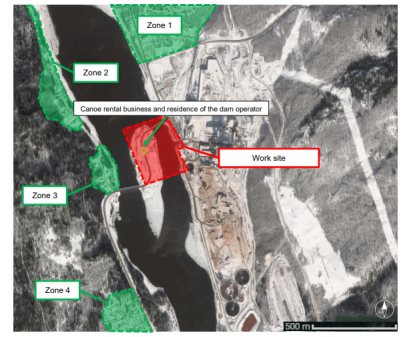
Figure 7 - Text version
The figure shows the location of four sensitive areas and the noise level monitoring stations. Area 1 is located north of the dam-bridge, Area 2 to the northwest, Area 3 to the east, and Area 4 to the southwest. Overall, the figure illustrates the spatial distribution of the monitoring points based on their proximity to the work site.
5.5.2 Analysis of Potential Effects and Proponent's Proposed Mitigation Measures
The proponent is of the view that the risks to human health are primarily associated with construction, when the use of equipment and machinery at the work site may result in noise, emissions of airborne contaminants and dust, or accidental releases of fuels or other liquid contaminants into the environment, which can affect air quality, surface water quality, noise levels, soils and sediments.
Effects on these environmental components could, in turn, lead to effects on human health through exposure by inhalation or by the consumption of fish, plants or wildlife in which bioaccumulation has occurred.
However, given the mitigation measures, monitoring and follow-up plans, and environmental management plans that will be put in place to control these effects, the proponent is of the opinion that the risks to human health are low.
Changes to Air Quality
During the construction phase, the activities associated with the installation and removal of the cofferdam and the deconstruction of the existing dam-bridge are the most likely to result in the emission and dispersion of dust. The proponent is of the opinion that vehicle traffic and the use of construction equipment are likely to emit contaminantsFootnote 19 into the air. The proponent is not planning any blasting activities during this stage of the Project.
Although the proponent has not directly modelled the air emissions associated with the Project, the proponent is of the view that the potential for dust and contaminant emissions in the air is low and that any emissions would be limited to the Project area. The Project will therefore have a negligible effect on ambient air quality. According to Health Canada, the Project should have a negligible effect on health in terms of threshold substances (i.e., those with an effect levelFootnote 20). However, since the annual baseline values exceed the CAAQS values, Health Canada has recommended that PM2.5 levels be monitored at the nearest human receptors to keep levels as low as possible and ensure that the Project does not further reduce local air quality.
During the operation phase, the proponent anticipates effects similar to those observed before the Project.
Mitigation Measures
During the construction phase, the proponent has committed to monitoring dust levels at the construction site on a daily basis and implementing appropriate measures to limit their spread into the air. These measures include, but are not limited to, watering surfaces, covering piles of debris, reducing vehicle speeds, and limiting or stopping operations in the event of high winds.
Although the proponent does not currently plan to use blasting for this project, it has also committed to developing an explosive and blasting management plan if this activity is required. Blasting, if necessary, will be carried out during a period when weather conditions are most optimal for limiting dust dispersion.
Changes to Surface Water Quality
The Project is likely to lead to a deterioration in surface water quality, which could result in the accumulation of contaminants in aquatic organisms, making them potentially unsafe for human consumption or affecting their availability.
According to the proponent, project-related activities would not result in the direct contamination of the environment by mercury. Nevertheless, the Project could cause the resuspension of sediments potentially contaminated with mercury, even though the work area contains very little of the fine sediments that are likely to be contaminated with mercury, due to the fast currents, which are not conducive to sediment deposition.
During the operation phase, the proponent anticipates effects similar to those observed before the Project.
Mitigation Measures
Once the existing dam-bridge would be closed and the turbidity curtain would be installed, the sediments in the area between the cofferdam and the existing dam-bridge would be characterized so that their quality can be determined and can be managed according to their level of contamination. Contaminated sediments would be transported to an appropriate disposal site.
The proponent has committed to begin the follow-up of surface water quality (including the three forms of mercury) four to six months before construction begins and until initial conditions are restored.
Changes to the Acoustic Environment
Noise levels during each construction activities were estimated and compared with Health Canada recommendations. Since noise levels already exceed the recommended threshold for speech intelligibility, the proponent is of the view that construction work will further affect staff and customers of the Algonquin Canoe Company and residents on the Ontario shore near the complex.
Blasting activities would also contribute to the degradation of the sound environment near the construction works.
During the operation phase, the proponent anticipates effects similar to those observed before the Project.
Mitigation Measures
The proponent has undertaken to comply with the regulations in force, in particular the bylaws of the Témiscamingue Regional County Municipality, which prohibit making noise on construction sites at nightFootnote 21, as well as Quebec's guidelines on noise levels at industrial construction sites ("Lignes directrices relativement aux niveaux sonores provenant d'un chantier de construction industriel"). Health Canada has recommended that the proponent take into account the commonly applied mitigation measures outlined in the document "Guidance for Evaluating Human Health Effects in Environmental Assessment: Noise" in the final project design and in the development of mitigation measures to address the increase in noise linked to the project and the associated health effects—notably, through compliance with the established noise and overpressure thresholds.
The proponent has committed to develop a noise and complaint management plan. This plan would include the modelling of anticipated noise levels based on the construction methods and equipment used, which would make it possible to update the assessment of noise effects in the EIS. If the modelling reveals that Health Canada recommendations are exceeded at other stations, additional mitigation measures will be identified and implemented. Noise mitigation measures for Long Sault Island will be developed in consultation with the Algonquin Canoe Company and the Wolf Lake First Nation. The proponent has also agreed to obtain sound measurements at the same five stations used for the baseline measurements.
The proponent will keep waterfront residents and Indigenous communities informed of the schedule of project phases and the planned activities. If blasting activities are required during the deconstruction of the existing dam-bridge, the proponent will inform the Indigenous communities and waterfront residents. A 150-meters safety perimeter will be established around the blasting point.
Changes to Country Foods
The proponent has noted that the Project poses a very low contamination risk for country foods and, in its view, no contamination pathways exist for these foods. The resuspension of sediments likely to contaminate water is unlikely.
The Indigenous groups consulted by IAAC are of the view that the Project poses a high contamination risk for country foods.
Mitigation Measures
To address the concerns of Indigenous groups, the proponent has committed to include a follow-up of country foods in the monitoring program, as well as to communicate the results of the latter program on a regular basis, including the results for the four forms of mercury.
5.5.3 IAAC Analysis and Conclusions on Residual Effects
IAAC recognizes that the Project activities during the construction and operation phases could have adverse health effects, due to changes in air quality, surface water quality, the acoustic environment and country foods. IAAC also recognizes the potential for the population to perceive a risk to its health associated with project-induced environmental changes, which could alter behaviours or practices and have adverse health effects.
Changes to Air Quality
IAAC recognizes that the Project could cause dust and contaminant emissions during the construction phase. During the proponent's effect assessment, air quality was found to be affected by emissions from the RYAM plant. IAAC understands that the proponent has committed to implement the Project in such a way that air quality will not be further reduced, by putting measures in place to limit the spread of contaminants and dust in the air. IAAC also notes that the proponent has committed to implementing an air quality monitoring and follow-up program that will focus on dust emissions, in accordance with the Quebec Règlement sur la qualité de l'atmosphère (Regulation Respecting the Quality of the Atmosphere). This regulation stipulates that any materials handling or transfer activities must not result in visible emissions of dust into the atmosphere more than two meters from the emission source. IAAC agrees with Health Canada's recommendation that the proponent must monitor PM2.5 levels at the nearest human receptors to keep levels as low as possible during the construction phase.
Changes to Surface Water Quality
IAAC is of the opinion that the Project could have effects on surface water quality during the construction phase. IAAC notes that concerns remain about the risk of increased concentrations of mercury and other contaminants present in soil and sediments. IAAC recognizes that the proponent has committed to sampling sediments and soils likely to be resuspended and to managing them according to the level of contamination. The proponent has also undertaken to implement a monitoring and follow-up program for water quality downstream of the work area throughout the construction phase and until initial conditions are restored. IAAC is of the opinion that these mitigation measures would adequately address the effects on surface water quality.
IAAC stresses the importance of continuing to collaborate with Indigenous groups on the development and implementation of mitigation measures and monitoring and follow-up programs for surface water quality, including the establishment of water quality criteria.
Changes to Acoustic Environment
IAAC notes that uncertainties remain over the extent and magnitude of the Project's effects at the main receptor sites. IAAC recognizes that the proponent has committed to complying with municipal and provincial bylaws and regulations and to following noise recommendations. IAAC also understands that the proponent has committed to carry out modelling prior to the construction work. IAAC recommends that the proponent develop a monitoring and follow-up program for the acoustic environment, in order to verify the results of the environmental assessment and the effectiveness of the mitigation measures and to determine whether any additional measures are required. IAAC deems the proponent's proposed program to develop and implement a noise complaint management procedure for the Project to be adequate.
Given the potential effects at the Algonquin Canoe Company site, IAAC stresses the importance of the participation of Wolf Lake First Nation in the development and implementation of a follow-up and monitoring program for the acoustic environment.
Changes to Country Foods
IAAC recognizes that Indigenous groups still have health concerns, due to emissions of airborne contaminants that can settle to the ground and be absorbed by plants consumed as food, as well as concentrations of contaminants in water, including mercury, that can bio-accumulate in fish. However, IAAC is of the view that the risks of contamination of country foods are low, given the nature of the work and the mitigation measures proposed by the proponent for air and water quality. IAAC also is of the opinion that the participation of Indigenous groups in various air and water quality monitoring programs should strengthen their confidence in the quality of the environment and in the possibility of harvesting traditional resources. IAAC recommends that the proponent consider the relevant mitigation measures outlined in Health Canada's document "Guidance for Evaluating Human Health Effects in Impact Assessment: Country Foods" when developing mitigation measures for potential effects on air quality, water quality, country foods and the health of Indigenous peoples.
Conclusion
IAAC is of the opinion that the proponent's proposed mitigation measures and monitoring and follow-up programs (including the implementation of environmental protection and management programs) will address the potential adverse environmental effects of the Project that could lead to health impacts.
Taking into account the implementation of key mitigation measures, as well as the monitoring and follow-up programs proposed by the proponent for air quality and water quality, IAAC assesses that the residual effects on human health would be moderate. Its assessment is based on the environmental assessment criteria in Appendix A and the following findings:
- The intensity of the Project's residual effects would be medium;
- The residual effects of the Project would be limited to the Project area (site-specific) and would be short- to medium-term;
- The residual effects of the Project would occur intermittently and would be reversible over time.
Thus, IAAC concludes that the Project is not likely to have significant adverse effects, within federal jurisdiction, on human health.
Determining Key Mitigation Measures
IAAC deems that, in addition to the mitigation measures and monitoring and follow-up programs presented in Chapter 5.1, the following measures are necessary to ensure that there will be no significant adverse environmental effects on human health:
Atmospheric Environment
- Prior to construction, develop a dust management plan and, during construction, implement appropriate and feasible mitigation measures.
Acoustic Environment
- Prior to construction, develop measures in consultation with Wolf Lake First Nation to mitigate the effects of the Project on the acoustic environment of the First Nation's business, the Algonquin Canoe Company, and implement these measures during construction.
Complaint Management
- Develop and implement, in consultation with Indigenous groups, a management plan to respond within 24 hours to complaints about the Project's effects on air quality, water quality and noise during the construction phase. Information on this plan and on how to file a complaint will be made available to the public online.
Need for and Requirements of Follow-Up
Atmospheric Environment
- Prior to construction, develop and implement a follow-up program, in consultation with Environment and Climate Change Canada and Health Canada, which makes it possible to verify the effectiveness of the mitigation measures in addressing the environmental effects of emissions of fine particulate matter (PM2.5) in the air on human health, at the nearest human receptors.
Acoustic Environment
- Prior to construction, develop and implement a follow-up program, in consultation with Health Canada, regarding project-related increases in noise levels, to include the following components:
- Continuous monitoring, during the construction phase, of sound levels at human receptors, taking into account Health Canada's document "Guidance for Evaluating Human Health Effects in Environmental Assessment: Noise";
- Development of additional mitigation measures, in consultation with Health Canada and Wolf Lake First Nation, to reduce noise levels if they exceed established triggers.
5.6 Current Use of Lands and Resources for Traditional Purposes by Indigenous Peoples
The Project could cause changes to the environment that would have effects on the current use of lands and resources for traditional purposes, protected under section 35 of the Constitution Act, 1982, by Indigenous peoples. This would mainly affect the availability of fish for subsistence fishingFootnote 22 and access to Long Sault Island, a valued fishing site.
5.6.1 Component Description
A number of AnishinabegFootnote 23 peoples have lived on their traditional territory—which is their homeland—since time immemorial. Their use of the territory is centered around the Ottawa RiverFootnote 24 watershed. They hold inherent rights, enabling them to practise contemporary and traditional activities, including camping, fishing, hunting, trapping, gathering, harvesting traditional medicinal plants, visiting sacred sites and participating in ceremonies recognized in this watershed (Supreme Court Judgment in R. v. Côté, 1996) for future generations, in accordance with their own laws, traditional ecological values and practices. The Anishinabeg peoples located near the Project site are:
- The Anishinabeg First Nations of the Upper Ottawa, on whose territory the Project is located, directly within the traditional territories under the rights and title of SART First Nations:
- Kebaowek First Nation is located 12 kilometers from the Project in Quebec. Its reserve lands are 10 kilometers east of the town of Temiscaming, on the shores of Lake Kipawa.
- Wolf Lake First Nation is located 37 kilometers northeast of the town of Temiscaming, Quebec, at Lac Hunter's Point. As the community has no reserve land, its members live mainly in the municipality of Temiscaming.
- Timiskaming First Nation is located 125 kilometers from the Project in Quebec. Its reserve lands are adjacent to the municipality of Notre-Dame-du-Nord, on the Ottawa River north of Lake Temiscamingue.
- The Algonquins of Pikwakanagan First Nation (AOPFN) whose unceded traditional territory is located 250 kilometers southeast of the Project, overlapping the Project, on the shores of Golden Lake and the Bonnechere River in Ontario.
Members of these First Nations indicated that the existing dam-bridge is part of their regular travel routes within their ancestral territory. Although it is used primarily today to access community services and local businesses, such as the Algonquin Canoe Company, members stressed that this connection supports their ability to move across the lands historically used by their people. They also recognized the importance of maintaining safe access, and expressed that they understood the need to replace the dam-bridge.
SART First Nations members who conducted assessment surveys and formed a fisheries working group report that although members still fish at the Project site, a number of them avoid it out of fear of contamination. Among valued fish species, lake sturgeonFootnote 25 holds a special place for the Anishinabeg people. It remains a species of great cultural significance, as it is considered their closest non-human relative and essential to the cultural and ecological integrity of the landscape. The First Nations still use all parts of the lake sturgeon for food, medicine and handicrafts. The quantity and quality of Indigenous fisheries related to current use are important, as this also makes it possible to continue the practice of sharing their harvest with other members of their community, owing to the concern about food security.
The First Nations still travel the river in various types of vessels for subsistence and recreational fishing. Long Sault Island is of historical significance, as it is located near Gordon Creek, a traditional harvesting and ceremonial gathering place, particularly for the Anishinabeg First Nations of the Upper Ottawa. The island also provides boat access to traditional land-use areas and portage trails on the river. The Algonquin Canoe Company is also located on the island. It is owned by the Wolf Lake First Nation, which operates a local equipment rental service and an Algonquin artisan crafts store there.
In and around the Project location, the First Nations consider the sediments, water and shoreline of the Ottawa River to be polluted due to the cumulative effects of numerous nearby development Projects and the existing dam-bridge, and they are concerned about the presence of pollutants in the food chain. This already discourages certain cultural, spiritual and recreational activities.
Various plantsFootnote 26 of cultural significance are also present, some of which are harvested in the vicinity of the Project. Owing to the cumulative effects of the industries present, the area is disturbed and, as a result, hunting and trapping activities on the Project site itself are limited, mainly because of the heavy road traffic on this major interprovincial link, which likely results in wildlife avoidance.
5.6.2 Analysis of Potential Effects and Proponent's Proposed Mitigation Measures
Decline in resource Availability – Subsistence Fishing and Gathering
The proponent considers that the Project would result in the destruction of spawning grounds used by various fish species, including lake sturgeon. The proponent also recognizes that the construction phase would pose a risk of introducing contaminants into the water, which could affect water quality, fish and the sustainability of Indigenous fisheries in the ASA.
The proponent also anticipates a decline in plants that can be harvested due to the permanent loss of 1,025 m² caused by the road modifications and the required infrastructure. However, the proponent plans to implement a revegetation plan after the work, which it intends to develop in consultation with the First Nations.
Mitigation Measures
The proponent estimates that the loss of fish habitat and the destruction of spawning grounds can be fully offset by the offsetting plan required under the Fisheries Act of Fisheries and Oceans Canada. It also plans to involve the First Nations in the development of the plan, as well as in all associated follow-ups. In addition, the proponent proposes to evaluate the possibility of including a fishway, in collaboration with the affected stakeholders, including Fisheries and Oceans Canada and the First Nations. The proponent also plans to relocate fish during the dewatering of the area upstream of the cofferdam, under the supervision of a competent person (e.g., a biologist).
The proponent plans to organize a plant and tree harvesting activity before construction begins, and to offer First Nations wishing to do so the opportunity to organize ceremonies. The proponent also proposes to revegetate, and to involve the First Nations in the choice of plant species to be used, in order to highlight their role as land stewards.
Changes to Access to the Territory – Changes to Long Sault Island, Loss of Practice Locations, Ability to Move Around the Territory and Navigation on the Ottawa River
The proponent does not anticipate any changes in access to the territory and the ability to travel between the two provinces, as the bridge would remain open to traffic during the construction phase. The proponent does not foresee any increase in traffic on the new dam-bridge. In the proponent's view, the navigability of this section of the Ottawa River would not be affected by the Project. Boat ramps and portage trails would remain open and unaffected. The proponent notes, however, that access to fishing could be affected by the presence of security fencing around the work area during the construction phase and then during the operation phase, to reduce risks to human safety.
Mitigation Measures
The proponent is committed to educating workers about cross-cultural realities in order to limit the risk of conflict, which should enable the First Nations to continue operating the Algonquin Canoe Company and enjoy the site, which is culturally important. The proponent would inform the First Nations of the work schedule and areas that will be inaccessible during the work to the Algonquin Canoe Company's commercial activities, as well as fishing, gathering, cultural gatherings and navigation.
Decreased Quality of Experience on the Land – Decreased Tranquility on Long Sault Island and Perceived Contamination of Resources
The proponent recognizes that the construction phase could help to increase the perception that resources, such as water and plants, are unfit for consumption and use, particularly due to dust deposition in the air and the dispersion of resuspended sediments in the water as a result of the work. However, the proponent is of the view that the Project poses very little risk to human health. The proponent acknowledges that construction would temporarily cause sensory disturbances.
Mitigation Measures
The proponent plans to implement a noise management plan developed in conjunction with the First Nations, with a mechanism for handling any complaints about the acoustic environment in the vicinity of the Project site. It also intends to involve the First Nations in follow-ups on sediments, water quality and the installation of the turbidity curtain. There are also provisions for communication plans tailored to each First Nation to inform them about the environmental follow-ups.
5.6.3 Views Expressed
SART First Nations
SART First Nations are observing a decline in lake sturgeon populations, noting that individuals are becoming smaller and smaller. The lake sturgeon spawning grounds near the existing dam-bridge are of sacred importance to the three First Nations. In their view, the conservation of these spawning grounds is essential to the survival of the species in this location. The First Nations consider the effects of the destruction of fish habitat by the Project to be significant and irreversible, and that it would contribute to their members already high food insecurity. They are also concerned about the Project's effects on the hickorynut, a freshwater mussel deemed important for water quality, the river ecosystem and lake sturgeon. In their view, the Project would harm the river's biodiversity.
SART First Nations are of the view that the construction work would hinder their ability to move freely around the territory to harvest resources. More broadly, they are of the opinion that the Project would contribute to the cumulative effects already experienced by their members on the Ottawa River and on Long Sault Island (see Chapter 6.5.2).
According to SART First Nations, the river's water quality is already poor due to the various cumulative effects of industrial development at this location and further upstream on the Ottawa River. They are concerned that the resuspension of sediment caused by the construction work will exacerbate the contamination of resources, which the First Nations already perceive as being contaminated. Many of their members consider that the Project would make their fishing, hunting and medicinal plant gathering activities unsafe due to their perception of contamination.
SART First Nations rate the effect of the Project on fish and fish habitat, including benthic fauna and special-status species, as severe.
SART First Nations note that the Project will amply and further worsen the residual effects on traditional land and resource use.
Algonquins of Pikwakanagan First Nation (AOPFN)
AOPFN has observed the disappearance of the American eel and a decline in lake sturgeon and yellow perch populations in the Ottawa River over the past few decades, and is concerned that the Project will further affect certain valued species. One of AOPFN's main concerns is the reduction in fish abundance and diversity, which would affect fish populations and the fisheries. AOPFN is also concerned about the potential effects of the Project on water quality, members' access to and navigation on the river, and culturally important plants, as well as the Project's effects on cultural and spiritual continuity and the transmission of Algonquin Knowledge.
AOPFN notes that each dam built on the river has reduced the presence of culturally important fish species in the territory, and has hindered the ability of AOPFN members to navigate on the river and travel to important cultural and spiritual sites in the unceded traditional territory. According to AOPFN, the current state of Long Sault Island has been considerably altered, but it remains an important place for teaching youth, portaging and fishing and for gatherings. Rebuilding the dam-bridge in its new location further downstream would exacerbate these alterations.
AOPFN disagrees that offsetting is an appropriate mitigation measure for fish and fish habitat, as it deals with effect after they have occurred. AOPFN is of the view that impacts on fish and fish habitat should be avoided, and that any offsetting measures should start prior to construction to ensure that there is no lapse in habitat or species available. AOPFN is also concerned that the minimum regulatory requirements will not be supportive of AOPFN fishing. AOPFN Algonquin Knowledge Holders have determined that a minimum ratio of 3 to 1 is required to promote the success of the offsetting measures and support AOPFN fishing.
AOPFN is concerned about the changes in water flow that will result from the Project. As stewards of AOPFN Algonquin unceded and unsurrendered traditional territory, AOPFN is of the opinion that it must be involved in all decisions relating to water flow management.
AOPFN is of the view that a revegetation plan must be developed and finalized with the First Nations prior to the start of construction, as it must be informed by site assessments to identify culturally and spiritually important plants.
AOPFN is of the view that the fishway should be assessed as part of the environmental assessment, as it was a requirement during permitting for the Ontario dam-bridge replacement project that was not fulfilled. It was AOPFN's expectation that the fishway requirement be implemented as part of this Project.
AOPFN members are concerned that there will be contamination from the Project. Any change in consumption has an effect on human health, whether it is from real or perceived contamination.
AOPFN stewardship protocols require that AOPFN be provided the opportunity to be present, monitor and be involved, according to AOPFN's needs and capacities, in the relocation of fish during the process of dewatering and drying the area upstream of the cofferdam. AOPFN expects that the environmental management plan will be co-developed to respond to the specific needs and concerns of each affected First Nation, and therefore substantial engagement is required. AOPFN expects the proponent to involve AOPFN not only in monitoring, but also in any adaptive management that is required.
5.6.4 IAAC Analysis and Conclusions on Residual Effects
Decrease Availability of Resources
Subsistence Fishing
In chapter 5.1, IAAC assesses that the residual effects of the Project on fish and fish habitat, including benthic fauna and special-status species, would be moderate.
Fisheries and Oceans Canada is of the opinion that the current substrate in the spawning ground is not optimal and that offsetting measures could be undertaken to improve the quality of the substrate in the spawning ground for lake sturgeon in the area. Fisheries and Oceans Canada and IAAC recognize, however, that uncertainties remain as to how long it will take for the new spawning grounds resulting from the offsetting measures to reach their initial recruitment levels. IAAC is of the opinion that the construction work could affect fish recruitment downstream of the Project. This could lead to a decline in the number of fish available to the subsistence fisheries. IAAC estimates that First Nations members fishing directly downstream of the existing dam-bridge could see their fishing success vary or decrease slightly during the construction phase. IAAC assesses, however, that the Project would not affect the spawning grounds located in the remainder of the 50 kilometers stretch downstream of the Project or the spawning of fish downstream of the Ontario dam-bridge.
IAAC recommends that qualified First Nations members be present during the installation of the cofferdam so that they can participate in the relocation of fish. Fisheries and Oceans Canada will also consult the First Nations on the habitat offsetting plan, and they will be able to share their preferences, Algonquin knowledge and recommendations.
IAAC recognizes that many First Nations members refrain from fishing in the Project area out of concern for contamination. However, IAAC understands that the First Nations want to see this area recover so that they can fish again. IAAC recommends that the First Nations be involved in monitoring fish habitat offsetting measures and in any corrective work where required. This would allow them to be informed of the results of the offsetting measures, enabling them to take this information into account in land-use planning.
The Project could include the construction of a fishway. This would allow free passage of fish in two sections of the river. Fisheries and Oceans Canada and IAAC are of the view that installing a fishway could help maintain fish populations in the area by reducing habitat fragmentation, which would have a positive effect on subsistence fishing.
IAAC is of the view that the Project could reduce the success of subsistence fishing in the Long Sault Island area. As SART First Nations and AOPFN still fish on the Ottawa River, the Project could reduce their food security. However, these effects would be partially reversible owing to the key mitigation measures identified by IAAC.
Gathering
IAAC is of the view that the loss of areas of vegetation could reduce harvesting temporarily and locally. However, IAAC considers that this loss will be negligible, due to the rehabilitation plan for Long Sault Island that it has recommended. IAAC recognizes, however, that this disturbance would add to the cumulative effects currently experienced on the use of Long Sault Island, which is highly valued (see Chapter 6.5.3). IAAC is confident that a plan, developed in consultation with the First Nations, will be put in place and would maintain, and even improve, harvesting for future generations at this location.
Changes to Access to the Territory
Changes to Long Sault Island
Throughout the construction phase, the existing dam-bridge would remain open to traffic. However, the Project would entail relocating part of the road's right-of-way, thus modifying its footprint on the island. Several temporary work areas would also be set up during the construction phase, for a total surface area of around 9,400 m². Thus, IAAC is of the view that there would be little or no access to Long Sault Island during the construction phase and the island could temporarily be less suitable for traditional activities.
Part of the existing road would be dismantled and then revegetated. The work areas that would be created on the island would also be restored. IAAC considers that general access to the island would be similar to the baseline once the surfaces have been revegetated and restored.
IAAC considers that the proponent should allow the First Nations to act as observers during the construction phase, given the cultural importance of the island. IAAC considers it essential that the proponent inform with the First Nations before and during the creation of any exclusion zone for safety purposes, whether on the island or in the water.
Loss of Practice Locations
IAAC understands that there are fishing sites valued by the First Nations at the Project location. IAAC assesses that any members of the First Nations fishing from the shore or on the water directly around or above the spawning grounds would temporarily lose this practice location. The members most affected by the Project would be those who fish and navigate on the eastern side of Long Sault Island.
IAAC is of the opinion that this loss would be temporary and partially reversible, since another spawning ground would be recreated downstream of the Project. However, it would be different from the existing spawning ground. User habits would have to be altered slightly in the downstream location.
Ability to Move Around the Territory by Car
IAAC estimates that construction would temporarily reduce the flow of vehicle traffic and ease of travel over the dam-bridge, whether for daily activities in or cultural visits on the territory. IAAC notes, however, that the existing dam-bridge will remain open during the work, which would mitigate this effect. SART First Nations are concerned that families who frequently travel the territory by car would have to adapt, which could generate stress and frustration. They also perceive that the Project will create more road traffic once the new dam-bridge is in operation. IAAC estimates, however, that the First Nations' capacity for mobility would return to a level similar to the baseline once construction has been completed.
Ability to Navigate on the Ottawa River
IAAC assesses that navigation around Long Sault Island could be temporarily modified. The sensory disturbance caused by the work could make navigation unattractive in this location. The cofferdam and turbidity curtain could act as temporary physical barriers reducing the navigable area.
Regular users of Long Sault Island are likely to choose other portage routes or boat launch during the construction phase. Once the construction phase is complete, the flow modifications associated with the new dam-bridge will alter the First Nations' navigation habits. First Nations members will probably have to adapt and change their habits.
IAAC points out that no navigation exclusion zones are planned during the Project. An existing navigation "warning zone" established for safety purposes, indicated visually by buoys and signs, would be renewed once the construction phase is complete. The navigable area would therefore be similar to the baseline.
IAAC is of the opinion that the First Nations' loss of access to the territory would be local, temporary and reversible.
Decreased Quality of Experience on the Territory – Decreased Tranquility and Perception of Resource Contamination During the Construction Phase
IAAC is of the opinion that the noise and disturbance during the construction phase would result in a decline in tranquility, thereby reducing the quality of the experience in the territory. IAAC assesses that a temporary feeling of loss of the territory could be experienced until the site is restored. The feeling of safety when walking on Long Sault Island or navigating downstream of the work site could be temporarily reduced. A reduction in the ease of car travel could make it less enjoyable and discourage some people from taking part in cultural activities. The presence of a construction site would therefore make Long Sault Island less suitable for the First Nations' activities.
IAAC also notes that, although fish from this area can be consumed, many members of First Nations avoid fishing for concerns about contamination. IAAC recommended that First Nations participate in water quality monitoring, which should ease their concerns about fish quality during and after the construction phase. Nevertheless, IAAC considers it likely that members of First Nations will continue to refrain from consuming fish from this location, even though fish quality is expected to remain the same.
AOPFN is concerned that water quality at its practice locations will be temporarily altered. If doubts persist about the effects of the Project on the entire Ottawa River ecosystem, this could reduce the level of satisfaction of Algonquin users of the territory.
IAAC recognizes that errors in readings of mercury concentrations units in sediments presented in the proponent's EIS may have caused concern and led to the perception that the Project area is contaminated. IAAC ensured that the proponent corrected its analysis and informed the Indigenous groups. IAAC recognizes, however, that the First Nations may still be concerned owing to the effects of past industrial and forestry development in the area. IAAC points out that the data presented in the EIS show that sediments in the area are not contaminated with mercury and comply with Quebec and Canadian standards.
IAAC notes that the proponent is proposing several appropriate measures to limit the disturbance associated with construction. IAAC notes, however, that the Project takes place in a regional context marked by the historical pollution of the Ottawa River by a number of actors, such as the mining and forestry industries. However, IAAC is of the view that the perceived intensity and frequency of contamination will likely be lower once Long Sault Island and the river are rehabilitated and restored.
Conclusion
Taking into account the implementation of the key mitigation measures, the proponent's commitments and the offsetting measures to be defined, IAAC assesses that the residual effects on the current use of land and resources for traditional purposes by Indigenous Peoples would be moderate. Its assessment is based on the environmental effects assessment criteria in Appendix A and the following findings:
- The intensity of the Project's residual adverse effects would be medium;
- The residual effects on Algonquin fishing would be local, since they would extend beyond Long Sault Island, but would be limited to the dam's direct area of influence;
- The duration of the effects on access to the territory and the quality of the experience on Long Sault Island would be concentrated during the construction phase (medium-term). The effects on the availability of fish of all species, other than lake sturgeon, for subsistence fishing, would be short-term. The effects on the availability of lake sturgeon for fishing could be felt over a period of more than five years (i.e., over the long-term);
- The frequency of effects would be intermittent because they could be felt during several phases of the Project (construction and early operation phases, mainly for fishing);
- The residual effects on fishing would be partially reversible, as it will not be possible to recreate the existing spawning ground exactly in the same location due to the hydraulic conditions of the new dam-bridge, which would alter fishing conditions. The availability of fish, access to Long Sault Island and the ability to travel and navigate safely in the territory are considered reversible. The perception of contamination is considered partially reversible.
Therefore, IAAC concludes that the Project is not likely to have significant adverse effects, within federal jurisdiction, on the current use of land and resources for traditional purposes by Indigenous Peoples.
Determining Key Mitigation Measures
Work in Fish Habitat and Fish Habitat Offsetting Plan
- Designate, with SART First Nations, observers during the construction phase and allow them access to the site in the presence of qualified people to ensure their safety. Allow these observers to be present to observe the work to install the turbidity curtain and fish relocation;
- Offer SART First Nations the opportunity to be present during the hickorynut searches and the relocation of fish during the in-water work.
Gathering, and Access and Experience of the Territory
- Develop and implement a rehabilitation program for Long Sault Island, in collaboration with SART First Nations and AOPFN, within the limits of the lands managed by the proponent, to include notably:
- Identification of plant species of interest that will be used to restore self-sustaining plant communities on Long Sault Island;
- The designation of a protected, development-free vegetation zone, located on the lands managed by the proponent.
- Implement a communication plan, in consultation with the SART First Nations and AOPFN, to inform the members of these First Nations of the schedule of construction, operation and maintenance activities for the dam-bridge. This plan must include communicating with First Nations' band councils on any restrictions on access on Long Sault Island and the Ottawa River for safety reasons, during each phase of the Project, if applicable.
Perception of Resource Contamination
- Involve the SART First Nations in the installation of the turbidity curtain;
- Hire an independent environmental monitor during construction. This independent monitor would be mandated to effectively disseminate, as soon as possible, the results of the following environmental follow-ups to SART First Nations and AOPFN:
- Water quality and concentrations of SS during the installation and removal of the cofferdam and turbidity curtain.
Need for and Requirements of Follow-Up
- IAAC recommends that a follow-up program be established to monitor the effectiveness of the developed spawning grounds in order to verify the predictions for maintaining the availability of fish in the Long Sault Island sector. This program will require the participation of SART First Nations and AOPFN.
- A follow-up would be conducted on the effectiveness of the spawning grounds developed after the work as part of fish habitat offsetting measures. The proponent should compare the results obtained with the information in the EIS concerning the baseline state of the spawning ground located downstream of the existing dam-bridge.
- This follow-up would be developed based primarily on meetings with First Nations representatives to review progress and share results. The proponent should reach an agreement with the First Nations on the First Nations' preferred way of presenting the results to their members, as required.
5.7 Physical and Cultural Heritage by Indigenous Peoples
The Project could have residual environmental effects on the physical and cultural heritage of Indigenous peoples, as well as on structures, sites, or objects of historical, archaeological, paleontological, or architectural significance.
After considering the key mitigation measures and recommended monitoring programs, IAAC is of the opinion that the Project is not likely to cause significant adverse environmental effects on the physical and cultural heritage of Indigenous peoples, as well as structures, sites, or things of historical, archaeological, paleontological, or architectural significance.
5.7.1 Component Description
Long Sault Island is an important heritage site that is of considerable spiritual significance for Indigenous groups. It has been and continues to be used for community celebrations (ceremonies, seasonal feasts), family and youth activities, the annual meeting of the tribal council, National Indigenous Peoples Day and the National Day for Truth and Reconciliation. These gatherings are held near the premises of the Algonquin Canoe Company and help contribute to a sense of belonging.
As a whole, the Ottawa River is a key cultural landscape for Algonquin culture and identity and serves as a prime site for spiritual and cultural activities. First Nations are concerned that the integrity of the river has been impacted by changes to its flows, which are expected to persist under the Project. First Nations are of the view that Algonquin women have a cultural responsibility as guardians of the water and waterways.
The island has been used to facilitate navigation, as well as for portaging and fishing, on the Ottawa River and Lake Timiskaming. Fishing is a cultural practice of heritage significance that extends beyond providing food and supports a way of life through opportunities for cultural transmission via oral histories, teachings and community sharing. Lake sturgeon and its existing spawning site located downstream of the Project are sacred to SART First Nations. They view this species as their closest non-human kin.
SART First Nations consider the Algonquin Canoe Company store, boat rack and shed to be heritage buildings. The Algonquin Canoe Company helps to promote Algonquin culture through ecotourism activities, outfitting operations and the sale of Algonquin arts and crafts.
Potential areas of terrestrial archaeological heritage have been identified in the study area. These areas were surveyed, but no artifacts were found. An underwater survey was also carried out, revealing a wooden cage that would not be impacted by in-water work. The rest of the findings consisted of debris from the construction of the existing dam-bridge.
5.7.2 Analysis of Potential Effects and Proponent's Proposed Mitigation Measures
The proponent is of the view that the Project would perpetuate the alteration of the visual and physical characteristics of Long Sault Island, which would have an impact on the integrity of its physical and cultural heritage. The proponent recognizes that a decline in the aesthetic qualities of the island could adversely impact gathering events and, consequently, the cultural well-being of Indigenous groups.
The proponent considers that the Project would not significantly impact lake sturgeon, given the planned offsetting measures for fish habitat. However, it acknowledges that the existing dam-bridge has altered the flow of the Ottawa River and its natural ecosystem.
Finally, the proponent considers that excavation and soil disturbance could destroy terrestrial and underwater artifacts. However, the proponent is of the opinion that it is unlikely, given the absence of artifacts documented in its land surveys.
Mitigation Measures
The proponent proposes to support First Nations in holding their own cultural activities, at times deemed appropriate by them, prior to construction. It plans to involve Indigenous groups in the planning, design, location, installation and maintenance of a plaque or other permanent structure that would present the history of the Ottawa River and Long Sault Island. The proponent has also committed to the revegetation of Long Sault Island.
The proponent has developed protocols in the event that artifacts are discovered in terrestrial or aquatic environments. If artifacts are found, the proponent would notify First Nations. It undertakes to hold the artifacts in trust until the appropriate protocol is implemented, as applicable.
The proponent has committed to discussing with SART First Nations opportunities for women to be involved in the overall management of the Project.
5.7.3 Views Expressed
SART First Nations
SART First Nations assess that the Project's effects on the integrity of the Ottawa River and its natural flows have been significant, permanent and irreversible since 1909, and that this situation would continue during the construction and operation phases of the Project. They reiterate the importance of the role played by Algonquin women in water stewardship.
SART First Nations are of the view that the Project's effect on lake sturgeon would result in an "enormous, cumulative and irreversible" loss to their physical and cultural heritage. This loss of fish habitat is considered a loss of sacred sites, culture and identity.
[…] Lake Sturgeon is not just a food source for the Algonquins. To catch the sturgeon, tools had to be created, teachings passed on, and preservation techniques were taught to younger generations. With all these practices happening, stories and legends were passed on to remember to protect and respect these sacred species. – Neme Bio-Cultural Study (SART, 2022)
They are of the view that the Project's effect on the sale of Algonquin art by the Algonquin Canoe Company could be severe and permanent, which could harm the cultural identity of Wolf Lake First Nation.
SART First Nations point out that they have had to deal with significant restrictions on organizing their cultural events during the Ontario dam-bridge replacement project. They are of the view that the disruptions associated with the construction and the presence of machinery will disturb the area around the business and prevent normal cultural gatherings from taking place, which could be detrimental to their sense of belonging.
SART First Nations are of the opinion that the archaeological surveys conducted by the proponent were insufficient and assesses that certain areas of terrestrial archaeological potential on Long Sault Island and along the Quebec shoreline should have been surveyed.
Algonquins of Pikwakanagan First Nation (AOPFN)
AOPFN considers the Ottawa River to be a culturally and spiritually important historical place. It notes that the existing dam-bridge has already affected cultural transmission across different generations of the First Nation.
While harvesting activities are extremely important for sustenance, they are equally significant as cultural practices that reinforce social ties and AOPFN's connection to the environment. – Knowledge and Land Use Study (AOPFN)
AOPFN is concerned that the Project will cause erosion, potentially resulting in the degradation of unknown burial or cultural sites. It is of the opinion that an additional archaeological inventory should be conducted once the cofferdam is installed.
AOPFN recommends the inclusion of cultural signage on Long Sault Island that would acknowledge the history and cultural significance of the island to the First Nations.
5.7.4 IAAC Analysis and Conclusions on Residual Effects
Long Sault Island and the Ottawa River as Cultural Landscapes and Opportunities to Practise and Transmit Culture
IAAC recognizes that Long Sault Island and the Ottawa River are integral to the physical and cultural heritage of SART First Nations and AOPFN.
Long Sault Island
IAAC acknowledges that Long Sault Island has been altered by the construction of the Timiskaming Dam Complex, which has altered the island's visual appearance and purpose since the early 20th century. Long Sault Island has become increasingly less accessible and suitable for cultural activities owing to the industrialization of the area. IAAC is of the opinion that the Project could reduce opportunities to practise culture on this heritage island and make it less conductive to cultural activities resulting in fewer opportunities to pass on culture to younger generations. These effects would be short-term. The geographic extent of this loss of sites for the practice and transmission of culture includes all of Long Sault Island and the navigation areas temporarily affected because of the cofferdam and turbidity curtain.
IAAC is of the opinion that the construction phase would make the island less suitable for Algonquin cultural activities, which would result in fewer opportunities to practise and transmit the culture to younger generations.
IAAC notes that the cultural landscape of Long Sault Island has been altered by the construction of the Timiskaming Dam Complex. The Project would extend the existing alteration of this cultural landscape and would have an effect on the physical and cultural heritage of First Nations. IAAC is of the opinion that the visual appearance of the island is characterized with a road that it intersects, sparse natural vegetation and several buildings. IAAC notes that the Algonquin Canoe Company buildings are the only potential visual landmarks of Algonquin heritage on Long Sault Island visible to the general public.
IAAC recommends that a series of measures be included in a plan to recognize the Algonquin heritage of Long Sault Island. These measures will be aimed at restoring the island (once construction is complete) to a more natural visual appearance that is consistent with its heritage significance for First Nations. IAAC also recommends the implementation, in consultation with First Nations, of public visual elements that recognize the importance of the island in Algonquin culture—for example, by making Algonquin place names and language visible, as well as highlighting historically important Algonquin cultural sites. IAAC is of the view that by implementing these measures—carried out in consultation with First Nations—Long Sault Island could be restored to a more natural visual appearance and could be more widely recognized as an important heritage site for the First Nations.
Given the significance of the island for the First Nations, IAAC considers it important to install a plaque recognizing the cultural and historical value of Long Sault Island for First Nations. IAAC is of the view that the presence of a plaque or monument would mitigate the effects of the Project on the cultural landscape of Long Sault Island.
Ottawa River
IAAC is of the view that the section of the Ottawa River at the work site is an Algonquin cultural landscape that has been modified by anthropogenic activity over the last century. It assesses that the Project would continue to alter the natural flows of the river, thus perpetuating the loss of its natural ecological integrity. IAAC considers that these effects would be continuous, long-term and irreversible, given that the dam-bridge is a major interprovincial highway link and a structure that is used to manage water levels in the area, particularly by First Nations themselves.
Once mitigation measures are put in place, IAAC is of the view that the Project's effect on the cultural landscapes of Long Sault Island and the Ottawa River would be of low intensity, local geographic extent, continuous and irreversible.
Ability to Hold Cultural Gatherings on Long Sault Island
IAAC notes that Long Sault Island is a valued site for Algonquin cultural gatherings. Although the entire island could be used for gatherings and the practice and transmission of culture, IAAC notes that these gatherings would likely be concentrated in the area surrounding the Algonquin Canoe Company. IAAC understands that the Project could perpetuate the altered conditions conducive to Algonquin gatherings on the island, owing to the dam-bridge's industrial appearance and road traffic.
IAAC is of the view that during the Project's construction phase, the island would be less suitable for Algonquin cultural gatherings. It assesses that the presence of machinery and increased noise and dust could reduce the appeal of Long Sault Island as a venue for cultural gatherings. IAAC therefore recommends that an Algonquin cultural space with basic outdoor facilities be created to facilitate Algonquin cultural gatherings or that an existing space be enhanced for this purpose. IAAC also recommends planning a construction stoppage and clearing the areas surrounding the company to provide conditions conducive to potential cultural gatherings for National Indigenous Peoples Day and the National Day for Truth and Reconciliation.
Once mitigation measures are put in place, IAAC is of the view that the Project's effect on the ability to hold cultural gatherings on Long Sault Island would be of low intensity, short-term, local and reversible.
Terrestrial and Underwater Archaeological Heritage
IAAC recognizes First Nations' interest in the potential terrestrial and underwater archaeological heritage of Long Sault Island and the riverbed of the Ottawa River. IAAC is satisfied with the protocols for chance finds in terrestrial and underwater environments, which were developed in consultation with First Nations and presented by the proponent. Parks Canada is of the opinion that the measures identified by the proponent are adequate to protect the potential archaeological resources and considers that there would be no residual effect.
IAAC takes into account that Algonquin people were settled along the river at the RYAM plant's site in the early 20th century and were relocated against their will for industrial development. This Indigenous presence may heighten the perception that artifacts are highly likely to be found during the construction phase. IAAC understands that this recent historical context may make the riverbed and its banks at this particular location a culturally significant site for First Nations.
IAAC takes into account that First Nations have raised concerns about the surveys and the artifacts that could be found in the riverbed during the construction phase. IAAC recommends that a survey be conducted in the riverbed, once the cofferdam is installed and if safety permits, in the presence of representatives of First Nations. IAAC also recommends providing a one-day internship to one youth from each of the Algonquin First Nations during the survey to mitigate the Project's effect on Algonquin cultural transmission during the construction phase. Once these measures are in place, IAAC is of the view that the Project's effects on archaeological heritage would be of low intensity, of local geographic extent, occasional in frequency and irreversible if artifacts were damaged or discovered.
Heritage Buildings of the Algonquin Canoe Company and Sustainability of the Sale of Algonquin Crafts, Which Promote the Algonquin Culture of Wolf Lake First Nation
IAAC takes into account the heritage value to the Algonquin Canoe Company store, boat rack and shed accorded by SART First Nations. IAAC is of the opinion that the construction work is not expected to alter the integrity of these heritage buildings, apart from the accumulation of dust, which could temporarily reduce their visual cleanliness. IAAC recommends developing a protocol for dust cleaning and establishing a protective perimeter around the company's buildings throughout the construction phase. IAAC also recommends that all employees working on the Project should receive information about the heritage value of these buildings for the First Nations, as a measure to limit the likelihood of damage or alteration.
IAAC recognizes that the Algonquin Canoe Company plays a role in promoting and showcasing Algonquin crafts and allows artists to earn an income by practising their culture. IAAC understands that the company's business model relies on spontaneous tourist stops. According to data, these stops have reduced during the Ontario dam-bridge replacement project, resulting in decreased sales, including the sale of Algonquin crafts. IAAC recommends that landscaped areas with basic outdoor facilities be developed to make spontaneous tourist stops near the Algonquin Canoe Company more appealing and to foster a rapid recovery in the sales of Algonquin crafts once the construction is completed.
IAAC recommends that the proponent install signage at relevant locations to inform road users that the Algonquin Canoe Company is open during the construction phase.
IAAC is of the view that implementing these measures could mitigate the effects on craft sales and ensure the short-term sustainability of Algonquin art objects. These effects would therefore be of moderate intensity, occur on an ad hoc basis and considered partially reversible.
Effects on Lake Sturgeon, a Sacred Species
In Chapter 6.5.2, IAAC determined that the cumulative effects of the Project on the availability of lake sturgeon for the fisheries would be insignificant due to the offsetting plan that would be required by Fisheries and Oceans Canada. IAAC recommends that the proponent explore the feasibility of a lake sturgeon stocking program. IAAC concludes that the Project's effects on lake sturgeon and its reproduction would be adequately mitigated by the offsetting plan, which would support the stability of the lake sturgeon population in this section of the Ottawa River.
However, IAAC acknowledges that the Project would have an adverse effect on the physical and cultural heritage represented by lake sturgeon, its presence in the cultural landscape of the Ottawa River and its spawning ground located downstream of the Project. IAAC takes into account the sacred value placed on the species and its spawning ground by First Nations. IAAC notes that the Project is being carried out in a context where lake sturgeon is vulnerable to habitat fragmentation caused by dams on the Ottawa River. IAAC also notes that the in-water construction work and the encroachment of the Project on this sacred spawning site could represent a cultural loss for the First Nations. Furthermore, IAAC acknowledges that the decline in lake sturgeon populations in the Ottawa River over the last century has reduced opportunities to fish for lake sturgeon and to transmit Algonquin cultural practices associated with this species to younger generations. IAAC is of the view that the Project would perpetuate this effect but to a moderate extent, given the required offsetting plan. IAAC recommends that the proponent provide a one-day internship to one youth from each of SART First Nations and AOPFN to participate in the activities associated with the offsetting plan. IAAC is confident that this measure could help mitigate the Project's effect on intergenerational cultural transmission.
Role of Algonquin Women in Water Stewardship
IAAC takes into account the cultural significance of Algonquin women as guardians of waterways for SART First Nations. IAAC considers that their culturally valued stewardship role may have been altered by changes to the cultural landscape of the Ottawa River resulting from dam construction over the last century.
IAAC also acknowledges that the stewardship role of Indigenous women in the Project has not been showcased due to the operational and technical nature of dam-bridge management. IAAC notes, however, that water management on the Ottawa River extends beyond the influence of the Project proponent and involves multiple stakeholders.
Nevertheless, IAAC acknowledges that the Project could perpetuate the context that led to changes in how Algonquin women practise water stewardship and management. IAAC considers that SART First Nations could choose to involve Algonquin women in water-related mitigation measures and in monitoring and follow-up programs. Algonquin women could thus share their knowledge and influence the governance of the Project.
Conclusion
Taking into account the implementation of the key mitigation measures and the proponent's commitments, IAAC assesses that the residual effects on the physical and cultural heritage by Indigenous Peoples would be low to moderate. Its assessment is based on the environmental effects assessment criteria in Appendix A and the following findings:
- The intensity of the Project's residual adverse effects would be medium for lake sturgeon and its spawning grounds, which are considered sacred by the First Nations. The intensity of the Project's residual adverse effects on other elements of the First Nations' physical and cultural heritage would be considered low.
- The geographic extent of the residual effects on Algonquin physical and cultural heritage would be local, since they would be limited to the Project's direct zone of influence.
- The effects on the ability to hold gatherings, the accumulation of dust on the heritage buildings of the Algonquin Canoe Company, the sale of Algonquin crafts and the potential alteration of artifacts during construction would be felt primarily during the construction phase and would therefore be short-term. The effects on lake sturgeon (considered a sacred species), Long Sault Island as a cultural landscape, and the integrity of the Ottawa River's original flows would last for more than five years and would be considered long-term.
- Most effects during the construction phase would occur once and with an intermittent frequency. The effects on lake sturgeon and Long Sault Island may be felt during more than one phase of the Project and continuously with respect to the integrity of the Ottawa River, whose natural flows will continue to be altered.
- With respect to the sale of crafts by the Algonquin Canoe Company, the ability to hold cultural gatherings, and effects on heritage buildings, the residual effects on Algonquin physical and cultural heritage would be reversible. With respect to the effects on lake sturgeon, which is considered a sacred species, and on Long Sault Island as an Algonquin cultural landscape, the residual effects would be considered partially reversible. The residual effects would be irreversible for artifacts that are damaged, undiscovered or found during construction, as well as for the continued alteration of the Ottawa River's natural flows.
Therefore, IAAC concludes that the Project is not likely to have significant adverse effects, within federal jurisdiction, on physical and cultural heritage by Indigenous Peoples.
Determining Key Mitigation Measures
Cultural Gatherings on Long Sault Island
- Plan, in consultation with SART First Nations and AOPFN, the following measures:
- A construction stoppage and the clearing of the areas surrounding the Algonquin Canoe Company to provide conditions conducive to holding cultural gatherings for the following annual events:
- National Indigenous Peoples Day (June 21);
- National Day for Truth and Reconciliation (September 30).
- The creation of an Algonquin cultural space with basic outdoor facilities to facilitate Algonquin cultural gatherings, or the enhancement of an existing space for this purpose.
- A construction stoppage and the clearing of the areas surrounding the Algonquin Canoe Company to provide conditions conducive to holding cultural gatherings for the following annual events:
Archaeological Potential
- Conduct an archaeological survey by certified archaeologists in the riverbed once the cofferdam is installed and, if safety permits, in the presence of representatives of SART First Nations and AOPFN.
Heritage on Long Sault Island
- Develop an implement a plan for the recognition of Algonquin heritage on Long Sault Island, in consultation with SART First Nations and AOPFN, within the boundaries of proponent-managed lands and consistent with the proponent's financial and technical capacities. The plan would include
- measures aimed at restoring the island, once construction is complete, to a more natural visual appearance consistent with its heritage significance for the First Nations;
- the inclusion of Algonquin place names at locations deemed relevant by them on signage identifying historical and contemporary Algonquin cultural sites on Long Sault Island; and
- developing and installing a plaque that acknowledges the heritage value of the island in Algonquin culture, in both of Canada's official languages and the Algonquin language.
Sustainability of the Sale of Crafts by the Algonquin Canoe Company and Protection of its Buildings with Heritage Value
- Develop and implement, in consultation with Wolf Lake First Nation, a landscaping plan to restore the appeal of spontaneous tourist stops near the Algonquin Canoe Company in order to promote the sale of Algonquin crafts, following completion of construction.
- Develop, together with Wolf Lake First Nation, a dust-cleaning protocol and establish a protective perimeter around the Algonquin Canoe Company's buildings throughout the construction phase.
- Inform the proponent's employees or any subcontractors of the heritage value of these buildings prior to the work.
Need for and Requirements of Follow-Up
IAAC does not recommend implementing a monitoring program.
5.8 Socio-Economic Conditions of Indigenous Peoples
The Project could result in environmental changes that would affect the socio-economic conditions of Indigenous peoples. The Project would primarily affect the activities of the Algonquin Canoe Company, operated by Wolf Lake First Nation.
IAAC is of the opinion that the Project is not likely to cause significant adverse effects on socio-economic conditions of Indigenous peoples, taking into account the implementation of the main mitigation measures and follow-up program.
5.8.1 Component Description
Indigenous groups often use the dam-bridge to access services, businesses and land on both sides of the Quebec–Ontario boundary.
Wolf Lake First Nation owns the Algonquin Canoe Company that has been located on Long Sault Island since 2004. The company sells Algonquin crafts and provides ecotourism services in the region, including boat and tourist accommodation rentals, as well as outfitting packages. Through the Algonquin Canoe Company, Wolf Lake First Nation seeks to develop its economy sustainably. Ecotourism allows the Nation to introduce non-Indigenous people to Algonquin culture by raising awareness of the environment, modern Algonquin history and activities still practised on the land. The Algonquin Canoe Company thus contributes to the cultural identity of Wolf Lake First Nation. It provides approximately five direct jobs and is open daily.
The company's business model is based primarily on spontaneous and unplanned tourist stops by visitors passing through the region. The peak sales periods are the summer and the Christmas holidays.
During the Ontario dam-bridge replacement project, the company reported losses in sales of crafts and boat rentals, particularly due to the noise generated by construction work and the constraints on parking and access to the business caused by slower traffic.
5.8.2 Analysis of Potential Effects and Proponent's Proposed Mitigation Measures
The proponent informed IAAC that it had offered financial compensation to the Algonquin Canoe Company during the Ontario dam-bridge replacement project but that circumstances had prevented it from reaching a compensation agreement with the business.
The proponent acknowledges that the Project could affect the company's revenues. The proponent has committed to implementing the measures recommended by the Algonquin Canoe Company to facilitate access to the business during the construction phase and to mitigate effects on the company's sustainability. These measures include:
- Keeping equipment, machinery and construction materials at a distance of at least five meters from the business and its parking lot;
- Placing equipment, machinery and construction materials on the other side of the highway;
- Maintaining a distance between machinery and the company that allows visitors to park safely; and
- Monitoring economic impacts and providing compensation for revenue lost during the construction phase.
The proponent considers that the Algonquin First Nations could benefit from the Project through potential jobs and contracts, although it acknowledges that barriers to employment may remain. It estimates that the Project could result in a temporary loss of skilled Algonquin labour employed in services located outside the First Nations. Specifically, the Project would create a maximum of 50 jobs, mainly during the construction phase, which will last approximately three years.
5.8.3 Views Expressed
SART First Nations
SART First Nations reiterate that the relationship between Algonquin culture and Long Sault Island is essential and that the presence of the Algonquin Canoe Company at this location reflects this significance. They are of the view that the adverse socio-economic effects, including destruction of wild rice beds, pollution and the decline in the commercial fisheries associated with the dam would be exacerbated by the Project.
Wolf Lake First Nation considers that the Project would have a significant impact on the company's revenues during the construction phase. It anticipates that visitor volume will decrease during construction due to traffic delays and the reduced number of highway lanes. The integrity of the business and access to it are of major concern to Wolf Lake First Nation, which reiterates that its company is in a fragile state. The First Nation is of the view that the construction phase could result in "severe and permanent" effects, while acknowledging that certain mitigation measures could potentially reduce those effects. It considers that the loss of a year's income could potentially be "catastrophic" and "likely irreversible".
SART First Nations are of the opinion that the Project could enable them to benefit from contracts and economic returns. However, they are also concerned about the potential adverse effects of the Project on their well-being and rights. They have indicated that they are facing a significant shortage of skilled labour and that the Project could result in the loss of skilled Algonquin workers for the benefit of the proponent.
The Algonquins of Pikwakanagan First Nation (AOPFN)
AOPFN is of the opinion that the Project could benefit its members in terms of employment, training and contract opportunities; however, they stress that these benefits should be sustainable and planned for the long term. Furthermore, it notes the many obstacles that must be overcome, such as transportation to the Project site, childcare, discrimination and the lack of organizational capacity to benefit from potential jobs.
With respect to housing-related impacts, AOPFN has identified potential indirect benefits related to the development of construction skills, while also expressing concerns about the loss of talent within the community for the benefit of the proponent.
From a cultural standpoint, AOPFN has expressed major concerns about the adverse effects of the Project on its territory, particularly concerning culturally significant species—effects that continue to impact the socio-economic situation of its members.
5.8.4 IAAC Analysis and Conclusions on Residual Effects
Access to Services and Businesses on Both Sides of the Dam-Bridge
IAAC considers that the Project could slow down road traffic intermittently, but without compromising it, as the existing dam-bridge would remain open to traffic during construction. IAAC notes that the construction of the new dam-bridge downstream would mitigate the potential effects on traffic flow. IAAC considers that this would maintain access to services and businesses on both sides of the Quebec-Ontario boundary. IAAC also considers that this effect would be local, short-term and reversible, occurring only once during the construction phase.
Ability to Access the Algonquin Canoe Company's Store, Boat Rack and Shed
IAAC takes into account the concerns of Wolf Lake First Nations and notes that they stem from the recent experience of the Ontario dam-bridge replacement project. IAAC understands that traffic management and the location of construction areas, which are managed by the same proponent, have made access to the business more difficult for road users, which may have adversely affected both access to and the revenues of the business.
IAAC is reassured by the proponent's commitment to keeping the business's parking lot accessible at all times, in particular by implementing the measures identified by the company. IAAC is of the view that road access to the company during construction would be similar to the current conditions. IAAC therefore considers that the business would remain accessible at all times. IAAC is of the view that this effect would be local, short-term and reversible, occurring only once during the construction phase.
Sales of Crafts, Outfitting Services, Cabin Rentals and Boat Rentals by the Algonquin Canoe Company
IAAC takes into account that the company experienced a decrease in revenue during the Ontario dam-bridge replacement project, with no financial compensation. IAAC recognizes the position of Wolf Lake First Nation regarding its assessment that the company is in a fragile state.
IAAC assesses that the sensory disturbances associated with the construction could alter customer behaviour, despite the fact that access to the business will be maintained. This avoidance effect may be more pronounced among potential new customers than among those who have already used their services. IAAC recommends installing signs indicating that the business is open during construction work. IAAC is of the view that this measure would help maintain spontaneous stops, which are the foundation of the company's business model. IAAC considers that these signs could even attract new customers. IAAC is of the view that it is still likely that construction phase will temporarily disrupt the customer experience, which could discourage customers from stopping.
The Project would require the installation of a cofferdam and a turbidity curtain downstream of the existing dam-bridge. IAAC considers that these two structures would be physical obstacles to navigation that could temporarily affect visitors' choice to use Long Sault Island and this section of the Ottawa River for recreational and tourism activities. Regular users of the Ottawa River for recreational and tourism purposes may temporarily relocate their activities. IAAC notes that the region has several alternative locations for these types of activities.
IAAC is of the view that the in-water work and the sensory disturbances associated with the construction site could temporarily affect the Algonquin Canoe Company's boat rentals from Long Sault Island. IAAC is of the opinion that boat rentals for use outside the study area, as well as the cabin rentals and the provision of outfitting services would continue.
IAAC acknowledges that uncertainty remains regarding the effects of the construction phase on customer behaviour and, therefore, on the company's revenues. Consequently, IAAC recommends the development and implementation of a program to monitor the financial losses incurred by the company during the construction phase of the Project. IAAC recommends that the proponent identify, on the basis of the monitoring results and in consultation with Wolf Lake First Nation, appropriate compensatory measures to mitigate the identified effects. IAAC is of the view that by implementing this measure, the residual effect on the company's sales would be of moderate intensity given the recent history, and that this effect would be local and short-term, occurring once during the construction phase of the Project. Once the mitigation measure has been implemented, the effects on the company's revenues are considered partially reversible.
First Nations' Economy
IAAC takes into account the concerns of SART First Nations and AOPFN regarding the potential loss of skilled labour to the proponent's Project. IAAC understands the link that the First Nations draw between the potential benefits for certain families and the possible adverse effects of the Project on skilled labour, which are essential for the delivery of their services.
IAAC is of the view that many members of the First Nations could benefit from jobs, income, training or contract opportunities, which could improve families' quality of life and workers' transferable skills. However, this effect would be temporary, since the construction phase would last approximately three years. It would also be limited, as only some 50 jobs would need to be filled.
Although it is possible that some workers in key positions within the First Nations' internal services may be recruited for the Project, IAAC considers that this adverse effect on the socio-economic conditions of the First Nations would be negligible, as it would only occur during the construction phase—that is, in the short term and locally. This effect is considered reversible.
IAAC considers that the Project's impact on the First Nations' economy would be minor, local, short-term, felt only during the construction phase, and reversible.
Conclusion
Taking into account the implementation of the recommended key mitigation measures and the proponent's commitments, IAAC assesses that the residual effects on the socio-economic conditions of Indigenous Peoples would be low to moderate. Its assessment is based on the environmental effects assessment criteria in Appendix A and the following findings:
- The intensity of the Project's residual adverse effects on the Algonquin Canoe Company would be medium, given the financial losses incurred during the Ontario dam-bridge replacement project.The construction phase could lead to changes in customer behaviour, a critical factor in the company's commercial activities, without compromising access to the business or its existence. The intensity of the residual effects on access to services in both provinces, on recreational and tourism activities, and on the First Nations' economy would be low;
- The geographic extent of the residual effects on access to the Algonquin Canoe Company and its sales would be site-specific, since the effects are limited to Long Sault Island. The geographic extent of the effects on access to services and businesses on both provinces, on recreational and tourism activities, and on the First Nations' economy would be local, since the effects would be limited to the Project's direct area of influence and exclusively on federal lands;
- The duration of effects on the Algonquin Canoe Company would be considered medium-term. The effects on access to services in both provinces and on the First Nations' economy would be considered short-term;
- The frequency of most effects would be one-time, as they would be concentrated during the construction phase; and that
- The residual effects on socio-economic conditions would be partially reversible for sales by the Algonquin Canoe Company, given the fragile state of the business as well as the uncertainties that remain regarding financial losses and the compensatory measures to be implemented. With respect to access to services in both provinces, recreational and tourism activities, and the First Nations' economy, the residual effects would be considered reversible.
Therefore, IAAC concludes that the Project is not likely to have significant effects, within federal jurisdiction, on socio-economic conditions of Indigenous Peoples.
Determination of Key Mitigation Measures
Signage
- In consultation with Wolf Lake First Nation, develop signs informing the public that the business is open during construction and identify locations for installation on lands owned by the proponent.
Communications
- In consultation with Wolf Lake First Nation, agree on a construction communications plan for the entire duration of the construction phase.
Need and Requirements of Follow-Up
In consultation with Wolf Lake First Nation, monitor the financial losses incurred by the Algonquin Canoe Company during the construction phase of the Project.
Once the monitoring results are available, identify, in consultation with Wolf Lake First Nation, compensatory measures to mitigate the effects of the Project on the Algonquin Canoe Company's revenues.
6. Other Effects Considered
6.1 Indigenous Groups in the Process of Rights Recognition
The Project could result in environmental changes that would affect land use, physical and cultural heritage, and the socio-economic conditions of Indigenous groups in the process of having their rights recognized.
After taking into account the implementation of key mitigation measures and monitoring and follow-up programs in Chapter 5, IAAC is of the view that the Project is not likely to have significant adverse effects on land use, physical and cultural heritage, socio-economic conditions, or the asserted rights of the Algonquins of Ontario, the Antoine Nation, and the historic Métis community of Mattawa/Ottawa River represented by the Métis Nation of Ontario.
6.1.1 Algonquins of Ontario
Since 2004, the Algonquins of Ontario (AOO) have served as an organization representing ten Algonquin communitiesFootnote 27Footnote 28. The organization was established to coordinate negotiations with the Crown and participation in consultation processes. Consultation is coordinated through the AOO Consultation Office. The Algonquins of Ontario signed an agreement in principleFootnote 29 with the governments of Ontario and Canada in October 2016 and continue to negotiate the settlement of their land claim at the time of writing this report.
Mattawa/North Bay Algonquins are the most locally affected Algonquin community of the AOO communities by the Project. Mattawa/North Bay community members have significant history and usage of the Project area. Mattawa/North Bay did not seek a separate consultation process with IAAC. Therefore, AOO has focused its consultation efforts on behalf of Mattawa/North Bay interests, perspectives and potential Project interactions as a locally affected Algonquin community.
Asserted Rights
AOO are involved in negotiations for a modern treaty with the federal and provincial governments. The territory covered by these discussions spans 36,000 km² of land. A future treaty would further clarify the rights being claimed.
Description of Current Land Use and Views Expressed
AOO, and specifically Mattawa/North Bay community members, harvest and consume a wide variety of traditional foods around the Project. The traditional diet includes game, edible plants (strawberries, raspberries, cranberries, blueberries, blackberries, saskatoon berries, and apples), mushrooms (chaga and other mushrooms), and fish (northern pike,walleye and bass). Medicinal and ceremonial plants are also harvested on Long Sault Island, although some species are not abundant there. Mattawa/North Bay community members have pointed out that the Long Sault Rapids are an important spawning habitat for many fish species living in the Ottawa River.
Fishing
The Ottawa River and its tributaries, Lake Nipissing, the Mattawa River and, to a lesser extent, Lake Timiskaming, are key fish harvesting areas for Mattawa/North Bay community members. They are of the view that the Project could reduce the local abundance of certain species important to its members, which would in turn reduce the suitability of fishing and fishing success near the site. Concerns have been raised regarding water contamination and potential effects on fish and fishing resulting from the concrete used in the new dam and from the disturbance of river bottom sediments during construction. Some Mattawa/North Bay community fishers may avoid the area owing to perceived contamination risks.
AOO have been requesting the design and implementation of a fishway for the new dam-bridge in order to mitigate the historic impacts to fish movement and habitat in the Ottawa River and Lake Temiskaming caused by the existing dam-bridge construction. Lake sturgeon, which is a threatened species in the Ottawa River under the Ontario Endangered Species Act, cannot move past the dam-bridge to occupy habitats upstream. Lake Sturgeon and Walleye both currently spawn downstream of the dam-bridge.
AOO is also concerned for the future ability of the American eel to be able to move past the dam-bridge should populations be restored downstream in the Ottawa River. AOO Is strongly of the view that the fishway design should be considered that may benefit these species.
There has been concern expressed by one local AOO community who fear negative effects on fish abundance and diversity if a fishway is included in the dam-bridge. In particular, they fear that certain species will migrate to Lake Temiskaming and remain upstream of the dam-bridge, reducing the availability and abundance of fish species downstream of the dam-bridge. They are also concerned that unwanted fish species like Asian Carp and common carp could move upstream of the dam-bridge, and that predatory fish like catfish will enter Lake Temiskaming and reduce populations of valuable fish, such as walleye.
Other Harvests
The study area encompasses a wide range of habitats that support the species important to AOO for harvesting, including moose, deer, bear, hare, grouse, beaver, muskrat, squirrels and waterfowl. The local AOO community has expressed concerns about the impacts of noise, lights and other disturbances on ducks and geese. These species may temporarily avoid Long Sault Island during the construction phase, which could briefly reduce harvesting opportunities. IAAC assesses the Project's effects on migratory birds in Chapter 5.2 of this report and does not anticipate any significant residual impacts. IAAC considers that hunting success for migratory birds in the area may decline during construction but is expected to return to baseline conditions subsequently. IAAC is confident that alternative hunting locations are available elsewhere in the region.
Plants in the Project area are generally not harvested by AOO owing to their scarcity and concerns about contamination.
Description of Physical and Cultural Heritage and Views Expressed
Places of Cultural Significance
AOO considers the Ottawa River to be a vital location for traditional activities, including travel, fishing, hunting, harvesting and spiritual practices. Long Sault Island is regarded as a major ancestral site, formerly used as a village, gathering place and harvesting area, and is considered to have significant archaeological potential. According to AOO, these sites have been substantially altered by industrialization, transportation infrastructure, urbanization and dam developments. Such changes have affected both the actual and perceived quality of these heritage sites, which are essential to the physical, cultural and spiritual health and well‑being of their communities.
The main concerns of AOO include the potential destruction of archaeological artifacts during construction, as well as the alteration of the natural landscape caused by the dam.
Culturally Significant Species
The American eel is a species of great cultural significance to AOO, as it was a staple food in their traditional diet present through the entire Ottawa River watershed before development of dams caused the significant decline of the species, which is now absent in certain reached of the Ottawa River. Although it is unlikely to be currently present in the Project area, AOO place great importance on the recovery of populations of the species through its historical range. AOO are concerned about the Project's potential effects on the species' habitat, population levels, and the species' ability to move upstream of the dam if and when the population of the American eel is restored in the Ottawa River.
The lake sturgeon is a species of major cultural and food value historically to AOO, who have traditionally fished for it for generations. Present in the Project study area, they are of the view that the Project could affect the well-being of the species in several ways such as impacts to the spawning ground below the dam. AOO were heavily involved in the informing development of lake sturgeon spawning ground mitigation and improvement and monitoring on the Ontario dam-bridge replacement project and desire to see similar efforts implemented for sturgeon during the Project.
Turtles also hold considerable cultural significance for AOO.
Description of Socio-Economic Conditions and Views Expressed
AOO anticipate positive outcomes from the Project for its members, including quality job opportunities and skills development. It also hopes to benefit from business and training opportunities associated with the Project, which would alleviate concerns and address employment barriers. It is also important to note that the Project could have adverse effects on fish and on the river, both of which are central to community health and well‑being.
IAAC Analysis and Conclusions on AOO
IAAC considers that this environmental assessment has supported project planning in a manner that promotes the continued availability and quality of resources used for traditional purposes. IAAC is of the opinion that the Project would not result in residual effects on AOO beyond those described in Chapters 5.6 to 5.8. IAAC also considers that it has recommended an adequate condition (see Chapter 6.2.4) to support the protection and maintenance of the physical and cultural heritage, health, and socio‑economic conditions relevant to AOO.
Therefore, IAAC concludes that the Project is not likely to have significant adverse effects, within federal jurisdiction, on asserted rights of AOO.
6.1.2 Antoine Nation
Antoine Nation is located in the Mattawa area, 50 kilometers southeast of the Project site as the crow flies. Its territory extends north, west, south and east from the confluence of the Mattawa and Ottawa rivers, including the northern portion of Algonquin Provincial Park.
Asserted Rights
Antoine Nation is not currently a federally recognized First Nation and therefore does not have reserve lands. Antoine Nation is currently seeking federal recognition and is involved in the Algonquin land claim process under AOO, the political organization representing Algonquin communities that is administering the land claim.
Description of Current Land use and Views Expressed
Fishing
Antoine Nation considers that the Project would have minimal impact on its fishing activities if no fishway is included or if the fishway is reserved exclusively for the American eel. However, if a multi‑species fishway is constructed, Antoine Nation is concerned about potential effects on fish abundance and diversity, which could impact members who rely on subsistence fishing. Antoine Nation fears that a multi‑species fishway could alter fish migration patterns and allow predatory species such as catfish to reach Lake Timiskaming, potentially harming valued species like walleye. Reflecting these concerns, the Band Council has passed a resolution categorically opposing the installation of a multi‑species fishway unless conclusive scientific evidence shows that subsistence fishing would not be negatively affected. This resolution has been communicated to the proponent. The proponent is committed to studying the possibility of installing a fishway in the new dam-bridge in Quebec to minimize the structure's effects on fish habitat fragmentation.
Antoine Nation also remains concerned about the effectiveness of the new spawning grounds proposed as a means of offsetting the loss of fish habitat. Antoine Nation wishes to stay informed of environmental monitoring, particularly with respect to fisheries.
Other Harvests
Members of Antoine Nation harvest fish, wildlife, plants, berries and mushrooms throughout the territory. Although several hunting and trapping areas are located near the Project site, members tend to avoid harvesting near roadways and populated areas. Antoine Nation does not anticipate changes to its wildlife harvesting practices, nor does it expect negative impacts on access or mobility within the region.
Drinking Water
Antoine Nation anticipates a temporary decline in user confidence in water quality during construction, which could affect the well‑being of land users. Antoine Nation has expressed concerns about long‑term deterioration in water quality and safety owing to pollution. The Ottawa River, once a trusted source of drinking water, is now generally avoided because of actual or perceived contamination from point sources, such as the RYAM plant.
Construction of the dam may lead some members of Antoine Nation to avoid using the Ottawa River for drinking or swimming because of real or perceived concerns about contamination from concrete or from the resuspension of sediment and organic matter.
Description of Physical and Cultural Heritage and Views Expressed
Places of Cultural Significance
The downstream shores of the Ottawa River and Long Sault Island are culturally important to Antoine Nation, as these areas were historically used for camps or harvesting during travel and portaging. The Project could affect Antoine Nation's physical and cultural heritage by risking the destruction of artifacts on Long Sault Island and along the Ottawa River, and by altering the natural state of these significant cultural sites.
Culturally Significant Species
Antoine Nation anticipates that the Project could improve the ecological integrity of fish habitat in the Ottawa River owing to the mitigation measures proposed see Chapter 5.1. Among the species harvested by Antoine Nation, walleye is identified as the most valued. However, certain species that were once central to the community's diet and culture have sharply declined. Lake sturgeon, still considered culturally important, is now rarely harvested because of its declining population. American eel, once a key resource, has disappeared from the upper Ottawa River Basin, primarily because dams block its migration.
Antoine Nation has observed a notable decline in the abundance of several valued species, including lake whitefish, sauger, lake sturgeon and walleye, and an increased presence of less desirable species, such as catfish, which prey on valued species. Concerns about actual or perceived contamination also lead some members to avoid consuming large fish from the Ottawa River.
Description of Socio-Economic Conditions and Views Expressed
Antoine Nation anticipates the Project's effects to be positive if opportunities are created for employment, training, participation in environmental monitoring and business development. Antoine Nation wishes to benefit from these opportunities but has expressed concerns about barriers to employment, including union requirements and the short duration of available positions.
IAAC Analysis and Conclusions on Antoine Nation
IAAC considers that this environmental assessment has supported project planning in a manner that promotes the continued availability and quality of resources used for traditional purposes. IAAC is of the opinion that the Project would not result in residual effects on Antoine Nation beyond those described in Chapters 5.6 to 5.8. IAAC also considers that it has recommended an adequate condition (see Chapter 6.2.4) to support the protection and maintenance of the physical and cultural heritage, health, and socio‑economic conditions relevant to Antoine Nation.
Therefore, IAAC concludes that the Project is not likely to have significant adverse effects, within federal jurisdiction, on asserted rights of Antoine Nation.
6.1.3 Métis Nation of Ontario and the Mattawa/Ottawa River Historic Métis Community
The Métis Nation of Ontario (MNO) is the democratically elected, federally and provincially recognized, Métis government representing Métis citizens and Métis communities in Ontario. These Métis communities include the Mattawa/Ottawa River Historic Métis Community (Métis Community), one of the seven historic Métis communities recognized by MNO and the provincial Crown in 2017 as meeting the criteria of a historic Métis communities as outlined by the Supreme Court of Canada (SCC) in R v. Powley (Powley).Footnote 30
MNO has established Regional Consultation Committees that are responsible to ensure MNO citizens and the historic Métis communities are meaningfully and effectively consulted by the Crown. As part of this environmental assessment, IAAC is engaging with the MNO's Land, Resources and Consultations Branch to consult MNO Region 5 Consultation Committee, which represents the interests of the successor to the Mattawa/Ottawa River Historic Métis Community.Footnote 31
Asserted Rights
In Powley the SCC affirmed that Métis are a "distinctive rights-bearing peoples whose own integral practices are entitled to constitutional protection" under Section 35, recognizing that the Métis are a distinct Indigenous people with their own customs, way of life, and collective identity which existed before Canada became a country.Footnote 32
The federal Crown and MNO have become involved in several agreements concerning recognition of Métis Section 35 rights in Ontario. In 2015, they signed the MNO-Canada Consultation Agreement which ensures the Métis communities represented by MNO are consulted and accommodated where their rights and interests may be impacted by contemplated federal Crown conduct.Footnote 33 The federal Crown has also signed two self-government agreements with MNO.Footnote 34 The 2019 Métis Government Recognition and Self-Government Agreement recognizes the Métis communities represented by MNO hold the inherent right of self-government protected by Section 35. The 2023 Métis Self-Government Recognition and Implementation Agreement recognizes MNO as a Métis Government of the Métis Communities Represented by MNO.
The provincial Crown has also recognized MNO and the Section 35 rights of the historic Métis communities. In 2017, after a decade of collaborative research, MNO and the provincial Crown jointly recognized seven historic rights-bearing Métis communities in Ontario. The Mattawa/Ottawa River Historic Métis Community was one of these communities and is identified as comprising "the interconnected Métis populations at Mattawa and spanning the Ottawa River from Lac des Allumettes (Pembroke) to Timiskaming and environs".Footnote 35 In 2018 the provincial Crown and MNO signed the Framework Agreement on Métis Harvesting which accommodates Métis harvesting rights within certain parts of Ontario, including hunting, trapping, fishing, and gathering for food, social, or ceremonial purposes, subject to conservation and resource management requirements.Footnote 36 These rights, as protected under Section 35, are based on evidence that distinct Métis communities with their own customs, way of life, and recognizable group identity emerged in the Upper Great Lakes and along fur trade routes and strategic waterways of northern Ontario before effective European control in those regions.
In 2017 MNO, federal and provincial Crown also signed the MNO-Canada-Ontario Framework Agreement for Advancing Reconciliation, through which they were committed to reach a trilateral agreement "that sets out a mutually agreeable process for addressing Crown consultation owing to rights-bearing Métis communities represented by MNO as well a map defining the geographic area over which consultation will be undertaken, including the provision of provincial and federal consultation capacity funding for MNO's consultation processes."Footnote 37
Description of Current Land Use and Views Expressed
MNO citizens with ancestral connections to the historic Mattawa/Ottawa River Community regularly consume culturally important wildlife, fish, plants and berries from the study area. They primarily consume trout, Northern pike, bass and walleye; however, some avoid fish from the Ottawa River owing to concerns about pollution. Lake sturgeon are harvested and remain a source of concern.
Fishing
MNO Region 5 Consultation Committee is concerned that the Project could cause actual or perceived contamination of the Ottawa River, potentially affecting fish health and causing Métis harvesters to avoid their usual fishing grounds, particularly given long-standing concerns about prior contamination.
It also expresses concerns about potential restrictions on physical access to fishing areas near Long Sault Island, which could discourage or prevent recreational fishing by its members.
MNO Region 5 Consultation Committee is concerned about the potential effects of a future fishway on fish availability. It fears that a decline in fish stocks could cause Métis harvesters to avoid the river, which would affect their way of life. The proponent has committed to studying the possibility of installing a fishway in Project to limit the structure's impact on the free passage of fish.
Bird Hunting
MNO Region 5 Consultation Committee is concerned that noise from construction work, including the deconstruction of the existing dam-bridge, may temporarily disturb ducks and geese and reduce their presence in harvesting areas. Noise may also discourage some hunters from using the area.
IAAC's assessment of migratory birds in Chapter 5.2 does not anticipate significant residual effects. It finds that migratory bird hunting success may decline during the construction phase but should return to baseline conditions, and that alternative hunting locations exist in the area. From MNO Region 5 Consultation Committee's perspective, a modification, relocation, or avoidance of preferred harvesting practices would be considered an impact on the Métis Community's Section 35 rights.
Description of Physical and Cultural Heritage and Views Expressed
MNO Region 5 Consultation Committee is of the opinion the Project may affect physical and cultural heritage associated with the Ottawa River, Long Sault Island and archaeological resources in the area, particularly through potential disturbance of artifacts and continued alteration of the natural state of the site. These places are considered vital to the cultural continuity of the Métis community. MNO Region 5 Consultation Committee also considers that the Project could create real or perceived barriers to Métis Community's traditional way of life.
Description of Socio-Economic Conditions and Views Expressed
The Project could have positive effects on skill development by creating opportunities for training and employment during construction. MNO Region 5 Consultation Committee has expressed interest in participating in contracting, training and environmental monitoring opportunities. However, it is concerned that barriers to accessing these jobs may persist. MNO Region 5 Consultation Committee has expressed an interest in continued discussions with IAAC and the proponent as part of the environmental assessment process.
IAAC Analysis and Conclusions on MNO
IAAC considers that the environmental assessment has supported Project planning in a manner that promotes the continued availability and quality of resources used for traditional purposes, including those identified in the Framework Agreement on Métis Harvesting. IAAC is of the opinion that the Project would not result in residual effects on MNO beyond those described in Chapters 5.6 to 5.8. IAAC also considers that it has recommended an adequate condition (see Chapter 6.2.4) to support the protection and maintenance of the physical and cultural heritage, health, and socio‑economic conditions relevant to MNO.
Therefore, IAAC concludes that the Project is not likely to have significant adverse effects, within federal jurisdiction, on asserted rights of MNO as set out in the Métis Self-Government Recognition and Implementation Agreement.
6.1.4 IAAC Conclusions Regarding the Project's Asserted Rights of Indigenous Groups in the Process of Recognizing Rights
Therefore, IAAC concludes that the Project is not likely to have significant adverse effects, within federal jurisdiction, on asserted rights of AOO, Antoine Nation and MNO.
Determining Key Mitigation Measures
IAAC will require the proponent to publish the results of all monitoring related to the key measures identified in Chapters 5.5 to 5.8 and 6.5 in IAAC Registry. This will allow Indigenous groups in the process of recognizing rights to access the results of all monitoring and follow-up programs, particularly those relating to their concerns about water quality, fish habitat compensation, and incidental discoveries of artifacts.
6.2 Transboundary Environmental Effects
The Project could result in residual transboundary effects associated with greenhouse gas (GHG) emissions during the construction phase of the new dam-bridge and the deconstruction of the existing dam-bridge.
IAAC is of the opinion that these effects are not likely to be significant, as the total amount of GHGs generated by the Project would contribute little to national emissionsFootnote 38.
6.2.1 Component Description
GHGs are recognized to be one of the causes of climate change, which can have a range of effects on ecosystems and human health. These gases disperse globally, and their emissions are considered transboundary environmental effects under CEAA 2012.
6.2.2 Analysis of Potential Effect and Proponent's Proposed Mitigation Measures
The proponent anticipates that approximately 3,411 tonnes of carbon dioxide (CO2) equivalent will be emitted during the construction of the new dam-bridge and the deconstruction of the existing one. These emissions will likely be generated primarily by the fossil fuel consumption of the machinery and vehicles used for construction, deconstruction and the transport of materials and employees.
During the operation phase, the proponent considers that emissions would be negligible, as electricity is used to run the infrastructure equipment. The proponent estimates annual emissions from the existing dam-bridge at 53.6 tonnes of CO2 equivalent. Assuming that the new dam-bridge would use the same amount of energy, the proponent estimates that around 4,020 tonnes of CO2 equivalent would be emitted over its 75-year useful life.
Mitigation Measures
To reduce GHG emissions, the proponent has committed to investigating the possibilities of erecting a mobile concrete batch plant near the site to reduce transport distances and of using materials with a lower carbon footprint, as well as to studying options for achieving carbon neutrality.
6.2.3 IAAC Analysis and Conclusions on Residual Effects
Taking into account the mitigation measures proposed by the proponent, IAAC is of the opinion that:
- The intensity of the Project's residual effects would be low;
- The residual effects of the Project would extend beyond the local study area, and over the long-term;
- The residual effects of the Project would be intermittent and would be irreversible over time.
Therefore, IAAC concludes that the Project is not likely to have significant adverse effects, within federal jurisdiction, on GHG emissions.
Determination of Key Mitigation Measures
Given the Project's small contribution to GHG emissions, IAAC is of the opinion that no additional measures are required to mitigate the Project's GHG emissions.
6.3 Effects of Accidents and Malfunctions
Paragraph 19(1)(a) of CEAA 2012 requires that the environmental assessment take into account the environmental effects of accidents and malfunctions that may occur in connection with the Project.
IAAC is of the opinion that these effects are not likely to be significant in light of the mitigation measures and follow-ups recommended.
6.3.1 Analysis of Potential Effects and Proponent's Proposed Mitigation Measures
Accidents and malfunctions can occur at any phase of the Project, which may cause adverse effects on the environment.
Spills and Accidental Releases
During construction and operation phases of the new dam-bridge, equipment malfunctions could lead to spills of hazardous materials, such as hydraulic oil and hydrocarbons, as well as construction materials and debris, concrete, and concrete wash water, into the aquatic and terrestrial environments. Depending on its nature, size, and location, an accidental release could adversely affect soil, surface water, and groundwater. This could result in indirect effects on human health, fish, vegetation and wetlands, wildlife, migratory birds, and species at risk within the ASA and TSA and in areas downstream of the LSA.
To limit these risks, the proponent has undertaken to carry out regular inspections of the machinery and equipment, store the various equipment in an appropriate space as far away as possible from aquatic environments, and develop an emergency response plan and the materials needed for an emergency response in the event of a spill.
Gate System Malfunction
During the operation phase, a malfunction of the gate system of the new dam-bridge could occur and limit the ability to manage water levels and flows on the Quebec side.
The proponent plans to perform regular maintenance on the system. In addition, a generator would be installed to keep the gate system running in the event of a power failure.
Dam-Bridge Malfunction or Failure
An earthquake or major flood could result in a malfunction or even a failure of the new dam-bridge, with effects on the physical and human environment, particularly the riverbanks and waterbodies, as well as the populations living there, buildings located on Long Sault Island and the infrastructure of the bridge section, such as the interprovincial highway and the gas, telephone, and electricity lines. A failure of the dam-bridge would also reduce water storage for the hydroelectric dams on the Ottawa River and cut off this access between Ontario and Quebec.
Simulations were carried out to estimate the effects of a failure of the new Quebec dam-bridge, the Ontario dam-bridge, and the complex, taking into account various flow conditions, including extreme flooding. The results showed that, in the event of an extreme flood, the increase in flow due to the failure of one of the dam-bridges could lead to flooding in the riverside residential areas of Mattawa. On the other hand, the Otto Holden Dam has sufficient spill capacity to allow the highest simulated flows through without being submerged, even in the event of a failure of the dam bridges. However, such situations are highly unlikely.
The new dam-bridge would be built to the latest standards, and its design would take into account the effects of climate change. Furthermore, the Project is not intended to increase water levels in Lake Timiskaming. The risk of the dam-bridge failing would therefore be no greater after the Project than before. The consequences of a failure would also be similar. However, the use of mechanized gates instead of wooden stop logs would improve emergency response to specific events.
In accordance with several federal laws, the proponent is required to establish an emergency response plan for its properties and activities. This emergency response plan is reviewed annually in collaboration with all potentially concerned stakeholders. Moreover, the Canadian Dam Association and provincial regulators require dam owners to undertake regular safety reviews of these works to protect people, property, and the environment from the adverse effects of misoperation or failure.
Significant Water Ingress Through the Cofferdam
During the construction phase, higher-than-expected water infiltration through the cofferdam could lead to decreased water quality due to the addition of SS, if the water were discharged untreated.
However, this risk would be mitigated by providing sufficient space to handle an additional volume of pumping water, carrying out reconnaissance drilling to estimate the hydraulic conductivity of the soils around the cofferdam, and monitoring water quality during construction.
6.3.2 IAAC Analysis and Conclusions
IAAC is of the opinion that the proponent has correctly identified and assessed the potential accident and malfunction scenarios associated with the Project and their potential effects on the environment, Indigenous peoples, and local communities.
IAAC recognizes that concerns remain about the potential environmental effects of accidental spills or releases, fires, explosions, and vehicle collisions. IAAC understands that the proponent has committed to develop emergency response plans that include measures to mitigate the potential effects on the environment in case of accidents and malfunctions. IAAC recommends that the proponent include in these emergency response plans worst-case scenarios, response measures (including on-site response times and notification measures), as well as the measures proposed to mitigate the potential environmental effects.
IAAC recommends that the proponent develop, prior to the start of the work, a plan to manage explosives and blasting activities, an emergency response plan, and emergency measures, in consultation with federal authorities and Indigenous groups, to ensure that outstanding concerns and Indigenous knowledge are taken into account. These plans should include a communication plan for accidents and malfunctions.
Although significant adverse effects could occur in some scenarios, the probability of such major accidents is low, given the Project design and the mitigation, monitoring, and follow-up measures proposed by the proponent. Therefore, IAAC concludes that the Project is not likely to cause significant adverse effects, within federal jurisdiction, due to accidents or malfunctions.
Determination of Key Mitigation Measures
To minimize the effects of potential accidents and malfunctions, IAAC has developed the following key mitigation measures:
- Implement the following mitigation measures to prevent accidents and malfunctions that may result in adverse effects within federal jurisdiction, where applicable:
- Establish fire and spill prevention plans.
- Limit refuelling and maintenance of vehicles and equipment to designated areas.
- Use secondary containment systems to store hazardous materials.
- Provide training to the Project employees on accident and malfunction prevention and related response measures.
- Prior to the start of the work, develop an accident and malfunction emergency response plan and maintain it throughout the operation phase, including:
- A description of potential accidents and malfunctions that could have adverse effects within federal jurisdiction during any phase of the Project, including worst case and most likely scenarios.
- Measures for each scenario in accordance with the "National Wildlife Emergency Response Network: Guidance of Environment and Climate Change Canada".
- Clearly defined roles and responsibilities for the proponent, competent authorities, and other parties involved in the response effort.
- In the event of an accident or malfunction:
- Notify appropriate emergency response authorities.
- Inform Indigenous groups as soon as possible and IAAC within 24 hours, specifying:
- the date, time, and location of the accident or malfunction;
- a summary of the accident or malfunction;
- the substance and the quantities spilled;
- the competent authorities who have been notified and are involved in the response.
- Submit a report to IAAC within 60 days, describing:
- the incident and its adverse effects under federal jurisdiction;
- measures taken to mitigate negative effects under federal jurisdiction;
- comments from Indigenous groups and competent authorities;
- residual effects and any additional mitigation or monitoring measures.
- Steps taken to prevent recurrence.
- Develop a communication plan in consultation with Indigenous groups for accidents and malfunctions, including:
- Geographical areas within which Indigenous groups want to receive notifications.
- Incident types and thresholds that would trigger notification.
- Information to include in notifications to support community preparedness and response.
- The method and frequency of notifications, including opportunities for Indigenous groups to participate in response efforts.
6.4 Effects of the Environment on the Project
Paragraph 19(1)(h) of CEAA 2012 requires that the environmental assessment take into account any change to the Project that may be caused by the environment, including extreme and periodic weather events.
IAAC is of the opinion that these effects are not likely to be significant in light of the mitigation measures.
6.4.1 Analysis of Potential Effects and Proponent's Proposed Mitigation Measures
The proponent indicated that environmental factors may damage the Project infrastructure and equipment, lead to interruptions in Project operations, and increase the likelihood of accidents and malfunctions.
Hydraulic Conditions
For the construction phase, the proponent has established a flow management schedule for the Timiskaming Dam Complex to avoid flooding upstream and downstream of the Project. This schedule was designed to ensure safe management of the water retained while preserving the safety of people and property.
The cofferdam should be designed to withstand a 10-year flood. An alert thresholdFootnote 39 has been set up to ensure that the river flow does not exceed the capacity of the Ontario dam-bridge. If water levels at the dam-bridge reach this alert threshold during the construction phase, the proponent would contact the stakeholders, including towns and Indigenous groups, to determine the actions to be implemented based on flow and water-level forecasts established by the Ottawa River Regulation Planning BoardFootnote 40. In the event of an exceptional flow that cannot be managed by the Ontario dam bridge alone, the entire cofferdam would have to be removed and the site evacuated to allow the reopening of the existing Quebec dam-bridge within 24 to 48 hours.
For the operation phase, the proponent used Ouranos (2015) climate change modelling for the 2080 horizon (2071–2100) to provide a framework for analyzing the potential expected environmental effects on the Project's hydraulic conditions. Climate change is expected to lead to an increase in liquid precipitation, especially in spring, and to a lesser extent in summer. Winter temperatures are expected to rise. Annual snowfall is set to decline, with sharper decreases in spring and fall.
The design flow rate for the new Quebec dam-bridge is 6,532.5 m3/sFootnote 41, which would make it possible to handle the additional flows and precipitation associated with climate change. Replacing the wooden stop logs used in the existing dam-bridge with mechanized gates opening from below would make it possible to respond more effectively to specific climate events. The new system would achieve a flow of 1,000 m3/s in 30 minutes instead of five hours. The dam would continue to be managed to maintain planned water levels in Lake Timiskaming and limit downstream flooding.
Earthquakes
The dam-bridge is located in an area of high seismic activity. The new dam-bridge will be designed in accordance with the National Building Code of Canada for earthquakes to ensure its ability to withstand these phenomena. The proponent carried out an assessment of the level of consequence in accordance with the dam safety recommendations of the Canadian Dam Association. Natural Resources Canada is of the opinion that the information provided by the proponent concerning seismic changes and risks is satisfactory.
Despite the low probability of such an eventFootnote 42, an earthquake of a magnitude greater than the capacities of the new dam-bridge could cause it to fail, triggering a wave of water and resulting in flooding. However, the small difference in water levels between the areas upstream and downstream of the dam-bridge minimizes the effects of such a situation.
An emergency response plan is currently in place to deal with such situations.
6.4.2 IAAC Analysis and Conclusions
IAAC considers that the proponent has correctly accounted for the environmental factors that could affect the Project.
Determination of key Mitigation Measures
Taking into account the application of the mitigation measures presented in Chapter 6.3.2, IAAC is of the opinion that it is unlikely that environmental effects would have significant adverse effects on the Project.
6.5 Cumulative Effects
Cumulative environmental effects are defined as the effects of a project that are likely to result when a residual effect acts in combination with those of other projects or physical activities that have been or will be carried out. IAAC focused its analysis on the lake sturgeon, Indigenous Peoples' current use and physical and cultural heritage. IAAC is of the view that effects on the other valued components identified in this report are unlikely to act in combination with the effects of other past, present, or reasonably foreseeable projects or physical activities, given the negligible to low magnitude and limited geographic extent of the Project's anticipated residual effects on these components. IAAC therefore excluded other valued components from the analysis of cumulative effects.
IAAC is of the view that the Project, in combination with past, present, and reasonably foreseeable projects and physical activities, is not likely to cause significant adverse cumulative effects on the valued components identified above taking into account the application of the recommended mitigation, monitoring and follow-up measures and other considerations specified in Chapters 6.5.2 and 6.5.3.
The proponent identified past, present, and reasonably foreseeable projects and physical activities that could potentially interact with the Project (Table 4).
|
Category of Physical Activity |
Specific Project or Physical Activity |
|---|---|
|
Past or Present Physical Activities that Have Been Carried Out |
|
|
Forest Industry |
Lumber, dredging, sawdust, log driving. |
|
Pulp and Paper Industry |
Sawmills Pulp and paper mills (RYAM plant) |
|
Hydroelectric dams, reservoirs, other dams |
All dams and structures that affect flows in the Ottawa River watershed. |
|
Commercial fishing |
Commercial fishing, mainly for lake sturgeon |
|
Chemicals and Nuclear materials Industry |
Chalk River Nuclear Laboratories/Atomic Energy of Canada Limited/National Research Universal reactors Nuclear power plant All incidents involving the discharge of radioactive material into water Expansion of the storage pit |
|
Future Physical Activities that are Certain or Reasonably Foreseeable |
|
|
Forest Industry |
Lumber, dredging, sawdust |
|
Pulp and Paper Industry |
Pulp and paper mills (RYAM plant) |
|
Hydroelectric dams, reservoirs, other dams |
The potential Onimiki Project on Gordon Creek. |
|
Chemicals and Nuclear materials Industry |
Near-surface waste management facility (Perch Lake and Creek, which are 1.1 kilometer from the Ottawa River), Global First Power's modular microreactor project. |
6.5.1 Cumulative Effects on Lake Sturgeon
Analysis of Potential Effects and Proponent's Proposed Mitigation Measures
The anticipated residual effects of the Project on lake sturgeon are described in Chapter 5.1. The Ottawa River lake sturgeon population, a species that was once abundant, has been particularly affected by various anthropogenic factors that have accumulated over time, notably the construction of dams that have fragmented the system and created barriers to the species' migratory routes. Dams can also impede movements during the spawning period. Since the early 1960s, movements of lake sturgeon between the St. Lawrence River and the Ottawa River have been almost entirely blocked by the Carillon hydroelectric dam at the entrance of the Lake of Two Mountains, resulting in a decline in lake sturgeon populations in the Ottawa River segment between Carillon and Gatineau.
According to the proponent, the Project would not result in additional habitat fragmentation or create an additional barrier to the species' movements. If implemented, the fishway could even allow movement from downstream to upstream of the dam-bridge. The proponent has also committed to developing, as required, a fish habitat compensation plan to mitigate potential residual effects of the Project on fish and fish habitat. For these reasons, the proponent concluded that cumulative residual effects of the Project, in combination with other reasonably foreseeable projects and activities, on fish and fish habitat are not expected.
Fisheries and Oceans Canada is also of the view that the Project would not create a new barrier to fish passage, as it involves the replacement of a structure that has existed for several decades. The Project could provide an opportunity to improve the current situation through the potential addition of a fishway, which would restore fish passage and reduce cumulative effects observed in the river, particularly for lake sturgeon. In addition, Fisheries and Oceans Canada considers that the proposed mitigation measures, combined with compensatory measures such as the creation of equivalent quality spawning habitats downstream of the structure (see Chapter 5.1.3), would avoid or limit the Project's cumulative effects. Environmental monitoring will be required to assess the effectiveness of these measures and to make adjustments as necessary, in collaboration with the proponent and the affected Indigenous groups.
IAAC Analysis and Conclusions
Lake sturgeon is a highly valued species for the First Nations affected by the Project. Cumulative effects on the current use of lands and resources for traditional purposes, as well as on the physical and cultural heritage associated with lake sturgeon, are analyzed in Chapter 6.5.2 and 6.5.3, respectively.
IAAC acknowledges that there would be an overlap between the effects of the project and the effects of past and present projects and activities identified in Table 4, which may act cumulatively to adversely affect lake sturgeon. The reasonably foreseeable Onimiki Project would have spatial and temporal overlap with the present Project. IAAC is of the opinion that the residual effects of the Project on lake sturgeon could interact with the effects of the Onimiki Project. Potential cumulative effects could include, among other things, the permanent destruction or alteration of lake sturgeon habitat, changes in fish passage, and changes in individual health and mortality. However, IAAC is of the opinion that the mitigation measures and the monitoring and follow-up programs proposed by the proponent (Appendix C), as well as the key mitigation measures identified in Chapters 5.1 and 5.6, would minimize the Project's contribution to cumulative effects on lake sturgeon.
Accordingly, IAAC concludes that, taking into account the Project's residual effects and their interactions with the effects of past, present, and reasonably foreseeable projects and activities, the Project is not likely to result in significant cumulative adverse environmental effects, within federal jurisdiction, on lake sturgeon.
Determination of Key Mitigation Measures
IAAC does not recommend additional mitigation measures or follow-up programs, as it is of the view that the measures recommended in Chapters 5.1.3 and 6.6.2 of this report, which target the Project's direct effects, are sufficient to mitigate cumulative effects on lake sturgeon.
6.5.2 Cumulative Effects on Current Use of Lands and Resources for Traditional Purposes
Analysis of Potential Effects and Proponent's Proposed Mitigation Measures
The proponent considers that the numerous development Projects carried out over the last century, including the existing dam-bridge, have altered the ecosystem of the Ottawa River and its watershed. It acknowledges that this has reduced the ability of the First Nations to exercise their ancestral rights. In the proponent's opinion, the Project would have effect equivalent to those of the existing dam-bridge, once compensation is carried out and the planned mitigation measures are implemented.
Views Expressed
SART First Nations
Many different cumulative effects have disrupted SART First Nation's ability to exercise their laws, rights and responsibilities in and around the Ottawa River watershed, including:
- Alienation from unceded lands;
- Disruption of water- and land-based livelihoods;
- Loss of sacred places and rituals;
- Erosion of customary governance and inherent management systems;
- Degradation of lands and waters, sacred sites;
- Erosion of cultural identity;
- Disruption of land-based activities;
- Decline in access to Indigenous food;
- Increased contamination and diseases in Indigenous food;
- Increases in income inequality;
- Land and waterway contamination impacts;
- Reduction in food availability;
- Negative impacts on mental health and spiritual well-being;
- Loss of accumulated Indigenous knowledge and eco-friendly practices.
"I am not nearly as knowledgeable regarding the environment, the economy or even my own culture as I would like to be. However, if there is one thing that I am absolutely certain of, it is that we should not allow profit to take precedence over sustainability. The proposed inconveniences are a meager sacrifice compared to the suffering we would impart on future generations should we not preserve the natural environment. I hope that those with the experience and influence to advocate for our descendants are of like mind and will do so. I appreciate the opportunity to weigh in on this issue, yet resent my inability to do so meaningfully. I can only hope that the right thing will be done." Timiskaming First Nation member
SART First Nations are of the view that the Project is likely to result in significant cumulative effects on the use of their ancestral lands.They assert that the existing dam-bridge is a historical symbol of the colonization suffered by the Algonquins over the last century, as well as of the legacy of the Catholic Church, the fur trade, forestry, farming and mining.
At the local level, SART First Nations consider that the existing dam-bridge has made all subsequent dams technically possible. These dams have altered the ecosystem of the Ottawa River, particularly with respect to water quality and biodiversity. The existing dam-bridge would be partially responsible for SART First Nations communities' food insecurity, as it would have resulted in:
- the loss of the Long Sault Rapids and multiple changes in navigation;
- a decline in the number and abundance of fish in the Ottawa River;
- the loss of intact and natural riparian habitats;
- increased access to their territory;
- the loss of productive spawning grounds and wild rice harvesting areas.
The SART Algonquins have a heavily impacted food system and are very concerned about protecting their access to wild foods, particularly fish – Bio-Cultural Impact Pathways Study (SART, 2024).
SART First Nations are of the view that the Project has contributed to their progressive loss of access to the Ottawa River. Several Algonquin families formerly lived in the vicinity of the RYAM plant site. In the early 1920s, they were reportedly relocated to make space for the plant. The presence of the plant and the release of contaminants into the water, combined with the perception of contaminated sediments from the existing dam-bridge, would also lead a number of members to avoid fishing activities in the Project area. They add that the eventual closure of the plant and the resulting dismantling activities would contribute to further degradation of Algonquin territory.
Although it is recognized that the dam-bridge historically facilitated the colonization and displacement of the Anishinabeg, it now allows them to travel between the provinces of Quebec and Ontario.
SART First Nations note that the Project has facilitated access to an area that has been heavily disrupted by the Quebec government's establishment of controlled harvesting zones (ZEC), which allow sport hunting and fishing. They state that, since the 1800s, lake sturgeon and other species have suffered from poorly regulated commercial and recreational overfishing, as well as a multitude of anthropogenic non-Indigenous disturbances, including the transport of timber on waterways.
Lastly, they reiterate the lack of adequate consultation by the proponent during the Ontario dam-bridge replacement project over the past decade, particularly with respect to the Project's fishing licence. This situation would have impacted fish habitat, the number of spawning lake sturgeon, and SART First Nations communities' ability to manage the land. In their view, this recent history forms part of the cumulative context that makes the Project a source of residual cumulative adverse effects on their use of the land.
SART First Nations consider the effects of the Project on their current uses of lands and resources to be of high significance.
The cumulative effects of the Project, combined with industrial activities adjacent to the Project site, have not been fully assessed by SART First Nations. The significance of these effects is likely to be high.
Algonquins of Pikwakanagan First Nation (AOPFN)
According to the Algonquins of Pikwakanagan First Nation, dams have contributed to the extirpation of the American eel and a significant decline in walleye and lake sturgeon populations in the Ottawa River. It also reiterates that several dams on the Ottawa River, including the existing dam-bridge, have historically contributed to water pollution and methylmercury contamination in fish.
According to the AOPFN, the Project's construction phase would undoubtedly exacerbate this perception of contamination in the Ottawa River, which is already well entrenched among the Nation's members owing to past industrial development in the same area. More generally, the AOPFN note that the cumulative effects of development in the region, particularly logging, have driven animals away, forcing AOPFN members to adapt and relocate their activities in order to maintain their harvest.
The AOPFN are of the view that each dam built on the Ottawa River has reduced the ability to navigate and move freely to important cultural sites within Algonquin territory. They anticipate that the Project could further exacerbate the current degradation of Long Sault Island, which remains an important cultural site.
The AOPFN therefore expect that the Project could result in cumulative effects and contribute to food insecurity among its members, mainly due to fears of contamination. They would like the Project to include measures to repair and mitigate the historical damage caused by dams to Algonquin cultural transmission.
IAAC Analysis and Conclusions
In Chapter 5.6, IAAC concluded that the Project was likely to have moderate residual effects on Algonquin subsistence fishing and the quality of the experience of the territory, but that these effects would not be significant due to the key mitigation measures and monitoring program identified.
IAAC is of the opinion that the Project could have adverse cumulative effects on the availability of fish and the fishing experience quality on the Ottawa River. For the assessment of cumulative effects on the Algonquin fisheries, the geographic scope determined by IAAC is limited to the Ottawa River, extending from the area downstream of the existing dam-bridge to the Carillon Dam. The temporal scope identified by the IAAC for this assessment is from 1900 to 2025.
Cumulative Decline in the Availability of Fish for Fishing
IAAC takes into account the cumulative effects of past projects that have altered the ecosystem most frequently used by the First Nations, that is, the Ottawa River and its watershed. IAAC is of the view that the First Nations have already experienced adverse cumulative effects from the significant industrialization of the region, as evidenced by the presence of nine major dams, eight of which are still in operation on the Ottawa River, including the existing dam-bridge.
IAAC acknowledges that dam construction on the Ottawa River has occurred progressively and continuously over the last century, with construction concentrated in the 1950s. These developments have had lasting impacts on the river and surrounding lands, which continue to affect the Algonquin people who use and rely on these areas today. IAAC recognizes that, over the last century, the First Nations have consistently had to adapt to constant changes in navigational conditions in the only watershed where they hold subsistence fishing rights formally recognized by the Supreme Court of Canada (R. v. CôtéFootnote 43). IAAC recognizes that the ability to navigate the river is essential to the practice of fishing.
IAAC recognizes that the American eel, which is a valued species, no longer occurs in the section of the Ottawa River where the Project is located, partly as a result of these dams. Furthermore, IAAC notes that all of these dams have contributed to the fragmentation of critical habitat for lake sturgeon, a species highly valued by the First Nations, resulting in impaired migration capacity and reduced populations. For these reasons, IAAC is of the view that cumulative adverse effects on the availability of fish, particularly American eel and lake sturgeon, already exist as part of the Project's baseline conditions. According to the First Nations, the critical thresholds for disturbance of lake sturgeon habitat on the river have already been exceeded, and each subsequent project would result in significant residual cumulative effects for this species. IAAC recognizes that any additional changes in this altered area of value could be perceived as significant by the First Nations. IAAC understands the link drawn by the First Nations between industrial development (dams, water-based timber transport, plants and paper mills), pollution and the decline in populations of fish species valued by the First Nations.
IAAC also takes into account reasonably foreseeable projects, such as the Onimiki Renewable Energy hydropower plant Project. This project could affect Gordon Creek, which flows into the Project study area. In addition, the Onimiki Renewable Energy Project could cause cumulative effects on fish and the aquatic environment and is likely to have adverse effects on the availability of fish in the Project area. However, the magnitude of these effects remains to be determined, as the Project is still being developed and assessed by provincial authorities at the time of writing this report.
Nonetheless, the proponents of this project include the First Nations of Kebaowek and Wolf Lake. IAAC recognizes their willingness to participate in the socio-economic development and stewardship of the territory in this area, given the historical context of the past century.
Although IAAC is of the view that replacing the dam-bridge does not create a new footprint on the Ottawa River, it nevertheless considers that the Project's construction phase would be a source of cumulative adverse effects on the availability of lake sturgeon for the Algonquin fisheries. This is due to the probable loss of three spawning seasons for this species and the uncertainties that remain regarding the recovery of spawning once habitat compensation measures have been implemented (see Chapter 5.6). IAAC and Fisheries and Oceans Canada reiterate that the quality of the existing spawning ground is poor and that the offsetting measures planned for the Project could significantly enhance the quality of the lake sturgeon spawning habitat in the future. After taking into account additional key measure, IAAC considers that the cumulative adverse effects of the Project on the availability of lake sturgeon could be low, temporary and limited to a relatively small area, given the substantial geographic extent of the Ottawa River.
For these reasons, IAAC concludes that the cumulative adverse effects of the Project on the Algonquin fisheries would not be significant. IAAC is of the view that the success of the fisheries for future generations of Algonquins in this section of the Ottawa River should remain stable, or even improve, once the planned compensation measures are implemented. IAAC does not recommend any additional monitoring programs, in light of the program already recommended in Chapter 5.6 for monitoring the effectiveness of restored spawning habitats.
Cumulative Decline in the Quality of the Experience on the Ottawa River due to Perceived Contamination
IAAC considers that the Project would be part of a regional context marked by a history of water contamination, particularly associated with past water contamination from the RYAM plant and log driving on waterways. IAAC understands the reasons why the First Nations avoid fishing in the area of Long Sault Island. However, IAAC underlines that fish consumption at this location is possible under baseline conditions and should remain so, taking into account the mitigation measures identified in Chapter 5.5 (Human Health).
IAAC's analysis also takes into account the potential Chalk River nuclear waste site, which is located near the Ottawa River, approximately 150 kilometers downstream of the existing dam-bridge. The Algonquin Nation of Kebaowek has raised concerns about this Near Surface Disposal Facility (NSDF) Project. IAAC considers that the implementation of this project could strengthen the perception that water quality in the Ottawa River would be compromised for consumption of fish. However, IAAC points out that, if implemented, the NSDF Project would be located downstream of the Project and, given the direction of water flow, would not be expected to affect the Project site. IAAC also recognizes that the perception of contamination in this important river could increase if the Chalk River Project proceeds. The geographic extent of this potential avoidance remains difficult to predict.
IAAC therefore considers that the construction phase could slightly exacerbate the First Nations already high perception of contamination at the Project site. IAAC recognizes that it is difficult to predict the exact extent of the areas that may be avoided by the First Nations because of the Project, or the potential duration of such avoidance. IAAC considers that the Project could result in low to moderate cumulative adverse effects on the experience of the territory, given the avoidance that is already occurring under baseline conditions.
IAAC reiterates that it does not anticipate any significant effects on the health of the First Nations, given the key measures recommended to limit risks and ensure the participation of First Nations in water quality monitoring (see Chapter 5.5). IAAC also reiterates its recommendation to hire an independent environmental monitor and to enable the First Nations to participate in the Project's various environmental monitoring activities to ensure the compliance, effectiveness and success of the mitigation measures and monitoring (see Chapter 5.6).
IAAC considers that the cumulative adverse effects of the Project on the First Nations' experience of the territory would not be significant owing to the planned mitigation measures and environmental monitoring. IAAC does not recommend adding any specific mitigation or monitoring measures, in light of the measures already proposed by the proponent and those outlined in Chapters 5.5 and 5.6.
Determination of Key Mitigation Measures
Cumulative Effects on the Availability of Lake Sturgeon for Subsistence Fishing
After taking into account past and reasonably foreseeable projects, IAAC recommends one additional key mitigation measure to reduce the likelihood of cumulative adverse effects, resulting from the Project's construction phase, on the availability of lake sturgeon for subsistence fishing:
- Implement measures that will mitigate the cumulative negative effects on the availability of lake sturgeon for subsistence fishing, in consultation with SART First Nations and AOPFN. The proponent shall explore stocking fish species valued by Indigenous Peoples.
6.5.3 Cumulative Effects on Physical and Cultural Heritage of Indigenous Peoples
Analysis of Potential Effects and Proponent's Proposed Mitigation Measures
The proponent considers the impact of the following industrial development as having been and continuing to be significant on the physical and cultural heritage of Long Sault Island and the Ottawa River.
The proponent acknowledges that dams, specifically, have had an impact on the First Nations, changing travel routes and access to cultural sites. It notes that this development has harmed culturally significant fish species. It acknowledges that these cumulative effects are recent, since there were no dams in the Ottawa River watershed before 1909. The proponent states that this ecosystem, which is important for Algonquin cultural practices in many ways, has been altered by the 43 dams and 30 reservoirs that have been constructed in this watershed since colonization began.
The proponent acknowledges that the Project will perpetuate many of the effects of the original dam-bridge but is of the opinion that the planned replacement would increase cumulative effects only marginally, mainly because of the mitigation measures it is proposing. It assesses the cumulative effect on the physical and cultural heritage of the Algonquin First Nations as low-intensity, local, irreversible, continuous but not significant.
Views Expressed
SART First Nations
SART First Nations have established links between the dam building on the Ottawa River, the fragmentation of sturgeon habitat, the decline in sturgeon populations, reduced fishing opportunities and intergenerational cultural loss. This loss of culture results from the fact that fishing is culturally a social practice that promotes community, a sense of place and the sharing of stories, knowledge and legends about species of interest. It is also said to be very common among members. This cultural loss also means fewer opportunities to share one's catch with members of the community.
SART First Nations state that the existing dam-bridge and subsequent dam development have led to the loss of several inland river islands in the Ottawa River, places that would have continued to be important places for cultural practices today. This loss of places and access has resulted in fewer opportunities to pass the Algonquin culture to younger generations. SART First Nations also point out that the development of the Ottawa River has undermined its ecological integrity and the ability of Algonquin women to fulfill their roles as guardians of the watershed's waters.
Algonquins of Pikwakanagan First Nation (AOPFN)
AOPFN have found that development has altered the Ottawa River waterway, reducing land use and the practice and transmission of Algonquin culture to younger generations. AOPFN lists the cumulative effects on physical and cultural heritage as follows:
- Displacement from cultural sites due to land privatization;
- Reduced access to land and resources for harvesting and other cultural purposes;
- Reduced availability of culturally important species;
- Reduced confidence in the quality of water and culturally significant plants, animals and fish;
- Disturbances in and around sacred Algonquin sites.
AOPFN links the cumulative effects of the Project to a diminished sense of place, cultural continuity and cultural transmission:
For AOPFN members' sense of place, accumulating developments and other changes in AOPFN unceded Algonquin Traditional Territory have created a highly altered visual landscape and sensory environment. Relative to the past, it is today much more difficult to peacefully enjoy many culturally important places valued by AOPFN members, including places along the length of Kichi-Sìbì and in the vicinity of the Project. The Timiskaming Dam and associated changes to Long Sault Island have been causes of this altered landscape and experience since the dam complex's construction in the early 20th century. At the site of the Project, Kichi-Sìbì and Long Sault Island have been largely overtaken by modifications and built structures (e.g., modified banks, roads, support buildings) and little natural vegetation remains. These changes have resulted in little opportunity for sense of place and Knowledge Sharing and associated cultural practices of any kind in the immediate vicinity of the Project - Cumulative Effects Study (AOPFN, 2022)
AOPFN has also identified a pathway of effects between industrial development and dam building, the fragmentation of American eel habitat, and its known disappearance from the Ottawa River, which has affected the cultural practice of eel fishing and the transmission of cultural traditions.
AOPFN is of the view that the proponent could contribute to AOPFN's Cultural Revitalization Program to compensate for the negative historical effects of the existing dam-bridge and its replacement on Algonquin heritage.
IAAC Analysis and Conclusions
In Chapter 5.7, IAAC concluded that the Project was likely to have low to moderate residual effects on the physical and cultural heritage of the First Nations but that these effects would not be significant because of the key mitigation measures recommended.
The geographical extent defined by IAAC for assessing cumulative effects on First Nations physical and cultural heritage is limited to Long Sault Island and the Ottawa River downstream of the existing dam-bridge. The temporal scope specified by IAAC for this assessment is from 1900 to 2025.
Cumulative Effects on Cultural Landscapes of Long Sault Island and Ottawa River
IAAC assesses that replacing the existing dam-bridge would perpetuate most of the effects of the dam-bridge built in 1909. IAAC acknowledges that this development has decreased the practice of traditional activities and related Algonquin cultural practices, as well as opportunities for intergenerational transmission.
The Project would continue to alter the visual aesthetics of Long Sault Island as an Algonquin heritage site. Although the Project footprint would change because the road would be relocated, IAAC is of the view that the encroachment of the new road on the island would be similar to that of the existing road, once the revegetation plan has been carried out. IAAC acknowledges that the existing dam-bridge has changed the use of the island and notes that its Algonquin heritage characteristics are currently obscured. As a key measure in Chapter 5.7, IAAC recommended implementing a plan to recognize Long Sault Island's Algonquin heritage. It is of the view that implementing this plan, in consultation with the First Nations, would mitigate the Project's ongoing effects on the Algonquin heritage of Long Sault Island by highlighting cultural landmarks of significance to the First Nations.
The Project would also continue to alter the ecological integrity of the Ottawa River at this location, including changing its original flow, which remains important to the First Nations. IAAC notes that this perpetuation of ecological change would occur in a context where the major regional industrial development that has altered the ecological integrity of this river is beyond the proponent's influence. The Project would continue to fragment the habitat of the sturgeon as a sacred species, unless a fishway is included in the Project, which is not certain at the time of writing.
IAAC considers that the Project could have cumulative adverse effects on the cultural landscapes of Long Sault Island and the Ottawa River and on possible intergenerational cultural transmission that can be practised on Long Sault Island. The intensity of the cumulative adverse effects of the Project is considered low by IAAC because of the measures to restore the island's aesthetic characteristics while enhancing the Algonquin heritage at this location. These effects would be considered non-significant because they would be localized, one-time and partially reversible.
Cumulative Effects on Cultural Transmission in Long Sault Island Area
IAAC acknowledges that the Project would make Long Sault Island a less desirable place for Algonquin cultural practices, especially for fishing. Fishing in a noise- and dust-free environment is no longer possible on Long Sault Island. IAAC takes into account that the existing dam-bridge and nearby industrial development have resulted in the avoidance of the area for plant and fish harvesting by Algonquin First Nations.
IAAC considers that the Project would accentuate the industrial appearance of Long Sault Island, making it less desirable for fishing and cultural gatherings. The Project could also increase the perception of contamination and the avoidance of Long Sault Island for fishing. The Project could therefore reduce opportunities to practise Algonquin culture and pass it on to younger generations. IAAC recommends adding one additional key measure to mitigate the cumulative effects of the Project on intergenerational cultural transmission: internship days with Algonquin youth and Elders during the archaeological survey of the riverbed and biology surveys in the Ottawa River. IAAC assesses that the Project could result in low, not significant and temporary cumulative adverse effects on intergenerational cultural transmission in the Long Sault Island area once this measure is taken into account.
Cumulative Effects on Lake Sturgeon as Sacred Species
IAAC considers all the industrial development described in Chapter 6.5.2 in its analysis of the effects on sturgeon as a sacred species in Algonquin culture.
IAAC acknowledges that the abundance of this sacred species inherently influences its harvest and associated Algonquin cultural practices. IAAC understands that declining populations have led to cultural loss for First Nations and that the Project could have cumulative effects on this important species. IAAC concludes that the construction work, which would be carried out in the existing spawning grounds, could be considered a non-negligible symbolic cultural loss for the First Nations.
However, IAAC is of the view that the offsetting plan required by Fisheries and Oceans Canada would mitigate the potential effects on the lake strugeon, a sacred species.
Having considered the effects of the Project and its interaction with effects from past, present and reasonably foreseeable future Projects or activities, IAAC finds it not likely that these effects will be significant.
Determination of Key Mitigation Measures
Cumulative Effects on Cultural Transmission in Long Sault Island Area
- Develop and organize, in consultation with SART First Nations and AOPFN, an opportunity for intercultural transmission, taking into account the financial and technical capabilities of the proponent, that could take the form of archaeology or biology internships involving youth and Elders.
7. Impact on Indigenous and Treaty Rights
As part of the present environmental assessment, IAAC conducted a collaborative drafting process with SART First Nations and AOPFN, notably for the chapter on impacts on rights. The SART First Nations and AOPFN expressed their intention to conduct their own analyses of the Project's impacts on their Indigenous and Treaty rights.
Chapter 7.1 of this chapter presents, in full, the SART grouping's analysis of the potential impacts of the Project on their rights. AOPFN's analysis of impacts on rights is still under development by AOPFN and will be included in the final EA Report.
For its part, IAAC is currently drafting its own analysis of impacts on rights for both the SART First Nations and AOPFN. IAAC will continue to discuss its collaborative analysis and preliminary conclusions with the Nations during the public consultation period. IAAC's analysis and conclusions regarding the Project's impacts on rights will be included in the final EA Report.
Finally, IAAC acknowledges the efforts and contributions of the SART First Nations and AOPFN, throughout the environmental assessment process.
7.1 Wolf Lake (WLFN), Kebaowek (KFN) and Timiskaming First Nation (TFN) Community Rights Impact Assessment of the Project
The following Chapter 7.1 presents, in full, SART First Nations analysis of the potential impacts of the Project on their rights.
7.1.1 Introduction
This Rights Impact Assessment (RIA) for the Timiskaming Dam-bridge Quebec Replacement Project (Project) has been developed by the Algonquin Statement of Asserted Rights and Title (SART) communities of Wolf Lake First Nation (WLFN), Kebaowek First Nation (KFN) and Timiskaming First Nation (TFN).
Throughout this chapter, for convenience, we will refer to the three Algonquin bands on the upper Ottawa River (Wolf Lake, Kebaowek and Timiskaming), the signatories to the Statement of Asserted Rights and Title (2013), as the SART First Nations. As Anishinaabeg (Algonquin) communities, we share a common experience and intertwined history around the Project site.
For our SART First Nations, a key component of self-determination is an environmental assessment framework that enables our communities to participate without compromising our long-held values, rights, responsibilities and title on our customary lands or our independence as sovereign peoples. Having this chapter (e.g., the chapter that considers the impacts of the Project on our rights and our views of the Project and the consultation process) drafted by the SART First Nations is an important part of demonstrating respect our self-determination and expertise within this assessment process.
This chapter also sits within a broader context. It is one part of our engagement with the Impact Assessment Agency of Canada (IAAC) to approach the Project assessment process as a pilot Project for aligning the assessment process with the spirit and objectives of the UN Declaration on the Rights of Indigenous Peoples (UNDRIP). It is our goal via the pilot to establish consultation, assessment and decision-making processes that are consistent with the UNDRIP and that ground the implementation of the UNDA in the context of environmental assessments in Indigenous jurisdiction. Accordingly, this chapter is part of a Consultation Framework Agreement and ultimately connecting the Project environmental assessment to the process of aiming to secure the free, prior and informed consent of SART First Nations.
It is important to acknowledge the process of developing this RIA was not without challenges resulting from the environmental assessment process. Public Services and Procurement Canada's (PSPC) environmental impact statement (EIS) failed to present feasible TDQRP design options for consultation with SART during the 2022 review period. In response to this issue, SART First Nations sought to transition the review of Project design options under the Canadian Environmental Assessment Act (2012) into a new timeframe under the Impact Assessment Act (2019) to support a more collaborative process aimed at addressing additional option feasibility. SART First Nations' request was declined by IAAC, forcing SART First Nations to conclude the Project environmental assessment within the allotted regulatory time of the CEAA (2012).
Notwithstanding these limitations and the challenges they created for a proper review of design solutions, this chapter includes information on SART First Nations and PSPC design-build solution. A core conclusion of this chapter is that the mitigation approach occurring through the design-build collaboration outside of the environmental assessment report is directly relevant to lessening community impacts from the downstream replacement option for the Project that is presented in this environmental assessment report.
In addition, the chapter finds that the solution led by the SART First Nations Kichi Sibi Technical team can lessen SART First Nations concerns that the Project downstream option will worsen the historical and cumulative impacts that SART First Nations members report in attempting to exercise their Aboriginal rights and responsibilities within the area of the Ottawa River watershed at the Timiskaming Dam Complex.
7.1.2 About SART First Nations
Background and Algonquin Governance
SART First Nations (WLFN, KFN and TFN) are three of eleven communities that constitute the broader Algonquin Nation of Canada. For centuries, the Algonquin Nation occupied the length of the Kichi Sìbì (Ottawa River) watershed, from its headwaters in north-central Québec, all the way to its outlet in Montreal.
The traditional territory of the Algonquin Nation includes the entire Ottawa River watershed in what is now part of the Canadian provinces of Québec and Ontario. The Algonquin Nation has never ceded its traditional territory, and its rights and title have not been extinguished.
The Kitchi Sibi Technical Team would like to acknowledge the Kitchi Sibi watershed and the spirit of our ancestors of the Kitchi Sibi (Ottawa River) and all its tributaries.
Our peoples are part of the Anishnaabeg language group, which extends throughout the Great Lakes basin. The term "Anishnaabeg", literally translates as "original man"Footnote 44.
Algonquin Anishinaabeg emerge from a rich historical legacy deep within the Ottawa River watershed that continues to surface new ideas and insights. The Kitchi Sibi or Ottawa River has been our home and highway since time immemorial. Inherently, our lands and waters are part of the Anishinaabeg Aki (earth), a vast territory surrounding the Great Lakes in North America. For centuries, we have relied on our lands and waterways for our ability to exercise our inherent rights under our own system of customary law and governance known to us as Ona'ken'age'win.
This law is based on our mobility on the landscape, the freedom to hunt, gather and control the sustainable use of our lands and waterways for future generations. That is how the Europeans discovered us – as a well-established society in control of the Ottawa River watershed. We had a vast trade network supported by our own economies that included levying tolls on canoe flotillas that descended the Ottawa River from Morrison Island. We were not only the gateway to the continent but the technology provider of the only craft that could navigate the rivers ahead. In no other part of the world have water and the canoe had such a huge influence on both in terms of Algonquin culture and the development of Canada post European contact.
Traditionally, our peoples' social, political and economic organization was based around watersheds, which served as our transportation corridors and family land management units (St. Denis 2009)Footnote 45. Speck (1915)Footnote 46 notes how members of each regional band traditionally held a territory in common, and this collectively held tenure was recognized in alliance with other bands. Algonquins, like all First Nations in Canada, have both rights to our territories and rights as people governed under customary laws. As Roark-CalnekFootnote 47 (2013:13) explains, "Mutuality, respect and consultation are integral to Algonquin social and political organization on a number of levels: family to family, band to band, and nation to nation".
As a people we regard ourselves as ‘keepers of the land', with ‘seven generations' worth of responsibilities for livelihood security, cultural identity, territoriality, and biodiversity.
Today, WLFN, KFN, and TFN are each recognized under the Indian Act in addition to being part of the Algonquin Nation in Canada.
Memberships combined our SART First Nations have a total of approximately 3,879 people living on and off reserve.
WLFN membership is made up of 227 people governed by an elected Chief and Council. All WLFN members live on their traditional unceded Algonquin Nation lands within both the Provinces of Québec and Ontario. WLFN has a band office in Temiskaming Quebec and a building location on Long Sault Island where it has an Ontario band office location and as well conducts tourism business on the Ottawa River under the name Anishinabek Outfitting Inc. and the Algonquin Canoe Company.
KFN membership is made up of 1130 people represented by an elected Chief and Council. Approximately 240 live on reserve on the shores of Lake Kipawa at Kebaowek Quebec. KFN also has an office downstream on the Ottawa River in Mattawa, Ontario, for its members.
TFN membership is also represented by an elected Chief and Council. TFN membership is 2,762 of which 470 live on reserve at the head of Lake Timiskaming in Notre Dame du Nord Québec. TFN also has an administration office in New Liskeard, Ontario.
KFN and TFN off reserve members generally live within the Algonquin Nation in what is now the Provinces of Québec and Ontario. All SART First Nations members continue to occupy, manage, safeguard and intensively use their territory as they carry out traditional and contemporary activities. All such initiatives are based on a model of self-determination and a history of Algonquin traditional knowledge, ecological sustainability and land governance.
WLFN, KFN and TFN traditional territory has been established, documented and substantiated through historical research and professional current land use and occupancy mapping projects.
Statement of Asserted Rights and Title
On January 23, 2013, WLFN, KFN, and TFN jointly released a Statement of Asserted Rights and Title (SART) which summarizes the Aboriginal rights, including title, that the three First Nations assert and provide detailed evidence to substantiate it. Copies of the SART, maps and background documentation were transmitted to the governments of Canada, Québec and Ontario in January 2013. In summary, our communities have not relinquished Aboriginal rights and title, over lands that straddle the Ottawa River basin on both sides of the Québec-Ontario boundary, including the location of the Timiskaming Dam Complex as depicted here.
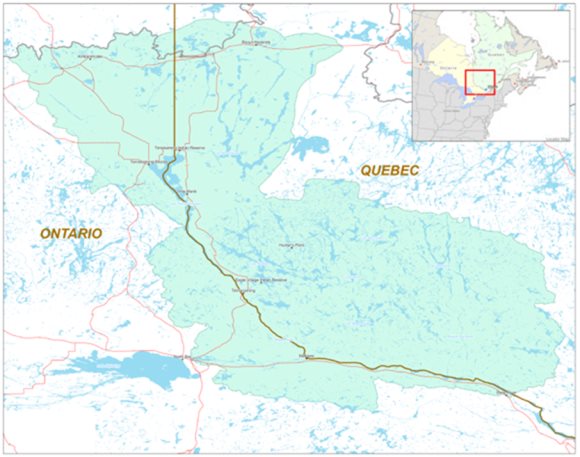
Figure 8 - Text version
The area of asserted rights and title by the SART First Nations in 2013 covers a vast territory on both sides of the provincial border between Quebec and Ontario, including the Temiscaming area.
Our communities, with other First Nations in Canada, have advocated for the implementation of the United Nations Declaration on the Rights of Indigenous Peoples (UNDRIP 2007)Footnote 48 for advancing our rights, dignity, survival, security and well-being.
Impacts of Colonialism and Other Challenges to SART's Way of Life
The temporal and spatial cumulative impacts of colonialism (of which the Timiskaming Dam Complex is a significant part) have been devastating for the three Anishinaabeg Algonquin First Nations of the upper Kitchi Sibi (Ottawa River). The Catholic church, the fur trade, forestry, agriculture, mining, hydroelectric industries, dam infrastructure, sports tourism and residential development over two hundred years have diminished our lands and waters and almost wiped out our culture. But we have survived! Our people are now learning the truth about our history. We are reclaiming our culture, territory and stewardship responsibilities to the resources that have been unsustainably taken from our land.
SART Objectives on Rights, Dignity, Survival and Well-Being
Our SART Indigenous-led assessment as described in Chapter 13.1 of the Project Environmental Impact Statement (EIS) has determined that the following are the key community objectives for Timiskaming, Kebaowek and Wolf Lake:
- The Statement of Asserted Rights and Title 2013 (SART) asserts authority of our three nations over our traditional territory and re-establishes our title to the lands on both sides of the Kitchi Sibi. This is the highest priority value for our three communities.
- Sufficient Lands and Services to enable our people and future generations to live in harmony with one another and with the land, plants, animals and waters around us.
- Culturally safe space and opportunity for younger generations to reclaim our language and culture.
- Control over development and services on our territory.
- Ability to heal our people and territory from historical events, and get social, cultural, economic and environmental reparations for the cumulative effects visited upon us.
Cumulative Effects of the Existing Timiskaming Dam Complex
The Timiskaming Dam Complex continues to enable the same colonial impacts as it did at the time of its construction in 1909-13. Without the dam, the hydroelectric facilities downstream from it would not function. The Long Sault rapids would return, and with them, the fish, wetlands and riparian habitat, including successful spawning beds, wild rice and other wild food sources.
The Timiskaming Dam Replacement Project represents an enormous opportunity to the federal government to redress these historic wrongs.
In 2022, the Kitchi Sibi technical team conducted a Socio-Cultural Economic Impact Assessment (SCEIA), to provide a baseline picture of our social fabric, cultural traditions, governance, economy, and overall livelihood. We wanted to know how our people are dealing with the past cumulative effects of colonial development, and to canvass our future hopes and worries about the future development of our lands and territories. The 2022 Social Cultural survey asked band members if they were aware of the Dam Replacement Project, and 66.67% of Kebaowek members and 74.7% of Wolf Lake members responded "yes".
SART Concerns and Expectations Relating to the Project
Based on our past lived experience and the lack of consultation with SART First Nations on the Ontario dam-bridge replacement project in 2014, SART First Nations had a number of socio-cultural-economic concerns and expectations, especially related to job creation, unsafe country food harvesting, increased traffic and traffic delays, access to territory, First Nation sovereignty/self-determination and environmental contamination and spawning bed destruction as the following results table demonstrates.
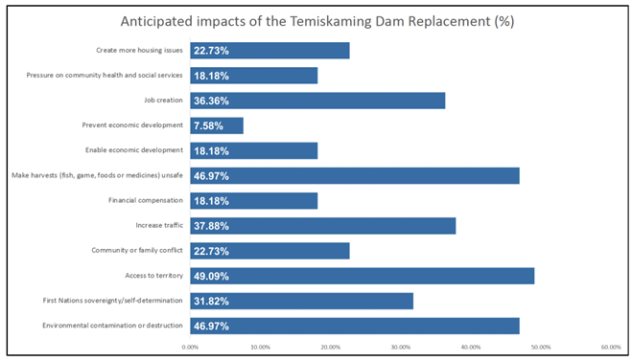
Figure 9 - Text version
The figure presents the anticipated impacts of the replacement of the Temiscaming Dam, expressed as percentages in the form of a horizontal bar chart. The impacts identified are:
- access to territory issues (49.09%),
- danger to harvesting activities (46.97%),
- environmental contamination or destruction (46.97%),
- increased traffic (37.88%),
- job creation (36.36%),
- impacts on the sovereignty and self-determination of First Nations (31.82%),
- worsening housing issues (22.73%),
- community or family conflict (22.73%),
- pressure on social and health services (18.18%),
- economic growth (18.18%),
- financial compensation (18.18%),
- and barriers to economic development (7.58%).
Clearly, most of the socio-cultural-economic problems facing our people cannot be solely attributed to the Timiskaming Dam Complex, neither can they be resolved through this Project. All we can expect is that the Project will not make things worse and will contribute to wellness of our bands, the spawning beds supporting fisheries and the Kitchi-Sibi watershed. The major socio-cultural-economic effect of the Project has been and continues to be its effect on Algonquin sovereignty and on the SART First Nations' ability to exercise our inherent rights and responsibilities to protect our sacred relations with the Kitchi Sibi watershed.
7.1.3 RIA Approach
SART Rights Affected by the Project
SART First Nations have identified 5 categories of rights that are most relevant for this RIA:
- Rights to harvest
- Harvesting rights include the right to hunt, fish, and gather food or plants through SART First Nations' preferred means and in the Project location. Harvesting rights protect the ability to engage in activities necessary to facilitate the harvesting right (e.g., improving current fisheries lifecycle conditions at the Project).
- Rights to govern and protect the territory
- Governance rights include the right to make decisions about issues that will impact SART First Nations' rights and interests (such as decisions around resource allocation or land development); the right to apply SART First Nations customs, protocols and law; and the right to exercise traditional governance mechanisms. As stewards, SART First Nations also has a sacred obligation to protect the land and resources, not only for its members but also other living beings rights to a healthy environment on the territory. SART First Nations must maintain and protect its treaty relationship with the living beings on the land.
- In particular, women have a special role as protectors of the Kichi Sìbì watershed:
- "Within Anishinaabeg societal knowledge(s), women's responsibility extends to the protection and preservation of Nibi, water. In these understandings, all forms of water are considered. Women generate water, while their child is within their first lodge, within their bodies. Anishinaabekwe have these life responsibilities…which also encompass water animals and other beings" - Mcguire, P., 2020
- Rights to maintain a cultural and spiritual relationship with the territory
- To maintain a relationship with the territory, SART First Nations must be able to protect, revitalize and teach their ways of being to future generations. SART First Nations ways of being are often understood in relation to natural environment and physical landscapes. As such, a crucial aspect of SART First Nations relationship with the land is SART First Nations' ability to use, travel through, and enjoy the surroundings in peace, without fear or trepidation. Physical obstructions in or alterations to the natural environment can not only sever the physical but also spiritual relationship to the territory.
- Rights to access and occupy traditional territory
- As traditionally nomadic peoples, mobility on the territory is a key aspect of Anishinaabe and SART First Nations' culture. Mobility means eliminating physical, environmental, legal, and psychological barriers (e.g., fear) to accessing the territory. A right to access and occupy traditional territory is both a right in itself, and a necessary condition for exercising other rights (e.g., harvesting).
- Rights to dignity of culture and enterprise
- SART First Nations' relationship with Long Sault Island is another crucial foundation for Algonquin culture and way of life. Algonquin culture comes from the land, and from being on the land. This relationship, based on respect and gratitude, is expressed through enterprise that reflects our cultural history, for example the Algonquin Canoe Company just next to the Project site. The integrity of and the access to this business site is a major concern to WLFN (See WLFN Business Impact Assessment Report).
Valued Components and Indicators
The SART First Nations developed and recommended the following as indicators /valued components to measure the Project's contribution to our SART First Nations' interests, values and needs:
- Respect for a recognition of the Statement of Asserted Rights and Title issued by our First Nations in 2013, including an understanding that – when the Québec -side bridge is being discussed – it is our First Nations who have jurisdiction and must be accommodated, not the Algonquins of Ontario;
- Commitment to respect the rights and title of our First Nations in future PSPC plans and Projects including the Project;
- Support for Kitchi Sibi Ikidowin Anishinaabeg – the Algonquin People Powered Governance Model for the Ottawa River Watershed, including continuing economic support for the Kichi Sibi Technical Team.
- The extent to which lands and resources to support the reclamation of community and traditional practices are increased by the Project: protection and enhancement of fish and fish habitat, restoration of Ottawa River water quality and riparian areas;
- The extent to which fish habitat is enhanced or damaged, in particular, sturgeon spawning beds. (A sturgeon spawning area will be damaged/destroyed if Option 1 for dam placement is approved, SART First Nations have made an FPIC decision through two surveys (2022 and 2025) that this is not the best option.
- The extent to which contamination caused by previous colonial/industrial activity in the vicinity of the dam is remediated, and/or compensated.
- The extent to which the Project contributes to economic opportunities for SART First Nations on the Project itself – specifically the enhancement of the Algonquin Canoe Company business and SART First Nations subcontracting opportunities during construction and maintenance afterwards. The Algonquin Canoe Company on Long Sault Island is the Anishinaabeg Algonquin Nation ambassador location to the territory.
- The extent to which the public and First Nation members are made aware of Anishinaabeg Algonquin culture on the Kitchi Sibi through architectural design elements, commemorative artwork on the site and elsewhere, educational materials, and support for research and publication about our Peoples.
- The extent to which construction does or does not contribute to drug and alcohol addictions, lateral violence and bullying in the proximate communities, or places greater demands on community services like housing, education and health.
- The extent to which the dam supports outside access to traditional lands, remembering the colonial impacts of roads on Indigenous rights and title.
- The extent to which the Project construction and operation affect the life cycle dynamics of aquatic species and species at risk in the Kitchi Sibi.
- The extent to which the Project accounts for cumulative impacts on freshwater ecosystems and related SART First Nations' Aboriginal fisheries through flooding, hydrologic alteration, fragmentation and obstructing migration routes.
- The extent to which the Project respects Indigenous-led conservation efforts and fisheries co-management priorities into the future. The adoption of the SART Neme (sturgeon) conservation plan.
- The extent to which the Project design options consider nature as infrastructure versus human-centred infrastructure development thinking and actions.
7.1.4 Rights Impact Assessment Findings
Results of 2023 Rights Impact Assessment Survey
The following section includes excerpts of the SART First Nations' comprehensive 2023 Project Rights Impact Assessment surveys. Results include elder, land user, knowledge holder and community member observations and perspectives related to constraints, stressors and barriers to their current and future ability to undertake associated cultural practices at the Project development site.
Qualitative information and observations about the state of the watershed at the Project on SART First Nations Traditional Territory the host landscape and Project area, as witnessed and experienced by SART First Nations members are set out in individual community reports. Results information relating to specific development features is categorized through questions (e.g. location preference related to impacts, fish ladder design, transportation activity, land use, etc.). In total 324 community survey responses were elicited.
From the SART First Nations' perspective, it makes little sense to talk about the potential impacts of the Project without considering the current quality and state of the Kitchi Sibi and the state of the Aboriginal fisheries that are further vulnerable to the Project. In short, that is a rights impact assessment that makes sense to the community, governs our reality and plays a determinative role in how and where the Project and fish ladder could be constructed.
Appendix E present SART Summary of Effects of the Project on the SART Environment and denotes the severity of impacts as determined by SART First Nations.
Results of Consideration of Preferred Location of the Dam
In 2023, the SART First Nations survey specifically asked community members about their preferred option for the replacement of the Dam. The options provided by PSPC at this time were:
- Option 1: Construction of a new dam/bridge downstream of the existing dam/bridge and deconstruction of the existing dam.
- Option 2: Construction of a new dam/bridge upstream of the existing dam/bridge and deconstruction of the existing dam.
- Option 3: Reconstruction of the dam/bridge based on the same place and layout as the existing dam/bridge and deconstruction of the existing dam.
SART First Nations members were asked to provide their first and second preferences to identify the preferred option. Although Option 2 was described as technically viable in the EIS, PSPC later informed SART First Nations in 2023 that it was not viable.
A total of 358 responses from community members were submitted over 179 surveys. Regarding the Primary Location of Dam, the top choice for preferred location of the Timiskaming Dam Replacement was Option 2 – Upstream of Existing Location. It was chosen by 47.5% of KFN members. Option 3 was a close second choice with 33.8% of responses. There were much fewer responses for Option 1 with only 14.5%. There were a total of 15 responses that were not submitted.
|
Location of Dam |
Responses |
Responses |
|---|---|---|
|
Please provide your first choice for the location of the new dam |
||
|
Option 1 – Downstream of Existing Location |
21 |
11.7% |
|
Option 2 - Upstream of Existing Location |
88 |
49.2% |
|
Option 3 - In Same Location |
65 |
36.3% |
|
Option 4 - No Opinion or Unlisted |
5 |
2.8% |
|
Total |
179 |
100% |
|
Please provide your second choice for the location of the new dam |
||
|
Option 1 – Downstream of Existing Location |
31 |
17.3% |
|
Option 2 - Upstream of Existing Location |
82 |
45.8% |
|
Option 3 - In Same Location |
56 |
31.3% |
|
Option 4 - No Opinion or Unlisted |
10 |
5.6% |
|
Total |
179 |
100% |
|
Total number of responses for each option |
||
|
Option 1 – Downstream of Existing Location |
52 |
14.5% |
|
Option 2 - Upstream of Existing Location |
170 |
47.5% |
|
Option 3 - In Same Location |
121 |
33.8% |
|
Option 4 - No Opinion or Unlisted |
15 |
4.2% |
|
Total |
358 |
100% |
In 2024, PSPC informed SART First Nations that the original upstream design option described in the EIS was not operationally feasible. PSPC proposed an in-situ Option D, prompting SART First Nations to commission a third-party engineering review of all options. This review assessed the technical aspects of replacement options, including reasons some were deemed unfeasible by PSPC. It also involved creating visualizations, conducting multi-criteria analyses, and holding workshops with the SART First Nations Kitchi Sibi technical team and a SART First Nations fisheries working group. In this re-evaluation process, the third-party engineer and SART First Nations introduced two new options both eliminating the need for a coffer dam in the downstream spawning bed.
SART First Nations Member Comments
Below we provide comments received from SART First Nations Members during the Project and Kitchi Sibi Ikidowin Anishinaabeg – the Algonquin People Powered Governance Model for the Ottawa River Watershed surveys that underscore concerns with the Project:
"Truth and reconciliation need to pump the brakes: need truth before reconciling". Kitchi Sibi Ikidowin survey
"When I was a kid, we used to swim in the Ottawa River by the marina right along its edges but in the late 50s we stopped because of the pollution contaminating the water….We used to catch river fish in the 60s, but by that point we couldn't eat them because of how much mercury there was. The Ottawa River experienced a lot of pollution from the logging business because of the residue from the wood seeping into the water….There was brown muck coming out of the mill and going straight into the river. Sometimes the logs would pass through the dam and go on the Ontario side and cause further pollution." WLFN member
"I hear people talk about the pollution, but do we ever see anything positive come out of it? Does it ever get cleaned up? We never hear anything about it." WLFN member
"Neme sibi- the river was known as Neme-Sibi because the sturgeon travelled everywhere. The fish and the animals provided the medicines. Today they are threatened and suffering. When the earth suffers everything suffers." Kitchi Sibi Ikidowin survey
"When I was younger, friends and I would go fishing off the dam when we had no access to a vehicle to get elsewhere." KFN member
"My kids use it to go with the school for activities. Go down there to hang out with friends to look at the view, take pictures etc." KFN member
"Algonquin Canoe Company visits. Indigenous and Anishinabek activities at Long Sault grounds and Ottawa River. Ottawa River boat access is always needed." KFN member
"Yes, it is important for me due to its proximity to our lands and our People. I enjoy using the river recreationally for both fishing and paddling. I've rafted several parts of the river as far as Ottawa itself, but also Pembroke and Laniel." KFN member
"Traditional territory. Spawning areas for endangered species. It provides habitat for many fish species and other aquatic habitats." KFN member
"Get started on clean up and then talk to me. Everyone has a role to play if they want to enjoy the water. We know there is cleanup that is needed- I was born on the Ottawa Rive me. At one time it was fine to pick up a cup and drink. They talk about minimizing pollution but I'll be happy when I start hearing about what's being done to clean it up." Kitchi Sibi Ikidowin survey
"The Ottawa river is very important to my people and has been for a long time. It produces habitat for fish and game. It provides food to the members. It was also our way of travel." KFN member
"The Ottawa River is important to me because it's home to the prehistoric lake sturgeon. I'd hate to see this fish become extinct. I'd hate for the water to become contaminated due to a new dam or bridge being constructed and then having the existing dam demolished." KFN member
"I see a lot to be worried about. The land our water, all being destroyed, our animals getting sick. We can't even get our traditional medicine, we have to be careful where we get our drinking water, there is machines everywhere… It's unbelievable how much they can destroy for greed. When will they realize that? Kitchi Sibi Ikidowin survey
"It is important that the area be not further damaged. There are people from our communities who use the area for family gatherings, trips up the lake, to fish & to camp." WLFN member
"Bridge is old and needs replacement; Temporary fix is not safe; wood top is very slippery in certain weather conditions; time for a modern up-to-date bridge" WLFN member
"The island is a place where we the Algonquin of Wolf Lake have business and have had some gatherings on this land." WLFN member
"The dam/bridge is our main way of transportation to the Ontario province, it is used daily/weekly from members in my family." WLFN member
"Yes, I would like to make sure that our environment isn't damaged as much as possible. Our food, our land, our source of water, etc." WLFN member
"Our traditional activities depends on water for transportation and provides habitat for plants & animals, we use for medicines & food. Fishing & swimming. Visiting areas close by." WLFN member
"Yes, to have a safe traffic and pedestrian passage as well as a safe environmental passage for all the aquatic species" WLFN member
"It is important to me and my family, it is our only means of access family, friends in Ontario. We have all our medical professionals on the Ontario side." WLFN member
"Home for many vital aquatic species that hold important environmental knowledge, space, and place for community members to connect with the land and its gifts." TFN member
"I want to just say the fish ladder pretty much so we can get sturgeon and maybe eels would be cool to get more of back up into the Lake."TFN member
"I think the most important issue we should be addressing is the fish habitat. That is does not get effected."TFN member
"Making sure our environment and land are spill free and contamination free."TFN member
"Our Elders walked this land ancestors…Making sure that all spawning and other animal habitats are protected."TFN member
SART First Nations Views on Impacts to Rights
It is our assessment that the downstream option for the Project as presented in the environmental assessment report is expected to have, among other things:
- significant adverse impacts on our Rights to Harvest with emphasis on the Timiskaming Dam Complex and the Project continued impact on Aboriginal fisheries spawning grounds and life cycles
- significant adverse impacts on our Rights to govern and protect the territory with emphasis on our inherent responsibility to protect the threatened Neme (Lake Sturgeon) population which in our laws is the leader of the Fish Nation
- significant adverse impacts on Rights to maintain a cultural and spiritual relationship with the territory with significant emphasis on Long Sault Island and Gordon Creek as both as a historic and contemporary Algonquin Anishinabeg ceremonial gathering location
- significant adverse impacts on Rights to access and occupy traditional territory with emphasis on waterflows at the Project site and access to fishing grounds from bridge and Gordon Creek
- significant adverse impacts on Rights to dignity of culture and enterprise with emphasis on Project disrupting Algonquin Canoe Company business and cultural gatherings on Long Sault Island, for example, National Aboriginal Day.
This assessment takes into account consideration of available information, engagement with community members and advice from the SART First Nations technical team.
As described in more detail below, this conclusion would change if the Project were to advance in alignment with the SART 1A option. This solution would mitigate the potential adverse effects of the Project on Lake Sturgeon (Neme) and their critical habitat at the site as well as SART First Nations inherent rights and responsibilities for wildlife protection within their constitution Ona'ken'age'win. Put differently, the SART 1A option, when combined with robust Project conditions, Project oversight and measures from DFO relating to lake sturgeon would lessen impacts to SART First Nations Rights compared to the impacts associated with the options presented in the environmental assessment report.
SART First Nations View on Crown Consultation
Construction of the Timiskaming Dam Complex site on Algonquin territory, in an area central to Algonquin traditional way of life began in 1909. For over 100 years, SART First Nations have suffered impacts as well as no consultation on this major infrastructure providing access into the heart of SART First Nations territory. Access and spiritual connection to the fishing site at Gordon Creek has diminished because of development of the Timiskaming Dam Complex.
It is our conclusion that the environmental assessment process under CEAA (2012) did not allow for the Crown to meaningfully discharge its consultation obligations for a number of reasons, including, e.g., the timelines were too short to allow for necessary technical reviews, studies and collaboration. SART First Nations provides the following consultation overview as to how the components of the Crown's Aboriginal consultation obligation has not been fulfilled by IAAC to date regarding the Project.
It is our understanding that there is a shared acknowledgement that more needs to be done for consultation to be completed. On June 3, 2025, SART First Nations provided in-person testimony during a tri-party mediation session with the IAAC and PSPC. We stated that PSPC had failed to include viable options in the EIS review and requested an extension of the assessment process under the Impact Assessment Act (2019). This extension was sought to allow for meaningful consultation on viable options, including SART First Nations' preferred Option 1A (downstream option as presented in this report with a different working method from rock filling for the cofferdam), which could potentially eliminate fisheries impacts associated with an in-situ coffer dam via an alternative sheet pile design option. While IAAC declined to transition the environmental assessment to the new Act, PSPC identified a "term sheet" for continued study and collaboration to prevent, mitigate, and accommodate any negative impacts of the downstream option. For example, implementing the SART 1A option through a design-build approach.
The "term sheet" is in a consultation phase at the time of writing this report. As a result, further work is anticipated to consult and collaborate on the SART 1A option. To be clear, commitments to advance the SART 1A option is a necessary part of consultation because it is a solution that would mitigate the potential adverse effects of the Project on Lake Sturgeon (Neme) and their critical habitat at the site as well as SART First Nations' inherent rights and responsibilities for wildlife protection within their constitution Ona'ken'age'win.
The Crown's obligations for the Project environmental assessment include a positive duty to ensure SART First Nations' concerns and impacts to our rights and interests are seriously considered and demonstrably integrated into the environmental assessment report. This has not even begun to occur. Therefore, changes to the Project description and alternative design, among other considerations may be required to accommodate SART First Nations' concerns which, at this point, remain outstanding.
SART First Nations View on Alignment with UNDRIP (2007) and United Nations Declaration on the Rights of Indigenous Peoples Act (2021)
As we continue to explore solutions, the SART First Nations are expecting that decision-making regarding the Project will be in keeping with provisions of UNDRIP (2007) and United Nations Declaration on the Rights of Indigenous Peoples Act (2021). Related, UNDRIP Article 27 states:
States shall establish and implement, in conjunction with Indigenous Peoples concerned, a fair, independent, impartial, open and transparent process, giving due recognition to Indigenous Peoples' laws, traditions, customs and land tenure systems, to recognize and adjudicate the rights of Indigenous Peoples pertaining to their lands, territories and resources, including those which were traditionally owned or otherwise occupied or used. Indigenous Peoples shall have the right to participate in this process.
In practice, UNDRIP would promote, amongst other things, transitions toward sustainability and enhanced legitimacy in environmental assessment decisions and regulatory outcomes on Algonquin lands versus a drift towards more conflict, legitimate activism and litigation as a result of the misrepresentations of Section 35 consultation and accommodation. The UN Declaration includes a number of articles, towards recognizing the need for a dominant state to respect and promote the rights of First Nations as affirmed in treaties and agreements, including how First Nations participate in decision-making processes that affect their traditional lands and livelihoods (UNDRIP, 2007).
For example, article 18 mentions that:
Indigenous peoples have the right to participate in decision-making in matters which would affect their rights, through representatives chosen by themselves in accordance with their own procedure, as well as to maintain and develop their own indigenous decision-making institutions.
Moreover, article 32 (2) of the UN Declaration states:
States shall consult and cooperate in good faith with the indigenous peoples concerned through their own representative institutions in order to obtain their free and informed consent prior to the approval of any Project affecting their lands or territories and other resources, particularly in connection with the development, utilization or exploitation of mineral, water and other resources.
The concept of free, prior, and informed consent promoted by UNDRIP article 32 is of paramount importance to the SART First Nations in terms of the Project site and option selection. The SART First Nations have been clear that commitments to further collaboration and implementation of the SART 1A Option is a critical component of aligning the Project with UNDRIP.
7.2 Assessment of Project Impacts on the Rights of AOPFN
The assessment of the Project's impacts on the rights of AOPFN is currently being prepared by AOPFN and will be included in the final Environmental Assessment Report.
7.3 IAAC Analysis and Conclusions
IAAC is currently preparing its analysis of impacts on rights for both SART First Nations and AOPFN. IAAC will continue to discuss its collaborative analysis and preliminary conclusions with the First Nations during the public consultation period. IAAC's analysis and conclusions regarding the Project's impacts on rights will be included in the final Environmental Assessment Report.
8. IAAC Conclusions and Recommendations
In preparing this version of the Environmental Assessment Report, IAAC considered the proponent's EIS, its responses to information requests, comments from federal authorities, Indigenous peoples, and the public, the measures proposed to mitigate the Project's effects, as well as the monitoring and follow-up programs.
The Project's environmental effects and their significance were determined using an assessment methodology consistent with currently accepted practices among environmental assessment and socio-economic assessment practitioners, including consideration of potential accidents and malfunctions and cumulative environmental effects.
IAAC acknowledges that, following the implementation of mitigation measures, the Project could result in residual adverse effects on valued components. IAAC concludes that, taking into account the implementation of mitigation measures and the proposed monitoring and follow-up programs, the Project is not likely to result in significant adverse residual environmental effects, as defined under section 5 of the CEAA 2012. IAAC has identified the key mitigation measures and monitoring and follow-up programs that the Minister of Environment, Climate Change and Nature must consider in establishing Project conditions as part of the environmental assessment decision statement, should the Project be authorized to proceed.
Furthermore, to ensure that the Project is carried out with due care and precaution, IAAC expects that all commitments made by the proponent – including mitigation measures and the monitoring and follow-up programs described in the EIS and supporting documents – will be implemented as proposed. IAAC also expects the proponent to continue to engage and inform Indigenous peoples and to maintain communication with them throughout the duration of the Project.
Appendices
Appendix A: Environmental Effects Rating Criteria
General Definitions of Criteria Used to Assess Residual Effects on Each of the Valued Components (VCs)
Magnitude: Indicates the level of disturbance (change) that the studied valued component (VC) would experience. The magnitude assessment takes into account the component's ecological context. The magnitude can incorporate the concept of the time when the effect would occur, which can refer to a phase of the component's life cycle (migration, reproduction, feeding, etc.) or a period during which a cultural, spiritual or recreational practice by a First Nation or population would occur (e.g., hunting season).
Extent: Geographical extent of the adverse effects.
Duration: Period of time during which the adverse effects would occur.
Frequency: Pace at which the adverse effects would occur in a given period.
Reversibility: Likelihood of a VC recovering from the adverse effects caused by the Project.
Significance: The significance of the adverse effects is determined by the combination of levels assigned to each of the criteria (magnitude, extent, duration, frequency and reversibility) for each component. A grid for determining the significance of the residual effects on the components is used for this purpose is presented below.
|
Assessment Criteria |
Level Descriptions |
|---|---|
|
Extent |
Site-specific: The effects would be limited to the Project site, the Aquatic Study Area (ASA) and the Terrestrial Study Area (TSA). Local: The effects would extend beyond the Project site, the ASA and TSA, but are in the local study area. Régional: The effects extend beyond the local study area. |
|
Duration |
Short term or temporary: The effects would occur over a period of less than one year. Medium term: The effects would occur over a period of one to five years. Long term: The effects would occur over a period of more than five years. |
|
Frequency |
Once: The effects would occur once in any phase of the Project. Intermittent: The effects would occur from time to time or intermittently during one or more phases of the Project. Continuous: The effects would occur continually during one or more phases of the Project. |
|
Reversibility |
Reversible: The VC would recover completely from the Project's effects (e.g., return to the baseline or another target). Partially reversible: The VC would partly recover from the Project's effects. Irreversible: The VC would not recover from the Project's effects. |
|
Levels |
Descriptions of Magnitude Ratings |
|---|---|
|
Fish and Fish Habitat, Including Special-Status Species |
|
|
LOW |
The effect would cause little to no disruption to one or more sensitive phases in the life cycle of fish. In the case of special-status fish: The effects would not disrupt the sustainability and/or management and/or recovery of one or more of these species. |
|
MEDIUM |
The effects would disrupt one or more sensitive phases of the life cycle of fish, BUT without harming the sustainability of the fish population. In the case of special-status fish: Effects on these species are anticipated, BUT measures (offsetting or protective) could be taken to avoid disrupting the sustainability and/or management and/or recovery of one or more of these species. |
|
HIGH |
The effects would disrupt the sustainability of the fish population. In the case of special-status fish: Effects on these species are anticipated AND no measures (offsetting or protective) could be taken to ensure the sustainability and/or recovery of one or more of these species. |
|
Birds, Including Special-Status Species |
|
|
LOW |
The effects would cause little to no disruption to one or more sensitive phases in the life cycle of birds. In the case of special-status birds: The effects would not disrupt the sustainability and/or management and/or recovery of one or more of these species. |
|
MEDIUM |
The effects would disrupt one or more sensitive phases of the life cycle of birds, BUT without harming the sustainability of the bird population. In the case of special-status birds: Effects on these species are anticipated, BUT measures (offsetting or protective) could be taken to avoid disrupting the sustainability and/or management and/or recovery of one or more of these species. |
|
HIGH |
The effects would disrupt the sustainability of the bird population. In the case of special-status birds: Effects on these species are anticipated AND no measures (offsetting or protective) could be taken to ensure the sustainability and/or recovery of one or more of these species. |
|
Other Special-Status Species |
|
|
LOW |
The effects would not disrupt the maintenance and/or management and/or recovery of one or more of these species. |
|
MEDIUM |
Effects on these species are anticipated, BUT measures (offsetting or protective) could be taken to avoid disrupting the sustainability and/or management and/or recovery of one or more of these species. |
|
HIGH |
Effects on these species are anticipated AND no measures (offsetting or protective) could be taken to ensure the sustainability and/or recovery of one or more of these species. |
|
Current Use of Lands and Resource, Physical and Cultural Heritage and Socio-Economic Conditions of Local Communities |
|
|
LOW |
The effects would modify practice conditions in a way that would result in few changes to land and resource use. AND/OR The effects would involve few behavioural changes, which would allow the maintenance of practice conditions on Crown land. |
|
MEDIUM |
The effects would modify practice conditions without compromising land and resource use. AND/OR Some behaviours would be modified, but land and resource use on Crown land would not be compromised. |
|
HIGH |
The effects would modify practice conditions in a way that would result in changes that compromise land and resource use. AND/OR Land and resource use on Crown land would no longer be possible or would be compromised. |
|
Human Health |
|
|
LOW |
The potential effects on physical health are related to exposure to contaminant levels that are well below the applicable standards and criteria for the protection of physical health. AND/OR Contaminant management and mitigation measures would minimize residual effects on the acoustic environment, air, water, soil, food or quality of life (including contaminants for which there are no thresholds); AND/OR Potential effects on physical health are related to exposure to low levels of nuisance (noise, light, vibrations, odours, dust). The effects can be felt by a few individuals. AND/OR The perception of the risk to health or safety that could be caused by Project-related changes to the environment is manifested by a few individuals but is not a concern for many social groups. |
|
MEDIUM |
Potential physical health effects are related to exposure to contaminant levels that are below the applicable standards and criteria for the protection of physical health, BUT at moderate levels of nuisance (noise, light, vibration, odour, dust). The effects may be felt by certain social groups. AND Residual effects will persist on acoustic environment, air, water, soil, food or quality of life despite contaminant management and mitigation measures (including contaminants for which there are no thresholds) AND/OR Certain individuals and social groups who would be affected by the Project perceive a risk to their health or safety that could be caused by Project-related changes to the environment but mitigation or compensation measures could be put in place. |
|
HIGH |
Potential physical health effects are related to exposure to contaminant levels that are above applicable standards and criteria for the protection of physical health or to high levels of nuisance (noise, light, vibration, odour, dust). The effects may be felt by several social groups or a significant portion of the affected population. AND Residual effects will persist on acoustic environment, air, water, soil, food or quality of life despite contaminant management and mitigation measures (including contaminants for which there are no thresholds). AND/OR Several social groups that would be affected by the Project perceive a high risk to their health or safety that could be caused by Project-related changes to the environment, AND no mitigation or compensation measures could be put in place. |
|
Current UseFootnote 49 of Lands and Resources for Traditional PurposesFootnote 50 by Indigenous Peoples |
|
|
LOW |
The effects would alter the conditions of traditional practicesFootnote 51 in a manner resulting in few changes to current use. AND/OR The effects involve few changes to behaviour, allowing current use to continue, in preferred ways or locations. |
|
MEDIUM |
The effects would alter the conditions of traditional practices without compromising current use. AND/OR Some behaviours would be modified, but current use would not be compromised. |
|
HIGH |
The effects would alter the conditions of traditional practices in a manner resulting in changes that would compromise current use. AND/OR Current Indigenous use would no longer be possible in accordance with preferred ways or would be compromised in the only suitable, available or most preferred locations. |
|
Physical or Cultural Heritage by Indigenous Peoples |
|
|
LOW |
The effects would slightly alter the characteristics of the unique nature of an element of the physical or cultural heritage and/or of a structure, site or thing of historical, archeological, paleontological or architectural significance. AND/OR Access to or use of an element of the physical or cultural heritage and/or of a structure, site or thing of importance would not be altered for users. In the case of designated heritage elements: The effects would not disrupt the sustainability and/or management of designated heritage elements. |
|
MEDIUM |
The effects would alter some characteristics of the unique nature of an element of the physical or cultural heritage and/or of a structure, site or thing of historical, archeological, paleontological or architectural significance, BUT would not compromise its integrity. AND/OR Access to or use of an element of the physical or cultural heritage and/or of a structure, site or thing would be altered BUT would not be compromised for users. In the case of designated heritage elements: The sustainability or management of designated heritage elements would be altered BUT would not alter their designation. |
|
HIGH |
The effects would lead to the loss of characteristics of the unique nature of an element of the physical or cultural heritage or of a structure, site or thing of historical, archeological, paleontological or architectural significance, such that its integrity would be compromised. AND/OR The effect would prevent users from accessing or using an element of the physical or cultural heritage or a structure, site or thing of historical, archeological, paleontological or architectural significance. In the case of designated heritage elements: The effects would interfere with the sustainability and/or management of designated heritage elements and could compromise their designation. |
|
Socio-Economic ConditionsFootnote 52 by Indigenous Peoples |
|
|
LOW |
The area is not commonly used for activities. The effects would cause few changes to behaviours required for carrying out activities and their economic impact. |
|
MEDIUM |
The effects would lead to changes in the behaviours required for carrying out activities BUT carrying out activities would not be compromised in the most commonly used areas. |
|
HIGH |
The effects would lead to noticeable changes in the behaviours required for carrying out activities in regularly used areas, such that the activity would be compromised or no longer possible. |
|
Extent |
Duration |
Frequency |
Reversibility / Irreversibility |
Level of effect |
Significance |
Extent |
Duration |
Frequency |
Reversibility / Irreversibility |
Level of effect |
Significance |
Extent |
Duration |
Frequency |
Reversibility / Irreversibility |
Level of effect |
Significance |
|---|---|---|---|---|---|---|---|---|---|---|---|---|---|---|---|---|---|
|
Regional |
Long Term |
Continuous |
Irreversible |
High |
Significant |
Local |
Long Term |
Continuous |
Irreversible |
High |
Significant |
Site-Specific |
Long Term |
Continuous |
Irreversible |
High |
Significant |
|
Partially |
High |
Significant |
Partially |
High |
Significant |
Partially |
High |
Significant |
|||||||||
|
Reversible |
High |
Significant |
Reversible |
High |
Significant |
Reversible |
High |
Significant |
|||||||||
|
Intermittent |
Irreversible |
High |
Significant |
Intermittent |
Irreversible |
High |
Significant |
Intermittent |
Irreversible |
High |
Significant |
||||||
|
Partially |
High |
Significant |
Partially |
High |
Significant |
Partially |
High |
Significant |
|||||||||
|
Reversible |
High |
Significant |
Reversible |
High |
Significant |
Reversible |
High |
Significant |
|||||||||
|
Once |
Irreversible |
High |
Significant |
Once |
Irreversible |
High |
Significant |
Once |
Irreversible |
High |
Significant |
||||||
|
Partially |
High |
Significant |
Partially |
High |
Significant |
Partially |
High |
Significant |
|||||||||
|
Reversible |
High |
Significant |
Reversible |
High |
Significant |
Reversible |
High |
Significant |
|||||||||
|
Medium Term |
Continuous |
Irreversible |
High |
Significant |
Medium Term |
Continuous |
Irreversible |
High |
Significant |
Medium Term |
Continuous |
Irreversible |
High |
Significant |
|||
|
Partially |
High |
Significant |
Partially |
High |
Significant |
Partially |
High |
Significant |
|||||||||
|
Reversible |
High |
Significant |
Reversible |
High |
Significant |
Reversible |
High |
Significant |
|||||||||
|
Intermittent |
Irreversible |
High |
Significant |
Intermittent |
Irreversible |
High |
Significant |
Intermittent |
Irreversible |
High |
Significant |
||||||
|
Partially |
High |
Significant |
Partially |
High |
Significant |
Partially |
High |
Significant |
|||||||||
|
Reversible |
High |
Significant |
Reversible |
High |
Significant |
Reversible |
Moderate |
Not Significant |
|||||||||
|
Once |
Irreversible |
High |
Significant |
Once |
Irreversible |
High |
Significant |
Once |
Irreversible |
High |
Significant |
||||||
|
Partially |
High |
Significant |
Partially |
High |
Significant |
Partially |
Moderate |
Not significant |
|||||||||
|
Reversible |
High |
Significant |
Reversible |
Moderate |
Not Significant |
Reversible |
Moderate |
Not significant |
|||||||||
|
Short Term |
Continuous |
Irreversible |
High |
Significant |
Short Term |
Continuous |
Irreversible |
High |
Significant |
Short Term |
Continuous |
Irreversible |
High |
Significant |
|||
|
Partially |
High |
Significant |
Partially |
High |
Significant |
Partially |
High |
Significant |
|||||||||
|
Reversible |
High |
Significant |
Reversible |
High |
Significant |
Reversible |
Moderate |
Not Significant |
|||||||||
|
Intermittent |
Irreversible |
High |
Significant |
Intermittent |
Irreversible |
High |
Significant |
Intermittent |
Irreversible |
High |
Significant |
||||||
|
Partially |
High |
Significant |
Partially |
High |
Significant |
Partially |
Moderate |
Not Significant |
|||||||||
|
Reversible |
High |
Significant |
Reversible |
Moderate |
Not Significant |
Reversible |
Moderate |
Not Significant |
|||||||||
|
Once |
Irreversible |
High |
Significant |
Once |
Irreversible |
High |
Significant |
Once |
Irreversible |
Moderate |
Not Significant |
||||||
|
Partially |
High |
Significant |
Partially |
Moderate |
Not significant |
Partially |
Moderate |
Not Significant |
|||||||||
|
Reversible |
High |
Significant |
Reversible |
Moderate |
Not Significant |
Reversible |
Moderate |
Not Significant |
|||||||||
|
*Only residual impacts with a "High" effect level demonstrate a significant effect within the meaning of the Canadian Environmental Assessment Act, 2012. |
|||||||||||||||||
|
Extent |
Duration |
Frequency |
Reversibility / Irreversibility |
Level of effect |
Significance |
Extent |
Duration |
Frequency |
Reversibility / Irreversibility |
Level of effect |
Significance |
Extent |
Duration |
Frequency |
Reversibility / Irreversibility |
Level of effect |
Significance |
|---|---|---|---|---|---|---|---|---|---|---|---|---|---|---|---|---|---|
|
Regional |
Long Term |
Continuous |
Irreversible |
High |
Significant |
Local |
Long Term |
Continuous |
Irreversible |
Moderate |
Not Significant |
Site-Specific |
Long Term |
Continuous |
Irreversible |
Moderate |
Not Significant |
|
Partially |
High |
Significant |
Partially |
Moderate |
Not Significant |
Partially |
Moderate |
Not Significant |
|||||||||
|
Reversible |
Moderate |
Not Significant |
Reversible |
Moderate |
Not Significant |
Reversible |
Moderate |
Not Significant |
|||||||||
|
Intermittent |
Irreversible |
High |
Significant |
Intermittent |
Irreversible |
Moderate |
Not Significant |
Intermittent |
Irreversible |
Moderate |
Not Significant |
||||||
|
Partially |
Moderate |
Not Significant |
Partially |
Moderate |
Not Significant |
Partially |
Moderate |
Not Significant |
|||||||||
|
Reversible |
Moderate |
Not Significant |
Reversible |
Moderate |
Not Significant |
Reversible |
Moderate |
Not Significant |
|||||||||
|
Once |
Irreversible |
Moderate |
Not Significant |
Once |
Irreversible |
Moderate |
Not Significant |
Once |
Irreversible |
Moderate |
Not Significant |
||||||
|
Partially |
Moderate |
Not Significant |
Partially |
Moderate |
Not Significant |
Partially |
Moderate |
Not Significant |
|||||||||
|
Reversible |
Moderate |
Not Significant |
Reversible |
Moderate |
Not Significant |
Reversible |
Moderate |
Not Significant |
|||||||||
|
Medium Term |
Continuous |
Irreversible |
High |
Significant |
Medium Term |
Continuous |
Irreversible |
Moderate |
Not Significant |
Medium Term |
Continuous |
Irreversible |
Moderate |
Not Significant |
|||
|
Partially |
Moderate |
Not Significant |
Partially |
Moderate |
Not Significant |
Partially |
Moderate |
Not Significant |
|||||||||
|
Reversible |
Moderate |
Not Significant |
Reversible |
Moderate |
Not Significant |
Reversible |
Moderate |
Not Significant |
|||||||||
|
Intermittent |
Irreversible |
Moderate |
Not Significant |
Intermittent |
Irreversible |
Moderate |
Not Significant |
Intermittent |
Irreversible |
Moderate |
Not Significant |
||||||
|
Partially |
Moderate |
Not Significant |
Partially |
Moderate |
Not Significant |
Partially |
Moderate |
Not Significant |
|||||||||
|
Reversible |
Moderate |
Not Significant |
Reversible |
Moderate |
Not Significant |
Reversible |
Moderate |
Not Significant |
|||||||||
|
Once |
Irreversible |
Moderate |
Not Significant |
Once |
Irreversible |
Moderate |
Not Significant |
Once |
Irreversible |
Moderate |
Not Significant |
||||||
|
Partially |
Moderate |
Not Significant |
Partially |
Moderate |
Not Significant |
Partially |
Moderate |
Not Significant |
|||||||||
|
Reversible |
Moderate |
Not Significant |
Reversible |
Moderate |
Not Significant |
Reversible |
Low |
Not Significant |
|||||||||
|
Short Term |
Continuous |
Irreversible |
Moderate |
Not Significant |
Short Term |
Continuous |
Irreversible |
Moderate |
Not Significant |
Short Term |
Continuous |
Irreversible |
Moderate |
Not Significant |
|||
|
Partially |
Moderate |
Not Significant |
Partially |
Moderate |
Not Significant |
Partially |
Moderate |
Not Significant |
|||||||||
|
Reversible |
Moderate |
Not Significant |
Reversible |
Moderate |
Not Significant |
Reversible |
Moderate |
Not Significant |
|||||||||
|
Intermittent |
Irreversible |
Moderate |
Not Significant |
Intermittent |
Irreversible |
Moderate |
Not Significant |
Intermittent |
Irreversible |
Moderate |
Not Significant |
||||||
|
Partially |
Moderate |
Not Significant |
Partially |
Moderate |
Not Significant |
Partially |
Moderate |
Not Significant |
|||||||||
|
Reversible |
Moderate |
Not Significant |
Reversible |
Moderate |
Not Significant |
Reversible |
Low |
Not Significant |
|||||||||
|
Once |
Irreversible |
Moderate |
Not Significant |
Once |
Irreversible |
Moderate |
Not Significant |
Once |
Irreversible |
Moderate |
Not Significant |
||||||
|
Partially |
Moderate |
Not Significant |
Partially |
Moderate |
Not Significant |
Partially |
Low |
Not Significant |
|||||||||
|
Reversible |
Moderate |
Not Significant |
Reversible |
Low |
Not Significant |
Reversible |
Low |
Not Significant |
|||||||||
|
* Only residual impacts with a "High" effect level demonstrate a significant effect within the meaning of the Canadian Environmental Assessment Act, 2012. |
|||||||||||||||||
|
Extent |
Duration |
Frequency |
Reversibility / Irreversibility |
Level of effect |
Significance |
Extent |
Duration |
Frequency |
Reversibility / Irreversibility |
Level of effect |
Significance |
Extent |
Duration |
Frequency |
Reversibility / Irreversibility |
Level of effect |
Significance |
|---|---|---|---|---|---|---|---|---|---|---|---|---|---|---|---|---|---|
|
Regional |
Long Term |
Continuous |
Irreversible |
Moderate |
Not Significant |
Local |
Long Term |
Continuous |
Irreversible |
Moderate |
Not Significant |
Site-Specific |
Long Term |
Continuous |
Irreversible |
Moderate |
Not Significant |
|
Partially |
Moderate |
Not Significant |
Partially |
Moderate |
Not Significant |
Partially |
Low |
Not Significant |
|||||||||
|
Reversible |
Moderate |
Not Significant |
Reversible |
Low |
Not Significant |
Reversible |
Low |
Not Significant |
|||||||||
|
Intermittent |
Irreversible |
Moderate |
Not Significant |
Intermittent |
Irreversible |
Moderate |
Not Significant |
Intermittent |
Irreversible |
Low |
Not Significant |
||||||
|
Partially |
Moderate |
Not Significant |
Partially |
Low |
Not Significant |
Partially |
Low |
Not Significant |
|||||||||
|
Reversible |
Low |
Not Significant |
Reversible |
Low |
Not Significant |
Reversible |
Low |
Not Significant |
|||||||||
|
Once |
Irreversible |
Moderate |
Not Significant |
Once |
Irreversible |
Low |
Not Significant |
Once |
Irreversible |
Low |
Not Significant |
||||||
|
Partially |
Low |
Not Significant |
Partially |
Low |
Not Significant |
Partially |
Low |
Not Significant |
|||||||||
|
Reversible |
Low |
Not Significant |
Reversible |
Low |
Not Significant |
Reversible |
Low |
Not Significant |
|||||||||
|
Medium Term |
Continuous |
Irreversible |
Moderate |
Not Significant |
Medium Term |
Continuous |
Irreversible |
Moderate |
Not Significant |
Medium Term |
Continuous |
Irreversible |
Low |
Not Significant |
|||
|
Partially |
Moderate |
Not Significant |
Partially |
Low |
Not Significant |
Partially |
Low |
Not Significant |
|||||||||
|
Reversible |
Low |
Not Significant |
Reversible |
Low |
Not Significant |
Reversible |
Low |
Not Significant |
|||||||||
|
Intermittent |
Irreversible |
Moderate |
Not Significant |
Intermittent |
Irreversible |
Low |
Not Significant |
Intermittent |
Irreversible |
Low |
Not Significant |
||||||
|
Partially |
Low |
Not Significant |
Partially |
Low |
Not Significant |
Partially |
Low |
Not Significant |
|||||||||
|
Reversible |
Low |
Not Significant |
Reversible |
Low |
Not Significant |
Reversible |
Low |
Not Significant |
|||||||||
|
Once |
Irreversible |
Low |
Not Significant |
Once |
Irreversible |
Low |
Not Significant |
Once |
Irreversible |
Low |
Not Significant |
||||||
|
Partially |
Low |
Not Significant |
Partially |
Low |
Not Significant |
Partially |
Low |
Not Significant |
|||||||||
|
Reversible |
Low |
Not Significant |
Reversible |
Low |
Not Significant |
Reversible |
Low |
Not Significant |
|||||||||
|
Short Term |
Continuous |
Irreversible |
Moderate |
Not Significant |
Short Term |
Continuous |
Irreversible |
Low |
Not Significant |
Short Term |
Continuous |
Irreversible |
Low |
Not Significant |
|||
|
Partially |
Low |
Not Significant |
Partially |
Low |
Not Significant |
Partially |
Low |
Not Significant |
|||||||||
|
Reversible |
Low |
Not Significant |
Reversible |
Low |
Not Significant |
Reversible |
Low |
Not Significant |
|||||||||
|
Intermittent |
Irreversible |
Low |
Not Significant |
Intermittent |
Irreversible |
Low |
Not Significant |
Intermittent |
Irreversible |
Low |
Not Significant |
||||||
|
Partially |
Low |
Not Significant |
Partially |
Low |
Not Significant |
Partially |
Low |
Not Significant |
|||||||||
|
Reversible |
Low |
Not Significant |
Reversible |
Low |
Not Significant |
Reversible |
Low |
Not Significant |
|||||||||
|
Once |
Irreversible |
Low |
Not Significant |
Once |
Irreversible |
Low |
Not Significant |
Once |
Irreversible |
Low |
Not Significant |
||||||
|
Partially |
Low |
Not Significant |
Partially |
Low |
Not Significant |
Partially |
Low |
Not Significant |
|||||||||
|
Reversible |
Low |
Not Significant |
Reversible |
Low |
Not Significant |
Reversible |
Low |
Not Significant |
|||||||||
|
* Only residual impacts with a "High" effect level demonstrate a significant effect within the meaning of the Canadian Environmental Assessment Act, 2012. |
|||||||||||||||||
Appendix B: Assessment of Residual Adverse Environmental Effects – Executive Summary
Note: The information presented in Chapter 5 prevails over the information presented in this appendix.
|
Potential Residual Effects |
Characterization of Potential Residual Effects |
Significance of Potential Residual Adverse Environmental Effects |
|---|---|---|
|
Fish and Fish Habitat, Including Special-Status Species |
||
|
Habitat Destruction and Alteration:
Fish Mortality:
Change in Water Quality:
Fish Passage:
|
Magnitude: Medium Extent: Local. Duration: Long-term. Frequency: Continuous. Reversibility: Partially reversible. |
Not Significant Taking into account the implementation of key mitigation mesures, the proponent's commitments, and the compensatory activities to be defined, IAAC assesses that the residual effects on fish and fish habitat, including special-status species, would be moderate. |
|
Bird, Including Special-Status Species |
||
|
Habitat Destruction and Alteration:
Mortality:
Malfunction:
|
Magnitude: Low. Extent: Site-specific. Duration: Short-term. Frequency: Intermittent. Reversibility: Reversible. |
Not Significant Taking into account the implementation of key mitigation measures and the proponent's commitments, IAAC assesses that the residual effects on birds, including special-status species, would be low. |
|
Other Special-Status Species |
||
|
Habitat Destruction and Alteration:
Mortality:
Sensory disturbances:
|
Magnitude: Low. Extent: Site-specific. Duration: Medium-term. Frequency: Intermittent. Reversibility: Reversible. |
Not Significant Taking into account the implementation of mitigation measures and the proponent's commitments, IAAC assesses that the residual effects on other special-status species would be low. |
|
Land and Resources Use, Physical and Cultural Heritage and the Socio-Economic Conditions of Local Communities |
||
|
Physical and cultural and construction, location or significant features:
Land and resources use:
Socio-economic conditions:
|
Magnitude: Low. Extent: Local. Duration: Medium-term. Frequency: Intermittent. Reversibility: Reversible. |
Not Significant Taking into account the implementation of key mitigation measures presented in section 5.6 to 5.8 and the proponent's commitments, IAAC assesses that the residual effects on land and resources use, physical en cultural heritage and the socio-economic conditions of local communities would be low. |
|
Human Health |
||
|
Air Quality:
Surface Water Quality:
Noise Environment:
|
Magnitude: Medium - Some individuals may experience moderate levels of nuisance and health effects (sleep disturbance) related to noise, vibrations, and dust, or may perceive a risk to their health or safety that could be caused by changes to the environment related to the project, but mitigation measures would be put in place. Extent: Site-specific. Durtion: Short- to medium-term. Frequency: Intermittent. Reversibility: Reversible over time. |
Not Significant Taking into account the implementation of key mitigation measures, as well as the air and water quality monitoring and follow-up programs proposed by the proponent, IAAC assesses that the residual effects on on human health, including that of First Nations, would be moderate. |
|
Current Use of Lands and Resources for Traditional Purposes by Indigenous Peoples |
||
|
Reduced availability of resources:
Change to access to the territory:
Reduced quality of the on-territory experience:
|
Magnitude: Medium. Extent: Local - some residual effects extend beyond the project site, but are limited to the local study area.. Duration: Short- to long-term – short-term effects on fish availability for subsistence fishing; medium-term effects on land access and quality of experience; long-term effects (≥ 5 years) on lake sturgeon.. Frequency: Intermittent. Reversibility: Partially reversible and reversible – effects on fishing are partially reversible, as the spawning ground cannot be restored identically due to new hydraulic conditions. Fish availability, access to Long Sault Island, navigation, and travel within the territory are considered reversible. The perception of contamination remains partially reversible. |
Not Significant Taking into account the implementation of key mitigation mesures, the proponent's commitments, and the compensatory activities to be defined, IAAC assesses that the residual effects on current uses of lands and resources for traditional purposes by First Nations, would be moderate. |
|
Physical and Cultural Heritage by Indigenous Peoples |
||
|
Long Sault Island and the Ottawa River:
Archaeological heritage on land and underwater:
Lake sturgeon, a sacred species:
Heritage buildings of the Algonquin Canoe Company:
Role of Algonquin women in water guardianship:
|
Magnitude: Low to medium – medium effects on lake sturgeon and spawning ground considered sacred; minor effects on other elements. Extent: Local. Duration: Short- to long-term – long-term effect on lake sturgeon, Long Sault Island, and the Ottawa River; short-term effects on company activities. Frequency: Intermittent to continuous – continuous effects on lake sturgeon, Long Sault Island, and the Ottawa River; intermittent or one-time effects on other elements. Reversibility: Reversible, partially reversible, and irreversible – irreversible effects on any damaged artifacts and on modification of the original flows of the Ottawa River; partially reversible effects on lake sturgeon and Long Sault Island; reversible effects on other elements. |
Not Significant Taking into account the implementation of key mitigation mesures, the proponent's commitments, IAAC assesses that the residual effects on physical and cultural heritage by Indigenous Peoples, would be low to moderate. |
|
Socio-Economic Conditions by Indigenous Peoples |
||
|
Activities and access to the Algonquin Canoe Company business:
Access to services and businesses:
First Nations economy:
|
Intensity: Low to medium – moderate effects on the Algonquin Canoe Company; minor effects on access to services in both provinces, recreational tourism activities, and the economy. Extent: Site-specific and local – specific effects on access to the Algonquin Canoe Company and its sales; local effects limited to the project site on recreational tourism activities and the economy. Duration: Short- to medium-term – medium-term effects on the Algonquin Canoe Company; short-term effects on access to services between the two provinces and the economy. Frequency: Once. Reversibility: Partially reversible – partially reversible effects on the activities or sales of the Algonquin Canoe Company and socio-economic conditions; reversible effects on access to services between the two provinces. |
Not Significant Taking into account the implementation of key mitigation mesures, the proponent's commitments, IAAC assesses that the residual effects on socio-economic conditions by Indigenous Peoples, would be low to moderate. |
|
Indigenous Groups in the Process of Rights Recognition |
||
|
Availability and quality of resources:
Physical and cultural heritage:
Health and socio-economic conditions:
|
- |
Not Significant Taking into account the implementation of key mitigation mesures, the proponent's commitments, IAAC assesses that the residual effects on availability and quality of resources, physical and cultural heritage, and health and socio-economic conditions on the Algonquins of Ontario, Antoine Nation and the Mattawa/Ottawa River Historic Métis Community, would be low. |
|
Transboundary Environemental Effects |
||
|
Magnitude: Low. Extent: Local. Duration: Long-term. Frequency: Intermittent. Reversibility: Irreversible. |
Not significant Greenhouse gas emissions would not contribute significantly to emissions at the provincial or national level. |
Appendix C: Key Mitigation and Monitoring Measures Identified by IAAC
IAAC has identified the key mitigation and monitoring measures required to ensure that the proposed project does not cause significant adverse environmental effects on valued components considered in the federal environmental assessment of the project. It took into account the mitigation measures proposed by the proponent, the advice of government experts, as well as the comments received from the First Nations consulted and the public. These mitigation and monitoring measures were used in the development of the document on potential conditions for the environmental assessment.
|
Key Mitigation Measures |
Monitoring Requirements |
|---|---|
|
Fish and Fish Habitat, Including Special-Status Species (Chapter 5.1) |
|
|
Project Schedule
Compensation Measures
Fish Passage
Erosion and Suspended Solids Control
Cofferdam and turbidity curtains
Concrete Plan
|
|
|
Birds, Including Special-Status Species (Chapter 5.2) |
|
|
No follow-up program is required. |
|
Other Special-Status Species (Chapter 5.3) |
|
|
Bats
Turtles
|
No follow-up program is required. |
|
Current Use of Land and Resources, Physical and Cultural Heritage and Socio-Economic Conditions of Local Communities (Chapter 5.4) |
|
|
No additional mitigation measures are required. |
No follow-up program is required. |
|
Human Health (Chapter 5.5) |
|
|
Atmospheric Environment
Acoustic Environment
Complaint Management
|
Atmospheric Environment
Acoustic Environment
|
|
Current Use of Lands and Resources for Traditional Purposes by Indigenous Peoples (Chapter 5.6) |
|
|
Works in fish habitat and fish habitat offsetting plan
Gathering, and Access and Experience of the Territory
Perception of Resource Contamination
|
|
|
Physical and Cultural Heritage by Indigenous Peoples (Chapter 5.7) |
|
|
Cultural Gatherings on Long Sault Island
Archaeological Potential
Heritage on Long Sault Island
Sustainability of the Sale of Crafts by the Algonquin Canoe Company and Protection of its Buildings with Heritage Value
|
No follow-up program is required. |
|
Socio-Economic Conditions by Indigenous Peoples (Chapter 5.8) |
|
|
Signage
Communications
|
|
|
Effects on Rights-Recognized Groups (Chapter 6.1) |
|
|
- |
|
Transboundary Effects (Chapter 6.2) |
|
|
No additional mitigation measures are required. |
No follow-up program is required. |
|
Effects of Accidents or Malfunctions (Chapter 6.3) |
|
|
No follow-up program is required. |
|
Effects of the Environment on the Project (Chapter 6.4) |
|
|
No additional mitigation measures are required |
No follow-up program is required. |
|
Cumulative Effects Lake Sturgeon (Chapter 6.5.1) |
|
|
No additional mitigation measures are required. |
No follow-up program is required. |
|
Cumulative Effects on the Current Use of Lands and Resources for Traditional Purposes by Indigenous Peoples (Chapter 6.5.2) |
|
|
Cumulative effects on the availability of sturgeon for subsistence fishing
|
No follow-up program is required. |
|
Cumulative Effects on Physical and Cultural Heritage by Indigenous Peoples (Chapter 6.5.3) |
|
|
Cumulative effects of the construction phase on cultural transmission in the Long Sault Island area
|
No follow-up program is required. |
Appendix D: Summary of Crown Consultation with Indigenous Groups
Appendix D contains a summary of the key issues of concern related to the Timiskaming Dam-Bridge of Quebec Replacement Project that were identified by Indigenous groups throughout the environmental assessment, along with Public Services and Procurement Canada's and the Impact Assessment Agency of Canada's (IAAC) responses.
|
Theme |
Summary of Comments or Concerns |
Summary of Proponent's Response |
IAAC Response |
|---|---|---|---|
|
SART (Kebaowek, Wolf Lake and Timiskaming First Nations) |
|||
|
Fish and Fish Habitat |
Concern about impacts on fish (primarily lake sturgeon), the destruction of a multi-species spawning ground, and the loss of associated cultural practices, with lake sturgeon being considered sacred. |
Alignment of the construction schedule with the spawning and hatching periods of lake sturgeon. The proponent commits to developing a fish and fish habitat compensation plan to the satisfaction of Fisheries and Oceans Canada, and in consultation with Indigenous groups. The proponent commits to assessing fish passage options, in consultation with Indigenous groups and Fisheries and Oceans Canada, prior to construction. |
IAAC assesses that the project's effects on lake sturgeon would be minimized through the planned fish habitat compensation and the program to monitor the effectiveness of spawning grounds in consultation with First Nations. |
|
Fish and Fish Habitat |
Concern about the impacts of the construction period on water quality and the perception of contamination, which is already high in this valued area. |
The proponent will develop an Environmental Management Plan that includes erosion and sediment control measures (e.g., barriers, turbidity curtains), will characterize excavated soils and sediments, will send contaminated materials to specialized disposal facilities, and will monitor water quality (turbidity) to ensure compliance with Fisheries and Oceans Canada criteria. |
IAAC believes that installing the turbidity curtain reduces the risk of water quality deterioration and has recommended a water quality monitoring program to identify any abnormal situations. IAAC recommended that Algonquin representatives be present during the installation of the turbidity curtain and that an independent environmental monitor be hired to report the results of environmental monitoring directly to First Nations in the format of their choice in order to limit the perception of contamination. |
|
Fish and Fish Habitat |
Concerns regarding the involvement of the SART Communities Working Group on fish passage in the decision-making process. |
The proponent commits to involving the SART communities in discussions related to fish passage that are planned as part of Fisheries and Oceans Canada (DFO) authorization process. This commitment is reflected in the proponent's Consultation and Communication Plan, developed in collaboration with SART. |
IAAC notes that Fisheries and Oceans Canada has already begun consulting with the SART First Nations at the time of completing this environmental assessment regarding the fishway. IAAC also recommended a condition for project approval to ensure the participation of the SART Nations in this process. |
|
Assessment of Alternative Means |
Concern regarding the review and justification of the different options, particularly the use of a cofferdam for Option 1 (downstream construction). SART does not support the cofferdam option and requests that the proponent undertake a more rigorous analysis of the alternatives in order to select the option that presents the lowest sediment load scenario. |
The proponent has agreed to consider the downstream option using a modified sheet-pile structure or an alternative cofferdam located closer to the work site than the earth cofferdam described in the Environmental Impact Statement (EIS). The proponent's design-build contractors will be required to validate the feasibility and design of this alternative cofferdam, with the participation of the Wolf Lake, Temiskaming, and Kebaowek First Nations. |
IAAC assessed the project as presented by the proponent. IAAC assessed, with the advice of Fisheries and Oceans Canada, that the current project design would have the least impact on fish habitat. IAAC recommended a condition to ensure consultation with the SART First Nations on the choice of the cofferdam work method to be used. |
|
Socio-economic |
Concern regarding the impacts of the construction period on the sales of the Wolf Lake Algonquin Nation's business. |
The proponent has committed to implementing the measures recommended by the Algonquin Canoe Company to facilitate access to the business during the construction phase and to mitigate effects on the long-term viability of the enterprise. |
IAAC recommends the development and implementation of a monitoring program to monitor financial losses incurred by the business during the project's construction phase. IAAC further recommends that, based on the results of this monitoring, the proponent identify appropriate compensatory measures, in consultation with the Wolf Lake Algonquin Nation, to mitigate the identified effects. |
|
Health |
Fear of increased contamination due to the resuspension of sediments, making fishing, hunting, and harvesting activities perceived as unsafe. These impacts would add to an already poor perceived water quality. |
The proponent acknowledges the perceived risk of contamination of traditional foods and has incorporated this concern into the assessment of effects on human health. Although no contamination pathway has been identified, the proponent commits to including these foods in monitoring programs and in the Environmental and Social Management Plan, and to collaborating with provincial public health authorities to ensure communication and follow-up with Indigenous groups, the public, and stakeholders. |
IAAC assesses that the project is unlikely to have any health effects. IAAC has recommended a dust management plan and an air quality monitoring program. IAAC assesses that the turbidity curtain will reduce the risk of water contamination from resuspended sediments. IAAC considers that the water quality monitoring program and the hiring of an independent environmental monitor will promote confidence in the quality of the environment. |
|
Physical and Cultural Heritage |
Concern regarding the impacts of the construction period on the mobility of Indigenous peoples and their ability to gather culturally on an island considered part of Algonquin cultural heritage. |
The proponent commits to maintaining access to parking and to implementing the measures proposed by the business. The proponent also proposes to support Algonquin Nations in holding their own cultural activities, at times they deem appropriate, prior to construction. In addition, the proponent has committed to involving Indigenous groups in the planning, design, location, installation, and maintenance of a plaque or other permanent structure presenting the history of the Ottawa River and Long Sault Island. The proponent has also committed to revegetating Long Sault Island. |
IAAC believes that the project design, which allows the current bridge to remain in place during construction, would maintain the flow of interprovincial traffic. IAAC recommended suspending construction work to allow for Algonquin community gatherings on two holidays: National Indigenous Peoples Day and National Day of Truth and Reconciliation. IAAC also recommended a measure to create or improve an existing structure for community gatherings on the outskirts of the Algonquin enterprise to mitigate the effects of the construction period on the ability to gather. |
|
Physical and Cultural Heritage |
Concern regarding the potential impacts of the project on artifacts of Algonquin origin. |
The proponent has developed protocols to be followed in the event that artifacts are discovered in both terrestrial and aquatic environments, and consulted the Algonquin Nations during their development. If artifacts are found, the proponent would notify the Algonquin Nations and consult them on their final disposition, in accordance with the protocols identifying potential conservation locations. The proponent also commits to holding any artifacts in trust until the appropriate protocol is implemented, as applicable. |
IAAC took First Nations concerns into account and recommended that an archaeological survey be conducted in the riverbed once the area has been drained by the cofferdam and, if safety permits, in the presence of representatives from the SART and AOPFN First Nations. |
|
Cumulative Effects |
Concern regarding the cumulative effects of the project's construction phase, which could exacerbate avoidance of the area due to perceived contamination and contribute to declines in sturgeon populations available for Algonquin cultural use, within a regional context characterized by major development along the Ottawa River over the past century. |
The proponent assesses that the project is not likely to cause cumulative effects. |
IAAC assessed that the project construction period was likely to have cumulative effects on the availability of lake sturgeon for fishing. IAAC notes that the proponent will need to obtain a permit from Fisheries and Oceans Canada to compensate for the project's effects on fish. The compensation project must be sufficient to offset temporary and permanent habitat losses, the delay between the losses and the time when the compensation measures are fully operational, and any uncertainty related to the success of the compensation measures. This reduces the likelihood of cumulative effects on fish populations. |
|
AOPFN |
|||
|
Socio-economic |
The Algonquins of Pikwakanagan First Nation recognize that the project could provide opportunities for employment, training, and contracting, but emphasize that these benefits must be sustainable and planned over the long term. The Nation identifies significant challenges, including transportation to the project site, childcare, discrimination, and a lack of organizational capacity to take full advantage of employment opportunities. |
The proponent commits to negotiating participation plans with each Indigenous group, prioritizing the awarding of contracts to AOPFN and SART communities, followed by the Algonquin Anishinabeg of Ontario (AOO), the Métis Nation of Ontario (MNO), and Antoine First Nation, and subsequently to local contractors at each phase of the project. |
IAAC cannot interfere in contractual relations between the proponent and First Nations. IAAC assesses that the project's impact on the Algonquin Nations' economy would be minor, local, short-term, felt during the construction phase, and reversible. |
|
Socio-economic |
The Nation sees an opportunity for skills development in the construction sector, which could strengthen local capacity and generate positive long-term benefits. However, a major concern is the risk of talent loss to the proponent, which could weaken the community if trained workers leave for external employment. |
The proponent assesses that the Algonquin Nations could benefit from the project through potential employment and contracting opportunities, while acknowledging that barriers to employment may remain. The proponent also assesses that the project could result in a temporary loss of skilled labour from Algonquin Nations' services to external employment. The proponent notes that the project would create up to 50 jobs, primarily during the construction phase, which is expected to last approximately three years. |
IAAC believes that several members of the Algonquin Nations could benefit from jobs, income, training, or contracts, which could improve the quality of life for families and the transferable skills of workers. However, this effect would be temporary, as the construction phase would last approximately three years. It would also be limited, as approximately 50 jobs would be available. |
|
Current Use of Lands and Resources for Traditional Purposes |
Concern regarding a decrease in fish abundance and diversity, combined with risks to water quality and access to the river. These impacts would affect fishing activities and spiritual practices. |
The proponent commits to developing a fish and fish habitat compensation plan to the satisfaction of Fisheries and Oceans Canada, in consultation with Indigenous groups. |
IAAC assesses that the project's effects on lake sturgeon would be minimized through the planned fish habitat compensation and the program to monitor the effectiveness of spawning grounds in consultation with First Nations. The turbidity curtain limits the risk of water contamination from resuspended sediments. A water quality monitoring program would allow First Nations to be informed by an independent environmental monitor of the quality of the environment. Access to navigation downstream of the project would be modified during the construction period, which would last only 30 months. |
|
Current Use of Lands and Resources for Traditional Purposes |
Concern regarding impediments to navigation and travel to spiritual sites, exacerbating the alteration of Long Sault Island, a key place for knowledge transmission and community activities. |
The proponent considers that the navigability of this section of the Ottawa River would not be affected by the project. The proponent also proposes to support Algonquin Nations in holding their own cultural activities, at times they deem appropriate, prior to construction. In addition, the proponent has committed to involving Indigenous groups in the planning, design, location, installation, and maintenance of a plaque or other permanent structure presenting the history of the Ottawa River and Long Sault Island. The proponent has also committed to revegetating Long Sault Island. |
IAAC recommended the implementation of a program to restore the Algonquin heritage of Long Sault Island after the work, in consultation with First Nations, which could include landscaping, Algonquin place names for cultural sites, and the installation of a plaque recognizing the Algonquin heritage of the island. IAAC identified a measure to limit the cumulative effects of the construction period on Algonquin cultural practices on Long Sault Island, which requires the creation of an opportunity for intercultural transmission on Long Sault Island during construction between young people and elders. This could take the form of internships during the archaeological inventory or in biology in connection with fish monitoring. |
|
Current Use of Lands and Resources for Traditional Purposes |
AOPFN considers that impacts on fish must be avoided and that compensation should be implemented prior to construction. It deems current regulatory requirements to be insufficient and proposes a 3:1 compensation ratio to protect fishing activities. |
Additional discussions with Indigenous groups regarding fish passage and habitat compensation are planned as part of the Fisheries and Oceans Canada (DFO) authorization process and will be organized based on the priorities and availability of the Indigenous groups. |
IAAC notes the concern and observes that current legislation allows for the Fisheries and Oceans Canada permitting process only after the project has been approved by the Minister. Thus, fish habitat compensation is studied, regulated, and permitted once the project has been authorized. Fisheries and Oceans Canada does not have a minimum ratio for fish habitat compensation and makes its recommendations on a case-by-case basis. IAAC is satisfied that Fisheries and Oceans Canada already consults with AOPFN as part of the permit process under the Fisheries Act and will be able to take into account AOPFN's recommendations on the required compensation ratios. |
|
Current Use of Lands and Resources for Traditional Purposes |
AOPFN is concerned about changes in water flow that would result from the project. As a steward of the Algonquin AOPFN's unceded and unsurrendered traditional territory, AOPFN must be involved in any decisions related to water flow management. |
Fisheries and Oceans Canada (DFO) is reviewing a draft protocol for the operation of the Timiskaming dam complex to protect aquatic life. Once approved, it will be shared with AOPFN and other Indigenous groups. |
IAAC recommended consulting with AOPFN in the dam management plan and in choosing the optimal water flow regime for lake sturgeon spawning conditions. |
|
Current Use of Lands and Resources for Traditional Purposes |
Members of AOPFN fear that the project could lead to contamination. Any change in consumption has an impact on human health, whether the contamination is real or perceived. |
The proponent acknowledges the perceived risk of contamination of traditional foods and has incorporated this concern into the assessment of effects on human health. Although no contamination pathway has been identified, the proponent commits to including these foods in monitoring programs and in the Environmental and Social Management Plan. |
IAAC estimates that the turbidity curtain will reduce the risk of water contamination due to sediment resuspension. IAAC believes that the water quality monitoring program and the hiring of an independent environmental monitor will help build confidence in the quality of the environment. |
|
AOO |
|||
|
Fish and Fish Habitat |
Major concern regarding the remobilization of contaminated sediments (mercury and methylmercury) during hydrological changes or in the event of flooding. |
In the draft Consultation and Communication Plan for the Algonquin Anishinabeg of Ontario (AOO), the proponent added these topics for discussion and resolution. The proponent reviewed the plans with AOO to ensure they reflect how AOO wishes to be consulted and the issues to be addressed. The proponent will develop an Environmental Management Plan that includes erosion and sediment control measures (e.g., barriers and turbidity curtains), will characterize excavated soils and sediments, will send contaminated materials to specialized facilities, and will monitor water quality (turbidity) to ensure compliance with Fisheries and Oceans Canada criteria. |
IAAC estimates that the turbidity curtain will reduce the risk of water contamination from resuspended sediments. IAAC believes that the water quality monitoring program and the hiring of an independent environmental monitor will help build confidence in the quality of the environment. |
|
Fish and Fish Habitat |
Importance of installing a multi-species fish passage and an eel ladder for American eel. |
In the draft Consultation and Communication Plan for the Algonquin Anishinabeg of Ontario (AOO), the proponent added these topics for discussion and resolution. The proponent reviewed the plans with AOO to ensure they reflect how AOO wishes to be consulted and the issues to be addressed. Additional discussions with Indigenous groups regarding fish passage and habitat compensation are planned as part of the Fisheries and Oceans Canada (DFO) authorization process and will be organized based on the priorities and availability of the Indigenous groups. |
IAAC is satisfied that AOO will be consulted on permits to be obtained under the Fisheries Act, which would include studying options for installing a fish pass. |
|
Cumulative Effects |
Ongoing concern regarding the cumulative impacts of road salt and suspended solids from roadway runoff into the Kichi-Sìbì. |
Detailed measures are planned to limit suspended solids and protect water quality during construction, including a sediment control plan, installation of barriers and turbidity curtains, restrictions on activities within the riparian zone, management of turbid waters, daily cleanup, and rapid stabilization of disturbed areas. |
IAAC believes that several standard construction site management mitigation measures will minimize the effects of road salt and that this is unlikely to have any health effects. IAAC emphasizes that the maintenance of these roads is the responsibility of the Quebec Ministry of Transport. |
|
Human Health |
Assess the health of fish communities and conduct contamination analyses to support consumption guidelines for Algonquin communities. |
The proponent acknowledges the perceived risk of contamination of traditional foods and has incorporated this concern into the assessment of effects on human health. Although no contamination pathway has been identified, the proponent commits to including these foods in monitoring programs and in the Environmental and Social Management Plan. |
IAAC notes that fish in the project area are edible and that this environmental assessment concludes that the project should not change this situation. IAAC recommended hiring an independent environmental monitor to monitor water quality after the turbidity curtain is installed. |
|
Antoine Nation |
|||
|
Fish and Fish Habitat |
Antoine First Nation is concerned that a multi-species fish passage could disrupt migration patterns and introduce predators (e.g., catfish), thereby threatening walleye (a valued species), traditional fishing, and subsistence fishing. |
Additional discussions with Indigenous groups regarding fish passage and habitat compensation are planned as part of the Fisheries and Oceans Canada (DFO) authorization process and will be organized based on the priorities and availability of the Indigenous groups. |
IAAC relies on the expertise of Fisheries and Oceans Canada regarding the effects of a potential fish passage on fish available for fishing. IAAC notes that, according to Fisheries and Oceans Canada, a fish passage does not cause certain species to migrate from one section of a river to another. |
|
Fish and Fish Habitat |
Antoine First Nation is concerned about the effectiveness of the new spawning habitats proposed as a compensatory measure for fish habitat. |
Additional discussions with Indigenous groups regarding fish passage and habitat compensation are planned as part of the Fisheries and Oceans Canada (DFO) authorization process and will be organized based on the priorities and availability of the Indigenous groups. |
IAAC recommended the implementation of a program to monitor the effectiveness of the restored spawning grounds, which will allow corrective measures to be taken if the new spawning grounds do not have similar productivity to the original ones. |
|
Human Health |
Concerns regarding impacts on water quality during the construction phase that could result in effects on users' health. |
The proponent acknowledges the perceived risk of contamination of traditional foods and has incorporated this concern into the assessment of effects on human health. Although no contamination pathway has been identified, the proponent commits to including these foods in monitoring programs and in the Environmental and Social Management Plan. |
The turbidity curtain limits the risk of water contamination from resuspended sediments. A water quality monitoring program would allow First Nations to be informed by an independent environmental monitor about the quality of the environment. |
|
Métis Nation of Ontario |
|||
|
Human Health |
The Métis Nation of Ontario is concerned that construction could heighten fears of river contamination, which could affect fish health and discourage some Métis from fishing in their traditional areas. |
The proponent acknowledges the perceived risk of contamination of traditional foods and has incorporated this concern into the assessment of effects on human health. Although no contamination pathway has been identified, the proponent commits to including these foods in monitoring programs and in the Environmental and Social Management Plan. |
The turbidity curtain limits the risk of water contamination from resuspended sediments. A water quality monitoring program would allow First Nations to be informed by an independent environmental monitor about the quality of the environment. IAAC notes that fish in the project area are safe to eat and that this environmental assessment concludes that the project should not change the situation. |
|
Fish and Fish Habitat |
The Métis Nation of Ontario is concerned about the potential effects of a future fish passage on fish availability. It fears that a decline in fish stocks could lead its members to avoid the river, thereby harming their culture. |
Additional discussions with Indigenous groups regarding fish passage and habitat compensation are planned as part of the Fisheries and Oceans Canada (DFO) authorization process and will be organized based on the priorities and availability of the Indigenous groups. |
IAAC relies on the expertise of Fisheries and Oceans regarding the effects of a potential fish passage on fish available for fishing. IAAC notes that, according to Fisheries and Oceans Canada, a fish passage does not cause certain species to migrate from one section of a river to another. |
|
Birds |
The Métis Nation of Ontario is concerned that construction noise (including demolition) could disturb wildlife (ducks and geese) and discourage its members from hunting in the area. |
The proponent is of the view that construction activities for the new dam-bridge and the demolition of the existing dam-bridge could cause sensory disturbances from noise, dust, and lighting, which could deter birds from using the LSA and the RSA or alter their behaviour. The proponent has committed to conducting noise monitoring in areas sensitive for bird nesting. The proponent has also committed to monitoring birds in wetlands along Gordon Creek between the spring and fall migration periods during the construction and demolition phases. |
IAAC estimates that the project construction period is likely to reduce the abundance of birds for Indigenous hunting in the project area itself due to sensory disturbances, but that this effect would be short-lived (30 months) and very localized geographically. IAAC believes that there are several alternative locations in the area for this type of hunting. |
|
Physical and Cultural Heritage |
The Métis Nation of Ontario is concerned that the project could compromise key heritage and archaeological sites that are essential to its cultural continuity. |
The proponent has developed protocols to be followed in the event that artifacts are discovered in both terrestrial and aquatic environments. |
IAAC took First Nations concerns into account and recommended that an archaeological survey be conducted in the riverbed once the area had been drained by the cofferdam. |
Appendix E: TDQRP Summary of Effects on the SART Environment
|
Valued Component affected |
Area of federal jurisdiction (√) |
Project Activity |
Potential effects |
Proposed mitigations or enhancements |
Direction of Effect |
Main criteria to determine the significance of effects |
Significance of residual adverse effect |
Likelihood of significance of residual adverse effect |
||||
|---|---|---|---|---|---|---|---|---|---|---|---|---|
|
Magnitude |
Geographical extent |
Duration |
Frequency |
Reversibility |
||||||||
|
Health and Socio-economic conditions and activities – SART Communities |
Section |
Planning and pre-construction |
AOO and Antoine Nation given recognition; Impacts Aboriginal Right/Responsibility to protect Territory |
|
Negative |
Severe |
Algonquin Traditional Territory |
N/A |
N/A |
Yes |
High |
High |
|
Health and Socio-economic conditions and activities – SART Communities |
Section |
Planning and pre-construction |
Duty of Crown to consult in good faith: Dismissive and time-wasting approach by PSPC – frustration for FNs. |
Re-evaluate consultation mechanisms to prioritize -35 Rights holders |
Negative |
Severe |
Local |
N/A |
N/A |
Yes |
N/A |
N/A |
|
Health and Socio-economic conditions and activities – SART Communities |
Section |
Planning and pre-construction |
Continued preference by PSPC for Option 1, despite effect on spawning beds; UNDRIP/ UNDA Rights impacted: Right to Protect Territory; Right to Harvest; Right to a Healthy Environment (CEPA). |
1. Proceed with design build Option 1A |
Negative |
High |
Ottawa River/ Kichi Sibi |
N/A |
N/A |
Yes |
High |
Likely |
|
Health and Socio-economic conditions and activities – SART Communities |
Section |
Planning and pre- construction |
Incomplete fishery contaminant studies; Potential rights impacted: Right to Harvest; Right to Healthy Environment Right to Protect Territory |
1. Complete studies prior to choosing site option |
Négative |
High |
Ottawa River/ Kichi Sibi |
N/A |
N/A |
Yes |
High |
Likely |
|
Health and Socio-economic conditions and activities -–SART Communities |
Section |
Dam construction |
Direct and indirect employment and business opportunities |
|
Positive |
N/A |
Local |
Short Term |
N/A |
N/A |
Significant |
Low |
|
Health and Socio-economic conditions and activities – SART communities |
Section |
Dam construction |
Barriers to employment |
|
Negative |
Low |
Local |
Medium |
Continuous |
N/A |
Significant |
N/A |
|
Health and Socio-economic conditions and activities – SART |
Section |
Dam construction |
Skills and capacity development |
|
- | - | - | - | - | - | - | - |
|
Health and Socio-economic conditions and activities – SART communities |
Section |
Dam construction |
Decreased participation in cultural events /activities and traditional economy |
|
Negative |
High |
Local |
- |
Cyclic |
- |
Significant |
- |
|
Health and Socio-economic conditions and activities – SART communities |
Section |
Dam construction |
Increased land use by non-Indigenous workers--This will certainly add strain to an existing issue. Often when temporary camps are set up there is an increase in violence that is often linked to substance abuse and increase in partner abuse |
|
Negative |
Medium |
Local |
Medium |
Cyclic |
N/A |
Significant |
Medium |
|
Health and Socio-economic conditions and activities–SART communities |
Section |
Duration of dam construction |
Increased pressure on SART Nations governance; Less time for other community concerns |
|
Negative |
High |
Local |
Ongoing |
N/A |
Yes |
N/A |
N/a |
|
Health and Socio-economic conditions and activities–SART communities |
Section |
Duration of Dam Construction/ Dismantling of Current Dam |
Impacts on fishery, spawning beds, mussel propagation; Loss of important food sources; Malnutrition, impoverishment |
Non-exhaustive proposed mitigation measures:
|
Negative |
N/A |
Ottawa River/Kichi SIbi |
Ongoing |
N/A |
No |
N/A |
N/A |
|
Health and Socio-economic conditions and activities–SART communities |
Section |
Duration of Dam Construction/Dismantling of Current Dam |
Impacts on fishery, spawning beds, loss of important food sources |
1. SART to have a co-management plan with DFO and PSPC to advance the SART Neme (a Species At Risk) Conservation Plan over time. On-going and regular monitoring of the sturgeon population is the only way to determine if the number of fish are in recovery mode or declining in the area below the dam. Since these fish are slow to reproduce, studies must cover many years, and ideally, decades to confidently determine any trends in the population. |
Negative |
Severe |
Ottawa River |
Ongoing |
N/A |
No |
Significant |
N/A |
|
Health and Socio-economic conditions and activities – Non-Indigenous |
Section |
Dam construction |
Direct and indirect employment and business opportunities |
|
Positive |
N/A |
N/A |
N/A |
N/A |
N/A |
N/A |
N/A |
|
Health and Socio-economic conditions and activities – Non-Indigenous |
Section |
Dam construction |
Increased use of local businesses by construction workforce |
|
Positive |
N/A |
N/A |
N/A |
N/A |
N/A |
N/A |
N/A |
|
Health and Socio-economic conditions and activities – Non-Indigenous |
Section |
Dam construction |
Disruption of community life due to construction activity and temporary workers |
|
Negative |
Low |
Local |
Medium |
Continuous |
Reversible |
Non-significant |
N/A |
|
Health and Socio-economic conditions and activities – Non-Indigenous |
Section |
Dam construction |
Change in population and demographics during construction |
None proposed |
Positive |
N/A |
N/A |
N/A |
N/A |
N/A |
N/A |
N/A |
|
Health and Socio-economic conditions and activities – Non-Indigenous |
Section |
Dam construction |
Increased demand on health care facilities during construction |
|
Negative |
Low |
Local |
Medium |
Cyclic |
Reversible |
Non-significant |
N/A |
|
Health and Socio-economic conditions and activities – Non-Indigenous |
Section |
Dam construction |
Increased land use during construction |
|
Negative |
Low |
Local |
Medium |
Cyclic |
Reversible |
Non-significant |
N/A |
|
Physical and cultural heritage; Historical, archaeological, paleontological or architectural elements of importance – the AOO,AN, AOPFN, MNO and Non-Indigenous |
Section |
Dam construction |
Destruction of archaeological resources on Long Sault Island |
|
Neutral |
N/A |
N/A |
N/A |
N/A |
N/A |
N/A |
N/A |
|
Physical and cultural heritage; Historical, archaeological, paleontological or architectural elements of importance – SART communities |
Section |
Dam construction |
Destruction of archaeological resources on Long Sault Island |
|
Negative |
High |
Local |
N/A |
N/A |
N/A |
N/A |
N/A (Cannot account for likelihood without baseline study) |
|
Physical and cultural heritage; Historical, archaeological, paleontological or architectural elements of importance – SART Communities |
Section |
Dam construction |
Destruction of marine archaeological resources |
If artefacts are found, they must be presented to SART communities to be held in-trust. |
Negative |
High |
Local |
N/A |
N /A |
N/A |
N/A |
N/A (Cannot account for likelihood without baseline study) |
|
Health and Socio-economic conditions and activities – Non-Indigenous |
Section |
Dam construction |
Conflicts between recreation vehicles and pedestrian traffic on the dam |
1. Install appropriate fencing and signage to limit pedestrian-recreational vehicle conflicts on the walkway |
Negative |
Low |
Footprint |
Perm anent |
Cyclic |
Reversible |
Non-significant |
N/A |
|
Health and Socio-economic conditions and activities – SART communities |
Section |
Dam construction |
Disruptions from traffic on bridge; Difficulty accessing services, etc on other sides of river; Frustration among already vulnerable people; increased frustration of hopes and economic well-being |
None proposed |
Negative |
Low |
Footprint |
Construction period |
N/A |
Potentially Reversible |
Significant |
N/A |
|
Health and Socio-economic conditions and activities – SART communities |
Section |
Dam construction |
Disrupted travel/daily life over bridge (school, shopping, appointments leading to increased frustration at home); potential rights impacted: Right to Occupy Territory; Right to a Safe and Healthy Environment |
Can be mitigated; none proposed |
Negative |
High |
Local |
Contruction Period |
N/A |
Reversible |
N/A |
N/A |
|
Health and Socio-economic conditions and activities – SART Communities |
Section |
Dam construction |
Noise; Impacts Right to a safe Environment; Contaminate, frighten wildlife, fish, medicines; loss of country foods |
Can be mitigated; none proposed |
Negative |
Severe |
Local |
Contstruction |
N/A |
Irreversible |
Significant |
N/A |
|
Health and Socio-economic conditions and activities – SART communities |
Section |
Dam Construction |
Impacts to Algonquin Canoe company-losses; Loss of income-generating, cultural business. Rights impacts: |
|
Negative |
Severe |
Local |
Construction |
N/A |
Irreversible/ Compensation |
Significant |
Likely |
|
Physical and cultural heritage; Historical, archaeological, paleontological or architectural elements of importance – SART Communities |
Section |
Dam construction |
Physical and cultural heritage value of Long Sault Island |
|
Negative |
High |
Local |
Medium |
N/A |
- | - | - |
|
Physical and cultural heritage; Historical, archaeological, paleontological or architectural elements of importance – SART communities |
Section |
Dam Construction and Dam Operation |
Physical and cultural heritage value of the Ottawa River; Less possibility to reclaim original flows of Ottawa River; impacts Rights to access and occupy traditional territory and Rights to maintain a cultural and spiritual relationship with the territory |
1. N/A |
Negative |
High |
Algonquin Territory |
Long-term; |
Continuous |
Irreversible |
Significant |
High |
|
Current use of land and resource for traditional purpose – SART Communities |
Section |
Dam construction |
Destruction of spawning bed (if Option 1 proceeds); potential rights impacted: Right to Harvest; to a Healthy Environment |
Feasibility of option 1A imperative in design build term sheet arrangement between SART and PSPC |
Negative |
High |
La Cave section of Ottawa River |
Years |
N/A |
No |
Significant |
N/A |
|
Current use of land and resource for traditional purpose – SART Communities |
Section |
Dam construction |
Damage to Fishery and interrelated ecosystem (if Option 1 proceeds); potential rights impacted: Right to Harvest; right to a healthy environment; to diversity (traditional foods) |
If Option 1A, can be mitigated Non-exhaustive proposed mitigation:
|
Negative |
High |
Local |
Construction period |
N/A |
No |
Significant |
N/A |
|
Current use of land and resource for traditional purpose – SART |
Section |
Dam construction |
Perceived/real impacts on fish health due to contaminants |
|
Negative |
Medium |
Local |
Medium |
Continuous |
Reversible |
Non-significant |
N/A |
|
Current use of land and resource for traditional purpose – SART Communities |
Section |
Dam construction |
Impacts to fish health due to contaminants |
1. Exposure of water to concrete can raise the pH levels of the waterbody to the point of toxicity for fish and other aquatic organisms. The Environmental Impact Statement (EIS) states that exposed water will be treated for increased pH during concrete work. It is recommended that the appropriate gear and staff are available on-site to allow for the capture and salvage of fish that come to the surface of the water during attempts to escape exposure to highly alkaline water. |
Negative |
N/A |
Ottawa River/ Kichi Sibi |
Construction |
N/A |
No |
Significant |
N/A |
|
Current use of land and resource for traditional purpose – SART Communities |
Section |
Dam Construction |
Contaminant sediment disturbance; Contaminate food sources; loss of country foods |
Possible; mitigate disturbance of river sediments and riparian soils See (SART memo author: Yvon Gratton) |
Severe |
High |
Local |
N/A |
Permanent |
No |
Significant |
Likely |
|
Current use of land and resource for traditional purpose – SART Communities |
Section |
Dam construction |
Impacts on fish health due to contaminants; Impacts: Right to a Safe Environment; Right to Harvest |
|
Negative |
High |
Ottawa River/ Kichi Sibi |
Long-term |
Continous |
Irreversible |
Significant |
Likely |
|
Current use of land and resource for traditional purpose – AN, the AOO, MNO |
Section |
Dam construction |
Changes to access to fishing areas near the dam from fencing and signage |
|
Negative |
Low |
Footprint |
Long-term |
Continuous |
Irreversible |
Non-significant |
N/A |
|
Health and Socio-economic conditions and activities – SART communities; Current use of land and resource for traditional purpose – SART Communities |
Section |
Dam Construction |
Air Quality; dust from blasting; Impacts Right to a Healthy environment |
None proposed; difficult to discern if blasting is or is not permitted |
Negative |
Medium |
Local |
Construction Period |
N/A |
Irreversible |
Significant |
N/A |
|
Current use of land and resource for traditional purpose – SART Communities |
Section |
Increased industrial uses of road |
Rights impacted: Right to Occupy and Use Territory |
Lake Sturgeon conservation plan Co management Board for fisheries |
Negative |
High |
Local |
Construction |
N/A |
No |
N/A |
N/A |
|
Current use of land and resource for traditional purpose – SART Communities |
Section |
Increase d non-native/ AOO use of territor; hunting; inability to protect culturally important areas. |
Rights impacted: to Occupy and use Territory; Right to Harvest; Right to Protect Territory. |
Lake Sturgeon conservation plan Co-management Board for Fsiheries |
Negative |
High |
Algonquin Territory |
Operations |
N/A |
No |
Significant |
N/A |
|
Current use of land and resource for traditional purpose – |
Section |
Dam construction and operation |
Diminished Fishery, due to spawning bed destruction, contaminant release, water flows. |
Of the options for dam placement, Option 1 will destroy a sturgeon spawning bed, human convenience and destruction one of the most sacred (and endangered) animal relatives. We submit that a spawning bed that nurtures sturgeon and other fish important to our diet and culture is worth the cost of Option 1 A fesibility and implementation. |
Negative |
High |
Local |
Medium |
Permanent |
No |
Significant: Rights impacted: Right to Govern and Protect Territory; Right to Harvest; right to Biodiversity |
- |
|
Current use of land and resource for traditional purposes - SART Communities |
Section |
Operation |
Depletion of healthy fish stocks; Loss of a culturally important food source; malnutrition; impoverishment; further loss of culture |
1. Co-management agreement centering SART communities knowledge, baseline studies, rights impacts. |
Negative |
Severe |
Ottawa River/Kichi Sibi |
N/A |
N/A |
No |
Significant |
Likely |
|
Current use of land and resource for traditional purposes - SART Communities |
Section |
Operation |
Changed water flows disrupting fish, benthic invertebrae, turtles and their predators |
Co-management agreement centering SART communities knowledge, baseline studies, rights impacts. |
- | - | - | - | - | - | - | - |
|
Current use of land and resource for traditional purpose – SART Communities |
Section |
Dam Operation |
Resuspension of contaminants (Rayoner effluent, for example) in the river, contaminating sediments, in turn, contaminating aquatic species and leading to a loss of culturally important food sources, malnutrition, impoverishment, loss of culture |
Lake Sturgeon conservation plan Fisheries Co-management Board |
Negative |
Severe |
Ottawa River/Kichi Sibi |
Ongoing |
N/A |
Not while dam in operation |
Significant |
Likely |
|
Current use of land and resource for traditional purpose – SART Communities |
Section |
Dam operation |
Destruction of a fisheries spawning area, leading to a loss of culturally important food source/ biocultural impacts, malnutrition, impoverishment, loss of culture |
|
Negative |
Severe |
Ottawa River/Kichi Sibi |
During dam operation |
N/A |
Yes |
Significant |
N/A |
|
Current use of land and resource for traditional purpose – SART Communities |
Section |
Dam operation |
Increased AOO and industrial traffic leading to further intrusion into culturally and socially important areas of traditional territory, oss of country foods, sacred spaces, culture and identity |
Respect for and recognition of the Statement of Asserted Rights and Title issued by the First Nations in 2013, including an understanding that – when the Quebec-side bridge is being discussed – it is the SART First Nations who have jurisdiction and must be accommodated, not the Algonquins of Ontario. |
Negative |
Severe |
Algonquin traditional territory |
Construction and operation |
N/A |
Yes |
Significant |
Likely |
|
Current use of land and resource for traditional purpose – the AOO |
Section |
Dam construction and operation |
Reduced harvesting of plants for food and medicine due to actual or perceived contamination of plants and medicines from dust, or plant absorption of chemicals from road runoff, or construction spills. |
|
Negative |
Low |
Local |
Medium |
Cyclic (seasonal) |
Reversible |
Non-significant |
N/A |
|
Health and Socio-economic conditions and activities – SART Communities |
Section |
Dam Construction and operation |
Employment; Opportunities for guardianship and monitoring |
As traditional custodians of the waterway, SART communities and the Kichi Sibi technical team must be involved in decisions regarding the local environment. A co-management agreement would act as a catalyst for improvement |
Positive |
High |
Local |
Years |
N/A |
N/A |
Significant |
Likely |