
Sorel-Tracy Port Terminal Project
Sorel-Tracy Port Terminal Project
Draft Impact Assessment Report
Document reference number: 83
June 2026
© His Majesty the King in right of Canada, represented by the Minister of the Environment and Climate Change, 2026.
This publication may be reproduced without permission for personal or internal use provided the source is fully acknowledged. However, multiple reproduction of this publication, in whole or in part, for redistribution requires prior written permission from the Impact Assessment Agency of Canada, Ottawa, Ontario K1A 0H3 or information@iaac-aeic.gc.ca .
The document is also published in French under the title: Projet de terminal portuaire de Sorel-Tracy – Rapport provisoire d'évaluation d'impact
Summary
The Impact Assessment Agency of Canada (IAAC) conducted an impact assessment of the Sorel-Tracy Port Terminal Project (the project) proposed by QSL International Ltd. (the proponent), according to the requirements of the Impact Assessment Act (IAA). The proponent is proposing the construction and operation of a new port terminal located in the Sorel-Tracy industrial-port zone, St. Lawrence sector, in Quebec. As proposed, the project would consist of the construction of a floating wharf and associated infrastructure. The project would support the transportation of fertilizer, de-icing salt, and oversized steel components and could accommodate up to 35 ships exceeding 25,000 deadweight tonnes per year. Of these 35 ships, eight would represent new additions to existing marine traffic.
The construction of a port terminal is subject to the environmental impact assessment and review procedure applicable in southern Quebec (EIARP) under the Environment Quality Act (CQLR, c. Q-2). IAAC sought to align its assessment process with the provincial review process to the extent possible.
IAAC collaborated with federal authorities, Indigenous groups, and other participants to assess the likely effects of the project (potential effects).
- Throughout the impact assessment, IAAC consulted and engaged with Indigenous groups in a manner consistent with Canada's commitment to reconciliation and, as appropriate, accommodation. IAAC considered the Indigenous Knowledge that was provided to inform the impact assessment.
- IAAC worked with the proponent, considering information presented in its Impact Statement and other submissions.
- IAAC consulted federal authorities, including Environment and Climate Change Canada, Fisheries and Oceans Canada, Transport Canada, and Health Canada.
- IAAC engaged with the public, inviting comments at various points during the impact assessment, and considered input received, including community knowledge.
This draft Impact Assessment Report (draft IA Report) provides information about the impact assessment and sets out IAAC's rationale and conclusions. It also provides a summary of the consultation process conducted with Indigenous groups to meet the Crown's duty to consult.
IAAC's impact assessment took into account the project's likely non-negligible ‘'adverse effects within federal jurisdiction'' and ‘'direct or incidental adverse effects'', collectively referred to as ‘'adverse federal effects''. IAAC considered a range of effect pathways that could result in adverse federal effects. For example, IAAC considered how effects on ‘'fish and fish habitat'' could be a pathway to an adverse federal effects on ‘'the current use of lands and resources for traditional purposes by Indigenous Peoples''. The report is focused on adverse federal effects and effect pathways that are key issues. Where likely residual adverse federal effects were predicted to occur after the implementation of mitigation and offsetting measures, IAAC assessed cumulative adverse federal effects. These effects are likely to result from the the residual effects of the project interacting with effects from other past, present, and reasonably foreseeable projects. IAAC's conclusions regarding the likelihood of significance of adverse federal effects are summarized in Table 1.
|
Adverse federal effect |
IAAC conclusion |
|---|---|
|
Effects on fish and fish habitat |
Residual effects are likely to be significant to a low extent, while cumulative effects are likely to be significant to a moderate extent, due primarily to the destruction and deterioration of fish habitat, as well as changes in fish behaviour resulting from sensory disturbances. |
|
Effects on migratory birds |
Residual effects are not likely to be significant. Cumulative effects are likely to be significant to a low extent, due primarily to the displacement of migratory birds resulting from habitat loss and noise disturbance. |
|
Effects on the physical and cultural heritage of Indigenous Peoples |
Residual effects are likely to be significant to a low extent, due to a reduction in the quality of Indigenous Peoples' experience as a result of sensory disturbances during travel on the St. Lawrence River and the alteration of the landscape. Cumulative effects are likely to be significant to a moderate extent, due to the historical transformation of the St. Lawrence River, marked by industrialization and port development that have already affected the physical and cultural heritage of First Nations. |
|
Effects on current use of lands and resources for traditional purposes by Indigenous Peoples |
Residual effects are likely to be significant to a low extent, due to a reduction in the quality of Indigenous Peoples' experience. Cumulative effects are likely to be significant to a moderate extent, due to the historical transformation of the St. Lawrence River, marked by industrialization and port development that have already affected the current use of lands and resources for traditional purposes, as well as the phyisical and cultural heritage of First Nations. |
|
Effects on the health, social or economic conditions of Indigenous Peoples |
With respect to health conditions, residual effects are likely to be significant to a low extent, due to environmental changes related to air quality, the acoustic environment, navigation conditions, the integrity of resources used by First Nations, and the landscape of the St. Lawrence River. Cumulative effects are likely to be significant to a moderate extent, due to the historical transformation of the St. Lawrence River, marked by industrialization and port development that have already affected the health conditions of First Nations. With respect to socio-economic conditions, residual effects are likely to be negligible. Cumulative effects were not assessed because the likely residual effects are negligible. |
|
Effects resulting from a federal undertaking: Berthing and departure operations at the Kildair port terminal |
Residual effects are not likely to be significant. There are no likely cumulative effects. |
|
Effects resulting from a federa undertaking: Other species at risk (turtles) |
Residual and cumulative effects are not likely to be significant. |
|
Effects resulting from a federal undertaking: Human health |
Residual effects are likely to be significant to a moderate extent, due to the project's effects on air quality and the associated risks to human health in an area where air quality is already degraded. Cumulative effects are likely to be significant to a moderate extent, due to the addition of the project's effects to those of other sources of air contamination and noise in an area already subject to anthropogenic pressures. |
|
Effects resulting from a federal undertaking: Greenhouse gas emissions |
Residual effects are not likely to be significant. Given that the project's effects on greenhouse gas emissions are expected to result in a net reduction of greenhouse gas emissions, cumulative effects were not assessed. |
|
Direct or incidental adverse effects from:
|
The likely direct and incidental adverse effects associated with federal permits or approvals are considered within the assessment of effects on fish and fish habitat, migratory birds, Indigenous Peoples and the exercise of their rights, as well as in the assessment of the effects of a federal undertaking. |
The impact assessment also took into account the adverse federal effects of malfunctions and accidents that may occur in connection with the project.
Once this draft IA Report is finalized, it will be provided to the Minister of the Environment, Climate Change and Nature (the Minister). The Minister will decide whether the adverse federal effects indicated in the IA Report are likely to be significant, and if so, the extent of their significance. If applicable, the Minister will then decide if the significant adverse federal effects are justified in the public interest based on the effects described in this report and the three decision-making factors set out in section 63 of the IAA. Table 2 identifies these factors and presents IAAC's summary conclusions regarding these factors. Alternatively, the Minister may pass these decisions to the Governor in Council.
|
Factor |
IAAC conclusion |
|---|---|
|
The impact that the likely effects of the project may have on any Indigenous group and any adverse impact that those effects might have on Indigenous rights (Sections 4.2 and 4.3) |
The project is likely to result in adverse effects, as described in Table 1. In addition, the Project would generate positive economic benefits for Indigenous Peoples. The likely adverse effects of the projet are likely to have adverse impacts on Indigenous Peoples as recognized and affirmed by section 35 of the Constitution Act, 1982, |
|
The extent to which the likely effects of the project contribute to the Government of Canada's ability to meet its environmental obligations and its commitments in respect of climate change (Sections 5 and 6) |
The likely effects of the project would not contribute to the meeting Canada's environmental obligations, specifically its biodiversity-related obligations. IAAC considered elements that mitigate the project's effects, including the nature and characteristics of the project site and the recommended mitigation measures, and their consistency with any applicable recovery strategies and action plans for species at risk. The likely effects of the project would contribute to the meeting Canada's climate change commitments to a low extent, particularly the objectives established under the Canadian Net-Zero Emissions Accountability Act. IAAC considered the adverse federal effects in Table 1 to inform its analysis. IAAC also considered positive effects of the project, including improved logistics and increased efficiency of port operations and freight transportation. |
|
The extent to which the likely effects of the project contribute to sustainability (Section 7) |
The likely effects of the project would contribute to sustainability to a low extent, particularly through regional socio-economic benefits and opportunities for the economic participation of Indigenous communities, despite certain residual effects on the St. Lawrence River and its ecosystem, Indigenous traditional practices, and health conditions. |
A comment period is being held on this draft IA Report, along with draft potential conditions. Following the comment period, IAAC will finalize this IA Report to support Minister's decision making.
In addition to the impact assessment, the project is expected to require federal permits for specific activities, including permits, or approvals under the Fisheries Act (FA), the Species at Risk Act (SARA), and the Canadian Navigable Waters Act (CNWA).. If it is decided that any likely significant adverse federal effects are justified in the public interest, IAAC will help coordinate the federal permits required for the project. See the Detailed Permitting Plan and permit status updates for more information.
On this page
- Summary
- List of table
- List of figures
- List of abbreviations and acronyms
- Glossary
- 1. Introduction to the project and the impact assessment process
- 2. Biophysical adverse federal effects
- 3. Accidents and malfunctions
- 4. Impacts on Indigenous Peoples and their rights
- 5. Extent to which project effects contribute to Canada's environmental obligations
- 6. Extent to which project effects contribute to Canada's climate change commitments
- 7. Extent to which project effects contribute to sustainability
- 8. Decision making and next steps
- Annex 1: IAAC's effects rating criteria
- Annex 2: Consideration of section 22 factors
- Annex 3: Summary of public comments
- Annex 4: Federal undertaking
- Annex 5: Activities considered within the scope of the project
List of table
- Table 1: IAAC's conclusions on adverse federal effects
- Table 2: IAAC's conclusions regarding factors to be taken into account in considering whether significant adverse federal effects are justified in the public interest
- Table 3: Categories used to characterise the extent to which adverse federal effects are significant
- Table 4: Area of fluvial fish habitat affected by permanent structures (in square metres)
- Table 5: Meetings held with each First Nation
- Table 6: Definition of severity levels of adverse effects on Indigenous Peoples' rights
- Table AX-1: Rating criteria for magnitude
- Table AX-2: Rating criteria for frequency (applicable to all effects)
- Table AX-3: Rating criteria for duration (applicable to all effects)
- Table AX-4: Rating criteria for geographical extent (applicable to all effects)
- Table AX-5: Rating criteria for reversibility (applicable to all effects)
- Table AX-6: Rating criteria for uncertainty (applicable to all effects)
- Table AX-7: Mandatory or recommended criteria for noise
List of figures
- Figure 1: Location of the project area (PA), existing and planned facilities (Design Option 1: two floating barges)
- Figure 2: Existing and projected facilities (Design Option 2: concrete deck and floating barge)
- Figure 3: Geographical scope of navigation generated by the project and local study area
- Figure 4: Distribution range of the copper redhorse
- Figure 5: Potential impacts on Indigenous Peoples' Rights on the St. Lawrence River – Pathways of effects
List of abbreviations and acronyms
- ACOA
- Water fowl gathering area
- CAAQS
- Canadian Ambient Air Quality Standards
- CAR
- Clean Air Regulation
- CCME
- Canadian Council of Ministers of the Environment
- CNWA
- Canadian Navigable Waters Act
- COSEWIC
- Committee on the Status of Endangered Wildlife in Canada
- DFO
- Fisheries and Oceans Canada
- ECCC
- Environment and Climate Change Canada
- EIARP
- Environmental impact assessment and review procedure
- EQA
- Environment Quality Act
- FA
- Fisheries Act
- FPIC
- Free, prior, and informed consent
- GBA Plus
- Gender-based Analysis Plus
- GHG
- Greenhouse gas
- HC
- Health Canada
- IAAC
- Impact Assessment Agency of Canada
- IAA
- Impact Assessment Act
- IA Report
- Impact Assessment Report
- IAS
- Invasive alien species
- IEPP
- Indigenous Engagement and Partnership Plan
- LSA
- Local Study Area
- LUOS
- Land use and occupancy study
- MBCA
- Migratory Birds Convention Act
- MBR
- Migratory Birds Regulations
- MCK
- Mohawk Council of Kahnawà:ke
- MELCCFP
- Ministère de l'Environnement, de la Lutte contre les changements climatiques, de la Faune et des Parcs
- Minister
- Minister of the Environment, Climate Change and Nature
- NO2
- Nitrogen dioxide
- NOx
- Nitrogen oxides
- PA
- Project Area
- PM10
- Particulate matter with a diameter of 10 micrometres or less
- PM2.5
- Fine particulate matter with a diameter of 2.5 micrometres or less
- Project
- Sorel-Tracy Port Terminal Project
- Proponent
- QSL International Ltd.
- RASL
- Regional assessment of the St. Lawrence
- REAFIE
- Regulation respecting the regulatory scheme applying to activities on the basis of their environmental impact
- Registry Internet Site
- Canadian Impact Assessment Registry Internet Site
- RTVS
- Act respecting threatened or vulnerable species
- SARA
- Species at Risk Act
- SO2
- Sulfur dioxide
- SOx
- Sulfur oxides
- SS
- Suspended solids
- TC
- Transport Canada
- TISG
- Tailored Impact Statement Guidelines
- TPM
- Total particulate matter
- UNDRIP
- United Nations Declaration on the Rights of Indigenous Peoples
- VC
- Valued component
- WHO
- World Health Organization
- WN
- Wendat Nation
Glossary
The table below defines or explains key terms or phrases that are used in this draft IA Report. Refer to section 2 of the Impact Assessment Act for key terms that are defined under that Act.
- Accident
- An unexpected and sudden event involving project components or activities that results in damage to valued components.
- Adaptive management
- Adaptive management, in the context of impact assessment, is a planned and systematic process to respond to uncertainty around predicted project effects or the effectiveness of mitigation measures. It ensures timely and meaningful actions are taken to respond to adverse outcomes and allows for learning from the results of the actions that are taken. Adaptive management plans for specific issues can be required in addition to a follow-up program.
- Adverse federal effects
- Collectively refers to two types of non-negligible effects defined in section 2 of the Impact Assessment Act, summarized here:
- "adverse effects within federal jurisdiction" (includes non-negligible adverse effects caused by a project to fish and fish habitat; to marine plants (which are included in addition to fish as "aquatic species"); to migratory birds; to the marine environment outside of Canada caused by pollution; to boundary waters, international waters, and interprovincial waters caused by pollution; to the environment on federal lands; to Indigenous Peoples; and the adverse effects of any federal work or undertaking or activity occurring on federal lands); and
- "direct or incidental adverse effects" (such as non-negligible adverse effects directly linked or necessarily incidental to a federal permit required for the project).
- Benthic fauna
- Animal species that live on the riverbed.
- Competent Authority
- Federal, provincial, or municipal authority that possesses specialist or expert information or knowledge, or that is responsible for administering legislation or regulations related to the key mitigation, offsetting or follow-up measures proposed in this report.
- Critical habitat
- Habitat that is necessary for the survival or recovery of a listed wildlife species and that is identified as the species' critical habitat in the recovery strategy or in an action plan for the species (Species at Risk Act (section 2(1)).
- Cumulative effects
- Effects likely to result from the project's residual effects in combination with other physical activities that have been or will be carried out.
- Effect pathway / Pathway of effect
- A cause-and-effect linkage between a project and a valued component.
- Failure
- The inability of equipment or a system to function as intended, resulting in damage to valued components.
- Federal Authorities
- Government of Canada experts who collaborated in the project's impact assessment process.
- Federal undertaking
- Pursuant to subsection 3(1) of the Canadian Environmental Protection Act, 1999, a federal undertaking means any work or undertaking that is within the legislative authority of Parliament, including
- a work or undertaking operated for or in connection with navigation and shipping, whether inland or maritime, including the operation of ships and transportation by ship; and
- a work or undertaking outside the exclusive legislative authority of the legislatures of the provinces. (entreprises fédérales)
- Fine Particulate Matter (PM2.5)
- Airborne particulate matter with a diameter of 2.5 micrometres or less.
- Fish
- As defined in the Fisheries Act, "fish" includes fish and fish parts, as well as shellfish, crustaceans, marine animals and their parts, and the eggs, sperms, spawn, larvae, spat and juveniles stages of these animals.
- Floral species
- Plant species.
- Follow-up program
- A program designed to verify the accuracy of the environmental assessment of a designated project and to evaluate the effectiveness of mitigation measures for adverse environmental effects.
- Impact Statement
- A detailed technical document prepared by the proponent of a designated project subject to an assessment under the Impact Assessment Act, describing the potential effects of the designated project, including cumulative effects, and the measures proposed to mitigate those effects.
- Migratory birds
- Birds identified and protected by the Migratory Birds Convention Act and listed in the schedule to that act.
- Mitigation Measures
- Measures aimed at eliminating, reducing, controlling, or limiting the adverse environmental effects of a designated project. This includes measures to repair any damage to the environment caused by such effects, including through replacement, restoration, or compensation.
- Monitoring
- The implementation of periodic or continuous inspections or checks, according to a predetermined schedule, of one or more environmental components. Monitoring is generally intended to determine compliance with established requirements or to observe the condition and trends of specific environmental components over time.
- Particulate Matter (PM10)
- Airborne particulate matter with a diameter of 10 micrometres or less.
- Receptors
- Biological: Wildlife or plant species that could experience potential project effects due to exposure to contaminants or disturbances.
Human: A person or group of people who could experience potential project effects due to exposure to contaminants or disturbances. - Residence (of a species)
- Within the meaning of the Species at Risk Act, a dwelling place (such as a den, nest, or other similar area or place) that is occupied or habitually occupied by one or more individuals during all or part of their life cycle, including during breeding, rearing, migration stopovers, wintering, feeding, or hibernation.
- Residual effect
- An effect expected to result from the project that is predicted to remain after the application of mitigation measures.
- Ship wake
- The waves generated by the wake of ships that break against shorelines, resulting in shoreline degradation.
- Species at risk
- Any species listed in Schedule 1 of the Species at Risk Act. This does not include species recommended for inclusion in Schedule 1 by the Committee on the Status of Endangered Wildlife in Canada (COSEWIC), nor species that are listed under only provincial legislation.
- Tailored impact statement Guidelines
- A document provided to the proponent outlining the information requirements for preparing an Impact Statement for a designated project subject to an assessment under the Impact Assessment Act. The document specifies the nature, scope, and extent of the information required.
- Total Particulate Matter (TPM)
- The total amount of particulate matter suspended in the air.
- Valued component
- An element of the natural or human environment that may be impacted by the project and is of value to participants.
- Waterfowl
- Wild aquatic birds such as ducks, geese, and brant.
1. Introduction to the project and the impact assessment process
The Impact Assessment Agency of Canada (IAAC) has conducted a federal impact assessment of the Sorel-Tracy port terminal project (the project) proposed by QSL International Ltd. (the proponent), according to the requirements of the Impact Assessment Act (IAA).
1.1 Project description
The project assessed by IAAC consists of the construction and operation of a new port terminal on the site of the former thermal power plant located in the Sorel-Tracy industrial-port zone in Quebec (Figure 1). The proponent currently operates a port terminal in Saint-Joseph-de-SorelFootnote 1 , which is operating at full capacity. According to the proponent, this situation results in waiting times for ships, currently estimated at approximately 200 days. This project aims to reduce these waiting times to less than 90 days, in order to optimise existing port operations and meet logistics demand.
The proposed terminal would have the capacity to accommodate ships with a deadweight of more than 25,000 tonnes. More specifically, it would handle up to 35 bulk carriers per year, representing an annual tonnage of approximately 440,000 metric tonnes, and would operate for approximately nine months per year (from April to December)Footnote 2. Of these 35 bulk carriers, 27 currently call at the Saint-Joseph-de-Sorel terminal and would be redirected upstream to this new terminal, while eight others would be new ships. The sequence of maritime operations would include berthing (approximately 20 minutes), a stay at the wharf for unloading operations (approximately 4 to 5 days) and departure (approximately 15 minutes).
The project site is already used by the proponent for storage purposes to support the operations of its existing port terminal in Saint-Joseph-de-Sorel. To this end, a warehouse and related infrastructure were constructed in 2021. A bulk storage area for de-icing salts would be developed and paved next to the warehouse, and a stormwater management system would also be implemented around these facilities.
Two design options for the wharf will be evaluated by IAAC. For the section perpendicular to the shore, Design Option 1 (Figure 1) proposes the use of a second floating barge, while Design Option 2 (Figure 2) comprises a concrete deck on piles. The proposed wharf would be situated between 108 and 120 metres from the shore, depending on the design option selected. In both cases, the unloading of ships would be carried out from a self-elevating floating barge positioned parallel to the shore. Both options would also include the construction of dolphins, buildings (office, garage, gatehouse) and ancillary infrastructure (parking area, weighing station), as well as the installation of a fixed electric conveyor linking the wharf to the warehouse.
Given the proponent's current use of the site and the available water depth in the river at the proposed wharf location, site preparation works would be limited. With the exception of sediment removal required for the installation of the wharf, minor works to provide access to the wharf, and limited vegetation clearing, no excavation, major earthworks, or dredging would be required for site preparation, the installation of temporary infrastructure, or the construction of the wharf. The in-water work consists primarily of installing caisson piles using a vibratory hammer, removing sediment from inside these piles and managing it on land, placing reinforcement and pouring the foundation concrete. Pile driving would be carried out directly in the water using a vibratory hammer mounted on a work barge.
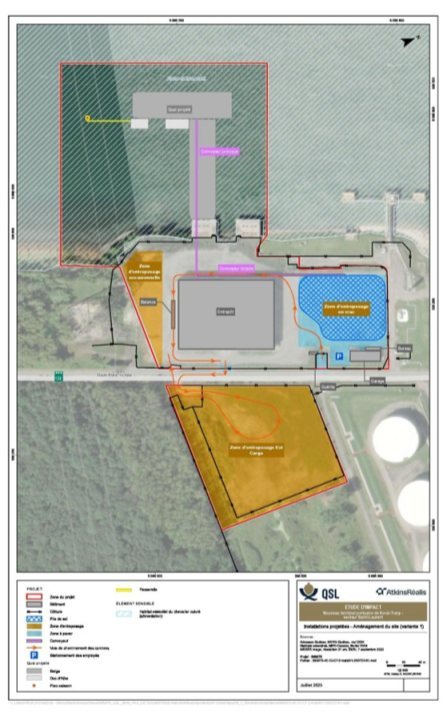
Source: New Sorel-Tracy Port Terminal – Saint-Laurent Sector Summary of the Impact Statement, Figure 7-2
Figure 1 - Text version
Map showing the location of the project area in the St. Lawrence sector of Sorel-Tracy. The figure shows the project area as well as the main existing and planned port facilities associated with the design option involving two floating barges. The boundaries of the project area and the location of the infrastructure are shown in relation to the St. Lawrence River and the surrounding area.
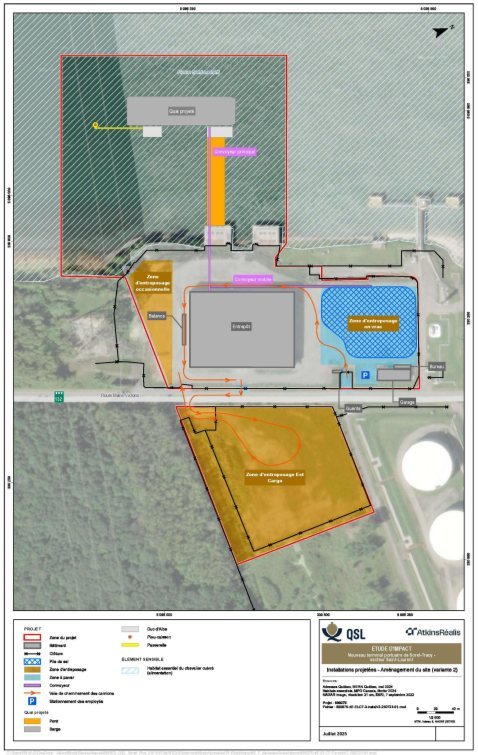
Source: New Sorel-Tracy Port Terminal – Saint-Laurent Sector Summary of the Impact Statement, Figure 7-3
Figure 2 - Text version
Map showing the existing and proposed facilities of the new Sorel-Tracy port terminal, based on the design option featuring a concrete deck and a floating barge. The figure shows the project area, the proposed wharf located on the St. Lawrence River, the main conveyor connecting the wharf to the onshore facilities, a central warehouse, a bulk storage area, an eastern cargo storage area, an occasional storage area, truck traffic routes, and service buildings and infrastructure. The project boundaries and the location of the main components are shown in relation to the St. Lawrence River and the surrounding land.
As shown in Figures 1 and 2, the project site is divided into two parts by Route 132, which crosses the area from south to north.
- In the section west of the road, the site includes, from south to north, a temporary storage area, a scale, the existing warehouse, the proposed wharf located in the St Lawrence River opposite this warehouse, and a bulk storage area at the northern end. A fixed conveyor would connect the proposed wharf to the warehouse. To the west of the bulk storage area, alongside Route 132, there would be a guardhouse, a parking lot, a garage and an office.
- The portion of the site located east of Route 132 consists solely of the East Cargo storage area.
During the operational phase, the terminal would primarily be used for the transportation and handling of solid bulk cargoFootnote 3 , specifically fertiliser and de-icing salt, as well as general cargo, such as oversized steel components. Solid bulk operations would be carried out using an electric conveyor and would take place 24 hours a day, over a maximum period of 4 to 5 days. General cargo would be transported by truck to storage sites located on or off the project site and would primarily be handled during the day, with the possibility of occasional nighttime extensions, as required (up to 1 a.m.). The onshore infrastructure would be used all year-round. All activities carried out on the project site would be considered in the effects analysis.
Regarding the navigation generated by the operation of the new terminal, this activity will be considered within a geographical area extending 0.75 nautical miles (1.389 kilometres) upstream of the proposed wharf and 1 nautical mile (1.852 kilometres) downstream (Figure 3). This geographical scope is based on the influence the proponent may exert on ships, as well as on where adverse federal effects related to project navigation are likely to occur. The assessment of the project's effects does not consider effects outside this area. However, for cumulative effects, the area of analysis may be broader and is defined according to each valued component.
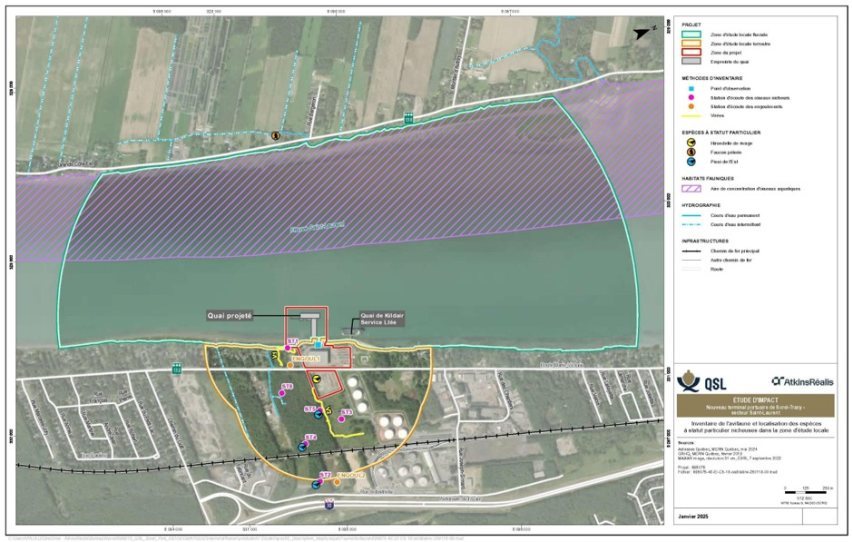
Source: New Sorel-Tracy Port Terminal – St. Lawrence Sector, Impact Statement (French only), Figure 5-18
Figure 3 - Text version
Map showing the geographic scope of navigation generated by the project as well as the local study area. The figure delineates the terrestrial and fluvial study areas around the proposed port terminal in the Saint Laurent sector in Sorel-Tracy. It locates the proposed wharf, the Kildair wharf, and the main wildlife inventory areas. The map also shows breeding bird monitoring stations, amphibian and reptile survey stations, observed movement routes, and occurrences of certain species of special concern.
Finally, the trucking associated with the project on the local road network will not be considered in the impact assessment, as the proponent's influence on this activity is limited and it falls primarily within provincial jurisdiction.
A detailed description of the activities included in the project's scope during the construction and operational phases is presented in Annex 5.
1.2 Impact assessment process, scope and considerations
IAAC initiated the impact assessment of the project on September 26, 2022, and issued the Tailored Impact Statement Guidelines (TISG) to the proponent on April 6, 2023. The TISG define the scope of the assessment as well as the information and studies required from the proponent. The proponent subsequently prepared an Impact Statement, which was reviewed by IAAC, federal authorities, Indigenous groups and the public. The Impact Statement was submitted to IAAC by the proponent on August 7, 2025.
IAAC reviewed the Impact Statement and prepared this draft Impact assessment (IA) report, which provides information on the impact assessment and includes IAAC's rationale and conclusions. In preparing this report, IAAC considered several sources of information, including the proponent's Impact Statement, Indigenous Knowledge and other contributions from Indigenous groups, as well as comments from the public, federal authorities and other participants.
In parallel with the federal process, the project is also subject to Quebec's environmental impact assessment and review procedure (EIARP), as provided for under the Environment Quality Act (EQA). IAAC considered information available through the ongoing provincial environmental assessment process, including the proponent's responses to questions from the Ministère de l'Environnement, de la Lutte contre les changements climatiques, de la Faune et des Parcs (MELCCFP).
1.2.1 Effects assessment
Based on the information made available through the federal impact assessment process, the project is likely to cause the following effects on the environment, and on health, social and economic conditions:
- adverse effects on:
- wildlife and its habitat, including fish and fish habitat, migratory birds, and species at risk listed in Schedule 1 of the Species at Risk Act (SARA);
- recreational navigation;
- the currrent use of lands and resources for traditional purposes by Indigenous Peoples;
- health, social and economic conditions;
- the visual, physical, atmospheric and acoustic environment;
- positive and adverse effects on commercial navigation;
- positive and adverse economic effects.
Among these effects, this report identifies and describes the adverse effects within federal jurisdiction and the direct or incidental effects of the project as defined in Section 2 of the IAA (collectively referred to in this report as ‘adverse federal effects'), as well as other effects that may inform decision-making.
The likely adverse federal effects are listed below and presented in Sections 2 and 4, as well as in Annex 4:
- Effects on fish and fish habitat;
- Effects on migratory birds;
- Effects on the physical and cultural heritage of Indigenous Peoples;
- Effects on structures, sites or things of historical, archaeological, palaeontological or architectural significance to Indigenous Peoples;
- Effects on the current use of lands and resources for traditional purposes by Indigenous Peoples;
- Effects on the health, social and economic conditions of Indigenous Peoples, and
- Other effects resulting from a federal undertaking.
Where effects could fall under more than one of the categories listed above, IAAC assessed them under a single category. Where applicable, the outcome of interactions between effects was considered in the analysis in Sections 2, 4 and Annex 4 of this report. Furthermore, where the two wharf design options are likely to result in different effects, this report identifies thoses differences explicitly. Otherwise, the anticipated effects are expected to be the same.
The direct or incidental adverse effects of the project associated with funding provided by Transport Canada (TC), or with permits or authorisations under the Canadian Navigable Waters Act (CNWA), the Fisheries Act (FA) and the Species at Risk Act, are included in, or are similar to, the changes to the environment related to adverse federal effects on fish and fish habitat, migratory birds, as well as those associated with effects on Indigenous Peoples, as well as other effects resulting from a federal undertaking. These effects are assessed in Sections 2 and 4, as well as in Annex 4.
IAAC considered likely pathways of effects that could lead to adverse federal effects. For example, IAAC considered how changes to surface water could be a pathway of effects on fish and fish habitat. This report focuses on adverse federal effects and pathways of effects that constitute key issues. The depth of the assessment in relation to an effect or pathway of effect was proportional to the risk of the effect. The higher the risk, the more extensive the information used to inform the assessment.
In addition to adverse federal effects, IAAC has considered information that may inform decision-making by the Minister or the Governor in Council at the end of the impact assessment process. Specifically, this includes information related to:
- the effects of the project on Indigenous groups (both positive and negative) and the adverse impacts on the rights of Indigenous Peoples;
- the extent to which the likely effects of the project contribute to the Government of Canada's ability to meet its environmental obligations and its commitments in respect of climate change; and
- the extent to which the likely effects the project contribute to sustainability.
Spatial and temporal boundaries
Project effects
The spatial boundaries for the project effects are determined based on the areas where the effects are likely to occur and are identified for each valued components assessed in the relevant section. These areas are shown in Figure 3 and are described below:
- Project Area (PA): The PA, outlined in red, corresponds to the area where the infrastructure will be constructed and where the proponent's transportation and handling activities would take place.
- Local study area (LSA): The LSA includes the area outlined in green (local aquatic study area) and the area outlined in yellow (local terrestrial study area). The aquatic area corresponds to the extent of project-related navigation, within which navigation-related effects are most likely to occur.
The temporal boundaries are established to account for all project activities likely to cause adverse effects on valued components. The temporal boundaries considered include the following life-cycles phases:
- Construction phase: This phase is estimated to last 16 to 17 months from the start of contractor mobilisation, depending on the selected design option;
- Operation phase: This phase would begin after construction, and no end date has been established for site operations, and no site closure or decommissionnng is currently planned.
Cumulative effects
The spatial boundaries used for the assessment of cumulative effects are specific to each valued component and are identified in the corresponding sections of this report.
The temporal boundaries for the cumulative effects assessment extend from 1954, marking the beginning of construction of the St. Lawrence Seaway, to the first 50 years of the project operation (approximately until 2079, corresponding to the expected service life of the wharf without major rehabilitation). For certain valued components, however, the temporal boundaries may differ from those described above. These distinctions are identified in the relevant sections of this report.
1.2.2 Other factors considered in the impact assessment
In conducting the impact assessment, IAAC considered the factors described in Section 22 of the IAA,to the extent that they are relevant to the impact assessment of this project. Given the focus of this IA Report on matters relevant to decision-making, it does not provide an exhaustive description of how IAAC considered all Section 22 factors. Annex 2 lists the Section 22 factors and identifies those included in this report. Additional information on certain factors is provided below.
Malfunction and accident scenarios
IAAC considered the effects of the following malfunction and accident scenarios in relation to the project:
- Scenario 1: A spill into the river of fertiliser, de-icing salt, slag or battery-related minerals during transhipment operations;
- Scenario 2: A spill likely to affect terrestrial or aquatic environments during the refuelling of heavy machinery or the bunkering of ships from tanker trucks;
- Scenario 3: Exposure of fertiliser stored on-site to heat from a fire or high temperatures, or accidental contact with incompatible substances;
- Scenario 4: A spill from a ship's fuel tank following a collision or mechanical failure.
For this purpose, IAAC relied on Chapter 11 of the proponent's Impact Statement Summary, which provides a description of potential malfunction and accident scenarios.
Of the scenarios identified, Scenarios 1 and 2 were determined to be likely to occur, meaning that they correspond to unforeseen events or reasonably foreseeable technical failures that could occur during the construction or operation phases of the project, considering the nature of the activities and equipment used, and that could result in adverse federal effects. The adverse federal effects resulting from likely malfunction and accident scenarios are presented in Sections 2 and 4, as applicable. The adverse federal effects resulting from unlikely scenarios are considered in Section 3 of this report.
Effects to the project caused by the environment
IAAC considered how environmental conditions, such as severe natural phenomena (e.g. extreme precipitation, high winds and seismic activity), could contribute to potential malfunctions and accidents. Furthermore, the baseline conditions used to inform the assessment take into account possible changes in environmental conditions due to climate change, where applicable.
Other projects considered in the cumulative effects assessment
IAAC considered how the likely residual adverse federal effects of the project could interact with the effects of other past, present or reasonably foreseeable physical activities, resulting in cumulative effects. The other physical activities considered included:
- shoreline artificialization;
- development of road transportation infrastructure;
- industrial-port development;
- commercial shipping;
- port terminals.
The physical activities considered are identified for each valued component in the relevant section. Cumulative effects are discussed in Sections 2 and 4, as well as in Annex 4 of this report.
Alternatives means of carrying out the project
IAAC considered the alternatives means identified by the proponent as technically and economically feasible, as well as their effects. It also considered the justifications provided by the proponent in support of the preferred solutions for the main project components. In particular, the proponent, assessed the possibility of expanding the existing terminal in Saint-Joseph-de-Sorel. However, this option was rejected, as constraints related to property boundaries, as well as the site's configuration and landlocked nature, do not allow either the expansion of the facilities or the intensification of operations at the existing wharf.Footnote 4
For a more detailed description of the alternative means considered by the proponent, please refer to Sections 3 and 4 of the proponent's Impact Statement Summary.
Gender-based Analysis Plus
IAAC applied the Gender-based Analysis Plus (GBA Plus) to inform its assessment of the project's potential adverse federal effects and its consideration of information that may inform federal decision-making. Where applicable, the differential effects of the project on diverse populations, taking into account intersectional identity factors, are identified and considered, notably in Section 4 and in Annex 4.
1.2.3 Criteria for significance of likely adverse federal effects
Taking into consideration the recommended mitigation measures, IAAC assessed whether there were are residual adverse federal effects of the project (i.e., adverse federal effects that are likely to remain after the implementation of the recommended mitigation measures). Where residual effects are predicted to occur, IAAC also assessed the cumulative effects that are likely to result from the project in combination with other physical activities that have been, are being, or will be carried out.
IAAC described the residual adverse federal effects and cumulative effects using the rating criteria defined in Annex 1. IAAC drew conclusions on whether those effects are likely to be significant and, where applicable, characterized the extent to which they are significant. Table 3 provides information on the criteria used to determine whether and to what extent adverse federal effects are likely to be significant.
|
Extent of significance |
Description |
|---|---|
|
Not significant |
Effect is sufficiently small that it does not individually or cumulatively have a significant effect on a valued component and generates no or few impacts in social or ecological contexts. |
|
Low |
Effect is significant but low in magnitude, of short duration, infrequent, small in spatial extent, reversible or readily avoided, and generates minor impacts in social or ecological contexts. Mitigation measures will allow baseline conditions to remain largely unchanged such that a valued component is not likely to be noticeable or measurably diminished or lost. |
|
Moderate |
Effect is significant and moderate in magnitude, of moderate duration, occasionally frequent, possibly/partially reversible, and generates a moderate level of impacts in social or ecological contexts. Mitigation measures may not fully eliminate, reduce, control or offset the effect, but should prevent severe dimishment or or loss of a valued component. |
|
High |
Effect is significant and high in magnitude, permanent/long-term, frequent, irreversible and over a large spatial extent or within an area of exclusive/preferred Indigenous use or of ecological/environmental sensitivity. High levels of impacts in social or ecological contexts are expected. There is a high degree of uncertainty of the effectiveness of mitigation measures, or mitigation measures are unable to fully address the effects, such that a valued component is likely to be severely diminished or lost. |
1.3 Consultation and engagement with Indigenous groups
As set out in the Indigenous Engagement and Partnership Plan (IEPP), IAAC consulted with and collaborated with Indigenous groups. Section 4 describes the consultation process carried out during the impact assessment and presents the perspectives of Indigenous groups regarding the process. It also provides information on Indigenous Knowledge that was provided in relation to the project and considered by IAAC in conducting the impact assessment and preparing this report. Comments and contributions from Indigenous groups informed IAAC's assessment and are incorporated throughout the IA Report.
1.4 Public engagement
As set out in the Public Engagement Plan, IAAC engaged the public during the impact assessment and considered comments received throughout the process.
Public engagement included:
- virtual and in-person meetings.
- public comment periods on the Summary of the Initial Project Description, the draft TSIG and the draft Public Engagement Plan, and the Impact Statement Summary.
Written public comments submitted to IAAC were published on the project page of the Canadian Impact Assessment Registry, subject to exceptions relating to privacy, security or confidentiality. Annex 3 provides a summary of the public comments. These comments informed IAAC's assessment and are incorporated, where appropriate, throughout IA Report.
2. Biophysical adverse federal effects
This section summarizes IAAC's rationale and conclusions related to the assessment of the biophysical adverse federal effects likely to be caused by the carrying out of the project. Adverse effects impacting Indigenous Peoples (also adverse federal effects) are considered in Section 4.
2.1 Fish and fish habitat
The project is likely to cause residual adverse effects on fish and fish habitat, through anticipated effects on the copper redhorse, a species listed as endangered under the SARA. Potential residual adverse effects include the destruction and deterioration of fish habitat and changes in fish behaviour due to sensory disturbances. Cumulative effects are also likely to cause habitat destruction or deterioration, or by factors that may alter fish behaviour. With the implementation of the recommended mitigation measures as well as the provisions of the FA and SARA, IAAC is of the view that the project's residual effects on fish and fish habitat would likely be significant to a low extent and that cumulative effects would likely be significant to a moderate extent.
This section focuses on the project's effects on fish and fish habitat. IAAC considered these effects within the fluvial section of the LSA (Figure 3) and considered both the construction and operation phases of the project.
A significant portion of aquatic habitats is located in the littoral section of the river, extending approximately 250 metres upstream to 500 metres downstream of the PA, and covering a width of 250 metres. It includes littoral marshes and 47,948 square metres of submerged aquatic grass beds. Several important beds are present, including two located upstream of the proposed wharf and one downstream of the Kildair Service ULC wharf (hereinafter Kildair). Smaller beds are also present between these structures. These habitats may be used for spawning, nursery, and growth by various species such as yellow perch, northern pike, and largemouth bass, and may also serve as feeding areas for species such as the copper redhorse and river redhorse.
Areas containing larvae, fry, and juveniles have also been observed near the wharves, where the intake area of the former thermal power plant may serve as habitat for juvenile and small-sized fish. The entire area would function as a feeding zone and migration corridor for the fish species identified.
According to the proponent, 66 fish species have been recorded in the Montreal–Sorel section. Regarding bivalves, five species were collected, including the zebra mussel, an invasive species. Some of these species are of particular importance to First Nations, including yellow perch, lake sturgeon, Atlantic sturgeon, striped bass, copper redhorse, American eel, walleye, bass, pike, and muskellunge. Finally, the copper redhorse (endangered), river redhorse (special concern), bridle shiner (special concern), channel darter (special concern), and hickorynut (endangered) are listed under SARA and could be affected by the project.
The effects assessment will focus on the copper redhorse and the hickorynut, two endangered species. In this regard, essential feeding habitat for adult copper redhorse is present in the PA and is protected under a ministerial order under SARA. The hickorynut, for its part, may be present in the project area, as suitable habitats exist and the species is found upstream and downstream of the PA.
2.1.1 Assessment of effects
To determine the extent of significance of adverse federal effects on fish and fish habitat, IAAC assessed whether these effects would interfere with fish life-cycle processes or the maintenance of their populations. For species listed under Schedule 1 of SARA, the assessment focused on whether the effects would hinder their survival, management, or recovery.
In addition, the project is subject to authorizations issued under the FA and SARA prior to the construction of the terminal. Fisheries and Oceans Canada (DFO) will issue such authorization only if it determines that project impacts on fish and fish habitat, including species at risk, have been sufficiently avoided, mitigated, and compensated. This authorization would require the implementation of several measures to reduce project effects on fish and fish habitat, including conducting in-water works outside sensitive periods for fish, as well as implementing a fish habitat offsetting plan.
Effects on fish and fish habitat would also be addressed through provincial legislative and regulatory frameworks, including the environmental impact assessment and review procedure in southern Quebec and the Regulation respecting the regulatory scheme applying to activities on the basis of their environmental impact (REAFIE).
It should be noted that the copper redhorse (threatened), hickorynut (threatened), river redhorse (vulnerable), bridle shiner (vulnerable), and northern riffleshell (vulnerable) are also listed under Québec's Act respecting threatened or vulnerable species (RTVS).
Potential effects on fish habitat
The project was designed to minimize encroachment on fish habitat, notably by prioritizing the use of floating barges and avoiding submerged grass beds to the extent possible. However, the installation of permanent structures (piles, pilings, and scour protection) in the littoral zone would result in a loss of aquatic habitats, the extent of which would vary depending on the selected project design option, with design option 2 resulting in the greatest habitat loss.
In addition, the presence of the wharf above the water would create a shading effect that could affect aquatic grass beds by reducing light availability, primarily during the summer period. This reduction in light would lead to habitat deterioration or destruction, thereby affecting fish that depend on these habitats. Table 4 presents the areas that would be affected depending on the project design option.
|
Habitat type |
Design option 1 |
Design option 2 |
|---|---|---|
|
Submerged aquatic grass bed affected by scour protection or shading from the wharf |
200 |
63 |
|
Other fish habitat affected by the presence of the wharf |
234 |
561 |
|
Total |
434 |
624 |
Submerged aquatic grass beds affected constitute essential feeding habitat for adult copper redhorse. In addition, given that the LSA does not include known spawning grounds for copper redhorse, the project is not expected to affect the species' reproduction. The same applies to the species' juveniles, which appear to remain in the Richelieu River.
An offsetting project is currently being developed by the proponent in consultation with DFO and the MELCCFP. This project would aim to compensate for all fish habitat losses resulting from the project in order to restore conditions favourable to the establishment and expansion of submerged aquatic grass beds presenting characteristics of essential feeding habitat for adult copper redhorse. This project would be implemented within the distribution range of the single copper redhorse population (Figure 4) and would therefore help mitigate effects on the species, while also meeting the requirements of the FA and SARA.
This offsetting project would also benefit other species associated with this type of habitat, although the benefits would not necessarily apply to all of the same species or populations present near the project site. Consequently, some residual loss could remain for certain species or populations. Moreover, although the compensation project would, in the medium term, restore the ecological functions of the affected habitat, a temporary loss of fish habitat would persist until the new submerged aquatic grass beds reach a level of development that provides equivalent functions. Finally, DFO would require the implementation of a follow-up program to verify the achievement of offset objectives and, as applicable, to impose corrective measures.
During the operation phase, the 35 additional ships associated with the project in the LSA could increase wave action and generate waves capable of altering the quality and long-term persistence of submerged aquatic grass beds important for copper redhorse and other fish species. However, during berthing operations, the gradual reduction of ship and tugboat speed would limit wave formation.
According to DFO, although mitigation measures are planned, including speed limits, and bulk carriers generally generate less wake than other ship types, these measures may not fully eliminate wave effects on riverbanks and submerged grass beds. These effects could influence the extent of fish habitat destruction or deterioration, including destruction of essential copper redhorse habitat, and therefore the associated offsetting requirements. DFO, supported by expertise from Environment and Climate Change Canada (ECCC), is currently continuing discussions with the proponent to further refine the analysis of potential wake-related effects. This analysis would continue through the regulatory review of the project by DFO for the issuance of authorizations under the FA and SARA, should the Minister make a positive decision under the IAA.
IAAC is of the view that the project is expected to result in limited residual effects related to fish habitat destruction and deterioration, given the project design and the mitigation measures recommended by IAAC and those that would be required by DFO as part of its authorization (Section 2.1.4), as well as the provincial regulatory framework. The remaining effects relate in particular to a temporary loss of habitat and a possible residual loss for certain species or populations. Wake effects on aquatic vegetation remain uncertain at this stage, but a follow-up program and adaptive measures are recommended for this purpose.
Mortality risk
If the hickorynut is present in the PAFootnote 5, it could be exposed to a risk of mortality, mainly due to direct encroachment associated with the installation of permanent structures. Due to its low mobility, the species cannot effectively avoid work areas. In the absence of prior relocation, individuals could be crushed or buried, resulting in direct mortality.
Consequently, under the authorization issued by DFO, the proponent would be required to develop and implement a capture, relocation, and monitoring plan for the hickorynut. According to DFO, this measure would significantly reduce mortality risks for the hickorynut during the construction phase.
Finally, risks of direct mortality or injury to fish, including copper redhorse, would be negligible, as individuals would be able to move away and avoid the work area. IAAC is of the view that, considering the implementation of the capture and relocation measures that would be required, the project would result in a limited mortality risk for the hickorynut and fish.
Potential effects due to underwater noise
The copper redhorse shows greater sensitivity to noise compared to other fish species. According to DFO, thresholds defined for this speciesFootnote 6 should help guide the assessment of effects and generally cover impacts on most other species. The main concern relates to potential avoidance of aquatic grass beds near the proposed wharf, which play a key role in feeding for several species, including copper redhorse. Excessive noise levels could compromise this function even if the vegetation remains physically present.
During the construction phase, vibratory pile driving could generate noise levels exceeding tolerance thresholds, causing localized avoidance or changes in fish feeding behaviour. However, mitigation measures required by DFO (Section 2.1.4) should reduce noise in aquatic grass beds to levels comparable to the existing acoustic environment.
No effects on feeding function are therefore anticipated, including for copper redhorse. In addition, DFO would require in-water works to be carried out outside sensitive periods for fish.
However, vribatory pile driving would generate underwater noise that could cause physiological effects in aquatic invertebrates. These effects would be short-lived and spatially limited, restricted to the construction period and the immediate work area. Sound levels exceeding physiological effect thresholds are estimated within a radius of approximately 15 metres from the source. The gradual start-up of operations would allow fish with swimming capacity to move away from the area.
During the operation phase, noise generated by ships and tugboats during berthing and departure would constitute the main acoustic disturbance source, potentially causing behavioural changes in fish such as avoidance or disorientation. According to DFO, these noises are not expected to cause significant behavioural effects, given their low frequency and short duration, as well as the already altered acoustic environment due to commercial navigation. Moreover, only a portion of ship passages would coincide with the copper redhorse feeding period.
According to DFO, although knowledge remains limited, available data suggest that anthropogenic noise may cause short-term behavioural changes (e.g., feeding, foraging) in some bivalves, without causing injury or mortality.
IAAC is of the view that anticipated acoustic disturbances would be short-term and localized and should result in little or no residual effects that would affect fish life-cycle processes or population maintenance, given the required mitigation measures and the existing acoustic context.
Potential effects due to water quality degradation
During the construction phase, in-water works, including vibratory pile driving, drilling, installation of scour protectionFootnote 7, and sediment excavation and management, could resuspend sediments. Increased turbidity could locally affect water quality and cause effects on fish such as avoidance behaviour, respiratory difficulties, reduced egg and larval survival, or mortality. Downstream habitats, including grass beds and spawning grounds, could also be affected by turbidity and sedimentation.
Since sediment quality at the proposed wharf location is unknown, uncertainty remains regarding the potential contamination of resuspended sediments and their dispersion in the aquatic environment.
However, the construction method selected for the dolphin structures, combining vibro-driving of caisson piles and localized excavation of sediments within them, as well as monitoring of suspended solids (SS) during the works, would help limit sediment resuspension and its dispersion in the aquatic environment. In addition, sediments excavated from the caisson piles would be collected on a barge, dewatered by decantation, and transported off-site for management in accordance with provincial regulations. The sediment dewatering basin would, however, need to be designed to allow monitoring of runoff and dewatering waters. Before being discharged into waters supporting fish, these waters would have to meet the Canadian Water Quality Guidelines for the Protection of Aquatic Life, or any other applicable criteria for the protection of aquatic life, particularly with respect to SS and contaminants potentially identified during sediment characterization (measure recommended in Section 2.1.4).
On land, the works would be limited, as most of the facilities have already been constructed. The remaining interventions would involve the development of the de-icing salt storage area as well as the installation of the associated stormwater management system. These works, as well as on-site transport, could generate SS and other contaminants through runoff, which could directly or indirectly affect the quality of water discharged into the river. IAAC and DFO would require the implementation of measures (Section 2.1.4) aimed at controlling erosion and managing SS and other harmful substances. Monitoring of surface runoff and groundwater quality would also be required to assess the effectiveness of the measures and to implement corrective actions if needed.
During the operation phase, the presence of the new wharf and repeated ship passages could also promote sediment resuspension. However, scour protection measures are included in the project design, which should help limit these effects.
The handling and storage of de-icing salts and chemical fertilizers pose a risk of surface and groundwater contamination, which could affect fish habitat. Fertilizer would be stored in a warehouse, while salt would be stored outdoors on a paved surface covered with a protective tarp. Runoff from this area would be directed to a retention ditch equipped with a hydrodynamic separator, and, in the event of overflow, the water would flow into the St. Lawrence River. Although this system, authorized by the MELCCFP, removes SS, it does not treat dissolved substances such as salt. ECCC therefore raises concerns regarding the risk of releasing harmful substances into the river or of infiltration into groundwater.
Monitoring of runoff water quality from both paved and unpaved areas, as well as groundwater monitoring, would be required to assess project effects on the aquatic environment, evaluate the effectiveness of mitigation measures, and determine whether adaptive measures are needed (Section 2.1.4).
Finally, the proponent plans to install a tarp deflector between ships and the wharf, use hoppers at transfer points, and implement dust suppression systems along the conveyor to limit material losses and their dispersion into the aquatic environment.
The risks of accidents and failures are mainly associated with the use and maintenance of machinery and the handling of hydrocarbons, hydraulic fluids, and hazardous materials. Accidental spills caused by incidents or equipment failures may occur during both construction and operation phases, with a risk of contamination of surface waters, the River, and groundwater. It should be noted, however, that the project does not include the handling of liquid bulk cargo or hazardous products on site.
To limit the risks of accidents and failures, the measures recommended in Section 3.2 include the implementation of prevention and protection measures during both construction and operation phases, as well as the development of emergency response plans.
IAAC is of the view that the project would likely result in limited residual effects related to water quality degradation, given the mitigation and monitoring measures that would be required, as well as the regulatory framework. Potential water quality degradation would be short-term and localized and are not expected to affect fish life cycles or population sustainability. Finally, the surface and groundwater quality follow-up program would allow, as necessary, for adaptive management.
2.1.2 Residual effects
Based on the above assessment, IAAC is of the view that the project would likely result in residual adverse effects on fish and fish habitat, including the copper redhorse, particularly due to effects on fish habitat, underwater noise, and water quality.
Taking into account existing federal legal requirements, the mitigation, offsetting, and monitoring measures described in Sections 2.1.4 and 3.2, as well as the rating criteria in Annex 1, IAAC concludes that the likely residual effects of the project would be low in magnitude, as they would not affect the productivity, viability, or maintenance of affected species populations. During the construction phase, the frequency of effects would generally be high, but short-term. During the operation phase, the frequency would generally be moderate and long-term. The geographic extent of the residual effects would be low, and the effects would be partially reversible, as some sources of disturbance would cease if terminal operations stop, while affected fish habitats would be subject to an offsetting project. However, full recovery of the condition and ecological functions of the compensated habitat would only be achieved in the medium term. The level of uncertainty associated with residual adverse effects is considered low, as the effectiveness of mitigation measures is moderate to high. Some uncertainty remains regarding the success of aquatic grass beds creation (offsetting project) and the effects of ship wake on existing aquatic grass beds (wharf area). Although these uncertainties are considered moderate, the implementation of follow-up programs would allow to evaluate the offsetting project's success and the monitoring of aquatic grass beds conditions, as necessary, the implementation adaptative measures.
IAAC concludes that the residual adverse effects of the project on fish and fish habitat are likely to be significant to a low extent.
2.1.3 Cumulative effects
The residual adverse effects of the project on fish and fish habitat are likely to interact with those of other past, present, and reasonably foreseeable projects. The cumulative effects analysis for fish and fish habitat will focus on the copper redhorse and its habitat, given its status as a species at risk, the sensitivity of its habitat, and its restricted range distribution. The spatial boundaries of the analysis correspond to the species' distribution area (Figure 4).
This spatial boundary covers areas where effects on the copper redhorse and its habitat could arise from other past, present, or reasonably foreseeable projects, including dredging of the navigation channel, operating ports (e.g., Kildair) or proposed ports (e.g., the Contrecœur port terminal), commercial navigation, the development of industrial-port zones (e.g., Sorel-Tracy and Contrecœur–Varennes), as well as riverbank stabilization works at the Rio Tinto Iron and Titanium complex in Sorel-Tracy. All of these projects are likely to cause environmental changes that could affect fish and fish habitat, and in particular the copper redhorse and its habitat.
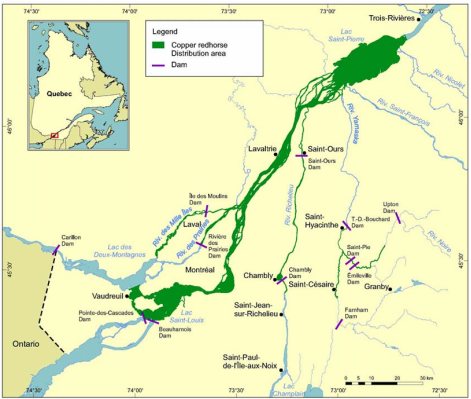
Source: Recovery Strategy for the Copper Redhorse, 2012
Figure 4 - Text version
Map showing the known range of the copper redhorse in Quebec. The species is found in the St. Lawrence River between Lake Saint-Pierre and the Montreal area, as well as in certain sections of the Richelieu, Mille Îles, and Prairies Rivers. The map also identifies several dams located within or near the species' range, particularly on the Richelieu and St. Lawrence Rivers.
According to the Copper Redhorse Recovery Strategy (2012), studies conducted since the early 1990s show that the species is experiencing reproductive difficulties in the wild and that its population is aging. Its range is extremely limited: the Richelieu River is the only known spawning site, while the St. Lawrence River and its main tributaries serve as feeding areas.
According to the Committee on the Status of Endangered Wildlife in Canada (COSEWIC, 2014), the six major anthropogenic pressures faced by the species have been agriculture, commercial navigation, shoreline artificialization, industrialization and urbanization, commercial fishing, and changes in hydrological regimes.
These pressures have contributed to the degradation and fragmentation of the Copper Redhorse's critical habitat, which is located in the most densely populated regions of Quebec. These habitat pressures, combined with the species' low reproductive success, are key factors explaining its decline and hindering its recovery (COSEWIC, 2014).
In the future, climate change, potential decreases in St. Lawrence River water levels, and the continuation or increase of anthropogenic pressuresFootnote 8 may further hinder the species' recovery. Although the magnitude of these effects is difficult to predict, a general trend of decreasing wetland areas in the St. Lawrence River, including submerged aquatic grass beds, has been observed since the 1990s. This decline may be attributable to various environmental factors, including increasing water temperatures, significant flow fluctuations, and a reduction in the photic zone.Footnote 9
Moreover, the St. Lawrence River, which provides important feeding areas for the copper redhorse, is a major navigation route for marine transportation. Several existing and planned projects in the regionFootnote 10 have resulted or may result in increased shipping activity and related operations. This intensification may generate various effects, including ship wake and shoreline erosion. According to Transport Canada's cumulative effects of marine shipping initiativeFootnote 11, the cumulative effects of marine activities (anchoring, accidental spills, dredging, shipwrecks, navigation, commercial fishing, and marine pollution) on shorelines and habitats are most pronounced in the fluvial section between Montreal and Trois-Rivières.
IAAC acknowledges that the project is located in a context already subject to multiple past anthropogenic pressures, some of which are ongoing, and that the current and reasonably foreseeable activities described above are likely to add to the project's effects. However, IAAC considers that existing federal and provincial legislative and regulatory frameworks (e.g., the Fisheries Act and the Species at Risk Act; Quebec's Environment Quality Act, Act respecting threatened or vulnerable species, Act respecting the conservation and development of wildlife, and the Quebec Fishery Regulations) that apply to fish and fish habitat, including the copper redhorse, help manage effects and contribute to the protection and conservation of the species and its habitat.
In addition to legal provisions, various initiatives also contribute to the protection and recovery of the copper redhorse, including:
- the operation of a multi-species fishway at the Saint-Ours Canal National Historic Site and dam, allowing free fish passage;
- the creation of the Chambly Rapids wildlife refuge, aimed at preserving the integrity of one of the two known spawning grounds, ensuring the tranquillity of spawners during reproduction, and protecting eggs from trampling during incubation;
- the protection of Île Jeannotte and Îles aux Cerfs, providing specific protection to areas suitable for copper redhorse growth;
- ongoing reproduction and stocking programs.
IAAC considers that it is unlikely that the project would compromise the recovery of the copper redhorse, given existing laws and regulations as well as ongoing conservation initiatives. Furthermore, considering the temporary and intermittent nature of some residual effects of the project, particularly behavioural changes and physiological effects related to underwater noise and water quality degradation, and the mitigation and monitoring measures recommended (Sections 2.1.4, 2.2.4, and 3.2), the potential interaction with other effects remains limited and primarily concerns noise. IAAC does not recommend further mitigation measures or follow-up program measures related to cumulative effects.
In this context, IAAC concludes that the likely cumulative effects on fish and fish habitat, particularly on the copper redhorse and its habitat, would be moderate in magnitude, given the species' precarious status and uniqueness, as well as anthropogenic pressures on its habitat. Frequency would be moderate to high, as the copper redhorse is regularly exposed to various anthropogenic pressures, including diffuse pollution and increased suspended solids in its habitat. Residual effects would be long-term, notably because species recovery is slow due to behavioural characteristics and ongoing anthropogenic pressures. The geographic extent of cumulative effects would be high, as effects extend across the species' entire range distribution. Cumulative effects would be partially reversible in the long term, although some may persist over time. Nevertheless, the existing legislative framework, including the SARA, ensures protection of the species and its habitat and requires the implementation of avoidance, mitigation, and, where possible and ecologically feasible, offsetting measures. For the types of projects assessed, the level of uncertainty is low, as effects are generally well understood and addressed through mitigation and offsetting measures required under federal and provincial laws and regulations. The project's contribution to these cumulative effects on key sites would be low.
IAAC concludes that cumulative adverse effects on fish and fish habitat are likely to be significant to a moderate extent, due to the interaction between the effects of the project and those of other past, present, and reasonably foreseeable projects.
2.1.4 IAAC's recommanded mitigation and offsetting measures, and follow-up program
Mitigation measures
The following recommended mitigation measures would be included as conditions in the impact assessment decision statement:
- Implement, at a minimum, the following mitigation measures to prevent or control the release of harmful substances, including suspended solids resulting from runoff and erosion, during all phases of the project, in order to comply with the Canadian Council of Ministers of the Environment (CCME) Canadian Water Quality Guidelines for the Protection of Aquatic Life, or any other applicable criteria for the protection of aquatic life:
- Stabilize all erosion areas (including excavated materials) and regularly inspect these areas to ensure their stability until they are permanently stabilized;
- Implement, during both construction and operation phases, stormwater management systems, including ditches and retention basins, to capture, manage, and if necessary treat runoff from service areas, storage areas, and parking lots before it is discharged into waters frequented by fish;
- Prevent the dispersion of SS and/or the release of harmful substances into waters frequented by fish through the installation of a tarp deflector between the ship and the wharf, the use of hoppers at transfer points, and the installation of dust suppression systems along conveyors;
- For sediment dewatering water, install a settling basin or filtration system to ensure that water discharged into the environment meets the CCME Canadian Water Quality Guidelines for the Protection of Aquatic Life or any other applicable criteria for the protection of aquatic life.
- Develop and implement, in consultation with ECCC and Indigenous groups, modified or additional mitigation measures when water quality monitoring shows exceedances of established criteria, and when such measures are deemed necessary to mitigate adverse federal effects on fish and fish habitat resulting from changes in water quality.
- Develop and implement, in consultation with DFO and Indigenous groups, modified or additional mitigation measures if submerged aquatic grass beds monitoring results show that additional measures are required to mitigate adverse environmental effects on submerged aquatic grass beds in order to maintain habitat quality. Indigenous groups shall be consulted in the selection of any additional measures, as applicable.
- Hire, prior to construction, an independent environmental monitor, in consultation with Indigenous groups. This independent monitor would be responsible for overseeing the implementation of mitigation measures and follow-up programs, and for effectively disseminating environmental monitoring results to Indigenous groups as soon as possible. The transmission of an English version of the results to relevant Indigenous groups should be considered where appropriate and feasible.
The following recommended mitigation and offsetting measures would be implemented by Fisheries and Oceans Canada under authorizations issued pursuant to the Fisheries Act and the Species at Risk Act:
- Develop, to the satisfaction of DFO and in consultation with Indigenous groups, and implement an offsetting project related to the deterioration, destruction or disturbance of fish habitat, including the destruction of critical habitat for the copper redhorse.
- To reduce the risk of harming or killing fish and to protect fish habitat, implement mitigation measures addressing the following themes:
- Conduct in-water or near-water activities that may harm fish and fish habitat during the timing windows established by DFO;
- Implement work methods during vibratory pile driving that avoid harming or killing fish;
- Implement erosion and sediment control measures to prevent sediment transport into waters frequented by fish;
- Implement measures to prevent the spread of invasive species.
- Develop and implement a capture and relocation plan for the hickorynut prior to the start of port terminal construction activities.
Follow-up programs
The following monitoring programs would be implemented through conditions included in the impact assessment decision statement:
- Develop and implement, in consultation with ECCC and Indigenous groups, water quality follow-up programs with the following objectives:
- During construction and operation, ensure that stormwater runoff within the project area meets the thresholds set out in the Canadian Water Quality Guidelines for the Protection of Aquatic Life, or any other applicable criteria for the protection of aquatic life, prior to discharge into waters frequented by fish;
- During in-water works in the St. Lawrence River, monitor the maximum average increase in SS concentrations to ensure compliance with the criteria set out in the Recommendations for the Management of SS During Dredging Activities established by MELCCFP and ECCC;
- During both construction and operation, monitor groundwater quality to ensure that planned activities do not alter water quality in a manner that would harm fish habitat.
- Prior to operation, develop and implement, in consultation with DFO and Indigenous groups, a follow-up program on the condition of submerged aquatic grass beds due to wake effects generated by commercial ships using the proposed terminal within the project's zone of influence.
2.2 Migratory birdsFootnote 12
The project is likely to have residual adverse effects on migratory birds due to habitat destruction or degradation, noise disturbance, and the risk of injury or mortality. Cumulative effects are also likely to occur, primarily due to changes in the movements of migratory birds and noise disturbance. Taking into account the legal requirements of the Species at Risk Act, the Migratory Birds Convention Act (MBCA), and the Migratory Birds Regulations (MBR), which the proponent must comply with, as well as the implementation of the recommended mitigation measures and the availability of alternative habitats, IAAC is of the view that the residual effects of the project are not likely to be significant. The cumulative effects on migratory birds are likely to be significant to a low extent, given that the potential for interaction with other effects remains limited and primarily concerns noise.
IAAC analyzed the project's effects on migratory birds within the LSA, covering all phases of the project, including construction and operation.
The LSA comprises a land portion and a fluvial portion. It consists of heavily anthropized environments with scattered vegetation, as well as woodlands, fallow lands, marshes, and swamps. An water fowl gathering area (ACOA)Footnote 13 is located in the St. Lawrence River opposite the PA, making the west bank of the St. Lawrence important for aquatic birdlife, especially during migration (Figure 3).
Most waterfowl and aquatic birds use of the river's water surface directly, particularly the emergent aquatic grass beds located upstream of the LSA. Shorebirds are rare there due to the prevalence of riprap and mature riparian woodlands. The LSA is not a preferred breeding habitat for waterfowl and aquatic birds.
Based on eBird dataFootnote 14, the proponent is of the view that, for the Pierre De Saurel RCM, the regional avifauna is diverse, with several species likely using habitats within the LSA. The LSA also provides potential habitat for various forest and open-habitat bird species, notably the Eastern Wood-pewee (potential nesting) and the Wood Thrush (one record), both of which are birds at risk. The PA, on the other hand, is almost entirely devoid of vegetationFootnote 15, which severely limits its potential for birdlife. Nevertheless, nesting by the Bank Swallow, a species at risk, was confirmed there in 2023 in an unconsolidated soil stockpile located in the East Cargo storage area; however, the colony had dwindled to three burrows by 2024. According to the proponent, vegetation growth could render this mound unsuitable for nesting in the coming years. Finally, no critical habitat for migratory birds at risk is present in the LSA.
2.2.1 Assessment of effects
To determine the extent to which adverse federal effects are significant for migratory birds, IAAC assessed whether the effects would interfere with one or more phases of the migratory birds' life cycle, the maintenance of their populations, and the conservation, management, and recovery of species of special concern, including the Bank Swallow, the Wood Thrush, and the Eastern Wood-pewee, which are listed in Schedule 1 and have threatened status under SARA.
Displacement of migratory birds
The project's construction phase would result in little destruction or deterioration of migratory bird habitat on the land portion of the PA, given that much of the infrastructure necessary for the port terminal's operation is already in place (Section 1.1) and that no deforestation is planned within the LSA or the PA. However, the development of the East Cargo storage area could result in the removal of an unconsolidated soil stockpile used as a nesting site by the Bank SwallowFootnote 16 (Figure 3), which appears to be in the process of being abandoned the species. This soil stockpile would be removed outside the nesting period to avoid disturbance or any risk of mortality to the species (see Risk of injury or mortality below).
In the aquatic environment, the construction of the wharf would result in the destruction of 200 square metres or 63 square metres of aquatic grass beds, depending on the selected design option (Table 4), and could indirectly affect aquatic birds that feed on the benthic invertebrates associated with these habitats. However, alternative habitats remain available throughout the LSA and near the PA.
Malfunctions and accidents that may occur could lead to a deterioration of migratory bird habitat, particularly in the event that a spill of substances reaches the river or exposes migratory birds to hydrocarbons. The MBCA prohibits the deposit or discharge of a substance harmful to migratory birds into waters or areas they frequent, or into any location from which such substances could spread to those areas. Furthermore, the recommended measures in Section 3.2 provide for the implementation of prevention and protection measures during the construction and operation phases, as well as the development of emergency response plans to prevent or limit the risks associated with malfunctions and accidents.
IAAC is of the view that, given the project's characteristics, the minimal habitat alteration within the LSA, the legal requirements, and the recommended mitigation measures (Section 3.2), the project is unlikely to have residual effects on migratory birds attributable to their displacement.
Risk of injury or mortality
The removal of the soil stockpile located in the East Cargo storage area should be carried out in accordance with the MBR and the SARA to avoid any disturbance or destruction of nests or eggs, as well as any injury, mortality, or disturbance to any Bank Swallow that may be present, or damage to their burrows. This removal must therefore be carried out outside the period when the species occupies its burrows.
During the construction and operation phases, the project could lead to collisions between migratory birds and vehicles or infrastructure, potentially causing injury or mortality. These risks are considered negligible due to the low height of the infrastructure and the reduced speed of vehicles on the site. However, they could be exacerbated during migration periods by nighttime lighting Footnote 17 on the site. To address this, the proponent plans to use low-intensity lighting directed toward the ground, equipped with timers and motion detectors to limit its use. A mitigation measure is recommended in Section 2.2.4.
For species that nest on the ground or on buildings, applicable laws and regulations, including the MBCA, SARA, and the MBR, as well as the Guidelines to avoid harm to migratory birds, govern the protection of nests, eggs, and habitats, including buffer zones around nests.
IAAC is of the view that, given the project's characteristics, the recommended mitigation measures (Section 2.2.4), and legal requirements, the residual effects likely to result in injury or mortality among migratory birds due to collisions would be negligible.
Sensory disturbance
According to ECCC, noise levels exceeding the ambient level in natural environments by 10 decibels or noise levels higher than 50 decibels are among the major sources of disturbance for migratory birds.
During the construction phase, noise levels exceeding 50 decibels are expected to be reached at the edges of the northern and southern woodlands outside the PA, which could disturb pairs of migratory birds nesting nearby and temporarily reduce habitat use near the noisy areas. Vibrations and human presence may also contribute to this disturbance.
However, given that the noisiest activity during the construction phase is vibratory driving, certain mitigation measures recommended for fish (Section 2.1.4) could also benefit migratory birds:
- the periods for in-water work recommended by DFO (August 1 to March 31) would largely fall outside the breeding period of migratory birds;
- a gradual start to vibratory driving would allow birds to move away from the work area;
- vibratory driving time would also be limited to one hour per day, thereby minimizing impacts.
The proponent also plans to comply with the MELCCFP's Guidelines for noise levels from industrial construction sitesFootnote 18, which regulate noise related to human health during the construction phase. Although these guidelines are primarily aimed at protecting human populations, their application could also help mitigate noise disturbances for avian wildlife, particularly birds.
During the operational phase, noise generated by terminal activities (maritime traffic, road transport, steel handling) could cause disturbance and trigger avoidance behavior in nearby habitats. Noise levels could reach up to 75 decibels in the PA and approximately 50 decibels within a 200-metre radius of the proposed wharf. Exceedances of noise levels in the southern and northern woodlands, as well as in the East Cargo storage area, could notably affect the Eastern Wood-pewee and the Wood Thrush, should individuals be present near the work area, particularly if work takes place during their nesting periodFootnote 19. Indeed, according to the proposed management plan for the Eastern Wood-peweeFootnote 20, since this is a songbird, it would likely avoid roads because vehicle noise could interfere with its territorial defense, mate-finding, and reproductive success. It is therefore possible that noise-sensitive species would avoid nesting near the PA or move to nearby alternative habitats. However, the portion of the wooded area likely to be affected by noise would remain relatively limited, and the birds inhabiting it would be able to move to other adjacent areas. It should be noted that, according to the proponent, the noise level in the northern and southern wooded areas is expected to exceed the ambient level in natural environments by only 10 decibels on rare occasions.
IAAC is of the view that the project could cause some disturbance to migratory birds as a result of noise and the presence of activities during the construction and operation phases. However, considering the mitigation measures, the temporary or intermittent nature of certain noise sources, and the availability of alternative habitats nearby, these disturbances are not expected to adversely affect the life cycle of migratory birds or the maintenance of their populations.
2.2.2 Residual Effects
Based on the above assessment, IAAC is of the view that the project is likely to cause residual adverse effects on migratory birds due to the destruction of aquatic habitats, the risk of injury or mortality, and disturbance.
Considering the applicable legal requirements, the characteristics of the PA and the project context, the availability of alternative habitats, and the implementation of the mitigation measures described in Sections 2.1.4, 2.2.4, and 3.2, and based on the rating criteria in Annex 1, IAAC concludes that the residual effects on migratory birds would be negligible to low in magnitude, since the project would affect only a few individuals, which would have no impact on the viability or maintenance of the populations of the affected species. The frequency would generally be low to moderate, since noise levels exceeding 50 decibels would be occasional. The residual effects would be long-lasting, since the proponent does not plan to close the port terminal. The geographic extent of the residual effects would be low to moderate, since the disturbance would occur primarily within the PA and its immediate vicinity, and the effects would be partially reversible, since the sources of disturbance could cease if terminal operations were halted. However, due to the permanent nature of the project and the absence of a planned end to operations, a complete return to initial conditions is not anticipated. The level of uncertainty associated with the residual effects is low.
IAAC concludes that the residual adverse effects of the project on migratory birds and their habitat are not likely to be significant.
2.2.3 Cumulative Effects
The residual adverse effects of the project on migratory birds are likely to combine with the effects of other past, present, and reasonably foreseeable projects. The cumulative effects assessment was conducted within a 15-kilometre radius of the PA. Given that the project's residual effects are deemed insignificant and are expected to occur on a limited spatial scale near the Project Area, IAAC determined that a 15-kilometre radius constitutes an appropriate spatial scope for assessing cumulative effects on migratory birds.
This study area includes the effects of other past, present, and reasonably foreseeable activities that may combine with those of the project, notably Highway 30, operating ports (e.g., Kildair) or proposed ports (reconstruction of the Saint-Ignace-de-Loyola and Sorel-Tracy port terminals), commercial shipping, the development of the Sorel-Tracy industrial-port zone, as well as bank stabilization work carried out at the Rio Tinto Iron and Titanium complex in Sorel-Tracy. These activities are likely to cause environmental changes that could affect migratory birds, particularly the Eastern Wood-pewee, the Wood Thrush, and waterfowl.
The Eastern Wood-pewee is one of the most common and widespread songbirds in the forests of eastern North America. According to COSEWICFootnote 21, the species appears to be relatively tolerant of various types of habitat changes. Its decline is believed to be primarily attributable to the sharp decrease in the availability of flying insects along its entire migratory route, as well as to habitat loss or degradation in its wintering range in South America. According to the proposed management plan for the species, residential and commercial development, including industrial zones, is considered a threat with a negligible impact. However, if these developments are linked to habitat loss, the impact becomes more significant. According to ECCC, the Eastern Wood-pewee population has shown a marked increase since 1980 in the Lake Saint-Pierre regionFootnote 22.
As for the Wood Thrush, the main threats it faces are nest predation and parasitism by the Brown-headed Cowbird. Habitat fragmentation can exacerbate the effects of predation and parasitism, since the Brown-headed Cowbird and several other predators are more commonly found in open or fragmented habitats. The trend in the species' presence in the Lake Saint-Pierre region remains stable.
The development of the Sorel-Tracy industrial-port zone could lead to the loss of the wooded area currently used by these species (although the Wood Thrush's nesting in this area has not been confirmed) and thus cause the displacement of the individuals that use it. However, the loss of this habitat is not expected to have a significant impact on the survival of these species' populations, as it would affect only a limited number of individuals. Other habitats are available within the study area. Moreover, ECCC notes that in the Lake Saint-Pierre region, forest birds are generally doing well, while the area of wetlands around Lake Saint-Pierre has been increasing and forests cover has remained stable between 1950 and 2016. ECCC nevertheless recommends conserving and maintaining existing managed wetlands, wet meadows, forests, and marshes, as these are essential for sustaining forest bird populations in this area.
Finally, with regard to waterfowl, the historical loss of wetlands, particularly in the St. Lawrence lowlands, has had significant impacts on population abundance and on the availability of breeding, foraging, and resting habitats. However, over the past few decades, various programs for the conservation, recovery, and creation of wetlands have helped stabilize, and in some cases improve, the populations of certain waterfowl species locally. The Lac Saint-Pierre Biosphere Reserve and the ACOAs, particularly the one located near the PA, help maintain high-quality waterfowl habitats. In this context, the loss of aquatic grass beds and the disturbance associated with the project are not expected to significantly combine with those caused by other current or planned projects in the area.
IAAC considers that the federal (e.g., the MBCA, SARA, and FA) and provincial (e.g., the EQA, the RTVS, and the Wildlife Conservation and Enhancement Act) legislative and regulatory framework, as well as the numerous sites, monitoring programs, and initiatives to protect migratory birds in and around the study area, provide a framework for managing the effects on migratory birds or contribute to the protection or conservation of their habitats.
Furthermore, the project's contribution to cumulative effects remains limited, as habitat loss, noise-related disturbance, and mortality risks are expected to be low, and the potential for interaction with other effects is limited. IAAC does not recommend any additional mitigation measures or monitoring programs regarding cumulative effects.
In this context, IAAC assesses that the cumulative effects on migratory birds would be of low magnitude. The main cumulative effects (disturbance and habitat loss) would result from increased anthropogenic activities in an industrialized environment used by commercial shipping traffic. However, the study area and its vicinity are recognized as important for migratory birds and benefit from several mechanisms and initiatives promoting the protection and conservation of species. The frequency would be low to moderate, since the overlap of interactions between the project's effects and those of other projects would be occasional, given that the project's residual effects, particularly disturbance, would occur intermittently. The cumulative effects would be long-term due to disturbance. The geographic extent would be moderate to high, given the presence of these effects in the river corridor and the Sorel-Tracy industrial-port area. The effects would be partially reversible and have a low level of uncertainty, since the potential effects on migratory birds are well documented and governed by federal and provincial laws and regulations, in addition to the mitigation and monitoring measures planned for the project. The project's contribution to these cumulative effects would be negligible.
IAAC concludes that the cumulative adverse effects of the project on migratory birds are not likely to be significant, particularly due to the efforts undertaken in and around the study area to protect migratory birds and their habitats.
2.2.4 IAAC's recommended mitigation measures
The following recommended mitigation measures would be included as conditions in the impact assessment decision statement:
- Under the direction of a qualified person, determine the presence or likely presence of nests of migratory birds protected under the Migratory Birds Convention Act, 1994Footnote 23 and its regulations, and of residences protected under the Species at Risk Act that are likely to suffer adverse effects from project-specific activities before commencing the activity.
- Non-intrusive methods used to determine the presence or likely presence of active or occupied nests of migratory birds must be appropriately selected based on the type of habitat and applied during the nesting period relevant to each species.
- Establish and demarcate, under the supervision of a qualified person, buffer zones around active or occupied nests and residences whose presence is likely or confirmed as described above, within which this activity shall not take place when such nests are protected under the Migratory Birds Convention Act, 1994, and its regulations or under the Species at Risk Act. When establishing buffer zones, take into account Environment and Climate Change Canada's Guidelines to avoid harm to migratory birds – Establishing buffer zones and setback distances.
- Control project lighting, while complying with regulatory, operational, and health and safety requirements, to mitigate the attraction and disorientation of migratory birds, taking into account the International Light Pollution Guidelines for Migratory Species of the Convention on the Conservation of Migratory Species, including the implementation of the following measures:
- Use directional lighting that targets only areas where illumination is essential.
- Optimize lighting design to reduce the total amount of lighting required.
- Use shielded fixtures to reduce glare and prevent light spill in directions where lighting is not essential.
- Use automatic sensors in areas where continuous lighting is not essential.
3. Accidents and malfunctions
Although unlikely to occur, certain project-related accidents and malfunctions could cause residual adverse federal residual effects. For example, an accidental hydrocarbon spill could affect fish and their habitat, migratory birds, or the current use of lands and resources by Indigenous peoples. The recommended mitigation measures to prevent potential accidents and malfunctions are listed in Section 3.2.
3.1 Assessment of effects
Accidents and malfunctions may be associated with the project. Likely scenarios were defined as unforeseen events or reasonably foreseeable technical malfunctions that could occur during the construction and operation phases of the project, given the nature of the activities and equipment used, and that could result in adverse federal effects. The associated adverse federal effects are presented in Sections 2 and 4, as applicable. The adverse federal effects of accidents and malfunctions scenarios deemed unlikely are presented below.
Exposure of fertilizer to heat from a fire or high temperatures, or accidental contact with incompatible substances
Exposure of stored fertilizer to extreme heat or an incompatible substance, or any other improper segregation of incompatible goods, may cause a chemical reaction or decomposition resulting in the release of toxic gases (e.g., ammonia, chlorine, nitrogen, sulfur, or phosphorus compounds, etc.). The released gases can form a toxic cloud that spreads depending on weather conditions (wind, temperature, etc.). This cloud can reach surrounding areas, including the river and adjacent areas, and have negative effects on:
- fish and their habitat, due to impaired water quality resulting from the deposition or dissolution of the gas, which may have potential impacts on fish habitat;
- migratory birds, due to inhalation, direct exposure, or temporary avoidance of the area (smoke, noise, habitat disturbance);
- navigation, due to temporary traffic restrictions for safety reasons;
- traditional practices and the well-being of Indigenous communities, due to a decline in the quality of the land or resources used for traditional purposes, increased safety risks, and contributions to stress and emotional distress.
However, cargo transshipment operations at the new facilities must be conducted in accordance with the provisions of the Cargo, Fumigation and Tackle Regulations (SOR/2007-128), made under the Canada Shipping Act, 2001, which governs the safety of ships and operations, particularly with regard to dangerous goods.
Spill from a ship's fuel tank following a collision or mechanical failure
A fuel spill resulting from a collision or mechanical failure could lead to the formation of a slick on the river's surface, which could spread downstream depending on hydrodynamic conditions and the response time.Footnote 24 Depending on the nature of the accident, the substances spilled, and the quantity involved, as well as the characteristics of the receiving environment and the hydrodynamic and meteorological conditions at the time of the accident, the incident could have negative effects on:
- fish and their habitat, due to water contamination, direct or prolonged exposure (mortality, injury, etc.), and habitat degradation;
- migratory birds in the event of direct exposure (contamination of plumage, ingestion, mortality) or avoidance of the area;
- navigation, due to temporary containment measures;
- traditional practices and the well-being of Indigenous communities, due to a decline in the quality of the land and resources used for traditional purposes and due to contributing to stress and emotional distress.
The Canada Shipping Act, 2001, and its regulations govern the prevention and management of spills from ships in Canadian waters. It prohibits the discharge of polluting substances by ships, except in cases provided for by regulation. Any actual or potential spill must be reported to the competent authorities, in accordance with regulatory requirements, including those of the Shipping Casualties Reporting RegulationsFootnote 25, the Vessel Pollution and Dangerous Chemicals RegulationsFootnote 26, or the Ballast Water Regulations. The Act establishes a response system under which the Canadian Coast Guard is responsible for overseeing and coordinating actions in the event of marine pollution. The polluter is responsible for the costs and cleanup operations, in accordance with the polluter-pays principle.
3.2 IAAC's recommended mitigation measures
In order to prevent and manage as quickly as possible any accidents or malfunctions, whether considered likely or unlikely, the mitigation measures recommended below would be incorporated as conditions in the decision statement regarding the environmental impact assessment:
- Before and during the operation of the proposed wharf, demonstrate that the structures allow for the safe mooring of ships, particularly with regard to:
- the minimum number of mooring lines required;
- the maximum working load of the wharf's mooring bollards and their ability to withstand the tension exerted by multiple mooring lines simultaneously;
- the mooring structure's ability to withstand the stresses caused by wave action and backwash generated by the combined effects of currents, wind, and waves.
- During operation, and in the event that the existing structures do not allow ships to moor safely at the proposed wharf, make the necessary corrections to ensure the safe operation of these facilities:
- Design the project's infrastructure to comply with applicable codes and standards regarding seismic activity, landslides, slope stability, and extreme weather events.
- Implement the following mitigation measures to prevent accidents and malfunctions that could result in adverse effects falling under federal jurisdiction, where applicable:
- Establish fire and spill prevention plans;
- Limit the refuelling and maintenance of vehicles and equipment to designated locations, while maintaining a distance of 30 metres from any water body or wetland;
- Use secondary containment systems for the storage of hazardous materials;
- Provide training to project employees on accident and malfunction prevention and related response procedures.
- Develop and maintain an accident and malfunction response plan, including:
- A description of potential accidents and malfunctions that could have adverse effects under federal jurisdiction during any phase of the project, including worst-case and most-likely scenarios;
- Measures for each scenario that comply with Environment and Climate Change Canada's National Wildlife Emergency Response Framework;
- A list of organizations to contact;
- Clearly defined roles and responsibilities for the proponent, the competent authorities, and other parties involved in the response efforts.
- In the event of an accident or malfunction:
- Notify the relevant emergency response authorities;
- Notify Indigenous groups as soon as possible and IAAC within 24 hours, specifying:
- the date, time, and location of the accident or malfunction;
- a summary of the accident or malfunction;
- the substance and quantities released;
- the competent authorities that have been notified and are participating in the response;
- Submit a report to IAAC within 60 days describing:
- the incident and its adverse effects under federal jurisdiction;
- the measures taken to mitigate the adverse effects under federal jurisdiction;
- comments from Indigenous groups and competent authorities;
- any residual effects and any additional mitigation or monitoring measures;
- the steps taken to prevent recurrence.
- Develop a communication plan, in consultation with Indigenous groups, for accidents and malfunctions, including:
- The geographic areas within which Indigenous groups wish to receive notifications;
- The types of incidents and the thresholds that would trigger notification;
- The information to be included in notifications to support community preparedness and response;
- The method and frequency of notifications, including opportunities for Indigenous groups to participate in response efforts.
- Participate, at the request of a competent federal authority, in regional initiatives related to the development of marine transportation spill response plans or other agreements subject to the requirements of the Canada Shipping Act, 2001, and the related regulations. In doing so, the proponent shall:
- implement any technically and economically feasible mitigation measures or monitoring programs, under the promoter's responsibility and control, as determined as part of such an initiative;
- submit to IAAC a description of its participation in such an initiative during the reporting year, including a description of any mitigation measures or monitoring programs implemented (or proposed for implementation).
4. Impacts on Indigenous Peoples and their rights
Indigenous Peoples have a deep connection to their lands, territories, and resources, and an important constitutional relationship with the Crown (i.e. the federal and provincial governments acting on behalf of the Crown), making their participation essential to making decisions regarding the impacts of major projects. Indigenous Peoples hold Aboriginal rights and, in some cases, treaty rights, which are recognized and affirmed by subsection 35(1) of the Constitution Act, 1982. Impact assessments must evaluate the potential effects of a project on Indigenous Peoples and their rights. The government must assess the extent to which consultation and engagement with Indigenous groups have been carried out meaningfully, in keeping with Canada's commitment to implement the United Nations Declaration on the Rights of Indigenous Peoples. Recognizing the interconnected nature of these considerations, and in the spirit of respectful and meaningful consultation and engagement, IAAC presents this information in a dedicated, integrated section.
4.1 Consultation and engagement
IAAC is responsible for leading Crown consultation and engagement with Indigenous Peoples groups for the Government of Canada throughout the impact assessment. For this project, both IAAC and the proponent maintain bilateral relationships with Indigenous groups throughout the impact assessment, with IAAC ensuring that consultation and engagement are coordinated, tracked, and responsive to the issues and interests raised.
4.1.1 IAAC-led consultation and engagement
IAAC consulted and engaged collaboratively with Indigenous groups through a whole of government approach, involving other federal departments as appropriate. IAAC worked collaboratively with Indigenous groups to understand and address concerns regarding potential impacts on rights.
From the outset of the impact assessment process, IAAC identified the organizations representing the First Nations that could potentially be affected by the project:
- W8banaki (representing the Abenaki communities of Odanak and Wôlinak)
- Council of the Wendat NationFootnote 27
- Mohawk Council of Kahnawà:ke
- Mohawk Council of Kanesatake
- Mohawk Council of Akwesasne
Initial contact was initiated in July 2022. It should be noted that the Mohawk Council of Kanesatake and the Mohawk Council of Akwesasne did not respond to IAAC's attempts to initiate dialogue. Consequently, IAAC issued non-interest letters to both communities in May 2023, while continuing to keep them informed of key milestones in the project's assessment process.
The Indigenous Engagement and Partnership Plan lists three First Nations with whom IAAC consulted, where there was a potential for adverse impacts by the proposed project on their rights:
- W8banaki Nation
- Wendat Nation
- Mohawk Council of Kahnawà:ke
The Councils of the Abenaki communities of Odanak and Wôlinak decided to delegate their consultation activities to the Ndakina Office of the W8banaki Tribal Council (formerly the Grand Council of the Waban-Aki Nation). The Ndakina Office is responsible for territorial consultations, environmental assessments, and land claims. It acts on behalf of the members and elected officials of the Odanak and Wôlinak Councils as a coordinator and intermediary for the transmission of information for consultation purposes.
IAAC held regular meetings with W8banaki and the Mohawk Council of Kahnawà:ke. Follow-up meetings with the Wendat Nation were held less frequently at their request. The table below lists the meetings held by IAAC with the First Nations. Most meetings were conducted virtually.
|
- |
W8banaki |
Mohawk Council of Kahnawà:ke |
Conseil de la Nation Wendat |
|---|---|---|---|
|
2022-2026 |
16 meetings (most recent: June 10, 2026) |
13 meetings (most recent: May 28, 2026) |
8 meetings (most recent: June 9, 2026) |
The W8banaki Nation and the Government of Canada signed a Consultation and Accommodation Protocol in 2018. IAAC applied the requirements of the IAA, which are consistent with this protocol. At the request of the Nation and in collaboration with it, an individualized Consultation Plan (or Annex to the IEPP) was developed in 2023–2024. Key issues raised included:
- Collaboration in drafting the section of the Impact Assessment report presenting the assessment of potential impacts on the rights of the W8banaki Nation and its members.
- The signing of a confidentiality agreement with the Crown to protect sensitive and confidential data shared by the Nation, in accordance with First Nations principles of OCAP® (Ownership, Control, Access, and Possession) regarding data governance.
The Wendat Nation and the Government of Canada signed a Consultation and Accommodation Protocol in 2019. IAAC also applied the requirements of the IAA, consistent with this protocol.
Regular meetings were held with, and comments were provided by, the Mohawk Council of Kahnawà:ke.
The contributions of First Nations, including Indigenous Knowledge where provided, informed the identification of valued components, the assessment of potential effects and pathways of effects, as well as conclusions regarding the significance of effects.
Funding provided to First Nations was allocated as follows:
- W8banaki: $139,060
- Council of the Wendat Nation: $49,117.72
- Mohawk Council of Kahnawà:ke: $122,728.14
4.1.2 Proponent-led engagement
The proponent engaged directly with Indigenous groups to support IAAC's assessment of effects and impacts on rights. The proponent's engagement does not replace or substitute Crown consultation, but does provide important information to support the Crown's informed understanding of potential impacts and appropriate responses.
From the outset, the proponent was required to undertake early, ongoing, and distinctions-based engagement, tailored to the specific circumstances and perspectives of each First Nation, with the aim of understanding and responding to project-specific concerns.
In spring 2022, the proponent initiated engagement activities by sending letters to representatives of Indigenous communities whose rights may be affected by the project, namely W8banaki, the Mohawk Council of Kahnawà:ke, the Mohawk Council of Kanesatake, the Mohawk Council of Akwesasne, and the Wendat Nation. Responses were received from all communities except the Mohawk Council of Kanesatake and the Mohawk Council of Akwesasne. In the absence of responses from these two communities, the proponent issued letters of non-interest in March 2025. All First Nations were engaged on an individual basis to gather their knowledge and expertise for integration into the Impact Statement. The proponent's engagement activities included email communications, letters, virtual meetings and working sessions, as well as the sharing of information and documents.
Overall, the proponent held a few meetings per year with the Mohawk Council of Kahnawà:ke and W8banaki. The Wendat Nation requested less frequent follow-up, due to capacity and availability constraints. Nevertheless, the project remains of interest to the Wendat Nation. W8banaki and the Mohawk Council of Kahnawà:ke requested to receive draft sections of the Impact Statement as they became available, whereas the Wendat Nation preferred to review all documents once they were fully completed. The Wendat Nation also indicated that it would comment only on Chapter 4 (Public and Indigenous Participation, Engagement and Views) and Chapter 11 (Effects on Indigenous Peoples).
Engagement activities were intended to present the project, explain key issues, provide information necessary for First Nations to assess potential effects, and gather their perspectives and recommendations. The engagement process was carried out in two phases:
- Early engagement prior to the Notice of Commencement of Impact Assessment (June 2022 – April 2023), to establish initial contacts; and
- Engagement during the Impact Statement phase (April 2023 – October 2025), allowing for in-depth analysis and the signing of collaboration agreements.
A collaboration agreement was signed with the Mohawk Council of Kahnawà:ke, and a memorandum of understanding regarding W8banaki Nation's participation in the project's impact assessment was signed with W8banaki. W8banaki also completed a land use and occupancy study (LUOS) and an archaeological potential study, which were incorporated into the Impact Statement.
The main concerns raised by Indigenous communities include: the maintenance of biodiversity, protection of the St. Lawrence River, effects on valued species, effects on physical and cultural heritage, effects on current use of lands and resources for traditional purposes, effects on Indigenous health determinants, such as on-the-land experience, sense of safety and tranquility during traditional activities, and cultural transmission, repercussions on rights, as well as cumulative effects of marine transportation. These concerns were addressed by the proponent in its Impact Statement.
4.1.3 Indigenous Knowledge provided with respect to the project
IAAC collaborated with Indigenous Knowledge holders and/or Indigenous institutions mandated to represent them to ensure that their Knowledge was respected and meaningfully incorporated, where possible, throughout the impact assessment process, in order to better understand the project's potential effects on Indigenous Peoples and their rights.
Indigenous Knowledge that was shared informed multiple parts of the assessment, including:
- describing current land and environmental conditions (baseline);
- identifying culturally significant species, places, and practices;
- identifying and assessing potential pathways of effects;
- evaluating the significance of potential effects; and
- developing measures to mitigate or monitor adverse effects.
The integration of Indigenous Knowledge into the assessment was guided by Indigenous groups and ethical standards, including the First Nations principles of Ownership, Control, Access, and Possession (OCAP®).
In 2023, W8banaki requested the signing of a confidentiality agreement to protect its confidential Indigenous Knowledge. In February 2025, IAAC transmitted the W8banaki–IAAC confidentiality letter, developed in collaboration with the Nation.
On June 26, 2025, W8banaki submitted its Portrait of Land and Resource Use to IAAC. This confidential document was considered, to the extent possible, alongside other sources of information, while ensuring the confidentiality of Indigenous Knowledge was maintained.
4.2 Effects on Indigenous Peoples
The project is likely to cause positive effects and adverse effects to Indigenous Peoples, as set out in the definition of adverse effects within federal jurisdiction in section 2 of the IAA.
4.2.1 Effects on the physical and cultural heritage of Indigenous Peoples
The project is likely to cause residual and cumulative adverse effects on the physical and cultural heritage of Indigenous Peoples, through a reduction in the quality of Indigenous Peoples' experience as a result of sensory disturbances during travel on the St. Lawrence River, as well as the alteration or degradation of the landscape. With the implementation of the recommended mitigation measures, IAAC is of the view that the residual effects of the project on the physical and cultural heritage of Indigenous Peoples are likely to be significant to a low extent. The cumulative effects of the project, in combination with other past, present, and reasonably foreseeable activities, are likely to be significant to a moderate extent, given the historical context of transformations of the St. Lawrence River, marked by industrialization and port development that have already affected the physical and cultural heritage of First Nations.
IAAC considers that physical and cultural heritage may include elements such as land or resources (e.g., an artefact, thing, or site), as well as a structure, location, or thing of historical, archaeological, palaeontological, or architectural significance, which are distinguished by the value attributed to themFootnote 28. For the purposes of this report, physical and cultural heritage includes structures, sites, or things of historical, archaeological, palaeontological, or architectural significance to Indigenous Peoples.
The LSA was selected as the study area for the assessment of the project's effects on physical and cultural heritage, as it encompasses both effects within the PA and those associated with navigation related to the project. Effects were assessed for both the construction and operation phases of the project.
Assessment of effects
To determine the extent of significance of adverse federal effects on physical and cultural heritage, IAAC assessed changes in the environment resulting from the project that would alter the characteristics of heritage elements or resources, as part of physical and cultural heritage, as well as changes in the experience of Indigenous Peoples resulting from environmental changes or disturbances.
IAAC considered the information provided by the proponent in its Impact Statement as well as concerns raised by the W8banaki, Wendat, and Mohawk First Nations. The assessment therefore focused on issues raised by Indigenous groups, including the degradation of the St. Lawrence River as a heritage element, the risk of alteration of archaeological sites or artifacts, and the effects of the project on culturally valued resources and species.
Degradation of the St. Lawrence River as a heritage element
The Indigenous Peoples of the region were the first to travel and navigate the St. Lawrence River. It is acknowledged that, for millennia, these Peoples have relied on its resources for subsistence and have used it as a transportation route, particularly for gatherings and trade. Today, the River is also recognized as an integral part of Quebec's cultural heritageFootnote 29. For W8banaki, Wendat, and Mohawk First Nations, the St. Lawrence River and its landscape constitute a central component of physical and cultural heritage, closely tied to their culture and identity due to its historical role as a mobility corridor, its importance for food practices, gatherings, and cultural transmission.
More specifically, First Nations members did not identify particular heritage elements or landscapes within the LSA, except for a walleye fishing site near the PA. According to W8banaki, this site could become less accessible, or its quality could be reduced as a result of the project implementation.
The addition of new infrastructure within the PA, its visibility from the River, and sensory disturbances associated with the proposed port activities, including the construction of a wharf perpendicular to the River and the increased of commercial ship traffic, could affect the physical and cultural landscape of the St. Lawrence River and the perception of its integrity, which is important to several Nations. IAAC considers that the landscape could be permanently altered by the construction and operation of the port terminal. However, its overall attractiveness would not be compromised, as the LSA is already characterized by the presence of industrial and port infrastructure. The addition of a new wharf and the increased of marine traffic could reinforce the perception of river degradation, particularly due to the perpendicular orientation of the wharf within the river corridor. Existing vegetation would help mitigate visual impacts, although it would not fully screen the project.
Sensory disturbances associated with the presence of the terminal and port activities, particularly noise and visual impacts, could alter the quality of First Nations members' experience during travel along the River within the LSA to culturally important locations or areas used for traditional practices. Construction activities are expected to generate the greatest effects on landscape and sensory environment, as activity and noise levels would be higher. The use of the noisiest construction equipment, namely the vibratory pile driver, could generate sudden and pronounced noise events. However, these would be short-term, intermittent and temporary. The Ndakina Office noted that despite significant inter-individual variability in experience of the land and tolerance its transformation, certain thresholds, particularly with respect to quality of on-the-land experience, are already perceived as having been reached by some W8banakiak, even though some members consulted appear to demonstrate a higher level of tolerance or even resilience.
Noise mitigation measures would be implemented by the proponent to comply with applicable provincialFootnote 30 and municipalFootnote 31 requirements. Nevertheless, residual sensory disturbances may persist and affect the tranquility required for traditional practices near the project. These disturbances could influence the exercise and transmission of practices as a more industrialized landscape may reduce the land's attractiveness.
Overall, IAAC is of the view that the project is likely to result in residual effects on the St. Lawrence River as a heritage element, particularly due to some degradation of the landscape and the potential reduction in the quality of experience of First Nations members during travel and traditional practices.
Archaeological Resources
In general, the QSL site in Sorel-Tracy is located in a region with high terrestrial, marine, and underwater archaeological potential, due to its proximity to several major watercourses (the St. Lawrence River, the Richelieu River, and other streams), as well as fertile plains, and elevated terraces, making the region rich in wildlife and plant resources suitable for the establishment of camps.
The proponent mandated the W8banaki Ndakina Office to conduct the archaeological potential analysis for the projectFootnote 32. Although the study area is located in a high-potential archaeological zone, the Office concluded that it has been heavily disturbed by modern development since the 1960s, making the presence of undisturbed archaeological soils unlikely, while recommending continued vigilance during construction work. The Mohawk Council of Kahnawà:ke, however, considers that the site may have higher archaeological potential than assessedFootnote 33.
To reduce the risk of altering archaeological remains, measures must be implemented in the event of chance finds during construction. In addition, the Council of the Wendat Nation wishes to be involved in all archaeological interventions.
Given that the wharf would be constructed on the site of a former thermal power plant and that no preparatory work is required, IAAC considers that residual effects on archaeological remains would be low to negligible.
Culturally valued species
The W8banaki, Wendat and Mohawk Nations have highlighted the importance of several species that play a role in traditional practices, cultural transmission, or the exercise of rights. Species of interest related to traditional uses, including fish, game birds, and plant species, are addressed in Section 4.2.2 "Effects on current use of lands and resources for traditional purposes".
Among other culturally valued species potentially present in the LSA are turtles. These species hold particular symbolic importance for the W8banaki First Nation, representing, among other things, wisdom, perseverance, and Mother Earth. However, as noted in Annex 4 ‘'Other species at risk'', turtles are rarely observed in the PA and LSA. It should nevertheless be noted that the rarity of species at risk makes detection more difficult, and absence of observations does not necessarily mean absence from the study area. Despite this uncertainty, it remains unlikely that the project would result in significant effects on this culturally valued component.
Residual effects
Based on the above assessment, IAAC is of the view that the project is likely to result in residual adverse effects on the physical and cultural heritage of Indigenous Peoples through the degradation of the St. Lawrence River as a heritage element, resulting from landscape alteration and a reduction in the quality of First Nations members' experience during travel due to sensory disturbances near the project.
With the implementation of the recommended measures, and based on the rating criteria in Annex 1, IAAC concludes that the likely residual effects of the project on physical and cultural heritage of Indigenous Peoples would be low in magnitude, as the effects would slightly alter the characteristics that contribute to the heritage value and access to it would not be compromised. The frequency would be moderate, considering that the port terminal is expected to receive between one and four ships per month throughout the life of the project. The residual effects would be long-term, as the proponent does not anticipate closure of the port terminal. They would be of moderate geographic extent, as they would be limited to the LSA, and would be irreversible, given that the proponent does not anticipate decommissioning the infrastructure. The level of uncertainty associated with the residual adverse effects is considered low.
IAAC concludes that the residual adverse effects of the project on physical and cultural heritage, including structures, sites or things of historical, archaeological, paleontological or architectural significance, are likely to be significant to a low extent.
Cumulative effects
The project's residual adverse effects on physical and cultural heritage, including structures, sites, or things of historical, archaeological, palaeontological, or architectural significance, when combined with those of other past, present, and reasonably foreseeable projects, are likely to result in cumulative effects.
The spatial boundaries for the cumulative effects assessment extend from upstream of Île Beauregard (upstream limit) to downstream of Île de Grâce, within the Sorel Islands (downstream limit), including the Sorel Islands. This study area corresponds to the area of of the St. Lawrence River use by the W8banaki First Nation, which makes more intensive use of the LSA. This study area encompasses locations where the project's potential residual effects may interact with those of other activities, including operating ports (e.g., Kildair, Rio Tinto, and Richardson) and proposed ports (e.g., the Contrecœur Port Terminal), commercial navigation, industrial-port development areas (e.g., Sorel-Tracy and Contrecœur–Varennes), as well as shoreline stabilization work at the Rio Tinto Iron and Titanium complex in Sorel-Tracy. Collectively, these projects may alter the environment and affect the physical and cultural heritage of Indigenous Peoples in a context where the River and its shorelines have already undergone extensive transformation and degradation, particularly since the construction of the St. Lawrence Seaway.
Since the construction of the St. Lawrence Seaway in 1954, industrialization and port development have profoundly transformed the River, its shorelines, and its islands, resulting in degradation of physical and cultural heritage. These transformations have included habitat loss and fragmentation, contamination of aquatic environments, disturbance of wildlife, and alteration of hydrological regimes. They have also affected the cultural heritage of First Nations through loss of access to shorelines and traditional territories, destruction or disturbance of cultural and spiritual sites, the loss of places associated with memory and ancestral practices, and a decline in traditional land uses and the transmission of land-based knowledge. As noted previously, W8banaki has indicated that thresholds related to the quality of the on-the-land experience may already have been reached for some W8banakiak, although some members appear to demonstrate higher levels of tolerance or resilience.
The Mohawks have also emphasized that the addition of port infrastructure, increased marine traffic, channel dredging, and the expansion of industrial activities have profoundly transformed their traditional territory, contributing to the gradual loss of the River's cultural and symbolic character in favour of an increasingly industrialized corridor. The W8banaki Nation has highlighted the degradation of natural components, including shoreline erosion, alteration of wetlands, and the loss of islands, which reduce ecological integrity and pose a direct threat to Indigenous archaeological heritage by potentially erasing important evidence of the history and occupation of Ndakina. The Wendat Nation has similarly expressed concerns regarding the cumulative effects of development and industrialization along the St. Lawrence River on the physical and cultural heritage of its traditional territory, Onyionhwentsïio'.
Increased navigation and the effects of ship wake on shoreline erosion are shared concerns among the Nations. In this regard, a voluntary ship speed reduction measure was introduced in 2000 in the Sorel–Varennes sector, over an approximately 25 kilometre stretch, to mitigate the effects of commercial ship wake on shoreline erosion.
In 2025, the Montreal Port Authority, through its 2025 Practices and Procedures Guide, made this speed reduction mandatory between Contrecœur and Pointe-aux-Trembles within areas under its jurisdiction. The speed reduction between Sainte-Anne-de-Sorel and the upstream entrance to Lake Saint-Pierre remains voluntary. Recommended ship speeds were established with consideration for navigational safety, including ship manoeuvrability requirements.
IAAC recognizes that the project is situated within a context already characterized by various past anthropogenic pressures, some of which remain ongoing, and that the current and reasonably foreseeable activities described above may cumulatively combine with the project's effects. However, IAAC considers that the legislative and regulatory mechanisms that would mitigate the project's effects on physical and cultural heritage also apply to existing and reasonably foreseeable projects. These mechanisms contribute to the consideration and management of potential effects on physical and cultural heritage, including through consultation processes with First Nations. In addition, several initiatives have been implemented and continue to be advanced to better manage anthropogenic pressures on the St. Lawrence River and guide actions aimed at improving environmental and social conditions for communities connected to the River. These initiatives, which involve Indigenous Peoples among other participants, are described in greater detail in Section 4.2.2, "Effects on the current use of lands and resources for traditional purposes."
Consultation and participation of affected communities, as well as the integration of Indigenous Knowledge throughout the decision-making process and the implementation of mitigation measures, would help reduce the risk of adverse effects on physical and cultural heritage components. In this context, the spatial and temporal overlap of effects is considered limited. Given the limited extent of spatial and temporal interactions and considering that several existing initiatives already address these issues, IAAC does not recommend further mitigation measures or follow-up program measures related to cumulative effects.
In this context, IAAC considers that cumulative effects on the physical and cultural heritage of Indigenous Peoples would be moderate in magnitude, largely attributable to the historical transformation of the St. Lawrence River through industrialization and port development. The frequency and geographic extent of effects would be low to moderate, as modifications to sites of significance would generally be limited to disturbed areas in near each project. However, with respect to the River as a heritage element, both the frequency and geographic extent would be high, because cumulative pressures associated with commercial navigation, port activities, and industrial-port development occur continuously throughout the River corridor. The effects would be long-term, as industrial and port activities are expected to persist. Cumulative effects would be partially reversible, as certain physical and cultural heritage components may benefit from mitigation, protection, or restoration measures. However, several impacts, including the loss of archaeological sites, degradation of cultural landscapes, and shoreline erosion, are likely to persist despite such measures. The project's contribution to these cumulative effects on sites of significance would be low.
IAAC concludes that the cumulative effects on physical and cultural heritage, including structures, sites or things of historical, archaeological, paleontological or architectural significance, are likely to be significant to a moderate extent, due to the interaction between the effects of the project and those of other past, present, and reasonably foreseeable future projects.
IAAC's recommended mitigation measures
The following recommended mitigation measures would be included as potential conditions in the impact assessment decision statement.
- Implement the following mitigation measures to protect and manage chance finds for any previously unidentified structures, sites or things of historical, archaeological, paleontological or architectural significance discovered within the Project area:
- Immediately halt work at the location of a discovery;
- Delineate an area around a discovery as a no-work zone;
- Notify Indigenous groups and IAAC within 24 hours of a discovery and allow Indigenous groups to monitor archaeological works;
- Develop mandatory training on chance finds, which includes the identification of sensitive locations within the Project area and the implementation of the above measures; and deliver this training to all employees and contractors associated with the Project.
- Provide terminal management personnel with the opportunity to participate in cultural safety training developed and delivered by an Indigenous group.
4.2.2 Effects on current use of lands and resources for traditional purposes by Indigenous Peoples
The project is likely to cause residual and cumulative adverse effects on the current use of lands and resources for traditional purposes due to a reduction in the quality of the experience of Indigenous Peoples. With the implementation of the recommended measures, IAAC is of the view that the project's residual effects on the current use of lands and resources for traditional purposes are likely to be significant to a low extent. The cumulative effects of the project, in combination with other past, present, or reasonably foreseeable activities, are likely to be significant to a moderate extent, given the context of historical transformations of the St. Lawrence River, marked by industrialization and port development that have already affected the current use of lands and resources for traditional purposes and the physical and cultural heritage of First Nations.
The current use of lands and resources for traditional purposes is defined as any practice or activity that is part of the distinctive culture of the Indigenous group and that has been customarily carried out by that group over a period extending from the recent past to the present. Such use is determined on a case-by-case basis, depending on the specific practice or activity in question. Examples include activities such as hunting, fishing, trapping, cultural uses, and other traditional land uses, such as gathering medicinal plants or using sacred sites.
The LSA was selected as the study area for the assessment of effects on the current use of lands and resources for traditional purposes, since it encompasses both the effects within the PA and those related to project-associated navigation. The effects were examined for both the construction and operation phases of the project.
Assessment of effects
To determine the extent to which adverse federal effects are significant on the current use of lands and resources for traditional purposes, IAAC considered changes in the quality and availability of resources, as well as changes in the conditions under which Indigenous Peoples carry out their practices and use the territory. IAAC considered the information provided by the proponent in its Impact Statement, as well as the concerns raised by the W8banaki, Wendat, and Mohawk First Nations.
The assessment thus focused on the issues raised by Indigenous groups, including changes in access to traditional practice sites, effects on the quality of the experience of traditional lands and resources, and effects on the availability and quality of resources.
Changes in resource availability, access, and the Indigenous hunting experience
The W8banaki and Wendat Nations practice waterfowl hunting in the Sorel region and its islands in the fall and spring, depending on water levels. The choice of hunting sites depends, in particular on travel conditions and the presence of species. The W8banaki, Wendat, and Mohawk Nations have not identified any hunting sites within the LSA. However, the W8banaki Nation emphasizes that the absence of specific sites does not imply a lack of use.
As noted in Section 2.2, project activities, particularly those associated with the construction phase, could lead to temporary avoidance of the portion of the LSA located near the terminal by waterfowl hunted by members of Indigenous groups, due to sensory disturbances (noise, human presence, vehicle and ship traffic). This situation is likely to temporarily reduce the availability of waterfowl in this specific area for Indigenous People who may pass through it, thereby limiting opportunities for incidental harvesting within the LSA during the construction period. However, IAAC considers that the hunted birds are likely to move to more favourable neighbouring areas, notably the St. Lawrence River–Lanoraie–Îles aux Foins ACOA, located across from the project, which is a recognized area for its abundance of waterfowl and a more suitable location for hunting. In this context and given that typical hunting practices take place primarily outside the LSA, IAAC is of the view that the project would not result in significant changes to hunting practices, as the ACOA is expected to continue providing favourable conditions, regardless of the activities planned at the project site.
Furthermore, the W8banakiak have indicated that commercial shipping poses a constraint on waterfowl hunting, particularly due to wave action, which detracts from the quality of the experience and the efficiency of the harvest by displacing boats and forcing hunters to reposition themselves. During the operation phase, the planned addition of approximately 16 ship passages per year could slightly exacerbate this phenomenon and marginally affect spontaneous hunting in the LSA and its surroundings. However, these effects occur within a context where the area is already characterized by heavy marine traffic, including the Kildair terminal (approximately 145 ships per year) and several anchorage areas, which contributes to limiting the LSA's appeal as a preferred hunting site. Furthermore, the speeds of ships and tugs would gradually decrease as they approach the wharf during mooring operations, thereby limiting wave formation.
Considering the presumed absence of valued hunting sites within the LSA, the occasional nature of its use for spontaneous hunting, the availability of more favourable alternative areas such as the ACOA, as well as the planned mitigation measures to reduce sensory disturbances during construction (Sections 2.1 and 2.2), IAAC is of the view that the project is likely to result in negligible residual effects on resource availability, access, or the Indigenous hunting experience.
Changes to the availability of resources, access, and the Indigenous fishing experience
Fishing activities take place year-round, with varying intensity depending on the season, but are more sustained during the summer on the river. Fishing sites are generally selected based on the quality of aquatic habitats, the abundance of target species, and access conditions. As described in Section 2.1, the project could result in temporary fish avoidance in the PA due to sensory disturbances caused by vibratory pile driving during the construction phase. However, Fisheries and Oceans Canada is of the view, that during construction activities, the effect of vibratory pile driving would be adequately mitigated to avoid the risk of injury or mortality to fish. During the operation phase, noise generated by ships is expected to result in an occasional and short-lived avoidance effect. IAAC therefore considers it unlikely that the project would result in residual adverse effects on the availability of fish for fishing in the LSA, and fishing success should remain comparable to baseline conditions during both construction and operation.
Most fishing sites are located outside the LSA, particularly in areas known for the quality and diversity of their habitats, such as the Sorel Islands archipelago and Lake Saint-Pierre. However, the W8banaki Nation has identified one fishing site within the LSA. According to the Nation, the project's implementation could result in the permanent loss of access to this site, particularly for walleye fishing, which could force some members to change their fishing habits and seek out alternative areas.
Furthermore, members of the W8banakiak have indicated that commercial and recreational boating constitutes a constraint on fishing on the river, disrupting the tranquility they seek and the overall quality of the experience. The passage of ships, noise pollution, and wake turbulence are perceived as disruptive factors. IAAC acknowledges that the project would increase marine traffic and the frequency of current disturbances affecting the quality of the fishing experience. Given the current level of marine traffic, the increase associated with the project, estimated at less than 0.5%, would be limited compared to existing conditions. IAAC is of the view it is unlikely that this project impact would alter users' habits regarding access to the river.
Furthermore, the W8banaki, Wendat, and Mohawk Nations have expressed concerns about potential contamination of water and fishery resources, as port areas are perceived as sources of risk to the river's ecological balance. Although the analyses presented in Chapters 2.1 and 3.1 indicate that the risks of contamination from accidental spills would be mitigated by the planned infrastructure and mitigation measures, IAAC is of the view that the perception of contamination could nonetheless negatively affect the fishing experience. This could lead to avoidance or a less satisfactory harvesting experience, with potential repercussions for the transmission and sharing of associated cultural practices.
Considering the limited number of fishing sites located within the LSA, the availability of alternative areas recognized as more favourable for fishing on a regional scale, the area's already industrialized and navigated character, as well as the planned mitigation measures to reduce disturbances during construction (Chapters 2.1 and 3.1), IAAC is of the view that the project is likely to result in low residual effects on the Indigenous fishing experience. However, IAAC acknowledges that the potential loss or reduction in the quality of the experience at the fishing site identified by the W8banaki Nation constitutes a localized and permanent adverse effect, likely to result in adjustments to the fishing practices of certain members, without, significantly compromising the overall practice of Indigenous fishing in the broader area.
Changes in the availability of plant resources
With regard to ostrich fern and narrow-leaf cattail, both species are of cultural significance to the W8banaki Nation due to their traditional food, utilitarian, and medicinal uses, as well as their role in the transmission of ecological knowledge and the maintenance of the cultural connection to the territory. Surveys conducted by the proponent confirmed the presence of these species within the terrestrial area of the LSA. However, no activities or infrastructure are planned in the sectors where they were identified. Therefore, IAAC is of the view that the project will have no effect on these culturally significant plant species.
Changes to access and navigation experience
Indigenous communities have travelled along the St. Lawrence River since time immemorial to exercise their rights and engage in traditional activities. According to IAAC, the project would have no effect on land access to the river or to boat ramps, either during the construction or operation phases, since the site is a former thermal power plant that has been rehabilitated and the existing ramps are located several kilometres from the PA.
All work and activities in the river during the construction phase could locally restrict navigation and require certain users to navigate around the construction zone, thereby temporarily extending travel times on an occasional basis. However, measures would be required under the Canadian Navigable Waters Act to ensure navigation use and safety during construction. In addition, IAAC would require a communication plan during construction to regularly inform First Nations about safety standards, terminal activities, and potential impacts on navigation through appropriate communication channels. During the operation phase, ship berthing manoeuvres (up to 35 per year) could also cause local disruptions. Navigating around the QSL facilities could force some users to navigate through areas with stronger currents and come closer to commercial ships travelling on the St. Lawrence River. According to W8banaki, this situation is likely to affect the sense of safety of certain users, and more specifically that of women, children, and Elders, who may be more vulnerable in a navigation context perceived as more restrictive or risky. These groups depend more heavily on safe and easy access to traditional sites, and any increase in the complexity or risk associated with travel may discourage them from using the area.
Finally, as noted in Section 4.2.1, the sensory disturbances associated with the terminal and its port activities, as well as changes to the landscape, could alter the quality of the experience for First Nations members as they travel on the river within the LSA.
Furthermore, IAAC acknowledges that the project would add a wharf and increase associated marine traffic, thereby accentuating the already prominent industrial character of the area. This could diminish the sense of safety on the water and increase discomfort and stress while travelling on the river.
Finally, IAAC is of the view that the combined effects of increased marine traffic and changes to the landscape would contribute to a decline in the quality of the experience on the St. Lawrence River.
Residual effects
Based on the above assessment, IAAC is of the view that the project would likely result in residual adverse effects on the current use of lands and resources for traditional purposes, particularly due to anticipated changes in the practice of certain uses as well as in the quality of the experience associated with these uses.
With the implementation of mitigation measures planned to reduce sensory disturbances during construction (Sections 2.1 and 2.2), and based on the rating criteria in Annex 1, IAAC is of the view that the residual effects on the current use of lands and resources for traditional purposes are of low in magnitude, since they would entail few behavioural changes, thereby allowing current practices and uses to continue. The frequency would be moderate, considering that the port terminal is expected to accommodate 1 to 4 ships per month throughout the project's lifespan. The residual effects would be long-lasting, since the proponent does not plan to close the port terminal. They would be limited to the portion of the LSA located near the proposed terminal and would be irreversible, since the changes in uses would persist over time. The level of uncertainty associated with adverse residual effects is considered low.
IAAC concludes that the residual adverse effects of the project on the current use of land and resources for traditional purposes are likely to be significant to a low extent.
Cumulative effects
The residual adverse effects of the project on the current use of lands and resources for traditional purposes, combined with those of other past, present, and reasonably foreseeable projects, are likely to result in cumulative effects. The spatial and temporal boundaries of the analysis are identical to those used for the assessment of cumulative effects on physical and cultural heritage and encompass areas where the project's potential residual effects could interact with those of the same activities or projects identified in this analysis. All of these projects are likely to alter the environment and result in effects on the current use of lands and resources for traditional purposes.
As with cumulative effects on First Nations heritage, the industrial and port development that has taken place in the region along the river since 1954 places the project within a context already marked by significant changes in First Nations uses and practices. In this regard, the Mohawk Council of Kahnawà:ke (MCK) notes out that the creation of the St. Lawrence Seaway in the 1950s has already led to the loss of islands and traditional access to the river, and that approximately 4,000 ship passages annually continue to significantly impair access to the territory. According to the MCK, this increase in marine traffic exacerbates noise and light pollution, landscape transformation, and the spread of invasive alien species (IAS), contributing to a general deterioration of the experience on the territory and the current use of lands for traditional purposes.
Thus, the intensification of current and future industrial and port activities could lead users to avoid certain areas, increase pressure on less disturbed areas, and, consequently, reduce the quality of the experience for First Nations members who use the study area. Generally speaking, with regard to traditional practices, Indigenous users report behavioural changes, avoidance of certain areas and a deterioration of the experience on the territory, though such uses remain possible. The residual effects of the project could thus compound the effects already felt by Indigenous communities due to the concentration of industrial and port projects along the St. Lawrence River.
Members of the W8banaki Nation and the MCK have reported for several years a decline in both the quality and quantity of their catch, raising concerns about the sustainability of traditional practices. From the Mohawks' perspective, IAS pose a major threat to the river's ecological integrity, fish habitats, and, by extension, the exercise of fishing rights and territorial governance.Footnote 34 The Wendat Nation shares these concerns and emphasizes that IAS alter the structure of aquatic habitats, affect the spawning grounds of culturally significant fish, and limit access to water.
Moreover, the three nations consulted as part of the impact assessment process unanimously emphasize and reiterate the importance of establishing a comprehensive, ecosystem-based overview of the St. Lawrence River to determine the river's capacity to withstand current and future anthropogenic pressures. To this end, a regional assessment of the St. Lawrence River Area (RASL), conducted under the IAA, is currently being prepared and will aim to better understand the state of the St. Lawrence River and the cumulative effects of human activities. The MCK and other Indigenous Peoples are partners in the RASL to guide actions that improve the environmental and social conditions of communities connected to the St. Lawrence River.
As part of the Oceans Protection Plan, Transport Canada launched the cumulative effects of marine shipping initiative in 2017, with the goal of better understanding the environmental, social, and cultural effects of marine shipping activities. This initiative is based on a collaborative approach involving Indigenous Peoples, coastal and riparian communities, academia and the scientific community, the marine shipping industry, port authorities, non-governmental organizations, and other federal departments as well as provincial and territorial governments. It led to the publication, in 2022, of the National Framework for Assessing the Cumulative Effects of Marine Shipping, which provides flexible guidance for conducting regional assessments of the cumulative effects of marine shipping, across the country.
Also, under this initiative, a project was carried out to assess the cumulative effects of shipping activities on the St. Lawrence and Saguenay Rivers. The results of this study indicate that the fluvial sector, including, among others, the area between Montreal and Trois-Rivières, is more sensitive and vulnerable to shipping activities than other regions of the St. Lawrence. According to the authors, this situation can be explained by the high concentration of marine traffic in a narrower corridor, compared to other shipping sectors. Although this finding is not surprising, it suggests that any increase in marine traffic could have more pronounced effects in this portion of the river than in other portions, particularly for marine shipping bound for the Great Lakes.
Finally, the National Framework also identifies various potential management levers and measures applicable to waters under federal jurisdiction, primarily based on existing federal laws and programs. TC is currently continuing to implement this initiative in collaboration with partners, stakeholders, and First Nations, in order to guide subsequent phases of decision-making and the development of recommendations tailored to regional realities. At the time of publication of this report, the recommendations associated with the assessment of the cumulative effects of marine shipping on the St. Lawrence and Saguenay Rivers are not yet final, but they are expected to be finalized by the end of March 2027.
As with cumulative effects on heritage, IAAC acknowledges that the project is taking place in a context already marked by various past human-induced pressures, some of which remain current, and that the ongoing and reasonably foreseeable activities mentioned above are likely to combine with the project's effects.
However, IAAC is of the view that the regional frameworks, initiatives, and assessments presented above contribute to a better understanding of the impacts associated with port development and navigation. These tools help identify key issues, guide decision-making, and pinpoint potential solutions tailored to the regional context. The work that has been initiated is progressing satisfactorily and demonstrates a commitment to the coordinated management of cumulative effects.
IAAC also considers that the legislative and regulatory mechanisms aimed at mitigating the project's effects on the current and traditional use of lands and resources also apply to existing and reasonably foreseeable projects. Furthermore, consultation with and participation by affected communities, as well as the integration of Indigenous Knowledge throughout the decision-making process, help reduce the risks of adverse effects.
In this context, IAAC is of the view that the cumulative effects on the current use of lands and resources for traditional purposes would be moderate in magnitude. This assessment is based on the fact that historical changes to the St. Lawrence River, linked to industrialization and development, have already influenced the conditions for traditional practices. However, various tools are currently in place or under development to better identify key issues, support decision-making, and identify potential solutions tailored to regional realities. The frequency and geographic extent of the effects would be high, as they would result from port and navigation activities occurring on an ongoing basis, particularly through noise, bank erosion and increased commercial shipping. The effects would be long-lasting, given the expected continuity of industrial and port activities along the river. The geographic extent would be high, as these effects could be felt beyond the LSA. Finally, the cumulative effects would be partially reversible; while certain conditions for practices could be improved through management or restoration measures, others are likely to persist in the long term. The project's contribution to these cumulative effects on sites of importance would be low.
IAAC concludes that the cumulative effects on the current use of lands and resources for traditional purposes would be significant to a moderate extent, due to the interaction between the project's effects and those of other past, present, and reasonably foreseeable future projects.
IAAC's recommended mitigation measures
The following recommended mitigation measures would be included as conditions in the impact assessment decision statement:
- Prior to the construction phase, develop a communication plan, in consultation with Indigenous groups, to inform them of the construction schedule and, during the construction phase, to notify them of safety standards, terminal operations, and potential impacts on navigation, and to provide them with the buoyage plan through appropriate communication channels.
- Notify Indigenous groups of the start of all project-related construction activities at least four weeks in advance.
The following recommended mitigation measures would be ensured by Fisheries and Oceans Canada through the authorization under the Fisheries Act and the Species at Risk Act to prevent the spread of invasive alien species:
- Before work begins:
- Set up away from bodies of water to inspect and clean all equipment (machinery, barges) that will be used during the work.
- Remove all traces of mud, aquatic plants, or other debris and dispose of the residue as waste or at a landfill site.
- During work:
- Dispose of excavated material affected by invasive species in a location far from bodies of water, preferably at a landfill site.
- At the end of the work:
- Drain any water that may be present in equipment before leaving the body of water.
- Clean and dry all equipment that came into contact with water during the work.
4.2.3 Effects on the health, social or economic conditions of Indigenous Peoples
The project is likely to cause residual and cumulative adverse effects on health conditions due to environmental changes related to air quality, noise levels, navigation conditions, the integrity of resources used by First Nations, and the landscape of the St. Lawrence River. The project is not likely to result in residual effects on socioeconomic conditions. With the implementation of the recommended mitigation measures, IAAC is of the view that the project's residual effects on health conditions are likely to be significant to a low extent. The cumulative effects of the project, in combination with other past, present, or reasonably foreseeable projects, are likely to be significant to a moderate extent, given the context of historical transformations of the St. Lawrence River, marked by industrialization and port development, that have already affected the health conditions of First Nations.
The analysis of potential interactions between the project and First Nations is based on the project's location, known land uses, and the nature and intensity of the proposed activities. This analysis aims to determine whether the project is likely to have impacts on Indigenous communities, their activities, food security, way of life, businesses, or access to community services and institutions.
The project would be located approximately 30 kilometres and 70 kilometres east of the communities of Odanak and Wôlinak. The Mohawk communities of Kahnawà:ke, Kanesatake, and Akwesasne are relatively far from the PA, with the community of Kahnawà:ke being the closest, located approximately 75 kilometres upstream from the project site. In addition, the Wendat Nation reserve is located approximately 170 kilometres downstream from the project.
The LSA may be visited intermittently by First Nations members for certain traditional or recreational activities. However, these uses are neither intensive nor permanent. Consequently, people who may be in the PA are not at risk of prolonged exposure to potential nuisances.
Furthermore, no use of the LSA for Indigenous socioeconomic purposes has been identified. It has also been established that no Indigenous businesses are located in the LSA or carry out any known economic activities there.
Assessment of effects
To determine the extent to which adverse federal effects are significant on the health, social, or economic conditions of Indigenous Peoples, IAAC examined environmental changes resulting from the project that are likely to influence health and socioeconomic conditions. The analysis focused specifically on changes related to air quality, noise levels, navigation conditions (changes to the river's hydrodynamic conditions), the integrity of resources used by First Nations, and the landscape of the St. Lawrence River, which is treated as an indivisible whole and recognized as a valued environmental component due to its cultural, spiritual, and functional importance to Indigenous Peoples. IAAC considered the information provided by the proponent in its Impact Statement and the concerns raised by the W8banaki, Wendat, and Mohawk First Nations regarding potential effects on their health and quality of life.
Effects on health conditions
Pollutant emissions and noise generated by the construction and operation of the project are expected to remain limited to the immediate vicinity of the PA. Since community members occasionally use the LSA for boating and fishing, these effects are not expected to adversely affect their health. However, the perception of poorer air quality could cause concern or stress for some individuals. Similarly, noise, especially during construction, could cause temporary and localized discomfort. IAAC has assessed the project's effects on human health in Annex 4 of this report. The recommended mitigation and monitoring measures will adequately reduce risks to the human health of Indigenous Peoples.
The increase in marine traffic on the St. Lawrence River and changes in navigation conditions (increased wave action) could affect the sense of safety among some Indigenous users. The W8banaki and Mohawk First Nations have indicated that this traffic causes a loss of the sense of safety in certain areas. The implementation of a new terminal and increased shipping activity could exacerbate this stress. According to the W8banaki Nation, women, children, and Elders would be particularly affected, as they are more vulnerable to the effects of the territory's industrialization and rely more heavily on safe and easy access to traditional sites.
Given the communities' deep connection to the St. Lawrence River, the transformation of its landscape, associated with the addition of port infrastructure and the intensification of shipping activities, could have repercussions on the psychological well-being of certain individuals. These changes could cause discomfort or a temporary increase in stress related to the alteration of landmarks associated with the river.
Port areas are a major source of concern for Indigenous Nations due to their effects on the river's ecological balance. The W8banaki Nation reports that its members have observed a decline in the quality of fish flesh in the river and its tributaries, including an increase in parasites, a decline in populations, and a reduction in the size of species such as bullhead, sunfish, pike, and muskellunge. The Wendat Nation also expresses concerns about the perceived contamination of traditional food. For their part, the Mohawks fear the environmental impacts associated with potential spills during the handling of de-icing salts and fertilizers, which are the main bulk commodities at the new terminal. The MCK shares an ongoing concern regarding the contamination of aquatic resources and the water of the St. Lawrence River. According to the MCK, whether real or perceived, this contamination undermines community members' ability to safely consume fish. IAAC has assessed that the risks of fish contamination are low and that adequate mitigation measures are recommended in Sections 2.1 and 3.1.
Thus, although certain changes may cause temporary discomfort or stress related to perceived nuisances, navigation, and changes to the St. Lawrence River, these effects are not expected to result in long-term health impacts.
Overall, IAAC is of the view that the project is likely to have few adverse effects on the health and well-being of First Nations members. However, IAAC acknowledges that certain effects related to stress, sense of safety, and the perception of contamination could affect First Nations members in different ways.
Effects on socioeconomic conditions
According to IAAC, changes to the environment would have negligible effects on the socioeconomic conditions of Indigenous Peoples, since no social, service, or commercial activities would be affected.
Residual effects
Based on the above assessment, IAAC is of the view that the project would likely result in residual adverse effects on health conditions of Indigenous Peoples, due to environmental changes related to air quality, noise levels, navigation conditions, the integrity of resources used by First Nations, and the landscape of the St. Lawrence River. With regard to the socioeconomic conditions of Indigenous Peoples, the environmental changes associated with the project are expected to have negligible impacts.
Given the generally temporary or localized nature of the environmental changes and the implementation of the measures recommended in this section as well as in Sections 2.1.4, 2.2.4, and 3.2, and based on the rating criteria in Annex 1, IAAC concludes that the residual effects on health conditions would be low in magnitude, since exposure to nuisances would be sporadic or short-lived, but concerns or perceptions of risk to health or safety, particularly among certain individuals such as women, children, and Elders, would be present. The residual effects would be of moderate frequency and long duration, as they would occur throughout the project's lifetime. The geographic extent of the effects would be low to moderate, as they would occur primarily near the new terminal and along shipping routes in the LSA, due to the marine transit activities associated with the project. The effects would be partially reversible, as even after the effects cease, certain effects on mental health could persist. The level of uncertainty regarding residual effects is low.
IAAC concludes that the residual adverse effects of the project on the health, social and economic conditions of First Nations are likely to be significant to a low extent.
Cumulative effects
The project's residual adverse effects on health conditions are likely to combine with the effects of other past, present, and reasonably foreseeable projects. Collectively, these projects are likely to alter the environment and result in effects on the health conditions of Indigenous Peoples.
The spatial and temporal boundaries of the analysis are identical to those used for the assessment of cumulative effects on physical and cultural heritage and encompass areas where the project's potential residual effects could interact with those of the same activities or projects identified in this analysis. The assessment of cumulative effects on health conditions takes place within a context marked by a historical and ongoing presence of industrial, port, and commercial shipping activities along the St. Lawrence River. These activities generate persistent environmental and social pressures that can interact over time and space.
The accumulation of these pressures, including the deterioration of aquatic and riparian environments, increased marine traffic, and changes in river use, is likely to affect key determinants of health. These cumulative effects can result in impacts on water quality, the quality of food resources, noise, air quality, as well as on the safe practice of fishing, harvesting, and land-based activities.
According to Indigenous conceptions of well-being, health is inseparable from the territory. According to W8banaki, the alteration of the territory, even without direct physical impacts, can lead to psychosocial effects, including a sense of disconnection or loss of reference points, particularly among women and Elders.
In this context, the project's residual adverse effects could compound the effects already felt by communities due to the proliferation of industrial and port projects along the St. Lawrence River. According to W8banaki and the Mohawk Council of Kahnawà:ke, cumulative environmental degradation could compromise access to safe food resources, leading to potential repercussions on physical and psychological health. Increased marine traffic would also be an additional source of stress for the communities. Furthermore, the actual or perceived contamination of resources attributed to decades of industrialization and human activities could harm fishing and traditional harvesting and, consequently, the food security of First Nations.
Several government programs and initiatives help address First Nations health issues and mitigate the effects of industrialization along the St. Lawrence River. Transport Canada is implementing various initiatives to better regulate and mitigate the effects of marine navigation, notably through the Oceans Protection Plan, which includes measures addressing underwater noise, marine safety, the reduction of air emissions, traffic management, and the advancement of scientific knowledge. These initiatives aim to support adaptive management of marine transportation in order to reduce environmental risks and potential impacts on the health and well-being of riparian and Indigenous communities.
Federal and provincial impact assessment processes for current and future projects also require an analysis of effects on human health and consideration of issues specific to Indigenous Peoples, particularly through consultation, participation, and monitoring mechanisms supported by Indigenous capacity-building programs. In addition, the First Nations of Quebec and Labrador Health and Social Services Commission plays an important role in developing and implementing programs for prevention, the promotion of healthy lifestyles, physical activity, and cultural safety, helping to reduce health vulnerabilities and strengthen communities' resilience in the face of environmental pressures. Finally, the policy directions of the 2025-2035 National Public Health and the National Health Prevention Strategy explicitly recognize the importance of addressing the social and environmental determinants of health, including those related to climate change and the degradation of natural environments, in a manner consistent with the realities of First Nations.
IAAC considers that the measures recommended in Sections 2.1.4, 2.2.4, and 3.2 contribute to reducing cumulative effects.
In this context, IAAC is of the view that the cumulative effects on health conditions would be moderate in magnitude. This assessment is based on the fact that historical changes to the St. Lawrence River, linked to industrialization and development, have already influenced health conditions. However, the effects and causes are known and recognized, and several initiatives and programs are being implemented or are in the process of being developed to reduce the cumulative effects on health conditions. The frequency and geographic extent of the effects would be high, as they would result from port and shipping activities occurring on an ongoing basis and from the intensification of commercial shipping. The effects would be long-lasting, given the expected continuity of industrial and port activities along the river. The geographic extent would be high, as the effects could be felt beyond the LSA. Finally, the cumulative effects would be partially reversible, as several programs or initiatives are being implemented to ensure improved health conditions for Indigenous Peoples. The project's contribution to these cumulative effects on sites of importance would be low.
IAAC concludes that the cumulative effects on health conditions would be significant to a moderate extent, due to the interaction between the project's effects and those of other past, present, and reasonably foreseeable future projects.
IAAC's recommended mitigation measures
The following recommended mitigation measure should be included as a condition in the impact assessment decision statement:
- Implement the following mitigation measures to create and enhance opportunities for Indigenous Peoples, including Indigenous women and Indigenous businesses, to obtain and maintain employment, procurement, or contracting opportunities related to the project, where applicable:
- Identify the prior skills and training, both certified and non-certified, required for employment on the project.
- Identify existing gaps in prerequisite skills and training among Indigenous Peoples who could be employed by the project and describe the additional measures for which the proponent is responsible to address these gaps.
- Inform Indigenous groups, through targeted communication procedures developed in consultation with Indigenous groups, about the prerequisite skills and training and the steps to obtain them.
- Inform Indigenous Peoples of employment and procurement opportunities associated with the project, using targeted communication procedures developed in consultation with Indigenous groups.
- Promote fair hiring and promotion processes.
- During the construction phase, offer Indigenous representatives the opportunity to be present at and have access to construction sites in order to monitor and contribute to the implementation of mitigation measures.
- Prior to the construction phase, as well as during the construction and operation phases, provide designated members of Indigenous communities with the opportunity to participate in environmental inventories, environmental monitoring, and the implementation of project-related offsetting measures. At an appropriate time and on a case-by-case basis, confirm the interest and availability of Indigenous groups to participate in these activities.
See the recommended measures in the "Human Health" section of Annex 4 of this report regarding mitigation measures for sensory disturbances (air quality), as well as the recommended measures in Sections 2.1.4 and 3.2 regarding water quality monitoring and accidental spills.
4.2.4 Positive effects on Indigenous Peoples
Indigenous Peoples expressed concerns regarding the economic benefits of the project, seeking to ensure that these benefits would directly benefit their members and businesses during both the construction and operation phases. This reflects a desire for equitable participation and recognition of Indigenous skills and expertise in regional economic development. The project would generate jobs, contracts for the supply of goods and services, and investments in local and regional economies. These economic benefits represent an important opportunity for Indigenous communities, provided that they are included in a proactive and structured manner.
The proponent plans to hold an initial meeting with Indigenous Peoples to discuss workforce needs and the services and skills available within their communities, as well as to inform them about its procurement process.
4.3 Impacts on Indigenous rights
The IAA requires that potential impacts on the exercise of Indigenous peoples' rights under section 35 be considered as part of a federal impact assessment of a designated project. The adverse federal effects to Indigenous peoples described in Section 4.2 of this report inform the assessment of impacts on the exercise of the rights referred to in section 35.
This section summarizes the project's potential impacts on the exercise of the rights referred to in section 35.
4.3.1 Methodology
The federal government has a legal obligation to consult with Indigenous peoples and, where necessary, to accommodate communities when the Crown is considering a decision that may have an adverse effect on the exercise of their Aboriginal and treaty rights, which are recognized and affirmed in section 35 of the Constitution Act, 1982. As part of the assessment of impacts on the exercise of rights, IAAC examined the impacts that significant adverse environmental changes would have on Indigenous peoples' current use of lands and resources for traditional purposes (Section 4.2.2), on sites of significance and on physical and cultural heritage (Section 4.2.1), as well as significant adverse changes in the health, social, and economic conditions of Indigenous peoples (Section 4.2.3) on the exercise of the rights referred to in section 35 by each community. IAAC's methodology for assessing impacts on the exercise of the rights referred to in section 35 consisted of identifying existing rights and key values that underpin the exercise of those rights, as well as understanding the pathways through which project-related activities lead to environmental changes that may result in changes to the exercise of those rights ("pathways of effects"). In its assessment, IAAC considered the potential of any reasonably foreseeable activity to contribute to conditions that could limit the actual exercise of the Section 35 rights of Indigenous communities.
Temporal scope of the analysis of impacts on rights
For the temporal boundaries, the cutoff date is 1954, the year construction of the St. Lawrence Seaway began, although the effects of anthropization in the area predate this period. For the future temporal boundary, the analysis considers a 50-year period following construction (the project's lifespan without major repairs).
Spatial boundaries of the analysis of impacts on rights
It should be noted that the spatial boundaries used to assess the impacts on the rights of the affected First Nations were determined by the First Nations themselves.
- For Wabanaki, the defined spatial area covers the fluvial section and its banks, from upstream of Beauregard Island (upstream boundary) to downstream of Grâce Island in the Sorel Islands (downstream boundary), including the Sorel Islands, as identified in the W8banaki LUOSFootnote 35.
- For the Wendat Nation, the defined spatial zone covers the fluvial section and its banks between the project area and the eastern boundary of the Onyionhwentsïio'.
- For the MCK, the delineated spatial area covers the section of the St. Lawrence River extending from the project site eastward to the estuary and westward to the Great Lakes, passing through Kahnawà:ke.
IAAC requested information, including Indigenous knowledge, from all potentially affected Indigenous communities regarding the nature and scope of their rights under section 35, as well as how the project might affect the exercise of those rights. IAAC recognizes that the knowledge shared by Indigenous communities may not reflect the entire body of existing Indigenous knowledge. However, IAAC considers this knowledge sufficient to support its analysis. For the purpose of assessing the impacts on the exercise of the rights referred to in section 35, IAAC relied on information provided by Indigenous communities regarding the project's potential impacts on these rights, as well as other available information, including that contained in the proponent's environmental impact statement. IAAC examined the likelihood, geographic extent, frequency, duration, and reversibility of the impacts. It also took into account contextual factors, including the health and well-being of the communities. It also examined the impact of cumulative effects and historical context on the current ability to exercise rights, the cumulative effects of reasonably foreseeable development, and the proposed mitigation measures designed to minimize or avoid impacts.
The impact pathways are organized into three categories: effects on resources, access, and experience. Effects on resources relate to Indigenous communities' right to access sufficient resources (in terms of quantity and quality) in areas of cultural significance, as well as their right to maintain a connection with these resources in a way that promotes cultural continuity and the intergenerational transfer of cultural practices and knowledge. Impacts on access refer to the right of Indigenous communities to access important areas of their traditional territory without difficulty or risks to health and safety, to use their preferred modes of transportation, and to visit these places at times they deem appropriate. The effects on experience per to the right of Indigenous communities to spend time on the territory in peace and quiet, in physical and mental safety, and free from sensory disturbances.
IAAC assessed the potential impacts on Indigenous rights raised by each First Nation, as described in Section 4.1.1. To the extent possible, IAAC has sought to act in accordance with the United Nations Declaration on the Rights of Indigenous Peoples (UNDRIP), particularly with respect to the principle of "free, prior, and informed consent" (FPIC). As part of the Government of Canada's commitment to the UNDRIP, IAAC has established a process to seek FPIC from Indigenous peoples for decisions that may affect their rights. Although expressions of consent, non-objection, or lack of consent may not have been received prior to the public consultation period for the draft version of this impact assessment report, First Nations will have the opportunity to share their perspectives with decision-makers during subsequent final stages of the assessment process. Where these perspectives were provided for the draft version of this impact assessment report, they are summarized below and will be reflected in the final report submitted to the Minister.
Since the rights are all related to activities on the St. Lawrence River, IAAC has illustrated the pathways of effects in the diagram below, based on available information.
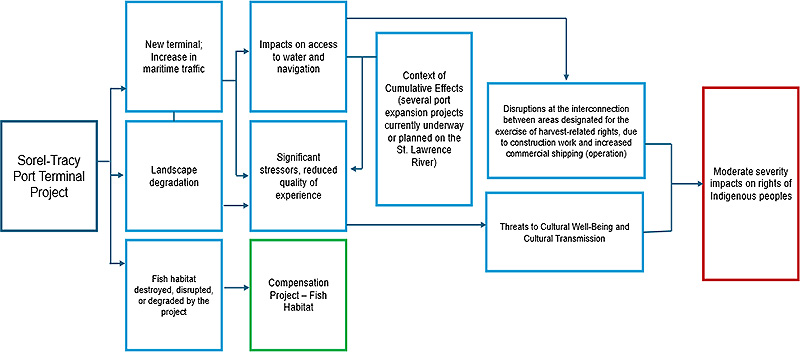
Figure 5 - Text version
Diagram illustrating the potential pathways through which the Sorel-Tracy port project could impact rights exercised on the St. Lawrence River. The figure shows how increased marine traffic, landscape degradation, and the destruction of fish habitats can impact access to the water, navigation, the quality of the experience, and fish abundance. These changes may reduce the success of fishing, hunting, and gathering activities, increase the time and costs required to engage in these activities, and decrease the use of historically known and valued areas. The figure indicates that these impacts may lead to a reduction in cultural continuity and, ultimately, undermine fishing, hunting, and gathering rights, as well as other rights and practices exercised on the St. Lawrence River.
W8banaki and the MCK pointed out that, in addition to maritime transport, past, present, and future activities affecting the exercise of rights include port projects (Trois-Rivières, Contrecœur, Bécancour, and Sorel-Tracy)Footnote 36, industrialization, erosion and bank development, the privatization of land and banks, urbanization, dams, the introduction of invasive exotic species, and agricultureFootnote 37.
4.3.2 Existing, ancestral and treaty rights
W8banaki
The W8banakiak hold ancestral rights under section 35(1) of the Constitution Act, 1982. The W8banakiak also assert that they hold treaty rights. Specifically, they claim to be among the "domiciled allies of the King of France" in the St. Lawrence Valley who entered into a treaty at Oswegatchie in 1760 with the British Crown. Furthermore, the Quebec Court of Appeal ruled in the Côté case (1993) that the 1760 Treaty of Oswegatchie (or Swegatchy) is indeed a treaty and that it grants Indigenous peoples "domiciled" in the St. Lawrence Valley, not only the right to remain on their settled lands, but also, for a nomadic people, a right of access to traditional hunting and fishing territoriesFootnote 38.
Kchitegw (the St. Lawrence River) is of central importance to the W8banaki Nation as one of its main transportation routes, but also for its islands and shores, which are used for other traditional activities, from both a historical and contemporary perspectiveFootnote 39. Kchitegw (the St. Lawrence River) is fundamental to W8banaki identity.
Over time, changes to the ecosystem have significantly affected the water quality of the Kchitegw (St. Lawrence River) and its fish populations, among other things. This change is primarily anthropogenic in nature: dredging of the navigation channel, human-induced alterations to the banks, the construction of dams and locks, increased navigation, the introduction of invasive alien species, and water pollution from municipal, industrial, and agricultural sources. These human-induced impacts, coupled with climate change, cumulatively affect the Nation's members' dietary, ritual, and social practices, as well as their ability to exercise their ancestral rights. Feelings of security, tranquility, escape, and reconnection with the territory, the transmission of knowledge, and collective and individual health are all affectedFootnote 40.
In the area identified by W8banakiFootnote 41, activities primarily include fishing, boating, hunting, trapping, foraging (or gathering), teaching (knowledge transmission), rejuvenation, and camping. Fishing, boating, teaching, and waterfowl hunting are the most common food-gathering, ritual, and social practices in this area. They are primarily concentrated on certain islands where members of the Nation engage in traditional activities. All these activities are family-based and intergenerational. They play an important role in cultural transmission and in strengthening intergenerational as well as social and community bonds. For many, they symbolize the cultural continuity of the Nation and its connection to the territoryFootnote 42. Industrial and port development on the territory is hindering the continuity of certain practices, either by causing them to be abandoned or displaced, thereby diminishing the experience of the territoryFootnote 43.
The rights of the W8banaki Nation affected by the project include the following:
- Right of access to and occupation of the territory and right to navigation;
- Right to fish;
- Right to hunt, trap, and gather;
- Right to education and cultural renewal.
Wendat Nation
The Wendat Nation (WN) has, since time immemorial, inhabited the Onyionhwentsïio' ("Our Magnificent Territory" in the Wendat language), its customary territory on which its rights and interests, guaranteed by the 1760 Huron-British Treaty, are constitutionally protectedFootnote 44.
The WN stated in its brief submitted to IAAC in March 2018Footnote 45 that the rights and freedoms protected by the 1760 Huron-British Treaty include, but are not limited to, freedom of trade and religion, the right to practise customs such as hunting, fishing, trapping, gathering, traditional rituals, the peaceful enjoyment of the Onyionhwentsïio', and, more generally, the right to self-government. According to the WN, this treaty of peace and alliance seals the nation-to-nation and treaty partner relationship between the Crown and the WN. The rights protected by this treaty are enshrined in the Canadian Constitution through section 35(1). This treaty, whose validity was recognized by the Supreme Court of Canada in 1990 in the Sioui decision, protects the customary and religious activities of the WN that take place on the Onyionhwentsïio'. None of the WN's comprehensive or specific land claims are located within the project areaFootnote 46.
The Savard decision, handed down in 2002 by the Quebec Court of Appeal, provided further confirmation of the treaty's validity, the rights it grants, and its territorial applicationFootnote 47.
The right to freely practise customs and religion protected by the 1760 Huron-British Treaty includes, among other things, fishing and hunting practices, as well as all activities reasonably incidental to these customs. In the Simon decisionFootnote 48, the Supreme Court of Canada clarified that "the right to hunt to be effective must embody those activities reasonably incidental to the act of hunting itself, an example of which is travelling with the requisite hunting equipment to the hunting grounds." Thus, navigation on the St. Lawrence River is one of the activities incidental to the Wendat's right to fish, and this right is therefore also protected by the 1760 Huron-British Treaty, just as the right to fish independently is. It is therefore not a so-called "recreational" activityFootnote 49.
The Wendat Nation continues to practise its ancestral customs on the Onyionhwentsïio'.
It should be noted that the project site would be located about fifty kilometres east of the boundary of the Onyionhwentsïio', near Trois-Rivières.
The rights asserted by the Wendat Nation are as follows:
- Right of access to and occupation of the territory and right to navigation;
- Right to fish;
- Right to hunt, trap, and gather;
- Right to education and cultural revitalization.
Mohawk Council of Kahnawà:ke
The Kanien'kéha (Mohawks) of Kahnawà:ke assert inherent rights, as well as rights protected by section 35 of the Constitution Act, 1982, including governance rights and stewardship obligations, within this project area. Within the Iroquois Confederacy, the Kanien'kehá:ka were and continue to be recognized as Keepers of the Eastern Door, a role that requires them to exercise governance rights and stewardship responsibilities in the territory stretching from the Great Lakes to the estuary of the Kaniatarowanenne (St. Lawrence River)Footnote 50.
The Kaniatarowanenne (St. Lawrence River), along with the surrounding wetlands and the tributaries that flow into it—notably the Richelieu River—are of immense importance to the Mohawk Nation. This environment has served as a source of food, trade goods, and medicine for centuries, particularly through fishing, hunting, gathering, and agriculture.
The Mohawk Council of Kahnawà:ke is deeply concerned about both the direct and cumulative impacts of the project. The MCK believes that industrial activities, urbanization, dams, landscape alteration, the introduction of exotic invasive species, maritime traffic, and agriculture have already profoundly degraded the conditions necessary for the Nation to exercise its rights. These factors have directly affected the exercise of these rights by causing changes in water levels and deterioration in water quality, the erosion and denaturalization of riverbanks, the loss of habitats leading to a decline in flora and fauna, as well as impediments to the migration of fish species such as eels and shad, and the fragmentation of sturgeon populationsFootnote 51.
The following principles guide the MCK:
"The Ohén:ton Karihwatéhkwen is also an environmental code based on Kanien'kehá:ka (Mohawk) traditional laws and practices. Its underlying philosophy provides us with a framework for categorizing and assessing the health of the environment, including the impacts of current actions on future environmental health.
In all environmental decision-making, we consider the impacts on future generations—sometimes referred to as the Seven Generations principle. Any decisions made today must take into account the impact of those actions on the next seven generations. By anticipating the consequences of our actions seven generations into the future, we ensure that our actions reflect our responsibility to maintain the cycles of life.
The timeframe of our connection to the St. Lawrence and Richelieu Rivers—from time immemorial to the end of time—requires us to consider the long-term consequences of human actions and environmental change. We depend on this place—the St. Lawrence River—to sustain our lives as Indigenous peoples.
All existing connections between species and their habitats play a role in maintaining functioning food webs and ecological health and must be respected and preserved as parts of a living ecosystem."
The rights set forth by the Mohawk Nation are as follows:
- Rights to governance;
- General fishing and stewardship rights;
- Fishing and stewardship rights related to the copper redhorse and other culturally significant species;
- Rights related to harvesting and food sovereignty;
- Linguistic and cultural rights.
4.3.3 Potential adverse impacts of the project on Aboriginal and treaty rights
Regional, historical, and cumulative context
Maritime traffic on the river has grown significantly since the creation of the St. Lawrence Seaway (increased port capacity, larger and more numerous ships, etc.) and causes disturbances that make it more difficult for Indigenous peoples to exercise their rights. The cumulative effects resulting from this traffic are the primary concern of the First Nations consulted regarding the project.
For its part, it is estimated that the project would result in a slight increase in the number of merchant ships on the St. Lawrence River during the operation phase (8 additional ships per year). The disturbances caused by these 8 additional ships (up to 16 passages) annually—particularly the effects of ship wake—would be in addition to the disturbances associated with existing marine traffic (estimated at 4,000 ship passages per year).
The wake caused by passing ships makes navigation and docking in small vessels (canoes, rowboats, etc.) more hazardous and degrades the quality of the experience when engaging in certain activities such as hunting migratory birds and fishing on the river, as well as during river travel necessary for other traditional activities (trapping, gathering plant species, etc.).
Harvesting rights (fishing, hunting, trapping, and gathering) and food sovereignty
Fishing is central to W8banaki identity. The fishing activities of the W8banakiak encountered as part of the Nation's LUOS primarily take place along the fluvial section between Montreal and Quebec CityFootnote 52. The species fished include, but are not limited to, bass, catfish, channel catfish, pike, walleye, yellow and black sturgeon, yellow perch, and eel. Fishing is widely practiced by the Nation's women, in equal proportion to men, and impacts on fishing can have greater effects on women in particular, as their access to remote territories is more difficult, as is the ability for some to embark on long stays in those territoriesFootnote 53.
The W8banakiak are already experiencing a decline in the abundance and quality of the species they fish, particularly striped bass, northern pike, walleye, and yellow perch, about which the Nation is particularly concernedFootnote 54. The W8banakiak must fish under increasingly unfavourable conditions, which cause them stress. The sense of security, tranquility, and escape on their territory, the transmission of knowledge, and collective and individual health are all affected by thisFootnote 55.
The W8banaki Nation hunts Canada geese, ducks, snow geese, moose, and white-tailed deer. Waterfowl hunting is particularly popularFootnote 56 and takes place along the shores of Kchitegw, often using small boats. The Nation also traps raccoons, muskrats, and coyotes. With regard to gathering, the LUOS provides information on harvests traditionally conducted using boats in the area considered for cumulative effects. The information available to date indicates that only a limited number of plant species are currently available for harvesting in the area covered by the LUOS. Although the Ndakina Office has not identified specific harvesting sites, the Nation's oral histories confirm the existence of significant collection areas known in the region to contain traditional and ancestral sites for harvesting black ash and sweetgrassFootnote 57. The area covered by the LUOS is of significant importance to the Nation due to the historical and current presence of these two species, particularly black ashFootnote 58. Ostrich fern (Matteuccia struthiopteris) is also harvested there.
Some members of the Wendat Nation navigate the study area and fish for pike and walleye in the vicinity of Sorel-Tracy and Lake Saint-Pierre. American eel, yellow and black sturgeon, and striped bass are also among the species fished and consumed by the Wendat Nation.
The Wendat engage in waterfowl and white-tailed deer hunting, as well as fur trapping, near the project area (particularly on the Sorel Islands). The Onyionhwentsïio' and the area beyond remain central to the Wendat's identityFootnote 59. Additionally, the Wendat Nation has identified sweetgrass and black ash as culturally significant species that they harvest, in addition to wild garlic, eastern white cedar, and SavoyaneFootnote 60.
For the Mohawk, fishing rights are extremely important, and they consider that these rights have been seriously impeded over the past few decades. Yellow sturgeon has always been consumed by the Nation and was used for trade. The copper redhorse is a species unique to the St. Lawrence River, and the MCK believes that its decline is an indicator of the river's deteriorating health.
The MCK notes that its members continue to suffer the cumulative effects of past industrialization, both upstream and downstream of the project, and that fish continue to exhibit high levels of mercury, to which other contaminants have recently been added, often making their consumption unsafeFootnote 61.
Regarding cumulative effects, the MCK notes that "the cumulative ecological impacts on the St. Lawrence River, including the major impacts from the shipping industry, have left the Mohawks of Kahnawà:ke with a depleted river ecosystem and restricted access to the resources that support our culture and way of life. […] Since the 1950s, our threshold for damage to the St. Lawrence River has been surpassedFootnote 62."
The MCK has implemented certain programs to facilitate a return to its members' traditional practices (including horticulture, maple syrup production, hunting, and fishing), but these programs all rely on the resources of the St. Lawrence River. According to the MCK, further damage to this ecosystem jeopardizes the Nation's food sovereignty.
Pathways of impacts of the project on rights
The project, which would take place on a W8banaki Nation fishing siteFootnote 63, would directly affect the Nation's experience of exercising its fishing rights, as disruptions associated with the project's construction phase and increased maritime traffic during the operation phase would make fishing less safe and more difficult for the W8banaki, Wendat, and Mohawk Nations.
The nuisances caused by maritime traffic, particularly that associated with the project, would also negatively affect the experience of hunting, trapping, and gathering activitiesFootnote 64, in addition to making navigation associated with these activities less safe. Due to increased marine traffic, the right to hunt migratory birds could be affected by the effects resulting from the disturbance of birds and, more significantly, by the effects on the experience of the territory resulting from the decrease in the number of suitable hunting sites due to the displacement of Indigenous hunters and increased competition with non-Indigenous hunters at the remaining sitesFootnote 65.
One of the testimonies collected by W8banaki states that "the passage of commercial ships and recreational boats on the river also impacts members' hunting experience and makes hunting in these areas more difficult and often frustrating. Indeed, waterfowl hunting requires a great deal of preparation and patience, all of which must be restarted after every disturbance. […] Once we're set up to hunt, a boat shouldn't be passing by every two hours. Otherwise, I wouldn't go hunting in this area anymore. The wake created by the ships pulls our rowboat along. […] We always have to reposition ourselves after they passFootnote 66."
W8banaki emphasizes that the impacts on rights will affect the Nation's security and food security. Indeed, there is a communal distribution of the products from these activities (fish, large and small game, fruits, and plants), which contributes in particular to the food security of the Nation's members, as well as to their overall health. Thanks to this sharing of resources, many elders who are no longer able to engage in these activities on the territory can also benefit from the harvests of other members of the Nation. The right to rejuvenation and tranquility through these practices is also invoked.
The MCK emphasizes that the direct impacts of the project and its contribution to cumulative impacts would affect the Mohawk Nation's fishing and stewardship rights. The Mohawks are concerned about the loss of 642 square metres of fish habitat that the project would cause, and believe that fish would avoid the area to an even greater extent. Furthermore, the MCK believes that the project contributes to the degradation of an ecologically sensitive area that supports cultural and spiritual practices related to water and fishing. Furthermore, the MCK is concerned about the impacts that potential accidents and malfunctions related to the project (see Section 3.1 of this report) could have on their traditional practices and well-being, as well as the repercussions on their harvesting and stewardship rights.
The MCK believes that the project would cause permanent alteration to a section of the river corridor that supports essential foraging habitats (seagrass beds and mid-depth habitats) for the Copper redhorse and the yellow sturgeon. These direct effects compound the cumulative effects already experienced by these species, which have been subjected to significant pressures from marine traffic, industrialization, and the accompanying water pollution, as well as the destruction of their essential habitats.
It should be noted that the MCK proposes, in its analysis, that monitoring criteria and thresholds triggering additional mitigation or offsetting measures be defined in advance and in consultation with the MCK, and that monitoring continues until measurable seagrass bed regeneration targets have been achieved if the observed impacts differ from those that were assessedFootnote 67.
According to the MCK, the project would have direct effects primarily on fishing practices and would consequently affect food sovereignty. The Nation's youth would be most severely impacted due to anticipated future impacts. The MCK states that their community simply cannot withstand further restrictions on fishing opportunities, such as those that may result from the projectFootnote 68, and notes that in the absence of sufficiently abundant and high-quality natural food resources (contamination or the perception of contamination is a major concern for land users), members are turning to processed foods, which lead to various health problems.
Right of access to and occupation of the territory
According to the W8banaki Nation, access to the territory is a prerequisite for the exercise of ancestral rights and a source of concern for members, who have seen it restricted in recent years. The Nation believes that barriers to access to the territory are caused primarily by development, privatization, and the appropriation of territories by non-Indigenous sport hunting clubs for all their activities. The Nation notes that the loss of access to traditional areas threatens the intergenerational transmission of knowledge and cultural practices, weakening community ties and cultural resilience.
Pathways of impacts of the project on rights
During the construction phase, the presence of the construction site would affect the exercise of rights in the immediate vicinity of the project on the St. Lawrence River, while the increase in marine traffic resulting from the project would make the practice of traditional activities on the water less safe and more difficult for the Nations.
Rights to culture, language, and resource gathering
W8banaki highlights the importance of the right to education as a means of cultural transmission (on the beaches and on the water), as well as camps and cultural and/or sacred sites. The Nation emphasizes the importance of women's role in passing on knowledge and skills to children, which also contributes to the development of cultural identity. W8banaki emphasizes that traditional activities such as fishing play a central role in shaping the identity of the Nation's members. For many, these practices are an integral part of their way of life and diet.
The Wendat Nation Council explains that the practice of contemporary traditional activities is the primary means of intergenerational knowledge transfer for the Wendat.
For the MCK, language and culture are linked to practices on the territory. Programs are in place for language revitalization, but these depend on opportunities to engage in these practices on the territory.
The Mohawks have regularly highlighted the negative impact of maritime transport on their activities, particularly fishingFootnote 69. The MCK notes that the St. Lawrence River is an essential traditional waterway used for fishing, access to cultural sites, and the transmission of knowledge. It emphasizes that the increase in commercial marine traffic, combined with existing and planned port infrastructure, is tangibly altering the boating experience due to the increased presence of large ships, safety constraints, wake waves, restricted access to certain areas (particularly access to the river, which was cut off by the seaway), and a sense of insecurity among small boat users. The MCK also notes that the raising of the Saint-LaurentFootnote 70 railway bridge when ships pass through disrupts the community's daily commutes, illustrating how commercial shipping directly influences mobility and quality of life.
Pathways of impacts of the project on rights
Access to sites where cultural practices are taught, as well as the quality of those practices, would be affected by the disturbances caused by the additional marine traffic associated with the project.
For the W8banaki, the accumulation of activities (agriculture, commercial and recreational boating) and infrastructure (port facilities, industrialization, and human development along the banks) is already undermining the conditions necessary for them to exercise their rights and pass on their culture. The project could exacerbate this pressure by limiting future opportunities for territorial restorationFootnote 71. As for the possibility of spiritual renewal, this is becoming increasingly difficult due to the heavy human development along the banks near the project site and the cumulative effects of various development activities and marine traffic.
The W8banaki Nation believes that "any factor that could lead to a reduction in the success of a traditional practice risks affecting the lived experience in a cumulative manner, adding to the many existing effects." In the context under consideration, these include the impacts caused by commercial and recreational boating, landscape degradation, and the scarcity of suitable sites for the intergenerational transmission of knowledge. This erosion of the lived experience may therefore contribute to a decline in the practice of activities on Kchitegw if the conditions supporting the exercise of rights fall below the threshold tolerated by those rights. Such a decline in practice would result in reduced use and, consequently, reduced transmission of knowledge"Footnote 72.
The MCK emphasizes that the project, as well as its contribution to cumulative impacts, would affect the linguistic and cultural rights of the Mohawk Nation. The MCK notes that the Mohawk language is directly linked to the territory and to the practice of traditional activities on it. Through practices, observation, and teaching, linguistic and cultural rights are perpetuated. The same is true of culture, whether it be matrilineality, the connection to the cycle of the seasons, or relationships with others, as well as with the environment and the spirit of sharing. In the words of the MCK: "If we are limited in our ability to harvest because fish are contaminated, or in low abundance, it is difficult for us to pass on core values and ways of living to our youth"Footnote 73. According to them, the project would have impacts on these rights, primarily due to its contribution to the cumulative effects of various development projects and the cumulative effects of marine traffic.
Right to governance and stewardship
The First Nations reminded the proponent and IAAC of the importance to them of exercising stewardship and responsibility over the territory.
According to W8banaki, "maritime activities and the cumulative changes affecting the territory—along Kchitegw in particular—impair the Nation's capacity for governance and the exercise of its duty of stewardship, that is, its ability to consistently fulfill its responsibility toward the territory within a relationship of reciprocity. […] The cumulative impacts and the loss of sections of the Ndakina River are part of a history of colonization, compounded by numerous pressures on the transmission of ancestral knowledge and techniques, as well as on the connection between the W8banakiak and the Ndakina. The members interviewed also expressed concerns about the proliferation of port and industrial projects and maritime activities on the river, foreshadowing an increase in navigation and the presence of increasingly massive vessels. This situation also leads them to fear further deepening of the shipping channel and impacts on the banks, which are already eroding significantlyFootnote 74."
For its part, the MCK notes that, with regard to the availability of resources for the exercise of rights and stewardship responsibilities, the limit has already been exceeded with the construction of the St. Lawrence Seaway and the expansion of marine transport, as well as the industrialization that accompanied them.
Within the Haudenosaunee, or Iroquois, Confederacy, the Mohawk Nation is the guardian of the eastern gate and is responsible to the other nations of the Confederacy for protecting the territory, including the project area. In the words of the MCK: "As part of our governance rights, we have a responsibility to care for and protect the St. Lawrence River and the Richelieu River ecosystems. We take our responsibility as stewards of the lands and waters for future generations seriouslyFootnote 75."
The most important diplomatic document for the Nation is the Two-Row Wampum, a belt of white and blue beads representing two rows, that is, two peoples: the peoples of European descent and the Iroquois people. Each of these peoples evolves independently, without attempting to influence the other's direction. Furthermore, decisions regarding the territory must take into account the next seven generations. According to the MCK, decisions must follow these principles:
- The duration of our connection to the St. Lawrence and Richelieu Rivers, from time immemorial to the end of time, compels us to take into account the long-term consequences of human actions and environmental changes. We depend on this place, the St. Lawrence River, for our survival as Indigenous peoples.
- All existing connections between species and their habitats play a role in maintaining the proper functioning of food webs and ecological health, and must be respected and preserved as integral parts of a living ecosystemFootnote 76.
Pathways of impacts of the project on rights
For the MCK, the project's effects, as well as the cumulative effects on valued components (particularly land, water, and fish), combined with the significant impacts of past and present river development, have substantially undermined their right to governance.
According to the MCK, an overall degradation of aquatic and riparian environments (water quality, habitats, natural cycles), leading to a loss of biodiversity and ecological functions, combined with human disturbances (noise, light, artificialization), causes impacts that directly affect the rights, cultural practices, spiritual framework, and decision-making authority of the Mohawk Nation. Its capacity to act, particularly its obligation to consider the next seven generations, has been or is likely to be seriously impeded, notably by the cumulative effects of activities such as dredging, the construction of the seaway, the expansion of port terminals (Contrecoeur, Bécancour, Trois-Rivières), and the construction of this project.
The MCK therefore emphasizes that the project, as well as its contribution to cumulative impacts, would affect the Mohawk Nation's right to self-governance.
4.3.4 Conclusion on impacts on Indigenous Peoples' rights
Based on its analysis, IAAC concludes that the project is likely to result in changes to the exercise of aboriginal and treaty rights related to fishing and hunting, as well as to the cultural practices of Indigenous communities.Footnote 77
Based on the analysis of adverse effects on federal biophysical components (Section 2), the effects on the current use of lands and resources for traditional purposes (Section 4.2), and the mitigation measures proposed in those same sections, IAAC concludes that the project could result in impacts of moderate severity on the rights of the W8banakiak and the Mohawks, and of low severity on the rights of the Wendat. With regard to low-severity impacts, IAAC generally considers these to be impacts on communities whose preferred areas for exercising their rights are on the edge of or only partially overlap with the area affected by the project's potential effects. These communities could continue to practise or exercise their rights without constraints or in a similar manner thanks to the mitigation measures.
The following paragraphs summarize the rationale supporting the conclusions regarding impacts of moderate severity on rights.
- The likelihood of negative impacts on harvesting rights (fishing, hunting, trapping, and gathering) and food sovereignty is moderate, as the project could alter the conditions of access and the quality of the experience in exercising these rights. However, these changes are not expected to prevent the continued exercise of these rights in a manner similar to before, particularly because the project is located in an area already subject to similar human activities. Regarding resource availability, although the project is likely to result in residual negative effects on fish and their habitat, IAAC concluded that these residual effects would not affect the productivity, viability, or maintenance of the populations of the affected species. No activities or infrastructure are planned in the areas where plant species of cultural significance have been identified within the LSA's terrestrial zone (Figure 3). IAAC noted (Section 4.2.2) that hunting patterns and hunting success are not expected to be significantly affected by the project, as preferred hunting sites are generally associated with areas having a greater abundance of waterfowl, which does not correspond to the conditions observed in the area near the terminal. IAAC also considers that the mitigation measures specified in Section 3.2 of this report regarding accidents and malfunctions will help prevent or address the potential impacts of accidents and malfunctions on Indigenous harvesting rights.
- The project's impacts will be felt locally and may occasionally disrupt connectivity or travel between certain areas designated for the exercise of harvesting rights, due in particular to construction activities during the construction phase (short term) and increased commercial navigation during the operational phase (long-term), without, however, preventing the exercise of these rights as they were exercised prior to the project, or in a similar manner, with certain adjustments in behaviour.
- Rights related to cultural well-being (rejuvenation, intergenerational transmission and identity, the practice and transmission of Indigenous languages, etc.) could be partially disrupted due, in particular, to disturbances associated with the exercise of the fishing and harvesting rights mentioned above or to changes to the landscape and sensory disturbances caused by the project. IAAC considers, however, that mitigation measures ensuring the continuity of traditional uses and activities and the associated rights, including those proposed in Sections 2.1.4 and 2.2.4 for fish and their habitat and migratory birds, would contribute to maintaining the cultural well-being of the affected communities.
- First Nations may feel the potential impact on Indigenous governance rights. As a result, Indigenous decision-making bodies (e.g., the Mohawks' Ohén:ton Karihwatéhkwen) and their ability to participate in decision-making processes related to the governance of the St. Lawrence River (stewardship, territorial governance) may have limited influence in the project's decision-making and development processes. However, IAAC believes that the participation of the consulted Indigenous communities in project decision-making, particularly through their input into the development of mitigation measures and their involvement in monitoring committees throughout the project's lifecycle, would help mitigate the impacts on Indigenous governance rights.
IAAC recognizes that the issue of cumulative impacts remains a major concern for First Nations. The Sorel-Tracy port terminal project is taking place in a context where, in addition to existing projects, there are several port expansion projects underway or planned along the St. Lawrence River. The combination of these projects will result in cumulative impacts on First Nations' activities. Although the Sorel-Tracy port terminal area is already heavily industrialized, the sensory disturbances associated with the addition of a wharf and the addition of approximately 16 additional ship passages (a number of which could transit the seaway upstream of the LSA) to maritime traffic on the river could impact First Nations' navigation experience. The project adds to a growing number of industrial developments that may reduce access to and the availability of culturally significant resources (fish, birds, plants) as well as the practice of traditional activities on the river. The experience associated with the exercise of Indigenous rights could therefore be marked by a sense that the ecological thresholds supporting the practice of these rights—and the conditions necessary for the intergenerational transmission of cultures and knowledge—have been exceeded.
IAAC has identified a number of measures that would mitigate the project's impacts, which could affect rights and the practice of traditional activities. These measures concern fish and their habitat (Section 2.1), migratory birds (Section 2.2), accidents and malfunctions (Section 3), impacts on physical and cultural heritage (Section 4.2.1), impacts on the current use of lands and resources for traditional purposes (Section 4.2.2), and impacts on the health, social, or economic conditions of Indigenous peoples (Section 4.2.3) as well as human health (Annex 4).
As mentioned above, the Regional assessment of the St. Lawrence River region conducted under the IAA is currently being prepared. Carried out in partnership with the MCK and other Indigenous groups, this assessment aims to better understand the state of the St. Lawrence River and the cumulative effects of human activities in order to guide actions that improve environmental and social conditions. The RASL will also help address the data gap identified by certain First Nations, which prevents them from analyzing and evaluating the cumulative impacts on the exercise of their rights in an informed manner.
Several other government programs and initiatives help ensure that First Nations are taken into account and that the impacts of the industrialization of the St. Lawrence River are mitigated. In particular, Transport Canada is implementing various initiatives aimed at better regulating and mitigating the impacts of maritime shipping, notably through the Oceans Protection Plan, which includes measures addressing underwater noise, maritime safety, the reduction of air emissions, traffic management, and the advancement of scientific knowledge. These initiatives aim to support adaptive management of maritime transport in order to reduce environmental risks and potential impacts on the health and well-being of riverside and Indigenous communities.
More specifically, in 2017, Transport Canada launched the cumulative effects of marine shipping initiative to better understand the environmental, social, and cultural impacts of shipping activities. This initiative led to the publication, in 2022, of the National Framework for Assessing the Cumulative Effects of Marine Shipping, which identifies various management levers and measures applicable to waters under federal jurisdiction, primarily based on existing federal laws and programs. Transport Canada is currently continuing to implement this initiative in collaboration with partners, stakeholders, and First Nations to guide subsequent phases of decision-making and the development of recommendations tailored to regional realities.
|
Severity of adverse effects on Indigenous Peoples' rights |
|
|---|---|
|
Low |
|
|
Moderate |
|
|
High |
|
IAAC emphasizes the importance of ongoing and constructive dialogue with the proponent to continue identifying and addressing the project's potential impacts on rights.
IAAC acknowledges that the consultation process is ongoing. Comments from Indigenous communities on the draft impact assessment report will be taken into account and will help IAAC finalize its conclusions regarding the project's potential impacts on the exercise of rights under section 35.
4.4 Federal Crown's Duty to Consult
This section provides IAAC's views of the Crown's consultation and accommodation efforts up until the drafting of the final IA Report. At the time of this draft IA Report, IAAC's views are preliminary regarding whether the Crown's record of consultation demonstrates a meaningful and adequate process for the duty to consult and, where appropriate, accommodate Indigenous Peoples. Nevertheless, the information below provides a summary of consultation activities to date, of procedural considerations, and of how well the Crown worked to understand and solve the concerns raised by Indigenous groups. This section will be updated in the final IA Report.
4.4.1 Adequacy of federal Crown consultation
IAAC's consultation approach was guided by Indigenous communities, respecting the approaches and means of consultation preferred by them throughout the IA process, as outlined in the IEPP and in Section 4.1.1 of this report. Sections 4.2.1, 4.2.2, 4.2.3, and 4.3 provide a detailed description of IAAC's understanding and conclusions regarding residual adverse effects and impacts on rights. These sections take into account the recommended mitigation measures regarding impacts on Indigenous peoples' customary use of lands and resources for traditional purposes, on structures, sites, or objects of historical, archaeological, or architectural significance to Indigenous peoples, as well as physical and cultural heritage; on health, social, and economic conditions; and with respect to adverse impacts on the exercise of rights. Additional mitigation measures may be identified throughout the remainder of the assessment period.
To inform the federal decision-making process regarding the project, Indigenous communities may provide comments directly to decision-makers, including expressions of consent, no objection, or non-consent regarding the findings of this IA report and IAAC's draft recommendations.
Throughout the IA process and up to the comment period on the draft IA report, Indigenous communities provided input on the Crown's consultation process for the project, including regarding its adequacy in addressing the issues raised and outstanding concerns.
IAAC consulted with Indigenous communities in a manner consistent with the Crown's obligations under section 35 of the Constitution Act, 1982, and sought to understand and address the potential impacts of the project on Indigenous rights and interests. IAAC began its consultations early in the process and continuously provided information to the communities to support their informed participation in the process. IAAC noted that the FPIC was a consultation objective and gave each community the opportunity to explicitly state its FPIC, or the absence thereof, regarding the project and the IA process. IAAC recognizes that Indigenous communities may have different perspectives on what FPIC means in the context of the project assessment or on IAAC's consultation approach that should have been adopted. IAAC is grateful for the feedback provided and views it as an opportunity to collaborate on the development of approaches to FPIC.
5. Extent to which project effects contribute to Canada's environmental obligations
Overall, IAAC is of the view that the project's effects would not contribute to Canada's ability to meet its environmental obligations, but would not undermine them either. The project would result in limited residual adverse federal effects on fish, migratory birds and species at risk, including their habitat.
IAAC analysed the extent to which the likely effects of the project would contribute to Canada's ability to meet the following environmental obligations in relation to the project:
- Biodiversity obligations:
- Convention on Biological Diversity and Kunming-Montreal Global Biodiversity Framework and its national framework: Canada's 2030 Nature Strategy, as well as the legislation supporting its implementation, including the Species at Risk Act and the Canada Wildlife Act, and related policies and guidance documents;
- recovery strategies, action plans and management plans developed under the Species at Risk Act for all species at risk potentially affected by the project;
- Convention on Wetlands of International Importance Especially as Waterfowl Habitat (Ramsar), implemented in part under the Federal Policy on Wetland Conservation and the North American Waterfowl Management Plan; and
- Convention for the Protection of Migratory Birds in the United States and Canada, implemented in part under the Migratory Birds Convention Act, 1994, as well as the conservation objectives of ECCC's Bird Conservation Regions and strategies.
- Air pollution obligations:
- Canada-United States Air Quality Agreement, implemented under the Air Quality Management System.
- Obligations regarding water quality and quantity:
- the Canada–United States Boundary Waters Treaty, implemented by the International Joint Commission.
5.1. Analysis
The analysis considered the specific context of the project, including:
- the location of the project:
- within the boundaries of the Lake Saint-Pierre World Biosphere Reserve;
- approximately 1,852 kilometres (1,000 nautical miles) upstream from the limits of Canada's territorial waters, following regular shipping routes through Cabot Strait; and
- approximately 109 kilometres from the United States border.
- potential emissions and discharges from the project (GHGs, potential malfunctions and accidents, etc.); and
- environmental components likely to be affected (such as species at risk and migratory birds), including potential effects on these components.
Accordingly, only environmental obligations related to biodiversity were considered in the analysis for the following reasons:
- given the low volume of emissions generated by the project (Section 6) and the distance between it and the United States border, the project is expected to generate a negligible volume of transboundary air pollution;
- given the distance between the project and United States territorial waters, it is unlikely that the project would cause transboundary water pollution; and
- the project does not involve any water withdrawals affecting United States territorial waters.
5.1.1 Biodiversity obligations
As described in Sections 2.1 and 2.2 and in Annex 4, the project is likely to result in residual adverse effects on fish and fish habitat, migratory birds (including species at risk), and turtles at risk and their habitat that could be affected by federal works or undertaking.
No plant species listed under the Species at Risk Act were identified in the LSA during the inventories conducted by the proponent or in past inventories.
The proponent has committed to implementing measures consistent with applicable recovery strategies and action or management plans for species at risk in order to mitigate the project's potential effects on those species and contribute to recovery efforts.
IAAC is of the opinion that the project' potential effects on species at risk, as well as on their critical habitat, may be mitigated to the extent possible given:
- the nature of the project site, which is already already heavily influenced by human activity;
- the characteristics of the project, which does not require clearing, excavation, earthworks, or grading;
- the recommended mitigation, offsetting and follow-up measures (Sections 2.1.4 and 2.2.4), which are compatible with the applicable recovery strategies and action plans and whose implementation would be ensured by federal conditions.
5.2 Conclusion
Based on the analysis, IAAC is of the view that the project's effects would not contribute to Canada's ability to meet its environmental obligations regarding biodiversity or species at risk, but would not undermine that ability either.
6. Extent to which project effects contribute to Canada's climate change commitments
The project is expected to emit greenhouse gases (GHGs) during the construction and operation phases. However, the GHG emissions avoided as a result of the project are expected to lead to a net reduction in GHG emissions in Canada. In addition, the proponent has committed to developing a credible plan to achieve net zero emissions by 2050. Overall, IAAC is of the view that the project's effects are likely to contribute, to a low extent, to Canada's climate change commitments.
IAAC analyzed the extent to which the likely effects of the project would contribute to Canada's ability to meet the following climate change commitments:
- The targets established under the Canadian Net-Zero Emissions Accountability Act, including:
- Canada's 2035 emissions reduction target of reducing greenhouse gas emissions by 45 to 50 percent below 2005 levels by 2035; and
- Canada's net-zero greenhouse gas emissions target by 2050.
6.1 Analysis
The project would result in GHG emissions during the construction and operational phases. The estimated maximum annual GHG emissions associated with the project's construction phase amount to 1,103 tonnes of carbon dioxide equivalent. The main sources of GHG emissions during this phase include land-based mobile equipment, road trucks for the disposal of excavated material and the procurement of construction materials, as well as tugboats operating on the river. The estimated maximum annual GHG emissions associated with the project's operational phase amount to 1,794 tonnes of carbon dioxide equivalent per year. The main sources of GHG emissions during this phase are ships manoeuvring, at anchor or at wharf, tugs, mobile equipment and conveyors powered by purchased energyFootnote 78 . The project would not have any direct impact on surrounding carbon sinks, as it would not alter land use within the PA.
However, despite the emissions generated by the project, it is likely to result in a net reduction in GHG emissions of 861 tonnes of carbon dioxide equivalent per year when emissions avoided in Canada are considered. This reduction would stem in particular from improvements in logistics and the efficiency of port operations and freight transport. The proposed terminal would reduce waiting times for ships offshore, thereby reducing emissions associated with the use of auxiliary engines and boilers during these periods. The transfer of some bulk carrier operations to the proposed terminal, combined with a reduction in the need for off-road mobile equipment at the existing terminal, would help reduce GHG emissions associated with the proponent's port operations. The project would also optimise maritime and road transport logistics by reducing certain shipping and road transport distances, as the proposed terminal is closer to certain target markets.
The project would have no significant impact on existing carbon sinks as it would be carried out on a site that is already heavily developed and would not require any deforestation.
Finally, the proponent has drawn up a net-zero emissions plan aiming for carbon neutrality by 2050. It provides for the gradual implementation of various measures to reduce its GHG emissions, including the use of low-carbon fuels, such as renewable diesel, as well as the deployment of equipment powered by fuel cells, such as hydrogen.
6.2 Conclusion
Based on the above analysis, IAAC is of the view that the likely effects of the project would contribute to a low extent to Canada's ability to meet its 2035 greenhouse gas emissions reduction target as well as its 2050 net-zero greenhouse gas emissions target.
7. Extent to which project effects contribute to sustainability
The project is expected to improve the efficiency and economic competitiveness of marine transportation, slightly reduce GHG emissions compared to current conditions, create sustainable employment opportunities, and act as a catalyst for regional economic development. In addition, the project would be located on a site that is already heavily anthropized and would involve the construction of infrastructure with potential adaptability to climate change. However, the project is also likely to result in residual adverse federal effects on fish and fish habitat, migratory birds, Indigenous physical and cultural heritage, the current use of lands and resources for traditional purposes, the health, social and economic conditions of Indigenous Peoples, as well as turtles at risk and human health (Annex 4). Overall, the project is expected to make a low net positive contribution to sustainability.
Sustainability is defined in the IAA to mean "the ability to protect the environment, contribute to the social and economic well-being of the people of Canada and preserve their health in a manner that benefits present and future generations." IAAC examined both the adverse effects within federal jurisdiction and the positive effects of the project on environmental, health, social, and economic components. The valued components and key considerations that inform the sustainability analysis are:
- the St. Lawrence River and its ecosystem, including fish and fish habitat, migratory birds, and species at risk;
- the use of lands and resources for traditional purposes by Indigenous Peoples;
- health conditions; and
- socioeconomic conditions.
The sustainability analysis considered how changes to these valued components and key considerations may be experienced differently between groups within communities, different Indigenous groups, and across generations.
Some project effects could persist for several generations, particularly those related to traditional practices and the transmission of Indigenous knowledge, community and economic well-being, and opportunities arising from the project. Given that the project would operate for an indefinite period, IAAC adopted a 55-year temporal boundary for the sustainability analysis to take into account the construction and operation phases, without major rehabilitation works, as well as potential effects on the well-being of present and future generations. IAAC also considered an expanded spatial boundary to allow for a comprehensive assessment of the potential effects of the project at regional scale.
7.1 Analysis
7.1.1 Interconnectedness and interdependence of human and ecological systems
The project would be situated within a dynamic and interconnected river ecosystem centred on the St. Lawrence River and its multiple ecological, social, economic, and cultural uses. This environment is characterized by a strong interdependence between human and ecological systems, including marine and industrial activities, as well as Indigenous cultural and traditional practices.
In this context, the project would be added to an already heavily used marine corridor and would contribute to increased marine transportation. Construction and operation activities could result in environmental effects through noise, vibration, lighting, ship traffic, and the destruction, degradation, or disturbance of aquatic habitats. These effects could influence the use of lands and resources for traditional purposes by Indigenous Peoples, as well as health and socioeconomic conditions (Section 4 and Annex 4).
Marine transportation associated with the project could contribute to cumulative effects already observed in the St. Lawrence River, including underwater noise, disturbances to fish and fish habitat, air emissions, and effects on land use. According to Transport Canada's cumulative effects assessment of marine shipping on the St. Lawrence River, the Sorel-Tracy area is characterized by a high concentration of stressors.
The St. Lawrence River and its ecosystem, as well as access to the territory, are particularly important to Indigenous communities. As described in Section 4, Indigenous communities use the river for hunting, fishing, and gathering activities that support the intergenerational transmission of knowledge, community well-being, and the continuation of traditional practices. Consequently, changes to the landscape, disturbances to wildlife, and perceptions of reduced safe access to the territory could affect these uses over the long term.
The project could also generate certain nuisances related to noise, air emissions, and increased marine and industrial activities, as described in Section 4 and Annex 4. These effects could influence the quality of life and well-being of nearby communities located approximately 190 metres and 250 metres from the PA, as well as Indigenous communities that use the area for traditional purposes.
Overall, negative interconnectedness would be primarily localized, temporary, or short-term duration and are expected to remain limited through the implementation of the mitigation, compensation, and follow-up measures recommended in Sections 2, 3, and 4, as well as Annex 4. Alongside these potential adverse interconnectedness, the project could contribute to regional economic development by supporting industrial-port activities, supply chains, and freight transportation. Employment opportunities, contracts, and skills development associated with the project could improve socioeconomic conditions of certain communities and contribute to regional economic resilience. In addition, the proponent has committed to continuing to prioritize local purchases, maintaining dialogue with economic development organizations and local businesses, promoting workforce preparation and training based on project needs, and collaborating with local stakeholders to support the economic diversification of Sorel-Tracy and the surrounding region. The participation of Indigenous communities in the project's economic benefits could contribute to the well-being of present and future generations (Section 4).
7.1.2 Well-being of present and future generations
Based on the valued components identified for the sustainability analysis, IAAC assessed the benefits and costs for the well-being of present and future generations.
Benefits for the well-being of present and future generations
The St Lawrence River and its ecosystem
- The Project would be located in an area that is already anthropized, thereby limiting effects on the environment, particularly shoreline alteration.
- The wharf design would not require dredging during construction because the existing water depth provides sufficient clearance beneath ships.
- The use of floating barges would reduce effects on the shoreline and fish habitat compared with a more traditional wharf structure. It would also allow for better adaptation to fluctuations in river water levels and the effects of climate change, thereby contributing to the resilience of the environment for future generations.
- The project would improve the efficiency of marine transportation on the St. Lawrence River by reducing ship waiting times at the proponent's existing terminal.
- The project would contribute to a slight reduction in GHG emissions (Section 6) and promote a means of transportation that is more energy-efficient than road transport.Footnote 79
- Due to its strategic location on the St. Lawrence Seaway and Great Lakes seaway system, the project could be used to lighten ships continuing upstream, thereby helping to improve the efficiency and competitiveness of this commercial route.
- The implementation of the mitigation, compensation, and follow-up measures recommended by IAAC would help limit the project's residual effects and, consequently, its effects on the well-being of present and future generations.
Socio-economic conditions
- The project would contribute to the economic development of Sorel-Tracy and the surrounding region, which face certain economic devitalization challenges.
- The project would require an investment of $36.3 million and would create approximately 50 direct and indirect jobs during construction phase and 26 direct and indirect jobs during operation phase. These employment opportunities would be at local and regional levels.
- The project could also support the establishment of new industrial and commercial activities within the Sorel-Tracy–Saint-Laurent industrial-port zone, strengthen regional supply chains, and improve the competitiveness of the St. Lawrence–Great Lakes marine transportation corridor. Over the long term, these benefits could contribute to regional economic development and skills acquisition for the benefit of present and future generations.
- The project could provide certain economic benefits to Indigenous communities through employment opportunities, contracts, and participation in regional economic activities.
- The measures recommended in Section 4.2, particularly those aimed at supporting Indigenous community participation in the project, could contribute to skills development and improved socioeconomic conditions for certain communities for present and future generations.
- The proponent also plans to hold meetings with Indigenous communities to discuss workforce needs and opportunities for economic participation in the project.
- The proponent has implemented an employment equity program targeting certain underrepresented groups, including Indigenous Peoples.
Costs to the well-being of present and future generations
The St. Lawrence River and its ecosystem
- The project would contribute modestly to increased marine traffic in an already heavily used corridor.
- Construction and operation activities could result in residual adverse effects on fish and fish habitat. However, these effects are expected to be localized and of short duration.
- Increased marine traffic could intensify certain existing pressures on the St. Lawrence River and its ecosystem, including risks of disturbance to aquatic wildlife, shoreline erosion, and air emissions. Although mitigation measures are expected to reduce these effects, some may persist over the long term and be experienced by future generations.
Use of land and resources for traditional practices by Indigenous Peoples
- Changes to the aquatic environment, increased marine traffic, disturbances to wildlife, and a reduced sense of safety on the water and in certain areas could affect some traditional uses.
- The project could contribute to a deterioration in the quality of users' experiences on the land and in their cultural connection to the river for present and future generations.
- These effects could have long-term repercussions for the transmission of traditional knowledge and practices to future generations.
Health conditions
- The project could generate certain nuisances for nearby communities and Indigenous communities, particularly related to noise, light pollution, and air emissions. Over the long term, these effects could influence quality of life and the well-being of communities and future generations.
- The project could contribute to a perception of poor air quality and degradation of the integrity of resources used by Indigenous communities. These perceptions, together with environmental and landscape changes, could create stress or negatively affect the psychological well-being of Indigenous groups.
Socio-economic conditions
- The project's economic benefits may not be distributed evenly among the communities and groups concerned.
7.2 Conclusion
IAAC is of the view that the project is likely to result in both positive contributions to sustainability and adverse federal effects that may negatively affect sustainability, with an overall positive contribution. Residual adverse effects would be primarily localized, temporary, or short-term duration and are expected to remain limited through the implementation of the mitigation, compensation, and follow-up measures recommended in Sections 2, 3, and 4, as well as Annex 4. Subject to the effective implementation of these measures, the benefits associated with the project, particularly with respect to the efficiency and competitiveness of marine transportation, relative reductions in GHG emissions, regional economic development, employment, and skills acquisition, could accumulate and be maintained over the long term for the benefit of present and future generations.
IAAC recognizes the uncertainties associated with potential adverse federal effects and with the project's benefits for future generations, including changes in regional economic and market conditions, as well as future investments and development in the region. IAAC also recognizes that sustainability gains would not be distributed equally among concerned communities and groups. Certain adverse effects could continue to be experienced by some Indigenous communities, particularly with respect to land use, traditional practices, and health conditions. Nevertheless, the recommended mitigation measures (Section 4.2 and Annex 4), together with the proponent's commitments regarding economic participation and the inclusion of Indigenous communities, would contribute to maintaining the economic, social, and cultural well-being of communities across generations.
IAAC concludes that the likely effects of the project would contribute positively to sustainability to a low extent.
8. Decision making and next steps
Following the comment period on this draft IA Report and the draft potential conditions, IAAC will finalize this IA Report and the potential conditions and provide them to the Minister to inform decision-making. The Minister may refer the decision to the Governor in Council. The decision-maker will consider the information contained in this report and determine:
- after taking into account the implementation of any mitigation measures that the Minister or the Governor in Council considers appropriate, whether the adverse federal effects identified in the final IA report (Sections 2, 4.2 and Annex 4) are likely to be significant and, if so, to what extent; and
- if there are adverse effects that are likely to be significant to some extent, and whether they are justified in the public interest, taking into account the following:
- the impacts that the likely effects may have on any Indigenous group and the adverse impacts that these effects may have on the rights of Indigenous Peoples (Section 4);
- the extent to which those effects contribute to Canada's ability to meet its environmental obligations and commitments in respect of climate change (Sections 5 and 6); and
- the extent to which those effects contribute to sustainability (Section 7).
Following this decision, the Minister will issue a Decision Statement to the proponent that:
- informs the proponent of the decision and the reasons for the decision;
- sets out any conditions that the Minister considers appropriate, except the implementation of which will be ensure by another person or by a jurisdiction;
- sets out the period within which the proponent must substantially begin to carry out the project;
- includes a description of the project.
If it is decided that any likely significant adverse federal effects are in the public interest, the project is expected to require the following federal permits for specific activities:
- permits under the Fisheries Act and the Species at Risk Act;
- approval under the Canadian Navigable Waters Act.
IAAC will help coordinate the federal authorizations required for the project, as described in the Permitting Plan.
Annex 1: IAAC's effects rating criteria
IAAC used the following criteria to describe the potential residual and cumulative adverse federal effects of the project. Table AX-1 provides definitions of levels for magnitude for specific adverse federal effects (e.g. fish and fish habitat). Tables AX-2 to AX-6 provide definitions of levels for the impact assessment criteria that apply to all adverse federal effects.
|
Rating |
Rating definitions |
|---|---|
|
Fish and Fish Habitat |
|
|
Low |
Measurable change affecting to fish or fish habitat at one or more ife cycle stages, that would not affect the populations of the species concerned. |
|
Moderate |
Measurable change affecting fish or fish habitat at one or more life cycle stages that could adversely affect the populations of the species concerned. |
|
High |
Measurable change affecting fish or fish habitat at one or more life cycle stages that would severely reduce or eliminate the populations of the species concerned. |
|
Migratory Birds |
|
|
Low |
Measurable change affecting migratory birds at one or more life stages that would not affect the populations of the species concerned. |
|
Moderate |
Measurable change affecting migratory birds at one or more life stages that could affect the populations of the species concerned. |
|
Hight |
Measurable change affecting migratory birds at one or more life stages that would significantly reduce or eliminate the populations of the species concerned. |
|
Navigation |
|
|
Low |
Few changes to vertical or horizontal clearance, visibility or available navigation depth, resulting in few or no constrains on navigation, such as congestion, blockage or restriction on ship access to and departure from nearby facilities, or limitation on the use of the waterway by ships. |
|
Moderate |
Changes to vertical or horizontal clearance, visibility or available navigable depth, or the imposition of significant constraints on navigation, such as congestion, blockage or restriction on ship access to and departure from nearby facilities, or limitations on the use of the waterway by ships. |
|
High |
Significant and permanent changes to vertical or horizontal clearance, visibility or available navigable depth, or the imposition of significant constraints on navigation, such as congestion, blockage or restriction on ship access to and from nearby facilities, or limitations on the use of the waterway by ships. |
|
Physical and Cultural Heritage and Structures, Sites or Objects of Historical, Archaeological, Palaeontological or Architectural Significance |
|
|
Low |
Minor or localized changes to certain characteristics that contribute to the distinctive nature of a physical or cultural heritage feature, or a structure, site or object of historical, archaeological, palaeontological or architectural significance, without affecting its overall cultural, spiritual or heritage value for Indigenous Peoples. Associated access or experience would be altered but would remain possible and uncompromised. |
|
Moderate |
Noticeable changes to certain characteristics that contribute to the distinctive nature of a physical or cultural heritage feature, or a structure, site or object of historical, archaeological, palaeontological or architectural significance, without compromising its integrity or its fundamental value for Indigenous Peoples. Associated access or experience would be clearly altered, without becoming inaccessible or unusable. |
|
High |
Partial or total loss of the characteristics that contribute to the distinctive nature of physical or cultural heritage feature, or a structure, site or object of historical, archaeological, palaeontological or architectural significance, compromising its integrity, and its cultural, spiritual or heritage value. Associated access or experience would be compromised. |
|
Current useFootnote 80 of Lands and Resources for traditional purposesFootnote 81 by Indigenous Peoples |
|
|
Low |
Changes to locations or resources, or to the quality of the experience or use of locations or resources for traditional purposes, without preventing those uses from taking place. |
|
Moderate |
Changes to locations or resources, or to the quality of the experience or use of locations or resources for traditional purposes, requiring a change in the manner in which those uses are carried out. |
|
High |
Changes to locations or resources, or to the quality of the experience or use of locations or resources for traditional purposes, that would prevent those uses from taking place. |
|
Socio-economic Conditions |
|
|
Low |
Changes to the environment would result in perceptible socio-economic effects, affecting certain activities, services, businesses or groups withing the population. These effects, generally manageable using existing resources and services, could have measurable short – or medium-term effects without resulting in lasting or structural changes to quality of life, local economic activities or the social fabric. |
|
Moderate |
Changes to the environment would result in clearly perceptible socio-economic effects, more significantly affecting certain activities, services, businesses or groups within the population. These effects, although manageable, could require specific mitigation or adaptation measures and result in measurable short-, medium-, or in some cases, long-term effects. They could also cause temporary or recurring disruptions to quality of life or local economic activities, without leading to profound or irreversible changes to the social fabric. |
|
High |
Changes to the environment would result in significant socio-economic effects, substantially affecting economic activities, services, businesses or a notable proportion of the population. These effects, which would be persistent or frequent, could exceed the capacity of existing resources and services to manage them and lead to lasting or structuring effects on local economic activities, social cohesion, or the organisation of the community. |
|
Human Health |
|
|
Low |
Changes to the environment could result in exposure to contaminants or nuisances generally below health protection standards, which may affect certain individuals or more vulnerable groups, without causing measurable effects on the physical health of the population within the study area. Changes to the environment or exposure to contaminants could lead to a perception of risk or occasional concerns regarding health or safety, as well as perceptible nuisances, without measurable effects on the well-being or psychological health of the population within the study area. |
|
Moderate |
Changes to the environment could result in exposure to contaminants or nuisances reaching or exceeding health protection standards, potentially causing measurable effects on physical health in certain individuals or more vulnerable groups, without, however, being severe or widespread across the population within the study area. Changes to the environment or exposure to contaminants could lead to an increased and persistent perception of risk to health or safety, as well as perceptible effects on the well-being and psychological health of certain individuals or groups, without serious or widespread effects across the entire population of the study area. |
|
High |
Changes to the environment would result in exposure to contaminants or nuisances that regularly or persistently exceed health protection standards, potentially causing measurable and adverse effects on physical health, both among more vulnerable groups and, potentially, within the broader population of the study area. Changes to the environment or exposure to contaminants would lead to a high and persistent perception of risk to health or safety, as well as measurable and significant effects on well-being and psychological health, potentially affecting a significant proportion or the entirety of the population within the study area. |
|
Species at Risk (Turtles) and Their Habitat |
|
|
Low |
Measurable change affecting species at risk and their habitat at one or more life cycle stages that would not affect the populations of the species concerned. |
|
Moderate |
Measurable change affecting species at risk and their habitat, at one or more life stages that could affect the populations of the species concerned. |
|
High |
Measurable change affecting species at risk and their habitat, at one or more life stages that would significantly reduce or eliminate populations of the species concerned. |
|
Rating |
Rating definitions |
|---|---|
|
Low |
Effect likely to occur rarely (i.e., no more than a few times per year). |
|
Moderate |
Effect likely to occur intermittently (i.e. several times per month). |
|
High |
Effect likely to occur frequently (i.e. daily, almost daily or continuously). |
|
Rating |
Rating definitions |
|---|---|
|
Short |
Effects would be experienced for a period of less than three years. |
|
Medium |
Effects would be experienced for a period of three to five years. |
|
Long |
Effects would be experienced for a period of more than five years. |
|
Rating |
Rating definitions |
|---|---|
|
Low |
Effects are expected to be confined to the Project Area. |
|
Moderate |
Effects are expected to extend to the Local Study Area. |
|
High |
Effects are expected to extend beyond the Local Study Srea. |
|
Rating |
Rating definitions |
|---|---|
|
Reversible |
The valued component (VC) can fully recover following the cessation of project effects. A return to baseline conditions or to a management or restauration target is expected within a reasonable timeframe, either through natural recovery or through the implementation of effective mitigation measures. This type of effect is generally associated with high resilience of the VC and a low to moderate level of existing stress. |
|
Partially reversible |
The VC can recover partially, without fully returning to its original condition or functionality. Recovery may require a medium- to long-term timeframe and depends on the resilience of the VC as well as the implementation of mitigation, offsetting, management or restoration measures. Although the effect is not permanent, some alterations may persist over a longer term. |
|
Irreversible |
The VC cannot recover, even over the long term, despite the cessation of the project or the implementation of mitigation measures. A return to baseline conditions or another ecological target is not feasible due to low resilience of the VC, high stress levels, or permanent changes to the condition or functionality of the VC. An irreversible effect is necessarily permanent in duration. |
|
Rating |
Rating definitions |
|---|---|
|
Low |
The cause-and-effect relationship between the project and the assessed VC is well understood, and the available data are sufficient to support the effects assessment. The effectiveness of the selected mitigation measures is moderate to high. The degree of uncertainty associated with the input data and/or modelling techniques is low, with little variation from the anticipated effect. |
|
Moderate |
The cause-and-effect relationships between the project and the assessed VC are not fully understood due to incomplete data or information. The effectiveness of the mitigation measures could be moderate or high. Model predictions are relatively reliable, with some possible variations from the anticipated effect. |
|
High |
The cause-and-effect relationships between the project and a CV are poorly understood. There may be several unknown external variables and/or incomplete data. The effectiveness of mitigation measures may not yet have been demonstrated. Modelling results may vary considerably depending on the input data, with variations from the anticipated effect. |
Annex 2: Consideration of section 22 factors
In conducting the impact assessment, IAAC considered the factors described in Section 22 of the Impact Assessment Act, insofar as they were relevant to the impact assessment. Where consideration of a factor is included in this Impact Assessment Report, or where a factor was not deemed relevant to the assessment, this is indicated below.
Factors under Section 22(1) considered throughout the report
- (a) the changes to the environment or to health, social or economic conditions, and the positive and negative consequences of these changes that are likely to be caused by the carrying out of the designated project, including:
- (i) the effects of malfunctions or accidents that may occur in connection with the designated project,
- (ii) any cumulative effects that are likely to result from the designated project in combination with other physical activities that have been or will be carried out, and,
- (iii) the result of any interaction between those effects;
- (b) mitigation measures that are technically and economically feasible and that would mitigate any adverse effects of the designated project;
- (g) Indigenous knowledge provided with respect to the designated project;
- (r) any study or plan that is conducted or prepared by a jurisdiction — or an Indigenous governing body not referred to in paragraphs (f) or (g) of the definition of "jurisdiction" in section 2 — that is in respect of a region related to the designated project and that has been provided with respect to the project;
Factors under Section 22(1) considered in Section 1 of the report
- (d) the purpose of and need for the designated project;
- (e) alternatives means of carrying out the designated project that are technically and economically feasible, including through the use of best available technologies, and the effects of those means;
- (f) any alternatives to the designated project that are technically and economically feasible and are directly related to the designated project;
Factors under Section 22(1) considered in Sections 2 and 3 of the report
- (j) any changes to the designated project that may be caused by the environment;
- (k) the requirements of the follow-up program in respect of the designated project;
- (m) community knowledge provided with respect to the designated project;
- (n) comments received from the public;
- (o) comments received from a jurisdiction that are received in the course of consultations conducted under section 21;
- (q) any assessment of the effects of the designated project that is conducted by or on behalf of an Indigenous governing body and that is provided with respect to the designated project;
Factors under Section 22(1) considered in Section 4 of the report
- (c) the impact that the designated project may have on any Indigenous group and any adverse impact that the designated project may have on the rights of the Indigenous peoples of Canada recognised and affirmed by section 35 of the Constitution Act, 1982;
- (k) the requirements of the follow-up program in respect of the designated project;
- (l) considerations related to Indigenous cultures raised with respect to the designation project;
- (m) community knowledge provided with respect to the designated project;
- (o) comments received from a jurisdiction that are received in the course of consultations conducted under section 21;
- (p) any relevant assessment referred to in sections 92, 93 or 95;
- (q) any assessment of the effects of the designated project that is conducted by or on behalf of an Indigenous governing body and that is provided with respect to the designated project;
- (s) the intersection of sex and gender with other identity factors;
Factors under Section 22(1) considered in Section 5 of the report
- (i) the extent to which the effects of the designated project hinder or contribute to the Government of Canada's ability to meet its environmental obligations and its commitments in respect of climate change;
- (o) comments received from a jurisdiction that are received in the course of consultations conducted under section 21;
Factors under Section 22(1) considered in Section 6 of the report
- (i) the extent to which the effects of the designated project hinder or contribute to the Government of Canada's ability to meet its environmental obligations and its commitments in respect of climate change;
Factors under Section 22(1) considered in Section 7 of the report
- (h) the extent to which the designated project contributes to sustainability;
- (o) comments received from from a jurisdiction that are received in the course of consultations conducted under section 21;
- (q) any assessment of the effects of the designated project that is conducted by or on behalf of an Indigenous governing body and that is provided with respect to the designated project;
Factors under Section 22(1) considered in Annex 3 of the report
- (n) comments received from the public;
Factors under Section 22(1) considered in Annex 4 of the report
- (j) any changes to the designated project that may be caused by the environment;
- (k) the requirements of the follow-up program in respect of the designated project;
- (l) considerations related to Indigenous cultures raised with respect to the designated project;
- (n) comments received from the public;
- (o) comments received from from a jurisdiction that are received in the course of consultations conducted under section 21;
- (q) any assessment of the effects of the designated project that is conducted by or on behalf of an Indigenous governing body and that is provided with respect to the designated project;
- (s) the intersection of sex and gender with other identity factors;
Factors under Section 22(1) not applicable
- (t) any other matter relevant to the impact assessment that the Agency requires to be taken into account.
Annex 3: Summary of public comments
Some participants expressed general support for the project, while others expressed their disapproval. The main comments relating to the project's potential adverse federal effects or federal decision-making factors are included in Sections 2 and 3, as well as in Annex 4 of this IA Report, and general comments are summarised below.
However, some concerns raised by the public fall outside the scope of the federal impact assessment, particularly those relating to nuisances associated with road transport on the local network between the project site and Highway 30 (e.g. noise, dust, accident risks, cyclist safety and the condition of road infrastructure), as well as measures to limit conflicts between different road users. These issues will instead be addressed by the provincial government as part of its impact assessment process, as well as by the City of Sorel-Tracy.
Summary of comments received from the public
- Comments on the importance of offsetting the loss and degradation of fish habitat (including the critical habitat of the copper redhorse), to apply the precautionary principle and cumulative effects, to prevent the introduction or proliferation of invasive species such as the zebra mussel, to minimise to the greated extent possible the potential discharge of handled materials into the aquatic environment (particularly de-icing salts and fertilisers) and to manage stormwater effectively.
- Comments on the importance of minimising GHG emissions.
- Importance of taking into account direct GHG emissions during all phases of the project and of considering indirect GHG emissions caused by the project, in particular the increase in emissions linked to the rise in maritime and land traffic that the project will generate.
- Importance of implementing reduction and offsetting measures to mitigate the adverse effects of GHG emissions.
- Comments on the importance of properly assessing and mitigating the effects on human health and quality of life, in particular the effects of the project's construction and operation on air quality and the acoustic environment, as well as the nuisance caused by ships waiting in anchorage areas.
- Comments on the importance of mitigating adverse effects on existing navigation, particularly the presence of obstacles and reduced sense of safety among recreational boaters, as well as the potential hindrance to the operations of Kildair Service ULC.
- Comments on the importance of limiting the risks of potential malfunctions and accidents by ensuring that the project wharf has the necessary features to allow for safe operation and that the risks associated with the goods handled are properly controlled.
- Comments on the importance of considering the cumulative impacts of developments following the implementation of the project for a proposed port terminal on sensitive ecosystems and of requiring consistency in regional development.
- Comments on the importance of the project striking a better balance between the three pillars of sustainable development (environmental, social and economic).
- Comments on the importance of maintaining or establishing vegetative buffers around the site to mitigate project-related nuisances.
Annex 4: Federal undertaking
Most of the potential adverse effects associated with a federal undertaking are addressed in the assessment of adverse federal effects on fish and fish habitat, migratory birds, and on Indigenous Peoples. These effects are evaluated in Sections 2 and 4.
This section is intended to specifically examine effects that are not addressed in the aforementioned sections. In particular, it focuses on the project's adverse effects on berthing and departure operations at the Kildair port terminal, on species at risk other than fish or migratory birds (turtles) that may be affected by the project, on human health in relation to air emissions and noise, and on the project's contribution to climate change through its greenhouse gas emissions.
Berthing and departure operations at the Kildair port terminal
The project is likely to have residual negative effects on berthing and departure operations at the Kildair port terminal due to the risk of obstruction that may result from the presence and operations of the proposed wharf. Considering the project's design characteristics, the requirements of the Canadian Navigable Waters Act that the proponent would need to meet, and the implementation of the recommended mitigation measures, IAAC is of the view that the residual effects of the project are not likely to be significant. No cumulative effects are expected, as the project's residual negative effects are not likely to combine with those of other past, present, or reasonably foreseeable projects.
This section focuses specifically on the project's effects on berthing and departure operations at the Kildair port terminal. IAAC examined these effects within a local area corresponding to the navigable waters used for these operations by ships calling at the Kildair wharf. The proposed wharf would be located approximately 150 metres upstream from the Kildair port terminal. This terminal handles approximately 145 ships per year. It specializes in the transport of hydrocarbons, including heavy fuel oil, marine diesel, and bitumen.
Assessment of effects
To determine the extent to which the adverse federal effects are significant on berthing and departure operations at the Kildair wharf, IAAC assessed whether the effects would interfere with the conduct of these activities.
During the construction phase, temporary work barges would be used to carry out construction work on the proposed wharf. They would be temporarily anchored in the PA. However, they would be moved to Wharf 10Footnote 82, in Ludger-Simard Park on the Richelieu River during extreme weather conditions. The movement of these barges could occasionally disrupt berthing and departure operations at Kildair wharf by creating an obstruction to navigation. To reduce the risk of obstruction, a mitigation measure related to work methods is recommended. This measure aims to ensure navigational safety and limit any obstruction to ship berthing and departure maneuvers at the Kildair terminal during the construction phase.
During the operation phase, ships accessing the proposed terminal could pose a risk of obstruction to ships using the Kildair wharf. However, the "L"-shaped design of the proposed wharf is intended to keep the proponent's operations separate from those at Kildair. Simulations conducted by the Maritime Simulation and Resource Centre show that maneuvers at both wharves could be carried out safely and that tugboats could respond effectively in the event of an incident. The simulations also helped determine the tugboat requirements needed to ensure safe maneuvering at the Kildair wharf. Since Kildair already uses tugboats with a pulling force of 40 metric tons for the berthing and departure of its ships, no impact on its operations is anticipated. However, two Z-Drive or Voith Schneider-type tugboats, of equivalent power, would be required at the Kildair wharf when ships are berthed at the proposed wharf, to ensure the safe manoeuvrability of ships in a more confined space.
If Design Option 1 (two floating barges) is selected, the winter maintenance of the transverse barge could result in a local change in ice dynamics, with no anticipated effect on the shipping channel. However, the presence of the wharf could reduce the downstream movement of ice, which could alter its accumulation or formation as it approaches the Kildair Wharf and, under certain conditions, interfere with docking or departure maneuvers. Thus, should the floating barges be retained during the winter, the proponent must demonstrate that their presence does not result in changes to ice dynamics that could pose unacceptable safety risks or constitute an unacceptable obstruction to navigation. If this were the case, corrective measures would need to be implemented.
Finally, navigation is governed by several federal laws, including the Canada Merchant Shipping Act, the Pilotage Act, the Canada Marine Act, and the CNWA, which are primarily aimed at ensuring the safety of navigation and managing the associated risks. An approval issued under the CNWA could also include measures such as notices to mariners, buoys, and signage to ensure the continued safety of navigation.
Residual effects
Based on the above assessment, IAAC is of the view that the project is likely to result in adverse residual effects on berthing and departure operations at the Kildair port terminal, due to the risk of obstruction that may result from the presence and operations of the new wharf.
Taking into account the wharf's design characteristics, the maintenance of access for navigation, the sporadic nature of most of the effects, compliance with legal requirements, the implementation of the mitigation measures listed below, and based on the rating criteria in Annex 1, IAAC concludes that the potential residual impacts on navigation would be low in magnitude, since the project would have little effect and impose few constraints. The frequency of the impacts would generally be low, due to their one-time nature. The residual impacts would be long-lasting, since the project proponent does not plan to close the port terminal. The geographic extent would be limited, and the impacts would be reversible, since once the impact ceases, there would be no risk to ships at the Kildair wharf. The level of uncertainty regarding the residual impacts is low.
IAAC concludes that the project's residual adverse effects on berthing and departure operations at the Kildair port terminal are not likely to be significant.
Cumulative effects
IAAC is of the view that the potential for spatial and temporal overlaps between the project's residual effects and those of other projects would be negligible. Consequently, the project's residual negative effects on berthing and departure operations at the Kildair port terminal are not expected to combine with the effects of other past, ongoing, or reasonably foreseeable projects.
IAAC's recommended mitigation measures
The following recommended mitigation measures would be included as conditions in the decision statement regarding the environmental impact assessment:
- Implement coordination and management practices for marine works to ensure navigational safety and minimize any interference with ship berthing and departure maneuvers at the Kildair terminal, including:
- positioning the barges and machinery required for infrastructure construction within the boundaries of the work area shown on the marker plan submitted as part of the application for authorization under the Canadian Navigable Waters Act, so as to maintain a safe distance from the Kildair moorings and from ships berthing at or departing from that terminal;
- During the construction phase, move, as soon as possible, any vessels that could interfere with operations in the event of specific weather conditions that complicate the berthing or departure of ships at the Kildair terminal and require additional space for tugboats;
- Establish a communication protocol between the Kildair wharf operations team and the marine construction teams to ensure a rapid and effective response in the event of a potentially conflictual or dangerous situation.
- During the construction phase, ensure that the presence of one or more floating barges belonging to the wharf structure does not alter ice dynamics in a way that could pose unacceptable safety risks or cause an unacceptable obstruction to navigation. If leaving one or more floating barges belonging to the proposed wharf structure in place during the winter poses unacceptable safety risks or an unacceptable obstruction to navigation, the proponent must:
- relocate the barge(s) causing the problem to a suitable location during the winter season; or
- mitigate the risk by engaging appropriate services within the necessary timeframes.
Other species at risk (turtles)
The project is likely to cause residual adverse effects on species at risk other than fish and migratory birds, particularly due to anticipated effects on the Northern Map Turtle, Snapping Turtle, and Midland Painted Turtle. Potential residual adverse effects include habitat loss or degradation, as well as the risk of injury or mortality. With the implementation of the recommended mitigation measures recommended in the Impact Assessment, as well as the general prohibitions under the SARA, IAAC is of the view that the residual effects of the project on species at risk other than fish and migratory birds are not likely to be significant. Cumulative effects are also likely to result from the reduction or alteration of habitats used by turtles, or from temporary disturbances that could disrupt, or, in rare cases, injure or kill individuals. IAAC is of the view that cumulative effects are not likely to be significant.
The project's effects on fish and migratory birds at risk were considered in Sections 2.1 and 2.2. The present analysis focuses on the project's effects on species at risk, namely the Northern Map Turtle, Snapping Turtle, and Midland Painted Turtle, and is limited to the LSA. With respect to other species at risk whose ranges overlap the PA, IAAC is of the opinion that potential project effects would be negligible.
No turtles were observed during targeted surveys, and existing data report only one record of a Snapping Turtle in 2015 within the PA. It should nevertheless be noted that the rarity of species at risk makes them more difficult to detect. Therefore, the absence of observations does not necessarily indicate the absence of the species within the study area.
The Northern Map Turtle, which is associated with relatively undisturbed environments, is unlikely to frequent the PA. The Snapping Turtle and Midland Painted Turtle could use certain nearshore aquatic habitats (shallow-water areas and aquatic grass beds), but the absence of suitable terrestrial habitats and the highly disturbed nature of the area would significantly limit their presence. Turtles could nonetheless occasionally use the fluvial section of the LSA. Accordingly, use of the LSA by these species is considered low, although possible.
Assessment of effects
To determine the significance of adverse federal effects on turtles at risk, IAAC assessed whether such effects would impair their survival, management, or recovery.
Effects associated with habitat loss or modification
Construction of the wharf would affect aquatic grass beds (Table 4), which constitute potential turtle habitat. Ships wake could contribute to the degradation of aquatic grass beds near the PA. DFO, with support from the expertise ECCC, is continuing discussions with the proponent to further refine the analysis of potential wake-related effects. However, the low ship speeds anticipated during berthing and departure manoeuvres are expected to limit the extent of these effects.
In addition, the project would not affect any watercourses or drainage ditches within the LSA. Therefore, it is not expected to result in any significant loss or deterioration of potential turtle habitat. A follow-up program is recommended in Section 2.1.4 to verify the condition of aquatic grass beds located near the PA and, if necessary, implement adaptive measures if the observed effects differ from those anticipated.
IAAC is of the view that the project could result in a limited loss or modification of potential turtle habitats, particularly due to effects on submerged aquatic grass beds. Given the low ship speeds anticipated, the absence of effects on watercourses and drainage ditches, and the recommended follow-up measures for aquatic grass beds, these effects are not expected to adversely affect the maintenance of turtle populations.
Disturbance
Turtles are sensitive to sensory disturbances such as noise and vibrations. Construction activities and ship traffic could influence their movements if they are present in the area. However, such effects would be limited given the localized and intermittent nature of these activities.
IAAC is of the view that these effects would be limited given the localized and intermittent nature of these activities. In addition, the measures proposed by DFO to reduce noise during the construction phase and mitigate effects on fish could also benefit turtles (Section 2.1.4).
Injury and Mortality
In terrestrial environments, increased road traffic within the PA could increase the risk of injury or mortality from vehicle collisions. However, because the PA is already fenced, turtle access is highly restricted, reducing the likelihood of such effects.
In aquatic environments, barges, tugboats, and ships would be unlikely to collide with turtles given the limited frequency and duration of berthing and departure manoeuvres, as well as the distance between the wharf and the shoreline, which would keep ships away from aquatic grass beds that could serve as turtle habitat.
IAAC is of the view that the Project could result in a limited risk of injury or mortality to turtles, given the restricted access to the site in the terrestrial environment and the low likelihood of collisions in the aquatic environment.
Residual effects
Taking into account the project's characteristics, the mitigation measures described in Sections 2.1.4 and 2.2.4 and in Annex 4, and the rating criteria in Annex 1, IAAC concludes that the likely residual effects of the project on species at risk other than fish and migratory birds, particularly the Northern Map Turtle, the Snapping Turtle, and the Midland Painted Turtle, would be negligible in magnitude, as the anticipated effects are localized and unlikely to measurably alter the use of the area by turtles. The frequency would be low, as the sources of effects would be occasional and intermittent. The effects would be long-term duration, as the proponent does not anticipate closure of the port terminal. The geographic extent would be low, since the effects would be largely confined to the PA and its immediate surroundings. The effects would be reversible, as most effects would cease upon termination of activities, although the presence of the wharf would result in long-term effects associated with habitat loss and modification. The level of uncertainty is low, as the effects are well documented and operating conditions are well defined.
IAAC concludes that the residual adverse effects of the project on species at risk other than fish and migratory birds, particularly due to the anticipated effects on the Northern Map Turtle, the Snapping Turtle, and the Midland Painted Turtle, are not likely to be significant.
Cumulative effects
The project's residual adverse effects on turtles at risk are likely to combine with the effects of other past, present, and reasonably foreseeable projects.
For the cumulative effects assessment of the project on turtle species at risk, the study area includes aquatic environments within a 25 kilometres radius of the PA, including the St. Lawrence River, wetlands and waterbodies, as well as terrestrial environments adjacent to these habitats. This study area corresponds to the home range of female Northern Map TurtlesFootnote 83. The project's residual effects on turtles and their habitat could interact with those of other past, present, or reasonably foreseeable projects, including existing ports (e.g., Kildair) and proposed ports (e.g., the Contrecoeur Port Terminal), commercial navigation activities, the development of industrial-port areas (e.g., Sorel-Tracy and Contrecoeur–Varennes), and shoreline stabilization works carried out at the Rio Tinto Iron and Titanium complex in Sorel-Tracy.
Turtles have a slow reproductive rate (late maturity and low recruitment) and are particularly sensitive to increases in adult mortality. They are primarily affected by habitat loss and degradation, as well as by collisions. Within the study area, certain activities could contribute to these effects.
Despite existing pressures, the project's contribution to these effects would remain limited. No turtles have been observed in the area since 2015, no dredging is proposed, shorelines are already anthropized and no additional shoreline development is planned, habitat losses would be minimal, and the low vessel speeds would reduce the risk of collisions. In addition, both the project and other activities are subject to federal (e.g., the Species at Risk Act) and provincial (e.g., Quebec's Environment Quality Act, Act Respecting Threatened or Vulnerable Species, and Act Respecting the Conservation and Development of Wildlife) legislative and regulatory frameworks.
In this context, IAAC does not recommend further mitigation measures or follow-up program measures related to cumulative effects.
IAAC concludes that the likely cumulative effects to species at risk other than fish and migratory birds, particularly the Northern Map Turtle, the Snapping Turtle, and the Midland Painted Turtle, would be low in magnitude, as the interactions between the project's effects and those of other projects would remain limited and would not be likely to affect the viability or persistence of turtle populations. The frequency would be low, given the occasional nature of potential interactions with other projects and the limited use of the area by these species. The cumulative effects would be long-term, as they would occur within the context of ongoing anthropogenic pressures. The geographic extent would be moderate, as the project's residual effects that could interact with those of other projects would be limited to the LSA. The cumulative effects would be partially reversible and of a low level of uncertainty.
IAAC concludes that cumulative adverse effects on species at risk other than fish and migratory birds, particularly the Northern Map Turtle, the Snapping Turtle, and the Midland Painted Turtle, are not likely to be significant, as a result of the interaction between the project's effects and those of other past, present, and reasonably foreseeable projects.
IAAC's recommended mitigation measures and follow-up program
Given that the Project's effects would be limited, and that the mitigation and follow-up measures presented in Section 2 and Annex 4, although primarily intended to address effects on fish and fish habitat, migratory birds, and human health, would also be expected to contribute to reducing effects on turtles at risk, IAAC does not recommend further mitigation measures or follow-up program measures related to cumulative effects.
Human health
The project is likely to result in adverse residual and cumulative effects on human health (physical and psychological) due to changes in air quality and the acoustic environment. However, effects on human health related to changes in surface or groundwater quality are unlikely, given the proposed work methods, the nature of the materials handled (salts, fertilizers, and general cargo), the high flow rate of the St. Lawrence River, the location of the water intakes downstreamFootnote 84, the fact that groundwater at the site is not a source of drinking waterFootnote 85, and the measures recommended in Section 2.1 of this report. Taking into account the recommended mitigation measures, IAAC is of the view that the residual effects of the project on human health are likely to be significant to a moderate extent and that the cumulative effects are also likely to be significant to a moderate extent.
Assessment of effects
For the analysis of the project's effects on human health, the study area covers a five-kilometre radius around the PA. This study area corresponds to the sector where the project's effects on human health are most likely to be felt and is similar to the area selected by the proponent as the modelling domain for the atmospheric dispersion of contaminants.
Human health effects related to changes in air quality
According to the proponent, available data indicate that the main sources of air contaminants in the study area are attributable to industrial activities (particularly petroleum product storage facilities), road and rail transportation, and various manufacturing activities. Although air quality has generally been considered good to acceptable at the regional level for several years, certain areas — particularly near the Richardson International facility, as well as in the urbanized areas of downtown Sorel-Tracy and Saint-Joseph-de-Sorel — occasionally exhibit poor air quality.
This comes against a backdrop of recognized vulnerability in terms of respiratory health. According to the Direction de santé publique de la Montérégie (DSPu), surveillance data indicate a high prevalence of asthma in Montérégie, particularly among young adults, as well as an increased incidence of respiratory diseases and lung cancer at the local level, notably within the Pierre-De Saurel local service network. Despite improvements in certain indicators — such as asthma-related mortality — these findings suggest that a segment of the population is more sensitive to air pollutants. However, the DSPu emphasizes that these health issues are multifactorial. It is continuing its work to better understand the factors underlying the higher prevalence of certain respiratory diseases in this region. In this regard, although outdoor air quality may contribute to exacerbating symptoms related to asthma and other respiratory conditions, other factors—including housing quality and certain lifestyle habits (such as smoking) — are also likely to influence the population's health status.
With regard to the project, sources of air emissions during the construction and operation phases would primarily stem from the combustion of fossil fuels by ships, tugboats, trucks, and other mobile equipment used, among other things, for cargo handling at the terminal. These emission sources, including those associated with project-related marine transportation, would contribute to the deterioration of air quality in the Sorel-Tracy area.
The atmospheric dispersion modelling of contaminants presented in the proponent's environmental impact statement predicts some instances where the standards and criteria of the Canadian Ambient Air Quality Standards (CAAQS), the Clean Air Regulation (CAR), and World Health Organization (WHO) would be exceeded at residences or sensitive receptors near the project.Footnote 86 During the construction and operation phases, exceedances could occur under certain circumstances for sulfur dioxide (SO2), nitrogen dioxide (NO2), total particulate matter (TPM)Footnote 87, fine particulate matter (PM2.5 and PM10), and black carbon.
Fine particulate matter with diameters less than 2.5 and 10 micrometres (PM2.5 and PM10) can penetrate the lungs and enter the bloodstream, leading to serious health problems, such as chronic respiratory diseases and worsening asthma, while NO2 can irritate the respiratory tract and worsen conditions such as asthma, as well as reduce lung function with prolonged exposure. Sulfur dioxide can cause irritation of the eyes, nose, throat, and lungs, and exacerbate existing respiratory diseases (AtkinsRéalis, 2025). Air pollution is also known to be linked to numerous mental health issues, such as dementia, depression, anxiety, and stress.Footnote 88
Air emission concentrations were modelled using estimated baseline concentrations, that is, an estimate of the concentrations of contaminants in the ambient air near the project site prior to its construction, and assuming typical terminal operations at maximum capacity. However, the use of data from different, distant monitoring stations or theoretical valuesFootnote 89 may not adequately reflect actual air quality conditions in the LSA. This introduces uncertainty regarding ambient concentrations prior to the project's implementation and, consequently, regarding the assessment of the project's impacts on air quality. This uncertainty appears particularly significant for certain contaminants, notably SO2. The initial concentration of SO2 is based on data from the Saint-Joseph-de-Sorel air quality station, located approximately six kilometres from the project. However, this station is situated less than 500 metres from the Rio Tinto Fer et Titane facilities, a major source of SO2 (over 2,000 metric tons/year), whereas the project site is located more than five kilometres from those facilities. In this context, using this station to represent baseline concentrations at the project site may not accurately reflect the atmospheric conditions surrounding the project.
Existing federal and provincial mechanisms are in place to mitigate the project's impact on air quality. With regard to air pollutant emissions from marine transportation, ships are subject to the International Convention for the Prevention of Pollution from Ships (MARPOL), which Canada has ratified; Annex VI of this convention sets out several mechanisms to regulate sulfur oxides (SOx), nitrogen oxides (NOx), fine particulate matter (PM10, PM2.5), volatile organic compounds, ozone-depleting substances, as well as emissions related to ship energy efficiency, including GHGs.
In Canada, these requirements are implemented through the Canada Shipping Act, 2001, and its Vessel Pollution and Dangerous Chemicals Regulations. These regulations enforce MARPOL's requirements and establish standards for fuels, marine engines, and air emissions. They also provide for inspections and other requirements for ships.
Canada is also part of the North American Emission Control Area, which includes the St. Lawrence Seaway. This area requires ships to use fuel with a sulfur content not exceeding 0.1 percent or to clean their exhaust gases so that their sulfur emission levels do not exceed this threshold.Footnote 90
At the provincial level, mechanisms would be in place to address the project's impact on air quality. The MELCCFP has indicated that, should the project receive approval as part of Quebec's EIARP, the decision would be conditional on all project terms and conditions included in the impact statement, as well as the mitigation measures and commitments that the proponent has submitted to the MELCCFP as part of the PÉEIE. The Government of Quebec may also impose additional or stricter conditions, criteria, or standards than those set forth in the regulations if it deems them insufficient to ensure adequate protection of the environment as part of its authorization. In addition, Quebec has the CAR, adopted under the Environment Quality Act, which establishes limit values and air quality standards related to the emission of contaminants and aims to protect human health and ecosystems.
To mitigate the project's impact on air quality, the project proponent plans to implement various measures during the construction and operation phases, such as covering loads with tarps when transporting materials containing fine particles, as well as using dust collectors along conveyor lines to minimize airborne particles emitted during bulk material transfer. Furthermore, IAAC recommends implementing measures to mitigate the project's impact on air quality, conducting monitoring to ensure their effectiveness, and addressing complaints from residents.
IAAC is of the view that, despite existing federal and provincial mechanisms, the project could result in residual effects on human health related to changes in air quality. However, these effects should be mitigated by the measures recommended in Section 2.1.4 and below and should remain confined primarily to the vicinity of the project and mainly within the boundaries of the LSA.
Effects on human health related to changes in the acoustic environment
The project would be located in an area where the acoustic environment is already affected by road traffic, the presence of ships at the Kildair Wharf, and noise generated by nearby industries (reverse alarms, impact noises, and others). The developer assessed the project's potential effects on the acoustic environment at four measurement points, including the locations of the residences closest to the project.Footnote 91 The noise surveys conducted by the developer showed that the baseline acoustic environment was already very close to, or could even exceed, at certain times (or locations), the acceptability limits set forth in the provincial guidelines, namely the Lignes directrices relatives à la gestion du bruit environnemental and the Lignes directrices relativement aux niveaux sonores provenant d'un chantier de construction industriel. At the time of the measurements, noise sources primarily included road traffic on Route 132, neighbouring industries, a ship at the Kildair Services wharf, and boats passing on the river. The initial noise levels at the four measurement points ranged from 49 to 62 A-weighted decibels,Footnote 92 which, according to Health Canada (HC)Footnote 93, is likely to disturb residents' sleep and interfere with speech intelligibility, but poses no risk of hearing loss. Furthermore, depending on the circumstances and the sensitivity of the individuals concerned, the noise generated by the project could also have negative effects on mental health.Footnote 94
During the construction phase, activities likely to affect the acoustic environment would take place only during the day (between 7:00 a.m. and 7:00 p.m.) and would include the movement of work barges, vibratory pile driving, concrete pouring, earthwork, and asphalt paving. During the operational phase, activities likely to affect the acoustic environment would include marine traffic, the handling of salt and other outdoor bulk materials, the handling of steel beams, the handling of fertilizer, and truck shipments. These activities could take place 24 hours a day, with the exception of steel beam handling and truck shipments, which would occur between 7 a.m. and 7 p.m., with the possibility of occasional overnight extensions as needed (until 1 a.m.).
Bylaw No. 2380 of the City of Sorel-Tracy requires compliance with noise criteria at the boundary of any residential property, whereas the MELCCFP has published two sets of guidelines recommending much stricter criteria (Table AX-7). It is important to note that the criteria proposed in the MELCCFP guidelines are merely recommendations that do not have the force of law; however, given the operation of the provincial decree described previously for this project, Quebec will require the proponent to comply with the criteria set forth in these guidelines.
According to the results of the modelling carried out by the project proponent, following the implementation of mitigation measures (e.g.: vibro-driving of piles instead of impact driving, acoustic screens around the vibratory pile driver, limiting the actual operating time of the vibratory pile driving to one hour per day, a noise barrier along the main conveyor, and enclosure/shell/screen around the main conveyor motor), all activities during the construction and operation phases would meet the criteria of the MELCCFP guidelines for the residences closest to the proposed terminal. Furthermore, IAAC recommends implementing measures to mitigate the project's impact on the acoustic environment, conducting monitoring to ensure their effectiveness, and addressing complaints from residents.
|
- |
Daytime |
Night time |
|---|---|---|
|
Sorel-Tracy Bylaw No. 2380 (Section 21)Footnote 95 |
65 A-weighted decibels from 8 a.m. to 8 p.m. |
50 A-weighted decibels from 8:00 p.m. to 8:00 a.m. |
|
Guidelines for Environmental Noise Management (MELCCFP)Footnote 96 |
45 A-weighted decibels from 7 a.m. to 7 p.m. |
40 A-weighted decibels from 7:00 p.m. to 7:00 a.m. |
|
Guidelines for Noise Levels from Industrial Construction Sites (MELCCFP) |
55 decibels (or the initial noise level if it exceeds 55 decibels) from 7 a.m. to 7 p.m. |
45 decibels (or the initial noise level if it exceeds 45 decibels) from 7:00 p.m. to 7:00 a.m. |
IAAC is of the view that, given the mitigation measures recommended by IAAC, the follow-programs to ensure their effectiveness, the working methods proposed by the proponent, and the characteristics of the project, the residual effects on human health resulting from changes to the acoustic environment should be limited, as the criteria set forth in the MELCCFP guidelines will be met.
Residual effects
Given the project's characteristics, the mitigation measures and follow-up programs described above, and based on the rating criteria in Annex 1, IAAC is of the view that the potential residual effects on human health would be moderate in magnitude, since changes in air quality could reach or exceed health protection standards and result in measurable effects on physical health, particularly among certain more vulnerable individuals or groups. The frequency would be moderate, since exceedances of certain public health criteria and standards due to the project are likely to occur intermittently. The effects would be long-lasting, since the proponent does not plan to close the port terminal. The geographic extent would be low to moderate, since the effects are primarily confined to the PA or in its vicinity and generally do not extend beyond the LSA. The effects would be partially reversible. According to HC, certain acute effects associated with exposure to air contaminants, such as respiratory irritation and temporary worsening of asthma symptoms, could diminish or cease following a reduction or cessation of project activities. However, certain effects associated with repeated or prolonged exposure — including the worsening or development of chronic respiratory diseases or an increased risk of cardiovascular disease — could persist in the longer term. The level of uncertainty is moderate, since the results of modelling the project's potential effects on air quality are based on initial contaminant concentrations that may not accurately reflect actual conditions in the PA and surrounding residential areas. However, the air quality monitoring recommended by IAAC, along with the implementation of additional measures as needed, will help reduce this uncertainty.
IAAC concludes that the project's residual adverse effects on human health are likely to be significant to a moderate extent.
Cumulative effects
The residual adverse effects of the project on human health (physical and psychological) are likely to combine with the effects of other past, present, and reasonably foreseeable projects. The time frame used to assess cumulative effects on human health extends from 1945 (to account for the average life expectancy of 82.7 years in Quebec) to 50 years following the project's construction (the project's lifespan without major repairs).
The spatial boundary for assessing cumulative effects encompasses a radius of eight kilometres around the PA. This spatial boundary covers areas where effects on human health could result from other past, present, or reasonably foreseeable projects, including operating ports (e.g., Kildair), commercial shipping, the metallurgical plants in Sorel-Tracy, the development of industrial-port zones, as well as the Rio Tinto Fer et Titane complex and Richardson International, two companies identified, respectively, as major emitters of SO2 and particulate matter in Sorel-Tracy. All of these projects are likely to cause environmental changes that could affect human health through air quality, given the ability of air pollutants to travel long distances. For its part, the project's impact on the acoustic environment is also likely to be cumulative with the impacts of other projects in the sector, although this combination of effects will be more spatially limited than the effects on air quality.
IAAC acknowledges that the project is situated in a context already marked by several past anthropogenic pressures, some of which are still present, and that the current and reasonably foreseeable activities mentioned above are likely to combine with the project's effects and exacerbate the impacts on human health (both physical and psychological). Furthermore, health problems related to air quality and noise will also compound the health problems already present in the community.
However, the project would result in the relocation of some of the operations of the QSL port terminal, currently located in downtown Sorel-Tracy near several major pollution sources, to the industrial-port zone in the Saint-Laurent sector. Thus, emissions associated with the 27 bulk ships that would head for the new terminal, the tugboats, and all logistics operations related to these ships (engines of various vehicles on-site, particulate matter generated by bulk cargo handling, trucking, etc.) would be transferred to an area with a lower population density.
Furthermore, the project and other activities are subject to federal (e.g., MARPOL) and provincial (e.g., EQA, CAR) legislative and regulatory frameworks governing air emissions that may affect human health. Furthermore, since 2017, the MELCCFP has been conducting an ambient air characterization study in the vicinity of Richardson International and has engaged with the company to ensure ongoing monitoring of the issue by verifying the measures implemented to reduce grain dust during loading and unloading activities and by validating the effectiveness of these measures.
Given the applicable laws, regulations, and conventions (EQA, CAR, MARPOL), and considering that, in the event of a favourable decision in the context of Quebec's environmental assessment, such approval will require compliance with the mitigation measures and commitments presented by the proponent in the EIARP or will impose additional conditions or standards if Quebec deems it appropriate, the ongoing efforts to improve air quality in Sorel-Tracy, as well as the measures recommended by IAAC to mitigate and monitor the project's effects on air quality and the acoustic environment, the does not recommend any additional mitigation measures or monitoring programs regarding cumulative effects.
IAAC is of the view that the cumulative effects on human health would be moderate in magnitude, given the local population's vulnerability to air quality issues in an area with high development potential that is already influenced by the presence of major industries, the proximity of the highway, and the seaway. The frequency of the effects would be moderate, since exceedances of certain public health criteria and standards, due to the combined effects of the project and other activities or projects, are likely to occur intermittently. The cumulative effects would be long-lasting, as they would occur within the context of ongoing regional development. The geographic extent would be high, as the cumulative effects would extend beyond the LSA. The cumulative effects would be partially reversible, as the effects on air quality and the acoustic environment would cease if activities were halted, even though the effects already caused on human health are likely to persist. The level of uncertainty is high, as numerous uncertain variables are likely to contribute positively or negatively to the deterioration of air quality and the environment near the PA in the future (e.g., the nature of businesses establishing themselves near the project, clean technologies used to mitigate emissions from ship engines).
IAAC concludes that the cumulative effects on human health are likely to be moderately significant due to the interaction between the effects of the project and those of other past, present, and reasonably foreseeable projects and activities.
IAAC's recommended mitigation measures and follow-up program
Mitigation measures
The following recommended mitigation measures would be included as conditions in the decision statement regarding the environmental impact assessment:
- Implement, as a minimum, the following mitigation measures to control fugitive emissions of suspended particulate matter (TPM, PM10, PM2.5, diesel particulate matter (DPM), and black carbon), as well as SO2 and NO2 generated by the project, in order to mitigate adverse effects on human health:
- Use water or another environmentally acceptable solution to stabilize the surface of project areas that may generate dust.
- Cover or contain materials that may produce fugitive dust, whether stored in piles, moved on conveyors, or transported within and outside the Project area.
- Establish and enforce an idling policy prohibiting unnecessary engine idling, except where required for health, safety, or operational reasons.
- Ensure regular inspection, maintenance, and servicing of engines and exhaust systems on mobile equipment and all vehicles.
- Prioritize the use of off-road equipment equipped with engines that meet the most stringent available emission standards, including the most recent applicable tier of the Off-road Compression-Ignition (Mobile and Stationary) and Large Spark-Ignition Engine Emission Regulations.
- Implement the following mitigation measures to reduce exposure to project-related noise in order to mitigate adverse effects on human health, taking into account Health Canada's Guidance for Evaluating Human Health Impacts in Environmental Assessment: Noise (2023):
- Conduct pile driving activities and any other activities generating tonal, impulsive, or highly impulsive noise from Monday to Friday during daytime hours (7:00 a.m. to 7:00 p.m.), unless this is not technically or economically feasible.
- Install physical mitigation measures, including acoustic barriers for noise-generating equipment.
- Equip machinery with broadband backup alarms and adjust them to achieve a maximum sound level of 10 A-weighted decibels above the ambient construction noise, while complying with health and safety standards.
- Minimize the slamming of truck tailgates during material unloading, as well as the dropping of materials from height.
- Ensure regular maintenance of equipment and proper functioning of mufflers and other noise-control devices.
- Develop and implement, in consultation with Indigenous groups, a management plan to respond within 24 hours to complaints regarding the project's impacts on air quality, water quality, and noise, as well as on the current use of lands and resources for traditional purposes in connection with the project's construction and operation phases. Information about this plan and how to file a complaint will be made available to the public online. Where appropriate, implement timely corrective measures to reduce exposure to nuisances arising from the project and inform complainants of the corrective measures implemented in response to their complaints.
Follow-up programs
The following follow-up programs would be implemented through conditions included in the decision statement regarding the environmental impact assessment:
- Prior to construction, develop,in consultation with ECCC and HC, and implement, during construction and operation, a monitoring program to verify the effectiveness of mitigation measures regarding the environmental effects of emissions of particulate matter, SO2 and NO2 emissions into the air on human health at the locations of the nearest human receptors.
- Prior to construction, develop, in consultation with HC, and implement during construction and operation, a monitoring program regarding project-related increases in noise levels, which will include monitoring of noise levels at human receptors, taking into account HC's "Guidance for Evaluating Human Health Effects in Impact Assessment: Noise."
Greenhouse gas emissions
Assessment of effects
During the construction phase, the project's GHG emissions would primarily result from diesel combustion by equipment, trucks, and tugboats. These emissions are estimated at 1,858 tonnes of carbon dioxide equivalent for design option 1 and 1,804 tonnes of carbon dioxide equivalent for design option 2, with no emissions associated with purchased or avoided energy.
During the operations phase, the project is estimated to generate 1,794 tonnes of carbon dioxide equivalent per year in direct and indirect emissions. However, according to the proponent, the project would avoid approximately 2,654 tonnes of carbon dioxide equivalent annually by improving the logistics chain. As a result, the project would lead to a net reduction of approximately 861 tonnes of carbon dioxide equivalent per year.
Residual effects
Based on the above assessment and the rating criteria in Annex 1, IAAC is of the view that the project is likely to have positive residual effects on GHG emissions. These effects would be of negligible magnitude, given the relative scale of the estimated reductions, with a moderate frequency and long-term duration, as they would persist throughout the life of the project. The geographic extent would be high, and the effects would be irreversible. The level of uncertainty is considered moderate due to uncertainties associated with emissions modelling.
IAAC concludes that the project's residual effects on GHG emissions are not likely to be significant.
Cumulative effects
Given that the project's effects on GHG emissions are expected to result in a net reduction of GHG emissions, cumulative effects were not assessed.
Mitigation and follow-up measures recommended by IAAC
IAAC does not recommend any additional mitigation measures or follow-up program.
Annex 5: Activities considered within the scope of the project
These activities are taken from the proponent's Impact Statement Summary.
Activities during the construction phase
- Mobilization and site preparation, including the installation of temporary buildings, development of temporary material storage areas, parking areas, machinery refuelling areas, and machinery wash areas.
- Installation and development of the stormwater management system for the west area of Route 132, including the construction of drainage and retention ditches, a control structure equipped with a flow regulator, a hydrodynamic separator, and an overflow catch basin.
- Barge handling using a tugboat (see the navigation scope in the following section).
- In-water works (wharf construction), including modification of the water intake, vibratory driving of caisson piles, including the removal of sediment inside these piles, construction (formwork and concrete placement) of foundation units (Option 2), dolphins, and the concrete deck, as well as asphalt paving.
- Waste management.
- Management of contaminated snow, where applicable.
Activities during the operational phase
- Navigation and ships berthing and departure within a geographic area extending 0.75 nautical miles (1.389 kilometres) upstream of the proposed wharf and 1 nautical mile (1.852 kilometre) downstream, including the use of two tugboats.
- Wharf operations, including the unloading of bulk and cargo ships.
- Storage operations.
- Stormwater management through the water management system.
- Waste and hazardous materials management.
- Management of contaminated snow, where applicable.