Woodfibre LNG Project
Analysis of Proposed Changes to the Woodfibre LNG Project – Floatel #2
Document reference number: 1008
Draft Report
September 2025
Table of Contents
- 1. Introduction
- 2. Proposed project change
- 3. Consultation and engagement
- 4. Potential adverse environmental effects
- 5. Indigenous interests
- 6. Conclusion
- Annex I: Description of the Designated Project
1. Introduction
Woodfibre LNG Limited Partnership (the proponent) is the owner and operator of a liquefied natural gas (LNG) production facility (the Project) located seven kilometers southwest of Squamish, British Columbia, on the west side of Howe Sound. The Project includes the development of a natural gas liquefaction facility and LNG transfer facility to enable the export of LNG to global markets via marine vessels. It is expected to produce between 1.5 and 2.2 million tonnes of LNG per year and operate for at least 25 years. The Project began construction in late 2022.
The Project was subject to an environmental assessment under the Canadian Environmental Assessment Act, 2012 (CEAA 2012) which was substituted to the British Columbia Environmental Assessment Office (EAO). The Minister of Environment and Climate Change issued a Decision Statement under CEAA 2012 for the Project on March 18, 2016. The Decision Statement was amended on March 7, 2018 and August 4, 2023, to accommodate a change to cooling technology, and address issues of feasibility and clarity issues with federal conditions related to an exclusion zone for pinnipeds and clarify water quality monitoring requirements, respectively. The Decision Statement was also amended in 2024 pursuant to transition provisions included in the Budget Implementation Act, 2024 so that the Decision Statement is deemed to be issued under the amended Impact Assessment Act. The proponent also proposed a floating worker accommodation facility in 2019, however, the IAAC determined that no amendments to the Decision Statement were required.
On June 11, 2025, the proponent notified the Impact Assessment Agency of Canada (IAAC) of proposed changes to the Project pursuant to condition 2.10 of the Decision Statement. This report provides a summary of the proposed project changes, an analysis of whether the changes constitute a new or different designated project under the Physical Activities Regulations, an analysis of whether these changes may result in increased adverse environmental effects within federal jurisdiction relative to those described in the original environmental assessment and consideration of whether any changes (including addition or removal) may be required to conditions or the project description in the Decision Statement to address the project changes. EAO and Squamish Nation are conducting separate but coordinated reviews of the proposed changes to the Project to inform their own decision-making processes.
The following analysis focuses on the potential adverse effects identified and assessed by the proponent in their project change submission that are within federal jurisdiction and on initial feedback received from Indigenous groups and federal authorities on the proposed project changes. Additional concerns outside of federal jurisdiction, including health and socio-economic effects to the public are being considered through the provincial process.
2. Proposed project change
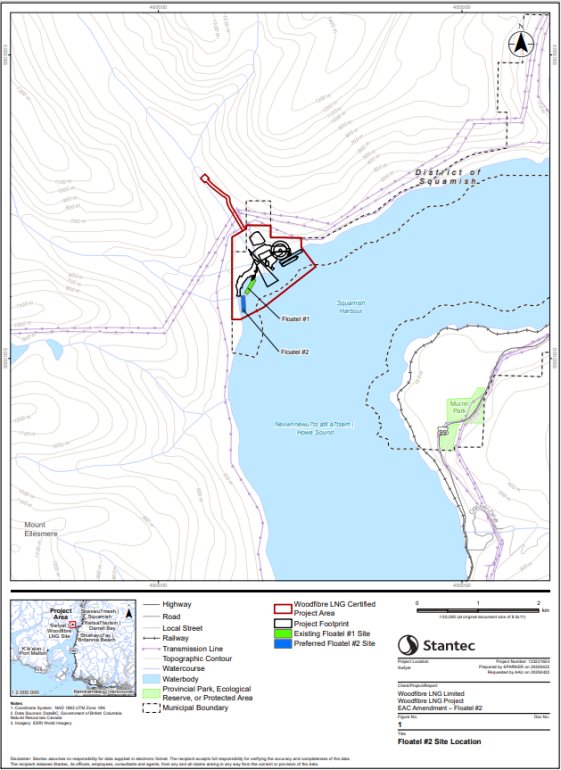
The proponent is proposing to install and operate a second floating worker accommodation facility (floatel #2) and associated facilities. Floatel #2 would provide temporary accommodation for approximately 630 workers and 85 floatel staff during the construction phase of the project. It would be located beside floatel #1, be of a similar size to floatel #1, and managed by the same third-party operator as floatel #1. The proponent would update and apply the same mitigation developed for floatel #1 to floatel #2. Floatel #2 would be located within the Certified Project Area (Figure 1).
Additional information about floatel #2 is found below:
- Floatel #2 would be approximately 167 meters long, 29 m wide and 22 m tall with a gross tonnage of 33,967 DWT and draft of 638 m.
- It would have approximately 630 cabins with private ensuite bathrooms for workers, and 85 cabins for floatel crew.
- Mooring would require nine 15-ton external anchors, six 3-inch chains to moor the vessel and a spud barge located at the stern with gangways allow workers to access the floatel from shore.
- Onboard amenities would include restaurants, gym, games rooms, outdoor sports court, medical services, meeting rooms, and an auditorium.
- Power would be supplied via connection to shore, although diesel generators would be required until the shore connection is set up (anticipated within approximately the first 6 months of operation).
- Freshwater would be provided from Woodfibre Creek and treated via an onshore treatment system located in a shipping container near floatel #2.
- Workers would be ferried to and from the floatel from the Lower Mainland (one passenger vessel to and from the site, six days per week).
- Food and other materials would be transported using cargo vessels and barges from the Lower Mainland (one cargo/servicing vessel to and from the site, six days per week).
- Domestic waste would be managed in accordance with the vessel's Waste Management Plan which considers the District of Squamish's Net Zero Waste Action Plan.
- There would be no discharge of wastewater or sewage from the floatel. Wastewater and sewage would be transported offsite for disposal.
- Workers would not be permitted to access Squamish except in exceptional circumstances as per provincial condition 29.
The proponent is proposing floatel #2 based on refined projections for the number of workers required during peak construction. Floatel #1 has been fully occupied at times and additional housing for workers is required for construction activities starting in December 2025.
2.1 Physical Activities Regulations analysis
The Physical Activities Regulations under the Impact Assessment Act (IAA) identify the physical activities that constitute designated projects that may require an impact assessment, including certain types of liquefied natural gas facilities. A worker accommodation facility is not a physical activity described in these regulations. Consequently, IAAC is of the view that the changes do not constitute a new or different designated project that may require a new impact assessment.
3. Consultation and engagement
3.1 Consultation with Indigenous groups
In its submission to IAAC, the proponent indicated that it had engaged with Sḵwx̱wú7mesh Úxwumixw (Squamish Nation), Tsleil-Waututh Nation, Musqueam First Nation, Cowichan Tribes First Nation, Halalt First Nation, Lake Cowichan First Nation, Lyackson First Nation, Penelakut Tribe, Stz'uminus First Nation, Lake Cowichan First Nation, and Métis Nation of British Columbia on the proposed floatel #2.
As part of the review process, IAAC sought comments from Sḵwx̱wú7mesh Úxwumixw (Squamish Nation), Tsleil-Waututh Nation, Musqueam First Nation, Cowichan Tribes First Nation, Halalt First Nation, Lake Cowichan First Nation, Lyackson First Nation, Penelakut Tribe, Stz'uminus First Nation, and Lake Cowichan First Nation. Squamish Nation and Tsleil-Waututh Nation provided comments which are discussed in the applicable sections below.
4. Potential adverse environmental effects
4.1 Fish and fish habitat
4.1.1 Proponent's assessment
Marine water quality and benthic habitat
The proponent indicated that installation and operation of the mooring infrastructure including chains, anchors, and spud barge(s) would directly affect approximately 98.6 m2 of benthic habitat. This direct disturbance would be from installation as well as chain drag associated with natural tides. In addition, the floatel would shade approximately 7,453 m2 of subtidal areas during morning hours. The proponent indicated that the benthic habitat that would be impacted is low quality and largely absent of marine vegetation.
The proponent indicated that existing mitigation measures assessed as part of the original environmental assessment, such as placement of structures in low quality habitat, would be sufficient and that there would be no change to the residual effects characterization made in the original environmental assessment.
Marine fish and marine mammals
The proponent indicated that artificial lighting from floatel #2 may cause phototaxis (i.e. the movement of fish towards or away from light), changes to the distribution and behaviour of marine fish and marine mammals, and may alter predator-prey dynamics.
The proponent indicated that existing mitigation measures assessed as part of the original environmental assessment, including fully shielding light fixtures to minimize uplight to the atmosphere, would be sufficient to manage effects to marine fish and marine mammals. The proponent also indicated that lighting is reassessed every six months as part their Lighting Implementation Plan. The proponent indicated that residual effects from artificial lighting would be negligible.
4.1.2 Views expressed
Squamish Nation and Tsleil-Waututh Nation provided comments related to fish and fish habitat. Fisheries and Oceans Canada did not provide comments.
Squamish Nation indicated that the location of the floatel would be adjacent to the most recent known herring spawning location in the Certified Project Area. They said that a herring spawn mitigation and monitoring plan should be required as part of the marine fish and fish habitat monitoring plan which is a condition of the provincial Environmental Assessment Certificate. Squamish Nation indicated that this herring spawn and mitigation plan could be developed and included in the existing fish and fish habitat monitoring plan in parallel to the floatel #2 decision process. In response, the proponent expressed their agreement with the comment and noted that a mitigation plan is currently being developed.
Squamish Nation also raised concerns about effects of drag anchors on individual glass sponges that were recently found by the proponent. Squamish Nation indicated that avoidance should be required as other mitigation measures would not be suitable. The proponent indicated that it was implementing a more comprehensive survey of glass sponges in the potentially impacted area, and would consider changes to mooring design to avoid impacts on glass sponges identified during the survey.
Tsleil-Waututh Nation shared comments and questions about the floatel's impacts on biomass, juvenile salmonid, and quality of benthic habitat, as well as the ability of these components to recover. The proponent provided responses and clarifications to these questions.
4.1.3 Analysis and conclusions
IAAC notes that the direct habitat disturbance is a 2.6% increase compared to the original environmental assessment (98.6 m2 compared to 3,856 m2).
IAAC recognizes the issues related to herring spawning and glass sponges raised by Squamish Nation as well as the proponent's ongoing work to advance and address the issues in parallel to the assessment. Further, IAAC notes that the potential impacts to glass sponge reefs and herring spawning were considered as part of the original environmental assessment. Squamish Nation has identified an appropriate path to address these issues as part of the proponent's marine fish and fish habitat monitoring plan which is a condition of the provincial Environmental Assessment Certificate. Condition 3.14 of the existing Decision Statement also requires the proponent to develop and implement a follow-up program for fish and fish habitat.
Taking into account the limited disturbance area and the proponent's commitments to address the issues raised by Squamish Nation, IAAC accepts the proponent's determination that the project change would not result in any changes to the findings of the original environmental assessment. IAAC is of the view that effects to fish and fish habitat would be within the range of effects predicted during the original environmental assessment and that no new conditions are required.
4.2 Current use of lands and resources for traditional purposes
The proponent indicated that there would be no effects to the current use of lands and resources for traditional purposes but provided information about effects to Indigenous interests. Consistent with the proponent's methodology, IAAC has assessed effects to the current use of lands and resources for traditional purposes as part of section 5 of this report.
4.3 Health of Indigenous peoples
4.3.1 Proponent's assessment
The proponent indicated that the project may affect human health from exposure to air pollutants from diesel generators which would be used for up to six months before the floatel is connected to shorepower. The proponent conducted an assessment of risks to residents of the District of Squamish (which would include members of Squamish Nation) and off-duty workers.
For its assessment of risks to residents of the District of Squamish, the proponent updated its emission inventory to consider the floatel #2 diesel generators in combination with construction emissions. The proponent determined that the total emissions would be less than the peak emissions which would be expected to occur during operation. As a result, the proponent said that there would be no change to conclusions of the original environmental assessment which concluded that health risk for residents in the District of Squamish (which would include members of Squamish Nation) would be negligible.
4.3.2 Views expressed
Health Canada and Squamish Nation provided comments related to air quality and effects to health of Indigenous peoples. Health Canada asked for additional rationale for the proponent's statements about effects of polyaromatic hydrocarbon and the rationale for using hexane as a surrogate for volatile organic hydrocarbons. The proponent provided technical responses to both questions.
Squamish Nation requested additional modeling of generator exhaust to confirm viability of health-based targets, recommended inclusion of diesel particulate in the air quality management and monitoring program, and requested the development of triggers for sulfur dioxide and volatile organic compounds in the air quality monitoring plan. The proponent responded indicating that they have initiated a screening-level dispersion model to quantify effects of generator exhaust, confirming that they are investigating installing two continuous diesel particulate monitors, and responded by identifying specific trigger levels for inclusion in the air quality management and monitoring plan.
4.3.3 Analysis and conclusions
IAAC notes that diesel generators would be used temporarily while awaiting shorepower connection so potential effects to health of Indigenous peoples would be limited in duration, and that the proponent already has in place an air quality monitoring and management plan that would be updated for floatel #2. IAAC notes the proponent's commitment to address the comments raised by Squamish Nation including the commitment to update the dispersion model and add thresholds to existing air quality monitoring and management plan.
Taking this into account, IAAC agrees with the proponent's determination that the project change would not result in any changes to the findings of the original environmental assessment. IAAC is of the view that effects to health of Indigenous peoples would be within the range of effects predicted during the original environmental assessment and that no new conditions are required.
5. Indigenous interests
5.1.1 Proponent's assessment
The proponent stated that the installation and operation of floatel #2 may affect the amount and quality of harvested marine resources and interactions between ferry routes and marine users. The floatel would not affect access to known harvesting or heritage sites.
The proponent stated that existing mitigation measures focused on biophysical effects and described in section 4.1.1 would be sufficient to manage effects to the amount and quality of harvested marine resources. The proponent also indicated that floatel #2 could affect interactions of marine users with ferry routes because floatel #2 would increase the number of ferries compared to the single floatel. There is currently one passenger and one service ferry three times per week (6 trips total per week) and that is expected to double. However, the proponent noted that the number of ferry trips would be less than assessed in the original environmental assessment as the proponent planned, at that time, to ferry workers to the project site daily. The proponent's Marine Transport Management and Monitoring Plan which was developed to satisfy the conditions of the original environmental assessment would apply to floatel #2
5.1.2 Views expressed
Squamish Nation and Tsleil-Waututh Nation provided technical comments on the proponent's submission which are already discussed in sections 4.1.2 and 4.3.2 of this report. Squamish Nation is also undertaking its own assessment in accordance with the Squamish Nation Environmental Assessment Agreement (SNEAA) review process.
5.1.3 Analysis and conclusions
Taking into account the proponent's predictions that the number of ferry trips would be less than assessed under the original environmental assessment, and comments from Indigenous groups, IAAC is of the view that effects to current use of lands and resources for traditional purposes would be within the range of effects predicted during the original environmental assessment and that no new conditions are required.
6. Conclusion
Based on the information provided by the proponent, and the input provided by Squamish Nation, Tsleil-Waututh Nation, and Health Canada, IAAC is of the view that effects from floatel #2 would be within the range of effects predicted during the original environmental assessment and that no modified or additional conditions are required.
IAAC recommends modifying the current definition of Designated Project to include the additional floatel.
In doing so, IAAC is also recommending modifying the approach to how the definition of Designated Project is presented in the Decision Statement for improved clarity and to align with IAAC's current approach. To date, the definition of Designated Project (condition 1.9) in the Decision Statement has referenced EAO's Certified Project Description. IAAC is recommending incorporating the content of the existing approved Certified Project Description as well as the proposed second floatel into the Decision Statement, as a schedule (see Annex I of this report where the proposed new wording is underlined) and modifying condition 1.9 so that it references the new Description of the Designated Project in this schedule (Table 1).
|
Decision Statement dated July 26, 2024 |
Recommended Amendment to the Decision Statement |
|---|---|
|
1.9 Designated Project means the Woodfibre LNG Project as described in the Certified Project Description in Schedule A of the Environmental Assessment Certificate issued by the Government of British Columbia (Canadian Environmental Assessment Registry Reference Number 80060). |
1.9 Designated Project means the Woodfibre LNG Project as described in |
Annex I: Description of the Designated Project
Project overview
The Woodfibre LNG Project is comprised of the following components:
- Liquefied natural gas (LNG) facility and supporting infrastructure;
- Temporary construction-related infrastructure and facilities; and
- Shipping.
These components are described below.
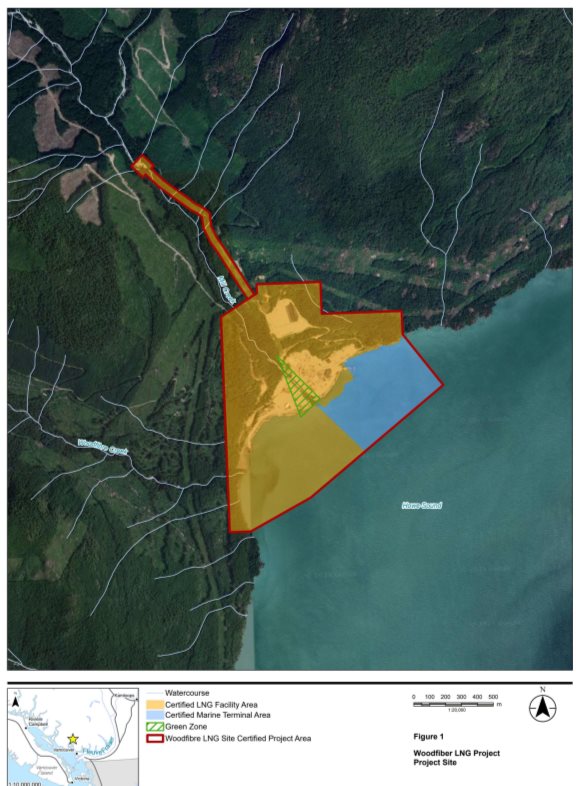
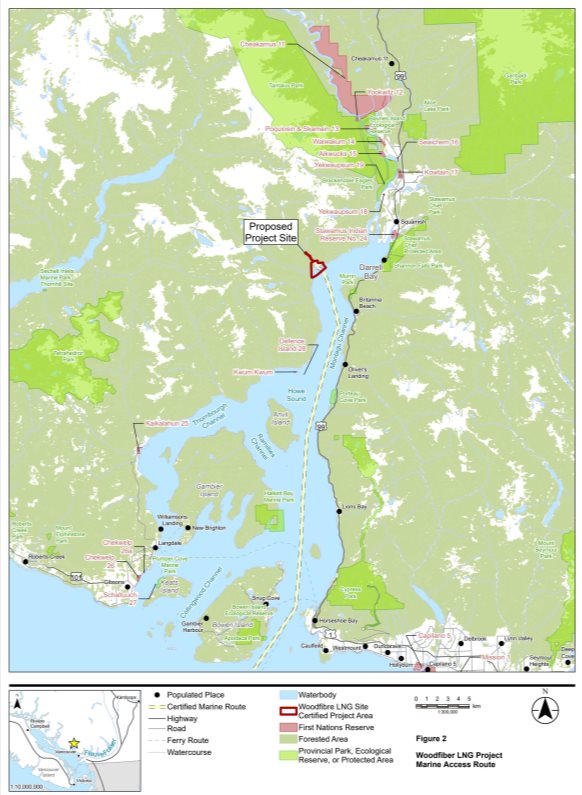
The LNG facility is located in the District of Squamish. Unless otherwise specified, all components are located within the areas specified on Figure 1 and Figure 2.
LNG facility and supporting infrastructure
The LNG facility includes: the land-based natural gas processing and liquefaction facility; the floating storage and offloading unit; and supporting infrastructure. The Project Area, as shown on Figure 1, comprises the LNG Facility Area and the Marine Terminal Area.
The components related to the LNG processing are located within the Project Area on Figure 1. The components related to LNG processing are:
- Control system;
- Natural gas inlet facility and piping;
- Natural gas pre-treatment facilities;
- Up to two natural gas liquefaction trains (also called processing units), comprised of gas treatment and liquefaction facilities with a maximum total combined production of LNG that does not exceed the volume authorized in the Licence to Export LNG issued June 9, 2017 pursuant to Section 117 of the National Energy Board Act;
- A condensate storage container;
- Flare system with a maximum flare stack height of 140 m;
- Fire control and safety infrastructure;
- An air cooling system
The Project uses electrical power sourced from BC Hydro.
The components related to the LNG loading system are located within the Project Area on Figure 1. The components related to the LNG loading system are:
- Supporting utility lines;
- LNG loading lines; and
- Boil off gas vapour return lines.
The components related to the marine terminal are located within the Certified Marine Terminal Area on Figure 1. The components related to the marine terminal are:
- One LNG carrier berth, able to accommodate one LNG carrier; and
- The floating storage and offloading unit consisting of two converted LNG carriers with a total capacity of no greater than 250,000 m3.
Supporting permanent infrastructure within the Project Area on Figure 1 are:
- Infrastructure to bring electrical power to LNG Facility Area;
- Fresh water supply infrastructure, including intake, piping and storage tank;
- Main administration building(s), control room(s), maintenance building(s), dry storage and chemical building(s), fire house(s), first aid building(s), and safety and guardhouse buildings;
- Facilities to provide site access, including floats, docks, barge ramp, passenger ferry terminal, and helipad;
- Marine offloading facility;
- Shoreline protection berm;
- Site security infrastructure;
- Water and wastewater treatment and discharge facilities;
- Storm water management, treatment and discharge facilities;
- Roads and bridges; and
- Landfill.
A Green Zone will be established in the area shown on Figure 1. Following Construction, this Green Zone will be planted with suitable native vegetation and would not contain any permanent Project buildings. Utilities, including power, process piping, communications cables, and roads and bridges would be within the Green Zone.
Construction infrastructure, facilities and activities
Within the Project Area on Figure 1, the Project includes the following construction-related infrastructure and facilities:
- Up to two temporary floating worker accommodation facilities (floatels) and associated mooring infrastructure, on-shore water treatment and freshwater intake(s);
- Concrete batch plant(s);
- Temporary buildings to house administration offices, temporary medical facilities, employee canteens and services, field offices, sanitary facilities, and a shipping and receiving warehouse;
- Temporary utilities for construction, including water, power, gas, sanitary wastewater collection and removal systems, and solid waste disposal; and
- Temporary stormwater collection and treatment systems.
The Project includes temporary laydown areas or suitable stockpile sites to stage or store construction materials within the Project Area on Figure 1. The Project includes limited dredging with total volume no greater than 80,000 m3 in the Marine Terminal Area on Figure 1.
Shipping
The Project marine access route is the Marine Route shown on Figure 2. This route must be used by all LNG carriers transiting to or from the Project, unless deviation is required due to exceptional circumstances.